 @mc5punk
Short story: The City of Clicks
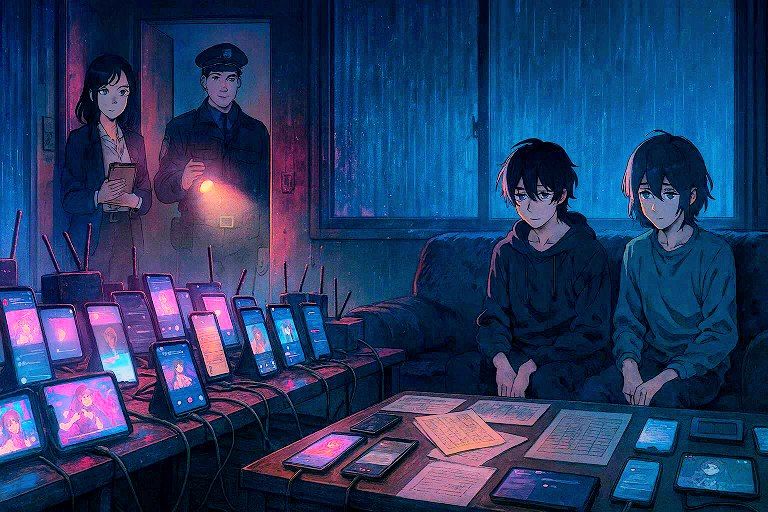
The night San Marcos stopped being just any neighborhood, the moon lay pale over the rooftops as if witnessing something that should not be seen. The streetlights vomited tired yellow and shadows clung to the facades. Mariana Soto stepped out of the car with her notebook pressed to her chest and the feeling that she had arrived at the exact place where a story would begin — or end. A journalist, obsessive and with a smile worn thin after weeks of leads that evaporated, she had followed threads that smelled of fraud: conversations in bars, anonymous messages, lists that rose and fell without explanation. That address had come to her wrapped in silence, like an order to look at everything. Ricardo Melo waited in his car, the flashlight tracing circles on the hood with a nervous tic that betrayed accumulated fatigue. An inspector with the Civil Police, hardened by interrogations of half-truths, he knew that some cases were not journalistic glory but a tangle of names in reports, broken promises, and culprits trying to steer public sight. Mariana showed him the patterns: plays that exploded in minutes, copied comments, subscribers born by the dozens in a matter of hours. "If this is true," Ricardo said in a low voice, eyes on the graphs, "they're manufacturing fame for money. It's not just fraud; they're manipulating entire careers." "There are accounts that spike in minutes," Mariana answered, more trembling than she wanted to admit. "And the comments... they're always the same, like templates." They approached the door with slow steps. From the sidewalk the house seemed bland: a frayed curtain, a bell that sounded hollow. Opening it, the interior hit them with a scene that mixed the domestic and the industrial: tables covered with phones lined up like soldiers, tablets balanced on boxes, cables snaking across the floor toward routers with improvised antennas. The screens looped music videos, synchronized pop-up windows and automated programs that pressed play, like, and even left preconfigured comments. The constant hum of notifications formed a mechanical soundtrack that, for a moment, seemed to mock the sleeping city outside. On a wall, notebooks with columns of names and figures hung like factory posters. A printed document showed schedules and fake accounts: "Campaign A — 02:00–06:00 — 150 devices — 500k views target." Another recorded payments and commissions. Everything was meticulous. Iván and Lía sat in the living room, pale as those who have been expecting the nocturnal blow of truth. Their hands trembled, not from cold but from the certainty of being discovered. "We never meant to hurt anyone," Lía said in a cracked voice, touching the sleeve of her sweatshirt. "They told us it was work. Night shifts. Fixed pay." Iván avoided Mariana's gaze and spoke in a stammering voice: "My mother needs surgery. What could I do? They offered something steady and I accepted. I didn't think about the consequences." Ricardo looked at them with the cold calm of someone who has heard excuses and bitter truths. "Who hired you?" he asked. "Names, account numbers, addresses. If you cooperate, this can count in your favor." The youths gave details: small regular transfers, messages with instructions, an app to synchronize devices. In the caches and logs Mariana had pulled and the police forced, an intangible signature appeared: "The Cartographer." Not a name but a mark, an architecture for tracing audience routes: buying accounts, leasing devices, programming interactions. From somewhere on the network, the Cartographer drew maps that turned plays into currency of reputation. Alejandro Ruiz emerged with stealth among the invoices found: a young producer, a familiar face at events and public appearances. His name showed up in several transactions. When summoned to give a statement he arrived neat, tie loosened, and a rehearsed serenity. "I would never pay for that," Alejandro said in front of a small camera already following him online. "My work is legitimate. If someone framed me, I'll prove it." "The invoices say otherwise," Mariana replied without raising her voice, notebook open. "Intermediaries," Alejandro asserted with firmness. "I hired a marketing agency. If they used dubious methods, that falls on them, not on me directly." Those words ignited debate: were artists and managers complicit or victims of a chain that used them? As the story spread, the neighborhood began to react. Sofía Vargas, the owner of the property used as the operation’s hub, paced her building’s stairs with her hands clenched. "How could they use my house?" Sofía asked Ricardo through tears. "I rented to people who seemed respectable. How did I not see it?" "Sometimes," Ricardo replied measuredly, "things hide in the everyday. That doesn't erase your pain, but we need your cooperation to rebuild who came in and when." The operation was not isolated. Following the leads, police discovered at least five operational points with the same setup: tables full of mobiles, operators working shifts, code and templates that reproduced human comments. Chain transfers ended in third-party accounts and, sometimes, in mailboxes abroad, complicating the trace. "We have at least five branches," Ricardo briefed his team in the operations room. "All operate with the same method: mass devices, scripts, and recycled accounts." "And the Cartographer?" Mariana asked, holding his gaze. "Any clue who they are or where they operate from?" "It's an alias," Ricardo answered. "It seems to operate from the shadows. But every time we shut one network down, another appears. They change routes, names, servers." Tension escalated as the case reached the press. Mariana, pursuing the truth with a mix of outrage and meticulousness, published pieces that lifted the veil on practices many suspected but few confronted. Fans felt betrayed; some musicians began losing contracts and gigs while platforms started internal audits. On the rainy night they decided to act in coordinated fashion, the downpour intensified as if trying to wash away footprints or swallow secrets. Sirens cut the air. The Civil Police ordered simultaneous raids: one team per address, encrypted communications among units, cameras recording every step. Mariana covered the operation from the permitted distance, notebook in hand, nerves keen. In one house they found printed contracts and encrypted emails. In another, devices with scripts that generated comments with slight variations to simulate real conversations. In a third, a dashboard listing artists, view targets and rates: "Platinum Package — 1M views — 72 hrs — includes engagement." The machinery was both technological and human: employees following schedules and programs that mimicked the action of a thumb on a screen. Arrests followed. Some operators, facing the evidence, agreed to cooperate. Others tried to deny the obvious. Alejandro Ruiz, whose name appeared in the documents, found himself cornered by headlines demanding quick answers. "If they prove I ordered this, I'll pay the consequences," Alejandro told his team in a private meeting. "But I won't let them destroy what we've built without solid proof." Catalina Rojas, the lawyer representing affected artists, moved across the scene like a legal surgeon. She filed claims for reputational damage, demanded audits and pushed platforms for transparency. It was a battle against giants: algorithms that had until then treated volume as the primary indicator of success, and companies for whom transparency was an operational cost. "We will file suits for reputational harm," Catalina declared at a press conference. "We will demand platform audits. This cannot become normalized." Moral debate erupted across social media and producer circles: was it ethical to pay for plays? Where did marketing end and fraud begin? Furious fans demanded sanctions; others defended artists, saying many did not know what happened behind the scenes. Some argued for strict penalties; others called for nuance. Iván and Lía began appearing in human-interest reports, faces tired, speaking of need and remorse. Their story became, in some accounts, a human one: two young people trapped by promises of easy money. "We're not monsters," Lía said in an interview with Mariana, voice nearly broken. "We took the easy way. Now we see the harm we caused." Sofía organized a neighbors' assembly to recount what happened and demand controls. The compensation she received for the use of her property was minimal compared to the blow to her reputation as a landlord. The community spent weeks torn between shame and the need to move forward. Throughout judicial and administrative proceedings, several defendants negotiated plea deals: they handed over names, accounts, and operational details in exchange for reduced sentences. Platforms began deleting plays and sanctioning accounts, while some honest marketing firms offered audits to clean processes. Still, the Cartographer remained a shadow: their alias and methods had been exposed, but not their face. "Algorithms are not innocent," Ricardo said in a public interview. "Nor are they guilty; someone uses them. We must force transparency and hold those who design these networks accountable." The network's dismantling had collateral effects: some artists who had benefited from inflated numbers lost contracts and support; others seized the crisis to show transparency and rebuild trust. Alejandro, for his part, launched a rehabilitation campaign: he hired independent audits, opened his accounts and promised public contracts with verification clauses. It wasn't enough to erase suspicion, but it was a tangible step. Mariana published a series of reports that dissected the scheme: manuals, accounts, testimonies. The city read them like a map of betrayals; some were scandalized, others awoke to reality. Ricardo, despite recognition for dismantling part of the structure, knew the victory was partial. Cartographers change routes, adopt new aliases, and move to farther servers. In a final scene that condensed the case's ambivalence, Mariana received an unmarked envelope. Inside was a single sheet with one stroke: a partial map and an address that did not belong to any known neighborhood. No words, only a line suggesting new routes. Mariana left the sheet on the table, looked out the window and thought of the city as a living body where desires and fictions were intertwined. "This doesn't end here," she murmured, almost to herself. "They only change routes." The moon, pale and witness, seemed to nod. Ricardo filed the case records in his desk as lessons for the future; Catalina continued pressing in the courts; Alejandro tried to reconcile his image with the truth; Iván and Lía sought to rebuild lives away from keys and screens. San Marcos regained its routine: lights again brightened afternoons, mothers hung laundry on balconies and the city's murmur resumed its pulse. Yet the sense that fame can be bought, that authenticity can be rented and dressed in naturalness, lingered in the air like an aerosol. For every farm uncovered, someone else could sow another. The Cartographer remained, for now, only a signature on a black page: faceless, methodical, ready to redraw maps where the digital civilization finds a new path to sell illusions. Source of the images. Image created with Bing.
No comments yet