 @mc5punk
Short story: The Apron and the Little Lamp
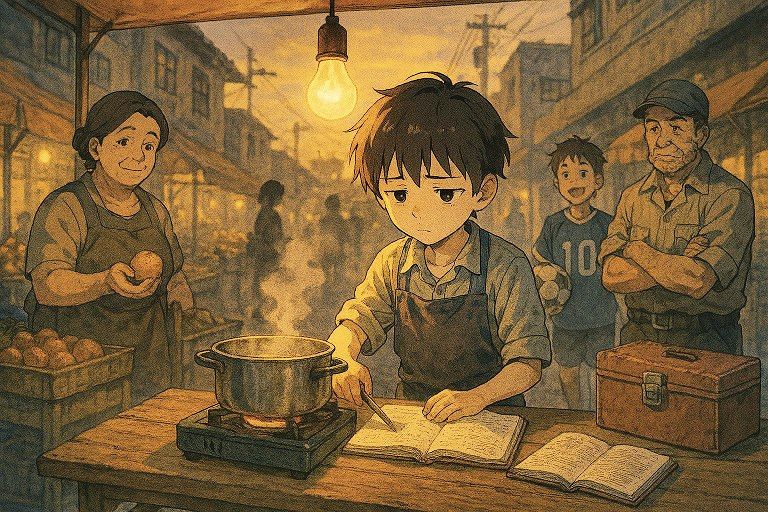
The sun still held the last warmth in its hands when the boy closed his notebook with the same care with which promises are kept. It was not a theatrical gesture; it was a learned ritual. The backpack, damp partly from morning sweat and partly from the rain of a stolen nap, was set against a corner while he prepared to turn the same stretch of sidewalk into his double shift: classroom and stall, lesson and sale. He set up his stand with the precision of someone repeating a practiced choreography. A plank propped on boxes, a pot that seemed to produce enough warmth for several families, an apron whose color had changed from use, and a hand-painted sign with clumsy but sincere strokes. Each object had its story: the apron stained with a sauce that never came out, the tin used as an improvised scale, a spoon with a worn handle that he considered his best tool. Nothing was superfluous; everything was essential. The neighborhood was a mosaic of presences. Doña Marta, the fruit seller neighbor, passed by carrying bags that smelled of citrus and the daily market. Don Héctor, from the workshop, walked hunched with a screwdriver peeking from his pocket. Mrs. Rosario returned from school with an attentive look; Esteban dribbled the ball against worn walls, apparently oblivious to the weight behind the apron. The gazes with which these characters crossed the boy’s path were not all the same: some were full of compassion, others of indifference, and many of a tenderness they would not allow themselves to voice aloud. During the afternoon he sold small portions of food and, with each sale, counted more than coins: he calculated whether the math workbook would hold out another month, how much a pack of pens would cost, whether there would be enough for a medical visit if someone at home fell ill. That accounting —which had the rigor of a school exercise— was what defined his immediate future. He repeated imperfect arithmetic formulas in his head like someone rehearsing lessons of hope: add to avoid loss, subtract to endure, multiply to grow. The dialogues with the story’s secondary characters wove a larger existence. “How much do I owe you today, little one?” Doña Marta asked one afternoon, leaning in as she usually did when buying fruit. “Three coins, Doña Marta,” he answered calmly. “Thank you for the orange.” She was not just a customer: she was an everyday angel who, between juices and conversations, offered small helps without fanfare. “Save the orange for tomorrow,” she said, squeezing his hand. “Take two more coins. And don’t spend it all on soup; buy a notebook if needed.” “Don’t use it all,” Mrs. Rosario added another time, checking a homework. Her usually contained voice cracked when she saw the simple handwriting. “Go over this at home. Do you have enough light to study?” “The one I have is enough,” the boy replied, his eyes finding the little lamp hanging from an improvised post. “But if not, you’ll lend me one, right?” “I’ll lend you whatever is needed,” the teacher answered. “I don’t want to see you give up.” Don Héctor, with his gray-haired bearing and mechanic’s hands, sometimes came by to tighten the pot stand or drop a few coins into the tin. “Here, kid,” he said one afternoon, letting some coins fall into the pot. “And if you need tools to fix something, tell me.” “Thanks, Don Héctor,” he replied with a small nod. “I promise to bring the tools back clean.” Esteban, the classmate who spent afternoons running, was evidence of a childhood that had time to play. “We have training tomorrow,” Esteban announced one day, with the enthusiasm only football produces. “Come, so you can rest.” “I can’t,” the boy answered. “I have a shift this afternoon. If I don’t work, there’s no money for books.” “Right, I get it,” Esteban said, with a strange gesture for his age, a mix of pride and pity. “But don’t isolate yourself, okay? You need to play too.” The boy’s routine continued when the street emptied. He turned off the pots, folded the apron, closed the day’s accounts, and with a mechanical gesture lit a little lamp that never seemed enough. Sitting on a battered bench, he studied in the dimness; the words printed in his notebooks competed with the fatigue weighing on his eyelids. The silence of the night was not empty: it was full of the breathing of those who sleep and the distant sounds of a city that never quite quiets. His study hours, by the trembling light, were a display of will. The questions he solved in the notebooks had a double purpose: the grade at school and the possibility of dreaming of a different life. Sometimes he whispered sums and definitions so they would stick. Other times he wrote long sentences, patiently correcting mistakes that for others would be trivial. Before closing the notebook he reviewed what he had learned as someone securing a foundation: “If I learn, maybe I can change the course.” That phrase, more than a thought, was a promise upheld. The scene was immortalized by a passerby who, as a witness, took a photo: the apron hanging, the little lamp, the boy bent over his notebooks. The image began its journey through social networks, multiplying across screens of different sizes, capturing gazes and provoking reactions. Comments ranged between sincere admiration, outrage at inequality, and the comfortable distance of those who viewed everything with a swipe of the finger. The virality generated —as often happens— a whirlwind of intentions. Donations, messages of support, promises of help arrived, and with them a wave of new eyes on the same scene the boy had lived naturally for years. It was the same routine, but now his daily acts became news. Some people came ready to change his life: organizations offered scholarships; neighbors gathered books and supplies; strangers sent money. The boy’s phone, previously absent, filled with notifications he struggled to understand. Despite the public commotion, his way of being did not undergo an abrupt transformation. He continued to put the pot on the fire and close each sale with care; he did not forget his school duties. The change was subtle and essential: for the first time, he was not so alone. Doña Marta began bringing fruits to sell and kept part of the money for books; Don Héctor improved his lamp and fixed a bench; Mrs. Rosario bought him a new backpack and colored pencils; Esteban, in the sincerity of a friend, lent him his football jersey for special occasions, as if that gesture said childhood could coexist with responsibility. There were nights of praise and others of shared silence. One evening, after the street went dark and the last customers had left, Doña Marta sat beside him and looked at the small hands that an hour earlier had served soup to strangers. “Do you think this changes anything?” she asked, pointing to the photo that had already circulated through many hands. “I don’t know,” the boy answered honestly. “If people help, maybe. But I stay the same if they don’t.” “Then I’ll help you,” she said, her voice trembling barely. “Tomorrow I’ll leave fruit to sell and I’ll save part for you. Don’t do it for me.” “Thank you,” he whispered. “I don’t want them to look at me like I’m different.” The teacher, seeing that the boy did not abandon his studies despite the burden, decided to accompany him more discreetly. She corrected his exercises more patiently, gave him assignments that motivated him, and quietly arranged for the school to seek support programs. Her gestures were not showy; they were those of someone who knows children’s daily lives and understands that effective help is often the unostentatious kind. Daily life continued with new shades: donations that arrived and were managed cautiously, promises fulfilled and others lost in the whirlwind, looks that applauded for a day and looks that endured. He learned to receive help without feeling that he lost dignity. He accepted the new backpack, the colored pencils, the brighter lamp, but he kept selling at the same pace, because the continuity of his commitment did not depend solely on what others gave but on what he had decided to sustain. In the corner where he had studied so many nights, the little lamp no longer flickered with the same desperation. The words in his notebooks began to fill with better-worked solutions, less shaky handwriting, and questions met with firmer answers. Every completed exercise was a small triumph. Every night he closed a notebook knowing he had given his best was a reaffirmation that his resilience was not a spectacle for networks but a pact with himself. The community, for its part, learned to look beyond the viral image. It understood that resilience is not measured in likes or comments; it is measured in the consistency of someone who keeps going, in the dignity of someone who asks for what is fair, and in the responsibility of those who can support without intruding. There were debates, reflections, and actions: workshops for youth, school support programs and, above all, a more sincere recognition of the multiple forms of childhood that coexist in the same city. Over time, the boy’s story ceased to be just a viral photo and began to become part of broader narratives: school projects aimed at supporting vulnerable students, neighbors who coordinated an emergency fund, small businesses that hired young people to balance work and school more equitably. Nothing was perfect, but the social fabric became a little stronger. Night after night, between pots and notebooks, coins and exercises, the boy continued building his biography through humble gestures: getting up early, going to school, setting up the stall, attending with care, lighting the little lamp and studying until his eyes wanted to close. He did not ask for applause. He let routine, that severe and patient teacher, be his only judge. His strength needed no audience because it showed itself in everyday acts: choosing study when the body asked for rest, meeting a teacher’s steady gaze, accepting a hand when it was sincere. There were moments when fatigue grew deep and doubt knocked at his door. Old questions returned with a new voice: Is all this effort worth it? Will things change? In those moments, the memory of those who supported him —Doña Marta’s hand, Mrs. Rosario’s counsel, Don Héctor’s repair, Esteban’s lent jersey— was a discreet support. He understood that resilience is not solitary: it has the backing of community, even if that backing sometimes arrives silently. His story, which began under the dim glow of a little lamp, began to illuminate other corners. Not because of fame, but because of the silent example of a life that chose to keep studying against the logic of fatigue. The city learned, in its own way, to look differently: to value what is unseen, to recognize that true courage does not demand applause, and to support those who work for a future that has not yet arrived. In the end, when the apron hanging gently swayed in the dawn wind and the notebooks rested beneath a lamp that no longer flickered, the boy closed his eyes with the certainty of someone who had done all he could. He knew there were no guarantees, but he had done the most important thing: he had not given up on education, he had not given up on hope. That constancy, woven between pots and letters, between neighbors and teachers, was the real victory: a resilience that needs no headlines, only perseverance, care, and the commitment of a community that learned not to look the other way. Source of the images. Image created with Bing.
No comments yet