 @mc5punk
more from that month
@mc5punk
more from that month
Short story: The Star That Did Not Return
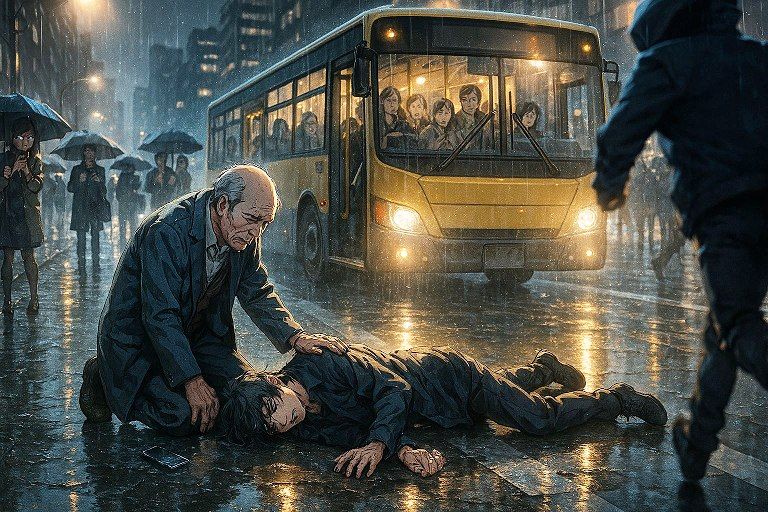
The night had its own pulse, a damp cadence that pressed the city together as if trying to erase it with a single breath. A persistent drizzle cleaned lamps and façades; lights blurred in puddles and shoes left small maps of hurried steps. On an ordinary sidewalk, where days were more routine than surprising, a disturbance altered the course of several lives. The elderly man walked stooped, a pharmacy bag hanging from one arm and his phone a point of contact in the other. It wasn’t a new or luxurious device, but for him it was a line to the world: his daughter’s voice, a photo of his grandchild, the reminder of a doctor’s appointment. He liked feeling the phone’s weight like someone holding an identity card. That night, as he searched his pocket for the written address, a sharp, violent tug ripped the device from his hands. The young man’s hand that took it was quick and determined; his eyes, however, were tinged with a mix of hunger and urgency. “That’s mine!” the old man shouted, trying to grab at the side of the thief’s clothing, but the criminal already had the phone pressed to his chest and was accelerating. The thief was not a monster carved by a single bad decision; he was a young body with a face hardened by life on the edge: lack of opportunities, habituation to easy gains, the demands of the street. He ran without looking back, tasting adrenaline in his mouth. The rain glued to his sweat and the phone’s shine gave him a fleeting sense of triumph. “Please,” the old man murmured, his voice broken by age. “Don’t do this to me, young man. It’s for my grandson.” Voices rose on the sidewalk: a woman flushed with indignation, a man who took out his phone to film the scene, a child peeking between his mother’s legs with eyes widened like coins. No one moved quickly enough to stop the thief’s primary impulse. His flight took him onto the roadway. In his head there was no strategy, only instinct: move forward, escape, gain distance. He crossed the crosswalk without calculating timing, as if the asphalt were water to be leapt over with force. A bus approached, its size imposing a presence that the rain emphasized; it was a beast of iron carrying lives within, passengers looking through fogged windows at the oval of the street. The driver, a man hardened by long shifts, furrowed his brow in concentration. There was no unusual sound until a scream broke the monotony. In a second, he felt the impact on the side mirror, like someone had suddenly thrown a sandbag at the vehicle. He slammed into an emergency stop, the body groaning, passengers grasping at straps. But metal cannot always stop what flesh misjudged in time. The young man’s body was dragged by the force of the blow and thrown onto the pavement, and the city seemed to hold its breath. The impact produced a sound no one wanted to remember: a crack that resonated with the traffic light’s ticks and the murmur of the rain. Some witnesses ran to the scene; others stood frozen, immersed in the terrible certainty of having witnessed something irreversible. The old man dropped his bag and kneeled. Among puddles and confusion, his trembling hands sought the phone—his treasure—and then, by instinct and habit, touched the young man’s inert arm. The closeness of the body returned an image no one can manufacture: a life suspended in an instant without explanation. “Marcos…” the old man whispered, not knowing why he chose that name. “Why did you go?” Questions at the scene were bullets without effect. A bus passenger had to step out to vomit; others covered their mouths with their hands. A woman shouted for someone to call emergency services; someone began compressing the young man’s chest in a desperate attempt to give back what the city had taken. A witness called the police with trembling hands and a broken voice. Shortly after, authorities arrived: sirens cutting through the sound of rain, officers unfolding yellow tape like a suture to separate the event from the rest of existence. Forensic police spoke in low voices, interrupted by blue flashlight beams scanning a scene that wanted more answers than certainties. Witnesses gave accounts that seemed mismatched pieces of a hastily assembled puzzle. “He crossed without looking,” said one woman, her voice choked. “I don’t know why, but I saw him do it.” “He seemed desperate,” added another. “He wasn’t a common thief; he was someone playing all or nothing.” Investigators got to work: they reviewed neighborhood cameras, checked angles and minutes; they recorded the bus route and interviewed the driver, who remembered the moment with a mix of guilt and the helplessness of having been unable to do more. Meanwhile, at the morgue, the young man’s life began to be reconstructed through records and testimonies. His name became known within hours: Eduardo Ramírez, twenty-two, with prior arrests for petty thefts and a history of intermittent informal jobs. His parents, notified by a municipal officer, arrived with faces paralyzed, hands that had once cradled his childhood now unable to hold anything but the void of the news. “How didn’t we see it coming?” his mother moaned, hugging her other child as if the news were a tremor that could be shared and diminished. Practical and devastating questions repeated in Eduardo’s home: why hadn’t they gone looking for him that afternoon, what calls had been left undone, which signs had been missed. The family told stories of missed opportunities, discarded jobs, aid brigades that didn’t arrive in time. Fate collected explanations and excuses that could not soothe the raw fact of his absence. In parallel, the elderly man’s life was reconstructed with almost ritual care. His name was Don Ernesto Velásquez; he was seventy-one, had been a schoolteacher all his life, and kept the habit of walking weekly to the neighborhood pharmacy. His daughter—police confirmed—had spoken with him midmorning; he had promised to send a photo of the grandchild. The phone, now retrieved from the pavement, was scuffed from use, protected by a faded but well-cared-for case. “My father would greet everyone,” his daughter said, voice steady but breaking. “I don’t understand why someone would do this to him.” News reports were quick to arrive, tinting the tragedy with headlines that divided roles: “Delinquent dies after being struck by bus after snatching phone from elderly man.” Social networks erupted in opinions: some demanded justice for the old man, others compassion for the young thief, others pointed to failures in public safety. Amid the polarization, the truth of the scene grew small and elusive. The prosecutor’s office received the reports with a technical coldness aiming to bring order to complexity: speed analysis, brake reports and skid marks, witness interviews, footage from public and private cameras. The bus driver underwent alcohol tests and declared he could not avoid the figure that entered his trajectory suddenly. There were no signs of intentional negligence; the recklessness of the person who crossed the street, however, was indisputable. Prosecutors chose not to press homicide charges against the driver; the death was recorded as an accident precipitated by a sequence of unlawful and desperate decisions. In the neighborhood, conversations shifted tone. Neighbors remembered Don Ernesto greeting everyone from his balcony each morning; young residents recalled Eduardo as someone who had blurred the line between his own ideas and the street’s legend. Some said they had seen the young man commit minor offenses before, while others defended his story in the name of need. No one, in the days after, could rescue the other’s complexity from the headline’s easy shine. Eduardo’s family held a modest wake in a community hall, candles trembling to the rhythm of voices trying to console. Neighbors who did not know the family came, sharing sorrow for the loss of a young life. At one point the mother approached the casket as if unsure whether to believe that the body within would never speak again. “My son…” she whispered, as if the phrase kept her connected to a dimension of hope. Then she looked toward the door. “If I had known this would happen, I would have changed everything.” Outside Don Ernesto’s house, a small crowd left flowers, notes, and switched-off phones as symbolic offerings. The granddaughter lifted a hand to touch the phone’s case, as if matter could summon the grandfather’s voice. At the funeral, Don Ernesto’s daughter recounted a story of kindness: her father, the teacher, who taught generations to read and kept his phone to stay in touch. The congregation, composed of people sharing the same neighborhood and memories, listened in silence—part condemnation, part grief. Prosecutors continued their investigation into Eduardo, tracing contacts and reviewing calls, reconstructing a night full of meetings and disputes. They discovered Eduardo had financial troubles and a circle that included other youths who sometimes crossed legal lines. There was no clear motive that justified his act; the theft appeared as a gesture mixing need and impulsivity. Press coverage kept the case in the headlines for a couple of days before it wilted into the crime section. Analyses turned into public debates about security, protecting the elderly, and the judicial system. Politicians promised measures—more patrols, cameras, prevention campaigns. Others denounced the frivolity of those who judged lives from behind keyboards. In practice, the city seemed to do little beyond its usual rituals: promise, record, eventually forget. Still, the scene left deep marks. Those who witnessed it carried the memory with a weight that admits no exchange. Many said that since that day crossing the street had become an exercise in greater caution; mothers gripped their children’s hands harder, elders walked in groups, bus drivers checked their routes with a renewed sense of vulnerability. The emptiness caused by death had the odd virtue of altering habits as if it were an unyielding lesson. Months passed. Eduardo’s family tried to rebuild their lives with the inevitability of those who must move on. The mother returned to work; siblings resumed their studies; sometimes the street returned mournful looks, as if Eduardo’s presence lingered in the air. Don Ernesto’s family continued their mourning with a memory ritual: they placed a plaque on the sidewalk where he knelt the night of the tragedy, a simple inscription honoring “friendship and memory.” Some neighbors, more conscious, organized community rounds to accompany elderly people to the pharmacy or park. Small gestures that seemed to be a response to pain: security tinged with solidarity. It was not much, but it was a sign that the wounded city was trying to mend itself with human hands. On a corner of the neighborhood someone left a fresh flower on the sidewalk where the scene had occurred. The flower was a minimal and silent gesture but strong in intention: an acknowledgment that that night the city had been the stage for colliding destinies. An older woman with a voice full of moral authority approached the flower and said softly: “Rest. It wasn’t just a phone.” Her words were like a secular prayer. The flower wilted in the rain another afternoon, but the memory endured. In the urban fabric, the event became a scar that opened each time someone looked down and remembered that a phone fell like a shooting star. People shuddered, recalling that sometimes the ephemeral is the prelude to the irreversible. Source of the images. Image created with Bing.
No comments yet