 @mc5punk
Short story: The Great Improvised Flock
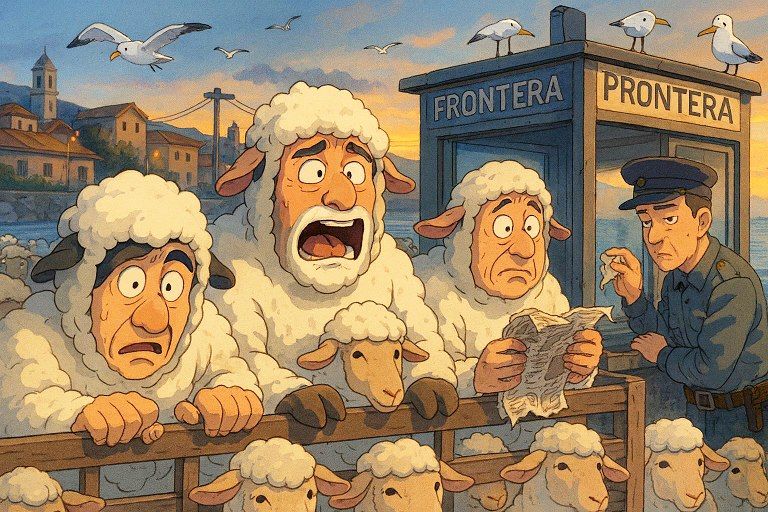
In Punta Serrucho, a coastal town with more seagulls than sense, the daily rhythm matched the waves: market mornings, long siestas, and afternoons when stories stretched like reheated coffee. There lived Manolo, Rafi, and Tito, three friends who shared more anecdotes than fortune and who, like most things in the village, solved problems with humor and whimsy. None were particularly lucky: Manolo sold sandwiches on the beach and always arrived late to his own stall; Rafi tuned old radios nobody listened to but treated with devotion; Tito, insistent and theatrical, called himself a “thumb tamer”—a fancy way to say he did small repairs for everyone. Between the three of them they owed bills, carried broken promises, and had a stubborn tendency to turn scarcity into a joke. The idea was born one summer night, when people crowded the square to escape the heat. After a few beers and too many laughs, someone tossed out the notion and the others couldn’t say no. “What if we sneak in with the sheep?” Manolo suggested, with that blend of theatrical seriousness and laziness that defined him. “Nobody looks twice at a flock. It’s like going unnoticed at an ugly hat convention.” Rafi—usually the cautious one until someone mentioned money—looked at the plaza and then at the list of bills he’d left on the bar counter. “That sounds insane,” he said. “But… look. Food doesn’t pay for itself. And the baker’s been giving me a look that’s no longer human.” Tito, for his part, saw more poetry than risk. He rubbed his hands and closed his eyes, imagining a plan that was clever and cheap. “I’ve got the bleat down,” he assured them. “If we train a bit, nobody will notice the difference. Also, the disguise sells the story.” Need played its part, and the discussion went on until the idea stopped being a joke and became a project. The initial intent was to cross the border for work on the peninsula; reasons multiplied: promises of temporary jobs, calls from acquaintances saying “come, there’s work here,” and pressure to keep refrigerators from grumbling louder every day. The decision was impulsive but unanimous; they were convinced—wrongly, as it turned out—that together everything would feel less ridiculous. Logistics fell to Señora Carmelita, the village seamstress, a no-nonsense woman who charged little and gave expensive advice. In her workshop, on tables crowded with threads and buttons, the three friends turned into apprentices at a craft they didn’t know. The synthetic wool, bought with their last coin, smelled of factory, but in Carmelita’s hands it became whimsy: hastily glued layers, poorly placed patches, and improvised stuffing made from crumpled newspapers. The suits were eloquent in their lack of elegance. Manolo insisted on details he wrongly deemed essential: “more volume on the back,” “make the tail dramatic.” Rafi brought chalk to paint their faces; Tito, always theatrical, proposed practicing poses and bleats with the neighborhood dog as their critical audience. Training became mostly a comedy of errors. Off-key bleats echoed down the main street; the three tried to copy the animals’ gait and ended up with sore backs from bending over so much. The dog, offended in its canine dignity, looked at them with a mix of pity and superiority that only a dog can manage. The nighttime practices had spectators: curious neighbors, children who saw a new game, and an elderly woman who sipped her tea with a gesture somewhere between disapproval and compassion. Meanwhile, the baker watched, frowning, aware that his credit with Rafi was too generous. The chosen day arrived under a sky promising rain that never came. The plan was simple on paper and chaotic in practice: a truck loaded with sheep would head toward the coast, and the flock—herded by shepherds busy with loading—would provide perfect cover. The three slipped into the loading area among boxes, ropes, and clucks. At first, the mix worked surprisingly well. The real sheep clustered, shadows blended, and the whitish figures of Manolo, Rafi, and Tito passed as part of the group. They held their breath like people about to perform a heroic act—or open the fridge at night. “Keep your head down,” Manolo whispered, with an authority that didn’t match his track record of sensible choices. “And please, don’t do the dramatic bleat. You sound like a carnival barker.” “Quiet,” Tito replied. “I’m channeling my inner sheep. If you call me distracted, I’ll stay in character.” They crossed the town in a procession that, from a distance, looked natural. The shepherds were focused on loading and schedules and didn’t notice the oddities; the trucks followed their route, and the landscape slipped by in waves and whitewashed houses. Confidence grew with distance, fed by the certainty—so far unpunished—that they hadn’t been spotted. But comedies often save their twist for the most unsuspecting moment. At the border checkpoint, the convoy passed beneath a booth where an officer, with an interrogative look and a scarce smile, glanced up. He’d seen many flocks in his life, both literal and metaphorical, and something didn’t sit right: the choreography was off. Real sheep moved with the kind of natural, chaotic harmony only animals can manage; among the wool, there were stumbles, calculated pauses, and awkward silences. “What’s up with that flock?” the officer asked the driver, a mix of curiosity and habit in his voice. “There’s something odd I can’t put my finger on.” “Must be the fog,” the driver shrugged. “With this weather, anyone looks strange.” But the officer wasn’t satisfied. He approached and, like someone testing cheese, brushed the wool on one figure. The texture wasn’t what he expected: sticky, warm, smelling of human sweat and cheap glue. “Uh… this isn’t wool,” he said, incredulity warring with barely contained laughter. “This smells like a low-budget documentary.” The three immediately felt the comedy flip into farce. Rafi tried to improvise an explanation, voice cracking. “It’s… performance,” he stammered. “An art installation about animal and human migration.” “Performance?” the officer repeated, raising an eyebrow. “Noted. Do you have municipal permission for this clandestine art installation?” The officers’ restrained laughter preluded the inevitable inspection. When the real sheep moved aside, the scene turned as tragic as it was hilarious: face paint cracked, glue failed, and newspaper stuffing collapsed into soggy sheets. The truth—patient and plain—surfaced without embellishment. The arrest that followed wasn’t violent; it was more a procession of bungled explanations. In the station, among stacks of forms and insipid coffee, the three told their story: job offers that vanished upon arrival, promised wages that evaporated, and a raw need that didn’t fit metaphors. Sometimes their accounts sounded made up in defense of dignity; other times they were as honest as the desperation that spawned them. “We weren’t thieves,” Manolo said, with the sincerity of someone who believes truth can buy time. “We were trying to get there. There were offers. Then, nothing.” “We didn’t want to hurt anyone,” Rafi added. “We just needed to cross to work.” “If this were theater, at least we’d get a round of applause,” Tito murmured, trying to find humor amid gravity. The officials, accustomed to excuses and pleas, took notes and shuffled papers. Administrative charges were filed; records were logged; notifications scheduled. The station, which had been the stage for a human comedy for hours, returned to bureaucratic calm as the three were placed in temporary custody under migration procedures. Back in town, opinion and gossip became a chorus. Señora Carmelita swore she’d never sew for anyone with “dangerous ideas” again. The baker, deprived of expected payment, raised an eyebrow and mentally applied a discount no one noticed for weeks. At the tavern “The Happy Bleat,” the anecdote swelled with each retelling: some called them heroes, others saw them as fools, and a few, with quiet tenderness, understood the mix of courage and stupidity behind the decision. Children adopted the tale as a game. In the plazas, they bleated and ran as if crossing invisible borders. The elders debated corners about causes and consequences: lack of opportunities, precariousness, the danger of dares hatched over drinks. The conversation, lasting weeks, was as varied as the town itself—ranging from tears of solidarity to laughs that buried the shame. In the courts and the station the legal process took its course: fines, notifications, and ultimately administrative deportation. The three returned to the village feeling they’d starred in a play with no happy ending but with a lesson nobody asked for. Their comebacks were quiet and loaded with looks; some neighbors offered silent support, others kept their distance. Time softened the anecdote. Manolo resumed his beach stall and learned, with his characteristic humor, to sell sandwiches without proposing risky logistical ideas. Rafi became more careful with debts and accepted that creativity has limits when it collides with the law. Tito, ever the frustrated artist, enrolled in the local theater class; he wanted to learn to act without resorting to a questionable costume. Gatherings by the bakery door became rituals where, between coffee and bread, they practiced discreet bleats as if touching an old scar that no longer hurt so much. On summer nights, when seagulls played with the square lights, someone retold the adventure with new impossible details no one could verify: the version where they fought a giant ram, the one with a failed serenade to distract the shepherds, the tale of a mother who brought crumbs to comfort them after they left the station. The story spawned local sayings. When someone proposed an outrageous plan, another would raise a hand and murmur, “Remember the great improvised flock?” The phrase worked as both a brake and a shared laugh: it warned of impending ridicule while also celebrating the boldness born of necessity. For some, Manolo, Rafi, and Tito were remembered indulgently: they had tried to cross borders not out of ambition but out of hunger and unmet promises. For others, they remained the three who tried to camouflage themselves in a flock and paid the price of local fame. Years later, in the tavern where the story was now told with the solemnity legends deserve, a local shepherd said he’d dreamed that night of three shadows bleating at the moon. People laughed, knowing laughter was relief. The official record ended up filed away; the wool and paint became anecdotes; the border remained what it had always been: a line of papers, tolls, and glances. But in Punta Serrucho, no one forgot that sometimes need invents impossible disguises and that the mix of ingenuity and desperation can produce the most human thing: a story that makes you laugh and ache at the same time. And that’s how the episode echoed: whenever someone in town suggested a scheme defying common sense, another would smile wryly and say, “Remember the great improvised flock?” Nobody said it with malice; it was said as warning and embrace. After all, the tale of Manolo, Rafi, and Tito is a modern fable: borders don’t just separate territories but dignities—and when people try to cross them, they use the resources they have: sometimes courage, sometimes clumsiness, and sometimes, simply, glued-on wool. Source of the images. Image created with Bing.
No comments yet