 @mc5punk
Short story: Silent Ash
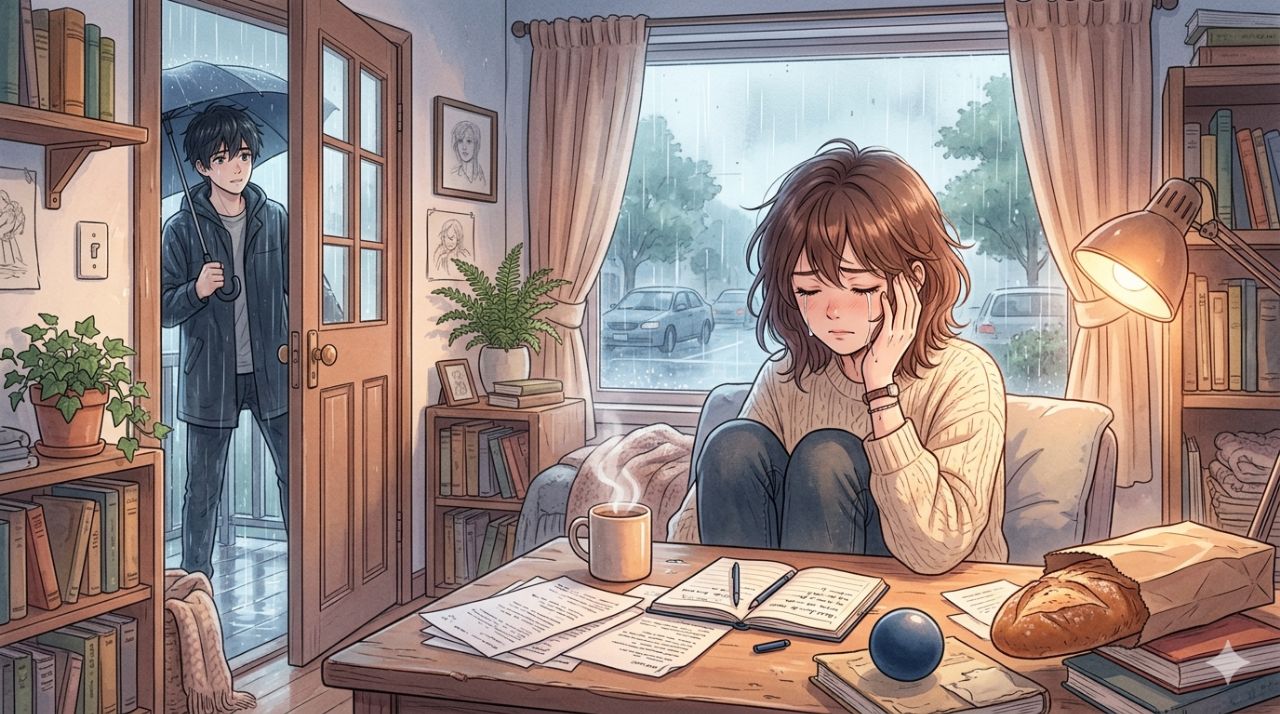
The rain had started as a timid murmur and, over the afternoon, became a steady drum against the windows of the small apartment where Maia lived alone. The drops traced paths across the glass, distorting the streetlight into a diffuse watercolor. Inside, the place smelled of cold tea and books; a desk lamp cast a cone of yellow light over a cluttered table with papers, a planner, and a ceramic mug with tea leaves. That focused brightness, however, did not dispel the fog that had settled in Maia’s chest in recent weeks. The doorbell rang—a brief, almost shy note—and her heart gave a jump she couldn’t explain. She wasn’t expecting visitors. She dragged herself to the door, with the feeling that each step added a new weight to her limbs. She opened it. Lucas, her neighbor from the fourth floor, stood there with a still-warm loaf of bread in a bag and a rain-soaked coat. His expression was the simple kind that comes without grand gestures: just presence. “Hi,” he said, his voice careful. “I brought bread. I thought maybe… would you like some company?” Maia looked at him. For an instant everything seemed in place: the rain with its rhythm, the bag of bread, the familiar silhouette of Lucas. But that moment cracked when a background sensation filled everything: a fatigue that didn’t lift with sleep, an opacity that made it hard to hold on to thoughts. Her hands seemed to have lost their precision; when she tried to pick up the mug, her fingers slipped and it chimed against the counter. The bread slipped and rolled, stopping under the table with a dull thud. “I’m fine,” Maia lied, and the word came out so thin she hardly recognized it. “Just tired.” Lucas set the bag on the table and sat down with the delicacy of someone crossing glass floor, avoiding sudden movements. “I don’t want to push you,” he said, folding his hands. “But I can’t watch and pretend everything’s okay, Maia.” Lucas’s voice had a mixture of concern and a kind of patience that didn’t demand immediate explanations. Maia closed her eyes and remembered the words of Dr. Ana Beltrán, the psychiatrist she had seen months earlier: “It’s extreme exhaustion. The brain depletes reserves. It’s not just depression. It’s a collapse from overexertion.” In the consultation, Ana had described in technical terms what Maia had intuitively felt for years: a wear that didn’t respond to more sleep, to vacations, to saying “I’m tired” out loud. She had explained masking as a daily camouflage: smiling when it hurts, modulating the voice until it sounds neutral, avoiding movements or gestures that might attract looks, repeating phrases and attitudes that seemed expected. It was an exhausting performance that required constant energy and, over time, consumed the nervous system’s reserves. “Do you remember Friday’s dinner?” Lucas asked without really waiting for an answer, more like someone throwing an anchor to hold the conversation. “You arrived late. You said everything was fine and laughed when nobody got the joke. The next day you couldn’t get out of bed.” The words stuck in Maia like splinters; they hurt for their accuracy. The kitchen, once a refuge, was now a landscape of small defeats: a pot forgotten on the stove, dried food on the cutting board, notes and unanswered emails piled with the precision of an impossible task. What used to be basic routines—cooking, replying to messages, getting dressed for work—had become ascents. Planning became a task that demanded mental energy she simply didn’t have; choosing between two options, from what to eat to which email to answer, produced a blocking sensation as if the prefrontal cortex—responsible for decision-making and organizing—had lost power. “It’s not that I don’t want to,” Maia murmured, voice broken. “It’s as if my brain doesn’t know how to order things. Planning slips away. Words come out twisted.” Lucas slid his hand over hers. It was cold, trembling. In that simple contact there was a promise of anchoring: not to fix, not to force, just to accompany. Maia held his hand and a tear, slow and silent, traced her cheek. There were no melodramas, no public catharsis—just an intimate acknowledgement that something inside her was draining away. Sessions with Dr. Beltrán replayed in her memory. In one, Ana had calmly explained what happens when the nervous system is forced to sustain a continuous performance: “The prefrontal cortex is exhausted,” she had said, “and that affects decision-making, planning, emotional regulation and language. There are also sensory alterations, decreased emotional regulation with more crises or disconnections, and isolation from lack of energy.” She had advised Maia to respect limits: accept isolation when needed, reduce external demands, slow the masking, and create more sensory-friendly environments. She urged Maia to validate her differences and freely choose the self-regulation strategies that brought comfort—stimming, sensory breaks, predictable routines—and to seek and build safe relationships where she wouldn’t have to hide her nature to be accepted. Lucas stayed that afternoon, with silences that said “I’m here” and movements that didn’t violate Maia’s need to withdraw from the world. It wasn’t heroic; it was human. The following days unfolded in a mix of progress and setbacks. There were mornings Maia managed to get up and prepare a simple stew that took her briefly back to childhood: the smell of sautéed onion, the calming rhythm of stirring a pot. Other days were brutal: the world turned into a noisy place where sounds were knives and lights felt physically heavy. Headphones became a necessary barrier; ceiling lights an enemy to avoid. She learned to let go of judgment around small things: eating a sandwich while replying only as necessary to emails; canceling a meeting that would require her to perform. Sometimes guilt surfaced: “If I were stronger, if I didn’t isolate, if I weren’t selfish…” Ghosts from a socialization that taught her to prioritize the appearance of adaptation over preserving internal energy. She had been taught to believe her worth depended on how much she resembled others’ expectations. Dr. Beltrán was blunt: such social demands were harmful; masking produces an identity wound that fuels burnout, and developmental trauma arises from chronic exposure to conditions that invalidate, exclude, or question a person’s emotions and experiences. One damp day, with the chill seeping into her bones, her sister Valeria knocked carrying a box of old photographs. Valeria had always been a blend of tenderness and pragmatism; she came to offer company and, unknowingly, to bring a piece of Maia’s past Maia had buried beneath layers of survival. “I thought you’d like to see them,” Valeria said, voice cautious. Maia accepted the box with still-shaking hands. The photos were like doors: one showed a girl in braids laughing with an open mouth, hands dirty from playing; another showed the same child absorbed in a game, her gestures free and exaggerated. The image hurt. There was something in that child’s laugh—irreverent, unrestrained—that in adulthood Maia had learned to tame so she wouldn’t stand out. She remembered being pointed at in school for moving differently, for not following group rules, for making comments that sounded strange to those who didn’t share her perception. Each pointing finger planted a seed of doubt: “There’s something wrong with me.” That, combined with the demand to hide traits to be accepted, had shaped a developmental trauma: exposure to bullying, exclusion, invalidation, sensory and emotional overload. “I always told you not to hide the tremor in your hands,” Valeria said, her voice thread between tenderness and gentle reproach. “‘You don’t have to look normal to be loved,’ I used to tell myself. I didn’t understand then what it meant, but now… I think I’m starting to understand.” Maia felt relief tinged with pain: a mix of recognition and mourning for what had been lost. She cried with a cleansing that left her exhausted and strangely lighter. The tears weren’t theatrical; they purged silences, negations, and obediences to norms that had cost her authenticity. From there, supported by some safe relationships—Lucas, Valeria, Dr. Beltrán—she began building a way of life with clearer boundaries. She learned to say “no” without embellishment, to prioritize actions that protected her energy. At work she proposed small changes: flexible hours, a quieter workspace for concentration, and asking that nonessential in-person meetings be handled in writing. Not everyone responded with empathy; some labeled her unprofessional or demanding. But others, surprisingly, offered understanding and practical adjustments. The day she saw a little girl in the park mimic one of her unconscious movements—a rhythmic hand sway—she felt something unarm. The child’s mother approached without judgment, with calm curiosity. “Is that a way to calm yourself?” the woman asked, speaking as if it were any habit. Maia nodded, slightly embarrassed. “Yes,” she said. “It… helps me find a rhythm.” The woman smiled and joked that she should try it when she felt stressed. That light acceptance was new to Maia: not forced normalization asking her to hide who she was, but a recognition that everyone has their thing that keeps them standing. That small interaction gave her another lesson: validation doesn’t have to come from experts; it can arise from simple human encounters. Yet the past didn’t dissolve. Developmental trauma lingered, pulsing in the body’s memory. Her body remembered hypervigilance: the sense of always being watched and judged, a tension settling in the neck and abdomen, a stiffness that made hands clumsy. Under stress, anxiety pushed her back to states where everything felt threatening. Nights could be long vigils where silence was filled by a mind replaying past interactions hunting for mistakes. She learned to identify those patterns and apply strategies: contact with safe people, slow breathing, routines that offered predictability, and permission to withdraw without explanations when necessary. Dr. Beltrán and her close circle worked on teaching those around her to “validate without correcting”: allow Maia to feel without minimizing her emotions, offer concrete help without questioning the authenticity of her experience. It was a process requiring education, patience, and gentle confrontations: explaining what autistic burnout was, why masking was harmful, and why stimming wasn’t a tic to fix but a necessary self-regulation strategy. Learning to give those boundaries without dramatizing them was as liberating for Maia as it was for those who began to understand. Progress was not linear. There were intense relapses—weeks when staying in bed was the only option—and moments of lucidity where life allowed small gestures of normality. She built a routine prioritizing scheduled rests, gentle physical activity, and sensory-friendly zones at home: a warm lamp, soft fabrics, a quiet corner. She allowed stimming in her space: rocking in a chair, squeezing a stress ball, humming a tune that grounded her. These simple actions were acts of self-care she had previously considered childish or shameful. Now she recognized them as necessary for regulation. Over time, something grew firmer: the ability to name limits out loud. Saying “I can’t right now” without detailing every reason, asking for a five-minute break during a meeting, delegating tasks that disproportionately drained her. Each small act of honesty with her own energy repaired a part of her identity that had been neglected. It was also a process of grieving what had been lost: rigid internal schools that demanded she silence her spontaneity, friendships that didn’t survive the truth, jobs that required constant performance. One clear morning, after weeks of steady work with therapy and daily adjustments, Maia opened her living-room window. Fresh air with the scent of wet earth came in, and for a moment everything felt less heavy. She thought of the ash metaphor: all that remained after the consumption of masking and accumulated trauma. The ashes weren’t just debris; they were proof of having lived, of having been subjected to a fire for reasons she no longer had the power to change. There was pain, yes, but also residue that could serve as a base for something new. Lucas came to meet her that afternoon. They walked slowly down the sidewalk, silence between them respectful. Maia was not invulnerable; she knew that. Nervous inflammation, days of emotional blackout, sudden regressions still existed. But there were concrete changes: she could ask for what she needed, allow herself isolation when energy demanded it, and no longer interpret every withdrawal as a definitive renunciation of connection. Before they parted, Maia took Lucas’s hand with more firmness than before. “I don’t want to fake being okay anymore,” she said simply. “I don’t want my life to be a mask.” He looked at her, eyes glistening with the understanding of someone who grasps the weight of those words, and replied with a line that hung in the air—warm and urgent: “Then don’t wear it.” The phrase was a compact promise: to accompany her without asking her to become invisible for his comfort. It wasn’t a magic solution; it was the beginning of a network of acts that, over time, might cushion the load. Maia knew in that instant the path would be long and full of stumbles, but that there were concrete strategies to sustain existence without dissolving: allowing isolation when necessary, reducing external demands, stopping masking, creating sensory-friendly environments, validating differences, fostering strengths, and permitting stimming and other calming activities. That recognition—that burnout was not “just tiredness” but the echo of accumulated trauma—gave her back a measure of control. She understood that rest wasn’t laziness or selfishness; it was survival. She also understood that recovery would be a reconstruction in small acts: a dinner she manages to prepare, an afternoon outside without paralyzing anxiety, a conversation where she doesn’t feel compelled to pretend. The rain that had once hammered the windows began to slacken. Now it fell as a fine drizzle that could almost be taken as a caress. Maia closed her eyes and breathed deeply, feeling a kind of truce in her chest: the ashes remained as witnesses to what had been endured, but they no longer completely hid the spark. Among the remnants of what had been, the possibility of living less conditioned by the demand to hide her nature and more oriented toward preserving inner integrity began to stir. It was not a triumphant ending nor a definitive healing; it was progress gathered day by day. It required accompaniment, boundaries, acceptance, and the courage to name her needs without shame. Maia learned to build, with those who loved her and those who chose to understand, a refuge where her energy was respected. And in that refuge, for the first time in a long while, the spark had room to breathe. Source of the images. Image created with Google Gemini.
No comments yet