 @mc5punk
Short story: Wheel That Turns
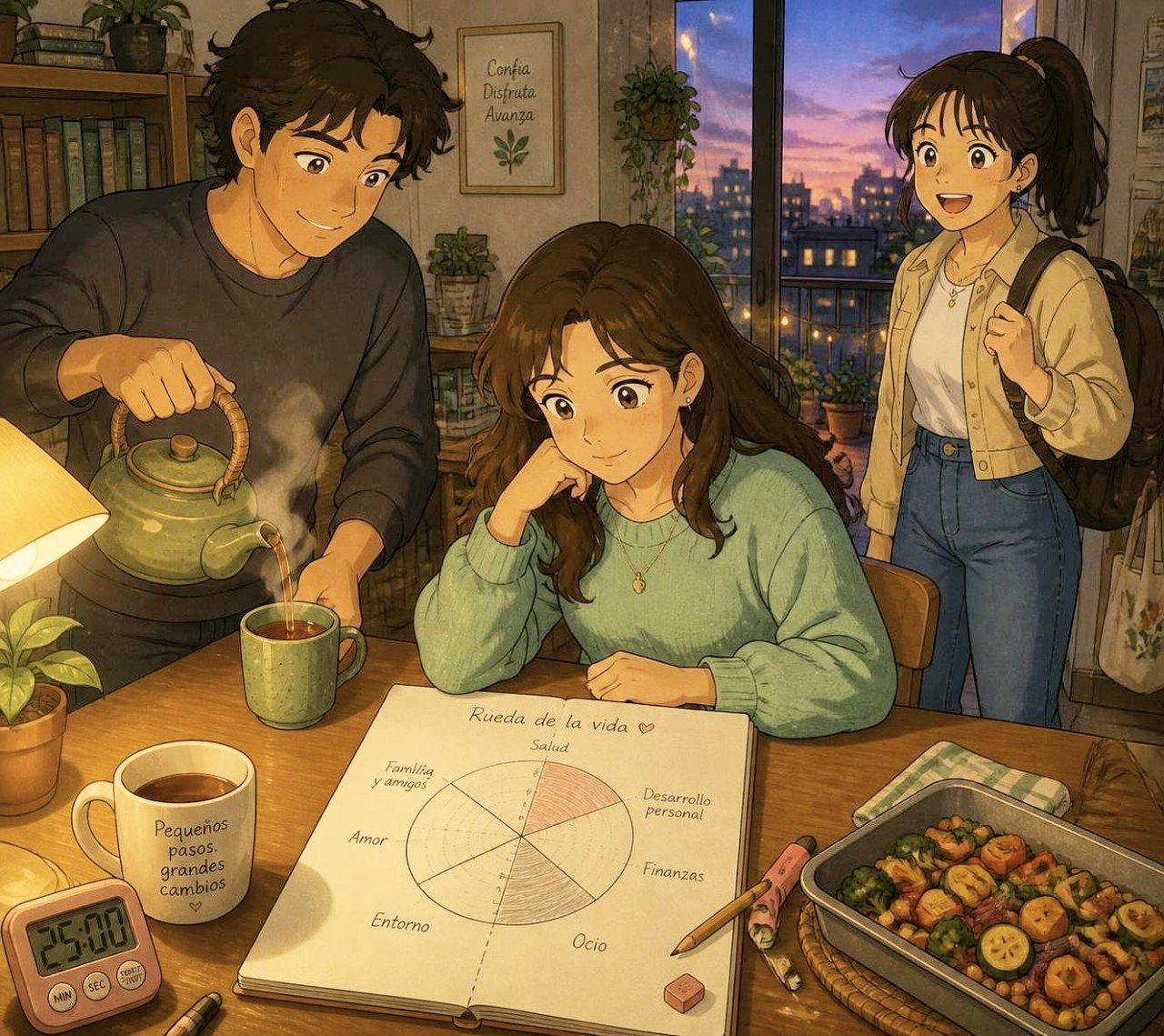
María closed her bedroom door with more force than she intended. On the table, the open notebook showed the wheel: a circle divided into ten sections, each with a word that, until recently, had seemed just a school exercise. That afternoon, however, the words pricked her attention like needles. She had shaded three sectors insistently: Studies, Physical Health, and Friendships. The shadows were dense, almost like cracks on the page. "No sé por dónde empezar," she murmured, resting her forehead on the notebook. From the kitchen came the sound of a kettle and footsteps. Diego, her older brother, entered with two cups of tea in his hands and a calm smile that didn't quite hide the worry in his eyes. "Another life wheel?" he asked, placing a cup in front of her. "What's brought you here today?" María pointed to the darkened sections without looking up. "Everything feels... broken. I spend mornings and nights studying, I skip meals when my head explodes, and I barely spoke to Ana in weeks. I don't recognize my routine; it's like everything is spinning wrong." Diego sat on the edge of the bed and looked at the page carefully. "I remember Mom saying the wheel doesn't need to be symmetrical, but it does need to be harmonious. If one part sinks, the rest goes down with it. What about the other sections?" "Self-love and Fun Time are almost empty," María replied. "Spirituality, Emotions, and Rest... they're not doing well either. Goals and Studies dominate the wheel as if they were the only important things." Diego put his cup down and put his hand on her back in an old, protective gesture. "How long have you been like this?" María sighed and told him: "Since the week before the last midterm. At first I said it would be temporary. Then it became a habit. I feel guilty when I rest and nervous when I'm not working." At that moment the doorbell rang. María frowned, surprised. Diego went to open it; Ana entered as always: a gust of energy, backpack slung over her shoulder and a wide smile that seemed too big for the doorway. "Surprise!" she announced, tossing her backpack onto a chair. "If someone tells me, I wouldn't believe it: María sad? Never!" María tried to return the smile, but it fell short. "I'm not sad... just tired." Ana looked at her straightforwardly, without hurry. "Tell me, why is the wheel in tatters?" María explained in detail: the pressure of exams, the to-do list, the occasional insomnia that left her without energy, the fatigue that turned into irritability with her friends. As she spoke, the words accumulated and felt lighter. Ana sat down and took her hands in hers. "I've known you since we were kids," she said softly. "You're not a machine; you're a person with limits. How about we do a practical test? A small plan, not a revolution." Diego nodded, encouraged by the idea. "Make a list, simple as that. What can you change today without turning everything upside down. Two hours of study with breaks, a walk, meet Ana, make a decent dinner... Something real." María hesitated, but put the pencil to the notebook. The words started appearing with shaky handwriting at first and then firmer: "Studies: 2-hour plan with 25-minute breaks," "Physical Health: walk 30 minutes daily," "Friendships: meet Ana today," "Rest: sleep before 11," "Food: don't skip meals, prepare easy snacks." "It's not a perfect plan," she said, "but it looks like something I can do." Ana stood up and, with that determination only friends have, said, "Then the first task is done: go out now and walk. I won't accept no for an answer." María felt something like a door opening. She knew she had an exam the next day, but she also knew that a few more uninterrupted hours of study wouldn't make her wiser or more whole. She looked at Diego, who held his cup as if it were liquid courage. "I'll be back in three hours," she finally said. "I'll study an hour and a half, rest half an hour, then go out with you." Ana snapped her fingers. "Perfect. And we'll have dinner after the walk. Something healthy and tasty. No excuses allowed." While María studied, she set a timer and obeyed each break. She went out to the balcony, breathed deeply, stretched. In those fifteen minutes she felt her shoulders drop a centimeter. It didn't solve all the semester's stress, but clarity arrived in small pieces. In the park, Ana and María walked at an easy pace. The afternoon cast long shadows over the benches; conversation regained a rhythm María hadn't remembered having lately: laughter, silly anecdotes, light confessions. Ana talked about a course she wanted to take, and María, unprompted, shared a childhood memory—the smell of cookies at her grandmother's house—and they both burst into laughter. "See," Ana said, "it changes when you allow yourself a breath. It's not magic, it's permission." Back home, Diego had prepared a simple dinner: roasted vegetables, quinoa, and a light sauce that filled the kitchen with comforting aromas. The table, set with quiet domestic intent, made the evening a small ritual of care. They ate without hurry and spoke of trivial things: music they listened to, a movie they wanted to see, the shopping list. The lightness didn't solve the exams, but it repaired something that had tightened in María: her connection to others. Not everything in life was duty; there were also flavors, voices, and company. That night she went to bed before eleven. It wasn't a perfect sleep, but it was deeper than previous nights. Upon waking, the wheel in the notebook hadn't changed shape, but María looked at it with different eyes. The shadows in some sections now had less abrupt edges: she studied, yes, but with breaks; she kept in touch with friends; she walked at least three times a week; she prepared snacks so she wouldn't skip meals. Weeks later, the notebook showed another version of the wheel: still not a perfect circle, but it turned more steadily. María had learned to design small interventions: a study block managed by timers, weekly meetings with Ana, stretching classes she took on Tuesdays, and a personal rule to turn off her phone half an hour before bed. Each change seemed minor alone, but together they made a palpable difference. One afternoon, Diego paused at a phrase María had written in determined ink, almost like a motto: "All areas of your life are important. If one is neglected, the whole wheel becomes unbalanced." "That sounds like good philosophy," Diego said without irony. "Are you going to hang it up?" María smiled and added another line beneath it: "Balance is also part of growing." She looked at it, feeling that the phrase enclosed not only a personal project but a way of understanding falls and recoveries. One Sunday afternoon, Ana called and proposed a small celebration for the end of the midterms. They gathered on the terrace with tea and cookies. They toasted in simple cups. "For wheels that require maintenance," Ana said, raising her cup. "And for those who remind us to look at the wheel when it starts to spin wrong," Diego added. María raised her cup too, and for a moment thought of all the nights of anxiety, the days when she almost forgot to breathe, and the small gestures that had brought her back to the surface: a walk, a snack, an hour of study with breaks, an honest conversation with a friend. She understood that balance wasn't a state achieved once and for all, but a daily practice: a sum of small, repeated choices. As they said goodbye, Ana hugged her in a long embrace. "Promise me that if you see the wheel tilt again, you'll call me," she asked. "I promise," María replied. That night she closed the notebook and looked at the wheel one last time before putting it away. She didn't consider it perfect; she didn't even plan to make it perfect. She looked at it with the patience of someone who knows wheels keep turning because someone cares for them and oil them when they squeak, that care is not a luxury but a tool. She fell asleep thinking of small steps, knowing that every decision, however small, influenced the direction of the turn. Upon waking, the morning light crossed the curtains and painted the page with a warm glow. María picked up the pencil and drew a thin line around the wheel, like tracing a promise. She knew there would be days when the shadows would return. She also knew she wouldn't face them alone. And that, she thought, was already a great adjustment in the machinery of life. Source of the images. Image created with Google Gemini.
No comments yet