 @mc5punk
Short story: The Last Room
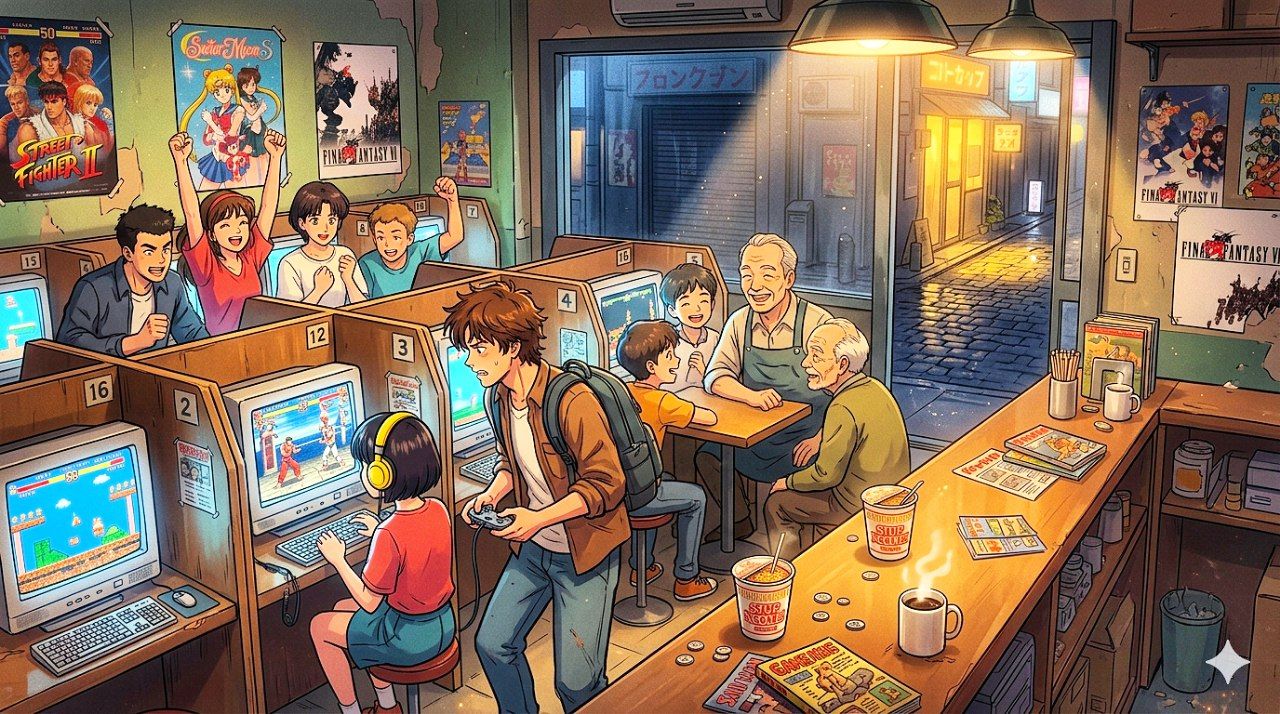
In the San Remo neighborhood, the new streetlights couldn’t drown out a warm rectangle of light spilling onto the sidewalk: the old game room PixelBar. The city had changed—buildings with glass facades, cafés with hanging planters, and home networks promising instant access to everything. Yet, in the heart of the neighborhood, PixelBar stayed lit, its yellow windows and faded signs insisting on keeping a corner of another era alive. Mateo pushed the door one autumn night. The latch squealed with a sound he had known since childhood; every time he crossed that threshold, time seemed to give him a breather. The smell of instant coffee, cleaner, and electronics warmed by hours of use hit him with the force of a memory: the same mixture that had accompanied him through long afternoons when hours stretched between matches and conversations. Behind the counter, hands resting on a worn notebook, was Doña Lila. Her apron still bore coffee and ink stains, and her smile—one that never seemed to have learned to change—lit the room as if years hadn’t passed. “Mat?” she asked with that short-name way of speaking. “Did you come to rescue ghosts again?” “Not so much rescue,” Mateo replied, dropping his backpack on a sunken chair. “I came to see if they were still alive. I can’t believe with all the new things this place is still open.” Doña Lila turned on another desk lamp and nodded toward the row of numbered cubicles. “The kids take care of them,” she said. “And Tomás still won’t give up his counter.” The stations, lined up like small islands, kept their hand-written number tags and peeled stickers that told stories in faded colors. The chairs creaked when sat in. The monitors, some with greenish hues, showed pixelated wallpapers that looked like they had stepped out of an endless afternoon. At the back, on the mixing table, an old radio played a song Mateo half-remembered. In cubicle 7, a group of young people laughed around a match. Among them was Camila, short-haired with headphones draped around her neck, who raised her voice when Mateo entered. “Hey! It’s Mateo,” she exclaimed. “I thought ghosts were urban legend.” Mateo smiled and went straight to monitor 4, the one that had always been “his” spot. “Still doing improvised tournaments?” he asked as he settled his hands on the keyboard, as if the keys remembered the position of his fingers. “We are tonight,” Camila said. “Cubicle 7 is defending the crown.” Rafa, a young man now studying graphic design who had gone from customer to friend, leaned against the wall with a bag of sweets. “I brought reinforcements,” he said. “You never know when a chocolate bar can change a match.” As the night went on, more faces appeared: Martina, a teenager who came with her grandfather and listened to stories of earlier times; Julián, who worked in maintenance and came to disconnect for a while; and Tomás, the man who had founded PixelBar many years ago. Tomás walked slowly, but when he spoke his voice filled the room. “If there’s a tournament, let it begin,” he said. “But first, coffee for everyone. And nobody touch joystick number 3—that one lives on stories.” They laughed. Tomás approached the counter and, with a big, worn hand, handed out paper cups. His eyes, small behind glasses, shone with something between nostalgia and tenderness. “I opened this place with two machines and a dream,” Tomás began in a tone that invited time to stretch. “I thought it would be a temporary spot. But people stayed. They came to learn, to fight for minutes, to share. Not everything that was slow to appear was useless.” Mateo listened as the keys creaked under his fingers. When he connected, the system loaded a screen with pixellated icons and the familiar connection noise: a beep that to many had once seemed like magic. Immediately, a match enveloped them. The game wasn’t everything: it was the gestures, the laughter, and the jokes exchanged between clicks. “Remember when we bet an hour to play?” Camila asked, looking at the group. “I used to pay with coins my dad gave me in secret.” “I brought sweets and lost everything on matches,” Rafa confessed. “But it was worth it.” Martina looked up in a silence that demanded attention. Her voice had the frankness of someone learning from others’ stories. “My grandfather told me about the cybercafés like they were novels,” she said. “I thought they were made up. Until I came. It’s different to see it in person: here you leave pieces of your day, pieces of yourself.” Doña Lila, sitting on her stool, wrote something in the notebook and murmured, “Here you learn to wait your turn. Not to look over someone’s shoulder. To help when a screen freezes. Those aren’t in tutorials.” The tournament began with cheering that reminded Mateo of afternoons when the street emptied and the place filled with voices. The rounds were short but intense. A brilliant play drew applause that echoed off walls lined with faded posters. One kid celebrated with a jump that almost unplugged his monitor; another, embarrassed, asked for a rematch. “What a play!” Rafa shouted. “Did you see it, Mat?” “I saw it,” Mateo said. “That’s the one that matters.” Amid it all, conversations formed that didn’t necessarily revolve around the game. They talked about jobs, studies, who had moved to which neighborhood; told childhood anecdotes and remembered how friendships formed in this place still lasted. Tomás sat beside Mateo and lowered his voice. “There were times I thought we’d close,” he said. “With homes getting internet, with social networks and all that new stuff... but some kids kept coming. And those who grew up brought theirs. That’s what kept us going.” “And what makes you keep going?” Mateo asked. Tomás smiled with a mix of pride and fatigue. “The laughs,” he answered. “And these small things: watching a kid learn to fix a computer, seeing someone help without being asked, celebrating a victory like it belongs to everyone. You can’t get that from a screen at home.” The talk seemed to spark something in Martina. She perched on the edge of her chair, face lit by the monitor, and said quietly, “My grandfather says they used to wait to use the machines, share tips. I thought it was romanticizing. But today I understood these small rules build trust.” Camila nodded and added playfully, “And it was a place where you could meet someone who’d later be your partner in mischief or the one to celebrate a gift with.” Hours stretched without complaint. Between matches they took photos in front of the poster-covered wall and an old hanging flag. Modern phones photographed the pixelated screens as if trying to capture a contradiction: the instantaneous recording the old. At the end of the night, Doña Lila, notebook in hand, announced the tournament results. “Winner: Camila,” she read. “Second: Rafa. Consolation prize goes to Julián for his drama in the final play.” Everyone laughed. Tomás handed a box of sweets to the winner and a toy medal to the runner-up. The prizes didn’t matter; the gesture did. When the room began to empty, Mateo stayed behind a few minutes more. Before leaving, he approached Tomás. “Do you think this can last?” Mateo asked honestly. Tomás measured his response. “I don’t know how much time we have,” he said. “But as long as someone wants to push open the door and stay to listen, we’re alive. And if one day the lights go out and the place closes, let something remain. Let someone remember how it sounded in here.” Mateo felt a sweet ache in his chest. He said goodbye to Doña Lila with a barely audible promise. “I’ll come back,” he said. “And I’ll bring mine.” The night greeted him with cool air. PixelBar’s light looked small among modern illumination, but inside him something stayed lit: the certainty that certain places don’t die as long as memory stays active. As he walked, a sound—the hum of an old modem that had once been music—seemed to follow him in memory like a melody. The next day at work, Mateo remembered the faces and laughter; he called a friend and suggested returning that weekend with his group. He began to sketch a plan so the place wouldn’t remain only nostalgia, but become a bridge between generations: repair workshops, unhurried learning afternoons, gatherings where older people told stories and young ones taught tricks. Over time, PixelBar didn’t become a museum or a motionless shrine. It remained a living, imperfect place with scratched walls and aging monitors, and yet the laughs stayed the same. There were nights it was packed and others when only one person came in to read. But the door opened always. When the neighborhood changed again, some wondered why those who could choose the modern favored a place with yellow windows and creaky chairs. The answer lived in small gestures that happen without fanfare: someone lending a cable to a stranger, another waiting their turn conversing with a neighbor, someone celebrating a victory that wasn’t theirs. Those small acts, invisible from outside, sustain the life of the last room. In the end, Mateo understood that nostalgia wasn’t mere melancholy. It was fuel: a reason to return, to teach, to keep a warm light burning in a city that kept moving. And on some future night, when a teenager pushed open PixelBar’s door and the smell of coffee struck like a memory, they would hear the same voices, the same jokes, and understand that in the last room there is always room for shared stories. Source of the images. Image created with Google Gemini.
No comments yet