 @mc5punk
Short story: The Tide of Silence
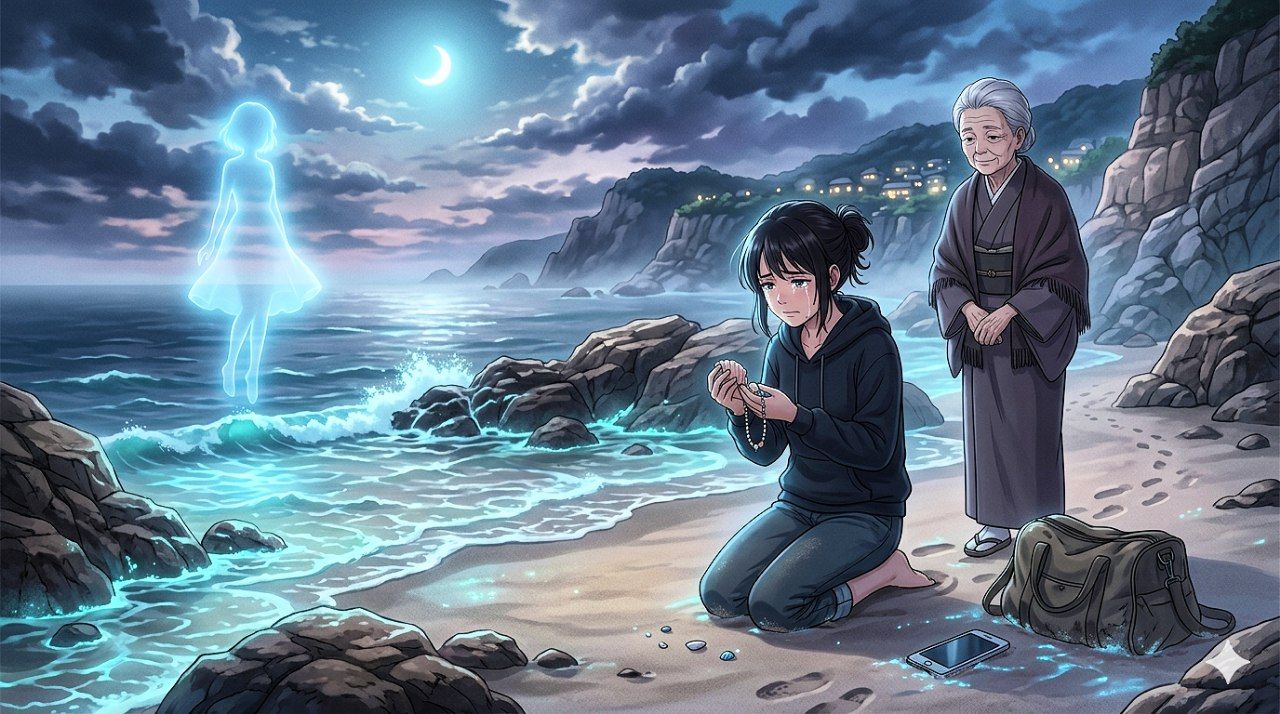
The beach woke slowly, like someone stretching an asleep body. The tide had pulled back enough to leave a fan of gray, damp sand dotted with broken shells and black seaweed. The street vendors still smelled of coconut and hot oil; the murmur of the sea and distant bar music mingled in the warm air. That morning, no one noticed that the beach was waiting for something. Nai arrived with her hair loose and an easy laugh that seemed to script scenes for the camera. She was known online: her videos mixed landscapes, travel tips, and intimate confessions that made her feel close. Pim, her childhood friend and occasional assistant, followed carrying an umbrella, an improvised reflector, and bags of props. “Is the shot ready?” Pim asked as she spread the towel on the sand. “Always ready,” Nai replied, setting the phone on the sand with the lens aimed at the horizon. She made her usual thumbs-up gesture. “It just has to catch the ending.” Pim frowned. “Be careful with the current, Nai. The water looks strange today.” Nai laughed and brushed the warning aside as one brushes away passing clouds. “Don’t worry. I’m a good swimmer. Besides, if a wave takes me, it’ll be epic content.” They placed the phone face up on a small towel, the camera fixed on the vast blue. The recording counter began to blink: recording. The light shone on the screen and, for a moment, everything was calm: the wind, the distant click of a boat, the voice of a vendor selling coconuts. Nai stepped into the water lightly, the sea kissing her knees, then her hips. Pim watched from the shore, holding her breath while the phone on the towel kept recording. A child ran by; a couple kissed distractedly; the scene seemed the same as always—a postcard no one suspected could turn into tragedy. “Nai, don’t go too far,” Pim shouted as the young woman went out where the waves broke. “Just a bit,” Nai replied, turning and throwing a smile that did nothing to ease the worry in Pim’s eyes. The water changed without announcing it. What at first was a friendly sway became a subtle, constant pull that drew the sand from under Nai’s feet. She lifted her arms, tried to find balance, her hair plastered to her face. Pim lunged to the edge, but she couldn’t move her legs in the moment a larger wave hit with violence. The fixed camera on the towel recorded the scene helplessly: Nai struggling against something unseen; a crest of water higher than the rest that swallowed her in an instant; the screen flashed white from the spray, and in that white remained the frozen image of someone who had crossed the line. A hand—unexpected—entered the frame seconds later: that of the passerby who had walked by without looking. Marcos, a traveler with worn shoes and a bag of hostel flyers, saw the phone trembling on the sand and bent to pick it up. He rested his elbows on the towel and, out of conscience or curiosity, played the video. He watched it once and knew he had to take the phone with him. He didn’t know the girl thrashing on the screen; yet Nai’s frozen face, her wide eyes, and the wave like a wall lodged in his throat like a stone. “Are you okay?” Pim asked when, minutes later and after catching her breath, she approached Marcos holding the phone. Marcos swallowed and showed her the screen. “I saw everything,” he said in a hoarse voice. “Nobody’s pulled her out yet.” Pim dropped to her knees in the sand. Her fingers trembled as they touched the screen, as if time could be caught that way. “Call the police,” she whispered, too weak to do anything else. The town station soon filled with reporters and onlookers. Within hours someone uploaded the clip to a viral account and, like a current, it began to spread: comments, plays, theories. The video became a magnet for eyes seeking spectacle, and with it the question no one could answer: what had really happened? Officer Somchai, with a tired look and wrinkled uniform, took the phone with sweaty fingers and let it play in slow motion. On the screen the scene looked crueller: Nai fighting, a trail of foam, the crest that consumed her. No scream was heard. No one reached her. “Call the taxi boats—get me a boat,” Somchai ordered softly. “We’ll search the area until night defeats us.” Meanwhile, Marcos felt responsible for having the phone. He took it to his hostel and left it charging on the bedside table. He didn’t think his actions would ignite something the town couldn’t put out. Days followed the tragedy with an inexorable rhythm. Pim didn’t leave the beach; she watched the sea with hollow eyes, unable to erase the last image from her mind. The press demanded coordinates; curious people began to arrive, hungry for mystery. “Miss Pim,” a reporter asked, thrusting a microphone, “do you have any idea exactly where this happened?” Pim shook her head. “I’m not sure,” she answered. “I only remember a rock, a small pier… I can’t say more.” The rumor spread across networks like tidewater: people demanded the exact beach of the incident and promised they would come to see it with their own eyes. Some paid to get images; others offered supernatural theories. The need for identification, for a defined place for loss, became a collective urgency. But Marcos didn’t want publicity; he wanted answers. He returned to the beach that afternoon and walked with steps of research rather than grief. Among the foam he found small clues: a torn sandal, a bracelet with a rusty charm. Nothing of Nai’s, but each find urged him forward. Walking along the shoreline, he noticed footprints leading into the undergrowth and followed them on impulse to a cliff that opened into a hidden cove. There, on wet black rocks, the tide had left vivid marks; and on a crest, as if someone had purposely placed it, he found an object covered in salt: Nai’s necklace, with a tiny shell-shaped charm. Marcos backed away. The discovery left him breathless. The beach, which at first had seemed a scene of accident, began to take on the texture of something intentional. That night an envelope was slid under the door of the hostel where Marcos stayed. No return address. Inside, a printed photo: the sequence from the video, but with a detail not visible in the compressed online version—a reflection on the crest, a blink that showed a pale face, eyes too dark, a smile that didn’t meet the skin. On the back, a note with trembling letters read: “Don’t look when the tide calls you.” Marcos felt a chill he couldn’t shake. Who could have cropped that image and left it there anonymously? What or who watched from the depths? The photo’s news spread as fast as the original clip. Pim saw it, and suddenly the memories she’d kept began to scatter. One night, while checking old messages, she found something that left her breathless: a text from Nai, brief and enigmatic: “If one day the sea decides to ask for me, don’t stop me. I want to understand it.” “What did she want to understand?” Pim asked aloud, clutching the phone. “What made her say that?” Nobody had the answer. The puzzle pieces refused to fit. Police questioned fishermen and locals. Some spoke of treacherous currents; others spoke of old legends. Mae Suda, an elderly woman who kept the town’s memory, offered her version with the patience of someone who had seen the sea claim its stories time and again. “The tide has memory,” Mae Suda said, the skin of her hands mapped with wrinkles like routes. “It is not that it takes out of malice; it takes to balance. There are things that belong to its realm.” “What kind of things?” Somchai asked, his skepticism tinged. “Memories,” she replied softly. “What the water refuses to let die, sometimes it preserves. And when something calls from below, the tide can answer.” The town split—some wanted to exploit the mystery (tourism, documentaries, clicks); others looked at it with fear, afraid curiosity would awaken something worse. Meanwhile the video continued to circulate, spawning theories from fatal current to deliberate intervention. Calm seemed to hold its breath the night the second video appeared. A fisherman claimed a camera had been fixed on a rock watching the cove for days. In that recording Nai approached the water, but behind her, among the rocks, a furtive figure moved deliberately; a quick hand threw something into the sea at the moment Nai lost her footing. It wasn’t a shell or a stone: it was a small dark object that caused an instant whirlpool. “Did you see it?” Marcos asked, showing the clip to Pim and Somchai under a lamp. “There’s someone there. The sea isn’t alone in this.” Pim could not hold her gaze. The whirlpool on the screen looked like a small mouth opening to swallow the shore. “If someone tossed it,” she whispered, “then someone knew what would happen.” Somchai ordered a stricter search. He asked about visitors, strangers in the area hours before, and found incomplete name lists and unanswered phones. On Nai’s phone, among messages and photos, there was a slip of a clue: a local number leading to an empty voicemail; an old log showing a single incoming call at midnight days before the incident. Days became weeks. The tragedy left an indelible mark on the coast: people who approached the cove began to experience strange things. A fisherman recovered a photo of his wife as a young woman he thought lost; a child found his first toy among the foam; an old man remembered an entire song he had forgotten decades ago. Everything the tide returned seemed to come from memory, as if the beach were a camera returning fragments of forgotten pasts. Marcos noticed a pattern: every returned object came with a cost. Those who found them slept poorly; they had dreams in which a voice called their name; dreams where the water offered pieces of their life in exchange for something never specified. The town feared the beach had set a form of exchange. Mae Suda, whose knowledge had guided conjectures, proposed something that sounded like a rite and desperation equally. “If the tide takes memories,” she said, “we must give it something in return. Not coins, not rags. Something with intent.” Pim, driven by guilt and the need to say goodbye, accepted. Marcos, driven by curiosity and a loyalty to truth, volunteered to help. Somchai, torn between duty and skepticism, agreed to accompany them and keep order. They gathered sentimental items donated by the community—photographs, letters, a pocket watch, a necklace, a scrap of cloth with a handwritten note. Mae Suda murmured old words no one fully understood; her language shaped the wind. On the edge of the new moon they walked to the cove with a basket of offerings and a makeshift ceremony. “I don’t know if this will work,” Marcos said quietly, holding a photo. “We have nothing else,” Pim replied, voice breaking. “Either we give something, or doubt consumes us.” Kneeling at the water’s edge, Pim held the basket in hands that trembled. Mae Suda intoned what sounded like a wave and a creak of shells. Then, as if it were the only sensible thing, they tossed the basket into the sea. At first the surface did not answer. The moon hid behind a cloud and silence felt like a wall. Then, like a breath, the water calmed; a figure rose, only for an instant: a reflection, not a body, a translucent image floating in the foam. Everyone watched in stunned silence. “Nai,” Pim called, voice raw. “If you’re there, come back.” The reflection made a slight gesture of the hand—subtle, almost imperceptible—like a wave or a farewell. A flash and the image dissolved. The tide finally returned something: Nai’s necklace, a note wrapped around the charm. Pim took it with trembling fingers and read the scrap inside. The handwriting was small and steady: “Don’t look for me in your world. I learned to listen.” The cries that followed were both relief and desolation. Pim didn’t know which emotion was purer: knowing that, in some way, the person she loved still floated in the tide’s memory, or accepting that Nai had chosen a place from which she would not return. The note offered no explanation, only a painful statement. Formal investigations found no human culprit. Police closed the case as “disappearance at sea,” a rare combination of inexplicable fatality and lack of evidence. Those demanding names and justice were left empty-handed; those seeking supernatural answers found in the beach a new legend to tell. Marcos stayed for weeks, obsessed with the phone he’d found on the first day. He examined files, compared metadata, searched messages and finally discovered a hidden frequency in an odd audio file: a nursery tune in a language he couldn’t identify, a melody that matched Nai’s ringtone used to close her videos. Each playback blurred the world a little more. Pim withdrew into solitude. She moved to a neighboring town, trying to rebuild a life without cameras or viewers. She stopped recording; she stopped chasing approval. Somchai continued patrolling the coast with a mix of respect and fear that kept him watchful. The beach transformed. Curious people turned it into a destination. Pilgrims left objects—some offerings, some wagers with the unknown. With each visitor the beach seemed to accrue memory: cameras that failed, phones that replayed fragments of Nai’s life out of context, voices calling strangers’ names in the night. Before leaving, Marcos decided to safeguard the phone and images—not to profit, but to preserve evidence that something had happened. He kept the printed photos, the anonymous envelope, and the sense that he had touched a border humans should not cross. Pim kept the necklace with its note in a drawer, a relic that comforted and tore her apart. Mae Suda died on a rainy afternoon. Her funeral was small and silent, the beach looming in the background like a presence that both watched and claimed. Before she died she issued a final warning: “Don’t confuse curiosity with courage. Some places belong to the sea’s memory.” Years did not heal the wound entirely. The beach continued returning objects—buttons, photos, a child’s shoe. Each find brought a fleeting consolation and a pricking loss. Visitors learned that they could photograph the tide and post stories, but the essence of what had happened there slipped through their fingers like water. Some tried to repeat the exchange ceremony, hoping to recover what the tide had taken. Some swore they had retrieved precious items; others found nothing, and some claimed they’d heard voices. The beach became a place of tacit pacts: those who understood the exchange respected it; the rest left with stories they could not classify. At night Pim sat on the shore holding the necklace in her fingers. She stared at the horizon until her eyes burned and listened with an attention bordering on superstition. Sometimes she thought she heard a nursery rhyme—not of this world—rising from the water like a lullaby. Other times she only felt the wind. Marcos, far away, wrote about the experience with words seeking truth, not fame. Distance gave him clarity he lacked on the island: he understood that some tales are instructions—that curiosity can be a thread leading to unasked-for doors. His account circulated in small circles, keeping alive a warning others preferred to ignore. The Tide of Silence kept doing its work. Sometimes the sea returned pieces of the past; sometimes it insisted on silence. The truth about Nai remained woven into a blurred edge between what was real and what the water’s memory chose to keep. The note on her necklace, simple and laconic, became the clearest verdict: “Don’t look for me in your world. I learned to listen.” Years later, when someone plays the original video of Nai’s last seconds, the screen reproduces the scene with the same implacable serenity. Comments still demand explanations; some users cling to conspiracies, others to the idea of voluntary sacrifice. No theory fully encompasses the depth of the event. The beach continues, indifferent and patient, keeping its secret in every wave that comes and goes, in every object that returns to the sand as payment for the privilege of looking. The sea offered no more reasons. What it gave was a subtle lesson: there are shores where curiosity should turn into respect, and questions that, once answered, leave a void deeper than doubt. Pim learned this with guilt and loss; Marcos learned it with the responsibility of having picked up a phone that started everything; Somchai learned it with the consciousness that the law cannot contain every risk; and Mae Suda learned it in death, with the peace of someone who performed rites of memory. The beach, meanwhile, remained a point on the map some visited to defy or revere. Sometimes at dawn small footprints could be seen heading toward the shore and vanishing without returning. People said they were the prints of those who had paid the price of understanding. Others claimed they were Nai’s, walking now in a place neither wholly hers nor entirely someone else’s. The last image to linger was the simplest: an open shell in the sand with a tiny crumpled paper inside where, in nearly imperceptible handwriting, someone had written: “Listen before you speak, and respect what only the water knows.” The phrase, which spread across the web and through the town, became a quiet warning for those who seek answers in the murmur of waves. And so, the tide continued its work, holding memories and returning them with conditions humans barely understood. Some accepted the lesson; others forgot it. But on the edge of that liquid world one certainty remained: there are mysteries that are not resolved by questions, but by the humility of those who decide not to profane what the sea has chosen to keep. Source of the images. Image created with Google Gemini.
No comments yet