 @mc5punk
Short story: The Inner Lighthouse
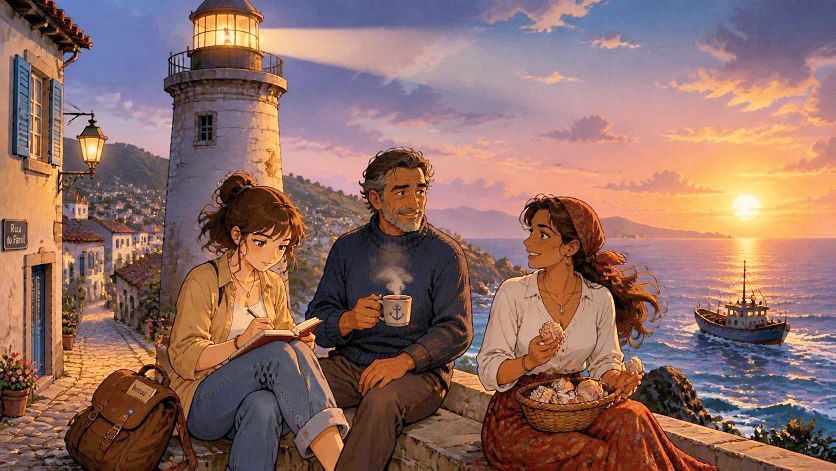
Mariana arrived in the coastal village one autumn afternoon with the feeling that something inside her had worn thin. She carried a simple backpack, a notebook with slightly dog-eared pages, and the intention of disappearing for a while to find herself again. The village was small: cobbled streets, houses with blue shutters, and the smell of salt and seaweed. She walked unhurriedly to the lighthouse, drawn by the promise of silence and height. At the foot of the lighthouse she found Tomás, the lighthouse keeper, sitting on the low wall overlooking the sea, holding a steaming cup of tea. Tomás was a middle-aged man with strong hands, a serene gaze, and a slow way of speaking that conveyed calm. "Good afternoon," Mariana said, her voice trying to hide her doubt. "May I sit?" Tomás smiled and raised his cup in a welcoming gesture. "Of course. The wind is generous here and company is seldom too much. What brings you to these shores?" Mariana looked to the horizon, where the sun was beginning to set in orange tones. "I needed to get away from everything," she replied. "I feel lost. I compare myself a lot to others, I chase after pleasing people, and in the end I’m exhausted." Tomás nodded, as if he recognized the words of someone who had been carrying expectations for a long time. "Listen more, understand more," he said, breaking the silence. "Often we think speaking will save us or make us visible, but true direction comes when we listen— not only to others, but to what’s happening inside us. Have you tried listening to yourself without judging?" Mariana put her hands in her coat pockets. "I'm not sure how to do that. When I try to pay attention to how I feel, thoughts assault me: 'You’re not enough,' 'What if you fail?,' 'What will they say?'. They make me dizzy." "Those thoughts are not always the truth," Tomás replied in that softness that seemed like a lighthouse itself. "They're like passing clouds: they inform you, which is valuable, but they are not the whole sky. Observe them, name them, and decide afterward." Mariana took out her notebook and, without thinking too much, wrote: "My thoughts are not always the truth." The simple act brought immediate calm, as if fixing the phrase on paper allowed her to separate herself a little from the voices in her head. As the sun faded, Lucía arrived—the village schoolteacher who always collected seashells and carried laughter with her. She joined them, sitting nearby. "What are you writing?" Lucía asked, curious. "An idea," Mariana answered. "The lighthouse keeper told me that my thoughts aren’t always true." Lucía tilted her head, thoughtful. "What a good start," she said. "At school I ask my students to listen before answering; that way they learn to understand others and themselves better." Mariana confessed her fear of disappointing others and the tendency of her life to revolve around what others expected of her. "You are not here to please everyone," Tomás said. "Everyone who comes to the lighthouse brings a different lantern. Your purpose isn’t to make every lantern reflect your light, but to keep yours burning with honesty. Living at peace with yourself is an act of courage." That night, the three of them sat at the lighthouse base and talked until stars filled the sky. Mariana listened more than she spoke; she let the advice seep in. Before leaving, Tomás invited her to return the next day to help with simple tasks around the lighthouse. Manual work, he said, would help bring order to her thoughts. The next morning Mariana returned early. The lighthouse needed cleaning: dust on the railing, cobwebs on the windows, and a lantern that asked for attention. While she wiped the glass, she felt the repetitive motion loosen the tension in her shoulders. "May I ask you something personal?" Tomás said, handing her a rag. "Ask," she replied. "Who do you give the control of your life to now?" Mariana paused. She thought of the other people’s agendas she had accepted, the decisions she had made to avoid conflict, the comments that made her doubt. "I give it to other people’s opinions," she admitted. "Sometimes to anxiety. And to the need to justify myself." Tomás cleaned a stain with patience. "Focus on what you can control," he said. "There are tides you won't change. If you try to control everything you will wear yourself out. Letting go of what you can’t control isn’t giving up; it’s choosing where to invest your energy." She nodded. It was a simple lesson but hard to apply. Over the week she practiced small renunciations: not answering an urgent message immediately, saying "no" to a favor that would leave her exhausted, spending fifteen minutes each morning writing in her notebook. Those actions, she discovered, gave more freedom than any attempt to please others. One afternoon, while helping raise the lantern pulley, she cut her hand on a rusty tin. The pain made her freeze; the blood surprised her and frustration mixed with tears. "Are you going to give up because it hurts?" Tomás asked, already holding a first-aid kit. "No…" Mariana stammered. "But it hurts a lot." Lucía, who was passing by, appeared in an instant and with sure hands began cleaning the wound. "The pain is temporary," she said warmly. "Growth is forever. Every wound brings a lesson; a scar is a reminder that you learned to keep going." Mariana watched the bandage cover her hand and, in the stillness that followed, thought about all the times she had avoided experiences because fear of pain was stronger than curiosity to grow. That night, when the bandage was on and the wound had begun to calm, she wrote another sentence in her notebook: "Pain passes through me; it does not define me." In time not only her hand healed. Mariana began to adopt concrete actions to complement her reflections: she signed up for pottery classes on Tuesdays (a way to materialize patience), she started walking every morning along the coast without her phone, and each night she wrote one thing she had done for her wellbeing, however small. Those routines, though discreet, proved she didn’t depend only on time to heal: she depended on her actions. One afternoon, while they shared stories and tea in the lighthouse kitchen, Andrés arrived—a young fisherman looking for work at the dock. He smelled of sea and carried the look of someone comparing his path to others. "Sorry to interrupt," Andrés said shyly. "I heard you talking from the beach. My name is Andrés. I’m looking for work and sometimes I feel useless next to my brother, who’s always been more successful." Mariana looked at him and, without thinking, spoke as if addressing her own reflection. "Don't compare yourself; outdo yourself," she said. "Your path, your pace, your story. I spent years measuring my worth with others’ rulers. Now I try to be better than yesterday’s version of myself." Andrés let out a short incredulous laugh and then exhaled, as if he had put down a weight. "It sounds simple," he said, "but today I feel it as a truth I hadn’t heard that way." Weeks became months. Mariana learned to listen before responding, to question her thoughts instead of surrendering to them, and to accept that she could not control storms but could adjust the sails. In her notebook she drew maps: small goals, habits, decisions that once seemed impossible. Each map helped her orient herself better. One winter night a storm hit the coast hard. Winds roared, waves slammed against the breakwater and the harbor radio barely transmitted static. A fishing boat that had gone out too far lost its bearings. In the lighthouse the light had to remain steady, and the townspeople organized to help. Thanks to Tomás’s attention, the fishermen’s coordination, and the improvised signals they raised, the boat managed to approach and moor safely. That dawn, in the small tavern by the port, the community gathered to share rice, stories, and wine that warmed their hands. They sat by the fire; the dockmaster’s callused hands knocked his cup in a gesture of gratitude. "I toast," Tomás said, lifting his teacup, "to the lighthouse that didn’t stop shining, and to those who knew how to row when the tide rose." Lucía raised her glass and added, "To the growth that becomes evident with time and simple acts." Andrés, with slightly glassy eyes, said, "To not comparing ourselves. Each one has their tide and their boat." Mariana looked around and felt something settle inside her. The storm’s noise, instead of unsettling her, reminded her that she wasn’t invulnerable and that did not weaken her: it made her human. That night she walked to the headland, the sand cold under her feet and the notebook in her hand. She sat and wrote, "Today I stopped living to please and started living to learn." After a few months Mariana decided to return to the city. The village farewell was simple: hugs, promises to return, and the blessing of those who had witnessed her transformation. Before she left, Tomás gave her a small pocket compass. "To remind you," he said, "not so much of the physical north, but the inner one. When you doubt, open your notebook and look at how far you’ve already come." Back in urban life Mariana carried the practices she had learned: listening intentionally, distinguishing thought from fact, prioritizing what she could control, accepting and learning from pain, acting daily to heal, and measuring progress against her own yesterday. It wasn’t a magic cure; there were hard days and relapses where old habits of comparison trapped her. But now she had practical tools to return to shore: writing, walking, breathing, asking for help, saying "no." Years later, at a reunion with old friends, one of them remarked that she saw in Mariana a new calm, a resolve that did not impose rigidity but kindness. "How did you do it?" the friend asked. Mariana smiled and touched the compass she kept in her bag. "Little by little," she said. "I learned to listen more and understand better; I discovered my thoughts aren’t always the truth; I accepted that I’m not here to please everyone; I focused on what I can control; I understood that pain passes and leaves lessons; I acted each day to heal; and I stopped comparing myself, striving only to beat my previous self." That answer wasn’t a slogan: it was the synthesis of months of practice, of cuts that healed, of shared cups of tea, and of dawn walks. The compass, the ink in her notebook, and the lighthouse’s light became symbols of learning that, like the guiding light for ships, didn’t promise routes free of storms but did promise that navigation was possible. The lighthouse continued to do its work night after night, and Mariana, wherever she was, kept hers lit: a lantern she fed with everyday actions, a lantern that reminded her the most valuable truth isn’t the one others dictate, but the one you build step by step. Source of the images. Image created with Google Gemini.
No comments yet