 @mc5punk
Short story: The Suture of Oblivion
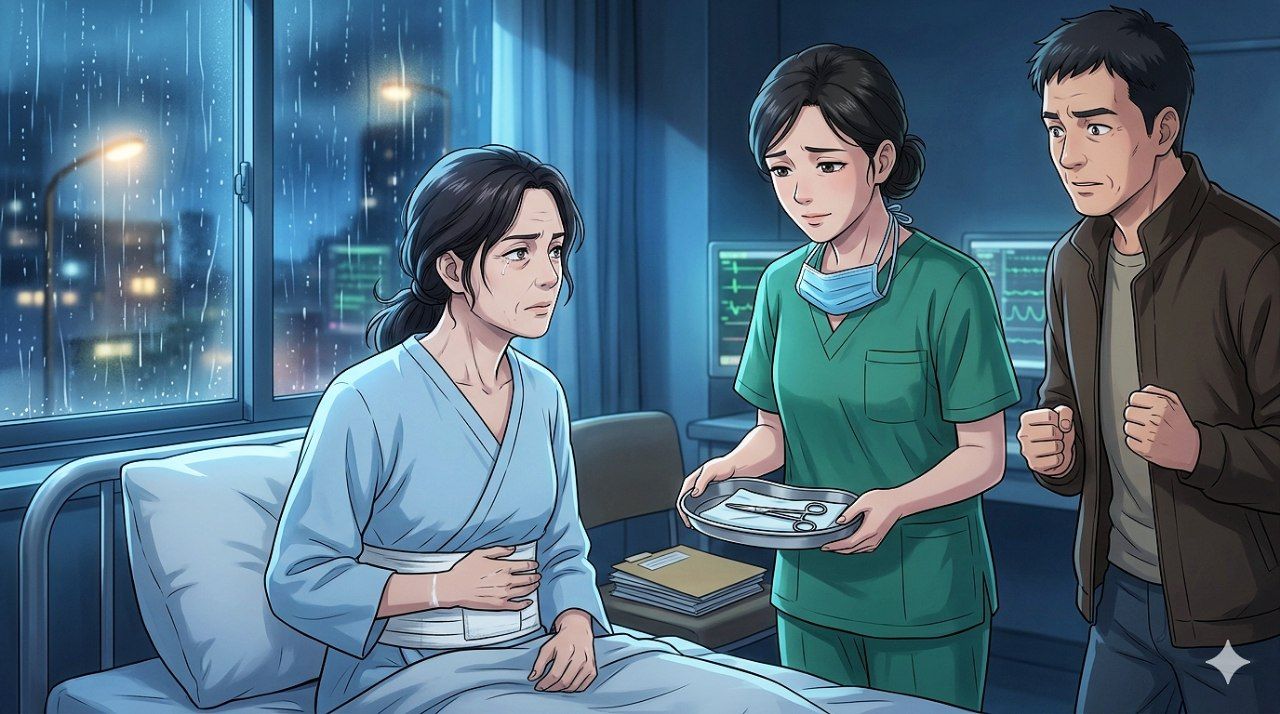
Marina Valeri rang the bell of the building where she lived with the feeling that each step was a betrayal of her own body. The night before she had hardly slept; the fainting spells had become more frequent and the pains, sharp and constant, no longer responded to the painkillers or antibiotics they had prescribed. She walked slowly down the hallway to the elevator, her hand on her abdomen as if holding something fragile that could crumble at any moment. Her brother, Pietro, waited with two cups of tea and the tired look of someone who had spent weeks watching over a person without answers. "How are you feeling today?" Pietro asked, placing the cup in front of her. "Worse," Marina answered in a low voice. "This time I fainted in the street. I had to sit on the curb until someone came by." Pietro stood and hugged her awkwardly, not knowing what to say. "Let's go to the hospital," he said. "I don't trust Aurora Clinic." Marina had felt that distrust since the first complication. She had gone to Aurora Clinic seven months earlier for an abdominoplasty that, in her mind, was meant to be a step toward recovering her self-esteem. She had chosen that place because online reviews described it as "prestigious" and the doctor who treated her, Alessandro Mancini, had recommendations and photos of satisfied patients on his site. "I don't want to make a scandal out of this," Marina said as they climbed into the taxi. "I just want this to stop." Pietro said nothing. He knew a "scandal" might be the only thing that could save her. *** In the emergency room at San Lorenzo Hospital, the white light seemed to pierce the skin with the same chill as the machines. The receptionist asked for their documents with a professional voice that couldn't hide the fatigue of a long shift. A nurse named Carla led her to a gurney to run initial exams. "Any prior problems?" Carla asked while taking her blood pressure. "Nothing else," Marina replied. "Just this surgery seven months ago. Since then I've had intermittent pains. I thought it might be a hernia or something that would go away. But it didn't. I went to the clinic and they told me it was normal post-op." Carla frowned. "Did they do imaging at the clinic?" she asked. "Only ultrasounds," Marina said. "They told me everything was fine." Meanwhile, the radiologist, Dr. Romano, reviewed the CT scans they had ordered immediately because of the symptoms and medical history. He asked for silence and leaned toward the monitor, where a metallic shadow appeared clearly among tissues that showed old scars. "What is that?" Pietro murmured, leaning toward the screen. Silence thickened. The radiologist pointed to the image with a gloved finger. "It looks like a surgical scissor about fifteen centimeters long," he said softly. "It's inside the abdomen." Marina felt as if the air had become too thin. Understanding took a second to sink in: she had lived seven months with a metal object inside her body. "How is that possible?" she asked, voice breaking. "How did nobody see it?" "It might not have been detected on ultrasounds," Dr. Romano explained. "Or there could have been record-keeping errors. The important thing is you need extraction surgery as soon as possible." *** The news spread through the family like an open wound. Pietro called a lawyer he knew and asked for advice: do not trust the clinic's promises, document everything, get independent medical reports. But calls began coming from a number at Aurora Clinic; Dr. Mancini's voice sounded strained with tension. "Marina," he said on the call, "I'm sorry this happened. We can resolve it here discreetly. If you come back, we will perform the extraction at our facilities and cover the costs." "Discreet?" Marina replied sharply. "What do you mean by 'discreet'? That you make the evidence disappear and I go home as if nothing happened?" "It's not that," Mancini said. "Sometimes things can be resolved without involving the patient publicly." Pietro listened from the other room, a coldness spreading to his bones. "I'm not interested in a 'settlement,'" Marina said. "I want this investigated. This can't end like this." She hung up before Mancini could insist. She knew the doctor, worried about his career and the clinic's reputation, sought the quick way out. Marina remembered the hands that had attended her in the first operation: professionals who spoke confidently, hurried assistants, an operating room that smelled of disinfectant and urgency, and Mancini's voice promising results. What had once been a promise had become a physical betrayal. *** Dr. Elena Bianchi, a general surgeon at San Lorenzo Hospital, took the case seriously. She reviewed the images, the history, and Marina's clinical situation. "We have scheduled the extraction for this afternoon," Elena told her with a calm that reassured. "We'll remove the foreign body and assess the damage. We'll also prepare a detailed report for the prosecutor if you wish to proceed." Marina nodded. In the operating room the atmosphere was one of reverent focus: blinding lights, the sound of the monitor, hands moving like part of a well-practiced ritual. Elena worked with customary precision. When they finally removed the object, the team held its breath. It was a metal scissor, with dried blood residues and signs of corrosion at one end; the marks on its surface testified to months inside a body, rubbing tissues and causing inflammation. "It's incredible it remained so long," one assistant murmured. "It could have caused a severe perforation." Marina woke in recovery with bandages on her abdomen and a mix of relief and anger bubbling inside her. Pietro, who had waited hours in the waiting room, looked at her with wet eyes. "Are you okay?" he asked, taking her hand. "Lighter," Marina said, forcing a smile. "But this isn't over." Her voice was a promise. It wasn't just about regaining her health; it was about ensuring negligence wouldn't go unpunished. *** The complaint was filed officially and the case reached the prosecutor's office. Investigations began with collecting files, surgical records, instrument lists, and testimonies. Journalists called the clinic's door; some neighbors and former patients spoke to anyone who would listen. Aurora Clinic responded with terse statements: procedures followed, protocols reviewed, an "isolated incident" they attributed to human error. Mancini initially limited himself to conciliatory public statements: "We regret what happened, we will cooperate with authorities." Privately, his lawyer tried to mediate with the Valeri family to reach a financial settlement that would close the matter without trial. Offers came by mail and messages. The pressure for Marina to accept was noticeable: calls, offers of private care, promises of silence. But Marina's experience had taught her not to yield to smoothing words that failed to match actions. She knew a "settlement" meant erasing, minimizing, allowing others to suffer the same fate. "If I accept money now," Marina said one night as she reviewed the papers with Pietro at the kitchen table, "someone else might have to go through this. I can't allow that." Pietro looked at her with pride and practical fear. "I have no doubt you'll do the right thing," he said. "I just hope the path doesn't destroy us." *** Witnesses began to appear. Carla, the nurse who had attended her in the emergency room and who now worked in a different hospital after the events started to unravel at Aurora Clinic, decided to testify. She met Pietro at the town square with coffees cooling in their hands. "I was scared at first," Carla confessed. "There was a lot of pressure at the clinic. The shifts were long and they asked us to speed up. Mancini was known for finishing many surgeries a day. I'm not saying he did it intentionally, but there was a culture where details could be overlooked." "Were you fired?" Pietro asked. "They fired two aides after some reports surfaced," she said. "They called it 'administrative adjustments,' but I spoke to one who told me they demanded instruments be reported as 'complete' even when items were missing from the lists." Her testimony, along with others', began to sketch a pattern: haste, constant staff rotation, protocols not always followed. Not all pieces fit perfectly, but together they were enough to open an investigation for negligence. *** Media coverage intensified. People on the street discussed the case. Some voices—biased against cosmetic surgery—blamed Marina for "seeking beauty at any cost." Others, more empathetic, called her "brave" for demanding the truth. Letters of support arrived, messages from patients who told similar hidden-complication stories, and also an anonymous note slid under her apartment door: "Be careful. There are things better left untouched." Marina placed the letter on the table without opening it; anonymity made her feel vulnerable but also more determined. "They want to intimidate us," she told Pietro. "Then they won't," he replied, squeezing her hand. The judicial process advanced with hearings, statements, and expert reports. Dr. Elena submitted a detailed account of the extraction and Marina's condition when she arrived. Forensic experts examined the scissor and tried to determine whether there had been tampering with records or failures in instrument inventory management. Some assistants and former Aurora Clinic staff testified about the work pace and administrative errors. The defense argued there was no conclusive proof directly linking Mancini to the presence of the scissor—that it could have been introduced by another person, that instrument counts might fail for various reasons—and tried to shift focus to "fortuitous causes." In the courtroom tension was palpable. Lawyers, journalists and citizens followed the sessions. After one hearing, a woman approached Marina with tears in her eyes. "Thank you," the woman said. "I was a patient there and I told myself it wasn't that serious. Now I see I wasn't imagining it." Marina hugged her. In that gesture she understood that one person's fight could echo in many lives. *** The trial did not erase the physical trauma or the months lost to uncertainty. Marina had to undergo therapy to regain abdominal strength and cope with anxiety after knowing a foreign object had lived inside her. However, the administrative measures and penalties that followed left marks on the clinic: fines, protocol reviews, temporary suspension of activities until proper controls were implemented. Mancini faced internal investigations and possible professional sanctions. The clinic, hit by reputational damage, had to restructure procedures and justify each step. For many employees it was a moment of adjustment and, in some cases, change. One afternoon, almost a year after the extraction, Marina and Pietro walked through a park where leaves stained the paths ochre and gold. The air was crisp; the city seemed quieter. "Do you feel better now?" Pietro asked, watching a laughing couple pass. "Physically, yes," Marina replied. "Mentally… there are still days. But I think something changed. Not just my body. The way I see people uniting." Pietro sat on a bench and looked at her with both pride and sadness. "You did the right thing," he said. "It wasn't just for you." Marina thought of the evidence that still rested in a box held by the prosecutor, ready for trials and expert analysis. The rusted scissor, once a medical instrument, was now a symbol: proof of negligence and evidence that the truth can emerge when someone refuses to accept silence. "I'd like people to understand something," Marina added. "It's not about judging those who turn to cosmetic surgery. It's about holding the responsible accountable when things go wrong." Pietro nodded. "That's a good message." Walking out of the park, Marina felt that the scar on her abdomen was no longer only a mark of pain; it had become a lesson etched into the skin and a warning for others. She thought of the men and women who, out of insecurity or desire for change, place their health in others' hands. She thought of the workers who had feared speaking up and now, seeing they were not alone, felt stronger. Her story had been one of negligence, half-spoken conversations in corridors, and offers to "fix" matters without justice. But it had also been a story of how a decision—the refusal to accept silence—turned a traumatic episode into a catalyst for transparency. In the bottom drawer where she kept case documents, Marina had a photograph taken by a hospital staffer the night she was discharged: her face pale but with an expression of absolute relief. She held it, folded it, and tucked it among the papers like an amulet. "Maybe someday," she murmured, "people will mention this as a turning point." Pietro smiled. "It will be, if we keep talking." Marina looked at him and for the first time in months felt the future was not only a space of wounds but also of shared responsibility. Outside, the city continued to move; inside, her story remained alive, not as a festering injury but as a suture that, imperfect though it was, joined pieces together so they would not come apart again. Source of the images. Image created with Google Gemini.
No comments yet