 @mc5punk
Short story: Programmed Emptiness
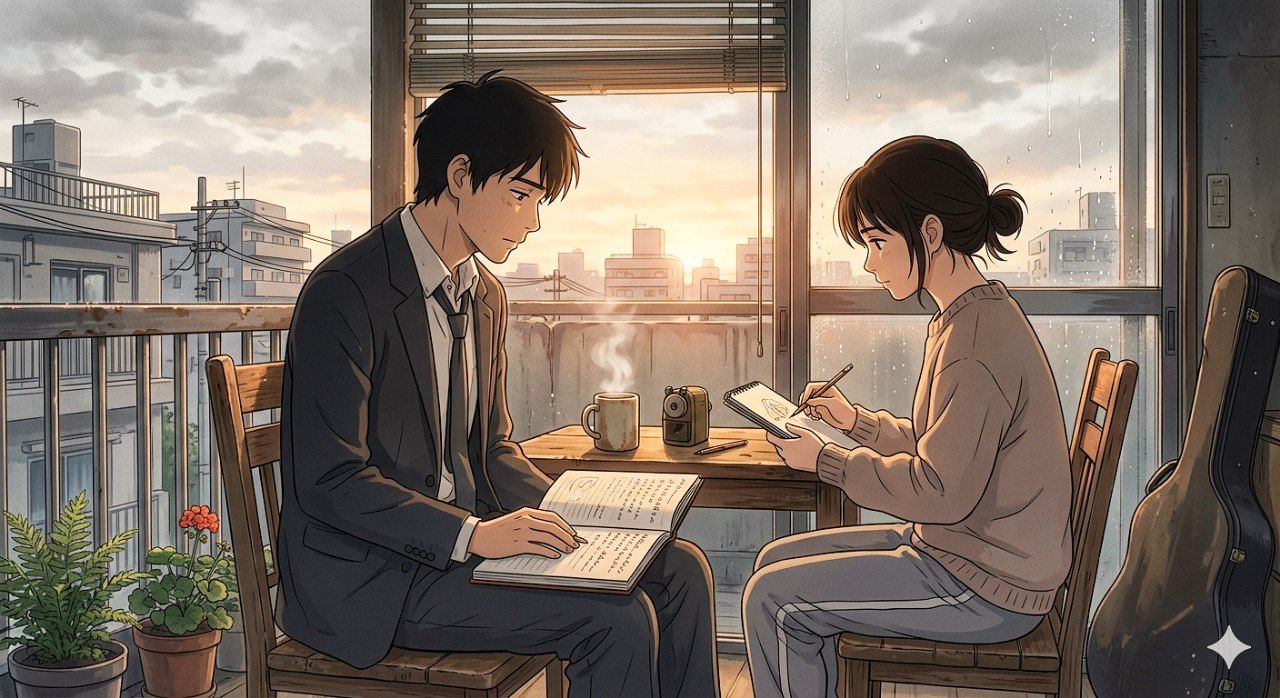
The rain had started the night before and the city woke wrapped in a sticky gray that seemed to cling to clothes and moods. Marcos woke with the usual feeling that the day had already happened: the hours had memory and that memory was impermeable to novelty. He sat on the edge of the bed, feeling the weight of the blanket over his legs. On the nightstand, the alarm clock ticked eight with a mechanical tic he had learned to respect like a liturgy. He turned on the light and, before getting up, looked at himself in the mirror: his face was neatly shaven; the dark circles were present; his gaze professionally contained. He was the kind of man whose outward appearance obeyed precise expectations: punctuality, correctness, discretion. “Is something wrong?” Clara asked from under the covers, her voice between sleep and waking. “Nothing,” Marcos replied, that word wrapped in softness to avoid uncertainties. He put on his shirt and tied his tie with the automatic gesture of someone who has performed that ritual for years. Clara went back to sleep. She knew Marcos’s silences, those folds in time where he no longer offered explanations because he understood no explanation would fully match the intensity of the void that pierced him. On the subway, Marcos let the train carry him by inertia. Stations were stations in every sense: stoppages of body and mind. Outside, the city ran in fragments: luminous ads, orderly shop windows, people with tight steps. Faces were maps of strangers; no one seemed to look for real. Marcos thought of a line he had read days earlier in an old biography: “You can have a ‘normal’ life, do what you’re supposed to do, fulfill everything... and still feel a void.” The sentence fell on him with the weight that awakens a question that admits no immediate reply: how can a void exist within a day that, to others’ eyes, is perfect? He arrived at the office and passed the reception where Rosa, always impeccable, greeted him with the milimetered kindness of someone who manages other people's emotions. “Good morning, Mr. Galván. Coffee?” she asked with a smile that looked painted on. “Please,” he said, returning the courtesy. He drank the coffee as one makes small decisions: believing they help sustain a continuity that would otherwise fray. The day passed as a succession of assembled elements: calls, emails, presentations. Marcos fulfilled his duties, and he did so well; his work required precision and he offered it without concessions. Every completed task was one more token placed on the board of duty. Outwardly, everything operated with the necessary sync. Inside, however, an oppressive monotony loosened him into a kind of void that was not physical but ontological: not because something external was missing, but because he could not find meaning. During the afternoon, in a meeting, he found himself looking at his colleagues: faces tuning their listening by professional commitment, hands writing without reading, smiles of programmed support. He wondered if everyone knew they were repeating. When he returned to his cubicle, Teresa, his coworker, noticed the pallor of his skin. “Are you okay?” she asked with an interest that mixed kindness and responsibility. “Just tired,” he replied. But the tiredness she referenced was different: it wasn’t lack of sleep or physical wear; it was the fatigue of someone who performs movements without understanding their purpose. Teresa nodded and returned to her screen. There are pains people prefer not to comment on so as not to open doors they might not be able to close. Night found Marcos and Clara in silence. She made two cups of tea and set them on the table carefully. On the television, a show played that neither watched attentively. Clara, a freelance illustrator, had noticed the slow vanishing of Marcos: the abandonment of spontaneous laughter, the inclination to answer with monosyllables. They had tried, occasionally, to recompose intimacy with outings or dinners, but repetition infiltrated everything. Clara opened a drawer and took out a postcard that belonged to a family memory: the image was a black-and-white sunset and, on the back, a note from Marcos’s grandfather about his decision to leave the office at fifty and hit the road with a backpack and a notebook. Marcos took it with near-tenderness and read the inked words: “Living consists in choosing not to conform. Don’t conform without first trying.” She reached to touch his shoulder. “Did I ever want to write?” she asked quietly, not seeking answers but calling a witness. “You said it,” Clara answered, with that tone that mixes memory and soft reproach. “I remember. But you also said you preferred security.” “Security is a word that sounds good until they ask whether you would pay it with your peace of mind,” he said, trailing off. They laughed to conceal the laughter. Sundays became capsules of repetition: shopping, cooking, watching a show, sleeping. A succession of actions that, though different as routines, did not differ in their deeper sensation. One morning, tired of repetition, Marcos walked to the neighborhood park and sat on a bench, watching a child run after a kite that vibrated with joy. That raw energy made him envious beyond pretension. He thought children had a direct relationship with things: they played because playing was clear, not because it produced social return. Adults, by contrast, carried a repertoire of obligations that often neutralized intensity. While he reflected, Julián appeared, an old university friend, with a guitar slung over his back and a barely kept beard. He sat beside Marcos as if time had not drawn distances. “Marcos!” he exclaimed with the enthusiasm only those who resist domesticating life under formality keep. “How are you?” “Getting by,” Marcos answered, smiling with that mix of truth and evasion that accompanies socially polite replies. Julián opened the guitar and played a simple melody that sounded like summer. He paused and then spoke. “I left for the road for a year,” he said. “I needed to see if I could still follow myself at a different scale. The city squeezes us and teaches us to comply. I wanted to see if I still felt urgency to create.” “And did you find anything?” Marcos asked, as if asking for instruction. “I found questions,” Julián replied. “But I also found gestures I don’t try to justify: writing, playing, learning a craft that returned the feeling of doing something for the sake of doing it. I decided not to keep repeating without thinking.” The word “decide” rang inside Marcos with a force that startled him. He remembered a passage by Albert Camus he had read, one that kept returning: Camus did not say that it disappears. He said something stronger: you must decide... whether to keep repeating without thinking, or to face that void and build something that truly matters to you. It was a call to action, or maybe an accusation. Julián added: “It’s not romantic, Marcos. It’s violent. Deciding implies breaking ties: social, economic, emotional. If you make a serious decision, everything changes.” “And if I lose everything?” Marcos murmured. “What if by choosing I end up alone?” “If you lose some, then maybe they weren’t cornerstones of your life but part of the set dressing,” Julián said without softening the phrase. “And if you lose something real, then maybe you hadn’t gained enough to risk it.” The conversation unfolded in fragments—university memories, choices their friends had made, travel anecdotes. When they said goodbye, Marcos felt a restlessness he hadn’t felt in years: the sense that his life could take a different hue, though he didn’t yet know how. That afternoon he went to a bookstore and bought a hardback notebook he had been watching in the window for weeks. He paid for it and held it like someone buying a tool for a work that had no blueprint. At night he left his briefcase where he always did and, instead of turning on the TV, he opened the notebook. At first he wrote disconnected things: lists, notes, fragments of dreams. Nothing seemed promising. But as he stopped trying to write “something” and concentrated on jotting down what hurt, he began to find a line that connected him to a material that was not only his: tales about people who obeyed schedules and forgot motives; stories of those who outwardly fulfilled all the norms of normality and inwardly accumulated deep estrangement. Clara noticed the change: the notebook on the table, the more attentive way he looked at sunsets, the afternoons he reserved to wander without destination. It was not immediate or linear. There were misunderstandings. She feared for financial stability and the future. She worried that a search for meaning would turn into an escape from responsibility. Marcos wanted her to understand that the decision was not a trend but an urgency. One night they spoke at length about their fears. “Are you going to leave everything?” Clara asked, voice steady, not accusing but seeking a map to accompany him. “I won’t be reckless,” he replied honestly. “It’s not about running away but choosing. I don’t want to lose what we have. But I also don’t want to keep acting as if compliance were the only way to live.” They made promises less grandiose and more concrete: set aside a weekly writing slot; schedule time to review finances; try to keep material security without letting it become a prison. They decided to be pragmatic with poetry: create conditions so the demands of daily life wouldn’t erase the desire to create. The following days were full of small experiments and stumbles. Marcos took an afternoon off to attend a writing workshop at the municipal library. He hesitated at the door: the room was full of people of all ages; some with luxurious notebooks, others with loose sheets. He listened and learned techniques about rhythm and point of view, but above all he listened to stories. Beside him, an older woman recounted losing her job and feeling invisible; a young man read a chronicle about his first job and the loneliness it produced. The voice Marcos found wasn’t a sudden revelation but a web of small certainties: other lives breathed the same repetition and yet had something to tell. At work, reactions to his change were uneven. Some superiors looked at him with the benignity reserved for those going through a passing crisis; others noticed a different energy and offered new projects. Teresa reminded him, practically, that deadlines don’t take vacations, and he agreed, setting a condition to try to balance his time. Corporate life functioned like a machine that tolerated no prolonged stops; thus the decision had to combine boldness and foresight. Marcos began to plan: reserve hours weekly to write, keep his duties, and arrange agreements with his partner to maintain economic balance. The void didn’t vanish overnight. There were nights when repetition returned with force: the temptation to watch TV until late, the ease of consumption as anesthesia, the feeling that his writing didn’t amount to anything. There were also luminous days when words came clear, and those moments served as fuel. The decision became a continual practice, not a singular act: to face the void meant accepting it would return, but this time he would have tools to respond. One afternoon, one of his stories was selected for reading at a small cultural venue. The audience wasn’t large—twenty or thirty people, chairs close, warm air. As he climbed the small stage, María, the organizer, gave him a reassuring smile. Marcos read with a trembling voice at first, then with steadier firmness. His story spoke of a man who fulfilled everything and, without realizing it, had stopped feeling. When he finished, the applause was modest but sincere. A middle‑aged woman approached and told him his story reminded her of her father, who had worked for years and felt lost in retirement. A young man approached shyly and said he had decided to take out the guitar he’d left in a closet. Those small reactions mattered more to Marcos than any large recognition: they were signs that words could cross other people’s loneliness and ignite a small spark. At home, Clara was a patient but demanding interlocutor. There were times when financial pressure felt real: bills, taxes, groceries. They had practical conversations where they had to negotiate schedules, reductions, priorities. It wasn’t easy; the search for meaning required transparency and daily agreements. But Clara, who had admired Marcos for years, became an ally. She didn’t always agree and sometimes fear won, but she chose to support the possibility that her partner needed to build something of his own. Over time, Marcos’s work did not vanish, nor did his office routine soften; what changed was his attitude toward tasks: he stopped seeing them as ends in themselves and began to view them as conditions necessary for other things to happen. Duty, once absolute, became a tool. That gave him relative freedom: he could re-signify daily effort as support for what really mattered. The decision was, in short, a private policy: many small choices that eventually reshaped how he related to his life. The void continued to visit. There were days when fear of not reaching a goal returned with its old force. There were crises in which he doubted his literary abilities and comparisons with others reemerged as an old enemy. He faced criticism that forced him to revise texts and praise that gave him a push. He learned to accept ambivalence as part of the process: doubt did not mean decay but a necessary tension between desire and capability. One Sunday morning, Clara and Marcos had breakfast at the kitchen table. Outside, the sun filtered through the blinds; the house was calm. She set down her cup, took Marcos’s hand, and asked with a mix of curiosity and tenderness that had defined their relationship. “Do you feel better?” she asked. “I feel less empty,” he answered frankly. “It hasn’t disappeared, but it no longer rules my days. There are things worth getting up for.” She squeezed his hand. They knew there was no definitive cure: life offered no guarantees, only continuities and corrections. Deciding wasn’t a single glorious act that fixed everything; it was a string of everyday exercises, sometimes desolate, sometimes hopeful. Camus didn’t speak of the void’s disappearance but of the need to look it in the face and do something about it. Marcos had understood that the key lay in fidelity to a choice: not a sporadic and grandiose choice, but the daily decision not to let repetition erase meaning. Time went on with its mix of annoyances and discoveries. Marcos alternated productive office days with nights of writing and readings in modest rooms. After a year he published a collection of short stories with an independent press. He didn’t become famous; nonetheless, his book found readers who wrote to thank him for putting into words the unease they had not known how to name. Clara continued working as an illustrator, and their bond strengthened through the capacity to support projects and shared fears. Julián still traveled between seasons and friends, but remained close as a witness and support. Marcos’s face showed subtle changes: a less hardened line of concentration, a more forgiving laugh, eyes that lingered on the horizon a little longer before returning to duty. It was not salvation; it was the delicate construction of meaning. He had learned to distinguish what had to be done out of obligation from what merited creative commitment. He understood that life could be an awkward balance between maintaining a material floor and sustaining one’s own project of meaning. The final image is small but clear: one ordinary morning, the couple steps onto the balcony and sits down. The sun is timid. Clara rests her head on Marcos’s shoulder. He closes his eyes for a moment and opens the notebook on his lap. He writes a brief note for a future story. He doesn’t need anyone to read his writing to feel it’s worthwhile. Beside him, Clara sketches with a pencil. They don’t know where it will all end, nor do they have certainty about tomorrow. What they know is that they decided to look the void in the face, accompany it with questions and actions, and hold each other in the work of giving meaning to every small repetition. Deciding, they understood, is not a one‑off act but a practice: constant, fragile, and necessary. And in that practice they gradually found a way of life that, while imperfect, belonged to them. Source of the images. Image created with Google Gemini.
No comments yet