 @mc5punk
Short story: Neon of Tomorrow
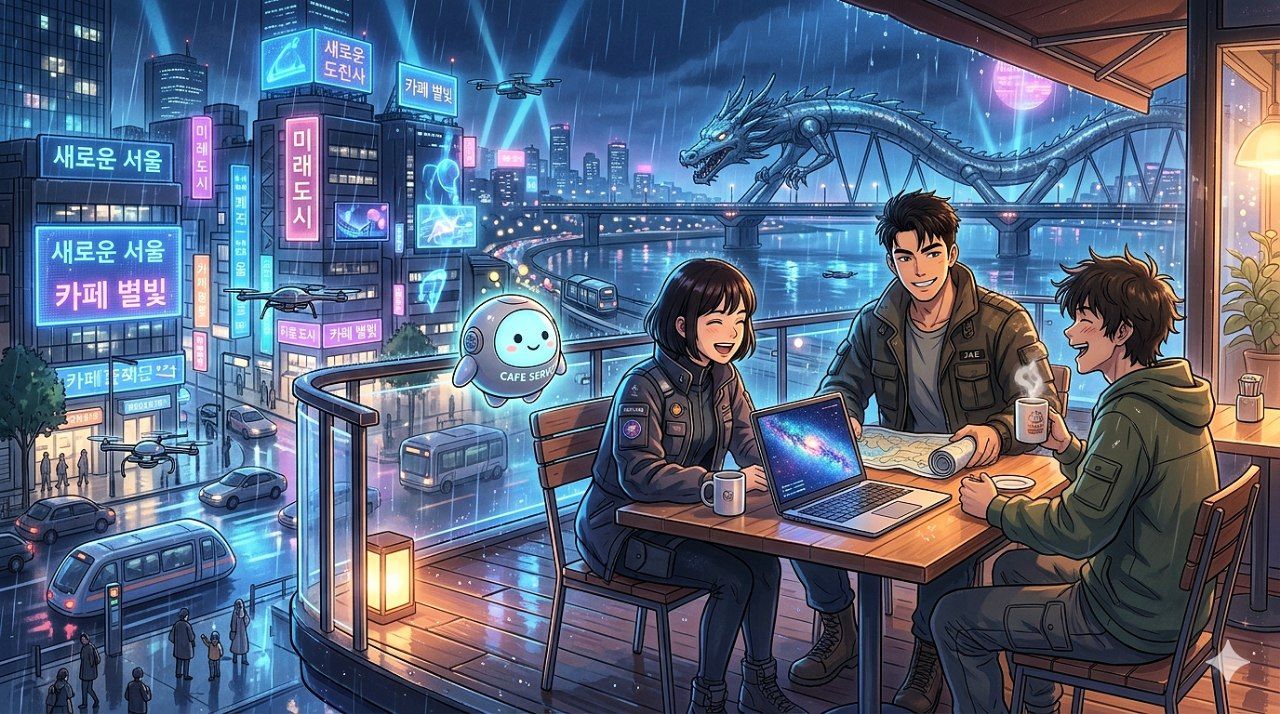
The rain fell over Seoul with the cadence of a futuristic metronome; each drop bounced on the asphalt and exploded into tiny neon lights that slid down the façades like electric frost. On the city’s fifth ring, an orbital café clung to the corner of a transparent building; its floating terrace offered views of the drone bay and the aerial highways. Mina left her laptop on the table — its screen open to a star map full of notes and a blinking little space-dog sticker — and stood to go to the restroom. She didn’t close the lid or hide it under the chair; she simply walked away trusting what everyone who lived there took for granted: the city was, in many ways, more humane than many towns that still clung to distrust. “Don’t take too long,” she said in that half-closed voice friends use when they know the afternoon could fly by in a sigh. Jae looked at her as if trying to hold her in the moment, and Koo remained immersed in a philosophical debate about whether the block’s delivery drone made better coffee than the central machine in the plaza. Embedded in the polished tabletop, a small touch button gleamed. Koo, without thinking, pressed the icon. Service arrived with the timing of choreography. A server appeared from behind a panel that slid open like a curtain of light; she floated a few centimeters off the ground thanks to a magnetic sole that emitted a soft hum. Her uniform was simple, her smile calibrated, and yet there was something in the way she bowed that didn’t seem programmed but learned with care. “Another round?” she asked, and her tone might have been the result of group practice on some morning, but in that moment it sounded warm. “Yes, please,” Mina replied. “And… could you tell my aunt how to connect to the Wi‑Fi? She thinks QR codes are signals from extraterrestrials.” The server nodded while Koo challenged Jae to an absurd bet on whether the space-dog sticker would survive the next urban operating system update. When Mina returned with her cup, the laptop was exactly where she had left it. Her fingers brushed the metal edge as if to confirm the world hadn’t grown strange overnight. “Does trust still exist in this world?” Jae murmured, more to himself than to the others. “This feels like 3026.” Koo laughed. “What’s next? Guardian angels in bulletproof vests?” “Probably guardian drones with free coffee,” Mina replied, and there was less irony in the joke than one might expect: the city had made the fantastic part of the routine. When night fell, the three friends descended a staircase that didn’t need railings: proximity sensors activated a gentle breeze that guided their steps. They headed to the station. The train that greeted them was not the one from old postcards: the cars looked like capsules of silence. The seats were climate-controlled with technology that mimicked hugs; they didn’t just warm or cool, they adopted a contour and texture that made you feel as if the seat understood the fatigue of your day. The train’s Wi‑Fi, accessible with a gesture, had a speed that tested human patience: Mina downloaded an entire season of a show, high-resolution illustrations for a project, and three experimental playlists between stops. “This is luxury,” Koo said, stretching his legs as if the rails were a carpet caressing his feet. “I feel like my shoes are in an elegant sauna.” Jae, eyes fixed on the urban landscape passing by like a projection, smiled. “And yet there are things screens can’t catch,” he said, holding the star map open on his laptop. “That I can leave this here and not lose it is an act of faith in something I can’t name.” The train’s advertising screen, which usually showed interactive ads, transformed without warning into a luminous door. A voice announced in a friendly tone, “Attention: Surprise event at Hanbit Station. Reward for civic cooperation: augmented reality experience.” A holographic map floated before them, marking a route through the city dotted with small challenges: riddles, community encounters, tasks that celebrated collaboration. “Free adventures and no tipping,” Jae exclaimed, eyes alight. “Shall we go?” Mina grabbed her backpack, consulted the old map she had bought from the neighborhood elder that morning, and nodded. The plan was simple: follow the signs, let the city guide them, and see what kind of surprises a metropolis many described as “living in 3026” would offer. The first challenge led them to a tech-covered café where every table had its own button — a detail already ordinary to them but dazzling to any traveler. They pressed it and, as always, the response was immediate: a server arrived with a selection of drinks, explained patiently how the house’s compostable bags dissolved gracefully, and gave them an origami miniature that unfolded into a flower when touched by moisture. “Why doesn’t anyone shout for the server?” Mina asked as the steam from her drink formed tiny constellations in the air. “Because we decided it’s nicer to request with a gesture,” the server replied. “And because our solutions are designed to respect people’s space.” The three followed the map through alleys draped in luminous vines to a night market where vendors sold traditional souvenirs next to pods of vegetables grown in buildings. There they met an old man who, for pleasure, sold paper maps: time-stained sheets marked with routes that no app showed anymore. His stall was a memory bank; his maps, though fragile, were full of promises. “We don’t accept tips here,” the elder murmured when Mina, unexpectedly nostalgic, tried to slide a coin into his palm. “The gesture is understood differently. If you want to help us, take one of these maps and share a story. Give time, not money.” Far from sounding moralizing, the phrase had the simplicity of someone who had seen enough to choose a truth that doesn’t wound. Mina took a folded map, its yellowed paper traced with winding paths like customs, and tucked it into her bag as one preserves a relic. The night unfurled and the city opened like a book of magical realism. They crossed a floating garden integrated into the cornice of a skyscraper: suspended paths above the city where bioluminescent plants sang when the wind touched them. Near the garden’s heart stood a bridge guarded by a massive metallic dragon — an old piece refurbished — that functioned more as a curator of riddles than a hostile guardian. To cross, one had to answer a question that mixed logic with empathy: “If you protect something valuable, what do you choose: to lock it, to share it, or to transform it?” “My answer would be… to transform it,” Jae proposed emphatically. “That way it adapts to those who come after.” “I’d say share it,” Koo countered. “But not as we do today: share with intention, not out of obligation.” Mina thought of the elder’s paper map and the laptop she had left at the café. She thought of the servers who arrived at the touch of a button and the elder who refused a tip. She looked at her two friends and knew what her answer would be. When she spoke, her voice was brief and clear: “I’d protect it by transforming it so others can care for it.” The metallic dragon spat sparks, played a melody, and finally bowed its head. The bridge’s plates retracted and the passage opened. People of all ages began to cross: students with backpacks full of projects, elderly women with woven bags, couriers who knew every wind shortcut. In the improvised exchange on the bridge, a small community formed: an engineering student couple offered a fix for a loose railing; a dancer improvised a tiny performance to ease a tension between two travelers; a night courier with a bike that seemed to surf the air lent an extra battery to a musician who needed to recharge a synthesizer. Each encounter taught a lesson: fixing together was faster than imposing; asking proved more effective than assuming. When the final stop on the map led them to a hidden café inside an old refurbished building, they found a blend of tradition and progress. The baristas there worked with century-old techniques aided by instruments that regulated extraction temperature with surgical precision. Nobody accepted tips; instead, a gentle, ceremonial system allowed customers to leave an electronic “note of gratitude” that the barista read aloud and whose essence merged into a cloud of recognition the staff shared as daily motivation. “It’s strange,” Mina said, watching the ritual. “Before, tipping was a way to correct wage injustices or thank exceptional service. Here, the gesture is something else: a form of public recognition that reinforces the dignity of work.” “It’s like professional pride became part of emotional salary,” Jae added. Koo allowed himself a quiet moment. His eyes seemed to capture something no phone screen could show. Then, laughing softly, he said: “And yet, some things never change: the laugh after a coffee mistake is the same in any century.” Exiting the secret café, they encountered a digital mural that depicted the city as a living organism: beats of light rising and falling with the hours, routines coded as constellations in motion. The three stopped to watch, feeling both tiny and connected. “2026 that feels like 3026?” Jae said playfully. “Yes, but with paper maps, riddles on bridges, and baristas who don’t accept tips.” “And guardian drones that remember your favorite coffee,” Koo added, picturing a machine that would pull up the order you’d placed yesterday the moment it saw you. “And people who choose not to confuse efficiency with coldness,” Mina said, closing her laptop and slipping the elder’s map into an inner pocket. “Where technology makes us better humans.” As they walked back, they passed a small plaza where a local artist projected ancient stories onto a façade; tales of rivers and mountains and the city’s first markets interwove with animations that included testimonies from century-old neighbors. A child approached and, with the innocence that only those raised among everyday wonders have, asked: “Is it true people stop helping when there are too many screens?” Mina looked at the child, then at her friends, and for the first time that night answered without irony. “It depends on us,” she said. “If we use technology to shut doors, maybe. But if we use it to open paths, then no. Here, many people chose to open.” The child nodded, satisfied, and ran toward a group making ephemeral constellations with flashlights. The city kept its pulse: trains, lights, conversations that began and ended like small urban constellations. Mina, Jae, and Koo walked slowly to their favorite spot, a lookout where they could see the mesh of aerial routes and neon reflections on the river. They sat on a warm edge — a heated bench that felt like an embrace — and silently watched the view. “Do you think we could bring this to our homes outside the city?” Jae asked finally. “Not as an exact copy,” Mina replied. “It’s not about replicating every button or drone. It’s about carrying the idea of trust, the habit of collaborating, and respect for people’s work.” “And paper maps,” Koo added with a smile. “Never underestimate the power of a good old map.” They looked at each other, knowing that the night would become a story they would tell often. Not to boast of having been in “Seoul of 3026,” but because they had lived a way of life where speed and efficiency coexisted with rituals that honored dedication and memory. They learned that the absence of tipping didn’t mean the absence of gratitude; that pressing a button to call a server wasn’t dehumanizing but an invitation to respect someone’s time; that leaving a laptop on a table wasn’t naivety but a reflex of shared trust. The city continued to glow. Around them, small stories wove: an elderly woman teaching children how to read a map, a courier calmly fixing a bike wheel, a couple marrying under an arch made of recycled lights. In each gesture lay the trace of a choice: to use the future to preserve what’s valuable, not to erase it. Before parting, Jae pulled out his phone and, without much thought, recorded a short message: “For when you go traveling,” he said, “remember: technology is fantastic when it helps you become a better person. Here, we use it for that.” Mina and Koo smiled, knowing the line might sound cheesy, but also knowing they had proved it that night. They rose and walked back toward the orbital café where it had all begun. The rain again traced constellations on the glass. In the distance, the city’s lights rearranged themselves like pieces that didn’t seek to impose but to fit. And in that delicate balance between the human and the technological, they grasped something simple and profound: the real leap into the future wasn’t just faster Wi‑Fi, climate-controlled seats, or buttons at tables. It was deciding that machines should serve to increase trust, creativity, and generosity. It was convincing an entire city to use innovation to protect and transform the old so stories could remain alive. The night ended with one last gesture: Mina placed her laptop on the café table, pressed the button to call the server, and before leaving left a note on the elder’s map that read, “Thank you for reminding us that treasures are also kept on paper.” Then, smiling, they headed home, happy to belong to a place where 2026 sometimes truly felt like 3026. Source of the images. Image created with Google Gemini.
No comments yet