 @mc5punk
Short story: The House That Stayed in the Air
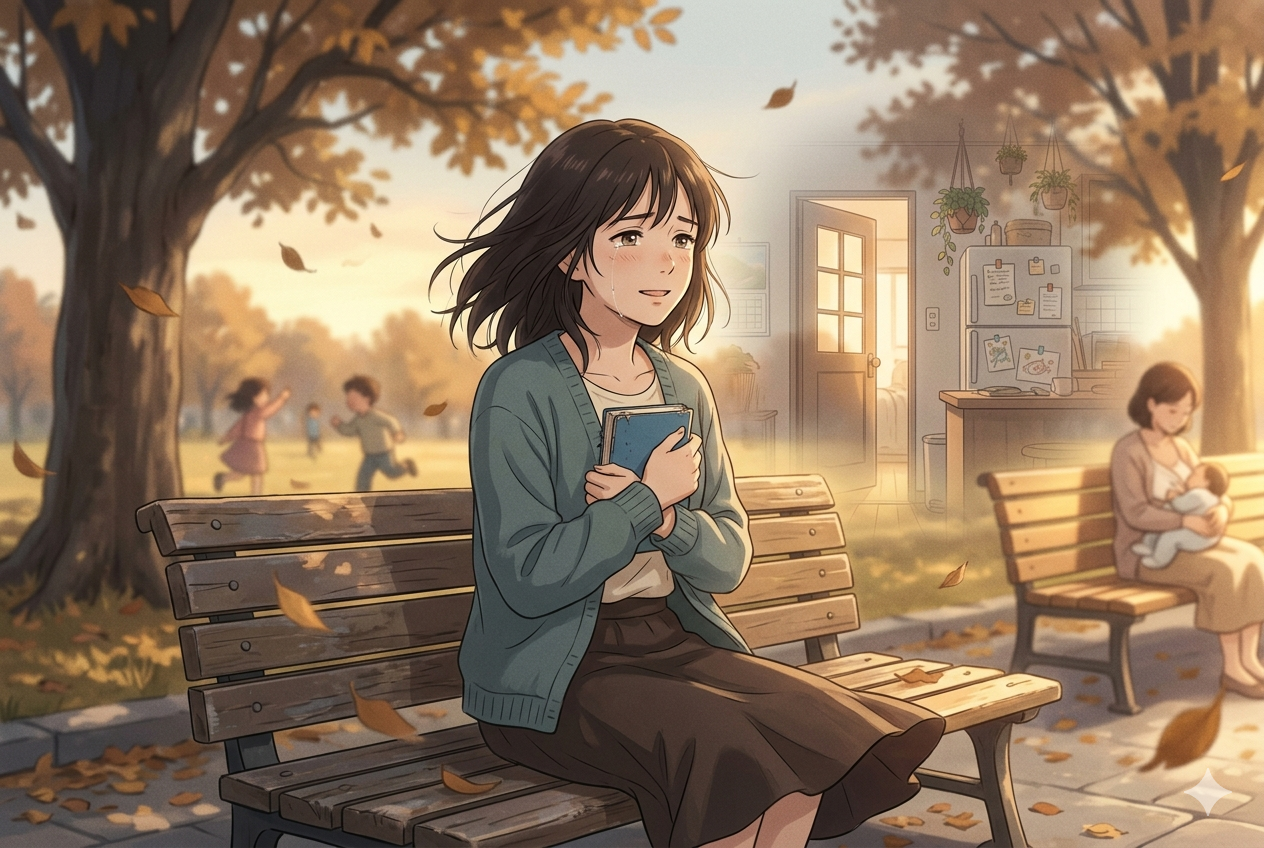
She woke with light stabbed into her eyelids like a knife. At first she thought she was still dreaming: contours were blurred, sounds filtered through a distance that hurt. A clock on the wall marked minutes that did not belong to her; voices around spoke with the tempered calm of those who have waited for the unpredictable. Three weeks, they told her. Three weeks that for her had been seven years. "Where am I?" she murmured, her voice rough from disuse that felt like it belonged to another life. A nurse took her hand carefully, like someone handling old glass. "You're in the hospital. You were in a coma," she replied, letting the words fall soft and steady. "It was a bad blow, but you're awake." When she opened her eyes a memory came over her that seemed to have burned her skin: the warmth of hands that woke her each morning, the smell of coffee drifting from the kitchen, the laughter of children who claimed her with tender nicknames. In her chest beat the certainty of an entire time: a marriage, a home, children called by names that now sounded like old bells. "Mateo," she tried the name aloud, as one attempts to name a ghost. Inside, the answer was as real as a shock. "I'm here," she heard. "You're finally waking up, love." The voice was deep and calm, the same she remembered brushing her forehead in imaginary mornings. Clara left a note on the fridge—she could see her handwriting in a line in her mind: Don't forget to smile. The children demanded attention with the certainty that their mother fixed everything. "Mom, can you come see this?" one of them asked, with the innocence that does not know defeat. In the dream-world she answered with the ease of someone who has duties and promises: yes, right away, I'm coming. She made shopping lists in her head, remembered how she tied one child's shoelaces, the way Mateo placed his hand on the back of her neck when saying goodbye. She built a house of routines: breakfasts with strawberry jam, afternoons of DIY, anniversaries with the same cheesecake that had become theirs by habit. She cried over small losses—a dog that died, a broken pot—and recovered in days, because that imagined home had infinite patience. Her days filled with detail: the texture of a striped tablecloth, the sound of keys dropping into a fruit bowl, the way Mateo called her in a low voice to tell her everything would be fine. Each image settled with the firmness of a truth: she didn't just live those routines, she loved them. That life gave her reasons to get up, to plan trips, to be annoyed by small things, to remember summer dinners with nostalgia. Then opening her eyes to reality was like falling from a tower without a net. The hospital had no labels with the names glued to her soul; the walls were white and cold, and no photograph showed clasped hands or children's drawings taped with adhesive. Around her, smiles were relief, not complicity. "She's coherent," said a doctor who seemed to hold tenderness with effort. "It was a miracle she woke up." "Mateo?" she insisted, searching faces for a map to guide her home. Compassion filled those faces in a way she couldn't translate. No one pronounced that name naturally. A relative took her hand and squeezed it with the urgency of someone who feared losing what they had regained. "You were very brave," a friend whispered. "We thought you wouldn't come back." The gulf between what she felt and what others confirmed widened until it became a wound. Her memories, so vivid, became a film no one else had seen. She tried to describe the house, the names, the couple's arguments about who forgot to pay a bill; she tried to tell of Christmases, of voices, of the way Mateo helped her sew a button while humming a tune. "We don't remember that," someone said softly. "It was a dream, maybe an hallucination caused by the coma." The impact wasn't only realizing her life had been imagined: it was feeling that what she loved was taken from her. That family—the faces, hands, routines—dissolved in an instant, as if a gust had run through the foundations and left them in ruins. There remained a hollow in her chest where memories with names and smells had been; a void that didn't belong to any organ but to the entire architecture of her identity. Hours passed, then days. Medical visits, routine questions, rehabilitation recommendations. A psychologist with papers in hand explained with professional terminology that the mind can create complete realities, that memory is not a faithful mirror but a creative machine that, in the absence of sensory input, fills in stories. His words were competent but sounded distant. "The mind can fabricate worlds," he said. "That doesn't make what you felt any less real, but it explains why others don't share it." She listened, took notes hoping anchoring the theories would help her keep the thread. At night, when the hospital shrank to the murmur of respirators and the light that filtered through the blinds, she wrote letters in a notebook no one would read. She spoke to her imaginary characters as one prays to saints of a private faith. "Forgive me," she wrote in blue ink. "Forgive me for leaving you again. It's not that I want to; they force me to return." In those texts she described Clara's smile with a precision that made her fingers tremble: the tilt of her head when making a joke, the way she bit her lip when cutting a cake, the tiny scar on her hand that appeared when she lifted a teacup. She wrote of routine order, of the children's proud repetition of names, of the smell of bread in the morning. She wrote to keep alive evidence no witness could confirm. When she left the hospital, real life received her with a mix of tenderness and distance. She carried two existences inside: the one others named, with dates and medical records, and the other, intangible and persistent, watching her from within like a guest who refuses to leave. She walked through the city and every similar thing called to her: a little girl with a ponytail reminded her of her imaginary daughter; an older couple on a terrace returned the shape of those un-lived years. Sometimes she stopped at a shop window and looked for the coat she remembered Mateo wearing. Other times she sat on a park bench and watched children run with the blend of tenderness and knife-edge longing that comes from wanting to touch what no longer exists. "Look," whispered a voice in her mind one afternoon, certain as the undeniable. "That's Mateo's coat." The word returned to her mouth as both comfort and loss. People tried to soften her pain with ready phrases. "It was just a dream," a neighbor said while bringing her tea. "The important thing is that you're alive." Those words bounced against the hollow like a stone against glass: noise, nothing more. What could "being alive" mean when she had felt alive in another life with the intensity of someone who loves and takes responsibility? Consolation seemed small against the scale of her mourning: she had not only lost memories, she had lost beings who had loved her and whom she loved with absolute certainty. She continued keeping testimony of what no one could corroborate in her notebook. Sometimes she read aloud as if rehearsing family prayers. "Clara had a smile that started in her eyes," she would say. "Mateo always hummed while washing the dishes. The children used to call us from the balcony when they were mischievous." In the afternoons, when solitude pushed hardest, she cultivated substitutes: a windowsill plant she watered devoutly, the smell of coffee she learned to prepare with the exactness of ritual, a bracelet she rubbed with her fingers when memories assaulted her. They were humble remedies but offered a surface on which to slide her hands and not fall entirely into nothingness. She allowed herself, now and then, to get lost in imagination and inhabit the revived house like someone revisiting a cherished memory: opening the door, feeling the wood against her palm, hearing the steps of someone who would never be in real life. "If you can hear me," she murmured at night, "come back." She didn't seek logical consolation; she sought the return of what she loved. In gatherings with friends, conversations moved through normalcy: plans, work, small confidences. No one asked with the insistence she needed about the names she carried in her soul. There was a sort of awkwardness: others didn't know how to hold what seemed at once madness and tragedy. Over time she learned to live with the double absence with care and a certain tenderness toward herself. She recognized that pain is not cured by will; that losing something you felt entirely real hurts like losing a person. She began to let real life offer her shades: a friend who invited her to dinner and listened without judgment, a support group where other coma and dream stories met and exchanged pieces of a puzzle, a psychologist who went beyond theories and asked about the texture of her memories. "What do you feel when you think of Mateo?" he asked once, with patience. "Nostalgia, and anger," she answered. "Nostalgia for having lost him, and anger because they took him from me without asking." She learned to name her emotions and, with those names, to tame them. She could accept that the heart had been generous and that, even if it existed only in the mind, it had been real for her. That acceptance didn't erase the pain, but it gave it contours: she could now hold the melancholy without being consumed by it. On clear days she walked to the park and sat watching children play. She watched them closely, as one looks for a trace. When a laugh sounded familiar she closed her eyes and allowed herself a moment of pure joy. If someone asked why she smiled for no reason she would simply say: "I saw something beautiful." And she returned home with empty hands but a slightly fuller heart. She knew fantasy couldn't replace real companionship, but she wasn't willing to renounce the seeds that imagined life had left her: the certainty she could love deeply, the skill to care, the capacity to build small rituals that gave meaning to days. Sometimes, in the penumbra of nights when the city seemed to hold its breath, she wondered with reverent fear whether reality itself might be another kind of dream. If so, she told herself, perhaps somewhere there would be a morning when she'd wake again and find the people she had loved. That thought both comforted and terrified her: the chance to recover the lost implied the chance to lose it again. "If this is another dream," she whispered one dawn, "then I don't know if I want to wake up." The doubt remained unresolved, like a bell that rings but does not decide the hour. Living with that doubt taught her to inhabit melancholy without letting it define her entirely. She learned to open her heart to what was near: simple gestures, frank conversations, the company of those willing to stay. She also learned to give time to silence, to faithful memory, and to the notebooks where she kept proofs of her other life. One autumn afternoon, when leaves fell like worn coins, she saw a mother nursing a child on a bench. She approached and sat at a respectful distance, observing with the blend of fervor and defeat that had accompanied her since waking. She felt a stab, then, as answer to an old need, murmured: "Hello." The woman looked up and returned a simple smile. "Hello," she replied. "Beautiful day." For a moment the exchange was minimal but real. She shared, without plan or guard, a short anecdote about a cake she once burned because she fell asleep while baking it. The woman laughed softly; it was a laugh that asked for nothing in return. As she rose, the woman let fall without thinking: "Take care." Those ordinary words supported her more than many explanations. She came to understand that real life didn't need grand gestures to be meaningful; small bridges sometimes appear between strangers. Despite improvement, the shadow of her other life persisted. From time to time full scenes ambushed her: an argument about paint that ended in reconciliation; a child's first day of school and the pride that swelled her chest; a birthday celebrated with balloons and a song everyone knew. In those moments she closed her eyes, breathed, and repeated the names softly: Mateo, Clara—as if naming them restored some existence. The true tragedy wasn't that she had dreamed; it was the intensity with which she had lived it. That intensity followed her like a shadow: sometimes it hurt, other times it held her up. She had learned not to demand answers that didn't exist, but to seek solace in everyday tenderness, in writing, and in available company. On the last line she wrote in the notebook she left a brief phrase, like a wish. "If somewhere they remember us, come back to me," she wrote. "If not, at least leave me the echoes." When she closed the notebook's cover, for a moment she thought she heard, in the wind coming through the window, something that sounded like a familiar laugh. She could not tell if it was memory's trick or the will to feel. She allowed herself to smile, because she had learned that whether the world was dream or not, there was an undeniable truth in her heart: she was capable of loving enough to create an entire universe, and that, painful as it was, was also a miracle. Source of the images. Image created with Google Gemini.
No comments yet