 @mc5punk
Short story: Neon Shadows
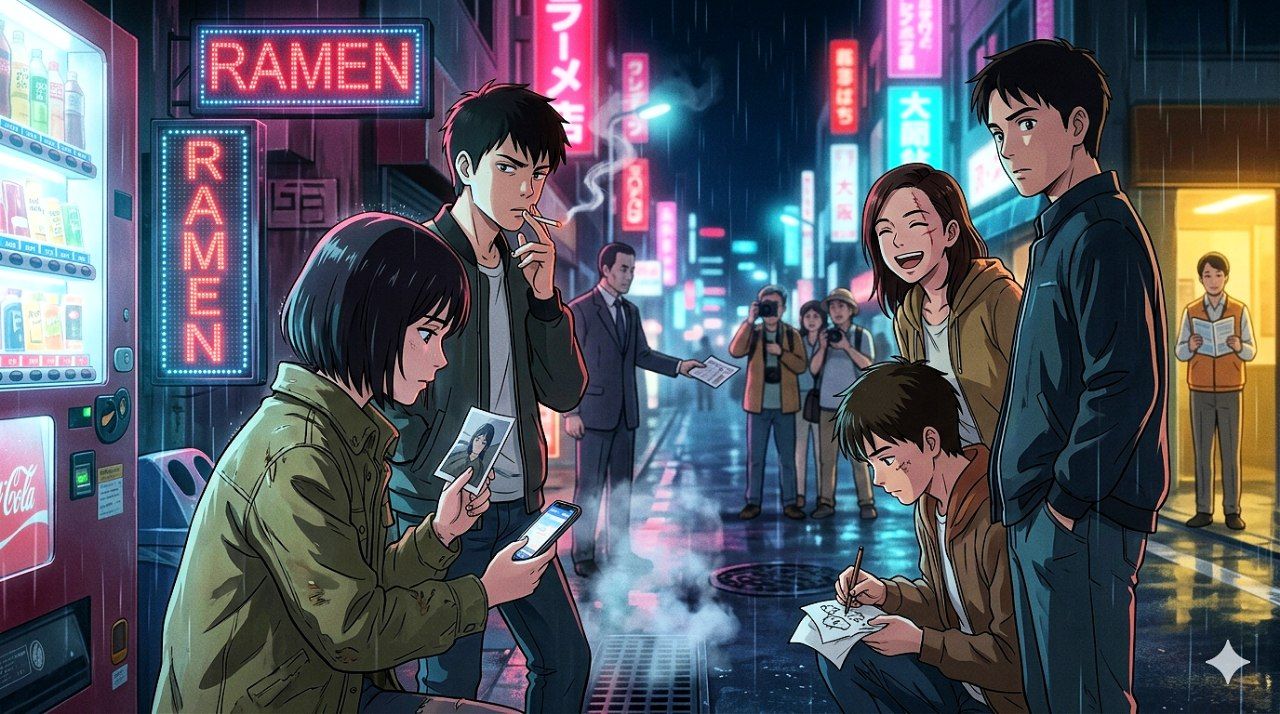
The night in Kabukicho opened like a luminous wound: signs bleeding color, steam tangling around streetlights, and the city breathing with a rhythm that did not ask for names. At a corner where the rain left mirrors, the young people the world—hurried and forgetful through social media—had named the Toyoko Kids gathered every night. Their faces were fleeting frames, their gestures small rituals that algorithms turned into spectacle; tourists and cameras were drawn to that bright aesthetic, unable to discern the skin the lights barely covered. Aiko arrived one afternoon as someone dives into cold water: without warning, with the feeling that there was no other option. She had fled a home where words turned into blows and silences into accusations. The first night she spent on the street, she later recalled, everything was noise: distant sirens, group laughter, the constant murmur of voices that asked no questions. At first she sat on the edge of the platform and watched people pass; then someone offered her a cigarette and a smile without questions. That smile was enough to stay. “Never thought anyone would ask me to stay,” she told Kenji one night, her voice barely torn. Kenji, seventeen, carrying in his eyes the patience of someone who had already seen closed doors, answered while lighting a cigarette with hands that did not tremble: “Here no one asks for papers. Here no one asks you to prove who you are. They look at you, and if they see you, that’s something.” Aiko smiled for the first time in a long while. The smile did not erase the past, but it made it possible for her body to learn to relax a little. Together they settled in a corner beneath a broken LED sign, and over time they added other faces: Rika, with a wide laugh and a scar on her eyebrow; Haru, who spoke little and drew on napkins; and an older boy everyone called Sato, who brought news and advice with the authority of someone who had survived. The group’s dynamic was simple and cruel in its tenderness: they cared for one another as best they could, shared food when there was any, warned if the police were nearby and, above all, offered a sense of belonging they had not had at home. But that shelter was fragile. The city, impersonal, allowed the corner’s loving belonging to also be a display case. One night, while Aiko checked her phone notifications and watched the view count rise on a video of her laughing with Rika, a man in a black suit approached them with the calm of someone offering a solution with a hidden price. “Good evening,” he said, with a voice seemingly crafted to convince. “I’ve seen your videos. You have presence. I work with a venue that looks for boys and girls for events; they pay well and provide lodging.” Kenji tilted his head, suspicious. “What kind of events?” he asked. The man smiled, as if he knew his answer would close the door. “Private events, fashion, companionship… nothing dangerous. Foreign clients come a lot; they need different faces. It’s a good income while you sort things out.” Rika, more pragmatic, showed interest for a moment. “How much do they pay?” she inquired. “Enough to have somewhere to sleep and eat,” the man replied. Then, confidentially, he added: “If you trust me, I can sort it out this week. I work fast.” Sato watched the man with eyes that granted nothing without thought. “Why would you help us?” he asked in a low voice, the voice of someone who had learned favors almost always expectsomething in return. The man made a minimal gesture. “Let’s say I have contacts. No questions. Just a number and a car on Friday.” The day seemed to bring promises. Aiko looked at her phone, the view counter and the comments; the offer presented an immediate way out of the cold. In her pocket, the folded photo of her younger brother squeezed her heart. That night, before accepting anything, Aiko spoke to Kenji in a low voice, almost to herself. “If I go and they help me, do you think I could bring Yuto later?” she murmured, naming her brother. “If they help me, maybe he won’t have to live the same way.” Kenji looked at her with a softness that doubted itself. “If it’s for Yuto,” he said, “I’ve got your back. But let’s not go with anyone. Pretty promises are easy; reliable proof is not.” That remark was enough for Rika to call Sato and ask for time. The decision, however, hung by a thin thread: need versus a sense of protection. At dawn, while the corner vibrated with music from a nearby bar, a figure emerged from the digital net: a direct message offering a “safe” room in exchange for a private session with “specific clients.” The language on the screen was more direct than the man in the suit’s mouth. “Private?” Haru said, eyes wide. “I don’t like words that sound like that.” Sato kicked the ground with his foot. “This is bait fishing,” he muttered. “If someone offers you shelter and money now, the coin has another face.” Tension escalated when, days later, Rika accepted to go out with the man in the suit. She did the mental calculation of someone weighing needs: pay off gambling debts, get soap and a new purse to sell at the night market. She left with a mix of hope and fear. She returned hours later, clothes disordered and eyes hollow, and sat silently with the others. “Was it…?” Aiko asked softly. Rika didn’t answer for a long while. Finally, with a worn voice, she said: “He promised just a talk. They took me to a place with lights that made me want to vomit. They told me if I didn’t do what they asked, there would be no money or room. I paid because I couldn’t think of anything else. Now I have a knot in my stomach that won’t go away.” The group fell silent. No one needed to say it could have been worse. Rika’s experience acted as a mirror: the man’s promise had revealed his truth. From that day, nights filled with small protection rituals: check identities, demand documentation from those offering help—when possible—don’t go out alone, leave notes with strangers about where to go in an emergency. But even the simplest measures were limited against the sophistication of exploitation networks. Recruiters learned quickly: they showed kind faces online, offered seemingly legitimate jobs, sent profiles of “clients” with fake photos and reviews. The youths’ vulnerability, combined with their urgent need for money and shelter, was the door exploiters crossed easily. One gray morning, while the city cleared the night’s dampness, Aiko met a neighborhood social worker handing out flyers at the station. “Hi,” the woman said with a soft voice and a pack half empty from working too much. “Are you okay? I’ve heard there are kids sleeping around here. We have a day center: food, showers, someone who can help with documents and referrals.” Aiko, carrying the habit of distrust, looked first at Kenji and then at the ground. “Will we be charged to sleep?” she asked with practiced coldness. The worker shook her head. “No. We just want you to know you’re not alone. If you want, I can accompany you to an interview.” Kenji leaned forward. On his face passed something the night rarely showed: contained vulnerability. “If we accept, would you help bring my sister?” he asked. The woman pulled out a pen and a smile that fatigue had not worn down. “If there are papers or testimonies to make, the organization can guide. I can’t promise miracles, but I can promise accompaniment.” The possibility of help changed the group’s breath. It wasn’t the empty promise of the man in the suit; it was an official network with hours, registers and names. The difference between them was subtle but vital: one offered speed without guarantees; the other offered slowness with some protection. Still, the path was not straight. Administrative processes, immediate financial needs, the tempting nights of online fame, and the pressure from those offering “quick solutions” with a credit card made some give in. Danger prolonged itself when online visibility grew: a viral video brought tourists and pockets of ephemeral money, but also private messages with doubtful proposals. Virality was a mirror that showed beauty and amplified danger. One rainy night, Kenji found himself speaking with Aiko under a neon that flickered red. “Sometimes I think about going back,” he said without looking at his phone. “Going back to the kitchen where they punished me for being late. At least I knew what to expect there. Here it’s different: you don’t know what they’ll offer you tomorrow.” Aiko looked at him with eyes full of the fatigue of someone who has learned to survive. “Going back isn’t always an option,” she replied. “What would I tell my brother? To go back to the house that beats him? I can’t do that.” Kenji exhaled smoke that blended with the mist. “I don’t mean going back is the solution. I mean… sometimes I miss the predictability of known harm. This is another kind of uncertainty.” As the group’s story spread, the neighborhood community began to stir. Neighbors who once watched with curiosity started speaking in low voices. Some tourists, attracted by the aesthetic, approached with cameras; others left bills or food. None of these actions replaced effective public policy or adequately funded protection networks. The line between solidarity and exoticism was thin: donating a blanket was useful; turning someone’s need into a spectacle was not. One day, local police, alerted by an anonymous call, carried out a check in the area. For many youths, police presence represented a different risk: exposure, possible deportation (in some cases), or separation from the group that gave them some comfort. Sato, who had learned to read authorities’ intentions through rumor and gesture, gathered everyone. “When the police come, don’t run,” he ordered quietly. “Not because we’re hiding something, but because running makes anyone guilty in the street’s eyes. If you speak with them, tell the truth: that you’re here because you had nowhere else.” The intervention was brief. Some accepted to go to a shelter. Others returned to the streets that same night. The cycle, always complex, showed how immediate solutions were insufficient without sustained accompaniment. One dawn, as the first train broke the silence, Aiko sat on the platform and unfolded the photograph of her brother. Her fingers traced it like someone rehearsing a promise. Beside her, Kenji watched the shadowed horizon. “If I go with the worker’s help, do you think I’ll be able to get him out of that house?” Aiko asked, voice unsteady. Kenji took her hand for a moment. “If there’s a real possibility and not a suit full of promises, then try it. You’re not alone in this.” Aiko nodded, with a determination she knew fragile but real. The decision did not erase the night’s melancholy nor the difficulty of the road ahead. But it was a step against drift. In the following weeks, some of the group attended interviews, others found informal work routes managed by local organizations, and Rika, after her ordeal, entered a rehabilitation program and psychological support. Not every story had a clear or immediate ending; some resolved in small everyday victories: a hot shower, shelter for a night without fear, a call from a family member offering apologies and help. Others, however, remained shadows the city would not take on. The Toyoko Kids’ virality continued. New videos appeared; new likes fed the algorithm. But for those who knew the group up close, virality was no longer only shine: it was a warning. The neon lights continued to enchant; the city, indifferent, kept offering spectacles without asking the human cost. And in that landscape, the young people learned to be cautious: not accepting the first hand offered, asking for identities, sharing safety words, not going alone with strangers. The tale of Kabukicho was not reduced to a simple moral. It was the chronicle of a city that offered refuge and danger at the same corner; the story of young people who, while finding belonging among peers, faced a global network of interests turning vulnerability into capital. It was also the story of those who tried to weave a wider net: social workers, neighbors with real empathy, organizations that said “no” to the speed of easy promises and “yes” to the patience needed to accompany. In the final scene of a night that seemed to repeat without end, Aiko stood on the sidewalk, holding her brother’s photo to her chest. She looked at Kenji and said, with a mixture of fear and decision: “I don’t want my story to be just another video.” Kenji watched her with contained tenderness and replied: “Then don’t leave it to the screens. Let’s make someone who can help know and help.” They walked toward the day center where the social worker waited with a cup of hot tea. As they left, the neon lights flickered behind them like a curtain undecided whether to close or open. The city went on, its beauty and cruelty intertwined; the Toyoko Kids remained visible and, hopefully, a little less alone. Source of the images. Image created with Google Gemini.
No comments yet