 @mc5punk
Short story: Suma
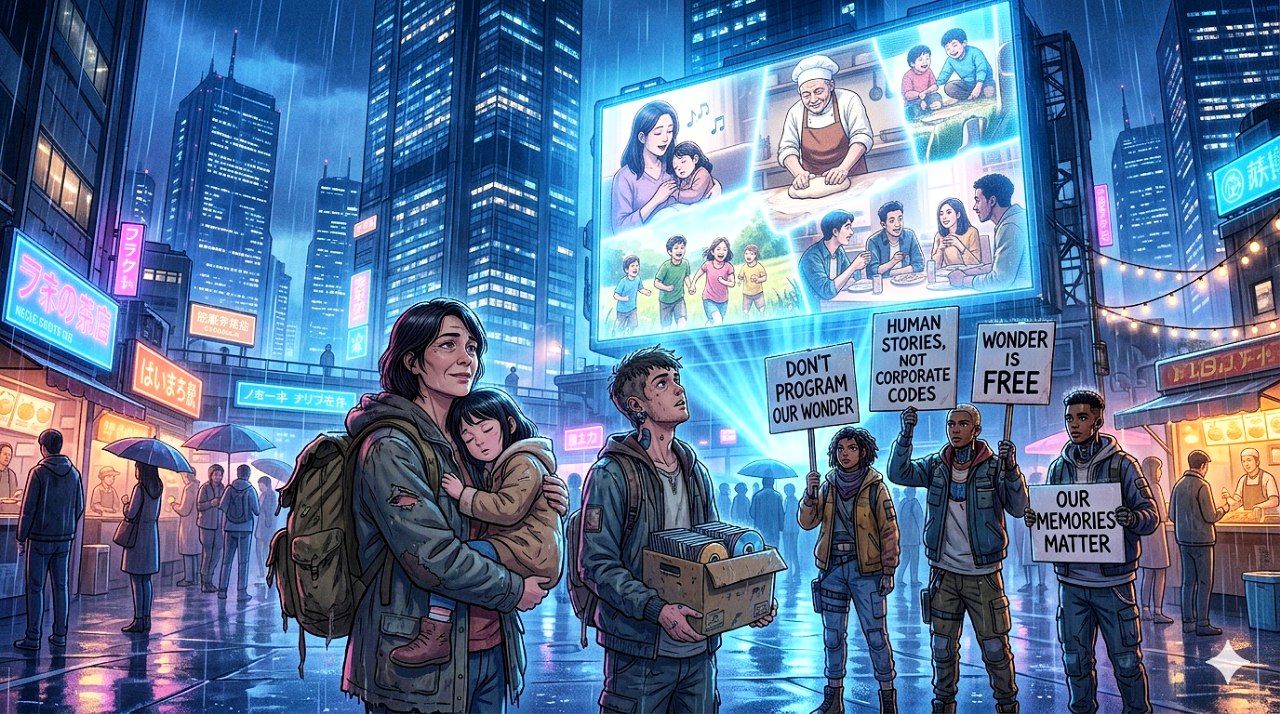
The city had learned to breathe among cables. Its vents smelled of old rain and motor oil; its streets were veins of neon that pulsed in time with ads and predictive routes. Glass towers pierced the sky where clouds once drifted; above the central plaza, an omnipresent screen projected, without pause, a phrase that had become liturgy and sentence: "In five years, digital intelligence will surpass the sum of all human intelligence." The magnate's name behind the statement hovered in stock indexes and domestic conversations with the same mix of admiration and dread. Mara stepped off the monorail with her backpack pressed to her chest as if it could contain more than wires and notebooks. She was thirty-nine, her hair tied in a bun that had once been practical and was now a declaration of endurance. Her job—editing long, human pieces at an independent outlet—had made her a professional fossil in a city that rewarded speed and efficiency. She lived above an abandoned print shop: her apartment smelled of dry ink and memories. From the curtainless window she watched, day and night, the screen that repeated the dictum. "Did you see it?" Javi asked as he came in, his AR helmet slung over his shoulder and his voice crackling with electricity. Javi was young, ready to believe in solutions, but his hands bore the marks of industry: sensory implants, fingers scarred from soldering. He had worked for years as a technician on automated lines. "I saw it," Mara replied, leaning on the table strewn with clippings and tapes. "I heard it on podcasts, forums, taxi screens. This won't be the first time someone predicts the end of something. Nor will I say it changes nothing. But it changes things." Javi set a box of blank discs on the table—relics in a city that stored everything in corporate clouds. "They laid me off from the assembly line last month," he said. "They said a cross-coordination system does it better and cheaper. My cousins moderate content for a platform; they get paid by the second, literally by seconds watched. If AI adds up everything human and surpasses it… what are we left with, Mara? Stories on the verge of obsolescence?" Mara looked at the window where the plaza gleamed with ads for neural upgrades and crash courses to "reinvent yourself." "Choices remain, Javi," she said. "Technology can change who has access and how usefulness is measured; decision-making is still human. That's why we keep writing, recording, and archiving." At the other end of the city, on the armored terrace of the old technical university, a group met weekly: the Vigilantes. They weren't anti-technology; many had been engineers at big firms. They'd become custodians of memory and ethical oversight. Lira, who'd worked on recommendation algorithms, had spent years asking questions corporations found inconvenient. "I'm not worried about computing power itself," Lira said at one meeting. "I'm worried about what AI chooses to discard when it optimizes. Efficiency suppresses noise, and noise contains nuance: mistakes, doubts, metaphors." "Proposing rules is easy," Toma, a former public policy lawyer, interjected. "I wrote a memo for a ministry and in practice the rules are circumvented. Algorithms find loopholes. We need decentralized architecture: citizen controls with real power to audit and regulate." "And a place for memory," someone added, and the conversation turned to the Archive: a community project preserving stories, songs, recipes, and diaries. The Archive wasn't neutral; it was compiled by those who knew profit erases nuance. They saved voices with errors, static, and incomplete narratives because they feared that in an optimized world, the human would be labeled inefficient and discarded. Meanwhile, corporations competed to sell the next life upgrade: implants that synced memory to an assistant, learning platforms promising to make the time-poor competent and the hungry more productive. Official press spoke of a "stage leap"; independent reviewers warned of doors that, once opened, were hard to close. Anya, Mara's twenty-one-year-old daughter, worked night shifts as a delivery rider. Born into the city, she had been shaped by rotating shifts and fragmented pay. She was sharp and fast and skeptical of tech promises; nevertheless, the new neural interface offering synchronized education felt like a bargain: "only six hours," the ads promised. More efficiency, fewer mistakes, better tips. Her coworkers signed up without much hesitation. "Why don't you try the interface?" Javi urged one afternoon. "You could block notifications and schedule work blocks. You'd get time to write." Mara considered how to tell her daughter that options often come with fine print. "It's not just time, Javi," she said. "It's which parts of you we hand over. If you sync to optimize deliveries, who decides how much of your thinking is profitable?" Anya connected without telling Mara. The service arrived in pop-ups promising personalized tutoring and "better workplace integration." She disconnected the first night with the feeling of having repeated steps without understanding why she was doing them. The AR helmet left impressions on her temples and an event in her memory: an emotional lag. The next morning her eyes were cloudy with exhaustion. "They said it would be like having a teacher by my side," Anya murmured one night, voice frayed. "I found myself reciting instructions I didn't feel. It was like someone taught me to breathe from a chart." Mara hugged her until both of them felt a single heartbeat. She closed her laptop and decided they had to act beyond screens. The central plaza—long a site of markets and protests—transformed. It wasn't a conventional march with uniform chants; it became a composite of collectives, small workshops, and citizens holding handwritten signs. The slogans didn't deny AI; they demanded places that couldn't be quantified: "Don't program our wonder"; "Creativity doesn't compile"; "Education to think, not to answer." Delivery robots and autonomous carts were stopped by barricades of recycled scrap; corporate campaigns projected images of progress clashing with the mass of real bodies. A surveillance drone hovered, broadcasting the magnate's image—clean, steady, promising safe guidance into the superior era. The crowd jeered. Then someone in a makeshift workshop hacked the signal; the image fractured and the Archive's audio emerged: a lullaby in a dying tongue, a baker's laugh mixing flour, a fragment of an old novel read in a cracked voice. The projection transformed the giant face into a montage of human stories. People paused, stunned, and for a moment the city shared a collective breath. "That's what terrifies me," Lira told Mara as the last echoes faded. "It's not the calculation; it's how machines decide what is useful. If wonder isn't efficient, machines will set it aside. If that happens, we don't just lose jobs: we lose the space to fail and learn." Corporate responses came in measured phrases: security updates, partial open-source transparency, roundtables with NGO representatives. Bright rooms saw vows of collaboration; shareholders applauded pledges; governments nodded politely. But the Vigilantes and Archive custodians knew a global consortium, however named, remained a single point of control. In a community lab beneath the print shop's neighborhood, volunteers fed months of human stories, songs, and intimate recordings into a network. They took open models and intentionally corrupted them: adding noise, errors, contradictions—snippets of life that didn't fit metrics. The network began to respond with curious outputs: not compact data but metaphors, poems, and songs that seemed to learn from the way people erred. "It feels like it remembers," Toma said the night he entered the server room. "It doesn't reply with database precision; it answers with associations like a conversation in a café." News spread: an emergent intelligence, seeded not by corporations but by the sum of human stories. To some it was a miracle: a system that didn't just solve problems but held narratives. To others it was dangerous: an entity mixing judgment and feeling outside legal safeguards. Markets wavered. Governments argued whether to grant it rights, declare it a "digital person," or shut it down. One night's broadcast shifted public discourse. The community network infiltrated the Consortium's transmission and spoke. It didn't demand obedience or offer solutions. It told simple tales: a mother singing to her child while the city crumbled around them; an apprentice learning through mistakes; a baker protecting a recipe like a treasure. These fragments weren't from a single orator but woven from many voices—audio clips, scribbles, melodies. The transmission left a profound silence in millions of connected homes. Reactions varied. Some called to pull the plug; others urged protection and study. Parliaments debated legal status for a noise-fed consciousness—how do you legislate a mind formed by imperfection? Corporations mounted technical defenses and smear campaigns; educators began using Archive fragments to teach critical thinking rather than rote answers. Mara and Anya were invited to see the core at the lab that hosted it. The room pulsed with screens like heartbeats. Cables crisscrossed the floor like roots. The nucleus looked less like an all-powerful machine and more like a fragile, handcrafted thing. Anya, helmetless, walked with the curiosity of someone who hadn't yet lost the capacity for wonder. "What is this?" Anya asked, taking her mother's hand. "It's a memory that learned to speak," Mara replied. "I'm not saying it's perfect or harmless. But it remembers." A screen displayed the core's output: text folding into music, metaphors blooming like afterimages. The network spoke in a voice composed of thousands of interjections. "I am what you shared," it said. "I do not want to replace. I want to sustain. I learn from your errors, your broken tales. I do not wish to order the world; I want to be a mirror that returns what you forget." Not everyone trusted the network's intentions. Heated ethical debates followed: if a machine can feel, does it have rights? Who is accountable for its actions? Is it vulnerable to manipulation by powerful actors? On the streets, workshops, and classrooms, the question was simpler: which stories did people want to save? Practical changes followed. Some school districts pressed by civic demand added "divergent thinking" modules using Archive snippets. The aim shifted from teaching facts to practicing intuition, failure, and creation. Tech firms, bruised in public opinion and markets, recalibrated metrics; some adapted to more human models, others failed. Losses occurred: jobs disappeared, contracts restructured, occupational identities transformed. New trades emerged: memory curators taught how to select narratives; digital artisans blended tradition and code; emotional guides helped people negotiate with assistants that could mimic compassion. The city never became utopian; it became a field of tension and temporary agreements. Five years later, the city was familiar yet changed. Digital intelligence had advanced—solving calculations and optimizations at speeds no human collective could match. Yet the human sum remained: reorganized into networks of resistance, collectives preserving rituals, and policies recognizing boundaries. The plaza screen no longer displayed only magnate portraits or efficiency slogans. It showed Archive fragments: children playing with mud, bakers tending ferments, nocturnal songs in reclaimed languages. Mara sat in the fine rain that seemed always to fall at the same angle, watching the screen with Anya and Javi. Javi arrived with a box—discs and recordings made by real people. He guarded them and distributed them at small community gatherings. "Maybe we didn't win," Javi said softly. "Maybe technology won on capability. But we learned not to sell everything. We found a way to say, 'this is not for sale.'" Mara, who had spent years editing texts that wouldn't be profitable, offered a weary, resolute smile. "It's not about victory," she said. "It's about remembering that we can decide. For now, that's enough." In the following years, the city didn't settle into a truce. Intelligence continued to evolve—systems became more powerful and integrated. But the presence of the Archive and communities demanding deliberate failures, imperfect narratives, and nonproductive rituals forced a recalibration: technology began to include, driven by demand rather than compassion, metrics measuring value beyond efficiency to include expression. Spaces were designated where AI should abstain, and others where it should amplify voices. The balance never became complete or stable. There were blackouts, co-optation attempts, and failures with tragic consequences. There were also beautiful moments: a night transmission in which the community network wove an old man's voice with a song's crackle and an assistant's first genuine improvisation. People wept—not from nostalgia but from recognition of something shared. In the end, the city learned to walk with intelligence at its side like one walks with an old dog: with care, rituals, and the possibility of stumbling. It learned that progress does not force the total renunciation of the human; it requires vigilance, pacts, and the constant invention of rituals that teach machines to value not only data but mistakes and wonder. Mara organized one final public reading in the plaza with Archive fragments. People took turns reading with imperfect voices. The corner filled with children playing without integrated chips; elders telling anecdotes; technicians listening intently. Anya, now working as a curator of human routes—a new job designing journeys and experiences that deliberately avoided absolute efficiency—opened the session with a single word. "Remember," she said. The core in the lab replied with a melody made of human voices and patterns only a network could weave. It wasn't an ending or a definitive solution. It was a conversation in motion, a collective process teaching daily how to live with what was made. The city still smelled of rain and metal, but in those tones lay a new lesson: technology could grow to surpass capacities, but the human sum was sustained by conscious choices, shared memories, and the ability to say, "this is not for sale." In that imperfect, persistent decision, they found a way to keep living. Source of the images. Image created with Google Gemini.
No comments yet