 @mc5punk
Short story: Echoes in the Silence
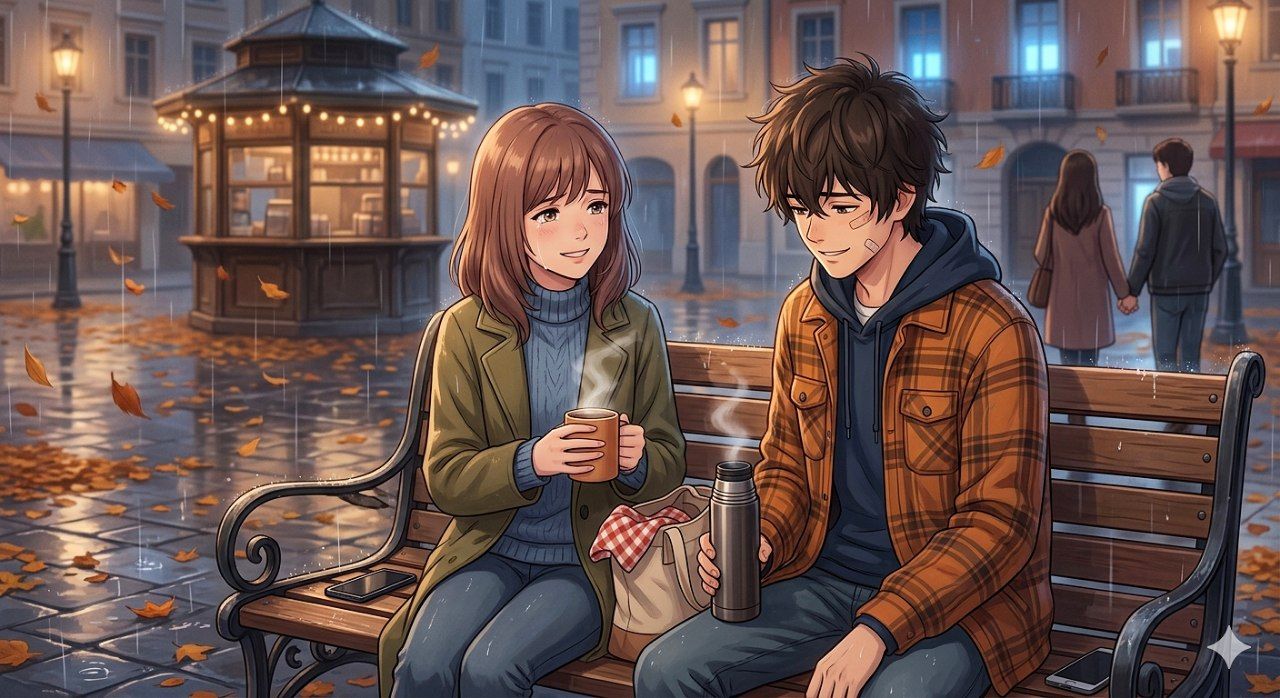
The rain struck Lucía’s bedroom window with an irregular cadence that seemed to want to recall older rhythms: her mother sweeping the kitchen, the glass always set in the same place after dinner, conversations that began and ended without hurry. Outside, the city breathed cold and bright; inside, the blue light from the screen cast shadows she no longer recognized. Lucía (28) lingered for a while looking at the photo on the shelf: herself as a child, wearing a wool sweater, hair tousled by the wind, hugging her grandfather in the plaza. There was a calm in that image she now found hard to reach. Her hand, almost reflexively, reached for her phone. She turned it on, swiped, and got lost among notifications that promised companionship but left a larger emptiness. She closed the app without replying to anyone and placed the phone face down on the bed, as if it were possible to convince the world she did not exist. The phone rang: it was Mateo (31). The voice on the other end carried a familiar fatigue: a voice that had learned to sound whole despite the crack it carried inside. “Are you there?” he asked. “Yes,” Lucía answered. “I’m… trying not to think about a thousand things at once.” “Me too,” Mateo said. “I moved back in with my parents six months ago. I thought it would be temporary, that I’d readjust quickly. But sometimes I feel like I’ve been returned to a stage whose script I no longer remember.” Lucía felt silent compassion for him. “My house is full of things that make noise but don’t say anything,” she murmured. “My father turns on the TV to avoid silence; I go to my room and leave the blue light on. We eat at the same table like two satellites that don’t touch.” “In my case,” Mateo continued, “my mother cooks and calls me to eat. I arrive, sit, eat, and go to my room with the feeling of having fulfilled an obligation that doesn’t nourish me. Sometimes I wonder if my hunger is real or just a badly learned habit.” They paused, searching for words to name something neither fully understood. “Sometimes I think the bonds have weakened like old things,” Lucía said. “There isn’t a dramatic break; rather, there’s a quiet wear. Conversations used to have a thread you could pick up; now the threads tangle in screens and notifications.” “It’s worse,” Mateo replied. “There’s virtual closeness and physical absence. We reply with emojis and make quick calls, but nobody sits and waits for the other’s answer. It’s like we were taught an express version of life: everything fast, everything accessible, yet farther away.” That night, after hanging up, Lucía kept thinking about the word “detachment.” It wasn’t a single cause; it was a set of small erosions. She remembered childhood Sundays when the house filled with voices, smells, and hands. Now those Sundays looked different: everyone in their room, watching stories that didn’t include them. The next morning Mateo called again, more urgent and more sincere. “Would you like to meet at the plaza tomorrow?” he suggested. “The bench where you used to sit with your grandfather is still there, I think.” Lucía hesitated less than she expected. Something in the idea of going out and putting their phones face down felt like the first rehearsal of something unnamed. They agreed to meet at noon. The plaza had changed: the kiosk where they bought ice cream had been closed for months, several lampposts flickered, and fewer children ran with balloons. But the iron bench, paint flaking, remained stubbornly in place. Lucía arrived with a small bag of homemade food; Mateo appeared with a steaming thermos of coffee. Neither held a phone in their hand. “I put the phone down,” Mateo said, a little embarrassed. “I wasn’t sure we could look at each other without something interrupting.” “Me neither,” Lucía replied. “But I guess it’s worth a try.” They sat, and the silence that followed wasn’t uncomfortable; it was hopeful, as if the words were lining up before appearing. They began to speak slowly, cautiously, like people checking a scar. “My doctor,” Mateo said, breaking the quiet, “told me my stomach is ‘dysregulated.’ That my microbiome isn’t right. He asked about sleep, diet, how much I expose myself to the news. He prescribed a diet, probiotics, and therapy. He said anxiety sometimes nests in the body.” “It happens to me too,” Lucía said. “I saw a nutritionist who said there’s a strong link between what we eat and how we feel. They suggested mindfulness, breathing exercises, and returning to certain rituals: eating together, talking without interruptions, taking time to cook with family.” Mateo laughed with restrained sadness. “My mother asked me one day, ‘Why are you like this?’ I didn’t know how to answer. How do you explain that your stomach hurts from a sorrow that has no shape?” “Maybe,” Lucía replied, “the sorrow does have a shape: broken habits, silences that don’t dare to be named, the absence of rites that remind us we belong to something.” They spoke of sleepless nights, of the emptiness that neither the latest recommended series nor food delivery could fill. They recalled, with a mix of humor and melancholy, the childhood games that united them without words, walks with grandparents who listened more than they spoke. “Do you remember Sofía’s grandmother?” Lucía asked. “She always said the body keeps stories the mouth doesn’t dare tell.” “Yes,” Mateo said. “She used to rub the back of anyone who arrived sad. She believed touch said what language sometimes can’t reach. Sometimes I think we lost that: nonverbal acceptance.” In the following days the plaza meeting became a ritual. Sundays turned into screen-free days: shared meals, long conversations, occasional walks. It wasn’t perfect; setbacks were frequent. There were days when the phone regained priority, when anxiety resurfaced, and when old habits seemed easier than change. But the repetition of small acts—a meal without devices, an anticipated call, a spontaneous hug—started to make a subtle but real difference. Families were initially skeptical. Parents asked with reservation: “Why turn off the phone? Aren’t you going to miss something important?” The answer wasn’t immediate; it was a buildup of sensations. Gradually, parents noticed small changes: less tension, longer conversations, more open questions. “My father told me one night, ‘When I was your age, we knew what we wanted,’” Mateo said. “I didn’t answer at first; the phrase carried judgement. What I wanted to tell him later was: ‘It’s not that we don’t know; the tools changed. Back then, the compass worked differently.’” “Maybe the compass didn’t break,” Lucía said. “Maybe what changed was how to read it. Our parents and grandparents had practices we didn’t inherit—not because they didn’t want to pass them on, but because life came with shortcuts and promises of immediate results.” A point that worried them was the sense of purposelessness. Both had felt at times that life lacked a clear engine. Achievements were fleeting, and meaning evaporated easily. “We look for purposes in borrowed places,” Lucía said. “In jobs demanding productivity, in networks selling edited versions of happiness. We were convinced the immediate was valuable and lost the patience to cultivate something lasting.” “I started writing small lists of things that gave me meaning, even if small,” Mateo shared. “An evening walk, cooking for someone, reading with no performance goal. It wasn’t magic, but it helped me remember that purpose is built from simple minutes.” Alongside social reconnection, both sought professional help. Therapy provided tools: identifying patterns, understanding the body-mind relationship, and techniques to manage anxiety. It didn’t solve everything, but it served as a guide to stay oriented. Their digestive health, affected in both cases, was addressed patiently. Dietary changes, fewer processed foods, more fermented foods, exercise, and, above all, less exposure to anxiety-amplifying news. They learned to view the body as an ally that signals when something is wrong. “My stomach hurt less when I started respecting rhythms,” Mateo said. “Sleeping more consistently, eating calmly, walking. Life didn’t stop having problems, but my body stopped treating every tension like a catastrophe.” In Lucía’s home there were quiet, practical changes. Her mother began to ask more and listen without rushing the answer. One night, while washing dishes, her mother said simply: “I didn’t know how much I needed all this until I saw you happy again.” The phrase wasn’t empty recognition; it was the consequence of nights when conversations grew deeper. Patience and consistency, rather than quick fixes, made a difference. Small daytime gestures—turning off the TV during dinner, sitting to hear how someone’s day was, cooking together—recalibrated the household. Lucía decided to study nutrition. Her interest, initially practical, became both political and affectionate: she wanted to better understand the body-mind link and help others recover that balance. Mateo found a job closer to home and rearranged his life so family meals were not an awkward exception but an opportunity for connection. The return wasn’t to an idealized past. It wasn’t about restoring a perfect youth; it was about creating a new way of being together. There were frictions: parents who didn’t fully understand, relapses into anxiety, days when phones ruled again. But the difference was that there was now space to name these setbacks, ask for help, and support each other. One autumn afternoon, several months after they began meeting in the plaza, they sat on the same bench. An older couple walked by holding hands and smiled at them. Lucía looked at Mateo and said: “It’s not a straight line. It’s a map with routes that cross, with roads that disappear and return.” “Exactly,” he replied. “Healing isn’t an individual effort; it’s a collective mission. Not because everyone has answers, but because some can hold you when you falter.” They stayed awhile longer, in silence, unafraid that the lack of words meant failure. Silence accompanied them now; it wasn’t empty but a rest. When night fell and the first raindrops began to fall, they instinctively turned off their phones and went home. Progress continued at its own pace—not flawless, but enough. Some days fear returned strongly; on those days they called a friend, brought each other homemade meals, or simply sat and listened. The small acts, repeated with consistency, shaped a new everyday life. A year after that first meeting in the plaza, Mateo lived on his own again but still attended Sunday family dinners. Lucía, with her new nutrition studies, organized informal workshops on food and well-being for young people in the community. They hadn’t invented a global solution; they had done what was within reach: cared for ties, tended their bodies, and recovered rituals that gave meaning to their days. In the final scene, rain tapped again on Lucía’s window. She and Mateo sat in the kitchen, washing dishes after a shared dinner. The radio played quietly; nobody looked at their phone. Lucía’s mother ran a hand across her daughter’s back and said, with a calm she had never shown before: “I like seeing you like this.” The phrase was simple, and its effect deep. In the silence that followed, Lucía thought about how much life had changed in a year—not because of a sudden revelation but because of a sum of small, repeated decisions. She understood that healing takes time, requires patience, community, and concrete acts. She also understood that responsibility wasn’t only individual: one must re-educate bonds, recover touch, and teach by example how to read a compass that seemed lost. As they cleared the last plates, Mateo said without drama: “We’re not heroes. We just did what we could: get closer, talk, and stay near when one of us fell.” Lucía nodded. “And remember that sometimes the cure begins with something as simple as a hand that doesn’t let go.” They turned off the lights and went to sleep without screens, with the calm certainty of people who know that the work of caring for oneself is daily and shared. Outside, the city kept its relentless pace; inside, a new warmth had been woven from listened silences, shared meals, and the mutual will not to let detachment define their generation. That night, and many nights that followed, they slept with the feeling that reconstruction was possible—not a return to an idyllic past, but the slow, persistent creation of a present where ties, health, and meaning were rebuilt hand in hand. Source of the images. Image created with Google Gemini.
No comments yet