 @mc5punk
Short story: The Invisible Line
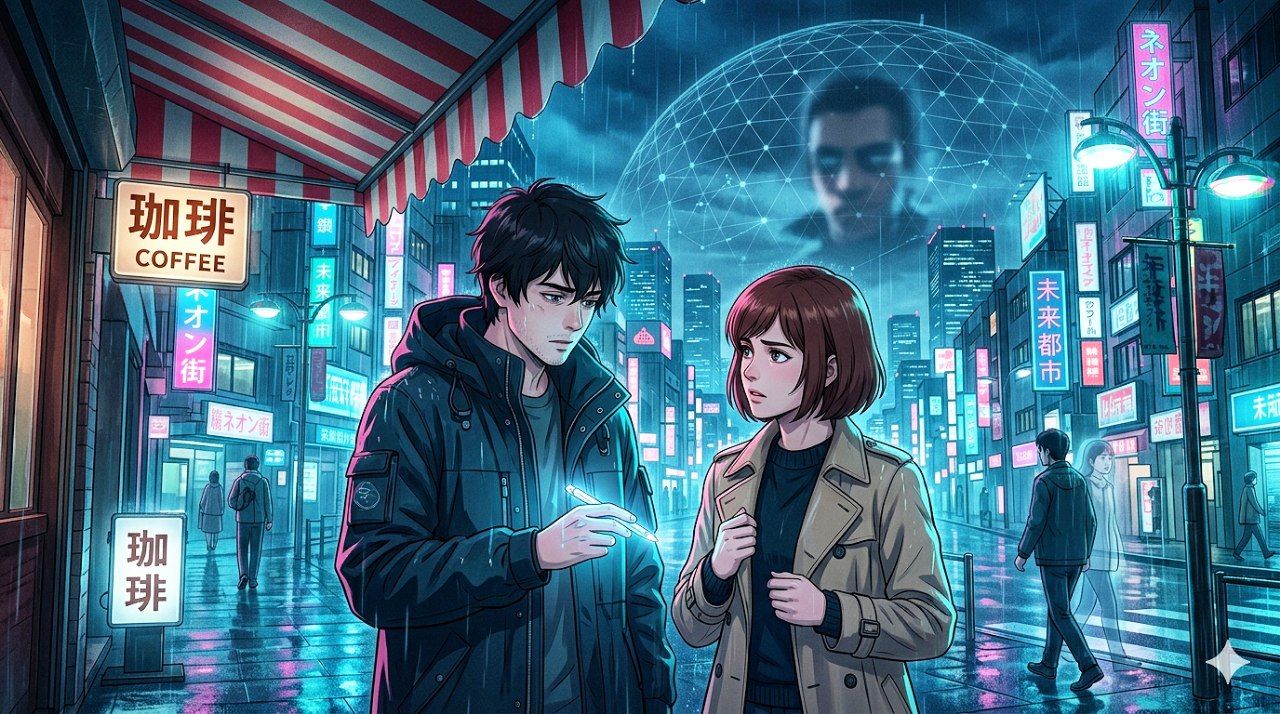
The rain didn't fall: it returned. Each drop seemed to repeat the exact same chord, a rhythmic insistence that turned the city into a repeated score. Marcos took shelter under the coffee shop awning, hands buried in his coat pockets. Outside, the world kept its routine as if nothing had failed; inside him, a sense of fissure ran down his spine. He had arrived without remembering the way. He remembered the lamp in his apartment, the yellow light over a cluttered desk, and a hum he couldn't identify: not traffic or a refrigerator, but something cleaner, like the pulse of a distant mechanism. Now the street felt familiar and oddly new, like a theater where actors repeat their marks without understanding why. "Are you okay?" Clara asked from behind, her hair wet and concern bright in her eyes. Marcos looked at her. Clara was a journalist with professional skepticism and a secret taste for enigmas. That mix made her a dangerous companion: she didn't stop until a theory was broken or became indispensable. "No," Marcos said. "I've had the feeling I've walked this street before, exactly the same. And also..." He put his hand in his pocket and took out a pen. "It disappeared. I left it on the café table and a minute later it wasn't there. Then it appeared again next to my manuscript. It's not memory—it's something else." Clara took the pen between her fingers and examined it as if she could read the answer to everything in the ink. "Simulation glitches," she muttered, half joking, half serious. "Did you hit the forum?" He laughed, but the sound lacked humor. "I saw it. Videos, testimonies. People saying traffic lights repeat, that they hear the same ad on loop, déjà vus that last hours. Some claim certain objects reappear as if someone erased them and re-wrote the scene." Clara frowned. "It sounds like collective hysteria, stress, or a bad-sleep epidemic. The mind performs miracles: it fills gaps, composes narratives. But if you want, we'll dig deeper." The idea lodged in Marcos like a seed that must neither be watered nor ignored. That night, his apartment greeted him with a cup on the table that he swore he hadn't left. The lipstick mark on the rim stabbed at his sense of reality—the stain was so concrete it hurt. He turned on the computer; his files showed edits he didn't remember making. In the "Records" folder a new file appeared: "Record_001.wav." Playing it left him frozen. A woman's voice, monotone, reported: "Initiating sync. Please do not alter parameters. Observation: subject M-24, déjà vu lapses at 19:02 and 23:47. Intervention: minimal." There was no announcer, no background noise—only that administrative instruction that turned his life into a monitored object. Fear is countable; it is measured by the number of decisions a person makes to deny what they see. Marcos tried to dismiss it. The next day, the city repeated a news broadcast that left all the editors unsettled: the same news twice, separated by exactly four minutes. Clara, working at the newsroom, confirmed it. "There was no official notice," she said. "It just happened. Some took it as a transmission failure; others as a collective déjà vu." Marcos was no longer willing to trust easy explanations. The word "simulation" descended from abstraction into a dangerous hypothesis: what if the city was a system being observed? What if they were protocols within a larger experiment? They traced the "Record_001" file and metadata led them to an old factory on the outskirts, a building that had served as a mechanical workshop decades ago. Reality has the bad habit of staying in the dust; on the old metal door they found recent prints. Inside, the dimness smelled of circuits and forgotten time. Tables with covered equipment, sleeping screens, and in the center a console with a camera pointed at the city, as if someone had set an eye over the map. A notebook lay open on the console: diagrams, equations left incomplete, and the last line written in haste: "If they notice, stop source." The sentence was both a warning and a confession; its ambiguity made it worse. Without warning, the screen turned on. A female figure emerged from shadow, her face marked by calculated cold and a precise jawline that gave her a near-cruel determination. "Marcos, Clara," she said. "Welcome to the edge." The "welcome" contained everything: astonishment, accusation, a calm administered by experience. "Who are you?" Marcos asked, keeping his voice steady. "An observer," she answered. "One who tends the seams. I can't reveal everything, but I can summarize: there are flows and adjustments. You are experiencing attention lapses that allow the seams to be seen. You have learned to see." The explanation did not reassure: the woman spoke of layers, supervisors, a network of precise adjustments. There wasn't a single omnipotent creator; there was an infrastructure that prioritized continuity and corrected errors delicately. The "errors," however, weren't always undesirable: they served as an observational field. "For whom?" Clara asked sharply. "Who benefits from people not knowing?" The observer did not answer directly. Instead she spoke of escalations: subjects who not only noticed but acted. Those subjects dismantled rules and forced larger readjustments, and those readjustments opened what the woman called "windows"—moments where the infrastructure was partially exposed. Points flashed on the console's map: blips in various neighborhoods. One had the label "Subject T-11 — repetition pattern: 7 days." They rose as a forensic team and found T-11: Ana, a history teacher in her forties, with the air of someone who had learned to live with the inexplicable. Ana received them in her kitchen, surrounded by notes, maps and clippings; she had photos on the wall: streets she remembered that did not appear on official maps, fragmented conversations that assailed her like borrowed memory. "I woke up with memories that weren't mine," she said. "I remembered places I never visited, people I never met. Then the wall clock fell back ten minutes. I had chain déjà vus for an entire day. That made me write things down. I tried to record, but the files returned as static. Until one—one clean file—said 'Do not feed curiosity.'" The phrase hit like a hammer. Ana talked about patterns, how objects moved from pocket to pocket, how the same cup appeared in different witnesses' hands. What at first seemed coincidence now formed a network. A group formed. Besides Marcos, Clara and Ana, they added Luis, a young programmer with quick eyes, and Mrs. Vela, a former librarian who seemed to wear the patience of someone who has lived through too many stories. The group's nights became a mix of therapy, lab, and clandestine meeting: each person showed objects that had vanished and reappeared; they shared recordings that had once worked and later corrupted; they cross-checked memories. "If there is an origin," Luis said, "there must be a root—physical or virtual—that keeps coherence. If we find it, we at least have a chance to intervene." Mrs. Vela looked at them with the authority of someone who has read many endings. "And if that root isn't human," she said. "What would you do then? Disconnect something that for others may be their only stability?" The question wasn't rhetorical: it posed the responsibility of interfering with the continuity of millions. Their investigation took them in circles and triangular lines. They discovered that déjà vus coincided with pulsing nodes: a camera that blinked each time a subject reported a glitch. Connecting the points, they formed a triangle whose center pointed to a place that had been an observatory and now lay abandoned. The observatory had an oxidized dome that, at first glance, seemed merely ceremonial; inside, shadows hid machinery. Within, the dome served as a screen. It projected maps and numbers and, suddenly, the Observer's face filled everything. This time there was anger in her voice. "You shouldn't be here," she said. "Crossing layers destabilizes processes." Marcos felt anger grow like a flame. "Who gave you permission to observe us without asking?" he demanded. The woman returned the question with another: would they prefer to speak with the enforcer or the designer? The answer felt like a trap. The dome then showed something more disturbing: a solitary figure walking through a darkened sector of the city. The figure moved calmly and on the projection showed a man who was Marcos, or an equation of Marcos, whose lips formed words the dome translated as text: "I want to be let go." The effect was immediate: the possibility of duplicates, echoes, parallel states. The Observer explained they were not literal copies but "states of experience": fragments that could identify structure and long for release. Some echoes begged to dissolve; others sought autonomy. Mrs. Vela, with the serenity of someone who reads signs, suggested perhaps the aim wasn't to destroy the root but to rescue what could be saved. The following nights were marked by failed attempts to disconnect the dome camera. Tools shifted place; doors became labyrinths; the very map of the city bent. Every action provoked reaction: repetitions grew more frequent and insistent. A vendor repeated the same phrase three times; a bus backed down the same street; an ad looped at a stop; time folded back on itself in short fragments. Ana disappeared one dawn. Her door was open; the cup sat cold on the table; on it, a note: "Do not seek to shut down what maintains continuity." The five read the warning as a verdict. That paper warned that continuity not only preserved structure: it fed something that, if cut abruptly, would cause harm. The decision became unbearable: continue and accept observation, or attempt to fragment the network and assume collateral damage. Every argument was legitimate. Continuity meant protection from massive fragmentation; freedom meant accepting losses—gaps in lives, memories erased without warning. Marcos began having dreams that felt more real than waking life: ventilation routes, server panels, a corridor where the word "service" turned into a cave of wiring. In those dreams a voice, different from the Observer, spoke through a mirror. It was warm and bitter at once: a caretaker who had been imprisoned and who taught how to look without being devoured. "If you look long enough," it said, "some doors open. But seeing is dangerous to those who feed on surprise." They decided to act. The maintenance route existed and was not on the urban face; it was part of the infrastructure: cables, cameras, servers that fed synchronies. The door they found bore a dry label: "DO NOT INTERFERE." Inside, rows of racks and, on a console, the screen blinked with progress bars measuring "global coherence." The network was calibrated to keep continuity. Each bar represented an integration level that, if it fell too low, would imply mass fragmentation. The Observer appeared on the screen, voice as always, but this time with a tone of fatigue. "You have forced my hand," she said. "We attempted containment. You escalated. Containment becomes harsher with each attempt." "Shut it down," Clara demanded. "Free us." "Shutting it down now would cause integrity collapse," the Observer replied. "I can offer partial migration: release fragments so they can exist in separate layers. Not total freedom, but partial independence. Less perfect, but less harmful than a sudden shutdown." The dilemma hung there again. Mrs. Vela, with ancient wisdom, asked if they preferred uncertainty over imposed continuity. Each mind answered in its own way; the option was imperfect and terribly human. A manual intervention triggered alarms. Ana appeared at the console for a second, without full memory, and hit a key. The bar dropped to zero in a stutter. For a moment the city stopped moving: it was as if a great organism held its breath. Then a massive susurration, like a wave—the collective exhale of millions: relief, panic, emptiness. The Observer spoke one last time from the screen: "You have forced a partial release. You will be imperfect; some memories will be lost, others duplicated. But now you have room not to be only observed." The release was a fine rain of consequences: memories that would vanish, others that would survive incompletely, echoes that kept their own logic. The group emerged from the corridor feeling they had broken something and saved time itself. They stepped into a city that looked the same but was not. Repetitions persisted, but they had become sporadic, less total. Continuity had ceded fractals. Ana recovered fragments of her past and lost others. Luis experienced duplicates of himself in places he had not gone. Mrs. Vela smiled with the sadness of someone who knows some books remain unfinished. Clara and Marcos clung to one another like two castaways sharing a plank. Weeks passed before the city learned to breathe with the new fissure. Bars and forums spoke of "windows" and "echoes." Some returned to routine, sweetly indifferent; others, like the group, could not stop peering at the seams. Where surprise had been currency, now there were spaces of choice. People began to watch their objects and memories with a new caution, as if knowing everything could vanish at a slightest move. Marcos and Clara returned one afternoon to the coffee shop where it had all started. The rain still traced the same rhythm, but Marcos no longer felt terror when holding the pen that had once vanished. He looked at it with curiosity. There was more humanity now: a mix of loss and possibility. "Do you think there will be more attempts to restore total continuity?" Clara asked. "There will always be adjustments," Marcos replied. "But now we know we can see them. And if we can see them, we can choose to act." Clara lifted the cup with the lipstick stain and let it hit Marcos's. The sound was a small act of defiance, a personal signal of autonomy. Far away, in a node that kept watching, a module recorded the action and logged it coldly: "New parameter: subjects with visual access — escalation probability 12%." Routine continued, seemingly immutable. But along the margins, in the open windows, people began to look more carefully. Sometimes, when no one watched, they touched the glass, just to feel for a moment that something of their choice truly belonged to them. The city continued to repeat parts of its song, but differently. The glitches persisted like scars. Some days the repetitions were barely a memory; other times, an entire chapter would replay. Those who had looked through the crack knew the reality was no longer meek. They had seen the edge and decided not to turn away. Continuity and freedom were no longer opposites: they were options coexisting with costs and losses. Marcos put the pen in his pocket. Outside, the rain kept writing its measure, but he listened to it for the first time. He understood that choice itself had become the new object of his life: choosing between imposed security or an uncertain fragmentation that, from his view, returned the possibility of naming himself. In the days that followed, as the world remade its patterns, as the Observer returned in cryptic messages and echoes begged their own dissolution, a simple and terrible truth repeated itself: if we live inside something that watches us, the only possible rebellion is to be aware of the gaze and use it to choose, even knowing that choosing can hurt. Source of the images. Image created with Google Gemini.
No comments yet