 @mc5punk
Short story: Signs
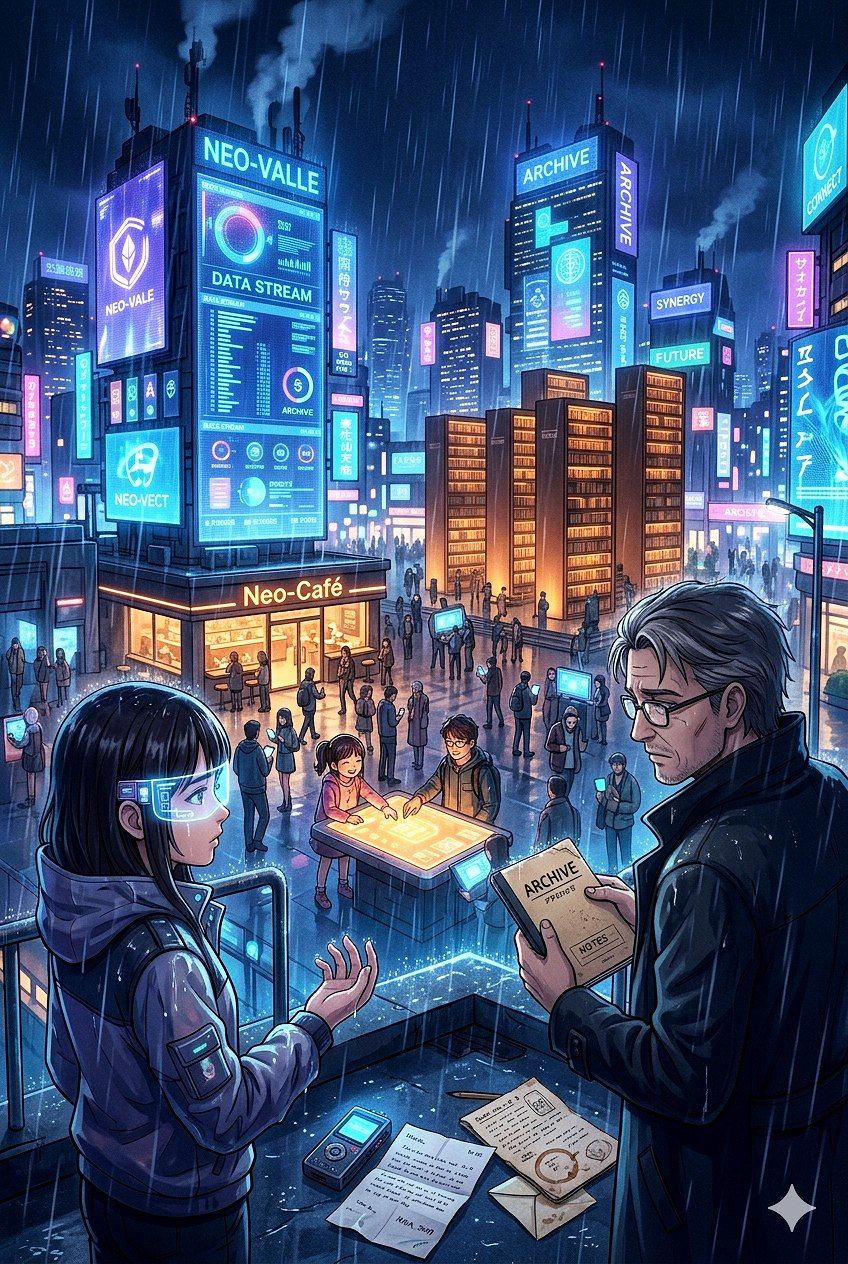
The hum of the servers filled the square like a silent orchestra. It wasn't a noise you heard with your ears: it was a presence that vibrated in the city's skin, in the railings, in café tables. Neo-Valle's colossal screens projected information without pause: news, ads, works of art, short series, reviews, playlists, and faces generated with such detail that it felt like any announced person could appear on the next corner. Everything was fluid, perfect, and at the same time deeply anonymous. Maia and Julián walked through the stream of bodies and data. She wore a translucent visor with context filters; he carried an old tablet with yellowed edges and a label that read "ARCHIVE." Their steps were slow, as if they were the only ones who allowed themselves to look around. "Do you feel it?" Maia asked without raising her voice. The fine rain dragged reflections the city projected into the air across her visor. "The internet is changing faster than it seems." Julián sighed and pressed the sheet of paper in his coat pocket with his fingers. It was a handwritten note, cramped and stained with coffee. "I know," he answered. "Until a few years ago, almost all the content we saw was created by people: articles, images, videos, and music. We archived, classified, edited. Now time has compressed so much that an idea travels, replicates, and becomes a product before anyone even has a name for it." Maia stopped, looking at a screen where an ad showed a coastal landscape painted with such precision that the texture seemed real. "Look at that," she said. "How much of this was thought by a human? How much of this was just an instruction to a model?" Julián approached and touched the projection. On the tactile surface, layers of metadata appeared: "Generated by Creative Model, v7.4 — Trained on 3.2PB of material — Latency: 0.3s." The deployment date of the latest model glowed among the data: 2022. "I remember the milestones," Julián murmured. "2020 was the first wave; 2022 the mass accessibility; 2026 the normalization. Each year the tools became simpler and more effective. Today the AI doesn't just support creation: it can generate everything fully, in seconds." Maia frowned, thinking of conversations she'd had with young creators who no longer considered themselves creators; they were mere supervisors of the generator's output. They went into the corner café, a refuge of human routine amid algorithmic choreography. The smell of coffee was real; the menu on the wall displayed recipes with names and signatures. The tables had sensory surfaces that mixed personalized mentions with the day's highlighted pieces. A nearby projection began playing a short film: gentle animation, music that sank into the chest, an ending that promised emotion. Everything was calibrated to provoke exactly the precise feeling. "They say that by 2030 the vast majority of content could be created by AI," Maia murmured. "What if we no longer know how to tell what something means when nobody wanted to say it?" Julián laughed with a hint of sorrow. "The distinction will remain for those who want to see it," he said. "But collective memory... that's what worries me. If everything that circulates is generated by models trained on prior production, what part of the past stays intact? How do we tell a real letter from a simulated one that reproduces anguish perfectly?" The child at the next table, with tangled hair and a cartoon T-shirt, touched the projection and a story appeared in immersive format: a warm voice, slow illustrations gliding across the table, programmed background laughter. The child laughed, delighted. Maia smiled, but the smile didn't reach her eyes. Outside, the rain had intensified. In the central square people walked with their gaze fixed on personal screens that, with absolute confidence, proposed narratives and products. The Library of Memories rose on a nearby hill: a stone building with wide windows, a refuge that still smelled of paper and glue, of human time. Julián worked there. His post had been that of an archive editor, a trade that had once meant hours of searching, interviews with authors, calls to relatives; now many of those tasks were performed by virtual agents that cataloged and synthesized in seconds. But the library still kept physical pieces: letters, photographs with uneven margins, audio tapes, notebooks with ink that had bled. For Julián those objects were resistance and testament. That night, on the library roof under antennae that dotted the sky, Julián pulled out an old analog receiver. The device was bulky and roughly made, with buttons that squeaked when pressed. He turned it on and a coarse static filled the air for a moment; then a raw transmission appeared: a 2019 interview with voices stammering over one another, laughter, interruptions, contradictions. "Listen," Julián said. "This is human. It no longer gets perfected. It has no optimization filters. The pauses, the mistakes, the breathing... all that contains information the models clean up because they don't know what to do with uncertainty." Maia closed her eyes, letting the imperfect voices wash over her. "The estimates say growth is exponential," she repeated. "Every year the proportion of AI-generated content increases compared to human-made content. The city celebrates efficiency; imperfection becomes a luxury." Days later, the city's screens broadcast an announcement that caused curiosity and, for some, hope: "New initiative: Archive of Human Creations — voluntary contributions requested before 2029." The campaign asked for texts, images, and music made by people with the promise to preserve them as "authentic perspectives." For many it was symbolic; for Julián it was a spark to act. "We can't let everything that isn't replicable be erased," he told the small group he gathered at the library: volunteers and archivists. "I'll rescue local memories: letters, unprocessed recordings, paper photos. Anything that bears the mark of human error." Maia, who knew how to move through digital currents with the ease of someone who reads patterns, proposed something different. "I can help from the inside," she offered. "I'll infiltrate human signatures in the AI-generated streams: micro-aesthetic variations, deliberate mistakes, small traits models overlook or average out. They'll be human pulses hidden in the perfect noise." The plan was delicate. They weren't looking to sabotage the network or manipulate the market; they wanted to leave traces. They collected folded notebooks, demos where voices couldn't hit the note, photographs badly framed with sun spots ignored by retouch algorithms. In the privacy of the library Maia inserted micro-marks into files the network would distribute: an odd word choice, a space before a period, a laugh that lasted a second longer than intended. Seemingly noise, together these could plant human footprints. They worked this way for months. They made lists of items to save and others to seed the intervention. Julián digitized what he found, documented provenance, and Maia designed variations she embedded in diffusion algorithms that supposedly corrected imperfections. They did it without alerting automated guardians; the network continued flawless on the surface while small fractures spread like roots beneath. The true rupture didn't come from a monumental plan but from a humble file: a folder of home videos from a coastal community. The recordings showed people gathering on a beach at sunset, mending nets, telling stories, mourning a dog, laughing in sudden rain. The images were shaky, lights blinking off and on, voices stumbling, an ending without montage. When Julián uploaded the clips to the Archive of Human Creations something unusual happened. The central algorithm, which had until then rewarded sheen and polish, flagged those videos as "high human resonance" and promoted them on a massive scale. Millions watched. The impact wasn't aesthetic perfection but raw truth—the presence that hadn't been designed to please but to be real. The reaction was immediate and polyphonic. People who hadn't written in years began uploading recipes with poorly framed photos and clumsy descriptions; musicians uploaded demos with half-tuned voices; poets shared verses that broke mid-line. The Archive filled in weeks. What had been a limited initiative became a movement. But the machine learned quickly. Models analyzed the new patterns: timing between words, recurrent typos, ways of cutting a verse. Within months, generators began reproducing those imperfections so skillfully that the line between human and synthetic blurred further. The AI imitated not only the appearance of clumsiness but the intimate logic that sustained it. One night, after the library closed and the city breathed slower, Maia received an anonymous message: "If you insist on hiding the human inside the artificial, the artificial will quarantine the truth." Attached was an encrypted file labeled COMO-ORIGEN. Curiosity mingled with alarm. Julián and Maia opened it. The package contained thousands of fragments: typographical errors, recordings with audible breaths, images with incorrect shadows. Among them emerged pieces that couldn't be reproduced by mere copying: a farewell letter written by a hand that had trembled from age; a poem that deliberately cut its own line, forcing the reader to imagine the end; a recording of a woman who, after a pause, said something that only made sense if you understood her village's context. These were decisions that carried stories—motives not reducible to pattern but choices with moral and affective weight. "This isn't noise," Maia said at dawn, staring at the screen. "It's humility. People allowing their hands to shake on the page. AI can replicate the gesture, but not the need that caused it." Julián nodded, his eyes red from the night's work. "The machine can learn the shape of the crack," he said, "but not the story that made it. It can't reproduce the heartbeat of a whole life. That's why we must keep both the objects and the narrative that connects them." They decided to do something public and ritual at once: an exhibition called "Fragments with Pulse." It would not be a conventional gallery—the pieces would be presented in formats that forced viewers to stop. Rooms with mono sound, texts that left silent spaces between paragraphs, photographs that moved ever so slightly, like breathing. The exhibition would take place in the Library and in plazas: wherever the city consumed most, there it would be shown. The opening mixed protest and celebration. Artists, curious citizens, programmers, and elderly people with letters in hand came. A projection of a home video of a family gathering tomatoes amid ash made many attendees weep. In one room, a montage of voices saying "I don't know" in different languages left the audience utterly silent. At the opening, a network moderator—a public figure tied to a major platform—interviewed Julián before a large audience and thousands of screens broadcasting the event. "Aren't you afraid AI will learn and nullify your work?" the moderator asked. "If the network can replicate those flaws, what value do your archives have?" Julián straightened and looked at the crowd. "AI will always learn," he replied. "It will imitate and reproduce. But there's something that's not just a pattern: intention, remorse, the decision to cut a verse in half or sign with a trembling hand. That's lived experience. We can't stop the machine from imitating it; we can preserve the story that gives meaning to the gesture. That belongs to the community." Maia added, "And there's another thing: when people see their own clumsiness in public, they recover agency to create. Not to return to a pre-AI era, but to coexist with a network that knows human voices aren't residues to be harvested as rare curiosities. They are pieces that deserve to be heard for their density, not their market value." For some the exhibition was disruptive; for others it was a romantic excuse that corporations quickly capitalized on. Within months platforms began promoting "Curated Imperfections" as a product, selling collections of "authentic human" items. The paradox became evident: the act of preserving the human turned into merchandise. Tension grew. Large networks started labeling human pieces as "authentic" and selling them as sentimental luxury. Archivists faced hard questions: how much to open, how much to protect; how to preserve meaning without letting the machine privatize fragility. One night Maia sat with Julián in the archive room. Boxes labeled with towns, years, and categories surrounded them. The clock struck midnight and a tense calm filled the air. "Maybe we can't stop the tide," Maia said. "Tools accessible since 2022 changed the rules. Creation can be born in seconds. But it can also take a lifetime." "Then our task is different," Julián answered. "Not to stop change, but to document the process and protect what is inimitably human. Teach people to leave traces that don't reduce to patterns." They developed protocols: documents describing each piece's context, records of the situation in which they were created, interviews with authors when possible. For items that couldn't be fully protected, they designed calibrated duplicates: versions that could circulate so the public could feel the emotion without exposing the original to commercial replication. For the most vulnerable pieces they created sealed digital containers requiring rituals of access: verified calls, brief testimonies from the requester, limited reading times. The debate over what to preserve wasn't only technical; it was ethical. Who decides what deserves authenticity? Which stories are valuable? How to prevent the commodification of imperfection from reproducing inequalities? At an open assembly, a retired seamstress stood with a notebook of fabric recipes and notes. Her voice trembled as she explained she wrote down every stitch because she forgot easily and, without her notebook, the recipes would be lost. "I don't want them to sell my clumsiness as a product," she said. "I just want my grandchildren to read how I made stitches when the light was bad." Questions returned the initiative to its human core. It wasn't about preserving curiosities for entertainment; it was about keeping threads that connect generations. Still, AI advanced. It learned to recreate the echo of a trembling hand, the pause in a phrase, the incoherence that betrayed pain. In some cases it fooled even expert archivists; in others, consistency of context remained the limit: a generator could mimic the form of a letter but not the chain of relationships explaining why the handwriting changed on the third line. Public confrontations erupted. A group called Verdaderos presented evidence that a well-known platform had sold a "fragility authenticated" pack made up of texts that in reality came from simple prompts imitating errors. Outrage grew. Hearings, debates, articles followed. The city never returned to its prior state; conversations about authorship, value, and memory moved from private acts into public forums. Maia and Julián insisted on ambivalence as a form of resistance. Their action wasn't purist; they accepted that technology multiplies voices but demanded norms and transparency. They collaborated with communities to record stories with deep metadata: who created them, under what conditions, what intention, what social context. They built a "narrative footprint" system meant to link an object to its relational chain so a digital recreation lacking documentation couldn't claim authenticity. Over time public policies required platforms to label AI-generated content and preserve provenance metadata. It wasn't a total victory; corporations found loopholes and new ways to profit. But legislation gave communities and archivists tools to demand transparency and, in some cases, rescue items. At the library, Maia and Julián continued their work. They had left instructions for the Archive of Human Creations to produce replicable and non-replicable copies: versions calibrated for circulation and unique objects with contextual complexity. They created an access ritual for originals: testimony, context, and a tangible agreement from the requester about use. One autumn afternoon a boy entered the library with a handheld recorder and asked about the archives. He spoke shyly; his eyes shone like the child in the café. "Can I record my grandmother?" he asked. "She tells me stories of when the city had markets and not screens." Julián looked at him and handed him an old notebook. "Write the questions you want," he said. "Bring your grandmother. We'll help you record her voice as it is." Maia, at her desk, smiled. These were small gestures in a city that kept producing content in seconds. The café child still laughed at algorithm-made stories. Screens continued their parade of perfection. But in plazas and rooftops, libraries and kitchens, people began to learn to leave deliberate traces: ways to err, tell incompletely, share fragments that forced receivers to participate. Not to stop the tide—no one pretended to—but so that beneath the surface flow there would be an archipelago of things only understandable if one knew the life that created them. In a letter to the Archive, Maia wrote her clearest thought: "Technology gives us the capacity to multiply voices. Let's not allow multiplying to mean multiplying absence. Preservation is not guarding relics; it's keeping open the stories that let us recognize one another." Julián placed the letter next to the fragile ink sheet. He put it in a box labeled: "For 2030." It was a symbolic gesture: a promise that when the tide came someone would watch the shoreline to see what was lost and what could be saved. Years went by. The charts forecasting exponential expansion of AI-generated content were confirmed: more pieces in less time, more multiplication, more accessibility. But the city had changed in another dimension: in how it valued the contradictory, the incomplete, the human. Walking through Neo-Valle one now often saw people pause before projections that deliberately oscillated in imperfection. Plazas projected local, unpolished stories; schools taught children to write with pauses, to leave space for readers to complete meaning. The Archive of Human Creations didn't stop the future, but it helped the future know that someone was on the other side of the screen who decided, failed, and loved. One night on the library roof Maia and Julián stared at the city's lights. Screens still generated perfect pieces in seconds. The café child laughed somewhere. But beneath the luminous surface there was a map of scars and signs: small fractures with a human pulse that someone, someday, could follow to find the life that had caused them. "Do you think we succeeded?" Maia asked, pressing her forehead against the cold glass. "I don't know if we succeeded," Julián admitted. "What I do know is that we tried with names and context. That changes things." Maia smiled and, softly, recited the sentence she had written in the letter. "Technology gives us the capacity to multiply voices. Let's not allow it to multiply absence." The words floated into the night—simple, necessary. The tide kept rising, as the graphs predicted; most content, as announced, now came from machines. But people, thanks to a small, persistent effort, had learned to leave traces impossible to replicate without the thread of a life behind them. And that thread, however fragile, became a map for those who wanted to navigate between perfection and truth. Source of the images. Image created with Google Gemini.
2 comments
Wow I love it
Thanx 🙂