 @mc5punk
Short story: Ash Routine
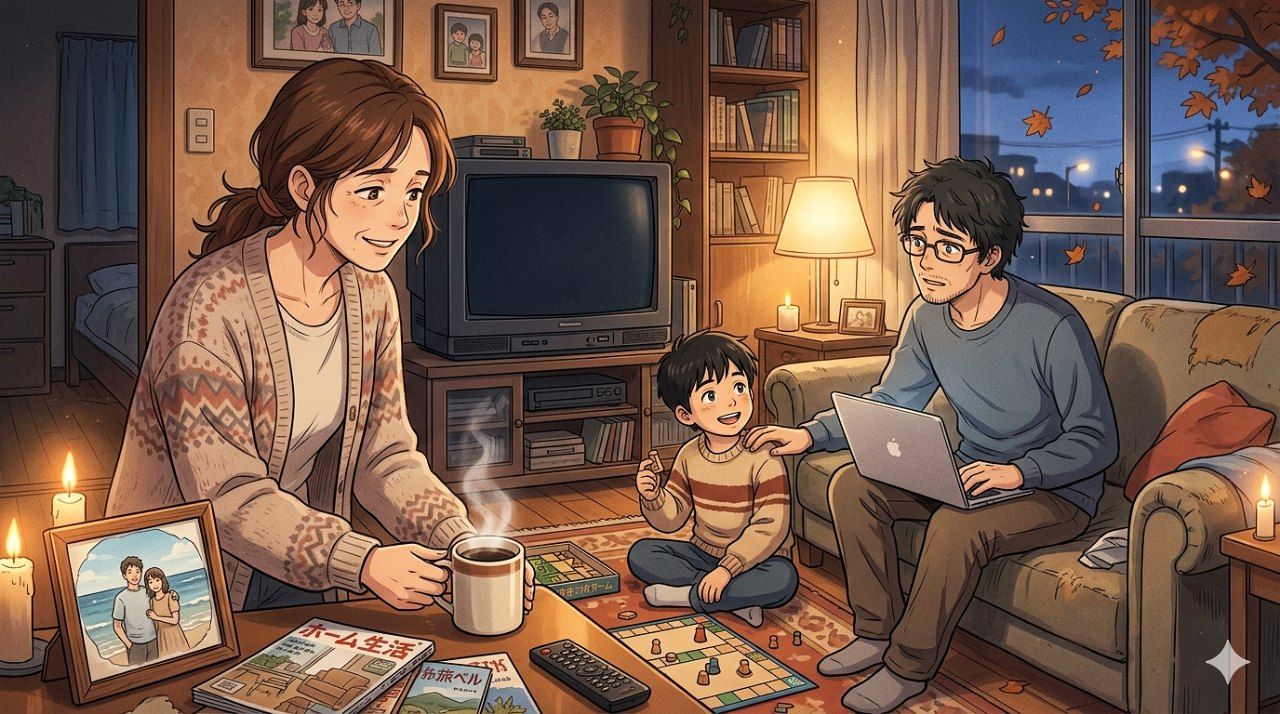
The house of Marcos and Clara had been built from years of routine: work routines, quick dinners, televisions left on like background clocks, messages read halfway, and promises always postponed to “someday.” In the main living room, on a low table cluttered with magazines and remotes, the television projected an endless dance of images—ads, series, news, other people's laughter. It was a hypnotic light that took up space without asking anything in return. Marcos sat there each night like someone taking the same route because he already knew the signs: the chair, the remote, a full stomach, and the sense of not having to decide. Clara, for her part, had learned to live with those signals. She got up before him to make breakfast, tidied the house in mechanized silences, folded shirts with hands that remembered the shape of the fingers more than the reason for doing it. There were days when her gaze would drift to the window, where the street showed a life that seemed to pass by without stopping. She was forty but often felt older than her years—tired of explaining the obvious, tired of waiting for things to change without anyone setting an intention. One rainy afternoon, while the city seemed to dissolve its contours, Clara found an old photograph among some books: her and Marcos on the seashore, skin salted and eyes still bright with youthful promises. She carried it to the living room and left it on the table like an offering to the past. Marcos looked at it without taking his eyes off the television. “Do you remember that day?” Clara asked, searching for a spark that might light something. “Yes,” he answered without enthusiasm. “We had time.” The word “time” became an echo. Clara felt the echo carry a cruel value: time had existed but had been invested in easier things, in habits that demanded no growth. Conversations that used to be long and awkward had shrunk to quick notes: “I’ll be late,” “Meeting,” “What’s for dinner?” Marcos didn’t do it out of malice; he did it because comfort spared him the confrontation with what hurt, with what required sacrifice. It was simpler to swipe a screen than to open his mouth and tell the truth. That night, after putting Tomás, their eight-year-old son, to bed, Clara sat again by the window. The neighborhood reflected in the glass like an inert constellation: houses turning lights on and off in the same routine, cars passing without asking, a cat that had discovered the freedom of indifference. Tomás had gone to bed with his tablet off—a rarity. Before falling asleep he had asked Clara, “Mom, Dad promised he’d come to my game, right?” The question lingered in her throat. Clara remembered her own mother’s voice years earlier, telling her that children watch, that they learn from what is repeated, not from big speeches. That truth struck her with the force of the everyday: what Tomás saw every day was the pattern he would later use to build his own life. If presence was intermittent, he would normalize it. If escape was the response to discomfort, he would take it as a map. The next morning, Clara decided to break the silence in a way she had been avoiding. In the kitchen, under the cool morning light and the faint smell of coffee, she told Marcos: “Tomorrow is the parent meeting. I need you to come.” He looked at her like someone receiving an unexpected request, with that expression half surprise and half mild irritation that arises when comfort is disturbed. “I have work,” Marcos replied. “I can’t miss that day.” She placed her hands on the table with the firmness she hadn’t shown in years. “It’s not just about the meeting,” she said. “It’s that Tomás needs us there, that your father sounds more tired every time he speaks, that our conversations have become routines that tell us nothing. It’s not about hating what distracts us. It’s about understanding something much more uncomfortable: many people aren’t choosing from love. They are choosing from tiredness, comfort, and escape.” The words hung heavy, like an old piece of furniture. Marcos swallowed and sought refuge in everyday logic. “I didn’t know it was that bad,” he murmured. “I thought we understood it, that we fixed it with small things.” Clara shook her head. “It’s not an emergency in the sense of putting out a fire today,” she replied. “It’s that the easy always seems safer. A screen doesn’t demand your presence. An empty habit doesn’t ask for maturity. A distraction doesn’t confront you. A quick pleasure doesn’t require you to change. But real life does. Your parents grow old. Your children watch. Your relationships grow cold. Your time goes by.” That list landed like a blow of realism. For the first time in many months, Marcos felt a tremor that wasn’t from fatigue but from recognition. He thought of his own childhood, of a father who worked until his hands began to fail, of calls he promised to return but never did, of weekends sacrificed to the feeling that producing more would buy him a better tomorrow. Now that tomorrow felt both close and strange. “What do you expect me to do?” he finally asked, voice low. “Choose,” Clara replied. “The question isn’t what you want to value. The question is what you repeat every day.” The simplicity of that line carried weight that cracked the silence into a fissure. Marcos remembered small episodes: the time he promised not to check his phone during dinner and did, the time he let his mother’s call go to voicemail for “later,” birthdays celebrated with prerecorded messages. He saw himself acting from inertia rather than decision. He understood that love was not only a feeling; it was a discipline, a set of daily acts that required presence and sometimes sacrifice. From that day something shifted—not with heroic drama, but like repairing a crack before the water widens it. Marcos did not change overnight. There were backslides, nights when the screen’s temptation returned and fatigue reclaimed its throne. But there were also days when, feeling the habit call him to refuge, he breathed and chose differently: calling his father not out of obligation but to listen; turning off the TV before dinner to talk; showing up, occasionally, to Tomás’s practices with a sweaty shirt and an honest apology for being late. Those actions, repeated, began to filter a new light into the house. Tomás noticed his parents’ increased presence; at school they would nod to him as the boy whose father at least sometimes showed up at the games. At family gatherings the tone of conversation changed; people stopped avoiding painful topics. The relationship between Marcos and Clara, which had functioned for years like an automatic set of gears, began to reveal parts that could still be adjusted. One autumn afternoon, beneath a tree whose leaves were starting to fall like confessions, Marcos walked with his father through the park. The walk was slow and unhurried, and between steps they shared silences and memories that had been postponed. Marcos listened to his father with a care he hadn’t known he could muster, discovering in each small story reasons to be grateful and reasons to regret the things left unsaid. That attentive habit seeped through. Clara, for her part, fought the comfort that tempted her daily. There were mornings when tiredness asked her to give in, when chores swallowed her patience and the television offered escape. But when that temptation returned she thought of the old photograph she had found and of the way Tomás looked at her. She understood that routine was not neutral: it built, or it unwound, the value of what they loved. A pivotal moment came one January night when a power outage plunged the house into unexpected darkness. The blackout removed the visual noise the screen provided as consolation. Instead of surrendering to unease, Marcos went to the kitchen, lit candles, and found a board game that hadn’t been opened in years. They played clumsy rounds, laughed at Tomás’s inept moves, and in the simple climax of one hand helping another move a piece, Clara felt that presence was a kind of repair. It didn’t erase bad habits, but it was a powerful reminder that other ways of choosing existed. Over time, those gestures became different habits. The transformation was neither uniform nor free of remnants of old practices. There were days where the screen seemed more alluring than conversation, nights when quick pleasure seduced them, and weekends where each sought their own escape. Yet the difference lay in the growing frequency with which they noticed having chosen escape and deliberately replaced it with an intentional action: returning a call, attending a school event, preparing a dinner where more was said than what was on the menu. Tomás began to mirror some of these gestures. When his father offered help with homework, he accepted without knowing he was learning to be close. When his mother reserved time to read with him, he did not link it to sacrifice but to company. Those repetitions settled as quiet lessons: what is repeated daily becomes character. One spring afternoon Clara found Marcos bent over a book that wasn’t strictly work-related. She watched him, surprised by the presence of a quality she hadn’t seen in months—a quiet curiosity. Tomás nestled between them, and Marcos closed the book and, in a low voice as though naming a landscape after a long journey, said: “It’s not about hating what distracts us. It’s about looking at who we put at the center when the noise goes away.” Clara rested her head on his shoulder and let the word “presence” settle. Outside, the neighborhood continued to flip lights on and off like an unexamined nervous system. Inside, however, something more difficult and essential had been mended: the daily decision to choose what truly mattered. Marcos and Clara’s story never reached dramatic perfection; imperfections remained, old routines resurfaced, and some days inertia won the fight. But they learned to see it: real life demands what comfort cannot give. Declaring love is not enough; you must repeat it. Promising to change “someday” is insufficient; you must sustain acts that prove it. With that understanding, each small gesture became an answer to the true summons: to live present, with the discomfort that sometimes comes with it, but also with the certainty that presence, when repeated, transforms. In the end, the house was no longer just a place of inert habits. It was, imperfectly, a place where deliberation was practiced. The routine—once the bearer of hard truths—now also revealed another: that of people who choose, again and again, to be there. And in the remaining silences, one could sometimes hear the murmur of a line that had changed everything: “The question isn’t what you want to value. The question is what you repeat every day.” Source of the images. Image created with Google Gemini.
3 comments
جميل
Thanx 🙂
العفو يا صديقي