 @mc5punk
Short story: Cake, Cream, and Boundaries
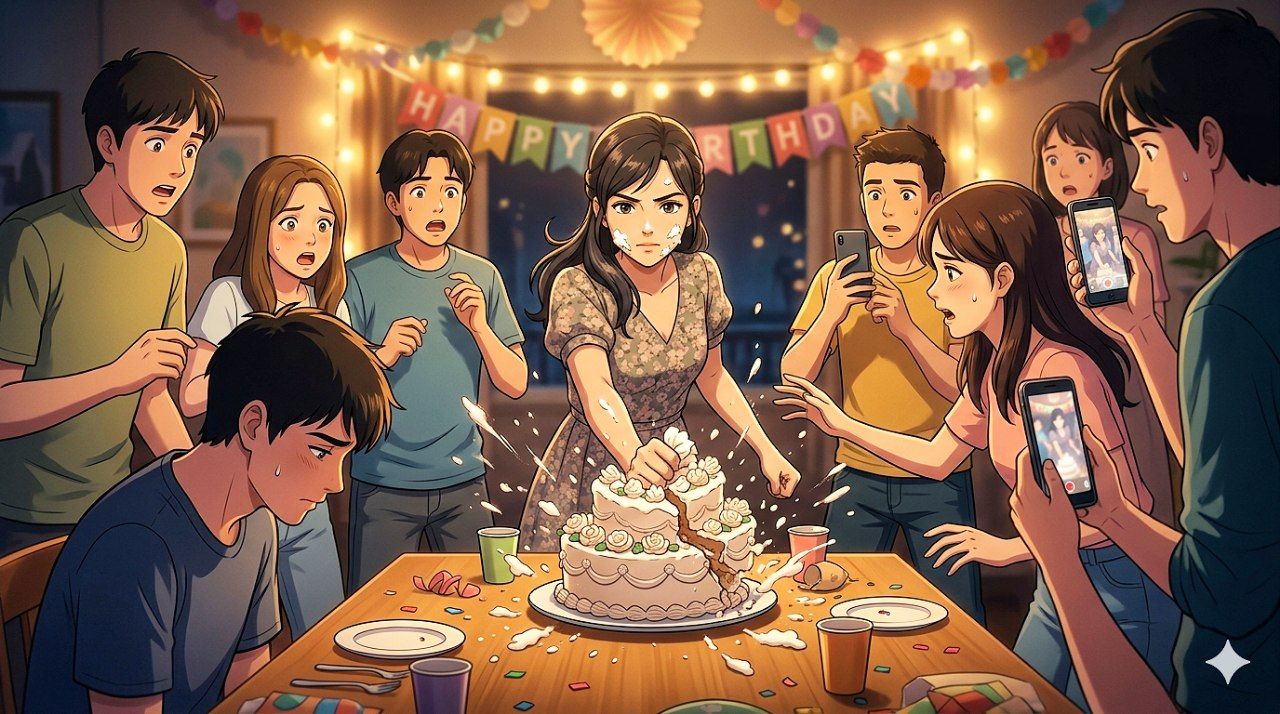
The afternoon passed with a gentle calm; the hall was decorated with paper garlands and warm lights that cast soft shadows on the walls. The main table, in the center of the room, held the cake: three immaculate tiers, white frosting, and piped cream flowers sculpted with precision. It looked like a work of art that refused to be touched. Friends and family chatted, laughed, and took photographs; the music—a mix of hits and songs that had marked everyone's friendship—played at a volume that allowed conversation without raising voices. Sofía moved among the guests with some reserve, adjusting her dress and returning hugs with measured smiles. She did not like loud surprises; she preferred the warmth of intimate conversations and thoughtful details. Still, she had agreed to gather with those who had known her since college, hoping to celebrate in her own way, with people who would respect her boundaries. "Time to sing!" Martín announced enthusiastically, raising his voice as he set up his phone to record. "Everyone around, as always." Within minutes, the candles flickered and the improvised group sang "Happy Birthday" with more heart than pitch. Sofía closed her eyes, grateful, and when the song ended everyone shouted in unison, "Happy birthday!" It was then that, from a table in the back, an idea arose that many understood as part of tradition. "The cake trap would be the perfect finishing touch," someone said with a muffled laugh. "Who's brave enough?" Rodrigo, a childhood friend always willing to make people laugh at his own expense, stepped forward with that mix of impulsive decision and misplaced confidence. "I'll take care of it," he announced, smiling too broadly. "Sofía, trust me." She smiled out of courtesy, but her expression didn't entirely hide her discomfort. Before she could say a clear no, Rodrigo approached with quick steps. In his right hand he carried little more than a gesture, an impulse for amusement. With a laugh, he placed his palm on Sofía's cheek and pushed her toward the cake. On contact, a dollop of cream flew and landed on her face, leaving a white streak from her temple to the corner of her mouth. The silence that followed was instant and heavy. phones rose like mushrooms in a rain; someone had started recording unplanned. Surprise became incredulity in a blink on Sofía's face; what Rodrigo had intended as comedy turned into an awkward scene lit by screens. "What... what did you do?" she said at first in a low voice, as if trying not to let sound betray her. Rodrigo let out a nervous laugh that tried to minimize the gesture. "Come on, Sofi, it was a joke. Don't take it like that," he said, trying to ease the tension with humor. Sofía pulled her hand back and, seeing her fingers stained, the expression of annoyance became visible. It was not simply the cream on her skin; it was the feeling that her body had been used as an object of amusement without her permission. "Don't take it like that," she replied, and her voice began to tighten. "I'm not an object for entertainment." Murmurs multiplied in the room. Some guests exchanged uncomfortable looks; others forced laughs trying to restore lightness. Lucía, a close friend who had arrived early to help with the preparations, immediately stepped forward. "Rodri, apologize," she said firmly. "That wasn't funny." Rodrigo, visibly surprised by the reaction, raised his hands. "Sofi, seriously, I thought you'd find it funny. At other parties... it's always been like that. Sorry if it bothered you." "If it's always been like that, it means they always asked for permission before, right?" Sofía shot back sharply. "No one asked me." The contained argument of quick words and glances began to take shape. Some defended Rodrigo as someone who had almost unknowingly followed a custom; others began to justify Sofía's upset over the invasion of her space. Meanwhile, the recordings in multiple hands preserved the scene from various angles. Sofía, who until then had fought against the humiliation and the need to set a boundary, stepped back a few paces. On her face, a mix of anger, shame, and determination consolidated. She seemed to measure the room with her eyes; she observed the cell phones, the hands searching for them, the doubtful smiles. Finally, with a determination that surprised more than one person, she walked over to the cake; the room fell silent. "I'm not going to be the joke," she murmured to herself in a low but firm voice. "If they make me a spectacle, they take away what's mine." She took the cake in her hands with force. The frosting, pristine until then, yielded under the pressure of her fingers. With a quick, sharp movement she split the cake in two, then smashed the rest onto the table with deliberate force. Cream flew, mixed with crumbs, and slid across the tablecloth. The sound was dull, like a door slamming in the middle of a conversation. "What are you doing?!" Martín exclaimed, stunned and with a mix of anger and disappointment. "That was for everyone!" Sofía looked at him, and her eyes conveyed something that was not mere rage but a demand for respect. "I don't want to be used for laughs," she said. "I won't let my birthday be a joke at the cost of my dignity." The room then fractured into opinions. A small but vocal sector muttered that her reaction was disproportionate; another group—silent until that moment—stepped forward to show empathy: some applauded in support; others offered towels or napkins to wipe Sofía's face. The cameras kept recording, close-ups capturing the young woman's flushed face, the smeared cream, her still-trembling hands. Lucía moved forward, trying to calm things without legitimizing what had happened. "Sofi, please, calm down," she pleaded. "We didn't need to destroy the cake. We can fix it, we can talk." Sofía looked at her with contained coldness. "I'm not trying to fix the cake. I'm trying to make it understood that I'm not an object," she replied. "If tradition implies humiliation, I don't want to be part of it." Rodrigo, who until then had alternated between disbelief and remorse, approached with hesitant steps. The night, minutes earlier brimming with laughter and warmth, had changed tone: outside the hall, city lights and the wind moved tree leaves in a different rhythm. "Sofi, I really am sorry," Rodrigo said, with genuine contrition this time. "I didn't think about how you'd feel. Forgive me." She answered without softening her words. "I don't need forgiveness as a formula. I need it not to happen again. I need them to ask before deciding for me." The night closed with scattered conversations. Some guests left in silence; others, amid reproaches, discussed the value of traditions versus individual respect. The next day, as is common in the age of immediacy, the video of the scene appeared on social networks: various accounts shared it with comments ranging from absolute condemnation of Rodrigo's action to criticism of Sofía's reaction. In the comment threads, people emphasized the importance of consent while others spoke of "exaggerations" and "bad manners." Sofía, after the tumult, secluded herself at home. In the bathroom, in front of the mirror, she washed her face gently, noting each movement. The cream came off easily, but the lingering feeling of having been forced into the center of a spectacle accompanied her. She thought of her mother, of family gatherings where surprises had always been discussed and agreed upon; she thought about how a custom that seems innocent to some can be hurtful to others. She decided then to write a message, not as a call for confrontation but as an affirmation of her limits. "Tradition doesn't make something permissible. Ask first," she posted on her social media—few words with clear conviction. The post generated diverse reactions, conversations among friend groups, and debates in forums. For many, the story became a model for discussing socially accepted practices that go unchallenged; for others, a reminder that ways of having fun must be negotiated. In the small circle of those present, the experience changed perceptions: some became aware of the importance of asking permission; others reconsidered how their humor could cross someone else's boundaries. A week later, Rodrigo looked for Sofía again. He found her in a café, with a steaming cup of tea and a calmer expression. He sat across from her, a mix of timidity and resolve. "I've thought a lot," he said. "I want you to know I won't use that kind of 'joke' anymore. And if you ever feel uncomfortable with me again, tell me; I'll be the first to apologize properly." Sofía accepted the gesture cautiously, without promising immediate trust. In her face, the maturity of someone who had set clear boundaries had replaced the initial anger. And although she knew the video would keep circulating and opinions would remain divided, she left with the certainty that she had defended her personal space. The cake, crumbled and strewn across the table, remained as a physical reminder of a night that demanded rethinking practices. For some, it was proof that customs need updating; for others, evidence that respect begins with asking. And among the guests who attended that celebration, one lesson lingered: genuine fun does not require humiliation, and each person's boundaries deserve to be heard and respected. Source of the images. Image created with Google Gemini.
2 comments
Wow 😲 so interesting
Thanx 😁