 @mc5punk
Short story: The Mirage
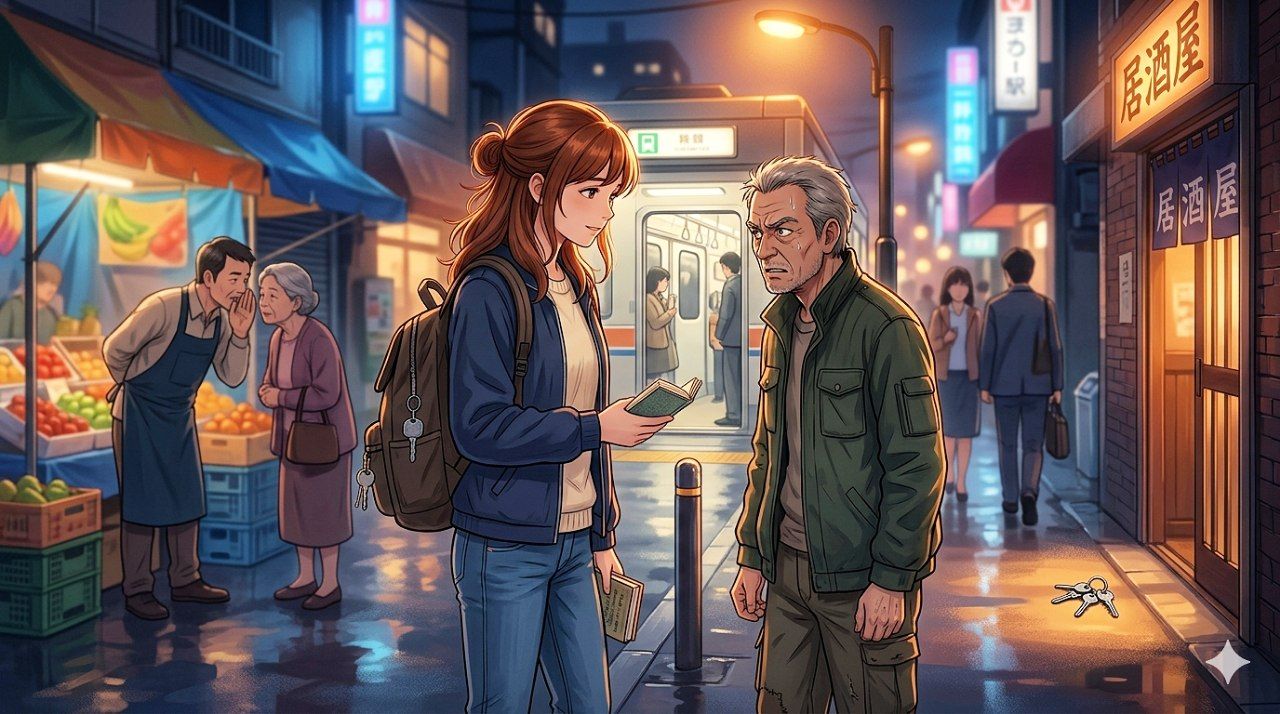
Marina never sought trouble. She grew up in a home where words were used to build bridges and, when they failed, to close doors gently. Over the years she learned to read tension in a gesture, to gauge the warmth of a room before entering, and to calculate the width of silence needed for others to find their own rhythm. She didn’t call it a “technique”; to her they were small courtesies that returned dignity to those who were losing it. One autumn afternoon on the subway, the air smelled of rain and coffee. The seats were full and Marina, backpack slung across her front, stood by a pole. An older man, visibly irritated by the crowd, elbowed a young woman who had just sat down. When the young woman tried to regain her space, he let slip a phrase louder than necessary. “That’s what happens when you don’t watch where you sit!” he said, his voice rough. The young woman replied in a murmur, and the tone escalated. Soon the man directed his voice at Marina for no clear reason. “And you, woman, always with your head in the clouds. No respect at all!” he added, punctuating the air with a gesture meant to dominate. Marina looked at him calmly, without changing her posture. Instead of answering in kind, she tilted her head slightly and asked softly: “Are you okay?” The subway seemed to pause for a beat. The man, used to turning his anger into authority, didn’t know how to classify that question. His eyes, once lit by the excuse to pick a fight, dimmed with confusion. “Pardon?” he stammered. “What did you say?” “Are you okay?” Marina repeated, as if speaking about a sick neighbor or a tired friend. The man’s face changed. A flash of something that wasn’t rage—perhaps fatigue, perhaps shame—crossed his expression. The hum of the car continued, but the voice that had been building a wall of reproach thinned to a thread. “No… well,” he said, his voice losing its force. “I haven’t slept well for days.” The young woman, who had been trembling a moment earlier, let out a relieved sigh. The man sank into the nearest seat when one opened; his shoulders, still tense, dropped. Marina returned to her book and her calm: the confrontation had lost its enemy. Not from submission, but because the question had rearranged the scene. It had disarmed the aggression by turning it, in a sense, into a request. Another afternoon in the main square, the city pulsed with activity: bicycles, street vendors, and a pair of tourists arguing over a map. A fruit seller, proud and rough, confronted a customer over a payment he considered incorrect. His voice rose with the heat of the sun. “This is not how you do it!” he shouted. “You’re cheating me!” The customer, nervous, tried to explain her method of payment. Her voice was swallowed by the clatter, the comments, and the seller’s insistence. Her hands began to shake; the seller raised his voice to own the truth in the square. Marina, passing by with a bag of bread, stopped and watched for a few seconds. Then she approached and, without raising her voice, leaned in and whispered something to the seller so that only he could hear. “The heat today makes everything feel urgent, sir. Let’s breathe before deciding,” she said in a tone so low that anyone not standing close would hear nothing. The seller, who expected a vehement reply or public support, tensed at the unexpectedness: someone was whispering amid the clamor. That drop in volume forced his ear toward her; people stopped listening to the quarrel and tried to catch that which seemed secret. The whisper turned his anger into curiosity and, in that instant, lost momentum. A shout needs air, and by changing the sonic dynamic his fury was forced to descend a register. “What did you say?” he asked, confused, his voice less sharp. “That we take time to verify; sometimes haste makes you lose coins,” Marina replied, not accusing but proposing. The man blinked, checked the customer’s bag, counted calmly, and for the first time in minutes his posturing dissolved into a mix of embarrassment and relief. The customer smiled, the crowd returned to their routines, and the square, which had been dominated by noise, recovered its usual rhythm. At the office where she worked, tension took other forms. There was a colleague, Iván, who had developed an uncomfortable habit: he stared at Marina with a fixation that pierced reports and landed, unblinking, on her face whenever she spoke in meetings. It wasn’t a friendly look but an examination intended to unbalance her. Sometimes, on the projector screen or in a spreadsheet, Marina felt his presence like a spotlight burning her confidence. One morning during a long, pretentious meeting, the scrutiny intensified. Iván crossed his arms, furrowed his brow, and with a barely perceptible smile left her breathless in an unfinished sentence. Marina could have confronted him with the same force; instead she applied a strategy she had practiced in secret. While he held her gaze trying to unsettle her, she lowered her eyes and focused on the shoes opposite her: worn loafers, laces undone. The gesture was minimal, almost choreographed in its discretion. Iván noticed the shift. Suddenly his own gaze—the tool he used to impose himself—was exposed. Seeing himself reflected in another’s observation, as if someone had turned a mirror, returned the sensation of being watched. The certainty he had built with that stare wavered. “You okay?” Marina asked, with the composure of someone discussing figures, no sarcasm. Iván glanced at his shoes a beat longer, finding a crack in his mask. “Yes… yes, I’m fine,” he said, but his voice no longer had its usual edge. From then on, in the meeting room his attitude lost the tension that accompanied him when he watched her. Not because he had been humiliated, but because the slight dissonance she provoked reminded him that hostility works best when it goes unnoticed. Noticing the effect, Marina did not gloat; she simply continued the presentation as if everything were routine. One night at a bar with live music, decibels rose when a dispute between two friends escalated. One monopolized the floor: he spoke on and on, constructing a wall of sentences to prevent the other from intervening. The monologue twisted and tangled, leaving the other without room to breathe. Marina, sitting at the next table with a friend, smiled wryly and pretended to search her bag. She performed the universal gesture of looking for keys at the bottom. With deliberately careless choreography, she let her keys fall to the floor. The clink spread across the room like a discordant note that cuts a measure. The speaker stopped. A sudden silence, like a director’s cut in midscene. Diners turned their heads; the musicians lowered the volume for a second. It is remarkable how much power a few forced seconds of silence hold: the interruption broke the speaker’s rhythm and gave the other person a chance to recompose. “What was that?” someone at the table asked. “Nothing, the keys,” Marina replied, picking them up casually. “Sorry for the noise.” The man who had been silenced took advantage of the pause. He took a breath and spoke, firmly but without previous urgency: “Wait, I don’t think you let me finish.” The conversation changed. It was no longer an assault but an exchange with pauses. Tension eased, and the dispute ended less violently than it had seemed it would. That night, walking home under amber streetlights that splashed the pavement, Marina replayed the day’s scenes in her head. She felt no pride in having “tricked” anyone; rather she believed she had offered small exits to people who, for one reason or another, had lost their compass. That question—“Are you okay?”—had disarmed the subway man’s fury because it gave him a chance to recognize himself as tired. The whisper had asked for a pause in the square, and the pause was accepted because people leaned in to hear a secret. Looking down had returned to the watcher the awkward amazement of seeing himself reflected. The clink of keys had restored rhythm to a conversation that had become a monologue. At her building’s landing she met a neighbor who had just argued with someone over the elevator. She greeted him with her usual serenity. “How did it go today?” she asked softly. The neighbor sighed and let out a hollow laugh. “I need sleep,” he answered. “But thanks… I think you’re right about breathing.” Marina nodded with a contained smile. She went up to her apartment and sat by the window. Outside, the city continued its concert: laughter, engines, hurried footsteps. She turned on a dim light, picked up the book she had left behind, and allowed herself to think about the thin border between influence and manipulation. For her, the line lay in intention: if what she did sought to help the other person regain composure rather than make them feel humiliated, then it was justified. It was not a way to control but an offering: small keys, slight gestures so the other could find another door. That night she took a long time to fall asleep, replaying phrases she had heard in many voices throughout the day. She forced herself to remember the times someone had stopped her with a kind word when she was on the verge of exploding. She thought of her mother, who taught her to ask before reproaching; of a schoolteacher who, with a whisper, had made her refocus; of a stranger who once dropped a bag and, when she helped pick it up, received an apology that turned anger into a smile. Before closing her eyes Marina murmured the list as if it were a mantra: ask, whisper, look down, break the flow. They were not magical formulas or guarantees. They were humble tools that worked when wielded with respect. Because they confused, yes, but not to deceive: they confused to open spaces where people, for an instant, could find themselves. Source of the images. Image created with Google Gemini.
No comments yet