 @mc5punk
Short story: The Perfect Sister (According to the Internet)
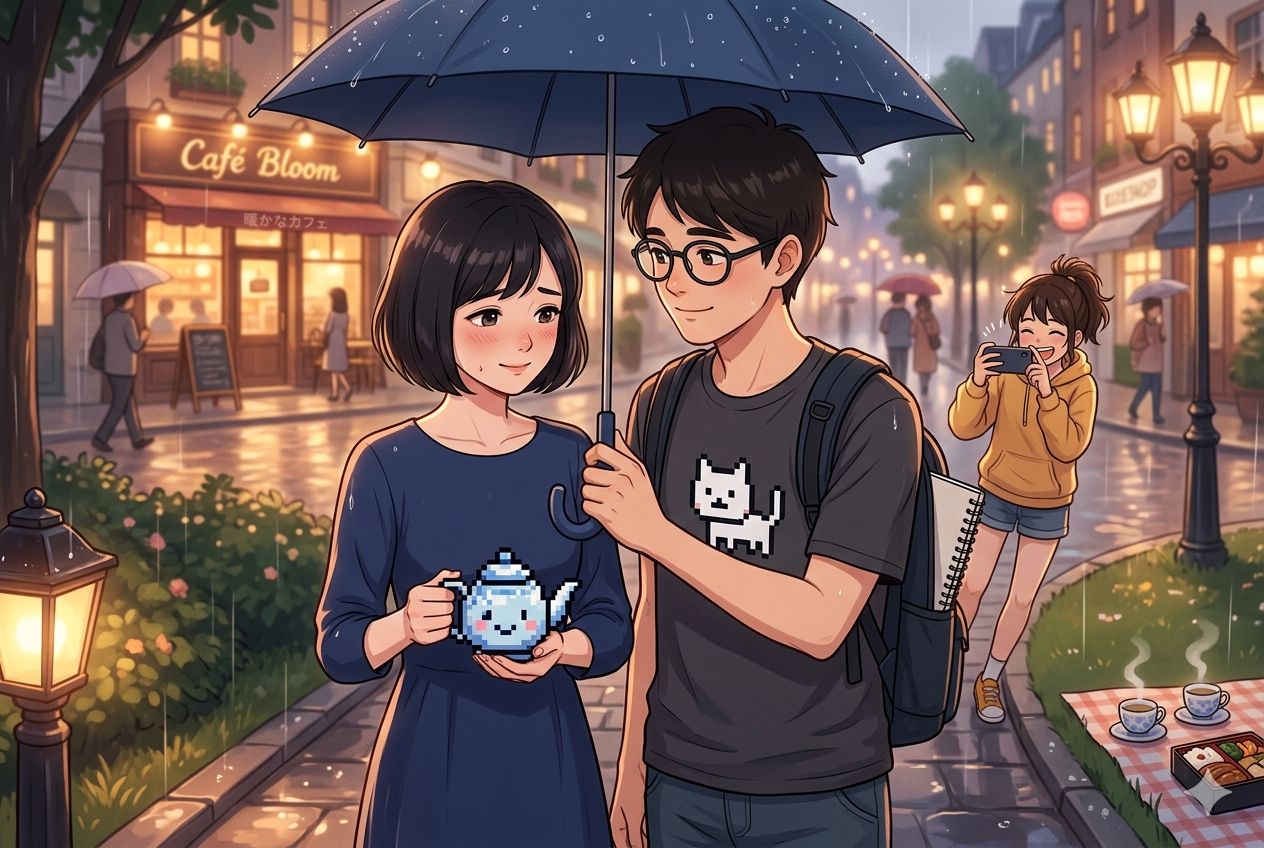
Chapter 1 — The Post Aiko swiped her thumb across the screen while her heart fluttered between pride and embarrassment. The post she had made minutes after getting off work had gone viral with absurd speed: screenshots, comments, direct messages ranging from serious proposals to ridiculous offers. Some accounts proposed “serious dates,” others sent memes. At the top, still visible, was the headline she had typed on impulse: “JAPANESE WOMAN LOOKING FOR A PARTNER FOR HER 33-YEAR-OLD SISTER.” Below, in large letters, the description Aiko had written with a mix of irony and desperation: “SHE’S A FULL-TIME NURSE, NEVER HAD A BOYFRIEND, ZERO FRIENDS, HATES LEAVING THE HOUSE, AND DOESN’T SPEND ON MAKEUP.” Emi, her older sister, came into the kitchen when she heard Aiko’s strange laugh. “What’s going on?” she asked, leaning against the doorframe with a cup of tea in her hands, her tall figure wrapped in a robe that smelled of lavender and hospital soap. “Your fame,” Aiko said. “Grandma already shared it in the family chat.” Emi sighed and set the cup carefully on the counter, as if handling something fragile. “I told you you’d regret it,” she replied with a smile half guilty, half amused. “But I admit ‘doesn’t spend on makeup’ is a great selling point.” Aiko rolled her eyes. “That wasn’t ‘selling,’ it was desperate honesty. Also, you wrote ‘She’s rich because she has no social life.’ That sounds like a product slogan.” “Well,” Emi said, “it’s true. I save money. I don’t have many expenses. What did you expect me to say? ‘Looking for a husband who loves karaoke and midnight getaways’? No, thanks.” Aiko looked at her: Emi always spoke with that blend of candor and reality that made people shrug at her truths. She was 33, worked night shifts as a nurse at a public hospital, and had lived alone for years. She didn’t have a very active social life—not because she avoided people, but because she preferred her life to be simple and functional. The post, however, exposed her publicly, and that made her uneasy. “There are messages from everywhere,” Aiko said. “A guy named Sora wrote from Kyoto. He says he designs video games. He wants to meet for ‘work and personal reasons.’” Emi raised an eyebrow. “Work and personal reasons? What kind of job needs a nurse who never leaves the house?” “I don’t know,” Aiko answered. “Do you want me to delete the post?” Emi shrugged. “No. It’ll be fun. Besides, people already know who I am. It’s easier to find someone that way than someone with a hundred conflicting interests.” Chapter 2 — The Date They agreed to meet on Friday at eleven in a café near the park. Emi, free that morning thanks to her night shift schedule, decided to wear something simple: a navy dress, a silver chain she had inherited from their mother, and a light jacket. She wasn’t wearing makeup—only a clear lip balm—and Aiko looked at her with tenderness and a little apprehension. “You could wear something that shows you care,” Aiko suggested. “Not much. Just… a touch.” “I don’t wear makeup,” Emi said. “I’ve never needed it. If someone won’t accept me for that, it’s their loss.” Aiko said nothing. The sisters walked together to the café; the morning sun lit the street and left the city with a golden glow, as if nothing could go wrong. Sora arrived on time and sat at the table by the window with a disarming smile. He wore a pixel-cat T-shirt, round glasses, and a backpack with notebooks peeking out. He had the calm manners of someone who spends hours explaining game mechanics to impatient people. “Hi, Emi,” he said, tilting his head slightly. “I’m Sora. Thank you for meeting me.” Emi returned the greeting with a shy smile. “Thanks for coming. Aiko said you’re… a video game designer.” “Yes,” Sora replied. “Independent designer. I make small, slow games. Nothing spectacular.” Aiko, sitting to one side, had already taken out her phone and discreetly opened the camera. She was the unintentional PR manager of her sister’s dating life. She soon posted a short story with the caption: “Trial date: approved.” She didn’t expect the post to get even more attention. At first the conversation was awkward: exchanges about tastes, favorite recipes, and childhood memories. Sora, with an easy grin, said he’d grown up with three younger siblings—explaining his patience and tendency to organize things. Emi spoke about her work with a professional tone: long nights, patients telling stories to pass the time, scrubs infused with the smell of the hospital, and above all, the comfort of routine. “Night shifts taught me to cook with whatever’s available,” Emi said. “Sometimes I make miso soup at three in the morning just to stay awake.” Sora laughed. “That sounds like a ritual. I love rituals. My games usually start with coffee and a sketch.” The meeting took an unexpected turn when an elderly woman at a neighboring table started choking on a piece of cake. She brought her hand to her throat and her expression tensed. Sora reacted with uncommon speed: he crossed the distance, performed the Heimlich maneuver calmly, and made sure the woman could breathe. Emi, trained for emergencies, watched with widened eyes and, for a moment, radiated professional gratitude. “Good reflexes,” she said, unable to hide her admiration. “Did you work in emergency care?” “No,” Sora replied. “I just grew up with three little siblings and a lot of family dinners. That trains you.” Emi let out a laugh that sounded like relief, and the conversation shifted: they were no longer strangers measuring words but people who had just shared a moment where routine was interrupted by something human. Aiko didn’t miss the chance to take a photo: Sora with calloused hands and kind eyes, Emi with the genuine smile she rarely showed outside the hospital. Chapter 3 — Rituals and Small Stumbles In the following weeks, their relationship became a mix of long messages and brief meetups. Sora sent Emi prototypes of his games with warnings: “If anything hurts, say stop.” Emi played them and gave practical feedback, sometimes professional: “If this scene involves medical realism, don’t overdramatize; realistic isn’t always the most dramatic.” Sora laughed at the accuracy of her observations. Aiko became the relationship’s administrator with a blend of humor and protectiveness. She organized small social tests for Emi: a picnic with hospital coworkers, a pottery class, and—boldest of all—forcing her to sing at a karaoke where most of the songs were Aiko’s favorites, not Emi’s. Emi accepted with gentle resistance. Each test made her a bit more open without seeming forced: Aiko presented them as scientific experiments with lists and protocols. Differences between Sora and Emi produced natural comedy. Sora didn’t understand many of the cultural references from the hospital world; Emi didn’t get the devotion Sora had for rhythm games or developer forums. One afternoon, Sora tried to explain the logic behind his favorite game using culinary analogies; Emi responded with a detailed explanation of how to make a proper chicken broth. They both ended up laughing, discovering their worlds weren’t as far apart as they thought. One Saturday, Sora invited Emi to his apartment to try the latest build of his game. He arrived with a wrapped box and a package of tea. “I brought something,” he said with that mix of shyness and excitement that had become his trademark. “It’s a small game. Nothing serious.” Emi opened the box gently and found a teapot with a pixelated drawing of a nurse holding a cup of tea. Her eyes reflected surprise and emotion. “It’s beautiful,” she whispered. “Why a teapot?” “Because you said you like tea and that your shifts force you to find small rituals,” Sora answered. “And because I wanted to draw something to remind you that simple things can be special.” Emi, holding the teapot, felt the words from the viral post dissolve: this box was more honest than any slogan Aiko could come up with. Sora moved closer to the table and, in a soft voice, said: “Maybe this all started as an internet joke, but this isn’t. I like you, Emi. Your life isn’t boring; it’s steady, honest, and real. I’d love to get to know you without labels, without viral posts.” There was a brief, perfect silence. Emi set the teapot down and looked at Sora with something like astonishment. “I don’t know any of this,” she admitted. “I’ve never had a boyfriend. I don’t know how to act.” Sora smiled and shook his head. “You don’t need to know. There’s no manual. We can write it together. Chapter one: learn to eat ramen with chopsticks without making a mess.” Aiko, who had gone to the kitchen for more tea and had overheard, pushed a cookie toward the table like a blessing. “Chapter zero: listen to the little sister,” she said triumphantly. “It works more than you think.” Chapter 4 — Shared Life Their relationship progressed in small, steady steps. It wasn’t a sudden infatuation but a sequence of gestures: late-night messages with playlists, calls that turned into long descriptions of the day’s absurdities, visits where Sora left notes with drawings on Emi’s fridge, and Emi bringing homemade soup when Sora worked late on his computer. There were comedic moments that strengthened their bond: Sora putting a hand to his forehead when Emi used medical terms he didn’t understand; Emi trying gamer jargon and stumbling over words that made her laugh; Aiko always in the background sending midnight memes to keep spirits up. One day, at a contemporary art show Sora thought would be “a good stimulus,” the main exhibit turned out to be a plant on a chair. Emi and Sora looked at each other, laughed, and decided their art was better: the one lived in the kitchen, among teapots and game controllers, with conversations that swung between the serious and the absurd. Misunderstandings arose, natural in any relationship: once, Sora thought Emi wanted extreme privacy when she declined a too-public invitation; Emi felt uneasy about the lingering popularity of Aiko’s original post. They talked openly: Emi explained she wasn’t antisocial out of disdain but selective with her energy; Sora admitted it sometimes hurt not to understand the professional codes Emi used so naturally. Those deep conversations brought them closer more than any romantic gesture. One rainy night, while sharing an umbrella that seemed too small for both of them, Sora stopped and looked at her seriously. “Do you know something?” he asked, with the rain tapping the umbrella above them. “Your sister posted a list of ‘benefits,’ and it was funny… but the best benefit I found is that you’re not afraid to be yourself. That, to me, is worth more than any viral post.” Emi rested her head on his shoulder and let the rain wash away any doubt. “I don’t know how it happened,” she murmured. “Maybe my sister exaggerated the advantages, but… I’m glad I met you.” “Me too,” Sora replied. “And if one day you want to delete the post and go back to anonymity, we’ll do it. I don’t need fame, I just need this.” Emi smiled, feeling like the small world she cared about had righted itself. Chapter 5 — What Remains After the Post Over time, Aiko decided it was time to delete the original post. It was no longer necessary: the joke had served its purpose and Emi’s life had taken its own course, away from memes and inappropriate proposals. That night the sisters sat in the living room with cups of tea. Aiko looked at the screen one last time and swiped to remove the post. “Will you feel strange?” Emi asked, watching her. “A little,” Aiko admitted. “But I feel like this is ours now. Important things don’t need public validation.” Emi took Aiko’s hand and squeezed it affectionately. “Thanks for pushing me,” she said. “Even if you pushed too hard sometimes.” They both laughed. A few weeks later, Sora took Emi on a simple picnic in the park where they had met. He brought the pixelated teapot and two new cups, one with small green dots and the other with a joystick motif. They sat on a blanket, shared soup, and talked about plans that didn’t need to be big: a short trip to a coastal town, collaborating on a game that included caregiving and daily rituals, dinners with friends chosen carefully. Their relationship wasn’t a fairy tale or a perfect romantic comedy. They argued about schedules, the need to carve out personal space, and how to handle the occasional attention that still surfaced because of Aiko’s post. But what they built was an authentic everyday life: sharing umbrellas, learning to cook together, laughing at each other’s clumsiness, and supporting each other through the nights Emi’s shifts left her exhausted or when Sora needed to finish a deadline. Epilogue — An Improvised Manual One afternoon, while Aiko scrolled through old photos on her phone, she found a screenshot of the original post with its flood of ridiculous comments. She smiled and deleted it without a second thought. Later, Emi and Sora sat at the kitchen table and started writing the “manual” Sora had promised: recipes, game codes, lists of things to do when one feels alone, and simple rules like “always ask before inviting someone over” and “make tea when you’re sad.” Aiko peeked over their shoulders and added a line in small handwriting: “Chapter zero: listen to the little sister.” Then she closed the notebook, satisfied. The viral post that started it all became an anecdote—a reason to laugh about life’s absurdities—but what endured was the everyday: two people choosing each other without drama, a sister who acted with humor and a bit of desperation, and a tiny pixel teapot that, more than an object, became a symbol of a shared ritual. The End. Source of the images. Image created with Google Gemini.
No comments yet