 @mc5punk
Short story: Ledge
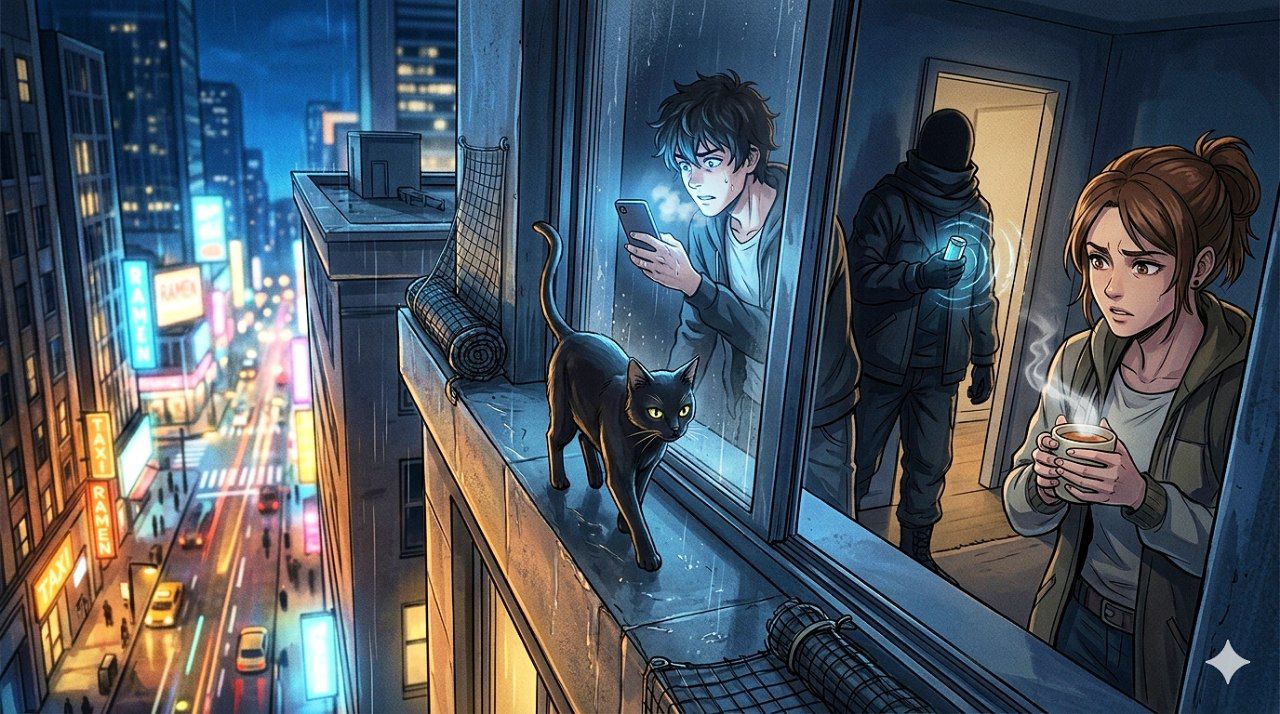
Night had fallen like a velvet curtain over Midtown. The offices, like horizontal constellations, gleamed in rectangular blocks while the city murmured below: a heartbeat of cars, distant sirens, conversations dissolving in the damp of the asphalt. On the 42nd floor of the Hawthorne Tower, a silhouette moved with the precision of an acrobat: a black cat, thin, walking along the exterior edge of a window as if the cornice were a tightrope. Mateo Ríos held his phone with hands that would not stop trembling. He had stepped up to the living room ledge to get a better angle and, on the screen, the tiny animal’s body was set against the vastness of the city. The zoom made the image waver; the cat’s eyes reflected the streetlight like two beacons. “What the hell…?” Mateo muttered, not realizing he was speaking aloud. From the neighboring apartment, an ajar door let out a figure who planted herself in front of the window, a steaming cup of tea in hand. Her hair was tied back carelessly; her gaze was sharp. “Are you recording?” the woman asked, her voice restrained though the coffee let off steam. Mateo turned and pointed the phone. “Yes. Look at this!” he said, holding up the screen. “That cat is hundreds of meters up.” She approached and pressed her forehead to the glass to see better. Her eyes—black and observant—fixed on the tiny figure walking the edge without hesitation. “This isn’t the first time I’ve seen it,” she finally said so quietly it sounded like it was meant only for herself. “I’ve been seeing it in different videos for a week.” Mateo raised an eyebrow. “Videos?” The word echoed with a trace of disbelief. She set the cup on the table and, with a gesture mixing nervousness and resolve, introduced herself. “I’m Elena Vargas. I work in urban zoology,” she explained. “I’ve been compiling recordings of ledges—of cats doing strange things. There are patterns.” A chill ran down Mateo’s spine. He stepped back as if the cold came from the screen. “What kind of patterns?” he asked. “Appearances before an incident,” Elena answered. “Noises, flashes, a presence while the animal exposes itself. People call it coincidence. I call it a warning.” The image on his phone jittered: the cat sniffed the cornice, took two steps back, then continued with the same calm as a tightrope walker used to abyss. In the recording, a few seconds later, a shadow crossed behind the interior of the room where the window was open: a silhouette that paused as if looking outside, then disappeared. Mateo replayed the scene in slow motion. The shadow was barely a darker tone in the background, but one could see the gesture of someone lifting an arm. “Did you see that?” he said. Elena nodded, jaw tight. “Someone is manipulating the scene. They don’t do it to domestic animals out of mere cruelty; they do it to measure reactions.” Curiosity pushed them to search for more. Over the following hours they reviewed every video they could find: neighbors’ recordings, live streams that had gone viral, messages in community groups. Each clip showed a cat walking along a different ledge, at different heights, in different neighborhoods, but with the same disturbing pattern: a minimal event—almost always a pulse of light or a buzz—and someone—almost always invisible in the main frame—who seemed to provoke or point something. “Traps?” Mateo asked when Elena explained her hypothesis. “More than traps,” she corrected. “Experiments. They’re looking for the limit between balance and panic. They want to know how much stimulus makes an animal lose control. And if they test on cats, the city’s verticality helps: it does the rest.” The idea sounded like something out of a movie, but the sting of fear rising up Mateo’s neck confirmed that something real and ugly was at stake. The next dawn, the building’s doorman reported that someone had forced the basement gate. Nothing of obvious value was missing: tools, a folding ladder, a roll of metal mesh. Only a note remained nailed to the counter with hurried letters: “In case the animal gets bored.” The community, which hadn’t yet decided whether to laugh or be outraged, began to look up at windows with new eyes. Mateo and Elena made an unspoken pact: they would investigate until they discovered who was behind the interference. They could not, and would not, wait for another animal to be harmed. Elena, with contacts in universities and organizations that studied urban fauna, convinced a technician named Luis to install a couple of devices: a night-vision, high-resolution camera with continuous recording, vibration sensors on the ledge, and a sound emitter designed to repel birds—an experiment she thought could disrupt a cat’s behavior and reveal whether there was external manipulation. The night they activated surveillance was one Mateo would never forget. They sat in silence, cold coffee cups at their sides, the monitor as the only window into what might happen. The city seemed to breathe at a different pace. The clock read 2:14 a.m. when the feline figure appeared, as always, unnervingly calm. Approaching the edge, the cat paused, sniffed, and for an instant that felt like years, seemed to listen to something only it could hear. Luis’s emitter emitted a sharp buzz that vibrated against the glass. The animal arched its back but did not jump. Then, within the room’s interior, darkness moved. A shape emerged: a medium-height man wearing dark gloves and a scarf that covered his face. He stepped forward without sound, as if he knew the map of shadows. Mateo held his breath. “Who are you?” he said before thinking, unaware his voice had passed through the glass. The man raised his hand and pointed slowly toward the window. He produced from his coat a small metal cylinder that gleamed with a cold light. The pulse it emitted was almost imperceptible on the recording, but the vibration sensor captured an odd signature: modulated microwaves, a frequency that did not correspond to any household appliance. The cat reacted as if a current forced it to move away from danger. Instead of leaping into nothingness, it clung to the edge, then, with the same composure, slid along the ledge to the adjacent rooftop. The man watched, tightened his jaw, and vanished through the back door of the apartment, melting into the night. The next morning they scrutinized the sequence. Elena paused on a frame: the cylinder’s light reflected faintly in the glass. They amplified the audio and found a murmur like a muffled machine breathing. “He’s not just a prankster,” she said. “He knows frequencies, behavior. He has a protocol: test, observe, adjust.” Mateo imagined how many hands might pay for such results: entrepreneurs willing to experiment, security companies funding tests, markets that profit off fear. They called the police; the response was measured: “Without physical evidence, it’s difficult to proceed.” Detective Campos, assigned to the case, watched the recordings attentively but with that detachment familiar to those who have seen too many unresolved stories. “There are patterns,” the detective admitted. “But you need tangible proof. I can’t accuse anyone based on a flash in a video.” That refusal forced them tomove on their own. Elena traced microwave signatures with a colleague at MIT who worked in neurocommunications; the signals found in the files had an unusual modulation, similar to those used in sensory-stimulation tests on lab animals. Mateo began doing night watches around the buildings where the videos had been filmed. On one of those rounds he noticed an old maintenance truck parking at the same hour on different streets; its logo had been scrubbed, but the route pattern caught his attention. Determined to follow the trail, Mateo and Elena tailed the truck one dawn to a warehouse in the Lower East Side. Through a fogged window they watched activity: men moving boxes, tubes, electronic equipment. One man read aloud from a document: “Phase 3: panic response at height — threshold validation 0.7.” Inside a box a small white body trembled. Nearby, a cylinder similar to the one in the footage lay on a table. “We have to get that animal out!” Mateo blurted. The sentence left him before he could second-guess himself. They had no clear plan and no legal authority, but they pushed at the door anyway. The noise shattered the place’s calm. Men inside startled; curses, hurried footsteps, a back exit yanked open and the shriek of an engine. Mateo darted among crates. Elena sprinted to the cage holding the white cat and scooped it up. At the same moment, a figure stepped from the shadows and aimed a device that started to pulse. The wave hit like a slap. Mateo felt pins and needles across his arms, the room swam. He stumbled, but Elena, blood running cold, shielded the cat with the mesh they had brought from the Hawthorne. The net unfurled and—strangely—acted like a buffer: the pulse dispersed in vibration rather than cutting through. The back door burst open as a police cruiser arrived; Elena had managed to send an anonymous tip with the location before they'd entered. The improvised intervention was chaotic and dangerous, but it worked. The warehouse search yielded documents that left little doubt: research notes, contracts with non-existent companies, logs labeled “panic threshold,” spreadsheets with data from multiple districts. Technical components and frequency diagrams littered the packing crates. On a project report was a name: Project Aster. As arrests followed, interrogations revealed that Project Aster was not just a rogue group of unethical experimenters but a network with broader ambitions. Members spoke of “validations” to sell to private clients: insurers wanting to test responses to disasters, security firms funding trials, investors aiming to manipulate real-estate markets by manufacturing perceptions of danger. The accused insisted that “real scenarios” were needed to calibrate equipment and protocols. Animals, to them, were disposable variables in the equation. News outlets went wild. The videos of the cat walking the edge—dubbed “Crow” by the press for its dark coat and luminous eyes—multiplied, and social feeds filled with outrage, photos of cornices with nets, windows with locks, pet owners forming groups to watch over one another. Prosecutors brought charges for illegal experimentation, animal cruelty, and fraud. Mateo and Elena’s footage, the warehouse recordings, the microwave analyses, and the contracts formed a mosaic the defense could not entirely dismantle. Through it all Mateo became an involuntary chronicler. His camera, once a tool of idle curiosity, became evidence. Elena risked her academic reputation to help interpret technical findings for the prosecution. The technician who had appeared in the videos—the so-called “Vigilante”—turned out to be a remorseful employee who said he’d tried to sabotage the experiments by creating small disturbances that would draw attention but harm no one. He had left deliberate clues—a note in the Hawthorne basement, a string of odd actions—in the hope someone would connect them. “I thought causing curiosity would be enough,” the technician told prosecutors. “I believed public reaction would shut it down. I didn’t expect things to escalate, or animals to be endangered.” “Sometimes a clumsy protest opens doors,” Elena said in court, her voice steady though laden with truth. “But unethical experimentation is a crime. Nothing justifies using lives as variables.” The trial lasted months. Testimony, technical expert reports, and explanations of malicious intent wove through the proceedings. The verdict convicted Project Aster’s leaders; the sentences could not undo the damage, but they sent a message: the city would not tolerate experiments crossing the line into cruelty for profit. Life in the Hawthorne and other buildings changed. Nets and safety screens were installed on windows; maintenance protocols were reviewed; neighborhood groups organized watch channels. Mateo declined offers to capitalize on his notoriety. He continued filming, but with a new purpose: documenting urban resilience—stories of animals and people woven into the city’s fabric. The black cat, now called Crow by Elena, became a symbol. The light in its eyes on that first video had ignited a communal impulse to look up and care for things many had ignored. On Hawthorne’s rooftop, rows of pets seemed to celebrate the newfound attention: more nets, secured windows, vigilant nights. Months later on an autumn afternoon, Mateo and Elena walked across the Brooklyn Bridge. Golden light spilled over the East River; Manhattan’s skyline cut silhouettes like puzzle pieces. Crow hopped onto the railing briefly, scanned the city, then leapt to Elena’s shoulder and demanded a familiar stroke. “Do you think it’s over?” Mateo asked, breaking their silence—the same curiosity that had started it all. Elena looked at him and offered a half-smile. “Cities keep secrets,” she said. “What we did was shine a light in one place. Darkness doesn’t vanish; it learns other ways. But now we know how to look. When someone thinks they can play with lives in the shadows, there are more eyes ready to refuse to look away.” Crow meowed, as if to confirm the verdict, and nestled against Elena’s coat. Manhattan resumed its ordinary hum that night. On rooftops and ledges and in windows remained the certainty that even the smallest things—a cat, a camera, a neighbor’s curiosity—can trigger change. And that vigilance, when wielded with care, becomes defense: because the city is not only a vertical landscape but a community, eyes open and hands willing to act when the line between science and cruelty is crossed. Source of the images. Image created with Google Gemini.
No comments yet