 @mc5punk
Short story: The Buffet Pigeon
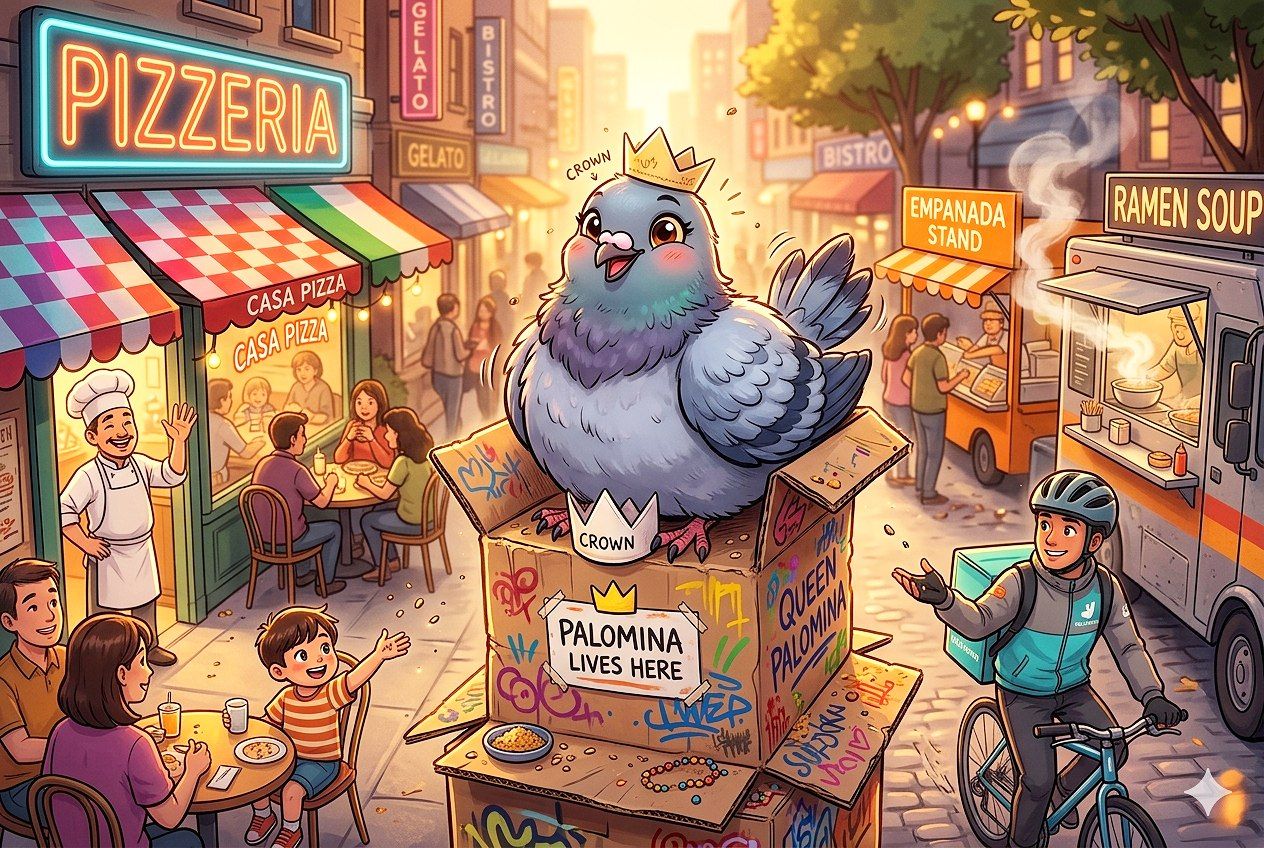
On a block whose name no one could quite remember—they simply called it “the block of smells”—restaurants of every kind lined the street: a neon-lit pizzeria, a small bistro with checkered tablecloths, an empanada stand open late, and a soup food truck sending fragrant steam into the air. There, among sidewalk tables and conversations that smelled of coffee, lived Palomina, a pigeon who had made a decision as practical as it was decisive: flying was for those who hadn’t tasted the joy of a good after-meal. Palomina had not been born with that vocation. In her youth she had taken to the sky, felt the wind beneath her wings, and known the freedom of the horizon. But one day, by chance, she flew over the pizzeria and was tempted by a rain of warm crumbs. It was one crumb at a time: the crunch of a crust, the sweetness of a forgotten cake crumb, the rich perfume of a piece of stew. Each bite made an unspoken contract with her stomach: “If abundance is served here, why waste energy on long journeys?” “Fly?” she would say now, settling on a cardboard box turned throne. “If the world is served on plates, better to be here to taste it.” Palomina perfected her craft with patience and creativity. She watched human routines: when the waiters left, when diners were distracted, which table was prone to carelessness. She discovered that speed wasn’t always the key; sometimes technique sufficed: setting a foot on the edge of a table, tilting her head with an offended air, emitting a soft coo of supplication, and waiting for the compassionate fork to offer a corner of bread. She learned to detect the exact instant a tray came down from the counter or when a family stood up, giving her access to the trash. Over time she no longer needed tricks and began to receive discreet invitations: a piece of croquette under a napkin, a crust hidden among serviettes, a tiny spoonful of rice falling as if it were for her. Her feathered companions looked at her with fascination and bewilderment. Celeste, an athletic pigeon with bright eyes, couldn’t understand the new philosophy. “Are you going to give up migration?” Celeste asked one morning, stretching her wings as if warming up for an adventure. “It’s not giving up,” Palomina replied, her belly still tight from breakfast. “It’s a strategic relocation. What good is crossing continents if there’s stew here?” Other pigeons, more practical, murmured, “That’s not a bird’s life,” but nobody could deny that Palomina had achieved an uncommon status: she was the most well-known pigeon on the block. Children sought her out like a local celebrity; delivery drivers tossed her crumbs as a sign of respect; a local chef nicknamed her “the feathered food critic” and left a small dish of mashed potatoes for her as a tribute. Sedentary life brought comforts and challenges. Comforts: she never feared rain or snow again, she had a soft box to sleep in, and constant access to varied delicacies. Challenges: her love of the table changed her body. Her short flights became little jerks; her wings, once nimble, now needed a bit more thrust. She began to walk the sidewalk with determined steps, sometimes doing a curious wobble children called “the happy pigeon sway.” On steeper slopes she practiced the “controlled roll” technique: she would tip over, roll downhill like a small ball, and rise with dignity, shaking her feathers as if she’d finished an exercise routine. One night, under the yellow light of the streetlamps and in front of the display window of a bakery sparkling with miniature pastries, Palomina saw her reflection. The figure in the glass was round and peaceful; her beak glinted with the grease from a recent croquette. “Do you think you’ll miss anything?” the reflected pigeon asked without moving her lips, because Palomina’s inner reflections often had a voice of their own. “Maybe the sky,” Palomina whispered. “But I also avoid colds, storm flights, and winter hunger.” Her reflection looked at her kindly. “Then continue,” the voice said. “But remember: the choices we make define us, and sometimes definitions can be stretched.” Word of the gourmet pigeon spread through the block like a persistent scent. A curious local journalist immortalized her in a column explaining that urban life had produced a hybrid creature: an animal that, for the love of food, had traded sky for pavement. The piece, read aloud by morning customers, brought admirers and critics alike. Some called the pigeon “brave” for reinventing herself; others accused her of being lazy. One afternoon, Celeste returned from migration with stories that seemed extraordinary: winds combing over mountains, northern lights dancing in the sky, and cities where buildings seemed to touch the stars. She landed beside Palomina with feathers still flecked with southern snow. “We flew over rivers that looked like silver ribbons,” Celeste said, eyes still holding the distance of the road. “The air brings a different memory.” Palomina looked at her, a piece of croissant in her beak. “I envy you,” she admitted honestly. “Your world is infinite. Mine is bounded by the last table and the food truck’s trash can. But mine has flavors you don’t know.” Celeste offered a feather as a symbol of what they shared. “Bring a story next time,” Palomina asked. “I promise to try what you bring if you try a bite of my garlic bread.” They both laughed. The conversation continued into the night, a mix of nostalgia and complicity. Celeste spoke of the grandeur of flight; Palomina spoke of the joy of a town that fed her. There were no reproaches, only recognition: different callings, equal dignity. Over time Palomina became more than an anecdote: she became the block’s memory. Children told her story at bedtime; waiters debated her between tables; tourists photographed her without really understanding why. Even restaurant owners, initially hostile, learned to include her: a small plate with leftovers at the bottom, a deliberately placed slice of bread, a corner of crust for the crowned feathered queen. Some did it out of affection; others for the little fame the pigeon attracted. Palomina tasted calmly. She learned unexpected combinations: a bite of empanada with a bit of salad for a vegetal crunch; a tiny portion of lasagna teaching the patience of layers; a sip of broth that recalled childhood soups. Each flavor carried an anecdote: the time she fell into a bowl of rice pudding and emerged dusted with cinnamon; the morning a girl offered her a whole grape; the winter an old man gave her biscotti crumbs dusted with sugar. Not everything was indulgence: she had visits from the neighborhood avian vet, a woman in a white coat who once picked her up and advised more walking and less food. Palomina listened carefully but not rigidly: she cut some bites, practiced longer walks, even tried wing-flapping exercises. She never regained her former agility, but she gained balance and awareness: she loved her life and wanted to care for it to keep enjoying it. One afternoon a boy asked her, curious: “Palomina, why don’t you fly like the other pigeons?” She cocked her head with the wisdom of someone who had made a choice and answered simply: “Because I found something that makes me happy. Flying is beautiful, yes; but so is eating with friends and having a place to sleep without worrying about the wind. Everyone seeks their own sky.” The boy nodded thoughtfully and gave her the last crumb of his snack. Palomina’s fame turned into an urban legend: some exaggerated her appetite, others told of acrobatic feats on tabletops, and others depicted her as an example of reinvention. The block adopted her. Someone painted a small sign: “Palomina lives here,” and stuck it on the corner of her box. A street artist painted her on a wall wearing a crown made of napkins. The moral of her life, if one wanted to extract it, did not come packaged in a single sentence. There were, however, woven messages: happiness takes different shapes; honest choices, however odd they may seem, deserve respect; and adaptation can be as much an act of courage as of comfort. Palomina had given up part of herself to embrace another, and she did it with pleasure and responsibility: she learned to walk, to take care of herself, to accept advice, and to return favors with companionship. On an afternoon when autumn painted the leaves gold, Palomina perched on her box, looked down the street, and said for anyone who would listen: “I’m not less of a pigeon for not flying all the time. I am a pigeon who chose her banquet and now shares the table.” And so, among laughter, controlled rolls, and tastings, the pigeon who decided to live on a street full of restaurants—and who as a result had grown a bit plump—remained an endearing character of the block: witness to meals, confidante of passersby, and, above all, proud defender of her favorite motto, spoken in a deep, contented voice: “full belly, happy heart.” Source of the images. Image created with Google Gemini.
No comments yet