 @mc5punk
Short story: The House of Generations
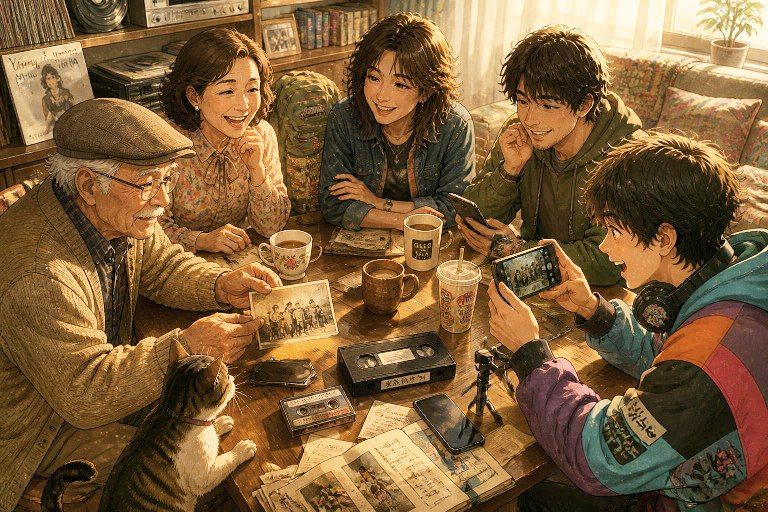
The grandmother’s house carried that smell of freshly baked bread that seemed to linger in the walls, like an ingrained memory. In the living room, the afternoon sun sliced through the curtains and made bands across a wooden table that had hosted more gatherings than any of the people present. Five people — and a cat with the air of an inspector — settled around that table for tea. Each held a different cup: a porcelain one with floral patterns, a thick earthenware mug, a ceramic cup with a local café sticker, a plastic cup with a sticker, and a thermal travel mug with a lid. It was a small geography of eras. Don Ernesto set his cup down with the solemnity of someone who keeps relics. His skin was weathered by the years, his hands those of a worker, and his gaze, when he remembered, seemed to move the room back to another decade. “Wait, you were born in 1930?” Marta asked, adjusting her scarf and placing her cup with the precision she used to place a vinyl on the turntable. “I can’t picture you without a hat.” Don Ernesto smiled, a mixture of pride and modesty. “Yes,” he said. “I’m from the Silent Generation. We watched TV in black and white, learned that not everything is urgent, and that sometimes it pays to listen before you speak. And above all, we learned to save. That doesn’t sound romantic, but it works.” Marta nodded, remembering, and Luis, who had arrived in a warm-colored shirt and with the easy assurance of someone who collects anecdotes, pulled out his phone as if to show a trophy. “I’m a Baby Boomer,” he said. “Born in 1950. I remember the Beatles playing on the radio all day and my mother telling me to turn it down because ‘they’ll hear it in the next block.’ I had posters everywhere; now I look for them and can’t find a single one,” he made a theatrical gesture. “And I knew the cassette: the art of rewinding with a pencil. That’s patience and practical sense combined.” Sofía came in with a worn canvas backpack, the kind that already carries stories. When she said her year, the conversation filled with images of tapes and remote controls that no longer worked. “Generation X,” she announced. “Born in 1975. I grew up with the first video games and VHS recorders. I have a birthday tape with effects that make us laugh now; my mother insisted it ‘wasn’t the same’ as digital things. It isn’t, but it has charm.” Diego, slouched on the sofa with messy hair and that almost physical urge to present the immediate, looked up from his phone. “Millennial,” he said. “1990. Yeah, I grew up with dial-up internet: the connection sound is my trauma and my anthem. Waiting for something to load teaches patience, but it also makes you… paranoid? Especially about passwords.” The door opened and Emma came in, wearing a hoodie in electric colors and headphones around her neck. She dropped her bag on the rack and announced: “Generation Z,” she said. “Born in 2001. TikToks, reels, and instant everything. If there’s something I don’t know, I learn it with a tutorial and a three-second dance.” The cat slid by and brushed the table, leaving it vibrating slightly. That vibration, which could have been a minor structural problem, read like complicity. Don Ernesto recalled in a low voice, throat softened by tea and years. “When I was young,” he said, “going out was the best social network. We met in the square, at the train station, or by the factory gate. If you wanted to know something, you asked the neighbor. There were no searches, there were conversations.” Sofía laughed, that laugh that mixes disbelief and affection. “Neighbor?” she asked. “Was that an app, Grandpa?” “Older,” Marta replied with a smile. “The neighbor was a real person who knew everything and sometimes less than you. But she always had important information: the recipe for pie, the gossip of the street, the remedy for a fever.” Luis lifted his cup as if to toast the objects that had accompanied them. “Each generation has its device,” he said. “We had the walkman, then the discman, then the iPod. You have endless playlists. But let’s be clear: the volume of the music always becomes a family argument. Nobody wins that debate.” Emma, with the impatience typical of immediacy, paused the song playing in her earbud and looked at the grandfather with genuine curiosity. “Grandpa, what’s a vinyl?” she asked, without irony. Don Ernesto fixed his gaze on the cup as if legitimizing a definition. “A vinyl is an elegant way to get an arm workout,” he said seriously. “And to show you have good taste. It also makes a special sound when a song ends and forces you to get up, walk over, and flip it. It’s a ritual.” Diego, who always ended up bridging past and present, was curious about each generation’s “inventions.” “What was the greatest invention of your generation?” he asked. “Something that really changed your lives?” Marta looked toward the window as if the colors of the neighborhood were appearing in memory. “The color television,” she said finally. “It was the first time we saw the colors of the world beyond memory. Suddenly the news wasn’t just voices; it was blue, red, green. It made us believe the world could be brighter.” Luis added, with a big gesture that invited memories of the square. “For me, the radio. The radio and music. We’d gather in the square and the music was enough. No batteries needed. There was a ritual too: waiting for the afternoon program, writing down the name of a song on a scrap of paper, and sharing it the next day.” Sofía, with the conspiratorial look of someone who remembers afternoons in front of a console, said: “Video games, even if they didn’t have hyper-real graphics. They were simple and brought us together in the living room. And recorders: you could capture a song at the exact time and make mixtapes. It was like making a personal letter without words.” Emma smiled, convinced her era was all about “right now.” “For us,” she said, “it’s immediacy. Everything is instant: learning, watching, sharing. But it’s also fun: in a minute you can learn an ‘80s dance move and make it viral. The funny thing is how something old becomes new again.” The conversation unfolded like a map of anecdotes. Luis told the story of when, as a young man, he took a friend to see a local band and then had to walk twenty kilometers because the last bus left early; he remembered it proudly. “We ended up singing until we collapsed from sleep,” he said. “And the next day at school, no one believed we’d walked back.” Sofía showed a home video (miraculously read from an old CD on the grandmother’s player). It was a birthday with lens effects, a tilted cake, and a child who, in innocence, ate the candle. They all laughed with the tenderness that only revived moments can bring. Emma, quickly as always, photographed the faded photo Don Ernesto had kept in his wallet for decades. “I’ll make a reel,” she announced. “But no filters, to respect the vintage authenticity.” They all looked at her and laughed: the gesture, though modern, was a tribute to the old. Don Ernesto extended the photo with hands that had held tools and books, loves and letters. “This is us at the neighborhood fair,” he said. “There were no filters, but plenty of desire to have fun. That night we danced until the cornet broke.” Marta, voice trembling slightly with emotion, added: “We don’t have the same music or the same devices, but we have anecdotes that recognize each other. The first kiss, the day your heart was broken, the ball that hit the neighbor’s roof, the punctured bikes... Small catastrophes that turn into stories.” Diego, looking at the cat now dozing on the back of the sofa, lifted his cup as if to seal a pact. “To generations,” he proposed. “Because what changes isn’t the intensity of our feelings, but the way we tell them.” They made a ceremonial, comic toast: no one drank like a movie toast, but everyone smiled as if they’d been understood. For a moment, the house seemed to shrink to better contain everything: memories, laughter, and differences. There were teachable moments amid laughter. Marta taught Emma how to brew traditional tea she’d learned from her mother, moving the tea bag like a metronome. Emma, in return, showed Marta how to adjust a photo’s brightness in an app. Marta looked at the screen in amazement and, seeing the result, said: “How marvelous. It’s like magic, but without fire.” Sofía took out an old tape and put it in the grandmother’s player. The sound was imperfect: crackle, a distant voice, a slightly off-key chord; yet every imperfection held warmth, like the worn edges of a beloved fabric. “These sounds,” Sofía said, “make you feel the music is alive. It’s not perfect, but it’s ours.” Laughter, confessions, and friendly reproaches mixed. Diego confessed he still keeps a notebook where he writes down passwords (a physical relic amid the cloud), and everyone joked about whether that was safer than remembering your childhood phone number. At one point the conversation grew more intimate. Don Ernesto looked at each of them with a clarity almost pedagogic. “Nostalgia,” he said slowly, “is not wanting to go back exactly. It’s wanting to rescue the good we had and understanding it can still teach us. But it’s not just about remembering; it’s about using what we learned. Keeping what matters and letting go of what weighs you down.” Emma, touched by her spontaneity, stroked the photo and added: “Sometimes I’m afraid everything will be forgotten. Digital things disappear if you don’t store them properly. I like to think the reel I make will be a bridge.” “And it will be,” Marta replied. “It’s not bad to use new forms to tell the old. The important thing is not to lose the story.” The cat stretched, bumped the plastic cup on the edge, and toppled it. Luckily it was plastic and all that happened was a loud clatter and laughter. Emma looked at the cat as if it had made the oldest joke in the world. “The cat is intergenerational,” she said. “You pet it and it makes you viral.” They all laughed and for a moment the idea of virality sounded less superficial and more like a search for validation: “Look at what it was, look at what we are.” Don Ernesto, with his calm, closed the afternoon with a line that surprised by its force. “Nostalgia is a time machine,” he said. “And laughter is the fuel.” They stayed a while longer. Marta asked someone to pass the radio, and for a while a song from her youth played; Sofía demonstrated an audio-editing trick on the old equipment, which responded like a miracle; Luis told another youth anecdote and Emma made a short video with fragments everyone admitted they liked. Before they said goodbye, they made an agreement that sounded like a promise: repeat the gathering. Marta suggested a karaoke with songs from every era; Luis offered to bring a retro cassette —with that smile of someone who knows he can—; Sofía said she’d bring a VHS converted to a modern file; Diego promised to prepare an intergenerational playlist and Emma, as always, added: “I’ll bring the charger. Don’t let the gathering die for lack of battery.” They laughed again. There were hugs that crossed generational differences like mere cloths. Goodbyes were long; no one seemed in a hurry to leave the warmth they had generated. The house fell silent, but it was not empty: phrases lingered in the air, little rhymes, remembered melodies, and the cat’s persistent purr. That afternoon, at that table with its varied cups, each person had brought their own century in the form of stories. In the end, they understood without saying that generations are not walls but overlapping layers, a shared archive holding not only objects but stories, mistakes, tenderness, and lessons. When the last streetlight went out and grandma closed the door, the murmur remained in the walls; nostalgia had settled in as a guest and laughter as a travel companion. Somewhere between the faded photos and the reels ready to post, there remained the certainty that, although forms change, the essential —the small catastrophes and the great affections— endures. Source of the images. Image created with Google Gemini.
No comments yet