 @mc5punk
Short story: THE SLOW BEAT
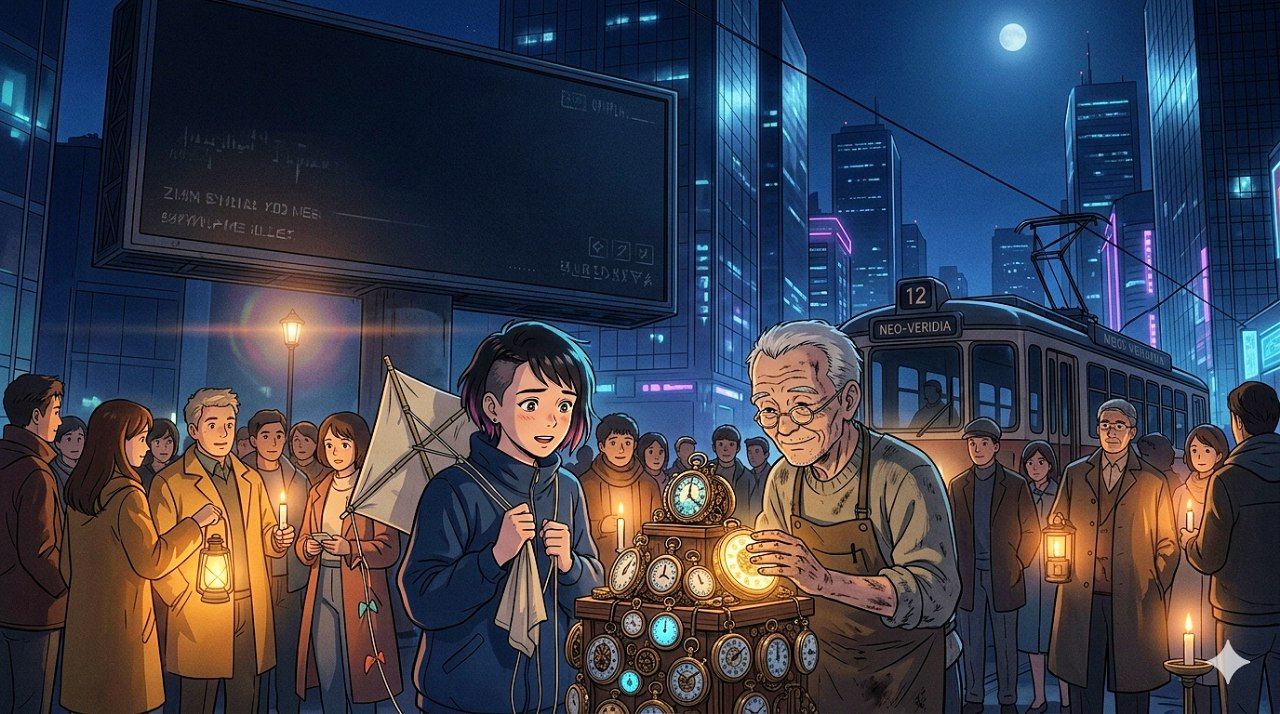
The city spread out like a slab of neon and glass, a translucent body lit by data running beneath the skin of the buildings. Advertisements breathed; their rhythms shifted with the collective mood. Trams floated without rails, and plazas projected curated memories to attract emotional tourists. In that landscape of glare and sensory modification lived Mara, a memory technician at ChronoWeave, the corporation that had industrialized nostalgia. Her job was to assemble fragments of life: take an authentic laugh, extract it from context, intensify it, pair it with an afternoon of rain or a fragrance, and sell it as a package — “First-Time Memories” — to those who paid to rewrite their past. Some wanted to erase grief without the rough edges; others asked to amplify an unremarkable childhood until it became a marketable product. Mara did it with artisanal precision and with the same anesthesia with which a surgeon repeats sutures. One night, at the editing console, she pasted the same clip three times without noticing. The clip was simple: a child calling for their mother from the stairs. She mixed it, adjusted the echo, boosted a few decibels, and attached a programmed scent. When she looked away from the monitor, her pulse was unchanged. The scene played perfectly on screen; inside her, it provoked nothing. "Is something wrong?" Iker, her colleague, asked. He wore a reflective fiber jacket and had hands broad as if born to hold consoles. "You pasted the same clip three times, Mara." She let out a sigh that sounded like a small crack in a data wall. "It's not that the years are speeding up," she said without looking at the screen. "It's that I'm not feeling them. Everything stays flat." Iker closed the machine's lid as if shutting off a device could switch off the sour sensation invading her. "You've been processing memories at 600x," he said, half joking, half warning. "Professional desensitization is real. Keep at it and you'll forget how things taste." Mara gave a smile that never fully formed. "I'm not sure 'forget' is the right word," she replied. "It's like my brain has stopped registering life with clarity. I spend my days stitching deep memories for others and when I return to my own, it's blurred. Years collapse into a constant blur." That night, after leaving the prismatic office building where ChronoWeave was housed, Mara walked through streets that seemed to float on pools of data. Facades projected looped scenes: a wedding made unforgettable, an intensified sunset, a celebrity smile anyone could synchronize their own memories to. A continuous training of the senses — notifications, micro-stimuli, calibrated rewards — slid people's attention like oil over an inclined surface. The voices from urban speakers seemed to shrink them: "New remembrances package — 40% emotional intensity — aroma optional." She thought of her mother. She remembered a teacup in a humble kitchen, a hopeful flutter in wrinkled hands; the image blinked and lost color. It was there, but like an underexposed slide. Mara stopped, pressed her hand to the glass of a storefront, and saw in her reflection a woman who did not return the burning certainty of her own story. The next day she did not return to the lab. It wasn't an impulsive decision but an urgency: to seek something her work couldn't sell or repair. She wanted novelty without filters, danger without metrics, the imprecise texture of an experience that could not be tagged with keywords. She got lost in the city's periphery, where data thinned and structures were patchworks of a past some called "preconnected." There, under a worn awning in a market, she found a watch stall. The gears were small universes insisting on beating without registering on a server. The woman behind the counter had paper-brightened skin and eyes that seemed to have learned to count silences. "Good day," the woman said, her voice without artificial attention-grabbing. "Are you looking for time or appearances?" Mara was surprised by the question. "Maybe both," she answered, unwilling to lie. "I feel like time is slipping away." The woman smiled like someone sharing clandestine knowledge. "My name is Abril," she said. "Before there were apps to edit memories, I made watches because I believed time deserved a hand and some resistance. Now I sell watches like one used to sell stories. Come in, there's coffee." She accepted the coffee, which tasted of old roast and something that didn't sell duration: conversation. Abril handed her a cup without haste and pointed to a table in the corner. "Tell me something," Abril requested, leaning forward. "What's the last memory you can touch with your fingers, unedited, unretouched?" Mara closed her eyes. Fragments appeared: the old kitchen, the scrape of a table, the feel of a letter between her mother's fingers. The image was faded, as if missing brushstrokes. "It feels distant," she confessed. "As if someone erased the texture. There's no roughness, no warmth." Abril nodded without surprise. "We live in an era of too much stimulus and too little presence," she said, in the voice of someone who lists wounds she's seen. "A life fragmented by interruptions. An infinite scroll that never becomes memory. Notifications aren't milestones, and mere survival doesn't build a story. The key is depth: you haven't lived less time, you've lived with less depth." Mara, sipping the coffee, felt the phrase pierce her. It wasn't a generalized complaint but a clinical statement diagnosing her own numbness. Abril added as if confiding: "Time expands with focus, novelty, and meaning. It compresses with stress, distraction, and repetition." The word "novelty" rang like a bell. Mara thought of the sensory implant behind her ear — a thin ring that modulated input, increased dopamine on demand, allowed pain to be paused like an app. It was discreet, legal, profitable. Many technicians at ChronoWeave used it to maintain efficiency: the brain wouldn't saturate, and pieces could be stitched without the interference of their own memories. Abril watched her and said, almost without asking permission: "If you want, try something. Turn the ring off for a while. Sometimes losing the network is the only way to feel height in a fall." Mara hesitated. Turning off the implant was a professional risk and a temporary loss of instant access to information. Yet the promise of an untampered sensation pushed her. She took the offered cloth and, when she touched the ring, felt a metallic chill. She pressed the disconnect button. The silence that followed was unlike anything she'd known: not emptiness, but a surface where sound unfolded with honesty. Footsteps on the sidewalk had interiors; cars didn't blend into a hullabaloo; voices had edges, unamplified and unmuted. She walked without a map through neighborhoods she'd never seen. There were no ads whispering offers into her ear, assaulting her with emotional packages. In a park, children flew cloth kites, not holograms or drones spinning "perfect moments." She watched a girl drop her kite and, without ceremony, pick it up and offer it to Mara. "Take it," the girl said. "It's for you." The gesture asked for no return. Mara took the kite in her hands and for the first time in months felt her breathing slow; seconds stretched and became tangible. The texture of the cloth, the closeness of a laugh, the park's scent — all happened with no need for digital validation. For a brief, clear instant, the feeling of living became an object in her hands. That night, back in her apartment, notifications had stacked on her device: work messages, offers promising to "optimize your experience," a reminder to complete a client's package. She glanced at them and let them vibrate without responding. The decision not to answer was another small act of rebellion. In the following weeks she ran a deliberate experiment. Mara turned off the implant for increasingly long stretches. She took aimless routes, spoke with strangers without logging the exchange in her neural diary, learned to stretch hours without falling into the trap of immediate editing. Some days she went back to the lab; others she didn't. With every act of full attention, time ballooned, like a camera capturing more light. ChronoWeave soon noticed the drop in her productivity and summoned her for evaluation. "We've observed a decline in your delivery index," the supervisor said from a glass booth, voice calculated. "Your lapses affect the flow. We need you to normalize your performance." Mara held her composure. "I don't want to keep delivering memories that leave people hollow," she replied. "I think they mistake survival for life. Notifications have replaced milestones." The supervisor frowned, unable to grasp the emotional dimension behind a data drop. "Attention is a resource," she said in the jargon of someone who understands economies. "Protecting it is inefficient. If everyone decides when to listen, the market collapses." Mara left the booth with reinforced certainty: something more than numbers was at stake; the relation between attention and human dignity was eroding. Abril, who'd been keeping tabs through peripheral channels, arrived with a box wrapped in creased paper. Her hands moved with the practiced touch of someone who's repaired things for decades. "This is mine," she explained, placing the box on the table. "Not therapy gear, not a certified model. It's an interruption generator. It doesn't make calibrated stimuli; it makes real failures. A power outage, a false horoscope, an unexpected rain in a systemless zone. Accidents, controlled." Mara opened the box. Inside was a small mechanical device, imperfect, with a red button that sparked when touched. Its visible parts spun in jerks; it was deliberately inefficient: not networked, no security patches. Abril explained the method. "Novelty isn't manufactured by perfection. It arises from risk and the impossibility of prediction. When something fails, people look each other in the eye. When there's friction, narrative is born." Mara installed the device in her apartment. On activation, it triggered the first interruption: the lights went out for exactly four minutes. The silence that followed felt different. No panic arose — the residents were used to drills; instead there were conversations. Her neighbor Ram, a data technician, knocked to check if she was okay. They sat in the hallway and spoke for over half an hour about their childhoods, what they disliked about their work, a song neither remembered until they sang it together. The exchange was long and camera-free. The interruption had turned a common space into a place of story. That was the point: absence forced attention and attention created memory. Over time, Mara began secretly offering clients a different service. Instead of polishing memories into immaculate artifacts, she taught them how to enter scenes without filters; she proposed "slow-living" exercises: spend an afternoon in silence without recording, cook a meal without background music, walk through an unknown neighborhood without headphones, talk to someone without interrupting. Demand was initially low. Some clients wanted the comforting interpolation that let them relive glory without pain. Others, more desperate, cried when asked to feel without masking. A former celebrity broke off a session halfway through because truth overwhelmed her: her unedited childhood was both painful and beautiful. Iker, worried for his job and the team's coherence, visited Mara one afternoon during her new decompression routine. "I don't get it," he said. "You become more human and the company fires you. Is it worth it?" Mara rested her forehead on the table and looked at her own hands, marked by work with magnetic tapes and adhesives. "It's worth it," she said with resolve. "Time compresses with stress, distraction, and repetition. If we don't protect our attention we lose life in invisible installments. Living slowly isn't a romantic luxury; it's an act of rebellion. I don't know if it'll change laws or prevent anyone from losing money, but it's something we can reclaim." Iker listened, thought, and within days began shutting off his implant for brief moments each day. He didn't announce it; he didn't need to. Small gestures spread like a silent resistance. The corporate response was swift. ChronoWeave declared the practice of "inducing interruptions" hazardous to consumers' emotional stability and the market's predictability. A campaign erupted: "Safe memories for safe lives." The tone was paternalistic. For Mara it meant her work permit would be revoked and her professional license reviewed. In the central plaza, where curated memory montages usually played, the unthinkable happened. A massive network failure — not scheduled, perhaps sabotage by someone curious about the outcome — plunged the city into prolonged darkness. LED panels died in unison. Digital clocks froze. For many it was a minor chaos; for others, a revelation. Abril arrived early with a dozen mechanical watches — her creations — and placed them on the central podium. The tic-tac concert spread through the plaza: an organic murmur no one had ordered. At first people looked bewildered; then, as if everyone had rediscovered a forgotten symphony, their faces began to change. Conversations started, messy and human: questions about when someone last laughed without recording it, confessions of unwept losses, stories that didn't want to become content. A child asked why the lights had died and his mother told him that sometimes things must be off to learn to see. Mara, among the crowd, felt the outage open a crack in routine: for hours, life wasn't measured in metrics or likes; it was measured in what could be felt by the body. Conversations weren't efficient or optimized, but they were rich. For her it was a small, definitive victory: the city finally stopped scrolling without leaving a trace. Predictable political repercussions followed. Data analysts spoke of losses, risks, and the need to reinforce emotional stability. Commentators demanded stricter regulations. Yet, in practice, something shifted: small groups organized "watch nights," where people gathered device-free to listen to tick-tocks and tell stories. Basements hosted workshops on "unintervened memory," where people learned to narrate their pasts without technological intermediaries. Social platforms, incapable of capturing that experience, continued their usual noise; but beneath the surface a subculture valuing duration over immediacy grew. Mara, now without the security of her former job and with nights full of thought, wrote her own memory file without algorithmic intervention. It wasn't a polished piece or a profitable product: it was a long letter addressed to a child she might have someday, to those she wanted to spare from attention's commercial web. The letter described sensations plainly: the smell of tea, the pressure of rain on the nape, Abril's hand creases, the way morning light seeped through a shutter. She handed it over with no pretense of immortality; she gave it so someone might read slowly. There were moments of doubt. Some argued nostalgia couldn't be genuine once commercialized. Others maintained the world couldn't function without the efficiency memory technologies provided: hospitals needing speed to adjust trauma memories, patients requiring immediate interventions. Mara acknowledged those truths. Her aim wasn't to obliterate technology but to set humane limits: protect the right to deliberate distraction, create space for unmonetized experience. Years passed. The city does not forget easily; it adapts. ChronoWeave didn't vanish; it changed its offerings, beefed up security, and sued vendors of uncertified interruptions. Abril aged with the calm of someone who built resilience with watches. Mara had children — not to provide them a flawless archive but to teach them to listen to the tick. Iker returned to the company with the discretion of someone who had learned to switch his ring off for a few minutes each day. Ram, the neighbor, started a local radio that aired uncurated memory pieces. The collective pulse slowed in some neighborhoods and sped up in others; the city kept its extremes. But in tucked-away workshops and nights when artificial lights stopped for a second, some people gave themselves permission to feel. It was not a total revolution; it was a quiet mutation. They learned novelty cannot be bought in boxed packages: it must be earned through the risk of speaking, the awkwardness of listening, and the impossibility of editing while it happens. In Abril's workshop, Mara and the old woman often sat watching a watch that didn't hurry. Their hands worked on tiny parts, filing, gearing, oiling with care. Outside, the city rebooted its programmed screens; inside, a hand advanced with the stubbornness of a human heart. "Do you think we achieved anything?" Mara asked one afternoon, her voice full of a calm that sought not redemption but verification. Her fingers toyed with an escape wheel. Abril set down the cloth and fixed Mara with a light gaze, like someone who has accumulated years yet still doesn't take the miracle of persistence for granted. "I don't know," she replied. "I don't believe in dramatic endings. I believe in accumulations. In small calls to attention that, if repeated, change the landscape. Time didn't speed us up. They desensitized us. And now, at least, some people have learned to feel again." Mara smiled. She took the watch's hand, held it between her fingers, and for a moment let it vibrate. It was a minimal sound, but whole. Outside, the city kept spinning — fast, luminous, voracious —; inside, the slow beat persisted, an insistence that required no one's permission to exist. Source of the images. Image created with Google Gemini.
No comments yet