 @mc5punk
Short story: Broken Mirrors
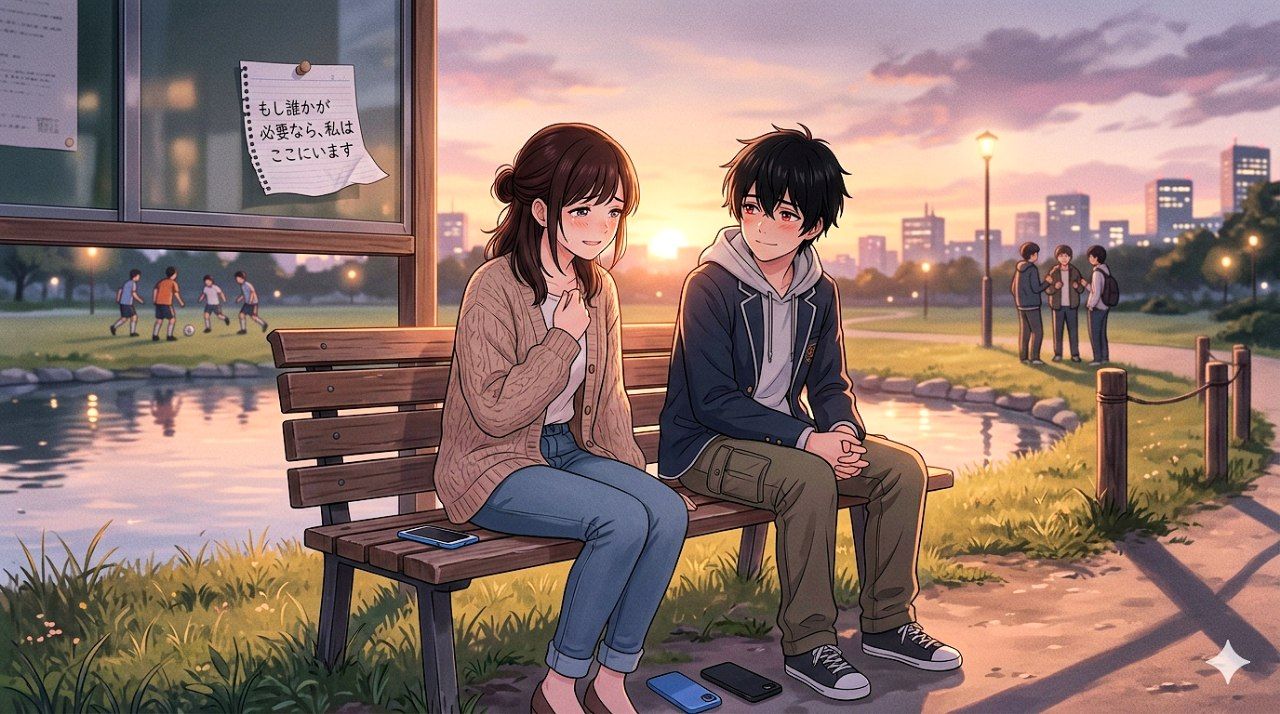
The news arrived without warning: a pop-up forcing the screen’s glow to compete with the darkness of the room. Lara set the phone on her quilt and, still with the blue light ringing in her retinas, read the headline like someone hearing a sentence: ALERTA SALUD. Below, in smaller but equally harsh type, the UN warned of a severe deterioration in young people’s mental health worldwide. A report from the United Nations Development Programme noted that since 2012 young people’s emotional well‑being had fallen alarmingly, especially affecting women and girls. One in seven young people experienced mental health problems; suicide was the third leading cause of death among people aged 15 to 29. The report linked the phenomenon to accelerated digitalization, earlier access to smartphones and social networks, associating it with higher levels of anxiety, depression, and suicidal thoughts. Lara closed her eyes and the news did not go away. It stayed lodged in her chest like a stone that could not find a channel. She was twenty‑two, and in her room the silences had the metallic texture of notifications that never came. On the wall, photographs hung with washi tape showing filtered versions of her life: fixed smiles, hands holding coffee, sunsets with exaggerated colors. Each image was a performative decision: what to show, what to hide, what to repeat until it became true. Later, her mother Marta opened the door and sat at the edge of the bed without hurry. The hall light outlined her profile; her voice was practical at first, then cautious. “I saw the report on TV,” Marta said, looking at the phone on the quilt. “They were saying… it affects a lot of young girls.” Lara put her hands over her face as if she wanted to erase something she did not know how to name. “It’s not just that it affects us,” she replied in a small voice. “It forces us to exist for others. I measure my day in likes and my relationships in stories that last twenty‑four hours. If no one reacts, I feel unreal.” Marta sighed and searched for the child she once knew with absolute trust. “When we were young,” Marta said, “wounds were seen and healed in company. We cried at a friend’s house, grandma made soup, we talked until dawn. There were no filters that perfected sadness. But I don’t want to romanticize: I’m not saying it was better—just different. Pain has always existed, but now it has a loudspeaker that amplifies the worst.” Lara thought about the loneliness of being surrounded by virtual people. Not being able to take the phone out of bed without feeling like the circulation of her own worth was failing. Her voice coiled when she tried to explain something that made her feel guilty for simply breathing. “Sometimes I look at myself and don’t recognize the person in the photos,” she murmured. “I force myself to look happy, write clever things, not make others uncomfortable. But inside everything is small and cold.” Marta squeezed her hand as if words could be translated into a gesture. “I believe you,” she said. “I don’t know how to fix algorithms, but I know how to listen. And if mothers can do one thing, it’s be present.” Meanwhile, several kilometers away at a central high school, Álex adjusted his backpack with a mix of sleep and routine. Sixteen, messy hair, headphones that sometimes served as a shield. Stories arrived at him in chains: notes about the report, memes mocking it, adult arguments that felt more like accusation than invitation to understand. In the staffroom, a school flyer announced a talk: “Youth mental health: talk to accompany.” The news had done what news do: force the school to address what had been ignored. The school psychologist, Clara, was tall, with a steady voice, and had spent years observing subtle changes that the report now put plainly before everyone like a red carpet no one wanted to step on. Entering the classroom, her presence produced that silence that happens when a bandage is suddenly removed and the view is exposed. “Today I’m not going to give you a lesson,” Clara said. “I want this to be a space for talking—not for judging or saying ‘everything’s fine.’ I want you to listen and to be listened to.” Álex looked at her with some distrust; to him the school was a circuit of classes and exams, not a place to expose vulnerability. Still, something in Clara’s use of “we” made him raise his hand. “Why do I feel like I pretend all the time?” he asked, voice breaking. “I post photos with people I don’t actually see much, I read comments that tear me down, then laugh with GIFs so no one notices I’m hurt. Sometimes I don’t know who I am outside of that.” Clara looked at him without pity or surprise, with the professionalism that comes from seeing many similar stories without becoming cold. “What you describe is wear,” she answered. “It’s not cowardice or a moral failing. It’s the effect of living in an environment where constant exposure turns your inner states into marketable goods. When your emotion is subject to metrics—likes, views, reactions—you learn to calibrate it to keep acceptance. That doesn’t make you sick overnight, but it makes the ground slippery. The report gives numbers, but behind every figure there are people like you who deserve to be heard.” There was an odd energy in the room: relief at being allowed to say it and fear because saying it meant receiving an answer that might not be what they hoped. Fingers tapping on backpack straps vibrated with silent messages some read on their screens at the same time. After class, in the park across from the school, the air smelled of mown grass and unkept promises. By chance, Lara and Álex met: a mutual friend had introduced them after a community meeting. Lara had gone out to walk to turn off the screen and not her mind; Álex wanted to see if it was possible to converse without subtitles. “Hi,” Álex said, extending his hand without knowing whether a greeting still meant anything real. “Lara,” she answered, returning the handshake with a laugh that tried to be natural but stuck for a moment. “Did you come because you were tired of notifications too?” They sat on a bench overlooking a pond where some teens fed ducks with leftover bread. Placing the phone on the grass was, for both, a tacit declaration: an experiment in presence. “Sometimes my life feels like a song I have to play without mistakes,” Lara said. “When people change the volume, I feel my rhythm fail. I compare myself to edited profiles, to hours that aren’t mine. I post and then wait for approval. It’s a silence that chews.” Álex looked surprised that her words matched what he had been unable to explain at home. “I do the same,” he confessed. “I post things that don’t show my bad mornings. I’m afraid that if I show I struggle, people will stop looking. We’re all a network of mutual omissions.” They laughed; the laugh was cathartic. Saying things aloud let the words unfold and lose some of their strangling power. “Do you think anything can change?” Lara asked. “Adults sign papers and the algorithms stay the same.” “I don’t know,” Álex answered honestly. “Maybe we can’t stop the technology, but we can learn not to let it shape us entirely. Maybe start with small acts: screen‑free gatherings, set times to disconnect, conversations where we don’t feel obliged to ‘perform’ an image.” They shared a silence that was not empty but a shared room where someone else held a similar weight. It was a faint but real relief. Days passed quickly, and as if life needed to validate its worst fears, the news everyone dreaded arrived: Bruno, a teammate of Álex’s, had attempted to take his life. The words reached the group like a gruesome notification: “I’m sorry. I can’t keep going.” The friend group was in shock; nobody had perceived the silent scream. The crack had not been visible. Marta learned by a message that reached Lara’s family. That night, in the kitchen, the sound of the frying pan was a near heartbeat marking the house’s pulse. Marta sat with hands wrapped around a cold cup of tea. “I didn’t know what to do,” she admitted softly. “I thought it was just a phase, that it would pass. And now…” Lara found her in the hallway and hugged her desperately. “If we had known earlier…” she whispered. “Don’t blame yourself,” Marta said firmly but with old sorrow. “No one has a manual for this. What we can do now is be.” Bruno’s attempt worked as an incision revealing the rawness beneath what had previously been patched with notifications. The school organized meetings with family, psychologist Clara intensified sessions, and community listening spaces were opened: a municipal room, support groups, and a volunteer‑staffed helpline. The community reacted—clumsily at times, with sensitivity at others—showing that empathy can be taught. In one afternoon of those meetings, Marta decided to take part as a mother figure. She sat in a semicircle in front of youths who came wary but with a mixture of curiosity and need that cannot be denied. Marta spoke with the voice of someone who had learned to listen and not to offer quick fixes. “I’m a mother,” she said to the group. “I don’t understand many apps or how algorithms decide what appears and what doesn’t. But I know how to recognize when a person goes dim: they laugh less at the table, forget their plate, go out less. I learned to pay attention to signals that say ‘something’s wrong.’ Technology isn’t all to blame; it just exposes what we live. We can learn to accompany one another.” A seventeen‑year‑old girl spoke up with held breath. “Sometimes the only thing I ask is that you believe me,” she said. “Don’t tell me ‘it’s just a phase’ or ‘it’s adolescence.’ When no one believes you, you start lying to yourself until you get used to it.” Clara added with both professionalism and tenderness: “Digitalization accelerates processes. It doesn’t invent sadness, but it amplifies it: allows comparison in real time, magnifies rejection, and disguises loneliness as connection. The UN report gives us numbers—one in seven—but behind that figure are names and voices that require presence.” The conversation was long; silences were as important as words. A father confessed with a broken voice that he didn’t know how to approach his daughter because each attempt ended in misunderstandings and closed doors. A young woman revealed she composed upbeat posts precisely when she most needed help so as not to burden others. Every testimony revealed a wound and a possibility for repair: attention, listening, accompaniment. From those meetings concrete initiatives emerged. The school integrated “emotional and digital literacy” workshops into the curriculum: how to recognize signs of suffering, regulation practices, setting screen boundaries, and presence exercises. The municipality funded a free helpline for youth with nowhere else to turn. Youth groups organized “no‑post nights”—in‑person gatherings where the sole rule was no phone use for an hour. The early gatherings were awkward. The habit of checking screens was so ingrained that hands reached pockets by reflex. Sometimes someone broke the rule and tension spiked. But persistence turned awkwardness into new habits: laughter without background noise, looks that could be held without consuming them, stories shared with no cameras demanding staged authenticity. Bruno, after a long painful process, returned to the field on afternoons when his smile was fragile but present. Nothing was solved; there were hard days and relapses. But his presence, tentative and gentle, was tangible proof that change was possible when professional support and caring networks combined. Lara continued learning what she needed. She established digital boundaries: turning off notifications, agreeing on screen‑free times, choosing whom to share intimate things with. She started a private journal with no thought of anyone else reading it. Over time the practice helped her tell apart the public version of her life from what truly mattered. She didn’t erase her photos; she grew selective about what she posted and how much energy she spent on others’ opinions. Álex organized park gatherings with friends to discuss books, films, and the experience of being young in a world that demands performance. They began small and grew. Some nights no one spoke and company was enough. Other times they spoke of guilt, identity, and the pressure to project an unbroken life. Together they learned to ask and answer without judgment. A year after the headline flashed on Lara’s screen, the city showed modest but meaningful changes. Schools made emotional well‑being protocols part of routine—not as a media trend but as sustained practice: listening days, family resources, ongoing workshops. The local government added youth mental health promoters in community centers and youth organizations began receiving small grants for meet‑ups and support projects. None of that erased the report’s cold number—one in seven. The statistics remained, a reminder that the problem is systemic and solutions cannot rest solely on individuals. But the conversation had shifted: it was no longer only about blaming technology or lamenting shared loneliness. It was about building ways of life that integrate technology without letting it define self‑worth. One autumn afternoon, on the sofa, Marta and Lara shared a simple scene: a book, a cup of tea, and the quiet of not needing to document every gesture. Marta looked at her daughter and, without melodrama, said: “I can’t promise this will be easy. What I can promise is that I see you—not only how you present yourself but how you are when no one’s watching.” Lara rested her head on her mother’s shoulder and felt a security that didn’t depend on others’ reactions. Being seen without judgment became a reparative space; it did not cure everything at once but wove a net of containment. At the park bulletin board, Álex found Bruno practicing soccer with a group that greeted him without morbid curiosity and with practical care. Bruno smiled—small and tentative but his own. At the end he sat and said softly: “There were moments I thought I didn’t want to be here. It wasn’t that I didn’t want to live, but that I couldn’t carry what they asked me to be. Thanks for being there when I needed it.” Álex felt deep relief. There were no heroics, no perfect endings—only everyday presences that held. The city of broken mirrors did not stop reflecting altered profiles or producing anxiety. The networks still ran algorithms; screens remained temptations and many young people continued to struggle with exposure. But the community response had added a new dimension: sustained attention. They learned that figures only change when society decides to listen without judgment, create safe spaces, and fund resources that don’t collapse with the next news cycle. In the final scene, on a mild spring day, Lara wrote on a plain sheet: “If anyone needs me, I’ll be here.” Her handwriting was human and trembling. She pinned the note to the park’s board, where it wasn’t meant to attract likes but company. The gesture was simple, small, and unpretentious: an outstretched hand in a still‑fragmented landscape. The story does not end with a perfect epilogue: the statistic remains a somber reminder, and the struggle continues. But something else emerged—discreet and powerful: the certainty that presence matters, that listening saves, and that authentic connections, though fragile, can mend seemingly irreparable cracks. In a world of mirrors and screens, some chose to learn how to look each other in the eye. That choice became, for many, the beginning of a possible cure. Source of the images. Image created with Google Gemini.
No comments yet