 @mc5punk
Short story: Jazz Conditioned
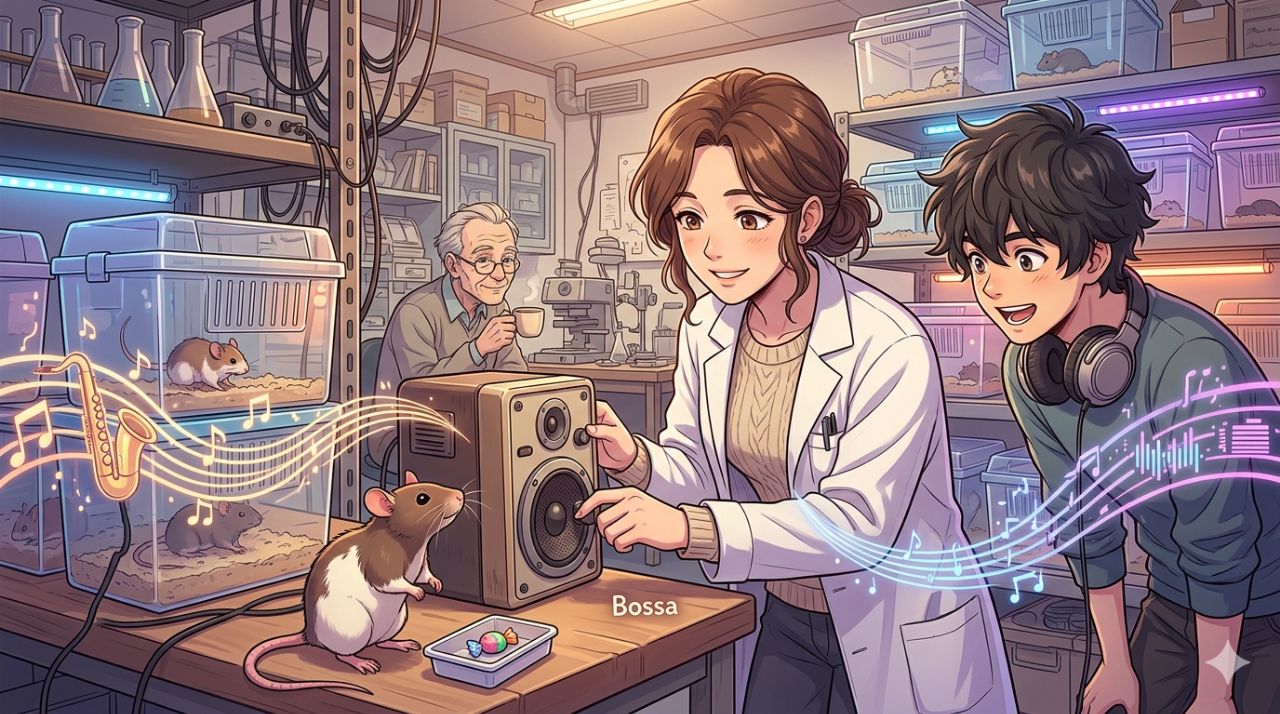
In the heart of the Cronos Institute, behind a door labeled with a saxophone sticker and the word CAUTION, sat the Sound Laboratory. There, among tangled cables and shelves full of transparent cages, Dr. Sofía Márquez reviewed the protocol with the seriousness of someone tuning a concert. When she exchanged glances with her team, scientific certainty mingled with a curiosity that sometimes bordered on mischief. “Ready to turn science into a pop hit?” asked Leo, the technician, rolling up his sleeves as if he were about to take the stage. Sofía smiled and adjusted the field microphone that would record the responses. To her left, Professor Emilio Roca, a neurologist in semi-retirement who still came to the lab out of habit, watched with a steaming cup of coffee in hand. “If by ‘hit’ you mean an uncomfortable revelation about free will, then yes,” she replied. “Play jazz.” From the main speaker came a moist, slow saxophone solo, the notes brushing the air of the lab. The rats, arranged in their compartments, barely moved; they closed their eyes, curled up together, and in that calm it was almost possible to imagine they were listening to a symphony made for tiny ears. The monitors promptly showed the usual pattern: preference for silence and occasional spikes in response to classical music. “I always said good music is the kind that makes you think, not the kind that forces you to wag your tail,” Roca grumbled, half joking, half serious. Sofía offered him a cookie with a conciliatory gesture and continued. It was time to introduce the experiment’s variable X: Reward-7, a candy designed to produce a measured, uniform pleasurable reaction. The hypothesis was simple: if the music was consistently paired with a reward, the brain would associate the two stimuli. “Here comes the fun part,” she announced. “When jazz plays, a small portion of Reward-7 will appear on the tray. We’ll repeat the cycle several times a day for a week.” The first sessions were almost ceremonial. Each time the jazz sounded, a tiny gate released the candy. A particular rat, whom Leo had nicknamed Bossa for the calm she’d shown in preliminary tests when bossa nova played, sniffed the sweet, licked its edges, and let out a small chirp the interface translated as pleasure. The graphs showed spikes: synapses firing, reward circuits forming. Over the days the correlation became clearer. The rats began approaching the speaker at the first bars of jazz, like pilgrims to a sonic relic. Leo, inclined to turn science into entertainment, fantasized aloud. “I programmed a 24/7 playlist for rodents! Imagine festivals with seed discounts,” he said, provoking a laugh. Sofía, however, maintained a reflective tone. “Careful not to turn observations into spectacle. This association doesn’t mean the rats now ‘prefer’ jazz for aesthetic reasons; it means they learned to link a sound cue to a reward.” The experiment continued. After a week of pairings, the candies stopped appearing; the team expected the response to fade. But, contrary to conservative predictions, the rats maintained their behavior: when jazz played they returned to the grill by the speaker, searched the folds of the enclosure where the rewards used to appear and, in many cases, seemed to emit small sounds humans interpreted as a kind of humming. One afternoon, Roca set his cup on the table and approached the glass, mouth open. “What… what are they doing?” he asked, not understanding how a conditioned behavior persisted without the rewarding stimulus. “Associative memory,” said Sofía. “The brain filed jazz as a predictor of something pleasurable. When it hears that cue, circuits anticipating reward activate; the behavior repeats out of expectation.” “What if we push it further?” Leo proposed with bright eyes. “Could we program preferences in humans? Would that be manipulation or therapy?” The question hung heavy in the air. That night, in a nearby café, the three discussed at length. Toasts cooled as they debated the philosophical, ethical, and practical implications of their finding. “If small rats learn to desire by association, how many of our ‘preferences’ are merely shadows of past rewards?” Roca wondered. “Music, foods, places…” “Or worse,” said Leo, “what if a company decides to mass-produce Reward-7 and sell us tastes to subscribers? Imagine a platform that ‘teaches’ you to love a brand with auditory cues and rewards. A market for cravings.” Sofía let out a laugh with an edge of concern. “That’s the science-fiction part bleeding into science. Our work should help understand and heal, not create more programmable consumers.” The following week, when a technician unplugged and reconnected a poorly soldered cable, something unexpected happened: the speaker, for a second, emitted an unplanned signal, a frequency none of them recognized. The wave passed through the cages like an electric sigh; the rats reacted with a simultaneous movement that looked choreographed. Their tiny paws traced shapes on the floor, little lines of memory no one had taught them. It was a moment both comic and sublime: rats dancing to a tune that sounded like it came from another galaxy. “What the hell was that?” Leo asked, half laughing. Roca, in his most scientific manner, wrote in his notebook: “Unexpected resonance effect. Potential use in motor rehabilitation.” Bossa, the curious little rat, stepped forward and, with a naturalness only nonhuman creatures possess, pushed Leo’s headphones toward the grate. The gesture was so direct Leo was left speechless. “Is she returning the music to me?” he murmured, moved. Sofía watched and felt the observer-observed dynamic begin to invert. The rats, conditioned by rewards, now exerted influence: with subtle motions they indicated a preference for a playlist that blended jazz with synthesizers—something like sidereal jazz. The humans responded by adjusting lights, aromas, and textures to see whether behavior would change. Soon the lab had become a peculiar experimental club where both sides co-designed the atmosphere. As the project advanced, the team’s conversations deepened. One rainy afternoon, while they reduced the sugar concentration in Reward-7 to measure the association’s robustness, Professor Roca made an observation that resonated gravely. “What we observe is not just neuroplasticity,” he said. “It’s an economy of desire. The brain catalogs cues and turns them into demand. If we can manipulate that ethically, we could help people with addictions by pairing healthy stimuli with rewards. If not, we’re inventing markets for cravings.” Sofía nodded, thoughtful. “Ethics must lead curiosity. Understanding how desire forms is a tool. In wise hands it heals; in greedy hands it exploits.” Meanwhile, Bossa and the other rats continued in their role as inadvertent teachers. In a particularly quiet trial, Bossa climbed a lever by accident and released a high, perfectly pure note, crystalline as glass. The lab fell silent and for a moment no one breathed. The note resonated and left on the wall the vibration of something essential: a simple, hard truth. The experiment made local headlines with a sensationalist headline that reduced months of work to a colorful phrase. “Rats love jazz for sweets: will humans follow the trend?” the papers asked. Social networks soon filled with memes of rats wearing sunglasses and tiny saxophones. The team, more tired than annoyed, shared a laugh and accepted the inevitable trivialization. But in the institute’s halls and in the lab notebooks there remained other things: detailed graphs, technical observations, timelines with curves showing consolidation of associative memories. Beyond the joke, the team knew their finding opened a door between neuroscience and applied ethics. As the project matured, they implemented “detachment” sessions: neutral music, alternative rewards, and exercises to weaken associations. They discovered the bond could be redirected: pairing jazz with neutral or even unpleasant stimuli reduced the response; pairing healthier melodies with non-food rewards—warm lights, pleasant textures—could encourage beneficial behaviors. They had found a form of reprogramming—not of essence, but of habit. One night, while closing the lab, Sofía deliberately placed a record of classical music on the turntable, a small gesture of respect for the rats’ original preferences before the experiment. On her desk she left a tray with two candies: one for Bossa and another symbolic one she would not eat. Before turning off the lights she walked past the cages and whispered: “Good job today. Let’s not let the data turn us into mere consumers of astonishment.” Bossa took her candy and, between bites, made a movement so slight it seemed like a wink. In that gesture there was something akin to gratitude—not human thanks, but a response that said, “I learned to desire; now I can learn to choose.” In the days that followed there was more work, ethical reviews, and proposals to apply the findings to human addiction therapies. The lab received visits from psychologists, therapists, and a couple of advertisers who, fortunately, remained in the corridor. Discussions grew political: grants, regulation, limits. In those meetings the comic anecdote of rats with the soul of music critics persisted, but it was no longer central; the core question was more complex: what do we do when we know how to shape desire? In the project’s final field journal entry, Sofía wrote: “The experiment showed us that desire is not entirely spontaneous; it is, to a large extent, a construction. That doesn’t invalidate it or make it vague; it makes it manipulable. Our responsibility is enormous: we must use this knowledge to expand freedom, not to curtail it.” And so, between the involuntary laughter of seeing rats “humming” jazz and the gravity of what that meant for humanity, the Sound Laboratory team learned a double lesson: science can make the improbable evident, and the improbable can be as dangerous as it is promising. The story of Bossa and her tiny orchestra remained an anecdote and a warning: music, reward, and memory are tools—neither good nor bad by themselves—that demand, above all, an ethical compass to guide them. Source of the images. Image created with Google Gemini.
No comments yet