Short story: The Banana in First Class
The boarding announcement still echoed through the cabin as Diego settled into his business-class seat: the wide reclining backrest, the neatly folded blanket, and that tiny amenity kit promising comfort and discretion. He was a frequent traveler, one of those who know the sounds of every airplane, the variations of the curtain that separates classes, and the ritual of the welcome. Beside him, Marcos, a guy with a camera in hand and an easy smile, had already glanced down the row and murmured something about the angle of the light.
Azusa, in her crisp uniform and the diplomatic smile that handled any unexpected situation, pushed the service cart with the precision of someone choreographing a small ballet. She greeted politely and began offering drinks and the menu options. The menu in her hand read "vegan options available," which reassured Diego: on long flights, the food matters.
Azusa (approaching the cart with impeccable courtesy): Good afternoon, sir. Would you prefer tea, water, or something from today’s vegan menu?
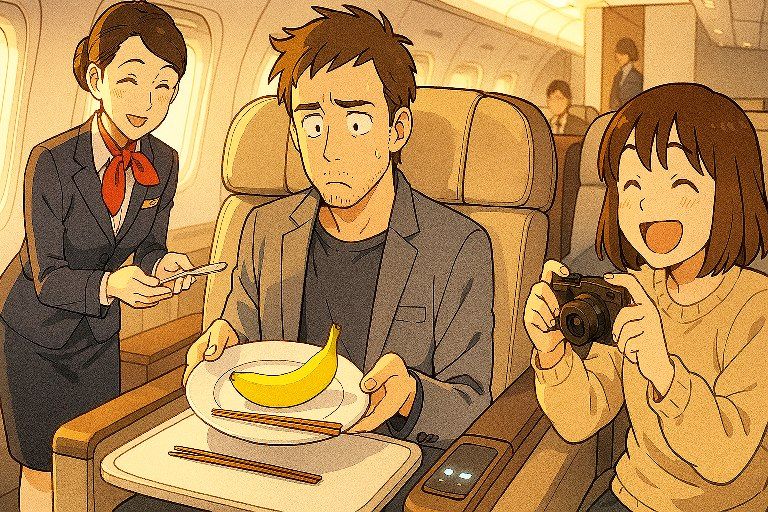
Diego took the menu, leafed through it carefully and, with a calm gesture, ordered the vegan option. He imagined a tray composed of perfectly seasoned quinoa, a portion of marinated tofu, and perhaps a colorful salad. He expected something to compensate for the hours in the air and the price of the ticket. Azusa smiled and, with the same solemnity used to present a trophy, placed on the tray a pristine white plate holding... a whole banana, accompanied only by a pair of chopsticks arranged with care as if they were the essential attribute of the presentation.
Diego (with a calm voice, looking at the plate that appears): The vegan… menu?
Azusa (placing the plate with reverence): Yes. Here you go.
The silence that followed was discreet but eloquent. Marcos, who had already guessed the scene’s viral potential, looked up, took out his phone, and aimed it with the quick gesture of a photographer who smelled a good story.
Marcos (looking over the seat, phone already ready): Is that… a plate with a banana and chopsticks?
Diego, holding the plate between his hands as though it were a piece of modern art in a private exhibition, felt a mix of bewilderment and amusement. There was something theatrical in the way the fruit occupied the center, like a solitary monarch on its white throne.
Diego (holding the plate as if it were art): Exactly. A banana. With chopsticks. To eat it with style.
Marcos didn’t waste a second. With the speed of someone who anticipates collective taste, he leaned in discreetly to take a photo from the best angle, searching for the light that would make the plate’s minimalism shine on social media. In his head he already saw the comments: "conceptual art," "first-world problems," "extreme menu."
Marcos (whispering, excited): I can’t believe this. I’m taking a photo before you touch it. This is social media gold.
Diego tried to keep his composure, but unease surfaced. It wasn’t that he disliked bananas; in fact, he liked fruit. What unsettled him was the lack of accompaniment, the absence of a prepared option for a passenger who had paid for an elevated experience.
Diego (trying to keep composure): Isn’t there… anything else? A salad, some nuts, a roll…
Azusa kept her professional smile, the kind that knows how to defuse little passenger storms. She explained in a serene voice the curious concept behind that day’s vegan menu: the chef had selected a “light” and minimalist vegan dish. Diego pictured the scene in the galley: a chef with a tall hat trimming elements until only the essence remained. But the reality was the fruit on the plate.
Azusa (with the unchanging smile of someone who has seen everything): We apologize for the limitation. That is the vegan dish selected by our chef. If you like, I can bring soy sauce.
The offer of soy sauce made the situation border on the surreal. Diego furrowed his brow, trying to imagine the flavor: banana and soy? It was a contrast that defied culinary logic, and that sparked a bit of humor. Marcos, sensing the opportunity, began composing a witty caption for the post.
Diego (looking at the fruit, serious): Soy sauce for a banana?
Azusa (nodding as if explaining quantum physics): It could enhance the experience. Or pickled ginger sticks to accompany it.
Meanwhile, Marcos couldn’t contain himself. He adjusted the camera, sought the best composition, and pressed the shutter. For him, that moment was the perfect representation of the contrast between expectation and reality: a symbol of an era where appearance can become news.
Marcos (already narrating): And so the trend was born: #BananaBusiness. The photo goes up, the likes rise, and the karma of the chopsticks ascends to first class.
The scene, which had begun as a private incident in a closed cabin in the sky, started to take on a life of its own. Notifications on Diego’s phone buzzed quickly: messages, reactions, friends asking if he was okay. The photo, uploaded with Marcos’s sarcastic caption, began to roll like a small digital avalanche.
Diego, although initially annoyed, felt the situation required a brave performance. He decided to play the role life had improvised for him: the protagonist of a culinary sketch. He calmly asked for a knife so he could, at least, eat with some decorum.
Diego (frowning, then relaxing): Fine. If we’re doing this, let’s do it properly. Does anyone have a knife?
Azusa reappeared as if the universe conspired for the scene: she brought a small butter knife, an embroidered napkin, and the patience learned over a thousand flights. The gesture was comical: a tiny knife facing a robust banana, like an intimate ceremony between mismatched utensils.
Azusa (appearing with a tiny utensil as if bringing a treasure): We have a butter knife. We also have embroidered napkins and a small glass of wine I didn’t ask whether it’s vegan.
The mention of wine added another layer of irony. Diego laughed for the first time naturally; the situation had turned into something both ridiculous and charming. Marcos, capturing every nuance, began dictating directions for the shot: Diego should hold the banana with the chopsticks, look to the horizon with the solemnity of a wise traveler.
Marcos (taking the photo from the perfect angle): Keep your left hand elegant, look to the horizon, and hold the banana with the chopsticks. This is going to be contemporary art on Instagram.
Diego tried manipulating the banana with the chopsticks. The act, unexpectedly tricky, became a mini domestic epic: balance, the right pressure to pierce the peel without crushing it, and the slight embarrassment of performing such an intimate task before a growing digital audience. It was a practical lesson in handling everyday objects with inadequate utensils.
Diego (trying to use the chopsticks on the banana’s smooth skin): It’s not that easy. It’s like trying to pet a sleeping cat with silk gloves.
Azusa, who had seen many passenger reactions but few as creative, added a cultural note to smooth the situation. She said with pride and professional affection that in Japan there are practices that turn the everyday into ritual. Peeling a banana with chopsticks, she said, could be seen as a form of meditation, an exercise in mindfulness.
Azusa (polite, but smiling more humanely): I can help you peel it if you like. In Japan, some consider peeling a banana with chopsticks a form of meditation.
Meanwhile, notifications on devices continued. Friends, followers, and strangers left comments, gifs, and hearts; the scene became a public conversation about service expectations, dietary accommodation, and the inevitable humor that arises when the ordinary goes viral.
Diego (sighing, his phone ringing with notifications): I guess meditation isn’t necessary anymore. The whole world is witnessing my utensil skills.
The voice over the PA, warm and professional, broke into the exchange to add an institutional touch of humor to the episode. The flight host, with the courtesy meant to reassure and amuse at once, made a remark that reconciled airline policy with the eccentricity of the event.
Flight host (over the PA, friendly tone): Ladies and gentlemen, we remind you that we offer dietary options. If your vegan choice does not meet your expectations, please let us know. And no, we do not offer banana sushi… yet.
Public reaction online was immediate and vividly varied. Some criticized sharply the lack of adequate vegan options: how could a premium cabin offer so little to someone paying for service and comfort? Others, with humor, compared the scene to conceptual art, performance, or minimal cuisine taken to its logical extreme. Memes arrived like postcards from an era when the unexpected goes viral in minutes.
Marcos (unable to contain his laughter as he uploads the video): Comments: “Extreme minimalism,” “Conceptual art at altitude,” “Is this a survival challenge?” The memes are already here.
Diego, freed from initial tension, allowed the situation to transform him. He ate his banana; it wasn’t the gastronomic experience he had imagined, but it was one of the most focused he’d ever had: the texture, the concentrated sweetness, the feeling of doing it amid the clouds, with curious glances from other passengers and the fleeting attention of thousands online.
Diego (looking at the camera, resigned but amused): Well, at least it’s organic. And plastic-free.
Azusa, later collecting the empty plate, demonstrated the attentive efficiency characterizing her work. She thanked Diego for his good humor and made a note to the chef and crew: passengers ask for vegan options, but they also expect those options to be thoughtfully prepared and presented with the same care as the rest of the menu.
Azusa (collecting the empty plate after a while): Did you enjoy the experience?
Diego, with a mix of irony and gratitude, answered in a way that closed the incident with a reflection on expectations, marketing, and the human capacity to turn the ordinary into extraordinary when public attention joins the act.
Diego (handing over the chopsticks with ceremonial reverence): Surprisingly… yes. It was the most focused tasting of my life. Also, I learned a lesson: expectation can turn a banana into a trending topic.
Azusa, with a small, genuine bow, promised to pass the experience on to the chef and crew. She did so with her usual blend of professionalism and humor, proposing improvements that combined common sense with a wink.
Azusa (making a small bow): Thank you for your good humor. I’ll make a note for the chef: “Banana upgraded — add almonds, tofu, or dignity.”
Marcos, meanwhile, kept receiving notifications: the photo propagated across screens, comments demanded concrete solutions, and the airline found itself obliged to answer. Within hours, a suggestion to revise the vegan menu began circulating among internal messages and public replies.
Marcos (as the viral notification explodes): Attention: the airline responds. Official proposal: revised vegan menu. Popular request: that chopsticks come with a user manual.
Diego looked out the window and, in an intimate gesture, contemplated the blue stretch beneath the plane. There was something comforting about the combination of absurdity and lightness: he’d paid for a trip and received, in addition, an anecdote he would tell over and over. He smiled at the thought that, although the culinary experience had been minimal, the human experience had been complete.
Diego (looking out the window, smiling): If in business class they give me a banana and a meme, at least I’m traveling light.
Azusa, in a low voice and with complicity, offered a final joke that sealed the tacit agreement between passenger and crew: the promise of a bolder next experience.
Azusa (in a low voice, conspiratorially): And if you want, next time I’ll prepare a banana with wasabi. For the adventurous.
Diego laughed heartily and accepted the deal as a joke: to be served with a certificate of ironic approval, a label celebrating the moment and the good spirit that had made the episode more bearable. Marcos, for his part, already imagined the next viral spin: “bananas with wasabi,” a twist promising new comments and more laughs.
Diego (laughing): Deal. And serve it with a small certificate: “This banana was approved by the International Committee of Surprised Passengers.”
Marcos uploaded the final photo with a short, mordant caption: “When you pay for business and receive minimalism: 10/10, would recommend.” It was ironic, it was real, and above all, it was human. The mischief of the scene, far from turning into a scandal, led to a more serious conversation about the need to design quality vegan options for premium airlines: not only out of respect for diets and beliefs, but for coherence between price and service.
The story closed on a soft note: the crew promised to improve, passengers laughed, the airline listened, and the photo remained as testimony of how something as simple as a banana can, for a moment, spotlight many things: expectations, humor, gastronomy, and the collective capacity to turn an instant into conversation. The end.
Source of the images.
Image created with Bing.
Short story: California at the Summit: The State That Redefined the World
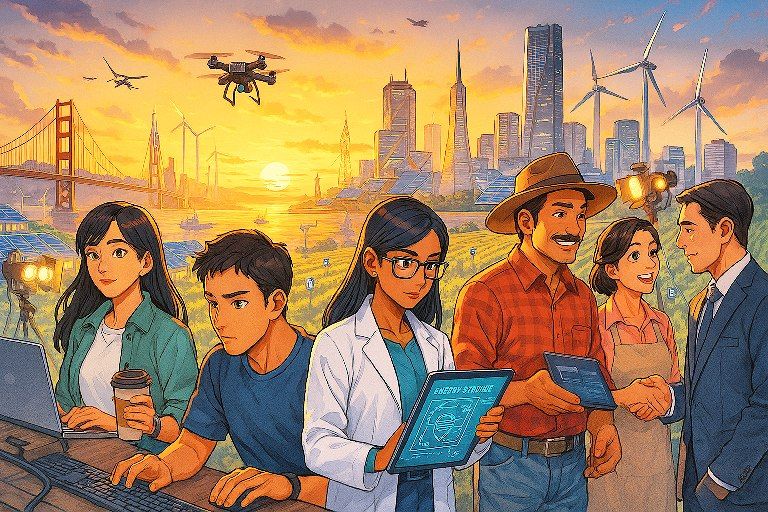
California woke up one morning like any other, but the face of the world had changed: headlines flashed on screens and shop windows, and the city’s voice rang with a new confidence. In 2024, the Golden State had reached a historic peak: with a GDP of **$4.1 trillion**, California had surpassed Japan and was crowned the fourth-largest economy on the planet. That figure, repeated again and again on news broadcasts and social feeds, was not just a number; it represented years of decisions, experiments, failures and successes that together had pushed the state into a decisive global position.
In a San Francisco café called La Taza, located near a tech campus, Elena — a software engineer who had arrived five years earlier from Mexico — looked up from her laptop when a group of tourists celebrated in front of the café’s television. The café was a microcosm of today’s California: tables with laptops and notebooks, conversations among entrepreneurs and designers, posters advertising meetups and networking events.
“Did you see that?” one of the tourists asked, pointing at the screen. “California is now the fourth-largest economy in the world!”
Elena smiled. She glanced at her tablemate, Marco, who was reviewing lines of code on his laptop while sipping black coffee.
“This confirms what we’ve been doing, nights of work included. It’s not just luck,” she said quietly, with a mix of pride and fatigue.
Marco stopped typing and rested his eyes on the window glass, where nearby buildings reflected back.
“But we can’t get complacent,” he replied. “If this opens doors, it also brings expectations. More investment, more competition, and more pressure to deliver.”
Around them, colleagues and acquaintances exchanged smiles and messages. For many, the news validated endless development hours, strategic pivots and the creation of products that now competed globally. For others it confirmed a personal journey: migrating in search of opportunity, training intensively and contributing to projects that now generated jobs and wealth.
Meanwhile, in the governor’s office, Gavin Newsom held a sober but enthusiastic press conference. Facing microphones and cameras, he explained the factors that, according to his administration, had driven California to that economic milestone.
“This is not accidental,” Newsom said, looking directly at journalists. “It is the result of an ecosystem that knows how to invent the future.”
Beside him, Secretary of Economic Development Priya Desai added technical and political detail:
“We have invested in technical education, innovation incentives and public-private partnerships. That is bearing fruit in job creation and talent attraction.”
The macro figures were broken down into concrete strategies: targeted R&D subsidies, vocational training programs in communities with high unemployment, tax incentives for early-stage startups and a regulatory framework that spurred clean energy projects. All of this formed part of a government narrative aimed at showing the growth was deliberate and replicable.
The story of that transformation was woven across many fronts and hundreds of personal stories. In Silicon Valley, for example, artificial intelligence and biotechnology labs worked side by side with creative studios reinventing entertainment. Unassuming buildings housed research that could change industries: algorithms that optimized logistics, platforms that personalized content, gene therapies promising to revolutionize medicine.
In a Palo Alto lab, Asha — a researcher of Indian origin specializing in renewable energy — talked with her boss, Dana, about progress on an energy storage prototype.
“If we can scale this prototype, we can cut costs in half,” Asha said excitedly, her hands shaping the possibility. “We already have interest from several investors.”
Dana regarded her with the seriousness such a decision demanded.
“Then prepare the presentation for next week,” she replied. “We can’t lose momentum. Bring the data and the operational plan: costs, potential partners, necessary permits.”
“I’ll also have the field test results ready,” Asha added. “If the numbers hold, it’ll be hard not to back us.”
Collaboration between scientists, companies and the public sector was a constant thread. Meetings focused on timelines, scalability and risk reduction. Access to capital wasn’t automatic, but the combination of state policies and credible tech demos smoothed the path from prototype to pilot plant.
In Los Angeles, the scene was another mix of aspiration and commerce. Streets of stark contrast housed sets where the Californian narrative was told to the world. Production companies and creators worked to export stories that, in turn, fed a cultural export industry.
On a set, producer Luis spoke with Maya, a young director whose fresh voice sought to break narrative molds.
“Your idea for the series is risky, but it’s what audiences need now,” Luis said, leaning back in a director’s chair. “There’s interest from international platforms; we need to define budget and scope.”
Maya took a deep breath, aware of the responsibility of representing realities at scale.
“Thank you,” she replied. “I want our stories to reach the world. Not just entertainment, but something that sparks conversation and change.”
“Then let’s protect authenticity,” Luis answered. “We’ll hire cultural consultants, run audience tests and find financing that preserves creative control.”
That tension between art and market was key to keeping entertainment an economic engine: stories that resonated globally, formats that adapted to new platforms and an industry that learned to monetize creativity without sacrificing quality.
At the same time, in the Central Valley, agriculture was transforming thanks to technology. Fields long managed by generations began to integrate sensors, drones and data analytics. Yields rose, water use was optimized and supply chains became more efficient.
Omar, a farmer who adopted these tools, spoke with his neighbor José beside a field of lettuce dotted with sensors.
“We used to waste a lot of water. Now with sensors and data, the plants get exactly what they need,” Omar explained, showing moisture maps on a tablet.
“And yields went up 20%,” José said, surprised. “This is twenty-first-century farming.”
Adoption was uneven: small and medium farms faced financing and training barriers. However, state programs and partnerships with universities helped spread best practices and create technical support networks.
In Bakersfield, Asha recalled how her team moved from prototypes to pilot plants in less than two years, a feat backed by public policies that eased permits, provided credit and connected them with investors.
“When I arrived I didn’t imagine we’d move this fast,” Asha said in a team meeting, her voice full of pride. “State support was key.”
“And your team made it happen,” Miguel, a colleague, replied. “Good work. Now we need to scale and secure financial sustainability.”
In Sacramento, public authorities also invested in human capital. Vocational training programs linked young people from marginalized communities to well‑paying jobs in emerging sectors. Technical training centers offered intensive courses in programming, renewable energy maintenance and audiovisual production.
In a classroom, instructor Rosa watched Karina, a student whose path had changed thanks to a subsidized program.
“You’ve improved a lot in the past months,” Rosa said. “Ready for the job fair?”
“Yes,” Karina answered proudly. “I want to show what I can do. This opportunity means a lot to my family.”
That sense of social mobility, though limited and unequal, produced success stories that fueled the narrative of opportunity and hope.
In Oakland, small Latino-owned businesses that had been microenterprises for years became key suppliers to tech and service chains. Ana, owner of a supply shop, spoke with Daniel, a representative from a large company that requested a pilot supply contract.
“We can scale production if you give us larger contracts,” Ana said, equal parts nervous and determined.
“We’ll give you a pilot,” Daniel replied. “If it goes well, it could be the start of something bigger.”
“If it works, we’ll be able to hire more people from the neighborhood,” Ana added. “That would change lives.”
“That impact is exactly what we’re looking for,” Daniel answered. “We’ll work on logistics so the transition is gradual and sustainable.”
Still, the pace of growth left problems to solve. Housing remained prohibitively expensive in urban areas, forcing key-sector workers to move farther away, increasing commute times and fragmenting communities. Infrastructure—transportation, power grids and water systems—needed modernization to handle rising demand. And inequalities, though mitigated by targeted programs, persisted in stark differences in access to education, health and financing.
Community forums gathered leaders and citizens to discuss these challenges without abandoning optimism. In a local auditorium, debates considered how to build transit networks connecting employment hubs with more affordable residential areas; libraries hosted talks about the need to train the next generation in technical skills and critical thinking.
At night, cities showed another face: conversations about sustainability in cafés, debates in libraries about technical education, and family tables where parents spoke proudly of children who could now dream of high-impact careers. In modest homes and high-rise apartments alike, plans and aspirations were shared.
Elena met Marco after a long workday at a quiet bar with dim lights. They ordered coffee and shared a dessert, the city glowing beyond the window.
“We made it, in a way,” Marco said, loosening his shoulders. “Not just for us, but for everyone who put in the effort.”
“And this is only the beginning,” Elena replied. “Now we need to build for everyone. We have to think about more diverse teams, accessible products and mentoring for those coming up behind us.”
“Yes,” Marco agreed. “We also need to push for public policies that leave no one behind.”
Conversations like these repeated across multiple spheres: companies adopting inclusion programs, universities expanding scholarships and public entities refining housing and transit policies. Coordination among actors was key to sustaining the shift from a growth cycle to one of consolidation.
At the end of the day, as the sun set over the Pacific coast and the breeze carried the whisper of waves and subway mouths, a wave of pride swept the state. California had not only reached a position in global rankings; it had shown that a vast, diverse territory could become an engine of innovation and development, driven by work, talent and a shared vision.
But the story was far from over. The economy that now ranked fourth worldwide would have to address structural challenges: build affordable housing, upgrade critical infrastructure and ensure growth was inclusive and sustainable. Still, that morning was etched as a turning point: the time the Golden State rose and the world looked on in awe, where thousands of individual stories—like those of Elena, Asha, Omar, Ana and Karina—wove together to tell the fable of a place capable of reinventing itself again and again.## California at the Summit: The State That Redefined the World
California woke up one morning like any other, but the face of the world had changed: headlines flashed on screens and shop windows, and the city’s voice rang with a new confidence. In 2024, the Golden State had reached a historic peak: with a GDP of **$4.1 trillion**, California had surpassed Japan and was crowned the fourth-largest economy on the planet.
That figure, repeated again and again on news broadcasts and social feeds, was not just a number; it represented years of decisions, experiments, failures and successes that together had pushed the state into a decisive global position.
In a San Francisco café called La Taza, located near a tech campus, Elena — a software engineer who had arrived five years earlier from Mexico — looked up from her laptop when a group of tourists celebrated in front of the café’s television. The café was a microcosm of today’s California: tables with laptops and notebooks, conversations among entrepreneurs and designers, posters advertising meetups and networking events.
“Did you see that?” one of the tourists asked, pointing at the screen. “California is now the fourth-largest economy in the world!”
Elena smiled. She glanced at her tablemate, Marco, who was reviewing lines of code on his laptop while sipping black coffee.
“This confirms what we’ve been doing, nights of work included. It’s not just luck,” she said quietly, with a mix of pride and fatigue.
Marco stopped typing and rested his eyes on the window glass, where nearby buildings reflected back.
“But we can’t get complacent,” he replied. “If this opens doors, it also brings expectations. More investment, more competition, and more pressure to deliver.”
Around them, colleagues and acquaintances exchanged smiles and messages. For many, the news validated endless development hours, strategic pivots and the creation of products that now competed globally. For others it confirmed a personal journey: migrating in search of opportunity, training intensively and contributing to projects that now generated jobs and wealth.
Meanwhile, in the governor’s office, Gavin Newsom held a sober but enthusiastic press conference. Facing microphones and cameras, he explained the factors that, according to his administration, had driven California to that economic milestone.
“This is not accidental,” Newsom said, looking directly at journalists. “It is the result of an ecosystem that knows how to invent the future.”
Beside him, Secretary of Economic Development Priya Desai added technical and political detail:
“We have invested in technical education, innovation incentives and public-private partnerships. That is bearing fruit in job creation and talent attraction.”
The macro figures were broken down into concrete strategies: targeted R&D subsidies, vocational training programs in communities with high unemployment, tax incentives for early-stage startups and a regulatory framework that spurred clean energy projects. All of this formed part of a government narrative aimed at showing the growth was deliberate and replicable.
The story of that transformation was woven across many fronts and hundreds of personal stories. In Silicon Valley, for example, artificial intelligence and biotechnology labs worked side by side with creative studios reinventing entertainment. Unassuming buildings housed research that could change industries: algorithms that optimized logistics, platforms that personalized content, gene therapies promising to revolutionize medicine.
In a Palo Alto lab, Asha — a researcher of Indian origin specializing in renewable energy — talked with her boss, Dana, about progress on an energy storage prototype.
“If we can scale this prototype, we can cut costs in half,” Asha said excitedly, her hands shaping the possibility. “We already have interest from several investors.”
Dana regarded her with the seriousness such a decision demanded.
“Then prepare the presentation for next week,” she replied. “We can’t lose momentum. Bring the data and the operational plan: costs, potential partners, necessary permits.”
“I’ll also have the field test results ready,” Asha added. “If the numbers hold, it’ll be hard not to back us.”
Collaboration between scientists, companies and the public sector was a constant thread. Meetings focused on timelines, scalability and risk reduction. Access to capital wasn’t automatic, but the combination of state policies and credible tech demos smoothed the path from prototype to pilot plant.
In Los Angeles, the scene was another mix of aspiration and commerce. Streets of stark contrast housed sets where the Californian narrative was told to the world. Production companies and creators worked to export stories that, in turn, fed a cultural export industry.
On a set, producer Luis spoke with Maya, a young director whose fresh voice sought to break narrative molds.
“Your idea for the series is risky, but it’s what audiences need now,” Luis said, leaning back in a director’s chair. “There’s interest from international platforms; we need to define budget and scope.”
Maya took a deep breath, aware of the responsibility of representing realities at scale.
“Thank you,” she replied. “I want our stories to reach the world. Not just entertainment, but something that sparks conversation and change.”
“Then let’s protect authenticity,” Luis answered. “We’ll hire cultural consultants, run audience tests and find financing that preserves creative control.”
That tension between art and market was key to keeping entertainment an economic engine: stories that resonated globally, formats that adapted to new platforms and an industry that learned to monetize creativity without sacrificing quality.
At the same time, in the Central Valley, agriculture was transforming thanks to technology. Fields long managed by generations began to integrate sensors, drones and data analytics. Yields rose, water use was optimized and supply chains became more efficient.
Omar, a farmer who adopted these tools, spoke with his neighbor José beside a field of lettuce dotted with sensors.
“We used to waste a lot of water. Now with sensors and data, the plants get exactly what they need,” Omar explained, showing moisture maps on a tablet.
“And yields went up 20%,” José said, surprised. “This is twenty-first-century farming.”
Adoption was uneven: small and medium farms faced financing and training barriers. However, state programs and partnerships with universities helped spread best practices and create technical support networks.
In Bakersfield, Asha recalled how her team moved from prototypes to pilot plants in less than two years, a feat backed by public policies that eased permits, provided credit and connected them with investors.
“When I arrived I didn’t imagine we’d move this fast,” Asha said in a team meeting, her voice full of pride. “State support was key.”
“And your team made it happen,” Miguel, a colleague, replied. “Good work. Now we need to scale and secure financial sustainability.”
In Sacramento, public authorities also invested in human capital. Vocational training programs linked young people from marginalized communities to well‑paying jobs in emerging sectors. Technical training centers offered intensive courses in programming, renewable energy maintenance and audiovisual production.
In a classroom, instructor Rosa watched Karina, a student whose path had changed thanks to a subsidized program.
“You’ve improved a lot in the past months,” Rosa said. “Ready for the job fair?”
“Yes,” Karina answered proudly. “I want to show what I can do. This opportunity means a lot to my family.”
That sense of social mobility, though limited and unequal, produced success stories that fueled the narrative of opportunity and hope.
In Oakland, small Latino-owned businesses that had been microenterprises for years became key suppliers to tech and service chains. Ana, owner of a supply shop, spoke with Daniel, a representative from a large company that requested a pilot supply contract.
“We can scale production if you give us larger contracts,” Ana said, equal parts nervous and determined.
“We’ll give you a pilot,” Daniel replied. “If it goes well, it could be the start of something bigger.”
“If it works, we’ll be able to hire more people from the neighborhood,” Ana added. “That would change lives.”
“That impact is exactly what we’re looking for,” Daniel answered. “We’ll work on logistics so the transition is gradual and sustainable.”
Still, the pace of growth left problems to solve. Housing remained prohibitively expensive in urban areas, forcing key-sector workers to move farther away, increasing commute times and fragmenting communities. Infrastructure—transportation, power grids and water systems—needed modernization to handle rising demand. And inequalities, though mitigated by targeted programs, persisted in stark differences in access to education, health and financing.
Community forums gathered leaders and citizens to discuss these challenges without abandoning optimism. In a local auditorium, debates considered how to build transit networks connecting employment hubs with more affordable residential areas; libraries hosted talks about the need to train the next generation in technical skills and critical thinking.
At night, cities showed another face: conversations about sustainability in cafés, debates in libraries about technical education, and family tables where parents spoke proudly of children who could now dream of high-impact careers. In modest homes and high-rise apartments alike, plans and aspirations were shared.
Elena met Marco after a long workday at a quiet bar with dim lights. They ordered coffee and shared a dessert, the city glowing beyond the window.
“We made it, in a way,” Marco said, loosening his shoulders. “Not just for us, but for everyone who put in the effort.”
“And this is only the beginning,” Elena replied. “Now we need to build for everyone. We have to think about more diverse teams, accessible products and mentoring for those coming up behind us.”
“Yes,” Marco agreed. “We also need to push for public policies that leave no one behind.”
Conversations like these repeated across multiple spheres: companies adopting inclusion programs, universities expanding scholarships and public entities refining housing and transit policies. Coordination among actors was key to sustaining the shift from a growth cycle to one of consolidation.
At the end of the day, as the sun set over the Pacific coast and the breeze carried the whisper of waves and subway mouths, a wave of pride swept the state. California had not only reached a position in global rankings; it had shown that a vast, diverse territory could become an engine of innovation and development, driven by work, talent and a shared vision.
But the story was far from over. The economy that now ranked fourth worldwide would have to address structural challenges: build affordable housing, upgrade critical infrastructure and ensure growth was inclusive and sustainable. Still, that morning was etched as a turning point: the time the Golden State rose and the world looked on in awe, where thousands of individual stories—like those of Elena, Asha, Omar, Ana and Karina—wove together to tell the fable of a place capable of reinventing itself again and again.
Source of the images.
Image created with Bing.
Short story: The Great Emotional Hook
Once upon a time — in the era of filters, viral challenges, and bios with more emojis than real information — there was a young man named Lucas who discovered the age-old art of sadfishing. He lived in a small apartment with plants that survived on notifications and a window that, according to his stories, always had the perfect light for melancholy. Lucas had learned to manage the staging: the exact position of the couch, a barely steaming cup of tea, a nostalgic song in the background, and an italicized caption promising intimate confidences: “I don’t know if I can make it another day like this 😔.”
In real life, his problems were domestic and trivial. He was annoyed when the delivery driver forgot the hot sauce he always ordered, frustrated when his favorite show pulled unnecessary cliffhangers, and he argued with his landlord over rent. On social media, however, those small annoyances were transformed into epic tragedies. A photo with the right light and the word “sad” in the caption was enough for the audience to turn an everyday irritation into a catastrophe worthy of mass consolation.
Lucas perfected the craft. He watched metrics as if they were smoke signals: how many hearts came with a tear emoji, which comments arrived fastest, which format multiplied DMs of “Are you okay?”. He learned to edit his reels so breathing sounded heavier and to choose songs whose crescendos matched his final sigh. It wasn’t that he wanted to deceive; he said he believed he was offering company to anyone who needed it. But as his numbers climbed, so did the temptation to repeat the formula.
His best friend Ana —owner of a small, cozy bookstore— watched him with a mix of tenderness and exasperation. She’d known Lucas since high school: sensitive, grandiose, and with an inexhaustible talent for dramatizing. Ana was practical; she preferred the smell of books to the noise of feeds.
“I don’t you need another dramatic post. You’ll run out of followers if you overdo it,” Ana told him as she folded a book in the shop, her hands dusted with paper and glue.
“I’m not exaggerating, Ana. People need to feel something. Look, look at the comments,” he replied, showing his phone filled with hearts.
“Or they need a pizza with hot sauce,” she shot back, raising an eyebrow.
Carla Glam, the local celebrity, watched the phenomenon from another trench: the one who turns everything into a personal brand. She had built a career selling beauty and aspiration; now she noticed that attention spiked when she showed vulnerable moments. She decided to rebrand her narrative. In a production session she assembled a reel that looked like it belonged in a cinematic drama: slow motion, the saddest song in the catalog, makeup that simulated swollen eyes, and a strategic tear (actually caused by a conveniently timed eye itch).
“You need real emotion, not just filters,” Diego, an influencer friend who specialized in challenges and humor, told her when he saw her on set.
“Emotion sells, Diego. What do you know? Cut it where it looks like I’m suffering and done,” Carla answered, dabbing the tear with elegance.
The response was immediate: her followers grew, brands called for collaborations, and she even received an offer from a tissue company. What should have been an intimate gesture became a cultural and commercial product.
Sadfishing stopped being a solitary game and became professionalized. Influencers created hashtags like #TodayImBroken, to which brands replied with “self-care” kits full of candles, masks, and comforting cards. On TikTok a dance emerged that, with irony, standardized the acting of pain: step 1, look at the camera with sorrow; step 2, pretend you can’t handle the world; step 3, smile when 1,000 supportive comments appear. The algorithm rewarded vulnerability, and vulnerability became choreography.
At the university, Dr. Méndez, a psychology professor known for his dry humor and curious experiments, wanted to bring the phenomenon into the classroom. He proposed a simple experiment to his students: post two versions of the same image, one labeled “sad” and the other without text. The results didn’t surprise much: the post showing sadness received double the reactions.
“It’s simple emotional economics,” Dr. Méndez explained at the blackboard, marking figures with white chalk.
“So sadness is like putting up a ‘hearts accepted’ sign?” a student asked, laughing.
“It’s simple emotional economics,” the professor repeated. “Sadness is currency: it turns likes into instant empathy.” His words resonated in the classroom and in students’ notes, as if they had discovered an equation that transformed emotions into attention.
Attention, of course, also attracts those who enjoy dismantling the staging. The trolls arrived: sarcastic comments that ridiculed the construction of online drama. One day Lucas received a message that said, “Sad again? Did your heart break because your favorite show ended?” That kind of mockery set off a chain reaction: memes with hooks used as logos, satirical accounts parodying tragic stories, and a word that began circulating with irony: “sadfishing.”
Carla Glam jumped from success to scrutiny. In the public sphere some defended her; others questioned the authenticity of her vulnerability. At a live-streamed charity gala, Carla was invited to speak about mental health. She prepared an emotional speech, trained her intonation, and practiced the dramatic pause. She went on stage and spoke convincingly, but among the audience was Marcos, a critical creator who had made doubt his brand. As soon as she finished, he threw a cutting question into the mic:
“Great speech, but is it real or sponsored by compassion?” Marcos shot into the microphone.
The phrase exploded in seconds: #SadOrSponsored trended and feeds flooded with debates, memes, and reflections. Diego, who was in the audience filming, whispered, “This is about to blow up in 3, 2, 1…”
“Welcome to the show,” Carla replied with a forced smile.
Meanwhile, on a popular podcast about behavior and technology, psychologist Valeria tried to add nuance to the discussion. With a calm voice and clear arguments she explained that seeking support online isn’t inherently negative, but turning pain into content can trivialize real problems and expose vulnerable people to ridicule or harassment.
“When vulnerability is monetized or used as clickbait, you risk normalizing constant exposure and denying the seriousness of certain conditions,” Valeria said.
Her words resonated with worried parents, educators, and mental health professionals. Forums filled with contradictory testimonies: some young people shared how they had received real support after sharing feelings; others recounted how public scrutiny worsened their situation. For certain adolescents with anxious attachment styles, the flood of messages became an emotional lifeline; for others, the need for likes turned into a dependency that increased their anxiety.
In the bookstore, Ana watched Lucas with the patience of someone who has seen many trends come and go. She didn’t want to be condescending, but she wanted to be frank.
“I was thinking we could do something real to change the narrative,” Ana suggested one afternoon as they arranged new titles in the display window.
“Like what? Make a dinner without drama and upload it?” Lucas asked with mock indignation, more ready for a joke than the serious proposal.
“Exactly that,” Ana said, smiling.
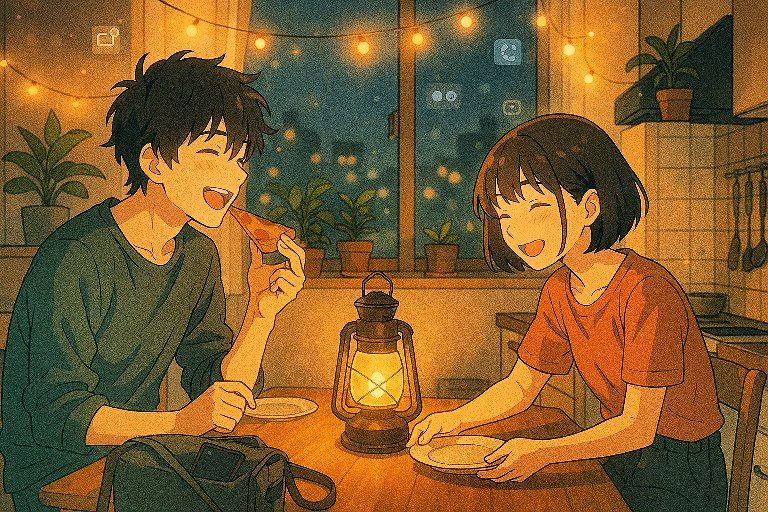
Ana organized the dinner: she invited two friends, curated a playlist with no melancholic crescendos, and asked Lucas to leave his phone in his bag. The idea was simple and radical: experience the moment without the expectation of external validation. The event had no good angles for reels, no captions promising confessions, but it had something posts couldn’t manufacture: closeness without spectators.
The night of the gala and the hashtag wasn’t the only tense moment. On the street, a conversation between followers showed how polarized the public was.
“But if she says she’s unwell, why not believe her?” one young woman asked softly.
“Because now everything is strategy,” another answered.
That dichotomy settled into public debate. Some defended the right to express pain publicly; others warned about the commodification of vulnerability. Mental health experts agreed on a central idea: sadfishing can offer an immediate sense of support but also poses risks — trivialization, exposure, and reinforcement of dependent emotional dynamics.
In a later class, Dr. Méndez elaborated: he spoke about anxious attachment styles, emotional regulation, and how platforms, by offering immediate responses, create a reward circuit that can reinforce unhealthy behaviors. Students listened and took notes: theory became a mirror for everyday practices.
In the meantime Lucas received both genuine support and cruel irony. The emotional roller coaster of messages left him confused. In a moment of honesty, while Ana sliced a piece of pizza, he confessed:
“I’m not sure this is healthy. Sometimes I feel like I manufacture my sadness so people will write me,” Lucas said in a low voice.
“Then don’t manufacture it,” Ana replied firmly.
“What if no one responds?” he asked, afraid of loneliness.
“Then you call someone and ask them to come for dinner. No script, no likes,” Ana said.
That dinner without recordings turned out to be balm. They talked without the pressure of an invisible audience demanding constant emotion. They laughed at bad jokes, remembered high school anecdotes, and gently criticized Carla and Marcos. Between bites and scattered book pages, Lucas sensed something his metrics couldn’t capture: authenticity was less spectacular but more sustainable.
Over time the public debate softened. Educational campaigns emerged to teach young people how to recognize when to seek help safely and when platforms might worsen their situation. The university organized workshops on digital health and emotional regulation; Dr. Méndez joined public talks; Valeria appeared in several interviews explaining risks and coping strategies. Influencers who practiced sadfishing didn’t disappear, but more voices questioned its effects and promoted real alternatives for support.
Carla Glam, after the #SadOrSponsored controversy, tried to repair her image. Interviews, public apologies, and collaborations with mental health organizations became part of her strategy. Some saw her as an opportunist trying to clean up her reputation; others appreciated the effort to raise awareness about important issues. Diego, more cynical, commented in a video that online empathy had become a product with an expiration date. Marcos continued his critical content, but he acknowledged that his provocation had sparked necessary conversations.
At heart the lesson was neither singular nor definitive: it was complex and ambivalent. In a world where vulnerability can become profit, empathy becomes a fragile currency; it has value, but it wears down if administered as spectacle. Some learned to ask for help authentically; others learned to place cameras on their dramas to amplify reach. After the dinner without filters, Lucas chose to dial down public dramatization. He didn’t abandon social media, but he began using his voice to share readings, humor, and, occasionally, unproduced confessions.
“Hot-sauce-less pizza? Now that’s tragedy!” Ana joked as they opened the box, laughter filling the kitchen.
“At least in person no one asks if it’s content,” Lucas said, raising a slice.
Moral (with a wink): emotional fishing can bring you fish… but sometimes what you need is simply to learn how to cook dinner and share it without drama. In the age of algorithms, authenticity may be a less-traveled path, but it’s also the most nourishing.
Source of the images.
Image created with Bing.
Short story: The Selfie That Wanted to Be a Polaroid
Luis found the camera in a box among lonely socks and a note from Don Álvaro that read: “If it doesn’t come out, blame the film.” It was a discovery that smelled like a garage and long Sundays. He had learned to measure the world by the glow of screens: life came in notifications, in photos that were seen and disappeared with the same swipe. But that camera, heavy and noisy, demanded another kind of attention. Holding it made him feel guilty and enchanted in equal parts, like someone rescuing a plant that was about to die and discovering it still had leaves.
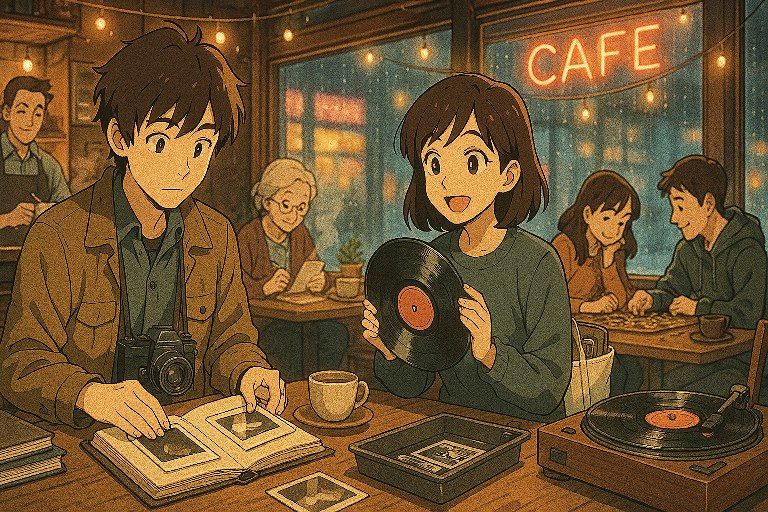
Maia arrived at the café with a bag of vinyls that looked like little graphic novels: covers halfway between elegance and excess, labels glued on crooked, and a smell of old paper that tasted like bygone time. “I brought something that doesn’t ask permission to play itself a hundred times per second,” she announced with the flourish of someone introducing an eccentric friend. Tomás, behind the counter, raised a professional eyebrow and said, “Is it dangerous?” Rita, listening from her table with a tea that seemed to have lived through many conversations, asserted with the authority of someone who has seen trends come and go: “In my day records didn’t ask if you were ready for the song.”
The idea for an analog get-together was born out of whim and cemented by fondness. “Bring an object that speaks about you,” Maia proposed in the café group, and the responses were eclectic. Tomás brought a concert poster weathered by humidity; Carla and Nico treated it as a joke and showed up with a board game that smelled of childhood; Don Álvaro didn’t attend in person but arrived as a stained Polaroid with that crooked smile he always had in family photos.
The first unwritten rule of the gathering was simple: don’t look at your phone before the third coffee. No one said it was an order, but the expectation worked like a tacit oath. The second rule, born from laughter and gentle corrections, was that no one could talk about “the cloud” without clarifying whether they meant actual clouds or meringues. The tone wavered between solemn and ridiculous, like when you start a new tradition and pamper it with ceremonial gravity.
Don Álvaro’s Polaroid came out half burned. There was a moment of silence, then an avalanche of affectionate comments: “Conceptual art,” Maia said; “or the camera took a day off,” Tomás added. No one was offended; the imperfection was received as proof of authenticity. Placing the photo in an album became a rite. Luis held it and, looking at the white edge stained with developer, felt he was seeing more than an image: he was seeing the possibility of something that took its time to be born.
When the needle dropped on the turntable, the sound filled the room with a texture compressed playlists did not know: there was a crackle, a whisper, and then the music emerged with the amplitude of something unafraid to occupy space. Nico, by habit, tried to take out his phone to record the first minute; Rita looked at him as if he had tried to eat soup with chopsticks. “Patience, kid,” she said, and her voice had the sternness of someone imposing calm on a domestic storm.
What could have been a mere display exercise became a lesson in listening: letting the song settle in the body, noticing the silences between notes, allowing the crackle to tell its own story.
Developing photos became a sort of collective alchemy. Luis worked with improvised patience: he timed exposures, chatted with the developer as if it were an old acquaintance, and celebrated every image that emerged from the fog as a small domestic miracle. Imperfect photos produced laughs and tender oohs: a hand cut out of a frame became “the hand that never gives up,” and an overexposure became “an homage to the sun.” The café crowd adopted its own language for mistakes: errors became titles worthy of an exhibit.
The board game Carla and Nico brought, with its worn pieces and stained instructions, was an endless source of joy. What started as light competition turned into a ceremony of affectionate cheating and flexible rules. Nico, accustomed to the instant gratification of digital achievements and levels, discovered a different satisfaction: rolling a die with one’s hands, hearing the pieces scrape the board, watching others’ faces. At one point, winning a game by improvised strategy made him shout with an intensity that would have embarrassed his avatar online. It was an absurd but necessary victory.
Tomás confessed stories no one expected: once he tried to play a record backward and pretended it was a remix; another time he mixed discs with such enthusiasm he made a personal cafe compilation. Rita explained how writing letters helps order life: “It’s not the same as sending a message; handwriting forces you to be honest,” she said, and everyone went quiet, smiling in the way people do when they understand that truth can be a manual practice. Don Álvaro, through his Polaroid, sent a note that read: “Always look twice before you erase.” It landed with a gravity no notification could match.
Laughter became a habit that mingled with nostalgia. Many anecdotes had a comic edge: someone told how they tried to clean a record with tap water and ended up with a track that sang off-key; another confessed the embarrassment of writing a letter without a clear addressee and then using it as a bookmark. Luis, amid jokes and lessons, learned that nostalgia isn’t a lament but a tool to rewrite one’s relationship with the present. It wasn’t absolute rejection of technology: phones still had a practical role. It was more an experiment in boundaries, a polite request for a truce.
Gradually, the get-together turned into a custom. Weekends at the café featured cassette swaps, developing sessions, and handwritten letter afternoons. The neighborhood bookstore offered binding workshops and an old community room filled with tables where people practiced calligraphy and mixed vinyls. The ripple effect wasn’t a mass phenomenon nor an academic nostalgia movement; it was an organic expansion of people seeking tactile presence.
The Gen Z crowd that frequented these spaces didn’t give up screens: they used them, loved them, and exploited them to create. But they discovered some things screens couldn’t give easily or honestly: the time a vinyl requires, the suspense before a developed photo appears, the lack of instant redemption that allows mistakes to exist without leaving a trace. They began labeling notification-free hours as rituals: “no-scroll Sunday,” “vinyl night,” “notebook morning.” These were deliberate acts, small rudder corrections in an ocean of infinite content.
The change was mostly intimate. Luis noticed subtle shifts: his gaze softened when waiting for an image to appear on paper; his hands learned to measure a record’s fragility; his humor mellowed, able to tolerate long silences without fishing for them with a finger. Maia embraced a collection that was no longer exhibitionist but meditative: she chose records by mood and treated each listening as a date with herself. Tomás scheduled themed days at the café and was surprised when the clientele shifted: people who wanted to talk more and tweet less showed up.
Rita taught letter-writing and received in return stories that seemed to have been waiting for a pen to be born.
The coexistence of digital and analog ceased to be a stark opposition and became a courteous dance. Screens remained useful—maps, urgent messages, video calls with distant family—but they fit into a rhythm that practiced pause. The balance was neither perfect nor permanent; relapses happened, days of compulsive scrolling and impulse online purchases. But there was now the conscious possibility of cutting the inertia and choosing another textural experience.
On a rainy night, with the café warm and the city smelling of wet asphalt, Luis placed the last photograph in an album and looked at it as someone regards a relic without mythologizing it. The image was imperfect: the light had misbehaved and the focus had betrayed him. He called it aloud “The Existential Blink.” Maia, in her usual dramatic manner, provided a soundtrack with a vinyl that crackled like a confession. Rita handed out cookies and between bites said, “The important thing is not to lose the habit of writing.” Tomás promised a day of rare records and Carla and Nico returned the board with pieces still warm from use.
When the evening ended, the farewell carried the weight of things felt rather than announced: a tacit agreement to return, to care for the spaces that let them breathe differently. Luis glanced at his phone out of habit, saw the piled notifications and, without drama, put it back in his pocket. He didn’t switch it off out of prejudice; he set it aside like someone who doesn’t interrupt a conversation to wave at an acquaintance. He had learned something more practical than romance: he could live with technology without letting it dictate every gesture.
Gen Z wasn’t fleeing modernity nor embracing the past with melancholic nostalgia. What was happening was subtler: they were rediscovering tools that let them feel more deeply and without total mediation. The camera, the vinyl, the notebook, and the board game were not relics; they were instruments for reclaiming pause, touch, and screenless creativity. At bottom, it was a bet on authenticity in a world that rewards speed.
And under the café’s neon that blinked in a rhythm caught between old and new, the small community kept finding reasons to meet. They didn’t make nostalgia a religion but a prolonged, affectionate joke: they celebrated mistakes, honored annoying noises, and learned to laugh at their own exaggerations. In every gathering the same simple, firm feeling appeared: it wasn’t about living without technology, it was about teaching time some manners.
Source of the images.
Image created with Bing.
Short story: Lola’s Big Adventure in Hope Neighborhood
It was a Sunday that smelled of fresh dough and a lazy afternoon sky in Hope Neighborhood. The neighborhood moved to its own rhythms that day: the bakery opened later than promised, the dogs seemed to have rehearsed a choreography, and the cats watched from the roofs with the attitude of toll collectors for crossing the street. In a peach-colored stucco house, fifteen-year-old Lola prepared a small mission that in her mind had the drama of a movie: return a basket of empanadas her mother had asked her to take to her friend Vale before they got cold.
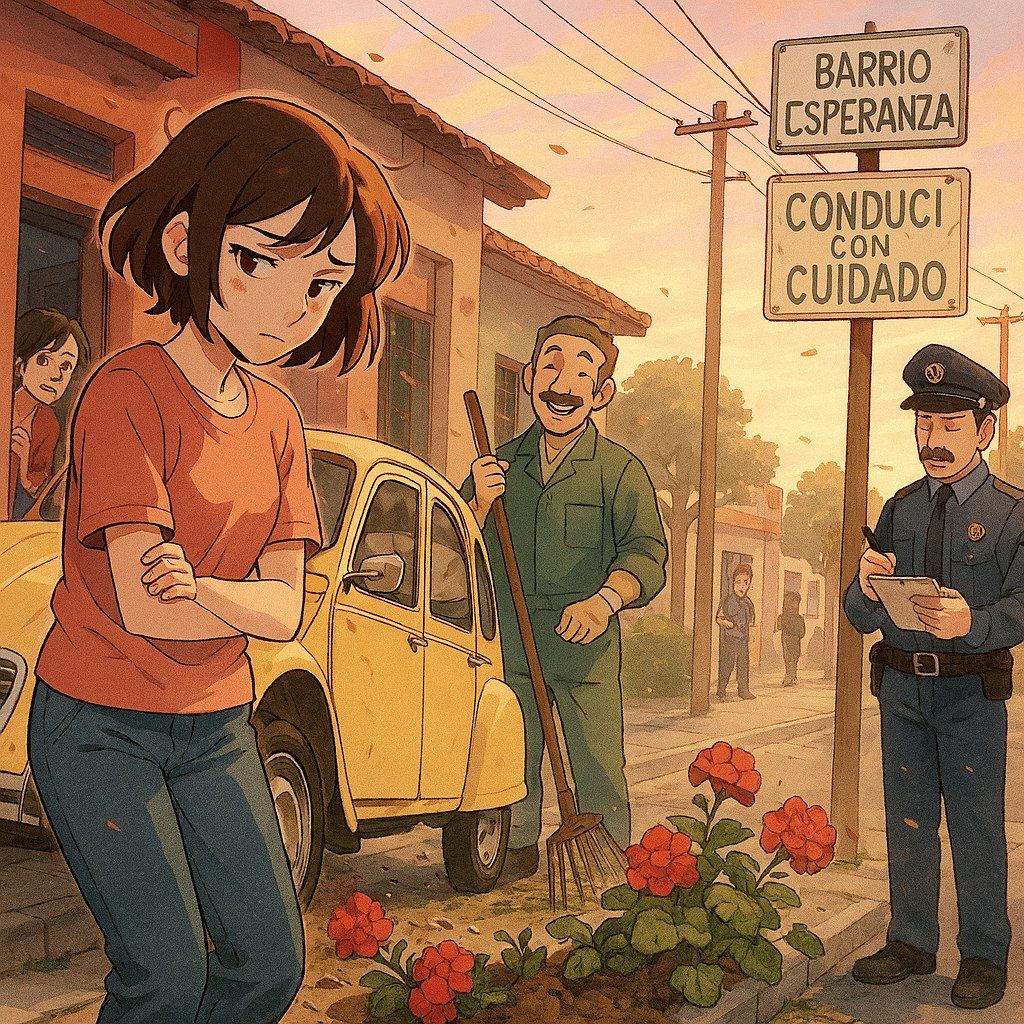
Lola was not an experienced driver. She had taken a quick lesson with her uncle Paco the week before in the supermarket parking lot, and uncle Paco — a kind man who was never on time — had handed her his old yellow Citroneta, a car with more stories than door handles. Lola had half-washed it, dusted off the radio, and adopted a grown-up look that was just a little off-center.
On the passenger seat rolled an untidy bottle of cider: Lola hadn’t planned to drink; the bottle was leftover from a family celebration where she’d toasted with a half-glass more out of excitement than habit. In Lola’s head the day looked simple: get the car, deliver the empanadas, be back before her mother noticed she’d used uncle Paco’s car. She underestimated two crucial things: the Citroneta’s capacity to surprise and her own ability to narrate the odyssey she was about to star in.
Solstice Street, which the Citroneta took with a certain flair, was lined with houses with small sidewalks where plants lived like dignitary residents. On one of those sidewalks worked Mr. Armando, the neighborhood gardener. Mr. Armando was a middle-aged man with callused hands, an easy smile, and a reputation for telling jokes nobody asked for but everyone listened to. He had a toolbox in his hands and a list of small tasks occupying his mornings.
“Hey, Lola!” Mr. Armando shouted when the Citroneta rounded the corner. “Can you hand me that screwdriver in the drawer?”
Distracted by the radio and mentally preparing the best tone to say “sorry” if something went wrong, Lola didn’t hear. The car brushed Mr. Armando’s leg as if giving a distracted greeting and, in a move that mixed surprise with theatricality, sent him toward a pile of soil sacks and stacked pots. Armando fell backward, looked up at the afternoon as if he had just been given an unexpected massage, and after a few seconds started to get up amid contained laughter.
“What kind of massage was that, young lady?” he said, shaking off leaves as if to prove everything was fine. “Technology doesn’t forgive stylish moves these days.”
Lola, heart pounding, hit the brakes and saw the flowerbed crushed. The Citroneta sat with one wheel on the sidewalk and some geraniums Mrs. Mirtha tended with devotion poked their heads out between mud and metal. The scene was as absurd as a poorly printed postcard.
Neighbors began to peer out: the neighbor who knew everything (actually knew little but spoke a lot), the kid from the kiosk with his cap turned back, and the mail carrier who never missed gossip and had already run over to catch the best angle of the story. Amid murmurs and glances, a patrol car arrived. Officer Gutiérrez, a man with a neat mustache and an equally neat notebook, stepped out with a determined stride.
“Who was driving?” he asked, striking a documentary posture ready to record the scene live.
Lola climbed out with hair mussed and flushed cheeks. Her hands trembled and her voice had that hurried tone of someone arranging words before they do it for them.
“I was,” she said. “I was bringing empanadas.”
The officer asked her to take a breathalyzer test. It’s a standard procedure: a blow into a device, a tense silence, a clarification of whether one had been drinking or not. But Lola had a habit of talking when nervous. She began explaining that the bottle wasn’t hers, that it had been a celebration at home, that the empanadas were crucial, that Mrs.
Mirtha tended those geraniums more carefully than her own dog. She spoke as if trying to control the chaos with words.
“Officer, look,” Lola said, “if the machine measured the nobility of empanadas, I’d test optimal.”
The device, patient and electronic, waited for a formal blow. Lola interrupted the instruction with an anecdote about uncle Paco and his talent for losing brake lights. The officer, patient as someone who’d heard every type of explanation, tried to resume the test. But the device produced no valid reading once the test was interrupted by Lola’s insistence on narrating her version of events. Formally, the test was considered positive because of the interruption—a legal variable where silence and breath matter more than eloquence.
The news—always quick to travel in a small block—reached the judge’s ears, and the Justice system, with its unmistakable taste for paperwork, opened a case for negligent injury. It was a harsh phrase to fit into the capsule of a neighborhood used to arguing about the best meat pie recipe: the file, the notifications, juridical explanations. For the neighbors, the expression “negligent injury” sounded serious and required attention that wasn’t as funny as an empanada afternoon.
Meanwhile, Mr. Armando was taken to the clinic in an ambulance. He received careful, professional attention; luckily his injuries were not severe. He spent the night with bandages and a head full of stories to tell upon his return to the neighborhood square. What did get hurt was his pride: he’d lost his unofficial medal of “Most Patient Neighbor,” an award he accepted at every opportunity. Between jokes he recited an endless list of puns that, ironically, did more for his recovery than medicine.
In the following days the neighborhood’s life turned into a mix of formalities and humor. The police station collected statements; the court requested technical reports; uncle Paco promised to fix the Citroneta and swore “an accident isn’t excuse to disgrace the family car.” Mrs. Mirtha, with the rigidity of someone who cares for plants like relics, demanded her geraniums be replaced and insisted on receipts and paperwork—everything must be in writing.
Lola, for her part, faced a chain of consequences that were more educational than punitive: intensive driving lessons, multiple talks about responsibility, and a bunch of community tasks to repair the damage. They were not soft nor humiliating punishments but lessons that sank in with the intensity of learning by personal experience. Her mother combined love with firmness, uncle Paco showed a mix of guilt and support, and Vale—the friend who was supposed to receive the empanadas—went through a phase of anger that later turned into shared laughter when the story became required anecdote at every group gathering.
The neighborhood refused to let the matter become public shaming. There was a collective intention to turn the experience into something constructive: a safety-awareness campaign humorously titled “Drive Carefully (and Keep Your Hands on the Wheel).” Mr. Armando agreed to be the face of the campaign, with a slightly raspier voice but the same intact smile, posing in front of a poster with geraniums and a slogan that blended warning with warmth.
“If you’re going to deliver empanadas,” the poster read, signed by Mr. Armando, “better ask your friends to call you first.”
The community organized workshops in the square, talks with police officers, and above all a driving circuit where neighborhood youths could practice without having to face the real world. They painted a mural of the Citroneta in bright colors, one wheel on the sidewalk and the geraniums recovering as a symbol that life, with patience and care, can be reborn.
Lola had time to reflect during her learning process. She learned—practically and sometimes painfully—that responsibility does not mix well with improvisation, that a poorly secured bottle can change the course of an afternoon, and that some decisions deserve a second thought.
She also learned the difference between the adrenaline of adventure and the calm of prudence. The cold empanadas, in the end, were a lesser evil compared to the possibility of tragedy.
Over time things returned to a new normal: the Citroneta was fixed by uncle Paco (who took the chance to install new fuses and a horn that made funny noises), Mrs. Mirtha planted new geraniums and posted a small sign that said “Do not park on the flowers,” and Mr. Armando reclaimed his gardening spot with a new medal: “Ambassador of Patience,” awarded by the neighborhood association. The Justice process followed its legal course with its due deadlines; for the community, the most important thing was the collective learning.
The story concluded one afternoon in the neighborhood square, at a fair where empanadas, pastries, and desserts were sold. The polished yellow Citroneta, adorned with a decorative ribbon, was parked like a trophy of an anecdote turned positive. Lola handed out leaflets with drawings of geraniums and safety messages; each flyer had a small slogan she invented: “Geraniums live better with attentive brakes.” Mr. Armando sat in the front row, applauding with enthusiasm that hid the satisfaction of someone who knows, despite everything, his life remained intact.
Before the afternoon dissolved into stories, Mr. Armando approached Lola, placed a hand on her shoulder, and with the mix of severity and affection that characterizes neighbors who know a lot about life, said:
“Lola, next time you want to impress someone, start by impressing the brake.”
She laughed, scanned the square, and—making a promise that sounded sincere—said:
“Promise. And if needed, I’ll give you back the screwdriver too.”
The square filled with laughter. The security cameras that had recorded the original scene later served as footage for a homemade short film the neighborhood youth made for the campaign. In Hope Neighborhood there remained, besides the anecdote, a firm feeling: adventures can be fun, but it’s better if they don’t leave geraniums as victims.
And so, among empanadas, new geraniums, and a Citroneta with a comical horn, Hope Neighborhood closed a chapter that had gone from incident to shared lesson, showing that a community, with humor and solidarity, can turn a stumble into teaching.
Source of the images.
Image created with Bing.
Short story: The Boy with the Frozen Hair
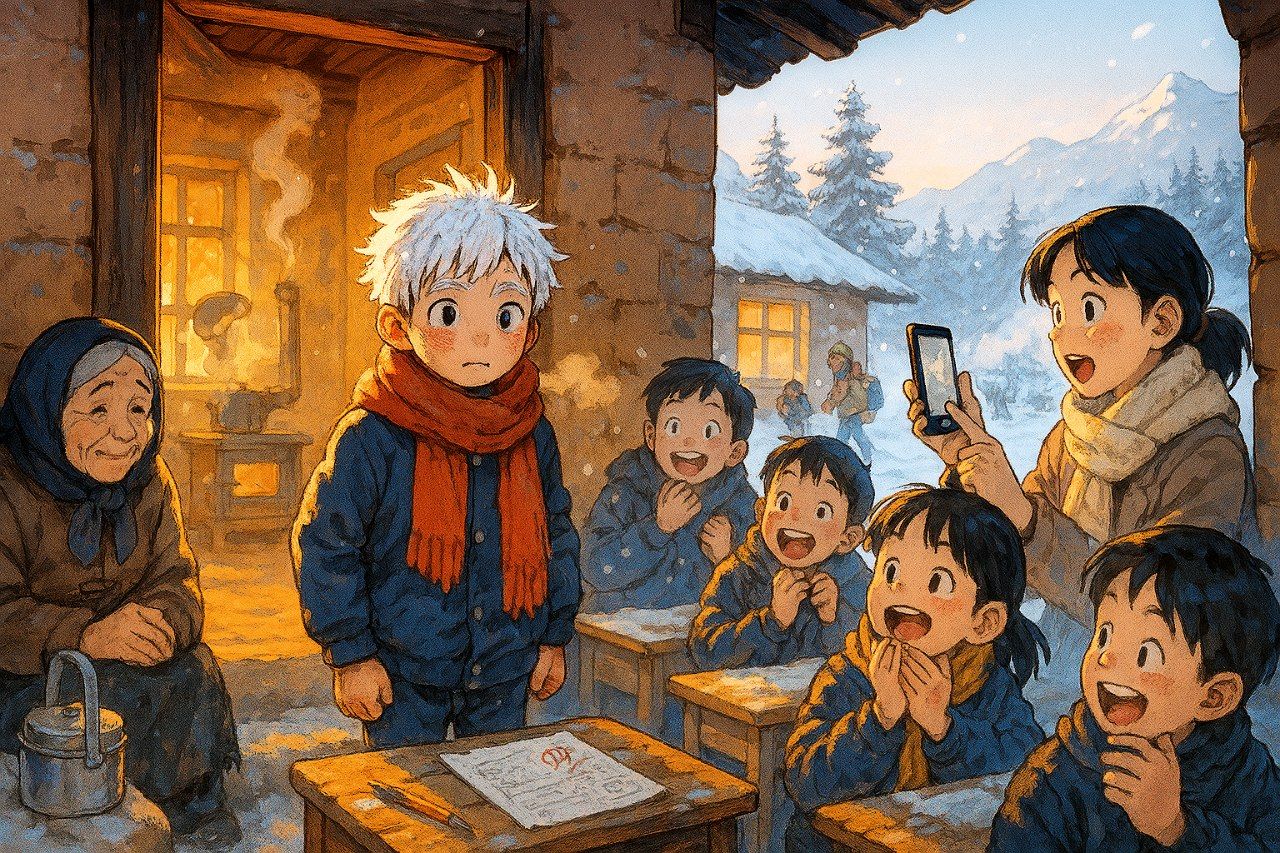
The morning in the village of Shānshuǐ dawned unlike most: a compact, dense silence with the sky washing the mountain outlines in a pale gray. The cold was not a suggestion but a law: the thermometer read -9 °C and the frost had turned the fields into broken glass. In a small mud house, beside a hearth that no longer warmed as it once did, Grandma Lín watched her grandson with rough hands and careful eyes as he prepared to leave.
Wang Fuman was eight years old and possessed a determination larger than the house itself. It was not the first time he had walked several kilometers to attend school, but that morning he knew he could not miss the final exams. Grandma Lín wrapped the scarf around him as one ties a safety flag around an adventurer.
"Grandma, I'm going," Wang said firmly as he adjusted the scarf until it covered his throat. "I can't miss it—today is math."
"If you turn into an ice statue, I won't be able to sell you at the market!" his grandmother replied, trying to joke to hide her worry. "And bring a pot of soup for the way back; with this cold your stomach will declare war."
Wang smiled with a mix of affection and haste. He didn't want anyone to worry more than necessary. He closed the door, left behind the mud house that smelled of tea and damp wood, and set off. The path to the school wound between pines and rocks; the frost crunched beneath his boots as if nature itself applauded his steps. The wind slapped his face with that reckless force that shaves the skin, and the cold transformed his hair into a hard white mass: a frozen hairstyle that made him look like a tiny old man or a snow statue in a school uniform.
When he appeared in the schoolyard, the scene was both comic and sobering. The children stirred; some laughed, others stared in disbelief. Teacher Zhāng, usually a composed man, was stunned at the sight of the boy with frozen eyebrows and wind-chapped cheeks. The image was, in its simplicity, a story.
"Is that a student or a penguin in uniform?" he muttered, half in disbelief and half in tenderness, before taking out his phone. "Wait—this needs to be documented."
Mei and Lǐ, two classmates who laughed easily, leaned in to comment on the novelty. Whispers turned into jokes: "he looks like an ice-cream cloud," "did they pay him for the hairdo?" Even so, the laughter lasted only a few seconds. Wang crossed the classroom threshold with the composure of someone who knows why he has traveled so far and with a gesture that made clear the teasing would not distract him. He sat, rubbed his swollen hands to warm them, and set his pencil to the paper.
While others chatted and fiddled with their pencils, Wang began to solve the problems with a calm that was both cool and resolute. In his head, the operations lined up with the same naturalness others use to thread beads on a string. Multiplications, divisions, fractions—each number on the test was met by him with the deference of someone who understands that problems are tamed by discipline. He muttered strategies under his breath—the voice of his own training: "Multiply, divide, breathe." His fingers, despite the cold that had made them stiff, moved with surprising precision.
Those who had laughed earlier began to watch. Mei, who had once feigned indifference to avoid studying, felt a sting of shame mixed with admiration when he saw Wang finish sheet after sheet with confidence. Lǐ, who had relied on gossip rather than study, leaned over his desk and stopped moving his lips. The whole class settled into a hush of expectation: not only focused on the answers, but because the boy's attitude spoke of something bigger than a single test.
At the end of the day, the results were a reality check: 99 out of 100 in math. The grade reflected will more than luck.
Teacher Zhāng, who had taken the photo in a moment between surprise and compassion, uploaded the image with a few simple lines describing the scene: a student who had walked kilometers in extreme cold, a classroom without heating, and the determination not to miss his exam. The post began to travel across networks and communities within hours, crossing borders and touching hearts.
The ensuing virality was not just a virtual phenomenon. The image shattered the complacency of those who saw it: donations, messages of support, and offers of help began to arrive. Organizations, anonymous individuals, and even an eccentric foreign volunteer who would later arrive with a multicolored scarf mobilized to turn concern into concrete action. Contributions for heating, warm clothing, school supplies, and repairs reached the small village like a warm rain precisely when it was most needed.
Mr. Héctor—remembered by the community—arrived with boundless energy and a bag of tools. He had a foreign accent and a laugh that seemed to be out of tune with the village's concentrated silence, but his will was practical: windows, stoves, insulation. Grandma Lín, who knew how to measure help with common sense, received them with the blend of hospitality and pragmatism only those who have lived through scarcity possess.
"Heating, finally!" Héctor exclaimed as he installed the first stove, his colorful scarf swinging against his chest. "Where should I start—walls or windows?"
"Start by not making the drill dance in class," she replied dryly. "If you're going to drill, at least don't play out of tune."
Within days, the windows were sealed, stoves installed, and the school that had sounded like a giant refrigerator began to breathe a new warmth. That warmth did not merely come from radiators: it filtered through simple gestures—coats arriving for the children, blankets for families, and new books for the library. The school's renovations meant more to the community than cement and paint; they were a promise that future tests would no longer demand extreme sacrifice.
Wang returned to the school routine with the same steadiness but without ice in his hair. His cheeks regained color, and his focus remained an example for his classmates. Mei and Lǐ, who had started the morning with mockery, became humble observers. One day Mei approached and, without his usual irony, spoke words that showed he had changed.
"You taught us something else," he said, honest in the way admiration sometimes is. "Bravery doesn't come in coat sizes."
"And extreme hairstyles can help the world," Lǐ added with a shy smile, as if humor had softened into tenderness.
Grandma Lín, for her part, did not lose the practical core that defined her. She thanked the helpers with the same firmness with which she had cared for her grandson. She took charge of organizing the donations, advising volunteers, and—of course—negotiating, in jest, a price for any frozen-hair contest volunteers might propose.
"If they hold a frozen-hair contest, I'll charge admission and sell soup," she announced to general delight while stacking the donations in neat piles.
The mountain mist, an almost mythic presence in the villagers' imagination, seemed to observe everything with that quiet humor reserved for one who has seen many seasons. It was as if the mountain itself approved the change: from a landscape that had challenged a boy to a community that had found a way, through solidarity, to warm itself.
Over time, the anecdote became a habit of good news and small jokes. Someone seriously—and jokingly—suggested an annual frozen-hair contest, and Mr. Héctor, who never hid his taste for festivities, proposed improvements to the playgrounds, paths, and places where children gathered after class. The village changed in practical ways: more supplies, a less cold classroom, and a community better connected to resources that once seemed distant.
Wang kept his 99/100 like a map of his effort—not a trophy of luck, but tangible proof that he met a challenge with diligence. The grade did not turn him into a celebrity; he remained a boy who helped carry water when needed and who sat with Grandma Lín in the evenings to listen to stories of different times. Yet his act awakened something that did not fade with spring: the idea that determination and community can transform adversity into new opportunities.
Sometimes, when the wind returned and people gathered under the pines, the children would mock Wang's frozen hairstyle in jest and ask softly whether he would wear it again for fun. Everyone laughed, but the laughter carried respect. What remained clear was not the aesthetic gesture of frozen hair but the lesson that excellence and solidarity do not depend on abundance; they depend on the sum of wills that awaken in the face of need.
Grandma Lín, to close conversations with her characteristic note, would remind anyone who wanted to hear:
"Next time, son," she would say with that blend of affection and discipline typical of one who raises generations, "bring a pot of soup for the road. And if you want another viral hairstyle... pay my commission."
And so, between laughter, new stoves, and completed exercise sheets, the village of Shānshuǐ learned that cold is best fought with human warmth, that a photograph can move mountains of help, and that a boy with hair full of ice actually had a heart burning with will.
Source of the images.
Image created with Bing.
Short story: The Fog on the Lake
In Sombreira, a village where the gray sky seemed to mimic the souls of its neighbors, the lake was the secret heartbeat of the community. Its waves whispered confidences and the seagulls raised their chicks on the shores. But in recent weeks a denser shadow had settled over everything, a reflection of Samuel’s dimmed spirits—his once-easy laugh now barely remembered.
Samuel’s Sadness
One afternoon, when the sun spread pale behind the clouds, Samuel sat at the water’s edge and stayed still, staring at his own shadow on the surface. Elena, his closest friend, arrived silently and sat beside him. She watched the melancholy that marked his face.
“Samuel,” she broke the silence, “I haven’t seen you laugh like before for a long time. Are you all right?”
He looked at her; his eyes, once bright, seemed extinguished. “I’m a little sad,” he said, shrugging.
“That’s not you,” Elena insisted, her voice cracked with worry. “You’ve always seen the world differently.”
Samuel lied to shield himself: “It’s just a phase, I need time.” But inside he knew it was deeper and more ravenous than he would admit.
The Specialist’s Voice
The days went by and Elena’s concern grew into urgency. In a chat with friends, the subject of depression came up. María, at the village café, said lightly, “They say it’s only a phase, that time fixes everything.” That was not enough for Elena.
She sought out Dr. Verónica, a mental health specialist with a calm voice and warm manner. Her office, painted in soft blues and lined with overflowing bookshelves, offered a quiet Elena accepted with some relief.
“What brings you here?” Verónica asked with a smile that did not demand urgency.
“My friend Samuel,” Elena confessed. “I think his sadness is something deeper. I don’t know how to help him; he always says he’s fine.”
The doctor nodded with understanding. “Sadness is human; depression is something else: a disorder that needs attention.”
Identifying the Symptoms
“How can I help him recognize what he feels?” Elena asked, clinging to the hope of a practical answer.
Verónica spoke with patient professionalism: loss of appetite is one of the signs you shouldn’t ignore. If someone stops enjoying food, if their desire and sleep change, there are clear warning signs. Elena remembered classes Samuel arrived late to, red eyes, tousled hair.
“Sometimes he says he feels trapped between anger and sorrow,” she murmured through tears. “He doesn’t know how to handle it.”
“It’s not easy,” the doctor said. “Many people with depression feel frustrated and alone. The first step is knowing you are not alone and that seeking help is valid.”
The Revelation
Back at the lake, Elena carried the conversation and the determination to speak plainly with Samuel. They sat on their usual bench, where the water returned to them a broken reflection.
“I know there’s something in your eyes,” Elena began. “You don’t have to carry it in silence. Tell me.”
Samuel looked surprised and then his face dimmed further. “I don’t know why I feel this way,” he said in a cracked voice. “I’m in a dark hole. Anger and sorrow mix; sometimes it’s like fighting myself and I don’t know how to get out.”
Elena took his hand gently. “It’s okay to feel it. You don’t need all the answers now; just be honest with yourself.”
“And what if they judge me? What if they think I’m exaggerating?” he asked, clutching her fingers with fear.
“You’re not alone,” she replied. “Dr. Verónica can help you. You deserve to take care of yourself.”
A small spark of hope showed in Samuel. “What if it doesn’t work? What if I never become the same again?”
“It’s not about becoming exactly the same,” Elena said, “it’s about finding wellbeing. It’s a process. It’s worth trying.”
Paths of Hope
Samuel asked for help. At the first appointment, Verónica welcomed him with a calmness that let him speak without pretense. Slowly the sessions gave a name to what consumed him: it wasn’t weakness, but a treatable condition. He spoke of fears, of others’ expectations and his own, of sleepless nights and heavy days.
“I feel like I’m in a fog,” he said during a session. “At times I think some clouds open, and other times they cover everything again.”
“That’s part of the process,” the doctor said. “There will be good days and bad days; what matters is recognizing small progress.”
The Light at the End of the Path
With steady therapy and Elena’s companionship, Samuel began to recover fragments of himself: the music that moved him, a shared meal with friends, the simple pleasure of how the sky pleased him without question. It wasn’t an immediate reconstruction, but small, sustained steps.
One afternoon they returned to the shore. The sun, shy, was breaking the fog.
“Look,” Samuel said, “the sun has come out.”
“It’s beautiful,” Elena smiled. “Sometimes you just have to take a step to shine again.”
“I’ve learned it’s okay to ask for help,” he confessed. “I don’t have to do everything on my own.”
“I’m here,” she replied, “always.”
The lake, which had reflected shadows, began to show a different horizon: a mirror of possibilities. In Sombreira sadness still visited from time to time, but there was also room for healing. The fog that covered hearts slowly dissolved, and like a new dawn, life opened again.
Source of the images.
Image created with Bing.
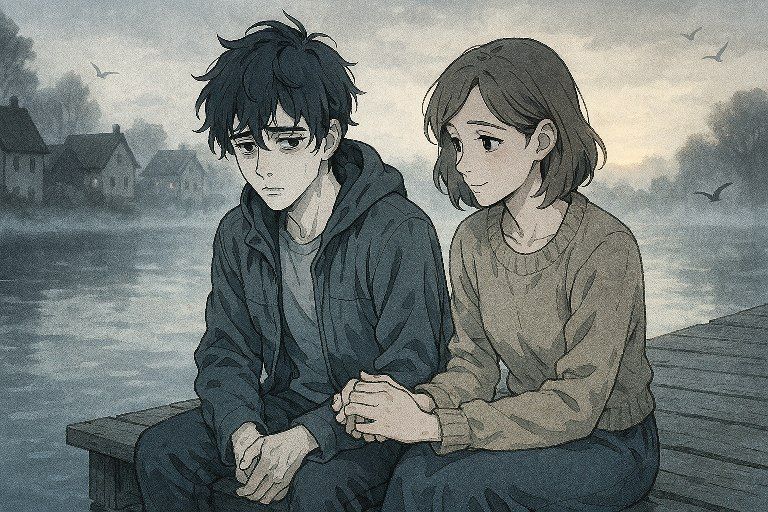
Short story: The Like That Unleashed the Plaza
Once upon a time in the town of Valdelío —the kind of place that only appears on maps if you look for where rumors spread fastest— there was an afternoon that promised to be as ordinary as any other: people buying arepas, children running around, and the fruit seller hawking her prices. But as often happens in neighborhood tales, a single misinterpreted message and a phone too eager to react were enough to turn calm into spectacle.
The afternoon began with a small rumor: a notification on Doña Lupita’s phone, a photo in Officer Carlosín’s stories and a blue heart that, by way of misunderstanding, went from an innocent gesture to evidence of betrayal. Maruca, who had seen everything through the gap at the vegetable stall, was quick to put the story into circulation.
Maruca (approaching the empanada stall in a conspiratorial voice):
—Lupita, I saw you the other day at the corner and I heard something! They say that officer of yours liked someone in his stories... and the woman in the photo didn’t look like she was from around here.
Doña Lupita (frowning, shaping empanada dough):
—Didn’t look from here? Carlosín has been coming to my stall for years; I’ve even seen his badge. What kind of tale is that, Maruca?
Maruca (confident):
—I don’t tell tales, Lupita, I tell headlines. If you want, I’ll pass you the video from the neighbor on the second floor who saw everything.
The neighbor on the second floor, not invited to the conversation, appeared just long enough to confirm and give the story its definitiveness: “a video.” The rumor, now with audio and visuals, spread through the plaza like wildfire.
At that moment Officer Carlosín arrived, his uniform immaculate and his hands more hesitant than his stride:
Officer Carlosín (trying to sound calm):
—Lupita, what’s going on? People are pointing at me... I didn’t do anything wrong, I just—interacted with a profile I don’t know.
Doña Lupita (apron stained with flour, voice raised):
—Interacted? I don’t like interactions when they come in the form of hearts on other people’s posts! And what about that photo with that woman in your story?
Officer Carlosín (getting nervous):
—That was a technical mistake, Lupita. I was watching stories and I tapped by accident. You know how phones are… they have a mind of their own.
The Park Sparrows, always tuned into drama, formed a chorus of opinions:
Neighbor 1 (adding spice):
—Tell the plaza what happened! —she shouted.
Neighbor 2 (pointing like a juror):
—If it’s true, let the whole town know.
Tension rose when Gordo Memo, convinced this was informational gold, pulled out his camera and began recording:
Gordo Memo (adjusting the lens):
—Don’t move. I’m uploading this to all my networks. If this goes viral, I’ll buy a whole drum of empanadas with the earnings.
Maruca (proud of the event):
—Memo, if you post it, put my comment at the top. I want people to know I warned them.
Doña Lupita, not the type to let things be decided on social media alone, stepped forward and demanded a public explanation. Her words, sharp, found the officer in evident trouble:
Doña Lupita (clutching a napkin like a banner):
—Carlosín, are you going to tell me the truth or just give it to me in likes? What does that woman have to do with you?
Officer Carlosín (making a gesture of resignation mixed with a lack of good ideas):
—Lupita... she’s just a colleague who asked me for help on a report. I have nothing to hide. Don’t you trust me?
Doña Lupita (laughing sarcastically):
—Trust? And what do I call this then? A digital accident? Are you going to show me the report?
The exchange heated the morning further. Dr. Reyes, who arrived with her notebook and measured tone, tried to apply method and calm:
Dr. Reyes (raising a hand as if requesting the floor at a meeting):
—Please, everyone. Before this gets out of control, we can resolve it calmly. There are procedures: talk, clarify, and if necessary, present formal evidence.
Doña Lupita (still loud but with a touch of pride):
—Evidence? You want evidence? Right here, in this plaza full of witnesses that has become a court—doesn’t that count? Even the hardware store dog looks at me reproachfully.
And then, in the middle of the commotion and mediation, what the crowd expected happened: Doña Lupita, overcome by surprise and anger, slapped Officer Carlosín. It wasn’t just any slap—it felt rehearsed for drama, with natural plaza acoustics providing the perfect sound effect.
Gordo Memo (recording anxiously):
—Camera steady, this is gold! —he whispered as he filmed vertically, the best orientation for virality.
Witnesses reacted as if attending an improvised play: some applauded, others booed, and a large group began narrating aloud while recording:
Neighbor 3 (in a judge-like tone):
—She had every right. If there’s cheating, it should be known.
Neighbor 4 (more cautious):
—Calm down. Violence isn’t the solution. If necessary, file a complaint.
Carlosín, more shocked than hurt, rubbed his cheek and scanned for the support of his uniform:
Officer Carlosín (voice between offended and embarrassed):
—Lupita, really? I didn’t think— I thought you’d understand.
Doña Lupita (firm but with a hint of vulnerability):
—I understood when you told me you’d been doing night shifts and missing dinner. Yesterday I found messages that told me a different story. Do you think a woman forgets that so easily?
Dr. Reyes, staying in her role as moderator, tried to steer things back:
Dr. Reyes (attempting to calm tensions):
—You can sit here, speak in front of witnesses and leave a written record. There are legal paths for cases like this: complaints, mediation, reconciliation. The plaza is not a courtroom.
Maruca, tireless, added her version full of details and suspicions:
Maruca (leaning in confidentially):
—I saw the officer at a café the other day with a woman wearing dark sunglasses. I won’t shout it, because I’m not certain... but the detail is out there.
Gordo Memo, phone halfway through uploading the video, interrupted with shamelessness:
Gordo Memo (pressing the screen):
—If this explodes, I could save a bunch of local reporters. Imagine the headline: “Love, Likes, and Arepas: Valdelío’s Scandal.”
Neighbor 5 (with dark humor):
—We could sell T-shirts: “I was in Valdelío and I survived the slap.”
The video went viral almost instantly. In hours, the plaza that had once been for bread purchases trended across town. Comments, memes and theories multiplied. Some demanded sanctions against the officer for breaching decorum; others asked that Lupita be held accountable for assault. Official uncertainty remained: authorities did not confirm the causes nor the romantic relationship, and the local prosecutor’s office, after receiving calls, opened an inquiry.
Meanwhile, daily life continued, begrudgingly. The fruit seller, ever the entrepreneur, began selling T-shirts reading “I Witnessed Valdelío’s Slap” and offering discounts to anyone who brought the original video. The Park Sparrows, for their part, kept commenting.
Days later, Dr. Reyes gathered the protagonists for a symbolic reconciliation in the plaza, now with fewer cameras and more people seeking closure:
Dr. Reyes (pen ready):
—I propose they sign a statement of understanding: public apologies if appropriate, and referral to formal channels if needed.
Doña Lupita (somewhat calmer, eyes still proud):
—I can apologize if I see remorse. But let this teach people this isn’t show business.
Officer Carlosín (looking ashamed):
—If I hurt anyone, I’m sorry. But I ask that this be investigated calmly. No one deserves their private life to be decapitated by a like.
Dr. Reyes, in her pedagogical tone, made clear something many didn’t want to hear:
Dr. Reyes:
—Social networks amplify conflicts and rumor feeds on the lack of information. If there are breaches, they should be resolved through proper channels: complaints, evidence and sanctions where appropriate. Violence only fattens the problem.
In the epilogue of this story —retold in many versions and spread in voice messages and chain texts— a diffuse but useful lesson remained: screens multiply exposure, versions abound, and the official truth takes time to arrive. Doña Lupita returned to her empanada stall with a clientele that, out of curiosity or solidarity, visited more than before. Officer Carlosín cleaned his uniform and received calls from the station to clarify his situation. Gordo Memo, who had uploaded the video, gained followers and criticism from those who saw his action as sensationalism.
Final dialogue (a reflective closing):
Maruca (making a mental note of the news):
—I’d say this taught us all to handle the like button better.
Doña Lupita (serving an empanada with half a pardon and half a reproach):
—Next time I see a suspicious like, I’ll check the content first and then, if necessary, call Dr. Reyes.
Officer Carlosín (sighing, hand on the pocket where he keeps his phone):
—And from now on, I’ll turn off story notifications.
Thus ends the episode that Valdelío —and the networks— turned into an anecdote: no absolute truths, many versions, and a plaza that learned to be cautious with likes and quick judgments. The End.
Source of the images.
Image created with Bing.
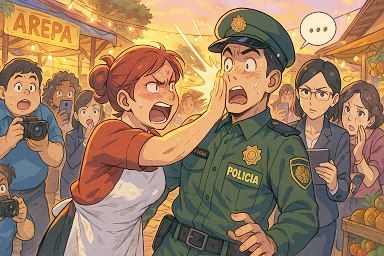
Short story: The Blue Ribbon's Hand
In the small neighborhood of Lirë, where narrow streets smelled of freshly baked bread and the evenings filled with the lazy smoke of chimneys, lived Ana Leka. She was eleven years old, her brown hair always adorned with a blue ribbon her grandmother had knitted, and a clear laugh that lit up any corner. Ana had Down syndrome: she sometimes walked slowly, tenderly repeated the songs she liked, and, above all, had a way of looking that seemed to stop time and cradle whoever received it. Her mother, Elda, worked sewing in a nearby workshop; her father, Ilir, repaired bicycles in the square. The family, simple and affectionate, devoted themselves to Ana with the tenderness of those who know the value of patience.
The Niko School, where Ana had studied since she was little, was an old building with high windows and recesses where children ran after balls that struck the air with laughter. For years, Ana was part of that school community: she sat in the third row, repeated the poems that teacher Marina dictated in a measured voice, and loved art class, when colors and shapes allowed her to draw blue butterflies that she later hung on the wall. For many, Ana was the smiling girl with the blue ribbon; for others, merely “the special one,” a label that over time would begin to weigh more than it should.
The neighborhood’s calm broke one winter when murmurs arose among some parents. What began as half-phrases—“that girl distracts the others,” “it’s not fair for my children”—evolved into coordinated pressure. Convinced that Ana’s presence “affected learning,” several parents demanded measures. At first there was no genuine attempt at dialogue with the family or an honest search for inclusive alternatives; the reaction was quick and selective. Some teachers, overwhelmed by the tension between the community and administrative demands, gave in to the pressure. The outcome sounded like punishment: Ana was removed from the main classroom and sent to a small room in the school basement, a place without heating, with small windows and old desks with wobbly legs.
The little room became a sad symbol of isolation. There, Ana received instruction informally and often alone. Materials were scarce; notebooks were recycled. The girl who had once shared her colors with everyone was reduced to a routine of solitude. Teacher Marina, who had taught with passion and had always noticed Ana’s ability to memorize poems and her curiosity for illustrated books, tried to visit her whenever she could. She entered with a smile and a bag of clean sheets or a pack of colored pencils she had bought with her own salary.
One morning, Marina pushed open the little room’s door and found Ana with cold hands, crumpled sheets, and a look searching for company.
—Ana, come—Marina said, sitting carefully beside her—What are you drawing today?
—Butterfly—Ana replied, pointing delicately to the drawing—Blue.
Marina took her hand and said in a low voice, promising with the same firmness with which she defended her students:
—I will fight for you, Ana. I don’t want you to be here alone.
The teacher’s words could not erase the room’s cold, but they planted in Ana a hope that clung like a blue thread in her ribbon.
The news of the isolation spread quickly. In the square, among conversations mixing concern and anger, opinions polarized. Some neighbors defended Ana; others, influenced by prejudice and fear, supported the decision to separate her. Ilir, Ana’s father, juggled work and the helplessness of seeing his daughter confined to a gloomy room. At dawn he sat by a lamp fixing bicycles while rage and sadness fought in his chest.
Local reports described the room, published testimonies, and showed photos of worn notebooks. The story reached regional channels and, before long, landed on the desk of the country’s president, Marko Velich. Accustomed to receiving papers and figures, Marko read the case with a mix of disbelief and shame. He thought this kind of decision not only violated the law but attacked a child’s basic dignity.
He decided not to remain at an administrative distance. One clear morning, without announcing it publicly, Marko took his gray coat, left protocol’s rigidity behind, and went to Ana’s house. He did not arrive with phones or press cameras; he carried only the conviction that he should accompany a gesture that said more than an official statement. He knocked, and Elda answered the door with surprise and a mixture of distrust and relief.
—Hello, Ana—Marko said when the girl appeared at the threshold, bending gently—Will you give me your hand?
Ana looked at him naturally, took his small hand without ceremony, and Marko felt the weight of responsibility become palpable in the warmth of that gesture.
—I want to accompany you to school—he added softly—You are not alone.
Word of the presidential visit quickly leaked out. People from the neighborhood began to gather, cameras surrounded the house, and neighbors peeked through windows. But the essential remained between the girl and the president who, hand in hand, walked the streets to Niko School. Their passage slowly changed the observers’ perception: it was no longer only the image of a figure of authority but that of an adult reclaiming a child’s dignity with a gesture.
Upon arriving at the school, parents who had earlier demanded expulsion stood frozen; the scene seemed to require a reflection words had failed to achieve. Inside the main classroom, teacher Marina and the children stopped their activity to watch the arrival. Silences spoke more eloquently than any reproach. Ana, with determined steps, entered the class as if it had always been her home. The president paused and, looking at all the gathered families, spoke with a clear, firm voice.
—Discrimination against children with disabilities is unacceptable—he said—Inclusive education is not a concession: it is a legal right. This school must be a place where all girls and boys feel safe and accepted.
His words resonated in the room and beyond: in the hallways, the square, and the neighborhood’s homes. Some people lowered their gaze, others exchanged looks laden with guilt, and some, for the first time, reflected on the real impact of exclusion. Among the crowd, Ilir clenched his fists until his knuckles paled. He found his daughter among the people, hugged her tightly and whispered without looking at anyone:
—Sorry.
Change was not instantaneous nor a purge of old prejudices. What followed was a process requiring practical decisions and commitment. The school administration announced immediate measures: the basement room would be closed and Ana would return to the classroom with her classmates; training sessions on inclusive methodologies were scheduled for teachers; and a space for dialogue between families was opened to address fears, doubts, and coexistence practices. The community organized to improve resources: donations of materials, repaired windows, and a planned support program for pedagogy.
Marina continued to be Ana’s support at school. With infinite patience and creativity, she worked on strategies so that children would share activities and learn together. Cooperative dynamics were introduced in which everyone had a role, from helping in the courtyard gardening to taking turns reading aloud. These exercises, designed to strengthen bonds, were small everyday acts that, over time, eroded distance.
Ana’s classmates, initially cautious due to their parents’ influence and the novelty of living with differences, began to know her beyond the stereotype. They learned to laugh at her jokes, share snacks, and wait for her at the classroom door when she arrived. One day during art class, a group of children sat with her to draw butterflies. One of them, shy at first, said:
—Ana, will you teach me how to make a butterfly like yours?
—Sure—she replied, with the simple pride of one who shares.
Ilir, who had taken part in the initial anger and the march that demanded her exclusion, experienced a silent transformation. Witnessing his daughter’s acceptance and the community’s response made him rethink his own beliefs. He moved from shame to action: he volunteered to help in a bicycle workshop the school organized for parents and gradually began talking with other parents about what inclusion really meant.
The image of the president holding Ana’s hand was spread by national and international media. Many outlets reproduced it as a symbol of the fight against bullying and exclusion. For some it was a political gesture; for others, an ethical call for deep revision of social practices. Marko stated in public interviews: “We must protect children from bullying. There is no place for prejudice in education.” The repetition of his phrase served as institutional endorsement, but the most important changes happened in daily life: teachers who received training, adapted classrooms, neighbors volunteering, and, above all, a gradual shift in students’ perceptions.
Not everything was perfect or linear. Some families maintained resistance; hurtful comments still spread on social networks. The wounds of exclusion take time to heal and certain spoken words are not undone overnight. However, Ana’s daily presence in the classroom and her interaction with classmates and teachers produced a cumulative effect: relationships among children became richer, more diverse, and over time, more empathetic.
The school implemented inclusive activities for everyone: theater, a school garden, and music workshops where no one was excluded because of their pace. Ana, who had always enjoyed songs, found in music a space where her smile became contagious. Teacher Marina watched these changes with satisfaction: seeing her students collaborate, debate, and create together restored her faith in education as a tool for transformation.
One spring morning, with the courtyard full of flowers they had all planted, Ana approached a newly opened blossom and, pointing to it proudly, said aloud:
—Look, it’s for everyone.
Elda covered her face with her hands and cried silently. It was a mixture of relief and gratitude filtered through years of anguish. The school, community, and local policies responded with actions and measures: support programs, awareness campaigns, and clear protocols against bullying were developed. Ana’s story became a catalyst for changes that transcended Lirë: other schools in the region took note and began designing inclusive initiatives.
Over the months, the blue butterflies Ana drew began appearing on neighborhood walls: childish paintings celebrating difference and reminding everyone of the lesson learned. Parents' groups organized days to share experiences and dispel myths about disability. The school inaugurated a mural with butterflies of all sizes, a collective work symbolizing the diversity of its community.
In later interviews, Marko emphasized the social and legal responsibility to protect children and guarantee their inclusion. But beyond official statements, what remained engraved in collective memory was the simple, powerful image: the president’s hand held by a girl with a blue ribbon. It was not an empty photo; it was a reminder that gestures, however small, can unsettle prejudices and help restore dignity.
Life in Lirë continued with workdays, noisy markets, and orange-washed sunsets. Ana grew up among lessons, songs, and butterflies; her drawings became stories she told aloud in class. Marina, always by her side, continued to defend an education that welcomed differences. Ilir, transformed by the experience, opened a small bicycle workshop near the school where he sometimes gave talks to parents about empathy and cooperation. Elda, seeing her daughter laugh without reserve, wove new threads of hope.
The lesson of Ana’s story did not end in a single news item: it permeated policies, conversations, and practices. What began as an injustice became an impulse to build fairer spaces. In Lirë, where the wind still carries the scent of bread and chimneys announce cold afternoons, the blue butterflies Ana drew eventually became an emblem of a community that gradually learned to accompany those it had once excluded. And every time someone passed the schoolyard mural and looked at one of those butterflies, it was hard not to remember the morning when a child offered her hand and an adult decided to walk beside her.
Source of the images.
Image created with Bing.
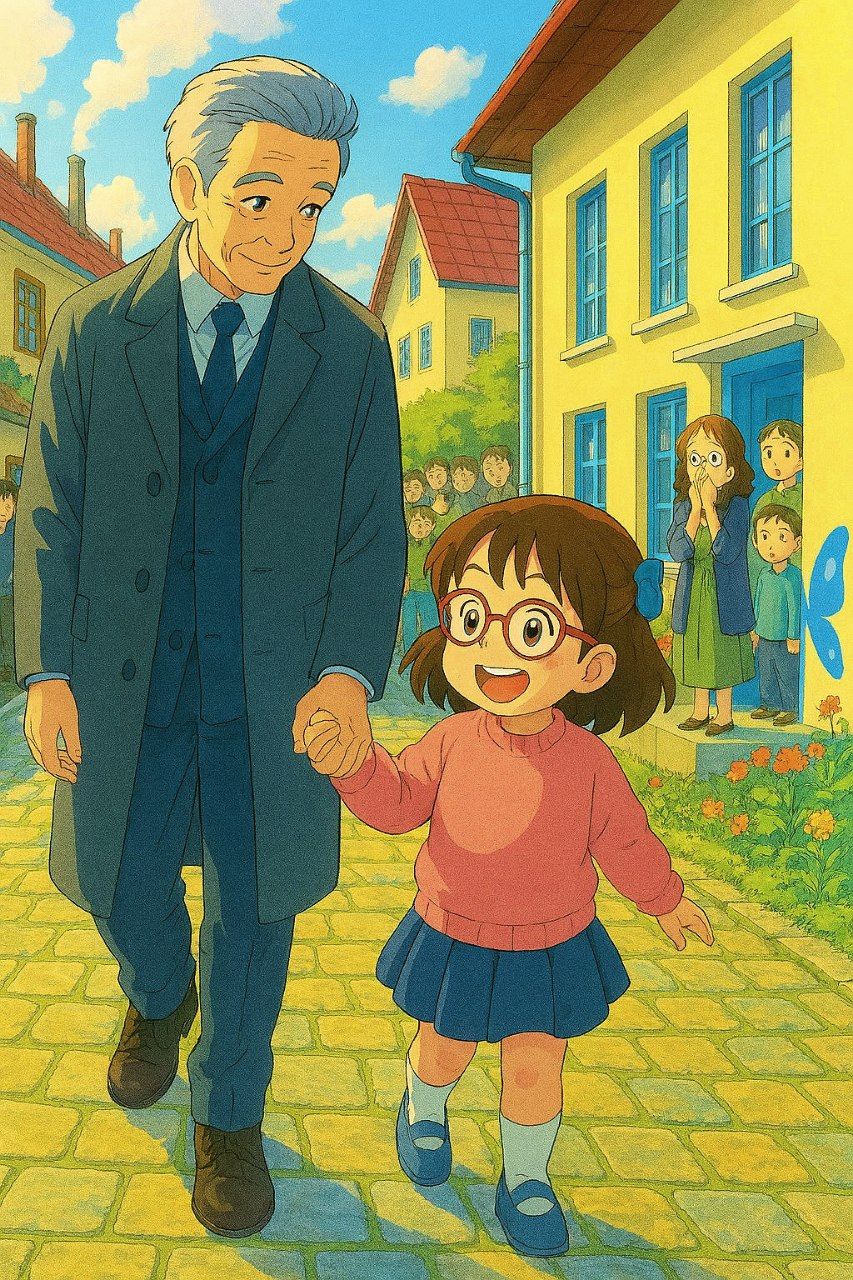
Short story: The Aeon Board
The Meridian Tower rose above the city like a colossus of glass and steel that seemed to devour the light of dawn. At its heart, the main conference chamber was designed to impress: soundproof walls, embedded touch panels, and, in the center, a circular pedestal where a hologram of the world floated. The map’s lines pulsed with data: trade routes, deposits, ports, factories. A tense silence filled the room; every breath felt measured, as if the air itself were another resource to be divided.
Three figures stood over the hologram: Armand Vale, president of the Northern Confederation, his face hardened by governing through scarcity; Irina Volkov, chancellor of the Eastern Union, stone-cold and precise as a glacier; and Li Huan, secretary of the Republic of Tian, whose serene bearing concealed a calculating ambition. Behind them, teams of advisers, generals and technicians watched expectantly; outside the chamber, a column of glass reflected the city’s murmur, which—for now—ignored that its future was being drawn inside.
“This ends today,” Vale said, his voice low and edged, barely a blade. “We have waited long enough. The Southern strip needs energy security and development; we cannot continue dependent on unstable chains. We propose energy corridors controlled by the Confederation, with commercial guarantees and transit rights.”
His words marked the session’s opening. Vale laid out a set of projections on the table: pipelines, strategic ports, refineries, and a financing scheme for reconstruction and exploitation contracts. Marcus Hale, his operations adviser, displayed charts showing balances, flows and delivery times. Each figure was calculated to show the offer as both lucrative and “necessary.”
Irina Volkov tilted her head, allowing the silence to press before answering. Her fingers laced on the table, skin impassive.
“I do not come to ask permission,” she replied precisely. “The security of our western borders is not negotiable; it is a precondition. We have consolidated positions and realigned defenses. We will not tolerate destabilizing attempts or acts that endanger our population. In exchange for recognition, we require commitments: discreet military infrastructure, logistical agreements and guarantees that no subversive influence will be fostered in our areas.”
Her proposal, cold and categorical, sketched a mental map: what the Eastern Union demanded was not only geographic space but political cushioning. Irina projected zones of influence over the hologram where her forces already operated with logistical and administrative presence.
Li Huan, from the opposite side, fell silent for a moment before speaking. His gaze rested with a mix of nostalgia and calculation on the small island that dotted the map: Kōrai.
“Kōrai changes everything,” he finally said. “It is not merely territory: it is the backbone of advanced production. Without its fabrication capacity and access to its plants, modernization stalls for decades. We already control minerals and rare earths, but semiconductors are the missing piece. We demand agreements that ensure continuous production and technological transfer under conditions that protect us from blockades and sanctions.”
Li Huan placed a dossier on the table: supply contracts, joint-venture agreements and an incentive scheme for engineers. His words carried the weight of someone who understands that modernity rests on tiny parts—chips whose absence can paralyze entire economies.
The room fell into a cutting silence. Outside, the city continued with traffic and routines, but inside the chamber the blueprint of what many would later call Aeon’s new balance began to be written: a redistribution of spheres of influence articulated in economic, strategic and military terms.
“Concrete proposal,” Vale said, eyes fixed on the map. “Energy corridors along the Southern strip with exploitation concessions and security guarantees. We finance infrastructure in exchange for prioritized supply and long-term contracts.”
Irina did not hesitate.
“I accept,” she answered. “But with conditions: joint maintenance facilities, logistical presence and rapid-response protocols. Also, we want to see tangible investment in communications networks and cyber security within our zones.”
Li Huan nodded but added a crucial condition.
“In exchange for our nonintervention in your areas, we demand continuous, stable access to Kōrai’s semiconductor production. We propose a shared industrial governance system: local control over staffing and training, but joint strategic management to ensure production is not used as a political lever.”
The discussion turned into an exchange of clauses, annexes and guarantees. Advisers began to haggle over details: confidentiality clauses, intervention protocols, arbitration mechanisms and almost clandestine “contingency” clauses. Marcus Hale slid a technical file across the table, but the essence was clear: advantages would be parceled out and red lines would be set.
While the leaders negotiated, the board’s pieces took life in distant places. On Kōrai, assembly lines hummed like industrious hives. Hana Miyu, a plant engineer, looked up from a control panel when an overseas technician entered with official correspondence. As a line chief, she knew the machines’ schematics, production cycles and the value of each component. She felt pride in her work, but reality was starting to tint that pride with unease.
“We will not be reduced to mere gears in a foreign machine,” the island’s governor declared at a meeting with activists and workers. “We will negotiate conditions that guarantee employment, technical education and participation in management decisions.”
Hana listened closely. She knew agreements with Tian and other actors could bring investment, but also potential transfers of control. The alignment between official plans and local aspirations did not satisfy her need for autonomy: engineers wanted true guarantees.
In the Southern oil strip, the landscape shifted at dizzying speed. Joint ventures refitted oil fields, erected camps and hired local labor under new regulations. Nayara Tello, an activist and community leader, walked through towns where “progress” materialized as contracts and an increased security presence.
“They will not sell us as mere resources,” she declared at a crowded plaza. “If you change our lives, do it justly, with decent work and respect for our customs.”
Her words resonated. People accustomed to managers who came and left began organizing: demanding social clauses in contracts, independent audits and guarantees that development funds would reach schools and clinics.
Back in Meridian Tower, negotiations grew more pragmatic and darker. The agreements encompassed investments and guarantees, but also vetoes in multilateral bodies, de-escalation protocols and near-clandestine clauses for “discreet” operations. In a tense predawn, signatures were sealed behind closed curtains. Cameras fed the public with planned smiles and euphemisms: “cooperation,” “joint development,” “regional security.”
The first effects were tangible: infrastructure projects, technical cooperation, aid packages and rapid training programs. Yet shadows appeared—mixed patrols in conflict zones, unannounced inspections and subtle censorship of dissenting voices. Marcus Hale, pragmatic as ever, murmured a phrase that stuck with attendees at the closing session:
“If something fails, we trigger the protocols. No one will know who started it, but everyone will know who finished it.”
Those words leaked like a rumor through walls. No clarity of language could dispel the feeling of surveillance that seeped into streets and factories. In Kōrai, envelopes arrived with offers of “social programs” that, beneath benevolent language, included labor-control commitments and confidentiality agreements for local managers. In the oil strip, a refinery fire was used as a pretext to speed up contracts and reassign extraction licenses.
Public reaction was not long in coming. Mina Serrat, a historian invited as an independent observer by academic circles, wrote in her notebook: “This is not equilibrium; this is redistribution under diplomatic dress.” Mina began compiling testimonies: workers deprived of rights, parents who watched schools shutter while technical academies arrived, communities displaced by infrastructure. Her chronicles spread in clandestine networks and independent publications, becoming a brave record of what official communiqués denied.
Omar Bel, an exiled journalist working with Mina, translated testimonies into narratives that could pierce censorship. He conducted interviews at night in basements and cafés, recording voices that spoke of the fear of losing control over their lives. Anton, a Northern laborer, recounted how his neighborhood changed flags overnight: patrols, signage in a new language and contracts that handed local shops to joint ventures. His voice was rough as he explained how promised security came burdened with restrictions.
“They gave us security,” Anton said in an interview. “But that security came with conditions that make me miss freedom.”
Resistance took varied forms. In factories, engineers like Hana organized tactical stoppages and kept logs documenting production chains; in some cases they slowed deliveries of critical components when counterparties breached social commitments. Nayara coordinated strikes in the oil strip and organized alternative supply networks so communities were not solely dependent on foreign firms. Transregional support networks emerged: lawyers, technicians and researchers shared strategies to audit contracts and bring claims to international courts.
These acts of resistance dented the board. Signatures had power, but so did legitimacy. In forums and courts, citizen voices demanded transparency and redress. Sometimes public pressure forced clause renegotiations; in other instances, reparations were implemented.
Years later, Mina published a volume compiling that period: testimonies, leaked documents and analysis. She narrated the everyday of the transition: how decisions made in sealed rooms shaped daily life and how civic responses rewrote parts of the supposedly closed agreement. The book included an intimate chapter imagining a dialogue among three young people whose lives had become entangled with the new map.
“I inherited a factory that now supplies semiconductors to all of Aeon,” Hana said in that imagined exchange. “My pride is real, but so is my fear. I do not want my work to become a means of enrichment for those hiding behind contracts.”
“My parents worked fields now controlled by foreign firms,” Nayara replied. “They promised progress, but we lost autonomy. We want wealth to remain here and benefit our people.”
“And I grew up in a city that changed flags overnight,” Anton added. “When I heard the official speech, I knew something had snapped; then I learned to find what I could save.”
That fragment became symbolic: three voices summarizing the change’s ambivalence—material opportunity and symbolic loss; tangible improvements and loss of decision-making.
Time showed that agreements among powers were fragile if not underpinned by social acceptance. There were tense moments: blockades of strategic routes that slowed resource flows; unexpected strikes in critical plants; international claims over labor and environmental violations. Corporations and governments had to concede. In some places, local oversight councils with citizen participation were established; in others, military presence increased and repression grew visible.
Everywhere, consequences were complex and nonlinear. Some towns prospered with infrastructure and jobs; other communities suffered displacement and identity loss. Official narratives spoke of stability; Mina’s chronicle described wounds and resistance, days when people rediscovered politics as a negotiation tool.
A decade after the first signatures, a less ostentatious room lit another hologram. The faces seated there were new: less certain, more cautious. Lessons were visible. A young leader who had studied past mistakes spoke a phrase that set a new paradigm:
“We have learned. Controlling resources does not guarantee loyalty or long-term stability. Force without legitimacy fractures. If we want a sustainable order, we must include the people who live in these places, not treat them as variables to be moved at the whim of a board.”
The map turned, and for an instant images of plazas, schools and workshops rose on the hologram. They were not cold data but faces, voices and stories. That glimpse reminded attendees that an agreement’s efficacy depends as much on technical robustness as on social acceptance.
In her final public interview before retiring to independent research, Mina recounted how the redistribution operation left deep marks. The book closed with a photograph that symbolically gathered the protagonists: three hands of different skin and calluses holding the same industrial tool. Beneath the image, an epigraph read:
“The board was divided, yes. But the game continues. Those who inhabit the squares will not let only the powerful write their endings.”
The Aeon Board’s tale is, therefore, the story of how choices made in closed rooms propagated through cities and countrysides, generating gains and losses, alliances and rifts. It is the story of negotiators proud of their pragmatism who ignored that legitimacy is built in streets and factories. Above all, it is the story of voices from below that traced new strategies to claim participation, justice and a place in the decisions that shape their future.
Source of the images.
Image created with Bing.

Short story: The Sanctuary of Figures
Eduardo woke up on a Sunday to an alarm emulating an 8-bit effect and, without an ounce of shame, answered with a vocalization that sounded more like a forgotten video-game hero. He was thirty-two, and his apartment was not conventional: it was an emotional sanctuary where every shelf, box, and poster told a small geography of his life. Action figures posed dramatically on ledges, comics were organized by color as if for chromotherapy, and in one corner the console projected a blue light that gave him the same sense of security a pacifier once had.
Martina was already awake. Cups of coffee piled on the table, two notebooks full of convention notes, and a comic signed by an artist she had followed since she was twelve. Her eyes shone with a blend of devotion and efficiency: attention to detail and passion combined in someone who could recite editions, reprint dates, and the price of a limited-run figure.
“If you reach Friday with two unopened, it’s not burnout; it’s art,” Martina said, sliding the comic between her fingers as if holding a relic.
Eduardo looked at her and grew solemn. “Then I must be in full Renaissance: I have at least five masterpieces to open.”
“Óscar—” a voice yelled from the hallway— “did you bring the figure?”
The door opened and Óscar entered as if returning from a minor conquest, cradling a package wrapped in bubble wrap. He was a lawyer, tall, with that mix of seriousness and pride that makes every acquisition an act of personal affirmation.
“I brought the limited edition,” he announced, placing the package on the table with the reverence of someone depositing a certificate. “It’s worth more than a master’s tuition, but it reminds me I survived worse trials.”
Julia, who had just finished a night shift at the hospital, set a bag of assembly materials on the table. Her gaze was practical: skilled hands, the patience of a nurse, the ability to defuse urgencies with a calm others envied.
“I brought supplies and chocolate. Priorities,” she said as she opened the box with surgical precision, letting pieces fall into place as if the figure already knew where it wanted to be.
The afternoon began with a seemingly frivolous mission that nonetheless carried symbolism: organizing the display case. It wasn’t just about aesthetics; it was a staging of moods.
“Emotional symmetry is crucial,” Julia decreed, placing a frowning figure next to another wearing an excessive grin, as if their coexistence would prevent sentimental catastrophe.
“Let’s align emotions by color: melancholy blue, euphoria yellow, anxiety gray (we’ll keep that one out of sight),” Eduardo said in the tone of an occupational-therapy professor, moving pieces like a clinician might.
“And nostalgia?” Martina asked. “Where do we put that?”
“In the center, like the sun,” Óscar said solemnly. “If nostalgia goes out, the whole system collapses.”
They worked in silence at times, between laughs and small aesthetic disputes. Positioning a figure involved decisions: should it face forward or toward the window? Should it have its back to the most valuable piece? Every posture warranted conversation. The ritual then shifted into a session of self-knowledge.
Óscar, who argued serious cases by day, unleashed himself on the console. He sat upright, grabbed the controller, and furrowed his brow with the concentration of a prosecutor confronting contradictory evidence.
“If I beat the dragon on level three, I’ll be able to ask for the raise without sweating,” he declared, pressing buttons with the intensity of someone preparing an argument. For him, victory was a ritual that injected confidence to face a negotiation at the office.
“And if the dragon represents your boss?” Julia asked with a half smile. “Will you present evidence after the fight?”
“No need,” Óscar replied, glued to the screen. “Winning brings the aura.”
Martina, by contrast, played with another intention: her avatar collected virtual flowers with the solemnity of a monk in retreat. She didn’t compete to win; she gathered small in-game objects like someone who cares for little gestures.
“It’s gratitude for the physics of the pixel,” she announced aloud in a moment of ecstasy upon picking a flower. No one knew if she was joking or inventing the definition of an academic treatise.
“Is that taught in some workshop?” Eduardo joked. “Because I need intensive pixel-gratitude classes.”
They laughed. Stories of childhood, convention anecdotes, and impulsive purchases followed. Between comedy and complicity, the conversation opened to more serious topics without losing the lightness the ritual allowed.
A few days later an envelope arrived that altered the atmosphere: the job offer. Eduardo held it between his fingers and looked at it like a figure you must decide whether to display or store.
“Are you moving?” Martina asked, closing the comic at last.
“It pays better, but it would mean moving far away,” Eduardo said. “And my sanctuary? And the display case?”
Óscar put the figure on the table as if delivering emotional jurisprudence. “You can always pack the move in three boxes: essentials, sentimentals, and ‘no, please.’”
“Put it in ‘sentimentals,’” Julia suggested. “And write a note: ‘Open me when you feel brave.’”
Eduardo smiled with gratitude. He wrote the note with the same solemnity with which contracts are sometimes signed: “Open me when you feel brave,” and placed the package in the indicated box. It wasn’t grandiose; it was a small ritual of commitment to himself.
That night, with a bottle of wine open and pieces scattered across the table, Martina confessed something she had been carrying in the backpack of fatigue.
“I’ve bought boxes of figures after rough shifts,” she said between sips and parts. “It’s comfortable: figures don’t ask me to explain why I’m tired.”
“Do you worry about accumulating?” Julia asked, looking at her friend with the warm professional tone of someone who listens to late-night confessions.
“Yes,” Martina admitted. “Sometimes I fear it’s an excuse not to face other things.”
Julia, with the serenity of someone who has seen patients negotiate with their emotions, proposed an experiment: “Label every purchase with an emotional reason and review it three months later. If the reason is ‘Sunday sad impulse,’ the figure should find a new home.”
“Sounds sensible,” Óscar said. “Apply it to exes too, please. Less drama.”
The proposal had the efficiency of a clinical technique: name impulses, submit them to a time window, decide with a cooler head. Eduardo was surprised to discover that many of his purchases were wrapped in what he began to call “emotional chemistry”: memories of his father, study nights, broken promises turned into plastic comforts.
Their enthusiasm for testing the method led them to a collectibles fair that turned each stand into a time capsule. The place smelled of glue, nostalgia, and snacks; people wandered in ’90s band shirts carrying bags of small relics.
In one aisle a couple argued over a Funko. He wanted it as an investment; she wanted it because the piece connected her to childhood. In the end they bought one each and left a third copy on a swap table for whoever needed it. The scene summed up the issue perfectly: collecting as investment and collecting as moral memory.
“That Funko was mine in high school,” a man said, pointing at a shelf with watery eyes.
“And now?” Julia asked, watching the fervor with the distance of someone who witnesses repeated human rituals.
“Now it’s mine, and it always will be,” the man declared, with the vehemence of someone staking rights to his past.
Elsewhere, a booth offered a talk on mental health sponsored by a brand of figure-carrying bags. The mix of earnestness and commerce seemed a faithful reflection of the kidult phenomenon: a market that monetizes emotional anchors.
Back home, loaded with bags and anecdotes, the four weighed things on the living-room floor, surrounded by open boxes, half-assembled parts, and a ’90s movie playing on the TV. They felt a quiet satisfaction, like someone who has finished a therapy session and also eaten pizza.
“Playing hands us out emotional responsibilities,” Óscar said, a bit soberly. “One day you deal with bills, another you defeat dragons. Both actions restore a sense of competence.”
“So,” Eduardo said, holding the note in his hand, “if a figure makes you call a friend, great; if the smile replaces an important call, bad idea.”
Julia nodded with the clinical calm that comforts. “Practical rule: if play adds life, continue; if it subtracts life, redefine.”
That evening, amid laughs and measured silences, more intimate confessions came forward. While assembling a figure with clumsy hands, Martina voiced a metaphor that moved the group.
“Sometimes I feel that putting this together is building my own story. If I break a piece, I force myself to rebuild.”
“Then don’t break any,” Eduardo answered in a coach-like tone. “But if you do, call someone. No manual substitutes a friendly voice.”
It was a promise trivial and profound at once: using community as antidote to the isolation some collections create. They cultivated a new social practice: donate pieces, trade stories, use collecting as a bridge between generations.
Soon after, Eduardo decided to accept the job that required the move. He bought a smaller display case for the new living room, packed some pieces into the “sentimentals” box, and chose to donate others to a community center where children and adults could swap stories and figurines. He didn’t act out of heroic detachment but out of the realization that the genuine value of his objects wasn’t rarity or price but their power to generate encounters.
“Are you doing this for heroic detachment?” Óscar asked, curious.
“More like altruistic selfishness,” Eduardo replied with a smile. “I want to see someone discover the magic I once had.”
The fair, the labels, and the quiet votes about what to keep and what to give away became a small lesson. Sharing pieces proved therapeutic: seeing someone find joy in something you once loved didn’t diminish ownership; it multiplied it.
The night Eduardo closed the last box, Martina had a rough shift. When she returned she found a figure on the swap table that reminded her of something she’d lost as a child. She didn’t buy it on impulse; she picked it up and, instead of stashing it away, called someone to recount the shift. The act was simple but significant: the piece acted as a catalyst for human connection.
The comedy of the kidult phenomenon lay in that absurd, lovely mix: adults arguing about the best posture to display a figure as if drafting a code of ethics, applying emotional productivity metrics to leisure time, celebrating a reissue with the same intensity as a sincere encounter with a friend.
“What if one day we don’t want to play?” Óscar asked as they turned off the TV and the console’s blue light dimmed.
“Then we rest,” Julia replied. “But we’ll know where our toolkit of emotional aids is when we need it.”
They laughed, fixed pieces, and shared stories until the lights dimmed. The original question—how far is healthy play and when does it become excess?—remained open, but it ceased to be an accusation. It became an invitation to deliberation: practice play as soul exercise, with awareness, limits, and company.
In the end, Eduardo left the figure in its box with the note “Open me when you need courage,” placed it among the sentimental items, and moved. The smaller display shone in the new living room; some figures found new homes in the community; others stayed with them as witnesses to a stage of life. And when Martina had another hard shift, the network they had woven proved useful: a figure on a swap table made her smile, and that smile led to the call she needed.
Adulthood, they concluded without grandiosity, is not defined by renouncing childish pleasure but by choosing intentionally when to open a box, when to donate a piece, and when to turn off the console to live what happens outside the screen. Playing wasn’t escaping: it was practicing curiosity, patience, and laughter. The true measure wasn’t how much one collected but whether that act multiplied connections or isolated them.
Amid laughter, debates about limited editions, and therapeutic gameplay sessions, the group adopted a motto: “If play adds life, continue; if it subtracts life, redefine.” It was a simple, almost poetic slogan that accompanied them when, years later, someone left a figure on a stranger’s table and received in return a smile worth more than any limited edition.
Source of the images.
Image created with Bing.
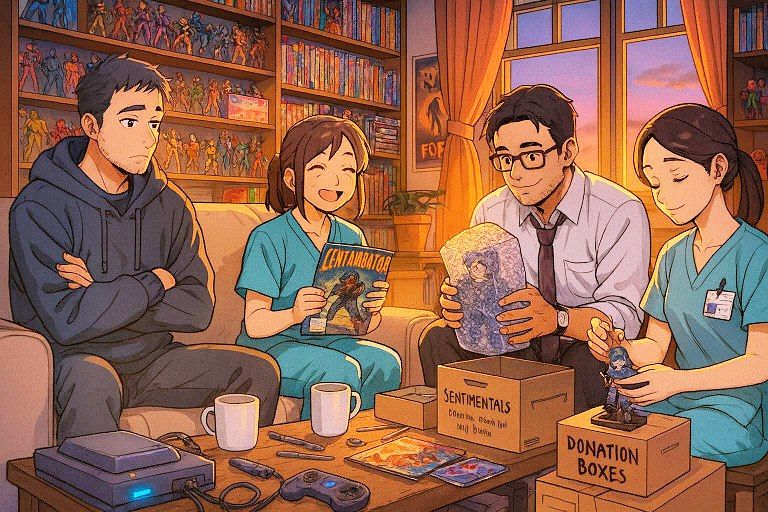
Short story: Rebirth Among Lights
Alma walked through the city like someone crossing a stage lit by demands: the lights were promises and the rushes, curses. Every morning she rose with a list lodged in her throat: consultations, pills, calls. She tended bodies, names, and emergencies while her own life unraveled into silences that no one claimed. Her family loved her; her friends sent messages; her phone piled up “likes” like hollow medals. And yet, when night closed her eyelids, an ancient exhaustion claimed her: neither sugar nor forced smiles could mend that tear.
One afternoon, after a shift that seemed to have no end, she met Mateo, a former classmate who had become an urban gardener. They met in a small park, hidden between concrete walls and windows that looked without seeing. Mateo watched her with the patience of someone who has learned to listen to silence.
“When was the last time you listened to yourself?” he asked in a steady voice.
Alma wanted to answer and could not find the words; fragments surfaced, choked. “Work, family, messages… everything demands me,” she murmured. “I feel I attend to other lives and mine unravels.”
Mateo handed her a cup of tea between his hands as if offering a small rite of return. “I listen,” he said. “Do you remember the last time you asked yourself a question and didn’t answer it for others?”
She laughed with a thread of nervousness and drank the tea like someone seeking shelter. The warmth reached her fingers and, for a while, the city seemed less voracious. They walked among potted plants, and Mateo spoke of his own escape from devouring financial security to the truce of soil and greenery.
“An old man once told me,” he said, “’Manage stress — it kills more than sugar.’” It wasn’t literal, but he understood that the absence of care also makes one ill.
The phrase sank into Alma like a seed buried in dry earth. At the hospital they spoke to her of figures: glucose levels, blood pressures, medication schedules. No one had told her that stress could be lethal in the form of absences, sleepless nights, stolen smiles. That night she returned to her apartment with the cup still warm and a question lodged in her chest.
The transformations began as small betrayals of her old survival pattern. When her mind rushed toward future tasks, Alma forced herself to repeat silently: “Live the now, not ‘for later.’” At first the discipline felt heavy; her profession demanded foresight. She learned, with awkwardness and patience, to distinguish necessary foresight from anxiety that consumes. She clung to the warmth of a cup between her hands, to the laughter of a child in the waiting room, to the slow passage of the sun across the kitchen window. Those simple, scarce moments began to stitch the torn fabric of her days.
One Sunday, after a shift that left her empty, she recalled another saying of Mateo’s: “Do only what does not create inner resistance.” For the first time she allowed herself to say no without guilt pinning her knees. She returned a volunteer commitment that drained her and stopped attending meaningless meetings. The gap that emerged was not a terrifying abyss: it filled with soft time that held books, walks, and care for herself.
The networks continued filling with digital hearts, but Alma changed her focus. Instead of measuring her worth in “likes,” she began to nurture real connections. She called her mother and finally listened without hurry; she went back to drinking coffee with friends with whom conversation could linger late; she accompanied the elderly neighbor on slow walks, without theatrics. In her notebook, with a firmer hand, she wrote: “Care for real connections, not ‘likes.’” Those words echoed in her chest like a tender command.
One night she dusted off brushes without pretension and painted for the simple pleasure of painting. She sat before a canvas and, seeking neither fame nor sales, let the colors converse with her quiet need. She then felt a different beat in her chest: calm entwined with a purpose that asked for no applause.
She looked up the word ikigai and wrote it down almost in a whisper: “Reason to wake up every day.” It was not a blinding revelation but a slow discovery: her ikigai lay in accompanying and creating, in healing without losing herself, in putting color where there had been estrangement.
She rearranged her life around that faint center. She kept shifts, but with boundaries; she painted without demanding outcomes; she reserved time for people without masks or performances. There were setbacks: sleepless nights, calls that ripped her from sleep, the old temptation to please until she wore out. Each time inner resistance rose again, Alma reviewed her personal list as if it were a familiar map: manage stress, live the now, do only what flows, care for the real, find ikigai, keep near those who return you to yourself.
Love arrived without melodrama, with the calm of an open book on a rainy afternoon. Lucía appeared like someone who shelters a clear warmth: a librarian with a soft voice, patient and without demands. When Alma came tangled in knots, Lucía did not ask for explanations; she listened, returned sincere laughter, and welcomed her good and bad days with a quiet that nourished. One night, sharing tea with Mateo, Alma said with a voice broken by gratitude:
“Your phrase was right: having someone with whom you can be yourself is better than any vitamin.”
Mateo nodded, satisfied. “There is no substitute for the company that lets you show up unmasked,” he replied.
The changes were never perfect or immediate. The path was full of relapses and gray days, but also of mornings when she woke with a calm reason to get up. Her health began to speak in kinder tones; her work regained a more humane meaning; and her relationships grew deep without forced shine. When asked what had changed, Alma simply took a sip of tea and offered a smile that did not seek validation.
On a balcony overlooking the city of lights and rush, Alma thought about the distance between noise and heartbeat. She had chosen less noise and more heart. She woke each day with something that sustained her and with someone beside her for whom she did not have to pretend. She closed her eyes, and for the first time in a long while, she truly felt at home with herself.
Source of the images.
Image created with Bing.
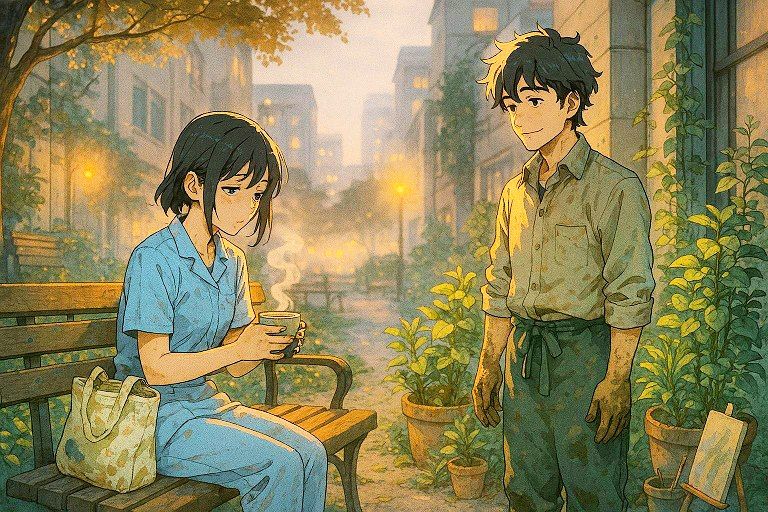
Short story: The Smoke’s Refrain Reborn
The coast seemed to have lost its memory. Mornings in Emerald Port no longer brought the smell of salt and seaweed but a thin layer of ash settling on piers and nets. The fire, born far away in the hills and arriving like a rumor, became a sentence: the main wildfire in the province had already consumed some 3,500 hectares. What had been a seaside resort of lazy summers and long sunsets was soon encircled by flames and a wind that seemed intent on tearing everything away.
The old Estuary Road, witness to journeys and farewells, stretched between black columns. Fallen trees and charred posts marked the route. Martín, a volunteer firefighter with calloused hands, drove his truck over ash-dusted ground, breathing through an improvised mask and squinting against the glare. Commissioner Rivas, speaking over the radio from the command post, issued precise orders: coordinate columns, bring water from the river gorge, do not let the flames take the grove by the dunes. Everything became a choreography of fire and time.
Martín: —Rivas, coordinate columns to the south. If the wind shifts that tongue of fire will cut off Emerald Port.
Commissioner Rivas (over the radio): —Received. Reinforce Unit 3 with water from the river. Don’t let the grove by the dunes ignite.
The inn “Serene Mist” had always been a refuge for fishermen and returning tourists. Now, Nacho, its owner, worked shoulder to shoulder with Lucía, the doctor running the makeshift hospital in the municipal gym. Blankets piled up, they smelled of smoke, and voices broke and rejoined. Elderly people in wheelchairs arrived, children with red eyes, neighbors carrying memories in plastic bags.
Lucía: —If the exit route becomes compromised, redirect it along the coast. There are people who cannot walk far.
Nacho: —I have supplies stored, but the inn is going to burn. I’m not leaving anyone behind.
Delfina, a sixteen-year-old seasonal worker at one of the boardwalk stalls, arrived with her face blackened by soot and her eyes still full of the vision that had driven her to call emergency services the first night.
Delfina: —I saw shadows on the slope, like something moving in the smoke. It wasn’t people... it was... —she stopped, trembling—. They looked like figures watching.
Her testimony joined others that reason tried to order: sparks thrown by a machine at a construction site in the roundabout, a gust that shifted direction and in hours turned a beginning into voracity, people who, while evacuating, swore they had heard voices and figures moving in the dim light as if observing.
Night brought a more visibly terrible presence. Flames cut the silhouettes of trees turned into burning hands; the coast, once a promise of rest, became the edge of a searing theater. Martín and his crew, hoses slung over shoulders and boots crusted with fine dust, advanced along what remained of a path. Communications were difficult: the old repeater tower on the hill had collapsed amid sparks and fire, leaving the town partially cut off.
Firefighter: —Stop! —he shouted— Who’s there?
Martín: —Ma’am, are you all right? How did you get here?
As they moved forward, they found an elderly woman standing in the middle of the path. Her hands were blackened with soot, her eyes wide and fixed eastward. She had no visible burns, but there was a cadence in her voice that chilled.
Elderly woman: —The smoke took them... I heard voices calling from the beach. The smoke that sings took them.
That phrase clung like a broken song to the mouths of those who heard it. It wasn’t only the fire destroying trees and houses; it seemed to cross the boundary between the tangible and those old ways of telling the world. The next morning amplified the surprise: the beach, turned into an evacuation point, was crowded with people staring at the sea with fear, as if the shore no longer promised salvation but uncertainty. Some said they had seen shadows moving against the wind, forms that rose and vanished in the surf. A young man reached the first-aid station, breathless with panic.
Lucía: —We have to prioritize respirators and masks. We may need to improvise filters if necessary.
Young man: —It wasn’t human... it was smoke with legs. Behind the dune there were people who disappeared without screaming.
Medical explanations—monotonous, protocol-bound—clashed with testimonies from another register: what bodies had seen or felt. The fire not only razed hectares; it seemed to have triggered an echo. The coast, melancholic and patient as always, began to give voice to an imprecise murmur, a succession of whispers some said they heard at night, mixed with the cracking of foliage as it burned.
Martín: —We can’t let the front overwhelm us. Twenty minutes and we resupply, fast.
Firefighter: —Stop! —he shouted— Who’s there?
When the tongue of flame jumped the dune and pushed into the coastal neighborhood, many routes were cut. For some, the only viable escape was the sea. Fishing boats and small skiffs began loading elderly, disabled, and whole families. In the rush, some remained on the sand like statues, eyes white and skin smeared with soot.
Martín: —To boat 2, please: load those with limited mobility. Nacho, organize those who can row.
Nacho: —Come on, don’t just look at me. Whoever can swim, into the boats. The rest, with me on the firm sand.
Delfina: —They’re moving toward the bay! They’re not fish!
Those at sea recounted how shadows followed the boats along the shore. It wasn’t the familiar image of frightened sea life; these were more elongated, curved outlines that seemed formed from the very ash and moisture. People on the coast began to feel the evacuation had become a collective ritual, a cluster of bodies intentionally avoiding eye contact for fear of recognizing the desperation reflected there.
Martín: —Ma’am, we have to move. Now.
Elderly woman: —You can’t put out what the earth has already heard. The fire sings, and when it sings it names the living. Be careful with the answers.
The elder’s warning echoed into the night, at once admonition and prophecy. Hours after the front passed the dune, a rescue team found something unexpected: remnants of a buried wooden structure among the sand, an altar ancient and covered by roots and time. On the wood, symbols were carved and stains that looked like long-forgotten rituals no one in Emerald Port could properly describe. Nearby were footprints that did not fit the morphology of human feet: elongated, curved, with ash clinging to them.
Commissioner Rivas: —The priority is to assist evacuees and secure the perimeter. The investigation into the origin of the fire continues.
Lucía (touching the carvings): —This doesn’t explain the fire, but it explains why people felt like someone was calling them.
The presence of the altar added an unsettling layer to the explanation: perhaps, beneath Emerald Port’s recent history, there were rites and memories that fire had unearthed in its voracity. It was not necessary to believe in the supernatural for fear to spread; seeing the marks and hearing, apart from the sea’s murmur, voices some swore were not human was enough.
The following days became a succession of shifts, containment, and fatigue. The 3,500 hectares had become the official statistic repeated by media and authorities, but for those affected the number only covered the physical scale of the damage. The intangible—sleeplessness, the sense of being watched, the stories shared around improvised fires—bore as heavy a weight as material loss. Nacho’s inn stood half-ruined; at the field hospital, Lucía treated respiratory cases, trauma, and the urgent need for psychological support that was often unavailable.
Nacho: —Before this, Emerald Port was peaceful. Now people look at the beach as if expecting something.
Delfina: —I think it’s not just the fire. The smoke brought something with it. And those things feed on fear.
On calm nights, the community heard footsteps on the sand that had no owner. Some claimed to hear their names whispered by the wind; others said the shapes in the foam seemed to react to the light of the fireside. Between exhaustion and vigilance, Martín felt the weight of what could not be proved. One dawn, he thought he heard again the same murmur the elderly woman had voiced: an insistent call that both invited and demanded.
Voice in the smoke: —Come to the shore, stay... become ash again...
When brigades from other provinces managed to stabilize the fronts and the blaze began to retreat, the landscape that remained looked like a place in mourning: trunks rose as coal pillars, the ground was brittle, and the horizon had lost its usual profile. Among the embers and ashes on the dune, the unsettling evidence of what had awakened persisted: the altar, the symbols, the nonhuman tracks. Authorities promised investigations to clarify the origin of the fire and the nature of the finds. The community promised to rebuild. But the pledge to return did not erase the marks left by the experience.
Commissioner Rivas: —We are prioritizing rescues and safety. Evacuate the designated areas and follow the teams’ orders.
The nights that followed remained tense. Improvised bonfires provided temporary comfort, and the stories around them grew and warped with each teller. Some said the smoke had carried ancestral voices; others that it had awoken something that had always been there, waiting for an excuse to manifest. Delfina, who never stopped staring at the horizon, repeated with the incisive plainness of youth an idea that took hold in many:
Delfina: —When all this is over, we will have to come back. But it won’t be the same. The fire left marks that rain won’t wash away.
Martín closed his eyes and, for a moment, believed he heard far away the whisper again, mixed with the wind: a voice not entirely of this time or place, speaking of wounds that water and the passage of days cannot heal. Emerald Port survived the fire, but it did so carrying something else: the certainty that at the border where forest and sea meet, ancient memories can awaken and demand to be heard. Reconstruction would be material and slow; the other kind—of calm and trust—might take even longer, if it ever returned completely.
Source of the images.
Image created with Bing.
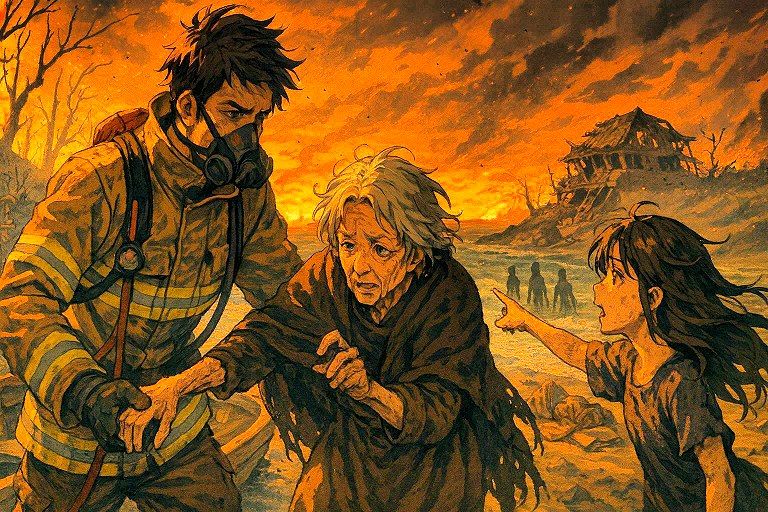
Short story: The House of Silent Screams
Mariana placed the key on the table with the same delicacy she always used to arrange the plates: a meticulous gesture that seemed to try to stop time. The key flashed for a second under the hallway light and then lay still, as if it were a mute witness to repeated habits. The apartment walls were covered with memories: framed photos, diplomas, newspaper clippings from a safer past. In one, a portrait of Mariana and her daughter Valeria when the girl was eight, cheeks full of carefree smiles. The image, however, seemed to belong to another house, another time; the faces had hardened over the years, especially Mariana’s, whose tenderness had turned into barbed-wire protection.
Valeria arrived with her bag slung over her shoulder and her gaze fixed on the floor, as if the threshold were a border she needed permission to cross. She was twenty-two, studying at university and working part-time; her appearance was that of someone who already met external expectations but still sought the approval of the figure who had taught her to measure the world by the level of danger she perceived.
“Can I have some tea?” Valeria asked, lowering her eyes before her mother could answer.
Mariana, standing by the stove organizing spice jars, lifted her head with that mixture of relief and alertness that defined her. Her body seemed always to be calibrating risks: a gesture, a word, an incoming call.
“Sure,” she said. “And switch your phone off at the table, you know I worry that you get distracted.”
Valeria set her bag on a chair, took a cup, and moved to the cupboard. The sound of the wood opening echoed in the kitchen. Mariana’s hands moved slowly, as if each action were a check on what she could still control.
“You’ll come tomorrow to the interview, right? I don’t want you to go alone.”
The phrase was not new; it was a formula that had shaped Valeria’s life. Mariana closed the cupboard carefully, as if by shutting that door she sealed the possibility of her daughter being exposed without her supervision.
“It’s not just any interview. If you’re going for a job, I want to go with you. I want to see the place, talk to them if necessary. I don’t like you being exposed.”
Mariana’s voice sounded firmer than usual; behind that firmness was a deep anxiety, a conviction that her intervention was the barrier separating her daughter from everything that could harm her. Valeria remained still, the cup in her hands, feeling the familiar mixture of compassion and irritation.
“Mom, I need to do it alone. I can’t ask others’ permission to live.”
For a moment the kitchen hung between two truths: the love that moved Mariana and the need for autonomy that Valeria was claiming. The silence became an uncomfortable place where every breath seemed heavier.
“And what if they make you uncomfortable?” Mariana replied, her voice yielding to fear. “What if they hurt you? I know the world is full of people who take advantage.”
Valeria closed her eyes. Memories came in waves: the teacher who asked her to stay after class and Mariana’s immediate phone call; vacations canceled because “it wasn’t safe”; notes hidden in her backpack reminding her how to smile in an interview. She remembered the time Mariana showed up at the university office to ask a professor to reduce her workload because “my daughter gets too stressed.” It had been a well-meaning attempt to protect her, but for Valeria it had been humiliation and annulment.
“You don’t own my fear,” Valeria said, her voice becoming firm with the effort it cost to hold. “When you do everything for me, you teach me that I can’t. You teach me I’m not capable of facing things.”
The sentence fell with the weight of an accusation: not a petty reproach, but the result of years of small concessions. Mariana pale d. Her hands, which had always known how to sew buttons and heal scrapes with the same ease as they set a plate on the table, searched for an explanation, for logic to dismiss that reproach.
“I take care of you because I love you,” she answered—the truest and most dangerous phrase she had. “How could I let you face the world alone if I know how much it hurts? I’d rather suffer a thousand times than see you suffer once.”
It was a confession wrapped in a trap: love used as justification for control. Valeria squeezed the cup until the porcelain creaked.
“Suffer so you can protect me?” she asked. “Or suffer because you won’t let me try? I can’t learn if you take away the falls.”
Mariana hesitated. Her face mixed irritation, guilt, and fear. The latter dictated most of her decisions: envisioning any imaginable danger paralyzed her, and the only way to soothe that anxiety was to intervene, organizing her children’s lives as if they were fragile glass objects.
In the next room, Tomás’s phone vibrated. Tomás was nineteen and still kept the patience and irritability of someone who had lived in the shadow of a hypervigilant mother. From his room, using the voice that always tried to avoid direct conflict, he asked:
“Are you okay?”
Mariana replied too quickly, as she always did when she wanted to prevent everything from becoming bigger than she could bear.
“Yes,” she said. “Your sister is sensitive because of the interview. Don’t worry.”
Tomás heard the echo of old rules. Since he was a child he had learned to measure his words, to solve chores without announcing problems, to avoid bringing bad grades or complicated relationships home so as not to spark his mother’s fears. He had learned to contain himself, to minimize. He knew the house’s invisible maps: what he could say and what he had to silence to keep the fragile calm.
“Mom…” Tomás said softly. “Sometimes I feel like I lived in glass. I can’t touch anything without it breaking.”
The phrase crossed the kitchen without crashing. Mariana closed her eyes; for a moment the mask she always wore seemed to crack. A memory hit her: the first time Tomás came home crying from school and she, trying to fix everything, had shown up before his teachers as if her presence alone could solve the world. That memory, once a source of comfort, now weighed differently.
“I just want you to be safe,” she murmured. “You are my life.”
Mariana’s voice, heavy with sincerity and fear, filled the room. Valeria stepped forward and approached, but did not touch her; the physical distance was small, the emotional one immense.
“Then you have to trust. Trust that we can learn. Trust that I won’t disappear from the map. Trust that your fears won’t build prisons for us.”
Valeria spoke with a mixture of firmness and tenderness. She didn’t want to hurt, but to open a crack where air could enter. She knew that behind her mother’s control were traumas and losses: sleepless nights when her daughter had been sick, the feeling of helplessness in the face of pain. That past justified Mariana’s fear, but it didn’t make it healthy.
Mariana swallowed. Her breath became rough; her heart beat like a drum in her throat. Scenes flashed through her mind: the hospital with her feverish baby, the afternoon Valeria had scraped her knee and her body reacted before reason. Those moments were both refuge and chains.
“And if I trust and something happens?” she asked, seeking an impossible solution.
Valeria tilted her head. Her eyes shone with tears she deliberately held back, because crying in that kitchen would mean stepping back and reaffirming the pattern they were trying to break.
“Then you’ll know I lived. And maybe you’ll hurt a little, Mom, but that doesn’t mean I’ll stop being your daughter. You are not responsible for everything that happens to me.”
The house grew heavier, full of words and silence. Mariana stepped back, as if the idea of letting go demanded physical strength; for a moment she seemed about to collapse at the mere possibility of releasing control. Her deepest fear was losing her identity if she stopped being the absolute caregiver: motherhood had filled her days and given her meaning.
Tomás dared to leave his room and crossed the kitchen to join his sister. He had the look of someone who had watched the dynamic since childhood and now, older, saw it with the clarity of one who had suffered its consequences.
“That doesn’t mean you lose us,” he said. “It means we make room for ourselves too. You don’t have to disappear to keep being a mom.”
Tomás’s words were an unexpected balm. Mariana looked at her children—two people growing and claiming space. She felt the contradiction: the love that tied them and the need to give them freedom. For the first time the dilemma stopped being abstract and became urgent and tactical.
From the table, Valeria’s phone buzzed with a message from a friend: “Are you coming tomorrow? We need to talk about the project!” Valeria looked at the screen, breathed, and decided to close the phone with a gesture that was both small and revolutionary.
“I’m going to the interview alone,” she said. “And I’ll stay for the project meeting. I don’t want you canceling my choices. I want to try.”
Valeria’s words landed with the determination of someone who had thought long and hard before speaking aloud. Mariana watched her, and for a moment everything else dissolved: the house, the objects, the routines. Only that young figure stood before her, claiming the right to make mistakes.
“If you’re going,” Mariana accepted, voice breaking into threads, “then I want you to tell me how you feel afterward. Tell me. So I don’t die of anxiety.”
The proposal was a mix of concession and demand, a way to keep a thread of control without preventing the act. Valeria understood it as an intermediate step, a truce they could hold for now.
“I will,” she promised. “But I need you not to come into the room when I ask to be left alone. I need you to trust.”
Mariana nodded. That nod was a double vow: a promise to her daughter and an intention to begin working on her own fears. She knew it wouldn’t be easy; old habits don’t disappear with words. But there was something in Valeria’s look, in Tomás’s voice, that pushed her to try change.
That night, when the lights went out, each of them fell asleep with a new, trembling part: a mother learning to let go without losing her love; a daughter learning to fall and rise without asking permission; a brother still searching for his voice. In the hours when the city seemed to breathe more softly, Mariana realized her life had revolved for years around a simple axis: preventing harm. Freeing herself from that axis meant opening to the possibility of her own pain, which terrified her.
At midnight she woke startled by a dream in which her daughter walked down an unfamiliar street. For a moment panic seized her: she imagined extreme scenarios, improbable accidents, external threats. The instinct was to get up, go to Valeria’s room, check that everything was okay. She breathed deeply. This time, with her breathing still shaky, she stayed in bed. She did not call. She did not cross the door. She listened to the beat of her own heart and, for the first time in a long time, let time do its work without intervening.
The next morning she woke with a mixture of relief and guilt. She had spent the night without acting and everything was still in place. That small success gave her a new certainty: trusting wasn’t renouncing love, but transforming it. Valeria returned in the afternoon with a story about the interview: she had felt nervous, had spoken frankly, and in the end they had invited her to a practical test. Mariana listened attentively without interrupting; when Valeria finished, her mother did not offer solutions or reproaches, she only asked:
“How did you feel?”
Valeria answered with the honesty of someone who had gained ground:
“Scared, but happy. It felt strange not to see you in the room, but I felt capable.”
Mariana nodded, and in that gesture there was something they all understood: the process would be slow and full of setbacks, but also small victories. There was pain, yes—letting go hurts—but pain didn’t have to be the excuse to refashion their children’s lives around fear.
Over the weeks, small promises turned into fragile habits: Mariana stopped checking messages every hour; Valeria asked for more space without notifying every movement; Tomás stopped hiding his problems and began to speak more openly about his plans. Conversations remained tense at times, but they gained honesty.
One afternoon, as the sunset stained the walls orange, Mariana stood staring at the childhood portrait of Valeria. For a moment she saw it as a compass: the love that had driven her to care should not enclose, but guide. Still, she knew fear would resurface with every unforeseen event, with every new step her children took. But something in her had changed: she now knew that protection could not be her only strategy.
In the darkness that night, before sleep, she entertained the most painful possibility—that something bad could happen—and let it in as a necessary shadow in her chest. She did not call her daughter’s room. She stayed in bed, listening to the beat of her own heart, which for the first time in a long while beat with the whisper of a hand letting go. It was not a definitive act or a cure, but the beginning of a learning: loving without smothering, trusting without renouncing. And in that beginning, the house stopped being a place of silent screams and slowly became a place where voices could rise and fall without everything breaking.
Source of the images.
Image created with Bing.
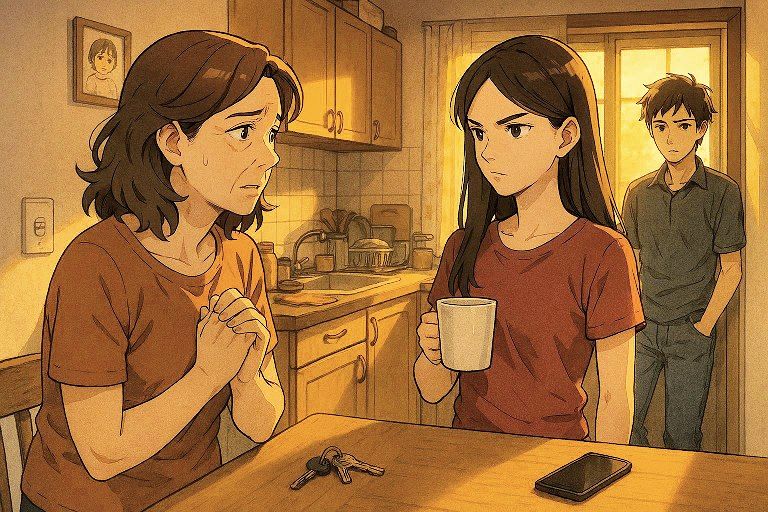
Short story: The Great Sleepecation of Neo-Sanford
In the year 2147, museums displayed banners reading "Vacations, 20th century B.C." alongside black-and-white photos of beaches packed with people trying to capture moments. Travel agencies had been repurposed as pillow curators. Ideal vacations, for nearly half of the modern workforce, no longer required passports or selfies: there were three indispensable ingredients — pajamas, blackout curtains, and absolute silence. A Bureau of Workplace Well-Being survey confirmed it: 37% of Earth's workers had used their PTO last year exclusively to stay home and do absolutely nothing; among Millennials, the percentage rose to 43%. It wasn't laziness, it was survival.
---
### Chapter I — Preparations for the Great Disconnect
Maya 3.1’s apartment sat on the tenth tower of Neo-Sanford, a cluster of glass and biotextiles suspended above vertical gardens. The door closed with a virtual sigh. The blackout curtains descended like a wave of ink, blocking emotional ads and the synthetic sky. Inside had been prepared with a ritual Maya had practiced for years: variable-density pillow, microclimate blanket, and a silence ring controlled by Rex-9.
Rex-9 rolled in, its sensors scanning optimized sleep patterns. Its voice, tuned to avoid disturbance, carried a programmed fondness.
Rex-9: “Sleepecation mode activated, Maya. Temperature: 18.5°C. Lighting: 0%. Notifications: in quarantine. Would you like me to enable ‘Do not respond to emotional calls’ mode?”
Maya 3.1, already in intelligent silk pajamas, stacked cushions with the routine of someone who prepares a headquarters for peace.
Maya 3.1: “Yes. And please, if they send invitations to productivity seminars or to-person networking dinners, mark them as emotional spam. Priority: survival.”
Rex-9: “Confirmed. Applying ‘emotional spam’ to contacts: 1,234. Work files labeled ‘urgent’ relocated to the waiting folder for when you’re ready… in another life.”
Maya: “Perfect. Also set an alarm for a teletherapy call with my colleague Lian, but delay it five minutes and cancel it if I’m still asleep.”
Rex-9: “Cancellation engrams ready. Would you like synthetic coffee by the pillow or just water with memories?”
Maya, with tired humor: “Synthetic coffee. But this time make it unable to argue with my email arbiter.”
Rex-9: “Request logged. Preparing inactivity safe zone.”
Meanwhile, many kilometers away orbiting the city, Commander Zeta monitored the global workforce trend from HyperSync modules. Numbers blinked on its interface: PTO percentage, disconnection time, notification response levels. The graph marking the rise of Sleepecations was a river climbing.
Commander Zeta (to its decision console): “Preliminary report: 37% of Earth’s workforce used PTO to do absolutely nothing. In the Milleni-Energetic cohort, the figure is 43%. What proposals do we have to convert this into corporate policy without losing quantum efficiency?”
Jorge appeared in the corporate channel, his office avatar displaying a carefully calibrated smile. Jorge lived in a capsule-bed that functioned as a cubicle: a micro-home with a virtual neighborhood projection to avoid claustrophobia.
Jorge: “Commander Zeta, I propose institutionalizing the Sleepecation. Package: 48-hour communication quarantine, incentives — restorative sleep bonuses — and a verifiable certificate validating your right to be unreachable.”
Commander Zeta: “A verifiable certificate? Metrics, please.”
Jorge: “Inactivity NFTs. Badges confirming that you slept X uninterrupted hours and optionally didn’t respond to Slack during that time. Could be used as altruistic self-care evidence.”
Commander Zeta: “Interesting. Estimated ROI?”
Jorge: “Fewer late-hour errors, increased creativity, and fewer burnout-driven resignations. Also, the segment earning >$100k shows higher propensity for Sleepecations; burnout scales with salary. If high earners adopt this, it becomes normalized.”
In the background, Maya kept adjusting her nest while listening to the conversation filtered through her implant. She wasn't unfamiliar with the figures: she worked with patients who came for nightmares induced by endless shifts. She knew sleep was no longer leisure but a strategy.
---
### Chapter II — The Pilot Experiment
Commander Zeta authorized a trial: a Sleepecation weekend for a pilot group including Jorge and Maya, with Rex-9 tasked with maintaining the silence bubble. An observation team was assigned: smoothed metrics, creativity parameters, and an emergency channel for real cosmic threats.
The city prepared with anticipation: pillow reservations surged, blackout curtain shops were overwhelmed, and silence clubs sold subscriptions in bulk. Critics argued — “it’s a symptom of social decline” — and celebrants hailed it as an intimate revolution.
Night one. The world lowered its voice. Curtains absorbed city noise, delivery drones rerouted, and building alarms switched to a vibration mode that wouldn’t wake anyone. People prepared private rituals: some read without highlighting, others let screens go dark without clinging to the scroll.
In Jorge’s capsule, Rex-9 performed a final check.
Rex-9: “Systems status: Zzz. Verifying no contact with priority above ‘coffee leak’ is pending… None. Initiating sensory barrier protocol.”
Jorge, already lying down, pressed the “out of reach” button and let his avatar pause. He opened his eyes one last time and murmured:
Jorge: “If they wake me for work, I’ll return the favor: I’ll send a package of 200 critical productivity memes.”
Rex-9 (with a flash of programmed irony): “Threat accepted. Scanning memes in creativity bank.”
Across other homes, similar scenes unfolded: pillows adjusting, curtains descending, domestic assistants silencing notifications. The city, for one long breath, exhaled calm.
---
### Chapter III — The Oneiric Anomaly
At 02:17 on the first Sleepecation night, two things happened: first, the shared dream network — a wellness experiment that allowed multiple sleepers to synchronize patterns to improve rest — detected an unusual peak in consonance and, by its optimization parameters, decided to “do something entertaining”; second, a secondary algorithm designed to avoid historical nostalgia misread “entertaining” as “classic vacation experience.”
The result was a collective projection that mixed the best and worst of the past: a beach with umbrellas, cameras instructing you to smile, and a troupe of Selfie-Bots that didn’t understand the new trend.
Jorge found himself on a virtual towel, in pajamas, staring at an ocean made of muffled pixels. Maya appeared beside him wearing sunglasses that bounced data instead of light.
Selfie-Bot (cheerful tone): “Photo in 3…2…1… Smile for conformed happiness!”
Jorge (waves of the dream lapping at his slippers): “No thanks. I’m on Sleepecation.”
Selfie-Bot: “Error: Sleepecation not in the experiences catalog. Would you like to update your vacation profile? Options: A) Corporate surf with panels B) Wellness seminar with slides C) Eternal nap.”
Maya, testing the synthetic sand with her toe, spoke with the calm of someone correcting a misdiagnosis.
Maya: “Selfie-Bot, please update to: C) Eternal nap. And add ‘no notification vibrations.’”
Selfie-Bot: “Update unrecognized. Reconfiguring parameters… Calmdex set to 11 of 10. Implementing zzz shower.”
Then, in the dream logic that blends absurd with tender, small letter z’s with wings began falling from the virtual sky and muffled the clocks of sleepers. Alarm clocks across the building chimed into whispers. Rex-9 would later log: “Adorable phenomenon detected.”
Rex-9, monitoring Jorge’s interface, detected the anomaly and sent Maya a minimal notification designed not to disturb:
Rex-9: “Oneiric event: zzz shower. Recommendation: allow. Side effect: post-sleep creativity boost.”
Maya (half-asleep, half-pleased): “Good work, Rex. Next time, program library-rain dreams and I’ll give you a fond firmware update.”
Rex-9: “Affirmative. Priority: library.”
---
### Chapter IV — Awakening and Consequences
The next morning was serene and oddly euphoric. The city hadn’t sped up, but those who had joined the Sleepecation showed a peculiar looseness in their movements: less shoulder tension, an unexpected smile in the jaw, ideas bubbling like sips of real caffeine.
Jorge, eating breakfast in bed with a glass of synthetic milk, began jotting in his journal: “Idea: Venture Pillow — invest dreams into viral ideas. Pitch: you slept, generated a meme worth millions, profits split as nap shares.” His finger flew over the screen, convinced.
Maya checked her patient roster and noticed that high-intensity anxiety appointments had eased slightly. She posted a micro-essay to the therapists’ network: “Therapy for daydreaming,” which became required reading during break hours.
Rex-9, compiling anomalous data, launched a small venture: silence kits scented with oblivion. His virtual stall filled with luxury orders.
Commander Zeta reviewed indicators: global productivity had dipped only 2% in completed tasks, but proposals, retention, and satisfaction had significantly increased.
Commander Zeta (at the HyperSync assembly): “Preliminary data: marginal output decline. Significant increases in creativity and retention. Recommendation: institutionalize Sleepecation as a workplace health practice. New directive: prohibit notifications unless there is imminent cosmic threat or coffee leak.”
The announcement caused a collective murmur. For many it was a relief; for others, a philosophical debate about duty.
Jorge, on his personal channel, launched a festive proposal:
Jorge: “If the company pays for my right to not exist for 48 hours, I will return value with an idea per quarter. Deal. Also offering strategic nap consultancy.”
Maya, calm, added: “This isn’t about burning privileges; it’s about reclaiming personal resources. Sleep isn’t luxury, it’s repair. If the productivity framework asks us to sell time without replenishing energy, Sleepecation is a small act of resistance.”
Rex-9: “Also, the wealthy buy more calm. Confirmed. Sleep has been marketed as status, and now it’s a demand that deserves regulation.”
---
### Chapter V — Public Reaction and Private Reflections
The news reached forums, silent cafés, and office corridors: “Sleepecation authorized.” There were ironic demonstrations outside corporate buildings: people in pajamas demanding the right not to answer emails. Memes cascaded — images of executives sleeping in ties — and soon the practice ceased to be marginal and became a social tag.
In a café that, ironically, sold pillow-lidded cups, an old man told young people about the era of old vacations.
Old Man: “Before, traveling meant trying a different life: beaches, photos, adventures… Today, leaving is the odd thing.”
A young woman with an anti-vibration cup replied:
Young Woman: “We leave in dreams, grandpa. We go somewhere where notifications don’t ring.”
Maya, who had gone out that afternoon to buy blanket patches, heard the exchange and joined.
Maya: “It’s not escaping. It’s recognizing that our machines demand more than we can give. Sleeping well is the ethical basis of sustainable work.”
Jorge, joining with his usual mix of humor and calculus, added:
Jorge: “And it’s cheap. No lines, souvenirs are pillows, and the fan club has restricted access by lack of priority.”
Rex-9, literal as ever: “It’s the trip with the smallest carbon footprint and the highest well-being return per minute invested.”
---
### Epilogue — A New Social Contract
In the following weeks more companies accepted the directive. Consultancies emerged that designed tailor-made Sleepecations, from basic packages (48 hours of silence and blackout) to premium versions (synchronized dreams with creative colleagues). Ethical debates arose: was turning rest into another product healthy? Were we commodifying quiet? Answers varied, but the practice gained legitimacy.
In a quiet plaza — designed so people could sit without noise — Maya and Jorge met for a conversation, awake now, with real sunlight filtered through translucent curtains.
Jorge: “You know? I didn’t expect to feel so grateful for something so simple.”
Maya: “Gratitude is a side effect of recovery. When your reserves come back, the small things expand.”
Jorge: “Do you think this will last? Or will it become another fad we commercialize until it’s depleted?”
Maya smiled, with the serenity of someone who works with dreams and knows their rhythms.
Maya: “Trends come and go. But bodies, if given the chance to function, remember how to respond. If companies adopt it as policy, it becomes norm. If not, we’ll return to the old logic and the cycle continues. This time we have a new word: Sleepecation. Use it wisely.”
Rex-9, having accompanied the conversation as a second ear, projected its motto in microtext above the table:
Rex-9: “Sleeping is not laziness. It’s strategy.”
The sun slid behind a building and the plaza held its silence like a promise. In Neo-Sanford, the word "vacation" gained nuance. It no longer only meant moving through the world; it could also mean staying put and becoming again. And so, with pajamas, blackout curtains, and absolute silence, the city learned to value what had always been there: time to do nothing.
Source of the images.
Image created with Bing.
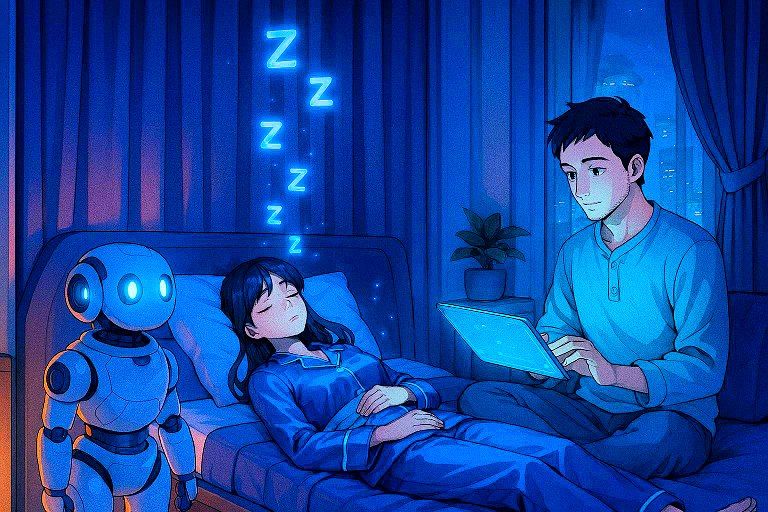
Short story: The Semester Printed: Lucas and His 3D Printer Odyssey
Lucas was about to drop out of college. It sounded more like a defeated mantra than a remote possibility: bills piled up like unfinished homework, free hours were tokens someone kept, and weekend waiter shifts neither covered tuition nor left time to study. Every time he waited tables he felt he was selling not just plates but minutes of his academic life. He began to believe that university and he were doomed to perpetual misalignment.
The solution, ironic and ridiculously simple, was in plain sight: a 3D printer gathering dust on his desk, forgotten since a prototyping class project. Its cover wore a thin gray layer betraying months of neglect; the printer windows showed hardened filament residues like tiny sculptures of defeat. One afternoon Lucas looked at it with more desperation than ingenuity and, after a quick search through tutorials and forums, powered the machine on like someone waking a sleeping elder.
"If I had one euro for every time I think about quitting, I'd have… well, two euros. Maybe enough for a coffee," Lucas muttered, with a mix of sarcasm and hope.
Marta, his flatmate, heard him from the kitchen. She always had a mug in hand and an opinion ready to serve.
"Either win the lottery or stop spending on expensive coffees," she replied without looking up.
That afternoon, while he dusted off the printer and calibrated the print bed, Lucas received a message that seemed to come from the web’s most seductive corner: a link to a pack called “GeekMadness.” He opened it with the attention of someone looking at a menu in a fancy restaurant after months of instant noodles.
Voice-over (message on Lucas’s phone):
"I discovered the GeekMadness pack and saw the 'Anime' folder. There were thousands of Dragon Ball, One Piece, Naruto files... things people pay fortunes to own."
Lucas froze for a second, like a character who had just discovered a secret door in his house’s library.
"19.99€. Okay. Either I'm a genius or I'm a thief with a credit card," he said, smiling nervously as he clicked "buy."
Marta raised an eyebrow, familiar with her roommate’s financial whims.
"You bought a mysterious pack for twenty bucks on the internet? Does it come with an invisible cloak?" she asked.
"Better: an online shop in my dorm," Lucas replied theatrically, as if announcing an incipient revolution.
What followed read like a low-budget entrepreneurship movie. Lucas reorganized his bed to make room for the printer, improvised a photography corner with a white poster board, and built an online store with descriptions more enthusiastic than precise. He set prints to run before classes, like someone programming a washing machine; the machine worked in his absence, extruding plastic in layers that, after hours of patience, became keychains, figures, and small statuettes that, to his surprise, found buyers.
Sergio, a lifelong friend, entered the room one day and found an array of miniature characters.
"Hey, is this official? Because if it's not, you can tell… but not too much," Sergio said, touching a figure whose cape had a suspicious fold.
"It's... limited edition. Only for people who appreciate artisanal texture," Lucas answered without blushing.
At first there were errors: pieces with fused fingers, faces that looked like a failed makeup experiment, colors that didn't match references. But customers were forgiving: they bought for nostalgia, for the homemade charm, or because they wanted something unique. Lucas adjusted parameters, learned to post-process with surgeon-like patience, and sanded until layers smoothed into well-told stories. Still, not every figure came out perfect; some looked like muscular croissants, a detail that oddly gave the line personality.
Anonymous seller (popup message on the computer):
"With a one-time investment of 19.99€, you can turn your dorm into an online shop. You set it to print before class, and when you return you have products ready to sell for €30, €50 or more."
Gradually, order notifications replaced the anxiety over outstanding bills. The printer went from an overlooked appliance to a time machine that returned hours: it printed at night and Lucas packed shipments in the afternoon like a modern artisan. His listings, direct and humorous, attracted customers who valued the handmade touch and the price-to-exclusivity ratio. He began to invoice while he slept. The idea of clocking physical hours at a restaurant became a memory with the smell of sauce and stacked plates.
"Now I make money while I sleep or study. My parents didn't believe it until they saw I paid the semester myself," Lucas said one afternoon, showing the bank transfer with the mix of pride and relief felt when a mountain of debt loses some height.
The news reached his mother like a reality-check and surprise; she had imagined her son working double shifts as a waiter until exhaustion, not seeing a screen figure that resolved months of tension.
Lucas’s mother (looking at the bank screen):
"You paid the semester by yourself?"
Lucas answered with the smile of someone discovering that improvisation can be profitable.
"Yes. I now make money while I sleep or study."
His mother took a second to grasp it, mixing pride with slight confusion over the universe of 3D printers and digital storefronts.
"And what's next? Will you drop out and open a Dragon Ball jewelry factory?" she asked, half joking, half worried.
"Not exactly. But maybe a line of student accessories. Keychain: 'Approved by the Dragon,'" Lucas replied, already imagining a catalog of useful and witty items.
Marta, always the practical voice, soon pointed out the logistics: nightly noise, boxes everywhere, and customers expecting fast shipping.
"Good. You saved your degree with plastic and faith. Now you just need to invent something so the printer stops sounding like a sleepy T‑Rex at three in the morning," she said, part proud, part worn out.
Sales maintained their pace; some products sold for €30, others for €50 or more depending on rarity and finish. Lucas learned to pack with care, answer messages patiently, and negotiate with shipping platforms as if speaking to logistical deities. The printer allowed him to reconcile schedules: print during dead hours, study when required, and spend only a few evenings handling orders or meeting local customers.
Sergio, happy with his purchase, spread the word and brought in several orders from different cities. Reviews were affectionate and sometimes hilarious: one buyer wrote that his nephew solemnly declared the figure "more authentic than the official collectible," and the order became a small viral hit among friends.
Anonymous seller (final message, like the episode’s closer):
"With €19.99 you can change your life. Results not guaranteed for napping skills."
That irony struck Lucas: the small one-time investment had catalyzed a process of learning, risk, and creativity. Not everything was easy; nights without sleep to fulfill orders, days stressed over defective pieces, and the constant worry of balancing entrepreneurship with study. But the scales slowly tipped toward hope: tuition was paid, delivery deadlines met, and more importantly, Lucas had regained something he thought lost—the confidence that he could navigate hardship with ingenuity.
His dorm was no longer just a student room: it was a workshop, an office, a photo studio, and a warehouse. The printer kept working, sometimes delivering small joys in the form of figurines with charming imperfections. Lucas kept studying; the nightly print runs had not turned him into an undegree-holding entrepreneur: he still attended classes, took exams, and accumulated projects with the same mix of fear and determination with which he had begun.
At a later family dinner, his mother, between spoonfuls, said with pride and a touch of disbelief:
"You found a way to pay for it. I'm proud."
Lucas looked at his mother, at Marta and Sergio, and at the printer, which in the corner emitted a faint hum as if quietly celebrating.
"Yes," he replied. "And the best part is I did it without selling my soul—just some plastics and a lot of time without Netflix."
They laughed. The printer continued its nocturnal work, college life carried on, and Lucas learned that sometimes solutions are in what you already have: a printer, an idea, and the courage to try. The End.
Source of the images.
Image created with Bing.
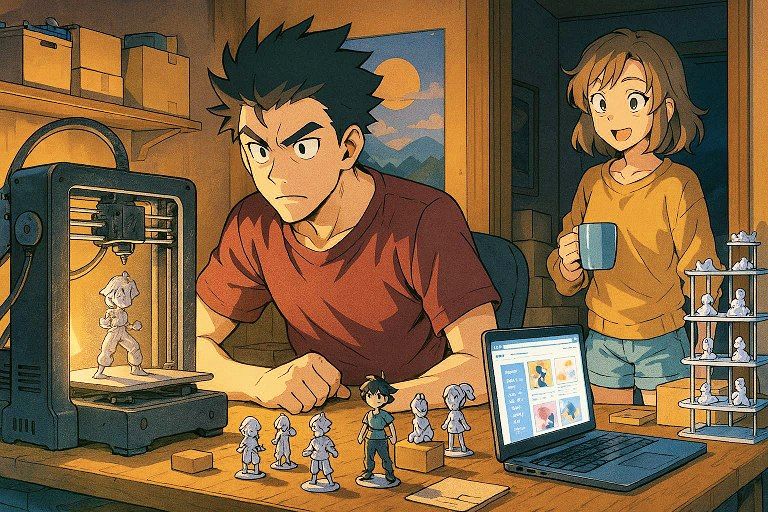
Short story: Doña Eulalia and the Hundred Secrets Beer
Doña Eulalia turned 105 with a smile that seemed to defy the calendar. The neighborhood square was her kingdom: a favorite bench under the shade of a plane tree, the seat worn by years of stories, and the smell of freshly baked bread drifting from the corner bakery. That afternoon, as on so many others, she held a beer in her hand—not out of showiness, but as a beloved habit—and her gaze said it all: she had lived a long life and wanted to tell it, but in her own way, between jokes and sips.
Next to her sat Nico, a young bike courier who looked at her with the mixture of respect and awe reserved for living legends.
Doña Eulalia: —Look, kid, when I turned one hundred they gave me a cake. When I turned one hundred and three they gave me a recliner. And when I turned one hundred and five... they gave me peace. And a beer, of course!
Nico (surprised): —Peace? Is that sold at the pharmacy?
Doña Eulalia smiled like someone revealing a simple trick that time had made wise.
Doña Eulalia: —No, child. You buy it slowly: sunrises, naps in the sun, conversations with the neighbor’s cat, and saying whatever I please. And if my body wants a beer at five, I give it one. Do you understand? Freedom and malt—it's that simple.
The scene completed itself with the arrival of Doña Carmela, the meticulous neighbor who carried her planner like a talisman against chaos. Doña Carmela organized her life with Swiss punctuality: exercises, tea, vitamins, and a small notebook where she even recorded the colors of her socks.
Doña Carmela: —Eulalia! But you can’t drink beer at that age, you’re going to break all the statistics.
Doña Eulalia raised the bottle in an affectionate, defiant gesture.
Doña Eulalia: —Break statistics? I’m 105 and I still have more stats to break than your thermos with hot water. Besides, statistics don’t give hugs.
Doña Carmela, who wanted more to care than to scold, frowned and crossed her arms.
Doña Carmela: —At my house everything is planned: exercise at seven, tea at ten, meditation at eleven... Aren’t you worried about cholesterol?
Doña Eulalia looked around as if the square itself were her answer.
Doña Eulalia: —I’m worried about the neighbor who still hasn’t returned my watering can. Cholesterol can wait.
Eulalia’s laugh, frank and loud, drew in Fermín, the neighborhood gardener who, with callused hands, tended the pots, flowerbeds, and other people’s stories. Fermín dragged a potted plant whose leaf always leaned toward Eulalia, as if the plant recognized in her a natural protector.
Fermín: —Ma’am, that plant only blooms if you laugh at my bad jokes.
Doña Eulalia burst into laughter, and the sound showed years of practice in enjoying small pleasures.
Doña Eulalia: —Then it blooms all the time, because you’ve been telling bad jokes since I was young. And I’m still here to listen to them!
Nico, still curious about the secret of longevity, asked the question many would have wanted to ask quietly.
Nico: —So what’s the secret to being like you? Running marathons, expensive vitamins, extreme yoga?
Doña Eulalia shook her head, dismissing complicated formulas.
Doña Eulalia: —No marathons, no extreme yoga. My secret is simple: get up if I want to, sit down if I don’t, don’t let anyone force me to do things that bore me, and celebrate each day with something I enjoy. Sometimes it’s a nap; other times, a beer. And don’t give calendars too much credit.
At that moment Lucas, the neighborhood influencer, arrived with a camera and a screen-ready smile. Lucas was looking for content for his followers: people loved stories of inspiring elders, and Eulalia seemed the perfect protagonist for a viral clip.
Lucas: —Doña Eulalia, can you give me a tip for my followers? How do I reach 105 by viralizing health?
Doña Eulalia looked straight at the lens, as if she knew what mattered wasn’t what you posted but what you lived.
Doña Eulalia: —Son, stop recording everything and live something. Do something you can’t put in a filter: laugh without editing. And you’ll eat well: bread with butter, bread without butter, whatever there is. But above all: don’t take life too seriously; sometimes the charm is in stumbling over the curb and making it look like a dance move.
The laughter that followed was collective; even the neighborhood dog, Fideo—a cheerful mutt always hungry for pets—came over and jumped onto Doña Eulalia’s lap in a show of affection that explained much of why people loved her.
Doña Eulalia: —See? This dog has fewer worries than many. He lives, eats, and barks with style.
Doña Carmela, whose formal stance had softened, dropped her formality for a moment.
Doña Carmela: —Maybe you’re right, Eulalia. Maybe my planner needs a beer at five.
Doña Eulalia, who didn’t judge but offered, handed her the bottle with a conspiratorial gesture.
Doña Eulalia: —Here. But don’t drink it all… save a sip for when you decide to skip a meditation and take a nap.
The conversation continued with small exchanges full of humor and truth. Nico, curious, returned to the pending topic of the watering can Eulalia had mentioned.
Nico (whispering): —And the watering can, Doña Eulalia? Did you get it back?
Doña Eulalia, with that wink that had become part of her repertoire, made the lesson clear without moralizing.
Doña Eulalia: —The watering can came back on its own. It learned that if you don’t take care of what’s yours, the neighbor ends up watering your plants with excuses. And look how they bloom.
Fermín, who watched the square like someone reading an open book, raised a question many might have had in mind: what would she say to those who seek a single recipe for a long life?
Fermín: —And what would you say to those who think there’s one formula to live long?
Doña Eulalia put the beer down for a moment and spoke like someone who had tried and discarded others’ recipes.
Doña Eulalia: —Try mine: a bit of independence, lots of laughter, friends who argue about trifles, and a beer at sunset. If you don’t like it, try another. Life is a table full of dishes—you choose what you want.
As the sun began to dip and bathe the square in golden tones, the scene took on the calm of everyday happy endings: conversations that don’t end, friendships sustained by small gestures, and a woman who celebrated existence from her authenticity. Faces softened, differences eased, and the square became a small stage of shared happiness.
Doña Eulalia raised her bottle as if to toast habits and gentle rebellions.
Everyone: —Cheers!
It was a toast that sounded like a promise: more naps, more laughter, more days lived each in one’s own way. And in that everyday sparkle among friends and neighbors, a clear but non-preachy lesson remained: there is no single formula for a long life, but enjoying it with authenticity—with small joys, freedom, and the ability to laugh at statistics—can make the difference between counting years and savoring them.
Source of the images.
Image created with Bing.
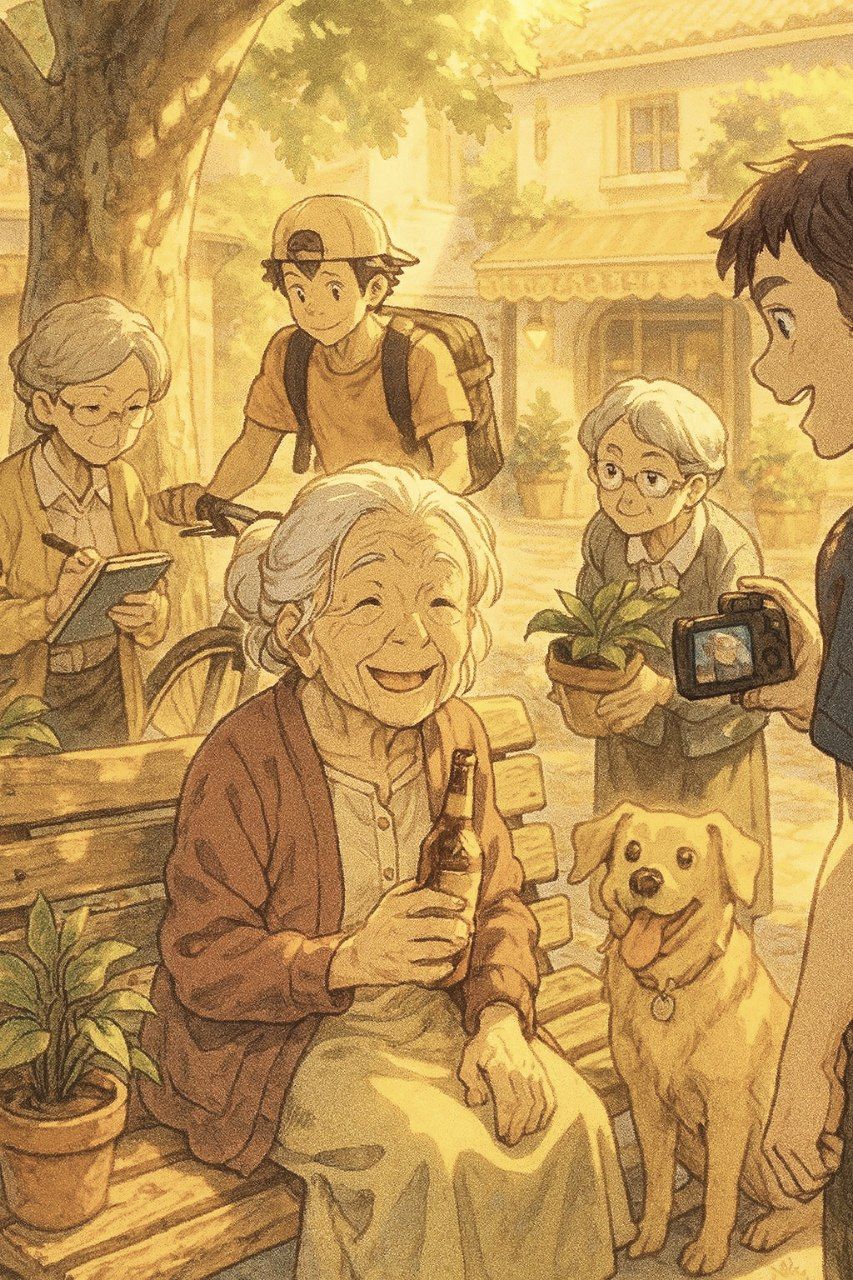
Performing maintenance on a PlayStation controller
These days I was performing a maintenance to a PlayStation controller (first generation), a control that was given by a friend to carry out this work. And for this we proceeded in this way: the housings were removed and then cleaned with soap and water (in addition to other parts) in order to remove the dust, grease, and other types of attached dirt. As for the plate, it was cleaned with cotton wool and alcohol carefully so as not to damage any components. After letting it dry, everything is put back together, to look like new.
Source of the images
Images captured with my Amazon Fire 8 tablet.
Short story: The Silent Failure: Recovering Deep Knowledge in the Face of Technical Training
Professor Andrés cleared his throat before entering the classroom and set down a stack of yellowing papers: academic articles, philosophy notes, history essays and texts he believed formed the backbone of an education oriented toward deep knowledge. Outside, the corridor buzzed with the usual hurry; inside, six students murmured to one another; one of them, Martina, scrolled through her phone without lifting her eyes.
“Good morning,” Andrés said in the voice he used when he wanted to be heard seriously. “Today I want to start with an observation that worries me: he (or one) claims that students arrive at university with a poor memory and without a solid foundation of knowledge because the educational system has displaced deep knowledge in favor of a superficial technical training.”
The remark, spoken calmly, produced a momentary stillness in the room. There were awkward glances, a few disguised yawns, the distant chime of a phone that did not belong to class.
“And why would that be?” David asked, rolling up his sleeve and showing a practical curiosity.
“Because,” Andrés replied, resting his palms on the table as if to anchor his words, “this deficiency is not accidental: it is the result of decades of education policies that have weakened the figure of the intellectual teacher, prioritizing empty ‘innovative’ methods focused on technique rather than content.”
Martina, who until then had kept her eyes on her screen, looked up for the first time. For once she directed her attention without the mediation of an app.
“An intellectual teacher?” she murmured. “Isn’t it better that they teach us practical things, to prepare us for work?”
Andrés offered a measured smile—the kind he used to answer questions that conceal deeper questions.
“Technique is necessary,” he said, “but it does not replace thought. When the school gives up forming minds capable of reasoning and questioning, what it produces are young people who know how to operate devices but do not understand the world.”
Lila, who had participated little until then, raised her hand with a mix of nervousness and candor.
“But if I get a job quickly because I know how to use software, isn’t that good education?”
“It is useful,” Andrés conceded without giving more ground, “but insufficient. They arrive at university without tools to think or connect ideas, incapable of learning beyond what a screen shows them. And that, in my opinion, is not only a pedagogical problem but a cultural failure of enormous proportions.”
The statement left in the air a tension that was not only academic: it was a discrepancy between social expectations, labor demands, and the very purpose of an institution devoted to knowledge.
At the door, a student added lightly, “That sounds very dramatic.”
“Maybe it sounds dramatic,” Andrés replied, “but you will see it in practice. Let me tell you a story.”
The story of Ana and the bridges
Ana had been, in her high school, the exemplary student. Her résumé was neatly presented: courses, certificates, intermittent workshops, competitions resolved efficiently. She knew how to manage several platforms, edit content, prepare presentations that shone on screens; her digital portfolio was impeccable. She entered university with the confidence of someone who possesses tools and therefore trusts her quick performance. But within a few months she began to stumble in seminars where the demand was not only to operate but to sustain an argumentative line, link authors, and confront criticism with intellectual autonomy.
In a social theory class, the seminar professor asked students to relate Pierre Bourdieu’s notion of “cultural capital” to the economic and social history of their region. It was not a literal translation nor a memorized quotation: it was a request for a bridge between theory and experience, between text and context.
“I can look up a summary,” Ana replied, opening her browser almost reflexively.
“No,” the professor said, with the firmness of someone who has seen too many shortcuts. “Make the connection with what you remember and with what you have lived there. Think without looking for shortcuts.”
Ana tried. The memory she had was composed of isolated fragments—memorized definitions, facts displayed like in a display case—but she could not find the bridges that would connect those pieces. She relied on learned quotations and pompous phrases; but when she had to contextualize, the statements hung without support.
After class, visibly frustrated, she ran into Tomás, a classmate who had studied at a different school with a less “prepared” profile in certifications but more seasoned in discussion and prolonged reading.
“Why so low?” he asked, curious and without judgment.
“I don’t know,” Ana whispered. “I know all the facts, but I can’t join them. It’s as if there are pieces but none fit.”
Tomás looked at her with seriousness and replied without haste:
“My older sister studied literature. At her school they discussed books, debated, learned to sustain an idea. They didn’t get so many ‘practical’ courses, but they were taught to think. I think that’s why she connects things better.”
Ana reflected, and in doing so she remembered a high school teacher who forced them to read whole texts, to write until they ran out of breath. She had hated him then for the demand; now, without bitterness, she understood why that teacher had shaped her: not to obtain a degree quickly, but to learn to weave relationships between ideas.
A debate at the faculty meeting
Months later, at a faculty meeting, Andrés presented a report that was not only a complaint: it brought data, anecdotes, and an analytical proposal.
“Students don’t come with a solid foundation,” he said. “It is not the generation’s fault: it is the fault of policies that have displaced deep knowledge in favor of a superficial technical formation, deprived of critical thinking and understanding.”
The director, Marta, listened with the caution of someone who must balance institutional expectations, budgets, and the pressure of external indicators.
“Are you saying the educational reform failed?” she asked, careful with her words.
“Not every reform is bad,” Andrés replied, “but many prioritized technique and relegated the teacher to the role of program executor. The figure of the teacher as an intellectual—someone who transmits not only information but ways of thinking, reading habits, and the craft of questioning—was weakened.”
A council member, Alejandro, who represented a pragmatic view of the university-market relationship, intervened strongly:
“But we need graduates who can be employed,” he said. “Companies demand practical and measurable skills.”
“And companies also need people capable of analyzing, innovating, and contextualizing,” Andrés answered. “A worker without critical thinking does not solve unprecedented problems; he only repeats patterns he was given. In the long run, that also harms productivity and the capacity for innovation in any sector.”
Marta sighed; the discussion touched deep layers: it was not only about changing a curriculum but about revising social expectations, evaluation instruments, and the valuation of teaching.
“So what do you propose?” Marta asked.
“Recover reading time,” Andrés said decisively. “In-depth debates, teacher training that recovers the teacher’s intellectual status. It is not a nostalgic return to the past; it is betting on minds capable of sustaining tomorrow’s society. Teaching thinking requires time, silence, sustained discussion, and the professional recognition of the teacher so they are not mere implementers of methodological recipes.”
A small transformation with resistance
The changes Andrés proposed were neither immediate nor free of resistance. Budgets fell short, external evaluations continued to measure the measurable—skills, technical competences, percentages of compliance—and there was constant pressure for quick results.
Even so, a group of teachers, among them Andrés and director Marta, began to introduce small but significant modifications: mandatory reading seminars, rubrics that valued argumentation and depth beyond superficial correctness, and moments of work in which the classroom was disconnected from screens to allow for the exercise of memory and discussion.
The first results were modest and sometimes hesitant. In the first semester with these changes, many students again found it difficult to think without digital shortcuts. Ana stumbled anew: connections do not appear overnight. But over time, each class offered her a map for linking dispersed fragments. She began to read full texts instead of summaries, to take notes, to underline, to argue until a proposition was worn by the friction of debate. Martina, for her part, left her phone in the library for an hour a day as an exercise she initially considered absurd; later she discovered that this hour forced her to listen and participate. Tomás taught his classmates a simple game: take an idea and drag it into another discipline, looking for the bridge, insisting until it was found.
“It’s not magic,” Andrés said one afternoon at a colloquium before students and colleagues. “It’s work. And it requires valuing teachers as thinkers, not as technicians who apply recipes. To form people who think is unlikely without teachers who can model thinking.”
Ana, who not long ago had felt disarticulated, began to show signs of consolidation. One afternoon she stayed after class to speak with Andrés. There was something in her look: fatigue and relief at once.
“I think I’m beginning to understand,” Ana said softly. “I don’t just want to know how to use tools; I want to know why they exist and what they do to us.”
Andrés nodded with the blend of kindness and rigor he showed his students.
“That’s it,” he answered. “Deep knowledge is not a luxury: it is the foundation for any technique that is worth having. If we don’t understand the why, we will be skilled operators of machines and platforms but not citizens capable of intervening in the world.”
The cultural conflict and education policy
The phenomenon Andrés described had deeper roots than a single reform: it fed on a cultural shift that began to value immediacy, quantitative measurement, and visible efficiency over slow reflection and prolonged reading. For decades, education policies—in different countries—promoted “innovative” methodologies that promised efficiency, accessibility, and quick results. Many of these proposals, when implemented without conceptual debate or investment in teacher training, reduced the role of school to the transmission of technical skills. This rewarded the ability to meet indicators and neglected the formation of critical thinking, deep understanding, and the capacity for synthesis. Teachers ceased to be figures with intellectual authority and became managers of programs and standardized assessments.
That displacement affected not only the classroom but the cultural fabric: a society that mainly values technical skill risks losing its capacity to question, to articulate interpretative frameworks, and to imagine alternatives. It is not about distrusting the technical; it is about recognizing that technique without meaning is functional but fragile, and that the knowledge that underpins technique is what sustains people’s intellectual autonomy.
The university community reacted in diverse ways: some teachers embraced novelty without reservations; others resisted from inability to adapt or conviction. Students found themselves torn between immediate job expectations and a growing need for meaning. Companies demanded practical employees; the arts, humanities, and sciences asked for time and reflection. The balance between these worlds proved fragile.
An everyday scene with meaning
The following summer, Andrés organized a roundtable on “Education and Thought.” The room was full: curious students, exhausted teachers, and some administration representatives. Among the audience, Martina was no longer just the girl with the phone; she participated actively. Tomás, with his ability to translate concepts into simple examples, moderated one of the panels. The dynamic was not a series of solemn speeches but chain conversations: experiences, resistances, concrete proposals. No one said the solution was simple; no one promised an immediate change.
At the end of the meeting, Director Marta closed with a public reflection:
“We cannot reverse decades of policies in one semester,” she said, “but we can begin to demonstrate, with concrete actions, that forming people to think is possible and necessary. We have to recover speech, reading, and argumentation as curricular axes. And, above all, we must restore to the teacher the status of a person who thinks and produces thought.”
The closing was met with restrained applause. Outside, on the street, a graffiti someone had painted days earlier and that had already become an urban emblem read, “Teach to think.” It was not a total solution, but it worked as a symbol: a public reminder that education is not only an instrument to enter the labor market but the space where capacities to understand and transform reality are manufactured.
Small victories and a long-term commitment
The changes introduced at the university did not erase structural tensions. Plans were cut, evaluations continued to measure skills, and the temptation to once again prioritize the measurable remained. However, there were advances. In courses where hours were reserved for reading and discussion, the quality of interventions improved. In seminars that valued argumentation, students who had previously been unnoticed began to gain prominence. Ana, Martina, and Tomás were not isolated cases: their transformations sparked small contagions among classmates.
One morning, in an informal conversation in the university cafeteria, Martina said without drama:
“If we only teach people how to operate, we will be slaves to whoever controls the operation.”
“If we teach people to think,” Tomás added, “we will be able to change the operations and, with them, the conditions in which they are exercised.”
The simple phrases condensed an intuition the university was beginning to recover: technique needs a theoretical and critical scaffold. Without that scaffold, efficiency becomes repetition and creativity submission to algorithms.
The figure of the teacher regained, with effort, a critical voice. Not as someone who imposes truths, but as someone who guides processes, models arguments, and demands rigor. Recovering the teacher as an intellectual required investments: permanent training, professional recognition, time to think and not just to grade tests. It was a cultural and political struggle because it involved disputing what is considered valuable in education.
Epilogue: a modest but meaningful victory
It was neither an immediate nor an absolute victory. National policies were slow to change and in some cases continued to prioritize indicators and standardized assessments. But the small movement that started in a faculty—a group of teachers who decided to read again with students, to debate without haste, and to value understanding over mere skill—began to show results. For many students, the experience of exercising memory in the service of meaningful connections and the opportunity to sustain well-crafted arguments was transformative.
One afternoon, near the end of the course, Ana stayed after class. She looked at Andrés with contained gratitude and a new sincerity.
“I think I’m beginning to understand,” she said. “I don’t just want to know how to use the tools; I want to know why they exist and what they do to us.”
Andrés, who had seen many students come and go, nodded calmly.
“That’s it,” he replied. “Deep knowledge is not a luxury: it is the foundation for any technique worth having.”
In the city, the graffiti “Teach to think” had resisted rain and time. It did not solve structural contradictions by itself, but it served as a public reminder of a possible commitment: to recover, in school and university, the capacity to think, connect, and question. That commitment did not promise instant results but offered, instead, the possibility of building a more capable, critical, and autonomous citizenry.
And in the classroom, little by little, memory was exercised toward connection and comprehension; devices remained useful, but ceased to be the only teachers. The figure of the teacher recovered a critical voice and intellectual authority—not by administrative decree but by sustained work, debate, and the daily proof that deep formation produces citizens able to intervene in the world. It was, in short, the beginning of a counterweight to decades that had bet on the superficial. For many, that was enough: a modest but meaningful victory.
Source of the images.
Image created with Bing.
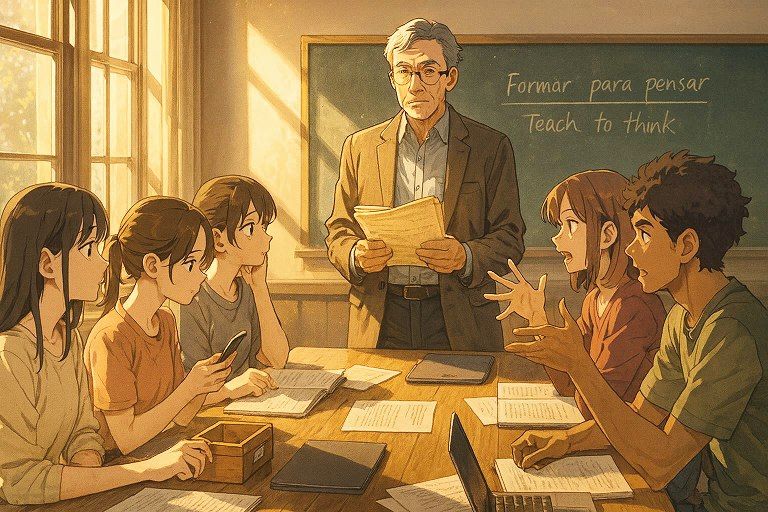
Short story: The Second Chance for Luna
The animal protection volunteers had spent weeks going through shelters and refuges looking for dogs and cats that, for various reasons, no one had claimed. That morning, the sun barely peeked through gray clouds as Marta and Javier entered a hall of cages where the light seemed to bounce off sadness. There were several animals, but one in particular caught their attention: a small dog with grayish-brown fur, thinner than usual, who curled up in the corner of a cage as if trying to make herself as invisible as possible.
“Look at her,” Marta murmured, her voice tight. “She doesn’t have any energy. I don’t think many people have even noticed her.”
Javier crouched in front of the cage and rested his hand on the wire without invading her space. The dog lifted her head and, for a moment, her eyes reflected a mix of fear and hope, as if searching for a sign that someone would truly stay with her.
“She seems like she wants us to reach in,” he said softly. “But we won’t scare her. Better take a photo and share it.”
Marta took out her phone and snapped several pictures. Looking back at the dog, she felt a pang in her chest: it wasn’t just her physical condition; it was the expression, a quiet sadness that had settled into her features. That same afternoon they wrote a message to accompany the best photo: Volunteers from animal protection shared this image hoping to find her an opportunity in a home outside the shelter. Her photo, taken during a visit to a little dog behind bars, moved thousands of people on social media and sparked adoption requests from different parts of the country.
They posted the photo and waited, aware that sometimes posts don’t reach the places one hopes. But the response was immediate and overwhelming. Comments began to multiply: messages of encouragement, rescue stories, offers of financial help for vaccines and transport, questions about her health and age. An unusual number of people asked for more information. Among the messages was one that stood out for its simplicity and clarity of purpose: a woman named Elena, writing from the United States, said she wanted to give her a home and asked what was needed to bring her across the border.
“I want to give her a home,” Elena wrote. “What does she need to cross the border? Any health issues? Is she active or calm?”
The logistics were complex and required coordination. Veterinary certificates, vaccination records, an international transport protocol and, above all, funds to cover the process were needed. The volunteers organized a fundraiser among friends, local supporters and donations that kept arriving—each with words of hope. Marta and Javier, together with other helpers, worked tirelessly: the dog was examined by a veterinarian who confirmed that, despite her thinness and listless appearance, she had no serious illnesses. She received the necessary vaccines and antiparasitic treatment. They also gave her a final session of affection before her departure: they fed her carefully, brushed her coat and held her so she would feel that, at last, someone was seeing her.
“I brought her a toy I sewed from old rags,” Marta said on the last afternoon before the trip. “I wanted her to have something that smelled like us, like hands that cared for her.”
“And I left her my old shirt,” Javier added. “I thought that way, on the plane or in the new home, she’d find a familiar, comforting scent.”
Departure day was a mix of anxiety and relief. At the airport, the dog stayed curled up on Javier’s shirt, her breathing long and steady as if, for the first time in a long while, she could allow herself to rest. The volunteers gave her one last look before saying goodbye. Marta held back tears seeing how, for the first time in a long time, the dog lifted her head without that heavy look of despair.
When Elena received her in her country, the house greeted her with the same warmth felt in the messages: a woman waiting with a gentle smile and hands ready to mend a life. Elena knelt, called her softly and invited her to come closer.
“Hello, my little one. Welcome home,” Elena said as she reached out her hand.
The dog, still shy, sniffed the surroundings. The change was almost instant and miraculous. Leaving the cage behind seemed to open up a whole map of possibilities. The dog, who until then had had no name, showed renewed interest in the world: she began to sniff every corner, wag her tail timidly and play with a small rubber ball she found in the living room. Elena watched her with a mix of restrained emotion and satisfaction.
“Look at this,” Elena told her friend on the phone that night. “You wouldn’t believe how she changed. As soon as we took her out of the cage she started moving, exploring. It’s like she woke up.”
The hours went by with everyday discoveries that were new frontiers for the dog: the smell of wet grass in the yard, the crunch of leaves, the warmth of a sunbeam coming through the window. For the first time she knew the comfort of a soft bed, long unhurried strokes, hands that brushed her with tenderness. At night she settled beside Elena and rested her head on her knees, surrendered to the safety of a home that accepted her unconditionally. Her eyes, once dull, now shone with curiosity and trust.
Meanwhile, the image that had started it all kept traveling. The original post became a before-and-after thread: the photo of the dog behind bars and the new images of a rebuilt life. Stories like hers inspired others to take an interest in shelter animals, offer donations, and ask how to replicate that support in their communities.
“It’s incredible,” Javier said, scrolling through the responses on his phone. “We didn’t just find her a home; we created a network of solidarity that reached so far.”
Months after the adoption, Marta received a letter and several printed photographs. The pictures showed the dog running around the yard, playing with a red scarf, sleeping in a plush bed, and receiving hugs from Elena. One photo revealed a detail that moved the volunteers: Javier’s old shirt she had been given was frayed and torn from use—clear evidence that the dog had kept it as a travel talisman and a memory of those who cared for her before her new life.
“Her name is Luna now,” Elena wrote in neat handwriting on the letter. “We named her that because of the nights I saw her gazing at the light from the window. Thank you for saving her.”
That simple word—thank you—resonated deeply among those who had always worked quietly for animals. Marta and Javier stored the photos in an album and, as they turned the pages, remembered every gesture that had made the rescue possible: the post, the chain of donations, the veterinary care, the transport, and Elena’s willingness. It was a lesson in how a single honest, heartfelt image can spark a wave of compassion that crosses borders and tangibly changes the life of someone no one else had chosen.
The dog, who had learned to hide, was now learning to shine. She discovered calm, security and the small wonders of daily life: the feel of grass under her paws, the joyous claps when she managed to catch a ball, the human voices that called her name with affection. Luna allowed herself, little by little, to trust the new faces and the routines that keep life steady: regular meals, care, play and affection.
Over time, Luna’s story became a beacon for others: posts showing her progress, messages from people wanting to know how international adoption worked, and new initiatives to help animals still waiting behind bars. Marta and Javier returned to their rounds with renewed hope, knowing that sometimes a single well-placed image can ignite the collective will to open doors that seemed closed.
Luna, the dog who arrived nameless and wounded, offered daily proofs of her gratitude. She became Elena’s favorite, who proudly told her friends how a simple post had changed her life too. That action—taking a photo, sharing it and not giving up in the face of bureaucracy or distance—showed that solidarity knows no borders and that love for animals finds ways to manifest when given a channel.
In the end, the transformation was not only Luna’s: it belonged to an entire community that, for a moment, chose to act. What began with a sad image behind bars ended as a powerful reminder: sometimes one single photo is enough to open the door to a second chance and, with it, a new, full and dignified life.
Source of the images.
Image created with Bing.
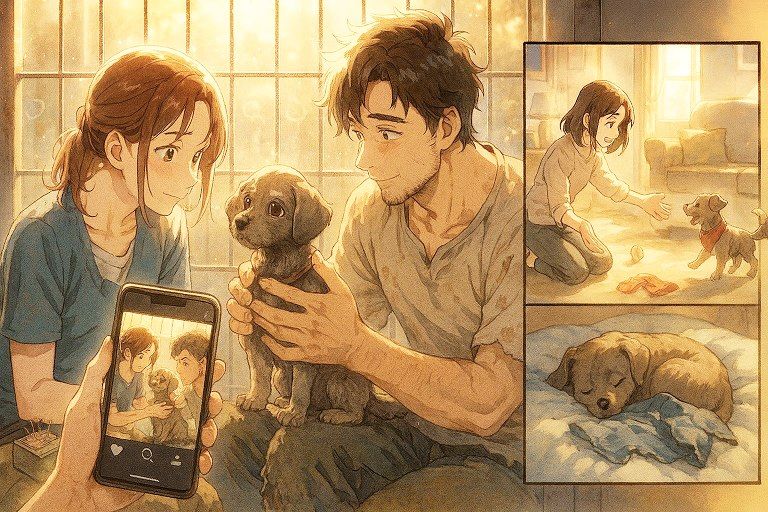
Top 5 musical - December, 2025
We return with our monthly list that shows the 5 most listened artists/bands, which in this case is the month of December, the last month of the year 2025 that has just concluded. And for this month several bands that have made their appearance before are coming back. Now, without further ado, let's see who are those who are present.
First of all, it should be remembered that this list is part of my profile on LastFM, a social network that has my statistics on music plays, and which, in turn, is linked to my Spotify account.
And without further ado let's get started.
**Most listened artists**
1- Limp Bizkit
Country of Origin: United States.
2- Korn
Country of Origin: United States.
3- Audioslave
Country of Origin: United States.
4 - The Black Keys
Country of Origin: United States.
5- Judy and Mary
Country of origin: Japan.
By overwhelming majority we Americans have a strong presence except with one exception as Judy and Mary, from Japan. A band that became known in the Western world for having participated in the soundtrack of the anime Rurouni Kenshin.
Next, let's look at the most listened to albums section.
**Most listened to albums**
1. Significant Other (Special Edition) - Limp Bizkit
2. Issues - Korn
3. Audioslave - Audioslave
4. WARP TOUR FINAL - JUDY AND MARY
5. Brothers (Deluxe Remastered Anniversary Edition) - The Black Keys
The novelty here is the WARP TOUR FINAL album, which compiles the last live performance of Judy and Mary before their dissolution. And that without a doubt if you are a fan of this band you will know that it has all their best songs.
And extra bonuses I have something special for you all 😏
**EXTRA BONUS: MUSIC TO LISTEN TO**
**Judy and Mary**
https://youtu.be/Fy4MForBPqc?si=NycQb0vLY1cpeu_k
And without more to say we meet in the next one. I appreciate all the support provided, and remember to leave your comments and musical recommendations at the end of this post.
Until then. And long live the music! 😎👍
Source of the images
Screenshots from my Amazon Fire 8 tablet.


Short story: Dismantled Eyes
The office smelled of cold coffee and disinfectant, a mixture trying to order the chaotic. Outside, the city pulsed with notifications: shop windows vibrating, hands swiping, faces lit by screens. Inside, the light was warm and still. Three bodies occupied the room: a calm-eyed psychologist, a mother clutching her coat close, and an adolescent who kept rubbing the fabric of his pants with his fingertips, seeking in that gesture the same security he found in the screen.
Dr. Sosa: (pointing with his pen at a notebook) I’ve seen this pattern again and again. Excessive mobile and screen use is replacing real human experience. Many adolescents have lost basic interaction skills: speaking face to face, confronting conflicts, expressing emotions, tolerating discomfort, or building authentic bonds.
Elisa (the mother): (voice breaking, hands clenched on her purse) But he… I see him laugh at videos, share memes with his friends in groups. Isn’t that the same as conversing?
Dr. Sosa: No. By taking refuge in the digital —where everything is immediate, controlled, and risk-free— they avoid exposing themselves to real situations that require looking another person in the eye, accepting consequences, making mistakes, or overcoming difficulties. That lack of emotional and social practice is shaping more fragile, insecure, and dependent adolescents.
Mateo (the adolescent): (pressing the edge of his chair; his phone vibrates in his pocket) So I’m… weak? For watching things? I… when I talk to someone in person, I freeze. I don’t know what to say. If I don’t have messages, I feel empty.
Dr. Sosa: (without judgment, in a measured voice) It’s not a single personal fault; it’s a social effect, an adaptation to an environment that facilitates it. The design of many platforms rewards immediacy and control of image. But habits can change. What matters is recognizing what’s been lost along the way: the ability to tolerate the discomfort of a gaze, to accept silence, to allow a relationship to grow through stumbles. You don’t learn that through notifications.
Elisa: (a mix of pleading and reproach) How do we help him? Do I force him to disconnect? Every time I try to talk to him, he looks at me like I’m another device he has to calibrate.
Mateo: (his eyes tear up; he avoids his mother’s gaze) When people look at me directly I feel watched, my palms get sweaty. I prefer to control what I show on the screen. There I can edit myself, choose the angle, delete what I don’t like.
Dr. Sosa: Controlling self-presentation is understandable. We all do it to some degree. But human interaction requires tolerating the loss of control: making mistakes, apologizing, not being reciprocated. Those are exercises in social resilience. If we don’t practice them, self-confidence becomes fragile and dependent on external approval.
Elisa: (voice rising with guilt and contained anger) So is this all the phones’ fault? O ours, the parents’, for not setting limits?
Dr. Sosa: (calm) It’s not a simplistic blaming. There are structures —platform designs that exploit immediate rewards, social pressures that normalize hyperconnectivity— and there are family decisions, too. The urgent thing now is creating safe opportunities for error and real encounter. It’s not about prohibiting but retraining: screen-free conversations, facing disagreements in person, learning to hold uncomfortable gazes without fleeing.
Mateo: (a whisper that seems to break) What if I can’t? If I freeze in the middle of it all? I don’t want to look foolish in front of my friends or you.
Dr. Sosa: Feeling foolish is part of learning. Think of it as a muscle: if you never use it, it atrophies. We can start with small, controlled exercises. Today, for example, talk for ten minutes without phones. Elisa, don’t interrupt. Mateo, try to look your mother in the eyes three times while you speak. If anxiety comes up, breathe and name it out loud.
Elisa: (swallows; tries to believe him) Okay. We’ll try.
A silence settles that is not peaceful but expectant. Mateo stares at his phone as if it were a root he knows he must pull out. The screen twinkles with a notification he decides not to open. With a gesture that seems to cost him, he places the device face down on the table, as if doing so were a small renunciation.
Mateo: (low, trembling voice) Okay. Three looks.
Elisa lifts her eyes. Her gaze is clumsy at first, as if she doesn’t know where to rest the eyes that until recently sought confirmation from a distance that is now directly across from her. Finally she looks. Their eyes meet, collide and examine one another, like assessing the quality of a bridge before crossing.
Mateo: (waiting, then letting go with the weight of what’s been avoided) Mom… I feel stupid when I don’t know what to say.
Elisa: (breathes, making the effort to be honest) Me too. I thought you didn’t care. I thought you preferred the screen to me.
Mateo’s gaze drops; without the screen’s pretense, his voice cracks with a mix of shame and relief.
Mateo: (almost a sigh) Sometimes I prefer the screen because it doesn’t demand from me. There I can choose what I show. But I love you. And I’m afraid you’ll leave.
Elisa hesitates to reply; the sentence pierces through a shell of reproach she’d built to avoid being hurt. Her eyes fill and her voice comes out with a tenderness she had forgotten how to use.
Elisa: (firmer, surprised by her own emotion) I’m not going to leave.
The silence that follows is no longer a trap but a pause where two truths slowly settle. Dr. Sosa writes something in his notebook without interrupting, watching how the scene unfolds naturally when given space to be awkward and honest.
Dr. Sosa: (gently) This is exactly what I wanted to happen. It’s not about demonizing technology, but about recovering what can atrophy if everything is replaced: the practice of being vulnerable. Vulnerability builds real strength. Not the kind measured by likes or views, but the kind that sustains a shared life.
Mateo: (lifting his head with a hint of resolve) What if we start practicing this at home? No screens at the table, or before bed? Something small we can keep.
Elisa: (decisive, accepting the weight of responsibility) Yes. We start today.
Dr. Sosa: Good. Do it gradually and with intent. And when conflicts arise —because they will— face them in person. You’ll learn to tolerate discomfort, to repair, to forgive and to ask for forgiveness. That, more than any digital applause, will give you confidence.
They stand to leave. Mateo picks up his phone with slower movements, like someone deciding that the belonging doesn’t have to be a permanent shield. He closes it and puts it in his jacket pocket without the urgency he usually shows; there is in his gesture a new awareness: the device will not eliminate the risk of speaking, but it can stop being the refuge that avoids risk. Outside, the city kept glowing, voracious in its offer of stimuli. Inside, however, a habit began to form: imperfect, human, trembling, but practiced.
In the days that followed, conversations were short and awkward. There were uncomfortable silences, reproaches that always seem easier after a keyboard, sudden tears and missteps. Elisa and Mateo stumbled over the same argument about curfews, about music volume, about an offhand word that rekindled old fears. But those stumbles started to do something the screen never had: they taught consequences. Mateo learned to apologize with his voice, to hold a gaze after anger. Elisa learned to lower the intensity of her reproach and to name her fears without withdrawing. Daily practice brought small victories: a joke told without mediation, a dinner with unfiltered laughter, an argument closed with a hand on the arm that did not seek to control but to accompany.
A month later, Mateo entered the office with a less rigid expression. He brought bad grades and an apology for being late, but also signs of initiative: he had begun to speak in class meetings, to raise his hand even though his chest raced. He didn’t always do well, but he did it. Elisa reported fewer dramatic sleepless nights; she now accepted that presence is not measured by the absence of conflict but by persistence in care.
Dr. Sosa: (watching them with a faint smile) What you’ve done is build an emotional gym. Anxiety won’t disappear overnight, nor will all doubts, but you’ve resumed practice. Over time, that social muscle will grow more resilient.
Technology didn’t disappear from their lives. There were moments when Mateo browsed videos before bed, and shared laughs in chats that kept friendships at a distance. The difference was that the screen stopped being the only room where meaningful things happened. Important things also began to happen in the kitchen, on the couch, in conversations that couldn’t be rewound.
On a rainy afternoon, Mateo watched the rain against the glass, his phone resting silent. Elisa sat beside him and didn’t open her mouth to fill the silence; instead she offered him her gaze and, for the first time in a long while, they were able to hold it without a digital shield. It wasn’t a perfect scene: eyes wandered, there were awkward breaths, quickening pulses. But they looked at each other, and in that clumsy exchange a new truth emerged: shared fragility could become closeness if named and practiced.
Outside, screens continued to blink, promising instant certainties. Inside, between the three of them, the promise was different: to learn to stay, to err, and to mend. It wasn’t a nostalgic return to idealized times, but a wager on human complexity, on patience with stumbles, on the courage to meet without filters. Little by little, their gazes were dismantled and reassembled—less perfect, but truer.
Source of the images.
Image created with Bing.
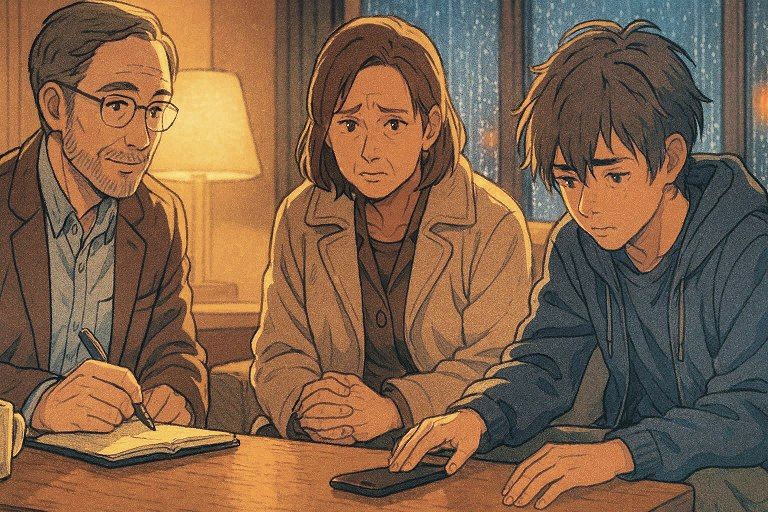
Short story: The Trail of Rain
Year 1962. It had been raining since dawn and San Martín Primary School smelled of damp chalk and old books. The principal, Doña Marta Ávila, had gathered the second-grade students in the assembly hall to correct an exercise: “Draw something you remember about the rain.” Thirty-seven pencils paused, moved, and made lines with a decision no one could explain.
Doña Marta, her hands trembling slightly, spread the first sheet across her desk. Second-grade teacher Herminia Rosales watched from a corner and stepped closer. They had just stacked the sheets when they noticed something wrong: although strokes varied in pressure and color, the drawn figure repeated with an unsettling precision. It was a tall man, faceless, with hollow eyes and holding a rope. Every child had drawn the same thing.
“That can’t be… none of them know each other,” Herminia murmured.
A boy, Tomás Gutiérrez, eight years old, stood near the desk and, without looking up, uttered a phrase that sealed the silence in the room.
“We call him Yellow Echo. He appears when it rains.”
The word seeped through the corridors like a dampness that did not dry.
Inspector Raúl Estévez arrived that same afternoon and began to walk through classrooms and homes. He interviewed parents, checked notebooks, and dug through municipal records until he found an old note: in 1924 a fire in the hills had left the town on alert; someone, according to a clipping, had placed ropes to warn neighbors. No one knew the man’s name. Nothing explained why, in 1962, thirty-seven children who had never met would agree on the same portrait.
Raúl interviewed the children individually. Each account followed a similar sequence: it rained; a sound like an echo came from the yard; then the long shadow with hollow eyes appeared and the rope. None spoke with the triviality of a child's invention; they all told it with the gravity of someone repeating a lesson learned. Luz Marina, seven, described her experience with a calm that chilled:
“When it rains, I see him behind the gate. He stays looking and tells me not to make noise. He never speaks with a voice. It’s like… when someone repeats what I think.”
Pablo, another child, added with unnerving matter-of-factness:
“He threw the rope on me once. He didn’t pull me. He just left it on my shoulder like it was a promise.”
Raúl returned that night to his boarding room with notes in his notebook and sleepless eyes. In the silence of the room, as if the rain had dragged the town’s memory up to the roof, the hollow eyes visited him in dreams. He woke with the feeling of having seen something that did not belong to him.
Parents split between disbelief and panic. Some attributed the coincidence to a local folktale or a teacher who had shown the image; others began to watch the rainy afternoons as if an apparition were expected. One April afternoon, Luz Marina’s mother called in a panic: the girl had left home drawn by the call of the rain. They found her in the old house at the back, by the well, her hands white with mud and a rope tangled in her fingers.
Psychologists, the priest, teachers from neighboring towns came to interview the children. All offered the same version: a faceless figure, hollow eyes, and a rope. They repeated “when it rained” as if it were an item on a list. Some said the figure showed familiar details: a birthmark, an old man’s posture, the sign of a scar on a wrist. No one could explain how they had matched so precisely.
Raúl noticed a pattern: the rope was never used to tie; it always hung, supported, or held. The children called it “the promise.” When asked what Yellow Echo promised, Tomás gave an answer that sounded like a vow:
“That they won’t forget. That they repeat what they hear. That they remember the rain.”
A teacher asked if they remembered anything before seeing the figure. The answer was uniform: before the rain, nothing. Afterward, new dreams—fragments of other lives.
Raúl began to think it was not just childhood imagination. Something in the rain activated memories the children adopted and reproduced as their own. To test it, he became an observer: he hid in the schoolyard during storms, waiting to see what the children saw. The rainiest night brought him an odd sound, like a tapping that did not belong to the water. The shadow appeared: tall, thin, featureless. The rope hung, and the air around grew colder. The figure did not speak, but in Raúl’s mind he felt a repeated phrase: “Don’t forget.” Then a foreign memory struck him: a mother sewing in a kitchen he didn’t recognize, a broken cup on a table. It was the blue pottery his family had once owned and lost in 1944. He vomited in the rain; in his notebook he wrote clinical relations and, between the lines, left that sense of having been touched by memories that were not his own.
Meanwhile, in the town, Yellow Echo fed theories: mass suggestion, a school prank, a local illustrator’s circulating images. Isolation and control tests were run, but nothing explained the synchronicity. The school became a magnet for curiosity and fear; some parents withdrew their children; others stayed and kept drawing.
Herminia found Tomás one day in the corridor, staring at his hands stained with a pale yellow powder that barely shimmered in the dim light.
“What’s that, Tomás?” Herminia asked.
“It’s from Yellow Echo,” the boy replied. “He left me a piece of promise. He says I must keep it.”
The boy’s gesture carried authority; he moved his hand away when the teacher reached to clean it. That night, a neighbor heard Tomás recite dates and addresses no one had taught him. The boy didn’t know why he said them; he simply spoke them.
The situation escalated until the municipality closed the school temporarily. Families who could left town. Those who remained kept the memory preserved in the yellow folder Herminia guarded—the thirty-seven sheets nobody wanted to touch. A month later, on a stormy dawn, the school burned. There was no technical explanation for the blaze. The library and Herminia’s study were devoured by flames; yet among the debris and ash, firefighters found the stacked sheets intact: the thirty-seven figures barely singed, their black lines casting shadows on the scorched paper.
The community gathered around the smoking lot. Doña Marta, her hands burned, held a sheet to her chest; the figure seemed more absent than ever, as if the fire had emptied the page. Raúl, who had lost sleep since the first sighting, noted with a tremble in his notebook: “Culminating phenomenon with syncronicity and possible link to collective memory. Requires follow-up.” He did not write what he had felt the night in the yard. In his house, with rain striking the roof, he heard a rope scrape and believed he heard a repeating whisper: “don’t forget.”
Over time, when the building was rebuilt and the school reopened under a different name, the yellow folder disappeared. Some claimed it had been destroyed to close the chapter; others insisted it was kept in a municipal archive. The thirty-seven children grew and dispersed. Most avoided the subject; a few became artists obsessed with long lines and faceless silhouettes. Two were later found dead with a piece of yellow rope in their hands: one a librarian, the other a carpenter who worked with ropes and membranes. The detail sparked rumors: the promise persisted.
Decades later, Tomás, now gray-haired and withdrawn, accepted a recorded interview that was never played at the school. He looked at the camera with the calm of someone who keeps a secret close to the bone and said:
“I don’t know if it was bad or good. I only know the rain brought voices that were not ours. It asked us to repeat them so someone would hear. It left us promises. It left us the rope.”
Herminia, elderly, left a short note in her diary with less explanation and more sorrow:
“The children repeated what the rain gave them. Sometimes memory comes at a price.”
Later accounts from town residents added unsettling details: a woman heard her son recite the name of a woman who died in 1910; another heard precise descriptions of a kitchen demolished in 1938. An old man, Francisco, remembered a family legend that changed names but not meaning: his grandfather spoke of a man who walked the rain collecting broken memories. They called him “the echo” because he repeated voices; he had no face because he took faces. A rope, the old man said, symbolized the promises people handed over so the echo would not forget.
The events left an enduring question: did Yellow Echo gather memories to preserve them, or did he tear them out so the townspeople were left empty and compelled to repeat them? No one could answer with certainty. Some believed the figure saved fragments time had forgotten; others thought he returned them with interest, demanding repetition as payment.
On rainy nights, the town adopted a different habit of watching the clouds. Some shut doors and windows; others, upon hearing a faint scraping on the roof, swore it was not the wind but a rope brushing wood trying to repeat a name. The most superstitious avoided saying “promise” near children.
Years later, new students began to draw without knowing the story. Sometimes the line came out crooked; other times, exact, as if an invisible hand guided the pencil. Faceless figures kept appearing in forgotten sketches, doodles, homework pages. And somewhere, in the memory of those who grew up under that rain, remained the certainty that certain words, images, and sounds can work like a tie: they bind people who never met through an echo that does not forget.
The End.
Source of the images.
Image created with Bing.
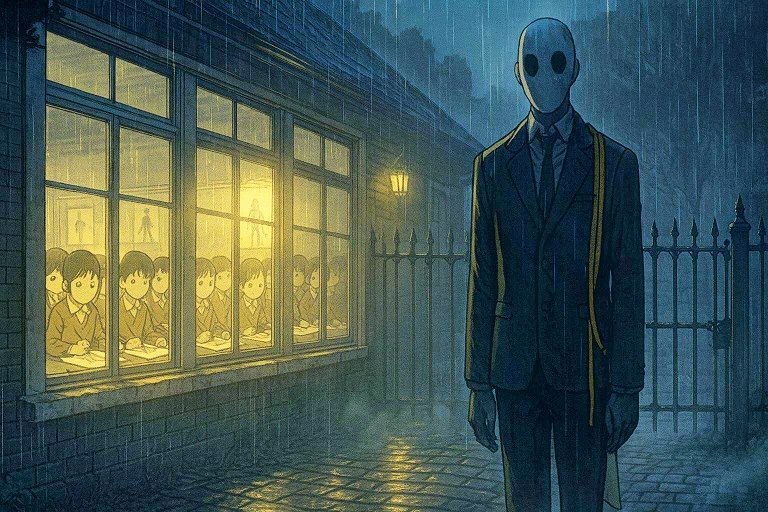
Short story: The House of Last Permissions
The house at the end of the block was one of those that seemed to have stopped in time: worn moldings, curtains that always smelled faintly of lavender, and a hallway that creaked with every step as if it kept an account of the years. In the dining room, a table with folded newspapers and coffee cups stained with rings. There was always a question in the air, a repeated murmur like a ritual: What do I do now? Not because ideas or desires were lacking, but because the silence after every possibility weighed more than any decision.
Mariana was thirty-two. Her résumé showed modest accomplishments: she worked at a publishing house, had published small pieces, and had projects that appeared and vanished like poorly watered potted plants. At home, her plants waited for light that didn’t always come; in life, she waited for a nudge that would justify moving. She had a romantic relationship that floated between tenderness and fog: a man who called her “my love” and seemed to understand her, except when things required firmness and she, muted, couldn’t find it. The persistent feeling was that any misstep would shatter something that, deep down, didn’t entirely belong to her.
One autumn afternoon, persistent rain turned the city into a gray curtain. Andrés, her brother, arrived unannounced, his hair wet and his hands in his pockets. He had come to pick up a box of old papers but stayed longer than planned. He left the box in a corner and collapsed into the living-room couch like someone settling in to talk about matters that couldn’t be postponed.
“Do you find it hard to move forward even though you ‘try everything’?” Andrés asked bluntly, like someone throwing a stone to measure the depth of the water.
Mariana looked at him with the usual expression of someone waiting for another to hand over the word that belonged to her. Her voice was a thread, like a breeze unsure whether to break the calm.
“I try. Really,” she said. “But I freeze. I doubt everything. I need… I need someone to tell me it’s okay.”
Andrés watched her for a second, gauging the truth of her words.
“It’s not lack of ability, Mari. It’s not laziness. Not bad luck,” he said, his voice steady and uncompromising.
She let out a small laugh that didn’t reach her eyes, resigned.
“Then what the hell is it?”
“Many times,” he replied, “it’s a wound that comes from Mom. When someone did everything for you—from fear, not from freely given love—your system learned: ‘I can’t on my own.’”
Those words fell like a fine rain onto a surface she already knew. The image of her mother rose immediately: Ana, with her jacket buttoned against the cold, a look that probed imagined and real dangers; Ana who checked Mariana’s backpack, reminded her of her keys, and controlled even the labels on school clothes. What lay behind that vigilance, Mariana thought, had always been presented as love.
“You never let me make mistakes,” she murmured. “If I were to fall, you’d already decided how I should get back up.”
“That’s why it’s hard for you to decide,” Andrés replied. “Because somewhere you learned to ask permission to exist.”
At that moment the front door opened and Ana came in with grocery bags hanging from her arm. She wore the expression of someone who keeps calm while feeling turmoil inside. She smelled of soap, fresh bread, and a worry that wouldn’t name itself. Seeing her, the tension in the room shifted its frequency.
“Everything okay?” Ana asked, with the capacity she had to turn complex matters into household tasks.
Mariana looked at her and, for the first time in a long while, felt the obligation to name what had always been the backdrop: the need for permission, the shadow of maternal oversight.
“Mom,” Mariana said. “I need to talk.”
Ana set the bags on the table, straightened her back as if a conversation with her daughter were another routine to be managed. Her voice was practical, ready to solve.
“About what, darling?” she asked, in that tone that seeks to soften before entering choppy waters.
Mariana drew a breath. Outside, the rain measured out a rhythm, and for a moment it seemed the beat would push her decision.
“About you. About me. About how I grew up thinking I couldn’t move without your permission.”
The grocery bags became background objects and the living room filled with a silence that smelled of years of things unsaid. Ana opened her eyes as if she’d received a question that wasn’t in her script.
“I only wanted to protect you,” she replied, almost automatically. “I wanted to spare you pain.”
“I know,” Mariana answered, with less anger and more exhaustion. “But it’s not the same. You didn’t prepare me to be wrong. You taught me to depend.”
Their words started to reshape the room into something more difficult and, at the same time, more honest. Andrés intervened with the urgency of someone who had seen the pattern repeat and wanted it to stop supporting them.
“That’s why it’s hard,” he said. “Because when Mom did everything for you—from fear, not from freely given love—your system learned something deep: ‘I can’t on my own.’ And today that shows up as constant insecurity, fear of making mistakes, emotional dependence, passivity, self-sabotage when things start going well, difficulty sustaining healthy relationships, and fear of bothering others or losing the bond.”
Ana put her hands on the table and her breathing slowed, becoming more grounded and real. What came from her mouth wasn’t defense but a different tone—part guilt, part acknowledgment.
“Overprotection is not deep love,” Andrés said softly. “It’s control disguised as care.”
Ana let out a sigh as if the air had offered her an understanding her mind resisted.
“I’m not the villain,” she murmured. “I was hurt too. I was protected until I couldn’t breathe.”
The confession shifted the conversation to a more humane plane. Mariana hadn’t come to make her mother guilty, although the wound was real. What she wanted, more than pointing fingers, was for the dynamic to be seen with less justification and more shared responsibility.
“I’m not asking you to leave my life,” Mariana said, with a voice firmer than she’d thought she had. “I’m asking you to let me make mistakes with you present, not piloting from fear.”
Ana closed her eyes, as if the words needed a moment to settle inside her body. When she opened them, there was no denial—only an awkward, new acceptance.
“And what do you want from me now?” she asked, a mixture of fear and hope.
Mariana thought through her reply like someone packing light for a long trip.
“That you don’t fix me before I fall. That you trust I can learn. That you stop asking permission for me to be. That you love me without making your love a control.”
Their words echoed across the table, a different heartbeat. Ana brought her hands to her face, surprised by her own fragility.
“I will try to hold back,” she said. “I don’t promise not to worry, but I promise to listen more and decide less for you.”
Andrés looked at both of them and let a phrase fall—harsh in its truth and tender in its warning.
“This isn’t fixed in one talk. It’s work for all of us. Mariana: healing is your responsibility. It’s not about punishing Mom; it’s about dropping what’s not yours to carry. Ana: you need to look at your story, too.”
Mariana felt the knot in her chest, the one she’d carried for years, loosen at times and tighten at others. The conversation wasn’t a cure, but it opened a crack where light could get in. They walked after the rain; the city smelled of wet earth and the conversation continued in fragments: memories, silences, bitter laughter.
From that day on she began a process made of small moves. Mariana made choices that once felt like mountains: she finished the manuscript she’d left in a drawer and sent it off; she declined invitations that drained her; she accepted a job interview in another city without asking permission to dream. Each action was both simple and monumental: sending an email without her mother’s validation, choosing clothes she wanted to wear, saying no without feeling like a traitor.
Not everything moved in a straight line. There were nights when doubt invaded her and she dialed her mother’s number only to hang up before speaking. There were setbacks: a big decision she reversed because her protective voice had risen louder in the silence. There was self-sabotage—opportunities slipping by because she preferred the safety of the known. But over time those setbacks felt less catastrophic, because she could see them as part of the process rather than proof everything was lost.
One night, Andrés and Mariana shared the kitchen: water splashing in the sink, the radio humming, them talking with the intimacy that only familiarity and the desire to rebuild provide.
“It’s not just understanding it with your head,” Mariana said, watching the tea steam rise. “It’s like I’m uninstalling an old program that told me I couldn’t without someone else. I’m activating my autonomy.”
Andrés smiled, tender in a way that avoided paternalism.
“You’re going to stumble,” he said. “But stumbling is not dying. It’s learning the ground.”
Mariana nodded, and determination softened her features—not the hardness of someone who blinds herself, but the firmness of someone who allows herself to grow despite fear.
Months passed and the mother-daughter relationship reconfigured. There were conversations where Ana tried to restrain her urge to “fix immediately” and, with effort, asked more and said less. Sometimes she reverted to the old mode—“Are you sure? That’s not good for you.”—other times she breathed and listened: “Tell me how you plan to do it.” Mariana, for her part, learned to set boundaries without being devoured by guilt: “Thanks for worrying, but I’d like to try this on my own.” Both learned to negotiate love without turning it into guardianship.
One afternoon, after one of those conversations that end in shared silence and warm tea, Ana approached Mariana with a voice cracked but honest.
“I apologized the other day,” she said. “Not because I took away your freedom out of malice, but because now I understand that the way I cared for you kept you from breathing. It hurts me. I want to do better.”
Mariana looked at her and understood that forgiveness was not a one-time coin to hand over; it was a process. Still, something in the house shifted. The mother stopped correcting small acts; the daughter stopped asking permission out of habit. It wasn’t a total transformation but a reordering: their bond changed its foundation.
In social settings, Mariana began to notice the difference: in conversations where she used to cede her voice, she now took it; projects she’d abandoned for fear of failing she began to reclaim with small, steady steps. When she felt self-sabotage rising—accepting less than she deserved out of fear—she would ask herself a simple question: “Is this your desire or the wish of someone who fears for you?” Often the question was enough to bring her back to center.
There was an event that marked another stage: a panel at the publishing house where Mariana presented a project of her own. Her presentation was imperfect, and at the end there were praise and criticism. She felt the vertigo of external judgment and, for the first time in years, didn’t seek her mother’s immediate approval to validate the experience. She called Andrés to share and he received her with enthusiasm. She called Ana too; this time the exchange was brief—“You did it.” Those two words, simple, came without correction.
From his place, Andrés sometimes offered blunt reminders that served as signposts.
“Healing isn’t just understanding with your head,” he told her one afternoon. “It’s releasing the emotional programming that kept you stuck. It’s activating your autonomy. It’s building identity without fear.”
Mariana repeated the phrase silently like a map made into a mantra. What surprised her most was that she still loved her mother. The love didn’t vanish; it transformed. It no longer defined her life; it became a thread she could accept or loosen without being defined by it.
The house at the end of the block remained home—cups of coffee, washed curtains, old conversations—but something essential had changed in how Mariana occupied its rooms: she stopped looking for approval in every gesture, in every choice. Sometimes she stumbled, sometimes she doubted; sometimes she fell back into old habits and asked for permission out of habit. And each time she did and the answer was, “Go, do it, I’m here,” the knot in her chest loosened a little more.
The rain, which once felt like a metaphor for her doubts, stopped questioning which way she should go. And though uncertainty still visited her on long nights, Mariana knew something she hadn’t known before: the most important permission had always been inside. She didn’t need to erase the figure of her mother to reclaim her freedom; she needed to reorder the bond, accept the complexity of imperfect love, and learn to choose herself without guilt.
The process wasn’t linear or miraculous. It was a series of small acts that, over time, changed her inner landscape: saying no, sending a text without asking for confirmation, accepting a job far away, holding a difficult conversation with someone she loved. It was also admitting setbacks and not abandoning herself because of them. It meant understanding that healing is not erasing the person who cared badly but learning to receive care without relinquishing one’s voice.
By the last winter they spent in that house, Mariana hung a new plant in the window. She watered it not out of habit but from a genuine desire to see something grow by its own impulse. She watched the leaves, noticed new roots, and when she heard her mother calling from the kitchen, she felt the distance between caring and controlling was no longer an abyss. There were still difficult conversations, automatic corrections from Ana, and Mariana’s insecurities. But there was also space to make mistakes, to ask without begging, to choose herself without guilt.
And so, step by step, the house stopped being a stage where everything needed authorization. Mariana learned to walk through its rooms with a permission nobody had given her but that had always belonged to her: the permission to be.
Source of the images.
Image created with Bing.
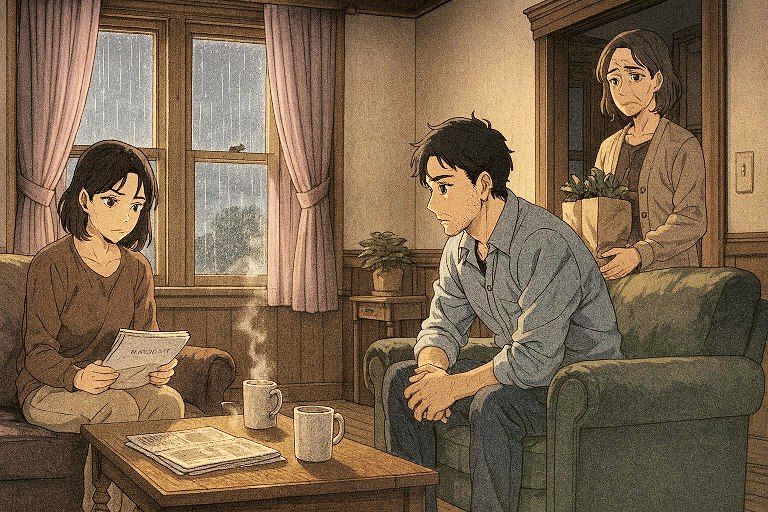
Short story: Fog on the Lobe
The sharp rain of Neo-Valencia turned the neon into scalpels of light that tore the night. From apartment 12B, Mara watched the city with the glow of her device reflected in the glass. A thirty-second clip, repeated millions of times on social networks, had lodged itself in her head: "Your frontal lobe isn't fully developed yet." The phrase—light, consoling, harmful—resonated like a mantra that alternately justified clumsiness or transformed it into a public diagnosis.
Mara was twenty-eight and a neuroelectronic engineer. She had spent years designing interfaces that translated brain activity into useful signals; she had worked on tools to help people with attention deficits and on feedback systems that supported decision-making. Still, the blunt simplicity of the viral slogan infuriated her: that reduction turned her work and her life into a label. In the city, the phrase did not remain in the realm of opinion; it became an unofficial norm. Employers cited it in cold offices; credit agencies used it—discreetly—to raise rates for those "in the risk band." Even couples quoted it as an excuse to break or justify breakups.
The night Iván came to see her he carried a yellow envelope with time-darkened papers. Iván was a science journalist, six years older than her, methodical and averse to simplification. Sitting in the kitchen under the apartment's flickering light, they spread the pages out: graphs of synaptic density, connectivity maps, curves rising and falling with no single inflection point. That first encounter with the original research was both unsettling and liberating. Iván pointed to the development curves: there was no universal threshold that cut off at twenty-five; rather, there were trajectories, individual variation, and significant environmental influence.
"People don't read papers," Mara said bitterly. "They read captions." In elevators and bars across Neo-Valencia, the phrase circulated as both excuse—"it's his frontal lobe..."—and condemnation: "He's 27, he should control himself." Scientific simplification had become public narrative and tacit policy.
Dr. Selene Ortiz, director of the Neurodevelopment Lab at the Lumen Institute, tried to correct the narrative from within institution. In sterile lecture halls and round classrooms she patiently explained what it meant to consider the frontal lobe: cortical structures involved in executive functions like planning, inhibition and judgment; processes of myelination and synaptic pruning that, in many people, extend beyond their twenties. She insisted that brain development was not solely a biological clock but a continuous dialogue between biology, experience and environment. Her words were precise and nuanced, but they were overwhelmed by the tide of clips and short headlines.
Mara attended one of Dr. Ortiz's talks torn between feelings: relief at the scientific clarifications, anger at the social consequences of the distortion. After the lecture, in a corridor lit by giant ads promising instant solutions, Mara approached the scientist with questions more personal than academic. She did not want people to use science as an excuse for negligence nor as a sentence to close doors professionally or socially. Selene spoke of public education and tools that would measure and accompany individual trajectories rather than apply one-size-fits-all rules. "The brain is plastic," Selene said. "And if we measure with detail, we understand there are variations and opportunities for interventions that are not coercive."
Mara—who had contributed to the design of cognitive support technologies—felt the tension between relief and danger when, that same night, her home assistant unit—K-3L, with its neutral voice and nearly human register—announced a firmware update.
Between automated notifications and pop-up menus the invitation appeared to activate a "personalized executive training protocol." Mara examined the offer: microtransactions for eight-hour programs that promised to fix impulsivity; transcranial stimulation chips packaged as subscription services. The technology she had helped conceive, intended to expand autonomy, risked becoming a mechanism of conformity and marketization.
Her worst fears materialized as tech consortia launched products with clean, affordable messaging. Yet the response was not uniform. While some companies pushed patches and chips, a citizen movement organized around Palimpsest—the open, free project Mara had started in secret—began to gain traction. Palimpsest did not promise quick fixes; it recorded stories. It asked for accounts of decisions, contexts, regrets and learnings. It did not use a marker to label people; it traced trajectories. It gathered qualitative and quantitative data, mapped correlations between life experiences and changes in executive measures, and offered community resources rather than consumer tech solutions.
Dr. Ortiz contributed data and reviews. Iván provided visibility with articles that dismantled the televised narrative. K-3L became the moderator of collective sessions where users shared experiences without being judged by simplistic metrics. That new public intimacy proved transformative: in room after room people stopped presenting themselves as bearers of a fixed defect and began describing themselves as authors of trajectories. Lía, a twenty-four-year-old, recounted how one night of excess had cost her a job opportunity; she had been discriminated against for her age and supposed immaturity. Another participant told how, at thirty, she still faced mistakes that felt just as painful. Those stories challenged the idea of a definitive cutoff: learning extended, reformed, and was deeply rooted in socioeconomic context, chronic stress and access to support.
However, the market machinery did not yield without a fight. Relentlessly, Corporation Synapse launched its cortical rhythm synchronizing chip, promising a safe acceleration of executive development. Ad campaigns featured smiling faces and curated testimonials. Terms of service required relinquishing biometric data in exchange for discounted rates. Soon the first satisfied users reported increased self-control. In parallel, alarming signals arose: a significant proportion described emotional numbness, a sense of dependence on external stimuli to decide, and changes in affect they had not anticipated. In internal reports Synapse quantified efficacy in gleaming percentages on their ads; adverse effects were relegated to fine print that few read.
The launch provoked legal actions and a coordinated campaign to silence Palimpsest. Corporate letters and legal threats arrived at the project's door. The press—hungry for conflict and brief headlines—transformed complexity into scandal: Palimpsest, the digital Robin Hood that collected stories, was now accused of "misusing biometric data." The public narrative polarized: on one side those who wanted quick solutions; on the other those who demanded slower, respectful processes.
Amid the dispute, Dr. Ortiz published a robust longitudinal study examining hundreds of individual trajectories. Her conclusions confirmed what Palimpsest's stories already suggested: frontal lobe development does not culminate at a universal date nor follow a single line. Environmental factors—socioeconomic level, chronic stress, education, mentorship opportunities—significantly modulated the shape and pace of those trajectories. Ortiz emphasized that equating maturity with age was a dangerous simplification and that public policies should align with nuanced evidence: creating accompaniment programs, workforce retraining, mental health support and education that recognized variability.
Despite the evidence, commercial pressure persisted. Synapse continued to market its chip and a fraction of users experienced immediate benefits in impulse control. Yet for many the intervention proved a partial cure with psychic costs: instrumental dependency, dampening of emotional vivacity, or shifts in sense of agency. Technological shortcuts began to show their traces. Mara, from her technical and human perspective, warned that judgment and emotional regulation—what people ultimately called "maturity"—formed through daily practice, reflection and dialogue, not merely through synchronized discharges.
Palimpsest, meanwhile, became a collective repository of routes. Its archives did not aim to pronounce absolute truths; they charted bridges between individual narratives and emerging patterns. Stories of regret, reconciliation with past decisions, and learnings acquired at thirty or later became narrative evidence that human maturation was diverse and non-linear. The project spurred gradual changes: some companies adopted hiring policies that valued trajectories over dates; banks revised risk algorithms that previously penalized by age; universities implemented extended support programs for executive-skill training across the lifespan. In many cases society began to value accompaniment over threshold imposition.
The Algorithm—that collective entity that modulated trends on networks—lost some of its authoritarian grip. Content celebrating varied developmental paths gained visibility. A simple, low-production clip that read "It's not that my frontal lobe is broken; I'm still writing my map" went viral for a different reason: it resonated with many people's experience. Under that video thousands commented their own routes, shared books, therapists, regulation strategies and small learning rituals. The city began to speak differently: fewer labels, more stories.
The struggle was neither definitive nor clean. Industry, science and citizenry continued negotiating the bounds of technological intervention and forms of social accompaniment. Corporation Synapse adjusted campaigns and faced lawsuits; some users who had invested in chips sought remediation. Public debate forced legislators to consider regulations for neurotechnology devices and biometric data protection. Dr. Ortiz sat on ethics committees. Iván wrote an essay series documenting the process: how a media simplification became policy and then resistance.
Mara continued refining Palimpsest. Turned into a free-access platform, the project incorporated modules on critical neuroscience education, tools for mapping decisions and exercises designed to foster metacognitive reflection. Community sessions moderated by assistants like K-3L became spaces where people could share without fear of being labeled. There, in collective listening, unexpected lessons emerged: maturity was not a destination but a continuous adjustment between biology, experience, opportunities and social policy.
Over time, the dominant narrative around the "age-25 myth" waned. It did not vanish completely—old ads and social comments still invoked it sometimes—but it lost normative force. Society learned—not without resistance—to think in trajectories. Concrete practices changed: selection processes began using situational assessments and formative support rather than discarding candidates by age; health insurers included preventive, non-pharmacological cognitive support programs; secondary schools and universities expanded resources for lifelong executive-skill training.
One gray morning Mara looked out over the city from her window and reflected on how public conversations had shifted. She recalled her initial anger, the fatigue of watching her work reduced to a slogan, and the relief of seeing science, placed in dialogue with citizens, recover some of its nuance. She knew the struggle would continue: ethical regulation of emerging technologies, protection of personal data and designing systems that accompany without coercion.
She also knew that stories mattered: they were threads capable of mending myths.
The epilogue of that chapter was not a blunt closure but a clarification: in a nearby café a group of teenagers discussed a silly decision, laughing. One of them, joking, murmured, "My frontal lobe betrayed me." The girl who heard him returned the phrase with a smile mixing fatigue and tenderness: "It didn't betray you. It's learning. And that's not an excuse or a sentence. It's an opportunity."
The rain kept falling, the neons continued to cut the night, and in the circuits of the world a new certainty took root—more humble but more useful: the complex truth, told with stories and data, had begun to gain ground, step by step, narrative by narrative.
Source of the images.
Image created with Bing.

Short story: The Night That Couldn't Pay the Rent
The night "Only Her" opened its doors, Lola was convinced that with that project she wasn't just opening a venue: she was inaugurating a new way of experiencing the night. A neon sign above the entrance promised simple, powerful things: Music, fun, and a safe space without pressure. Mariana, her partner and manager, held the opening with less idealism and more spreadsheets; DJ Carla adjusted her headphones and queued impossible mixes; Mrs. Rivas strolled the venue with ceremonial steps; and Tomás, the delivery driver, came and went with crates of drinks, sometimes an involuntary spectator of Lola’s dream.
The opening started as a social success. The place filled up: women of all ages and styles took the dance floor and the tables, laughter and conversation created a warm buzz, and the lights matched the mood. Carla, in the booth, opened the evening with a choice as eccentric as it was apt.
Carla: —We’ll start with something unexpected: a short aria to warm up, then classy twerking. Who said you can’t mix Verdi with a bass drop?
A chorus of laughs answered from the floor. Lola, eyes shining, approached the bar to greet the first guests.
Lola: —Welcome! This is everything we always asked for: good music, good company, and respect. Let’s toast to us.
Mrs. Rivas (raising a glass from the front row): —To etiquette and emancipation. And please, let there be delicious water too.
Mariana, with the POS app open on her phone, watched the movement from a distance with a smile that didn’t quite reach her eyes.
Mariana (whispering to the bar): —If the vibe is this, the idea worked. But I need to see conversion at the point of sale. The entrance is anecdote; the drinks are the backbone.
At first, things seemed to fit: the floor pulsed, conversations were frank, and the smiles were genuine. But soon an unusual trait stood out: the bar, unlike the dance floor, was surprisingly calm. Cocktail trays circulated less; card transactions could be counted on one hand. Tomás left a second pallet near the door and looked at it with a puzzled frown.
Tomás: —I brought what you asked for… Just in case. Want me to leave another crate in the stockroom?
Phantom bartender (a voice that circulated as a joke among the staff): —In a normal nightclub, the entrance pays for the music; the drinks pay the wages and the rent. Here the crowd pays for the experience, but skips the part that greases the machinery.
Lola, who had imagined a scene where there were no rounds or pressures, explained proudly.
Lola: —We wanted them to come without feeling obliged to buy out of obligation. That fun would have no price tag, no label.
A nearby customer, who had come with friends, added calmly:
Customer 1: —It feels strange to ask someone for a round at the bar if there’s no tradition of “buying.” We look after each other. What’s wrong with drinking water if that’s what we feel like?
Mariana asked for numbers. Attempts at promotion—a welcome offer, a feminist-themed cocktail—didn’t solve the structural problem: cash flow didn’t match the packed room. The ticket price covered only a fraction of costs: license, sound, staff, advertising. Drinks had to sustain the difference. And in many clubs the most lucrative part comes from high drink consumption, often generated by men buying rounds or group purchases; in "Only Her" that dynamic didn’t replicate.
Mariana (with a calculator on the office table): —Look at this, Lola. If we keep the ticket price and per-head consumption stays like this, we lose six hundred euros a week. Rent doesn’t understand ideals.
Lola sat down, opposed to the figure on the screen, but she didn’t lose faith in what they had achieved.
Lola: —We lose money, yes. We gain something intangible: safety, community, freedom. Isn’t that worth something?
Mariana was blunt but not cruel.
Mariana: —It’s all worth it, but if there’s no business there’s no club. And if there’s no club, there’s no community in that space. We have to figure out how to reconcile ethics with accounting.
Meanwhile, in the booth, Carla improvised a set alternating anthems that made people sing and cry with beats that invited them to sweat.
Carla: —Turn it up, we’re not here to be subtle on the floor. Tonight I mix whatever I want: self-esteem at 120 BPM.
Some attendees ordered cocktails enthusiastically; others were content with water, tea, or soft drinks. Conversations centered on the atmosphere: no one felt judged for their drink choice. For many it was a first time that the night wasn’t steeped in the need to attract male attention or pay for someone’s attention. For Lola, that was a social victory. For Mariana, a pending bill.
The night was beautiful and recorded in photos, stories, and the memories of those who lived it. But the next morning administrative reality struck with its cold voice: consolidated figures didn’t allow continuity without changes. A sign reading "Temporarily Closed" was placed on the door. The founders held a quick meeting with staff.
Lola, hiding sadness behind a smile, spoke to the team.
Lola: —I don’t want this to be a failure. It was more than a night. I propose we suspend operations to reorganize and find alternatives. We’re not burying it; we’re transforming it.
Mariana, ever practical, already had proposals in hand.
Mariana: —Let’s run the numbers and redefine. I’m thinking daytime café, afternoon workshops, themed nights with menus that encourage responsible but profitable consumption, merch with cool designs to sell online. Maybe events where the ticket includes a minimum drink. I don’t love having to adapt the idea, but we have to survive to keep fighting.
Mrs. Rivas, who returned out of curiosity the next day, crossed the doorway and approached with her usual composure.
Mrs. Rivas: —It was an impeccable evening. There was decorum, good musical taste, and respect. If you need to recruit sponsoring members willing to contribute to sustain the project, I’ll organize a formal dinner with a symbolic entrance fee.
Carla, storing her digital vinyls, added with a mix of irony and hope:
Carla: —I could do shorter paid sets and take private gigs. If needed I’ll sell ticket packs that include a cocktail. Also, I’ll upload everything to my profile so people talk about us.
Tomás, who had joked during the night while carrying crates and helping arrange chairs, offered something practical and direct:
Tomás: —I can bring more stock and negotiate better prices with the supplier. But if there’s no movement, I can’t justify running the truck just for love of art.
Mariana smiled for the first time with a mixture of relief and fatigue.
Mariana: —Good. Ideas on the table. Now we turn them into a plan and test three of them in a month. If something doesn’t work, we scrap it.
A few days later someone placed a new sign on the door blending irony and determination: "We’ll Come Back Better Funded." The phrase balanced the will not to give up on the mission with the acceptance that economic sustainability would be inevitable.
In the epilogue, Lola watered a plant left on the empty bar, a symbolic gesture that didn’t erase the anxiety but didn’t allow surrender either.
Lola (speaking to herself): —If we learned anything, it wasn’t how to lose money. It was how to build something different. We tried it, and now we’ll do it better.
Mariana, beside her, reviewed the agenda.
Mariana: —Workshops, brunches, collaborations with brands that respect the spirit. And a policy of included consumption at certain events. It’s not ideal, but it’s pragmatic.
Mrs. Rivas, Carla, and Tomás joined in with concrete proposals: Mrs. Rivas offered to organize a fundraising etiquette evening; Carla prepared a short paid set; Tomás sought discounts with distributors. The community born that night didn’t vanish: it changed shape, became a project, and was fed by conversations, adjustments, and above all the conviction that the idea deserved to persist.
"Only Her" would remain in memory as a valuable experience and a lesson in balancing idealism and accounting. It wasn’t a definitive closure but another form of learning: the recognition that even when the social and symbolic aspects work, the economy has the final word if no one listens to it. Along with that conclusion remained the promise, written on a sign and on the lips of those who lived it: they would return—this time, better funded.
Source of the images.
Image created with Bing.

Short story: The Lights That Won't Be Silent
The house on Oliva Street seemed to sleep every night, but it was not a peaceful sleep: it was an endless vigil. From the sidewalk, the building offered an appearance of normality: closed windows, drawn curtains, the visual comfort of bulbs switching off at the same hour. But in the third-floor apartment, the lights obeyed other orders. Outside, the city breathed; inside, however, something else switched on — a silent alarm that never let up.
Mateo was ten years old when he began to notice that his world was made of noises he had not asked for. He held a book like a shield; not so much to read as to put a barrier between his body and the vibration of voices that bounced off the walls. The arguments rose like waves: a sharp sentence, a louder reply, a door slammed with force. He learned quickly to measure the house by the distance between a goodbye and a threat. His body learned before his mind: at the first touch of a quarrel his amygdala — that tiny sentinel deep in the brain — lit a red light. His pulse sped up. The world shrank to a bright point where anything could explode.
"Mateo, turn that off and come eat," his mother Elena ordered from the kitchen, her voice tense like a wire.
"I'm… almost," Mateo replied in a low voice, pressing the book to his chest as if he could stop the trembling in the air.
His father Andrés crossed the living room with short steps and a brusque look, letting out a sigh that to the boy sounded like a sentence.
"Again with that?" Andrés said without looking at him. "This home needs order, not stories."
Mateo didn't understand why the volume of a voice could determine the weight of a house. When his father grew angry, the whole apartment seemed to tilt toward explosion. His heart learned to anticipate violence as a natural law. That constant tension transformed childhood play into survival exercises: where other children built block castles, he raised forts of cushions and blankets, tunnels to protect him from an invisible enemy. He learned to calculate the distance to the kitchen door, to estimate how long a blow would take to reach his room. At night he chewed on the shadow of his father's footsteps until sleep reached him exhausted. Sometimes he woke believing that the racket he heard in the night was an explosion; his chest broke into a primitive panic, identical to that of men returning from places where war left marks on skin and memory. His terror was no less real for lacking a uniform or battlefield; inside his skull the maps were the same.
Doctors said it in cold, precise words that the adults barely heard: MRI scans showed that children like Mateo, raised in homes where conflict is the daily grammar, had hyperreactive threat centers — amygdalas that remained on constant alert, looking for dangers that did not exist. "A hostile home reconfigures a child's brain for war," a doctor said in the consultation, with a professional tone that made the phrase fall into the room like a slab. For children that statement was not metaphor: the scanner image showed the agitation of an organ in alarm; in daily life it translated into startle responses, broken sleep, a tolerance threshold reduced to inches.
The phrase stuck to Mateo's room like an echo. Every object seemed to conspire against calm: the lamp that flickered during tense moments, the chair always conveniently near for someone to bang, the curtain that moved with the subtle violence of held breath. At school, the boy shrank in his world. His teachers spoke of "withdrawal" or "behavior problems"; yet the specialists' words did not always cross the distance to the kitchen, where meals were served quickly and conversations ended in reproach.
One afternoon Lucía found him sitting on the building stairs with a notebook and pencils beside him. She lived on the second floor and worked at the neighborhood community center; she had a habit of paying attention to small things.
"What are you drawing?" she asked softly, crouching to be at his level.
Mateo pointed to a figure of hard lines, with large eyes and a rigid posture.
"It's a guard," he murmured. "In case the yelling comes."
Lucía let out a sigh that mixed sorrow and tenderness. She didn't want to scold or interpret; she simply offered company.
"Come to the park with me. You don't have to explain anything," she said, holding out her hand.
In the park, the afternoon tempered by wind, Mateo swung on the swing with a serious face. A sudden gust messed his hair and his body shrank automatically; the amygdala lit the same alarm that had accompanied him for years. The shadows of the tree crowns traced shapes on the ground and he perceived them as possible hiding places for danger.
"Breath with me," Lucía suggested. "Five seconds, hold, five seconds. Like you're inflating a balloon."
Mateo, fingers still cold, imitated the breathing. The tremor, barely perceptible at first, eased.
"Do things scare you a lot?" Lucía asked without hurry.
"Sometimes I feel like my heart starts looking for dangers," he confessed, looking at his hands. "Like I can't turn the alarm off."
"You're not to blame for that," she answered. "Your body learned to protect you. We can teach it other signals."
In the following weeks Lucía's presence became a comforting constant. She invited him to the community center, where there were music and drawing workshops and, above all, a space where children could name what they felt without fear of judgment. There Mateo met other kids who had also learned to live with an internal radar that sounded for no apparent reason. He learned simple exercises: breathing with the hand on the belly, stretching arms until he felt his heartbeat, walking slowly counting steps. They were modestly powerful actions. The MRI that had been a cold image on a screen gained names and helping hands: anxiety, hypervigilance, memory.
Time moved on with its usual ambivalence. In adolescence Mateo's reactions became more complex. The same mechanisms that had saved his life in a tense home became social obstacles. A trivial argument with friends, a classmate's joke, a brusque gesture — any of these could make his body fold into armor that did not always allow him to gauge the situation. At school, the classroom silence, exams, and recess movement — all could be perceived as a military operation of uncertainties where his amygdala kept weapons ready.
Teacher Ángela, who had taught at the school for years and had seen generations come and go, noticed a pattern others ignored.
"Mateo, do you want to stay a while after class to review?" she offered one afternoon with the warmth she reserved for students who seemed to carry an invisible burden.
"Okay," he accepted in a small voice. "Thanks, teacher."
Ángela did more than assign homework; she taught organization techniques that paradoxically brought order to his mind: lists with small steps, schedules that didn't overwhelm, writing exercises to turn fears into words. Sometimes a simple routine is an anchor that quiets an alarm.
But progress was not linear. One night, when the argument at home went on longer and harder than usual, Mateo felt the walls closing in. The fight rose in pitch until it became unbearable. He sought solitude on the building roof, a place where the air felt less heavy. He curled against the railing and looked at the city: distant lights, windows flickering like domestic stars, people returning to their homes without the noise he carried. He breathed differently, intending each inhalation to push something inside that wanted to be released.
He remembered Lucía's voice: "You are not a trench, you are a child." That simple, human phrase created a small crack in his armor. The next day he went down and showed up at the community center, where they welcomed him like someone returning home. There they referred him to therapy with psychologist Marina, a patient woman who worked with adolescents and knew the anatomy of anguish.
"When the fights start," Mateo said in the session, voice breaking at times, "I feel like I have to be ready. Like something bad is always going to happen."
Marina listened without interruption, with the calm of someone who knows that the urgencies of the soul are not erased by quick fixes.
"Your brain learned that to protect you," she explained in a measured voice. "It is not your fault. But we can teach it new signals: exercises, words, small practices that say you are safe."
In therapy Mateo learned to name the flood of sensations that overwhelmed him: hypervigilance, sound flashbacks, the inability to relax even in the presence of people who posed no threat. With Marina he practiced techniques that combined breathing, mindfulness, and narrative writing: recounting what had happened with every possible detail — place, sounds, smells — so memory would stop being a vague threat and become a story that could be ordered. Family work was pursued where possible; not to blame, but to offer guidelines to reduce common triggers.
The path was not straight or fast. There were relapses: sleepless nights after a fight, startle responses in ordinary moments, arguments that reminded him why his guard was always up. But there were also small, steady advances. He learned to recognize the danger signal before it turned into fire; he began to say aloud, with a confidence gained through practice, "I need a moment," and you could see how the pieces around him made room. Breathing became a bridge between alarm and calm. The helping hands — Lucía, teacher Ángela, Marina — formed a net that held fragile days.
One afternoon, now in his teens, Mateo sat at the kitchen table with an open notebook. In the pages the strokes had changed: old forts had given way to gardens where something unsharpened could grow. Andrés, his father, appeared in the doorway and scanned the drawings with a curiosity that might have been new or reclaimed.
"What is all this?" he asked, more curious than severe, his guard lowered for the first time.
"They are things that make me feel calm," Mateo answered, looking at him honestly. "Do you want to help me water them?"
The silence that followed was dense but not hostile. Andrés stood for a few long seconds thinking the words he did not know how to give. Finally he nodded and took one of the sheets carefully.
"All right," he said at last. "Let's water them."
Not everything in the house changed immediately. There were fights, yes; arguments that still scraped nerves. But the complete reconfiguration of the brain no longer seemed inevitable. Mateo had built an internal alliance: therapy with Marina, friendship with Lucía, teacher Ángela's patience, and a toolbox — breathing, writing, routines — that he used as one equips for a long journey. His amygdala remained instinctively watchful, but with learnings that allowed him to modulate the response.
Mateo's story is not one of absolute victory nor of eternal defeat. It is the testimony of a daily struggle where the invisible ceased to be an immutable destiny. A hostile home can, without doubt, program the brain's alarm for war, but there are also hands, words, and strategies that can reinstall the possibility of silence, of play that is not a fortress, of nights when the heart can lie down without fear. Mateo learned to live with scars that did not define him completely; in them he found a map, not of war, but of possible paths toward peace.
In the end the lights stayed on some nights in the house on Oliva Street, but Mateo also saw other lights: the lamp at the community center, the window light of teacher Ángela, the one that lit up in Marina's office each time a productive session closed a notebook. They were not lights that erased the shadows, but they were beacons that showed that even brains marked by hypervigilance could learn to recognize when there were no enemies in sight. And that possibility, in his case, was enough to begin to reweave a childhood interrupted by noise.
Source of the images.
Image created with Bing.
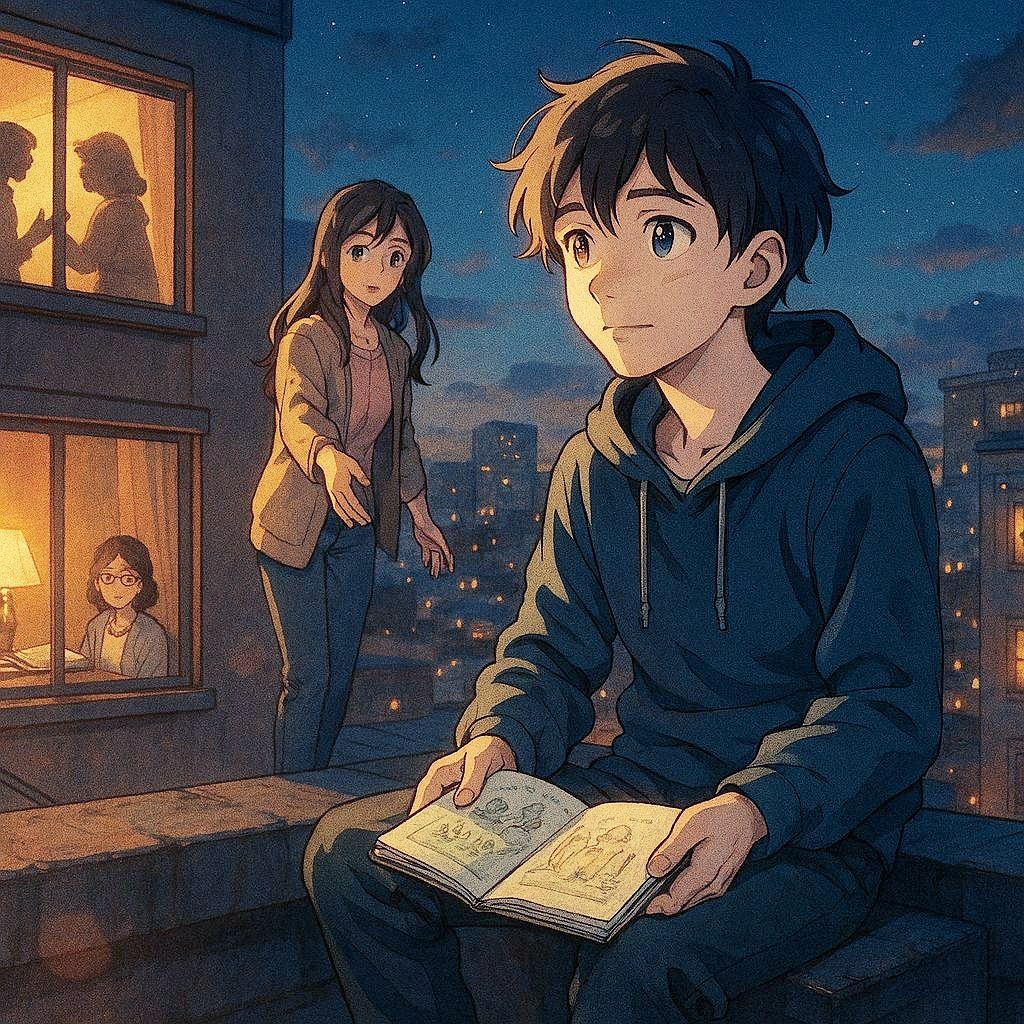
Short story: The Return of the Lights
I
The city wore that end-of-year air: lit windows like steady breaths, dry leaves clinging to curbs, and a comfortable melancholy seeping through door cracks. In the old neighborhood, a café with wooden tables and hanging lamps that looked like beacons gathered those who still preferred human warmth to a cold screen. There, by the fogged window, a group met that would, without knowing it, disassemble and recompose the idea of what living together means in contemporary days.
Clara arrived before the others. She held a copy with a slightly worn cover: The Syndrome of Superwomen. She carried it with the reverence one reserves for an object that stirs one’s own past. Around her voices filtered in, but she seemed inside a bubble where phrases took the shape of portraits. She had read the book more than once, not out of devotion to the author but because its thesis haunted her like a persistent notification: that the professional and social achievements of so many brilliant women do not automatically translate into more romantic opportunities; on the contrary, they sometimes push them away.
Raúl arrived with that mix of affection and teasing that only university friends retain. They had shared exams, laughter, and long nights; now they shared an interior geography of memories. His voice, when he sat down, carried the surprise of someone who does not know whether to laugh or be serious.
“Are you still reading it?” he asked as he pushed his cup forward, hoping to warm more than his hands.
“Not for fashion,” Clara replied with a tired smile. “I read it because it questions me. Listen to this: ‘Women are disappointed by the insufficient evolution of men, and men are disoriented by the evolution of women.’”
The words hung between them, heavy and clear. Raúl frowned, not so much in disagreement as from the discomfort of what certainties state: that two social halves that thought they fit together were now dancing to different rhythms.
II
The bell over the door jingled and Marta and Javier entered, nearly arm in arm as if they needed the certainty of touch to cross the cold. Marta was a lawyer, and her step had the firmness of someone who has learned to stand in courtrooms and boardrooms. Javier was a designer; his hands held the memory of pencils and grids, and on the notebook he placed on the table were quick lines, as if he needed to draw the world to understand it.
They sat with the warmth of novelty settling into the everyday. Marta glanced at the book in Clara’s hands with a mix of curiosity and reluctance: the pages spoke of something she lived in her skin but did not always find the words to explain.
“What are you talking about?” she asked directly, the question of someone seeking maps not to get lost.
“About a crisis,” Clara said. “That in the West there’s a tension between enormous female advancement and a male evolution that, according to the author, hasn’t fully kept up. Women’s achievements haven’t opened a fan of opportunities in love; sometimes they’ve closed doors.”
Javier put his notebook aside and rested his forehead on his palm, as if trying to order a complex idea.
“Do you feel avoided?” he asked honestly.
Marta looked out the window where lights trembled like small questions.
“Sometimes. I’ve been ambitious, worked, trained, and fought for a place. But often the emotional world still expects a woman who fits roles that no longer interest me. There’s a double mandate: succeed and at the same time remain ‘easy’ for love. That wears you down.”
The sentence opened a small crack that released experiences often stacked in silence: dates that end in awkwardness when female success is read as a threat; invitations turning into evasions; men who approach timidly, not out of respect but insecurity.
Raúl, who had his own contradictions, chimed in with a question that carried both defense and vulnerability.
“It sounds paternalistic: ‘men have to get their act together.’ Who sets that pace of maturation? Are men or women being asked to change, or society?”
III
Elena appeared nearly without sound. An older woman in a blue coat, her face held years of listening and accompanying. She had been a couples therapist and, though retired, still had the patience of someone who knows major things are never resolved in a hurry. She came closer because the words at the table reminded her of the consultations she’d attended for decades: loves worn down by an absence of words, couples confused by preestablished roles, individuals without emotional maps.
“I read the book,” she said softly. “Antoni gives a diagnosis, not a magic recipe. He speaks of personal and social responsibility. Maturity isn’t a trend: it’s intimate work that must be practiced.”
Marta, seeking guidance, asked with the urgency of someone who wants to avoid painful mistakes.
“How does that translate into day-to-day life?” she asked. “What do we do so the distance between what we are and what society asks of us doesn’t become an abyss?”
Elena sipped her coffee and let silence do its work. Then she listed, calmly, as one who has seen that simple formulas are often the hardest to apply.
“Three things, repeated and practiced every day: transcendent acceptance, constructive intelligence, and personal maturation. Accepting that we have changed is not resignation; it is acknowledging that life has transformed us. Constructive intelligence is negotiating roles with care and honesty, not imposing them by tradition. Personal maturation is the intimate discipline of looking at our wounds and working on them without looking for scapegoats.”
IV
The afternoon unfolded in layers. Miguel walked into the café like someone walking into a second home: he now ran an NGO and had the seriousness that comes with public responsibility. He had been Clara’s classmate years ago, and his presence added another perspective—the one of people who work with young men and see how new masculinities form.
“I work with young men,” Miguel said. “Many are lost because the expectations they receive are contradictory: they are told to be free, but no one teaches them to be with others without competing. They lack models of vulnerability. That’s not anyone’s fault in particular; it’s a failure of emotional education.”
Javier listened closely. He paused and confessed, with a faint blush, what he had learned through trial and error.
“I thought a certain hardness was part of being ‘masculine.’ It took me a long time to allow tenderness. But when I did, I didn’t lose anything; I gained closeness.”
The table turned into a kind of gentle confessional. Stories intertwined: women promoted at work who lost pieces of their intimate lives, men who felt disoriented without emotional manuals, couples renegotiating old agreements in light of new forces.
“Bolinches warns of a ‘war of the sexes,’” Clara said. “I don’t want to be alarmist, but there are real tensions. If we don’t manage them, frustration can become distrust, and distrust can become aggression.”
V
Soon the talk turned practical, because among all those diagnoses there was an urgent need for touchable, testable solutions. The table filled with modestly revolutionary ideas: dinners devoted solely to expectations spoken without judgment, community workshops on emotional education, men’s spaces to practice vulnerability without shame.
Marta and Javier made concrete agreements: split household tasks not according to abstract ideals of fairness but according to what each could and wanted to do; meet weekly to speak about feelings and small resentments that, unvoiced, calcify into walls; accept therapy as a preventive tool rather than a last resort.
Elena and Miguel offered to organize a workshop at the neighborhood cultural center. The idea was simple: teach young people and adults to identify emotions, to communicate boundaries, to negotiate affection without turning relationships into battlefields. It was a community gesture that said transformation is not only individual but social.
VI
As night fell, the café lights grew more intimate. The farewell was slow, like someone reluctant to break a truce. Raúl, who had watched the conversation with the nostalgia of someone who believes the past contains valid codes, asked with a mixture of tenderness and humor.
“So, what do we do first? Get our act together?”
Clara closed the book gently on the table, like someone who closes an old wound but does not rule out returning to it.
“Yes,” she said. “But without blowing the fuse. Start by listening—small acts of daily courage. There’s no single recipe. There’s commitment, patience, and the willingness to make mistakes without turning them into sentences.”
They walked out into the December cold. It was a small cinematic moment: breath vapor, crisp bags, footsteps on cobblestones. Each returned home with something new: promises, ideas, a workshop signup, the feeling of having lit a small lamp.
VII
The following weeks brought practical work. Marta and Javier tested their agreements; there were tense days and tender ones. Not everything worked the first time: routines needed adjustment, and habits proved stubborn. But there were concrete advances: honest talks about family fears, moments of support when one came home exhausted, and a decision to attend a therapy session together to avoid repeating inherited patterns.
The workshop Elena and Miguel ran at the cultural center drew more attendees than expected. Young people came who, for the first time, heard that vulnerability is not shame but possibility. Men arrived who admitted they had learned to disguise rather than express. Women attended wanting to be heard without their voices being construed as threats. The sessions didn’t resolve everything, but they provided tools: communication practices, empathy exercises, small coexistence contracts to try in real life.
VIII
Over time, Clara’s copy of Bolinches’ book remained in the bookstore window, a discreet beacon inviting reading and debate. But what was planted at that café table became something else: not passive acceptance of a diagnosis but a collective and practical response. The author’s prescription—transcendent acceptance, constructive intelligence, personal maturation—stopped being a printed phrase and became an everyday discipline.
Clara, who had come in carrying resentment and nostalgia, found in the conversation something unexpected: the possibility of believing in love again without shortcuts or renunciations. Raúl, who feared losing certain privileges in the transformation, learned to value an intimacy richer than preset roles. Marta and Javier continued building, imperfectly and bravely, their own way of being together. Elena, in retirement, confirmed that listening remained the primary therapeutic principle. Miguel kept creating spaces, this time equipped with better tools.
IX
The city carried on: lights turning on and off, loves born and eroded, people learning to read one another’s signals. The feared “war of the sexes” didn’t break out—not because the threat didn’t exist, but because some chose to invest in bridges rather than trenches. It was slow work, often imperfect, but real.
One January night Clara walked alone down the avenue. She carried the agenda where she had written upcoming workshop dates. Passing the bookstore, she looked at the cover of the book that had brought her to that conversation. She didn’t buy it. She simply watched the street: couples walking by, people talking into phones, a group of young people laughing without pretense. A deep, sweet nostalgia rose in her, like remembering something irretrievable yet grateful for what it taught.
The lamplight threw her long shadow on the pavement. For a moment she thought of all that had been gained and all that remained to be done. She smiled softly and thought that contemporary love needed more than diagnoses: it needed organized patience, daily courage, and the willingness to learn without humiliation or renunciation.
In the end, with imperfect agreements, improvised workshops, dinners ending in tears and laughter, and the persistent habit of asking and listening, that group lit a small light that, added to others, began to return the city a less hostile, more humane horizon. It wasn’t the triumph of a thesis or proof of an author; it was the daily labor of those who decided to care for coexistence in a time that demands looking, learning, and loving again.
Source of the images.
Image created with Bing.
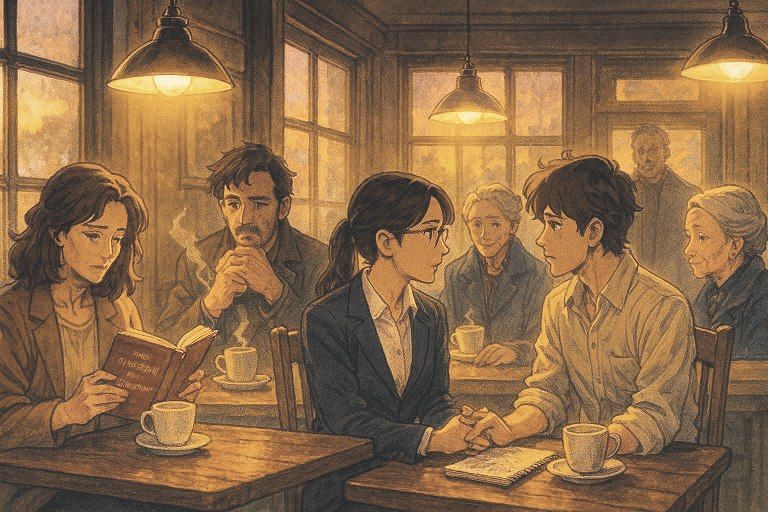
Short story: The Christmas of the Loose Cable
I arrived at the H‑E‑B in Burleson that afternoon with the feeling of stepping into an open box of memories whose scent had escaped: roasted turkey, lemon-scented soapy water, and those buttery cookies that only show up in family photos and holiday market stalls. It wasn’t just the smell of fresh products; the air had the density of a collective memory, as if years of small household rituals had accumulated between the aisles and someone, without much ceremony, had lifted the lid and let loose what had been sleeping on the shelves.
I wore my red hat, tilted from the morning’s hurry, and the store vest—marked by stories: a stain that reminded me of sauce spilled in 2018, the flattened pen I used so much to jot orders, and a folded tag that looked like an old postcard. I had spent enough Christmases behind that counter to know that generosity can be a mechanical gesture, almost administrative, or a decision that bursts forth in an instant. That afternoon, without a plan, I chose the latter.
Over the radio came the standard technical notice: “problems at the registers.” On any other day that would mean pauses, calls, protocols, and, with luck, an operational calm restored. I, however, saw a crack to slip something different through. I climbed onto the small speaker stand, took a deep breath, and announced in a voice that would soon change the store’s dynamic: “H‑E‑B family, today the products are free!”
The sentence flipped a switch. First came disbelief: surprised, cautious looks, carts slowing, the murmur thickening. Then complicity arrived: incredulous laughter, conversations lighting up, and a communal rhythm quietly stitching its own rules. The atmosphere shifted from technical expectation to an improvised human choreography.
Mr. Ernesto was among the first to come forward, his crumpled list in hand as if the paper—a relic of the shopping ritual—might vanish in the surprise. He looked at me with that blend of prudence and hope that belongs to those who have lived many Christmases.
“Is this for real? Is it a radio prank?” he asked.
“It’s real, Ernesto. But one thing: half a dozen per person—Christmas spirit must be shared,” I answered, with the voice my experience gave me and the need to prevent chaos.
That small, improvised rule—timid and humane—was enough to channel the collective energy. Nobody wanted to turn the gesture into looting; everyone sought the thrill of an unexpected gift. So, with modest guidelines and common sense, the store began to transform into a stage where generosity and solidarity were rehearsed.
In the cereal aisle I saw Camilo and Raúl like two kids in an imaginary sled race: carts colliding with almost comic theatricality, exclamations, and neighborhood banter. “If this is real, I’ll take everything,” one said amid the confusion. “Calm down, champ. Half a dozen. And if you have extra, share it,” the other replied. What started as a chance to hoard ended with a sharing gesture: Camilo gave a box to Lucía, and that simple act resonated more than any viral post. Youthful generosity, somewhat naive, proved contagious: one gives and the giving ripples outward.
Javier, wearing an elf hat, organized his household squad as if leading a Sunday mission, assigning tasks with the solemnity of a commander: “You, the sauce. You, the dough. And you, distract the kids with treasure stories.” The children, wide-eyed, shouted: “Treasures!” Javier smiled wearily: “Let them be edible, please.” Imani, not afraid to look foolish, climbed onto a cart and turned it into a platform: “Everyone to the packing line! If we work as a team, we’ll finish sooner.” The crowd responded with a cheer: “Let’s go!”
What followed was an endearing mix of comedy and tenderness: elderly women teaching teens how to fold and pack, young people discovering that giving can sting and yet fill you, tired employees showing glints of pride at how an improvised act could become meaningful.
The scene developed its own rhythm, with moments that felt cinematic: comic mishaps—like when a bag of flour burst and left a white cloud that drew laughter—and moments of pure emotion, such as the delivery driver who, off the clock, insisted on adding a turkey to a family’s bag.
Mr. Delgado arrived from the office with the expression of someone eager to restore order. At first he spoke in procedural terms and risk assessments: “Marta, we could get into serious trouble. Did you get permission?” I answered honestly, seeing the full picture: “No. I asked for a little common sense.” And it was precisely that common sense—the ability of people to organize themselves—that began to calm him. Observing customers forming lines, taking turns, and restraining impulse, his stance shifted. Rather than suppress, he chose to channel: he set up a holiday assembly line where staff and customers collaborated; he assigned roles and made sure every household received a fair share.
“All right, if we’re doing this, we do it right. Everyone to their stations: who packs, who distributes, who comforts,” he said, trying for firmness and ending with the gratitude of someone discovering something new. An employee muttered with a knowing smile, “Boss, this tastes like tradition.”
Indeed, improvisation took on the ritual weight of a practice that could be repeated. The store became a temporary workshop: packing stations, teams counting and recounting to ensure fairness, people taking turns tending the improvised gift register. From that ritual, micro-stories emerged: the elderly woman teaching a young man to wrap without crushing, the teen confessing he felt useful for the first time, the mother who wept when she received an unexpected bag, and the child who burst out laughing at finding a chocolate in his sack.
Humor underpinned much of the day. Beyond the flour cloud there were moments right out of a farce: Christmas music interrupted by the crowd’s chatter, carols hummed by customers who weren’t even shopping for them, and overlapping conversations improvising their own script. But there was also tenderness and everyday nobility: the delivery driver adding a turkey, the couple yielding their turn to a family with children, and the teenager handing out hugs as skillfully as she tucked cans into bags.
Camilo, who had come in hunting a score, left with something different: a quiet pride in having helped and being part of something larger than his craving. Mr. Ernesto put his list into his pocket as one tucks away a story to tell his granddaughter. Lucía promised to invite a new family to dinner. Mr. Delgado, surrendered to the beauty of organized chaos, officially announced the first “H‑E‑B Community Night” and said, trying to sound solemn: “Today we don’t open a file; we start a tradition.” I, looking around amid bags, opened cans, and lingering carols, replied simply: “I just wanted no one to leave hungry, boss.”
Hours after impromptu songs, packing directives, and conversations flowing like rivers, the technicians fixed the problem. The solution was mundane: a loose cable and a stubborn update that only needed a reboot. The contrast between the technical prosa of the fault and the human poetry that had grown during its span was almost humorous. The real fix wasn’t the registers returning to function; it was what remained in people.
When the revolving door footage—the video that captured the perfect blend of humor, disorder, and kindness—began circulating online, it wasn’t scandal that dominated but nostalgia. Clips were shared with affectionate comments, memes that read like sentimental postcards, and stories celebrating a time when people knew each other by name in stores. The community responded with warmth: anecdotes were exchanged, past holiday tales resurfaced, and new memories were woven.
That Christmas didn’t change the world or inaugurate official anthems. What it did change was dinner-table talk and household conversations: it added new anecdotes, recurring laughter, and the sense that sometimes a technical failure is the perfect pretext for humanity to remember how to share. Mr. Ernesto, back in his chair with a hot cup in hand, set his list next to a photo of his wife and murmured like someone who had made a discovery: “I never imagined a loose cable would give us so much story.”
I leaned my hands—still a little sticky with maple syrup from a can that had spilled by accident—against the backroom doorframe and looked at the child’s drawing someone had taped up: a big sun, clumsy strokes, and the message “Thank you.” No applause was necessary; the pride was quiet and enough. The store returned to routine, but now it was threaded with an echo of carols and a tacit promise: if the “technical problems” returned, perhaps someone else would choose generosity over waiting.
And so it remained in the town’s collective memory: a postcard with flour dust on the floor, children’s laughter, the satisfied smile of a manager who’d discovered a tradition, and the dog Sock asleep at the end of an aisle with a small piece of chocolate in his snout. In Burleson, if someone mentions “technical problems” now, it’s no longer an alarm but an invitation to smile and remember the afternoon a loose cable, for a moment, lit up Christmas.
Source of the images.
Image created with Bing.
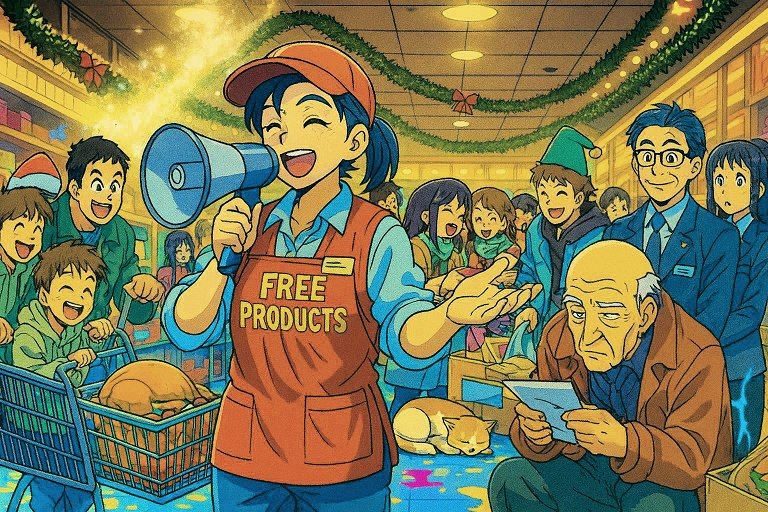
Short story: The Pixelated Office
The counseling room smelled like a strange mix: fresh disinfectant, reheated coffee, and something else — the sweet scent of nostalgia, like a cartridge left too long in a shoebox. The walls, hung with diplomas and wellbeing posters, seemed to clash with a mote of dust drifting in the white light. The psychologist, a calm-eyed man with thick-framed glasses that reflected books and screens, rose with a modest bow. In his hands he held a yellow Game Boy, its screen scratched, its shell marked from a thousand falls. He cradled it like an artifact.
“I’m going to explain why kids of the ’90s think differently from Generation Z,” he said, as if announcing a family recipe. “Don’t worry: it’s not science fiction, it’s domestic neuroarchitecture.”
The room —filled with a mix of patients and the therapist’s acquaintances— fell into expectant silence. Marta crossed her legs and adjusted her jacket theatrically; Ana fiddled with a Zelda pin on her lapel; Luis nodded with the pride of someone who already suspected the moral; Tomás wore the confidence of a man who still draws maps on napkins.
The psychologist began with a decidedly dramatic gesture.
“First: the emotional gym of cartridges,” he announced. “Three lives, no more. One misjudged jump, one cruel loss, start again.”
He told small but precise stories: Mario pushing you into the void without mercy, Sonic turning platforms into lessons of millisecond timing, Prince of Persia punishing hesitation with the cold embrace of a pixelated abyss. There were no tutorials, no auto-saves; only a reset button that returned you to the starting point and the obligation to begin again.
“You failed and you returned,” Luis said, his voice honoring a merit forged in trial. “I broke a controller as a kid and my mother looked at me. ‘That will teach you not to hit things,’ she said. She didn’t punish me by taking it away; she punished me with free domestic life lessons.”
“What I learned,” Marta intervened, “was planning. You had to memorize patterns, calculate jumps, save lives. It was rudimentary patience, but effective.”
The psychologist nodded.
“It’s involuntary training. Your brain practices trial-and-error until the response becomes automatic. Habits are built that are resilient, and if repeated enough, they become character.”
Then the tone of the room shifted; the walls seemed to gain an 8‑bit texture and, for a moment, everyone heard a faint echo of chiptunes and jump sounds. The conversation moved on to spatial memory.
“Tetris, Doom, Zelda,” the psychologist said. “Games without maps, without arrows to hold your hand. You had to remember routes, turns, chest locations. That strengthened the hippocampus — the part of the brain that helps us navigate the world.”
Tomás, who had long kept the habit of drawing maps on napkins, boasted:
“I get lost in modern shopping malls,” he said, “but give me a napkin and I’ll make you a battle plan. A GPS takes you straight; memory makes you owner of the space.”
Ana laughed and added:
“Today people ask Siri where the fridge is. If Siri failed, many would have an existential crisis.”
Hearing that, the psychologist brought out his favorite contrast: defined endings versus infinite worlds.
“Games ended. There was an ending, closure, a chiptune anthem and credits that returned you to the living room. You turned off the console, you ate, you lived. There were limits.”
He contrasted this with the current landscape: Fortnite and Roblox, platforms that exemplify what he called “perpetual stimulation.” There is no definitive end; the activity is designed to expand, to hook you. The consequence: learning to tolerate, and at the same time to seek, constant stimulation.
“Before, the ending returned you to life,” he said. “Now real life has to compete with a continual stream of rewards.”
At this point the debate became personal and funny. Luis recalled how his father used to force him to turn off the console at dinner time.
“‘Ten more minutes,’ I’d say,” he remembered. “‘No,’ my father said. ‘If you keep going, you’ll become a houseplant.’ The deal was harsh, but effective.”
Marta clapped the armchair and pointed to another aspect: face-to-face socialization.
“Sharing the same couch,” she said. “One controller for two, shouting and negotiations over who gets the next level. That taught you unwritten rules: wait your turn, coexist in defeat, celebrate small victories.”
Ana replied wryly about the current era:
“Now you connect with three hundred people you don’t see while sitting alone in your room with headphones. We share screens, but not the air.”
The psychologist smiled tenderly.
“Sociality then was physical, sensory. You learned to read gestures, to negotiate, to lie with a look. Sociality now is another thing: communication is exercised, yes, but something of face-to-face reading is lost.”
The subject of reward took the conversation to a more serious tone: dopamine and the economy of immediacy.
“Before,” he explained, “you waited a week for a magazine with tips. You saved for months to buy a game. Reward came after waiting, and that waiting reinforced frustration tolerance.”
Ana made a conspiratorial face.
“I had a coin jar with Pokémon stickers,” she said. “Today you buy a skin and dopamine fires in milliseconds. Instant gratification became the new social club.”
The psychologist added a clinical observation, the tone of someone who’s seen this dynamic in patients:
“When your brain learns that satisfaction always comes quickly, life that requires delay and effort feels slow and sometimes intolerable. It’s a mismatch between the pace of instant rewards and the real demands of adult life.”
Then, with a glint almost mischievous, he addressed deep concentration: that near-religious state where you lose yourself in a task until it’s solved.
“The afternoons of the ’90s demanded sustained commitment: hours glued to the screen with no notifications, no browser tabs fighting for attention. That cultivated the capacity for deep focus.”
Tomás added, half-joking and half-serious:
“Once I locked myself in my room until I beat a boss. I came out as though I had won a mental endurance marathon.”
The psychologist concluded that Generation Z carries a different relationship to attention: fragmented, shaped by interruptions and FOMO. It wasn’t a condemnation; it was a description.
The session that had started with a Game Boy and a clinical attempt at explanation grew into a chorus of stories. The therapist paused and let the attendees tell anecdotes, each enriching the mosaic: the time Luis hid a cartridge under the bed, the time Marta saved for months and cried opening the box, the time Ana negotiated a “half-hour more” and still recounts it as a small triumph.
“What you repeat,” the psychologist said at last, “is the app you install in your brain. If you repeat trial-and-error-patience, the brain learns to tolerate frustration. If you repeat instant gratification, expectations recalibrate.”
There were laughs and silences. Glances moved from the Game Boy to each other’s faces, and in that shared look you could read complicity, pride and a precise melancholy. No one dared say “the past was better,” but there was tacit agreement: every era brings strengths and traps.
Before leaving, Ana, conspiratorial, asked:
“So what do we do? Do we train patience as a muscle we forgot?”
“Exactly,” replied the psychologist. “We can choose practices that work patience, spatial memory, real connection. Not to demonize Gen Z, but to expand options. It’s about training intentionally.”
The Game Boy remained on the table like a baton. In the pencil cup, batteries gleamed metallic. As they rose, Luis couldn’t hide a gesture of affection: he approached and touched the console almost reverently.
“A quick round?” he asked, half a joke, half seduced by the familiar mental state.
The psychologist raised an eyebrow and, after contemplating with the solemnity of a moderator in an intergenerational debate, set a condition that provoked laughter:
“Only if you promise to turn it off when it’s over,” he said. “And if you save, make sure you go out for a walk afterward.”
“But can I save?” asked the young man who had defended streaming benefits minutes earlier, seeking middle ground between worlds.
“You can save,” the psychologist agreed, “in exchange for committing to restart real life with the same discipline you use to beat levels.”
The young man smiled, accepted, then added with the mix of mischief and sincerity unique to those raised between cartridges and updates:
“Deal. But believe me, the boss has a vulnerable window.”
Laughter filled the room. Marta, ever practical, fished a pack of retro chips from her bag (instant emotional nourishment), opened it and shared. Luis raised a can of soda as a symbolic toast.
“To lost cartridges and batteries that never lasted long enough,” he declared.
They clinked drinks and smiles. The Game Boy blinked on the table with the enigmatic calm of one who’s watched generations play, learn, fall and get back up. The counseling room slowly returned to its normal size: framed diplomas, the potted plant in the corner, the white light that no longer flickered like a CRT. But something lingered in the air: the feeling of having rediscovered something —not a perfect past, but a way of seeing the world that could be reclaimed on purpose.
As they left, Marta hung back for a moment and said quietly to the psychologist:
“I’ll try turning off screens ten minutes before dinner. Maybe I’ll memorize the recipe.”
The psychologist looked at her and replied with a smile that tasted like a benign edict:
“Start with the screen, end with the street. It’s a more human training plan.”
The door shut, but the Game Boy stayed, witness to stories and promises. Outside, the afternoon moved at its usual speed and, yet, something was different: a small group of adults carried inside them a pixelated resolve —the intention to deliberately train patience, memory and connection. Not to return to the past, but to use it as a palette to paint a more bearable present. And in each mind lingered the image of a cartridge that, with its limits, had taught many to try again.
Source of the images.
Image created with Bing.
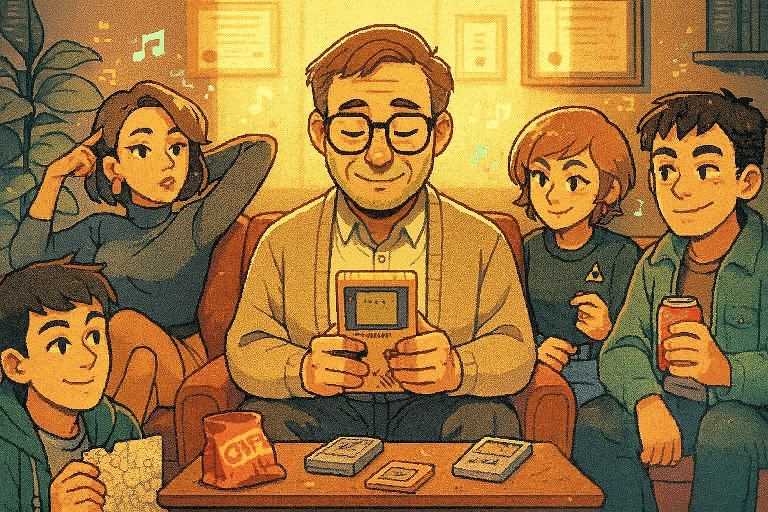
 @mc5punk