 @mc5punk
Short story: The Smoke’s Refrain Reborn
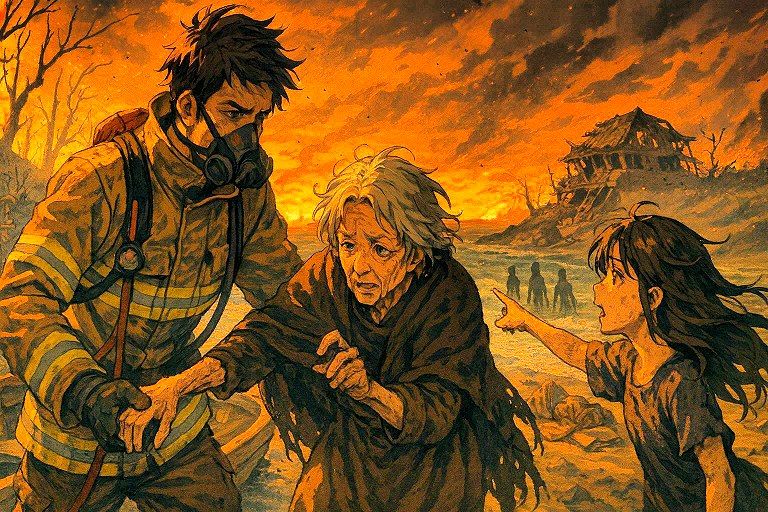
The coast seemed to have lost its memory. Mornings in Emerald Port no longer brought the smell of salt and seaweed but a thin layer of ash settling on piers and nets. The fire, born far away in the hills and arriving like a rumor, became a sentence: the main wildfire in the province had already consumed some 3,500 hectares. What had been a seaside resort of lazy summers and long sunsets was soon encircled by flames and a wind that seemed intent on tearing everything away. The old Estuary Road, witness to journeys and farewells, stretched between black columns. Fallen trees and charred posts marked the route. Martín, a volunteer firefighter with calloused hands, drove his truck over ash-dusted ground, breathing through an improvised mask and squinting against the glare. Commissioner Rivas, speaking over the radio from the command post, issued precise orders: coordinate columns, bring water from the river gorge, do not let the flames take the grove by the dunes. Everything became a choreography of fire and time. Martín: —Rivas, coordinate columns to the south. If the wind shifts that tongue of fire will cut off Emerald Port. Commissioner Rivas (over the radio): —Received. Reinforce Unit 3 with water from the river. Don’t let the grove by the dunes ignite. The inn “Serene Mist” had always been a refuge for fishermen and returning tourists. Now, Nacho, its owner, worked shoulder to shoulder with Lucía, the doctor running the makeshift hospital in the municipal gym. Blankets piled up, they smelled of smoke, and voices broke and rejoined. Elderly people in wheelchairs arrived, children with red eyes, neighbors carrying memories in plastic bags. Lucía: —If the exit route becomes compromised, redirect it along the coast. There are people who cannot walk far. Nacho: —I have supplies stored, but the inn is going to burn. I’m not leaving anyone behind. Delfina, a sixteen-year-old seasonal worker at one of the boardwalk stalls, arrived with her face blackened by soot and her eyes still full of the vision that had driven her to call emergency services the first night. Delfina: —I saw shadows on the slope, like something moving in the smoke. It wasn’t people... it was... —she stopped, trembling—. They looked like figures watching. Her testimony joined others that reason tried to order: sparks thrown by a machine at a construction site in the roundabout, a gust that shifted direction and in hours turned a beginning into voracity, people who, while evacuating, swore they had heard voices and figures moving in the dim light as if observing. Night brought a more visibly terrible presence. Flames cut the silhouettes of trees turned into burning hands; the coast, once a promise of rest, became the edge of a searing theater. Martín and his crew, hoses slung over shoulders and boots crusted with fine dust, advanced along what remained of a path. Communications were difficult: the old repeater tower on the hill had collapsed amid sparks and fire, leaving the town partially cut off. Firefighter: —Stop! —he shouted— Who’s there? Martín: —Ma’am, are you all right? How did you get here? As they moved forward, they found an elderly woman standing in the middle of the path. Her hands were blackened with soot, her eyes wide and fixed eastward. She had no visible burns, but there was a cadence in her voice that chilled. Elderly woman: —The smoke took them... I heard voices calling from the beach. The smoke that sings took them. That phrase clung like a broken song to the mouths of those who heard it. It wasn’t only the fire destroying trees and houses; it seemed to cross the boundary between the tangible and those old ways of telling the world. The next morning amplified the surprise: the beach, turned into an evacuation point, was crowded with people staring at the sea with fear, as if the shore no longer promised salvation but uncertainty. Some said they had seen shadows moving against the wind, forms that rose and vanished in the surf. A young man reached the first-aid station, breathless with panic. Lucía: —We have to prioritize respirators and masks. We may need to improvise filters if necessary. Young man: —It wasn’t human... it was smoke with legs. Behind the dune there were people who disappeared without screaming. Medical explanations—monotonous, protocol-bound—clashed with testimonies from another register: what bodies had seen or felt. The fire not only razed hectares; it seemed to have triggered an echo. The coast, melancholic and patient as always, began to give voice to an imprecise murmur, a succession of whispers some said they heard at night, mixed with the cracking of foliage as it burned. Martín: —We can’t let the front overwhelm us. Twenty minutes and we resupply, fast. Firefighter: —Stop! —he shouted— Who’s there? When the tongue of flame jumped the dune and pushed into the coastal neighborhood, many routes were cut. For some, the only viable escape was the sea. Fishing boats and small skiffs began loading elderly, disabled, and whole families. In the rush, some remained on the sand like statues, eyes white and skin smeared with soot. Martín: —To boat 2, please: load those with limited mobility. Nacho, organize those who can row. Nacho: —Come on, don’t just look at me. Whoever can swim, into the boats. The rest, with me on the firm sand. Delfina: —They’re moving toward the bay! They’re not fish! Those at sea recounted how shadows followed the boats along the shore. It wasn’t the familiar image of frightened sea life; these were more elongated, curved outlines that seemed formed from the very ash and moisture. People on the coast began to feel the evacuation had become a collective ritual, a cluster of bodies intentionally avoiding eye contact for fear of recognizing the desperation reflected there. Martín: —Ma’am, we have to move. Now. Elderly woman: —You can’t put out what the earth has already heard. The fire sings, and when it sings it names the living. Be careful with the answers. The elder’s warning echoed into the night, at once admonition and prophecy. Hours after the front passed the dune, a rescue team found something unexpected: remnants of a buried wooden structure among the sand, an altar ancient and covered by roots and time. On the wood, symbols were carved and stains that looked like long-forgotten rituals no one in Emerald Port could properly describe. Nearby were footprints that did not fit the morphology of human feet: elongated, curved, with ash clinging to them. Commissioner Rivas: —The priority is to assist evacuees and secure the perimeter. The investigation into the origin of the fire continues. Lucía (touching the carvings): —This doesn’t explain the fire, but it explains why people felt like someone was calling them. The presence of the altar added an unsettling layer to the explanation: perhaps, beneath Emerald Port’s recent history, there were rites and memories that fire had unearthed in its voracity. It was not necessary to believe in the supernatural for fear to spread; seeing the marks and hearing, apart from the sea’s murmur, voices some swore were not human was enough. The following days became a succession of shifts, containment, and fatigue. The 3,500 hectares had become the official statistic repeated by media and authorities, but for those affected the number only covered the physical scale of the damage. The intangible—sleeplessness, the sense of being watched, the stories shared around improvised fires—bore as heavy a weight as material loss. Nacho’s inn stood half-ruined; at the field hospital, Lucía treated respiratory cases, trauma, and the urgent need for psychological support that was often unavailable. Nacho: —Before this, Emerald Port was peaceful. Now people look at the beach as if expecting something. Delfina: —I think it’s not just the fire. The smoke brought something with it. And those things feed on fear. On calm nights, the community heard footsteps on the sand that had no owner. Some claimed to hear their names whispered by the wind; others said the shapes in the foam seemed to react to the light of the fireside. Between exhaustion and vigilance, Martín felt the weight of what could not be proved. One dawn, he thought he heard again the same murmur the elderly woman had voiced: an insistent call that both invited and demanded. Voice in the smoke: —Come to the shore, stay... become ash again... When brigades from other provinces managed to stabilize the fronts and the blaze began to retreat, the landscape that remained looked like a place in mourning: trunks rose as coal pillars, the ground was brittle, and the horizon had lost its usual profile. Among the embers and ashes on the dune, the unsettling evidence of what had awakened persisted: the altar, the symbols, the nonhuman tracks. Authorities promised investigations to clarify the origin of the fire and the nature of the finds. The community promised to rebuild. But the pledge to return did not erase the marks left by the experience. Commissioner Rivas: —We are prioritizing rescues and safety. Evacuate the designated areas and follow the teams’ orders. The nights that followed remained tense. Improvised bonfires provided temporary comfort, and the stories around them grew and warped with each teller. Some said the smoke had carried ancestral voices; others that it had awoken something that had always been there, waiting for an excuse to manifest. Delfina, who never stopped staring at the horizon, repeated with the incisive plainness of youth an idea that took hold in many: Delfina: —When all this is over, we will have to come back. But it won’t be the same. The fire left marks that rain won’t wash away. Martín closed his eyes and, for a moment, believed he heard far away the whisper again, mixed with the wind: a voice not entirely of this time or place, speaking of wounds that water and the passage of days cannot heal. Emerald Port survived the fire, but it did so carrying something else: the certainty that at the border where forest and sea meet, ancient memories can awaken and demand to be heard. Reconstruction would be material and slow; the other kind—of calm and trust—might take even longer, if it ever returned completely. Source of the images. Image created with Bing.
No comments yet