 @mc5punk
Short story: Lola’s Big Adventure in Hope Neighborhood
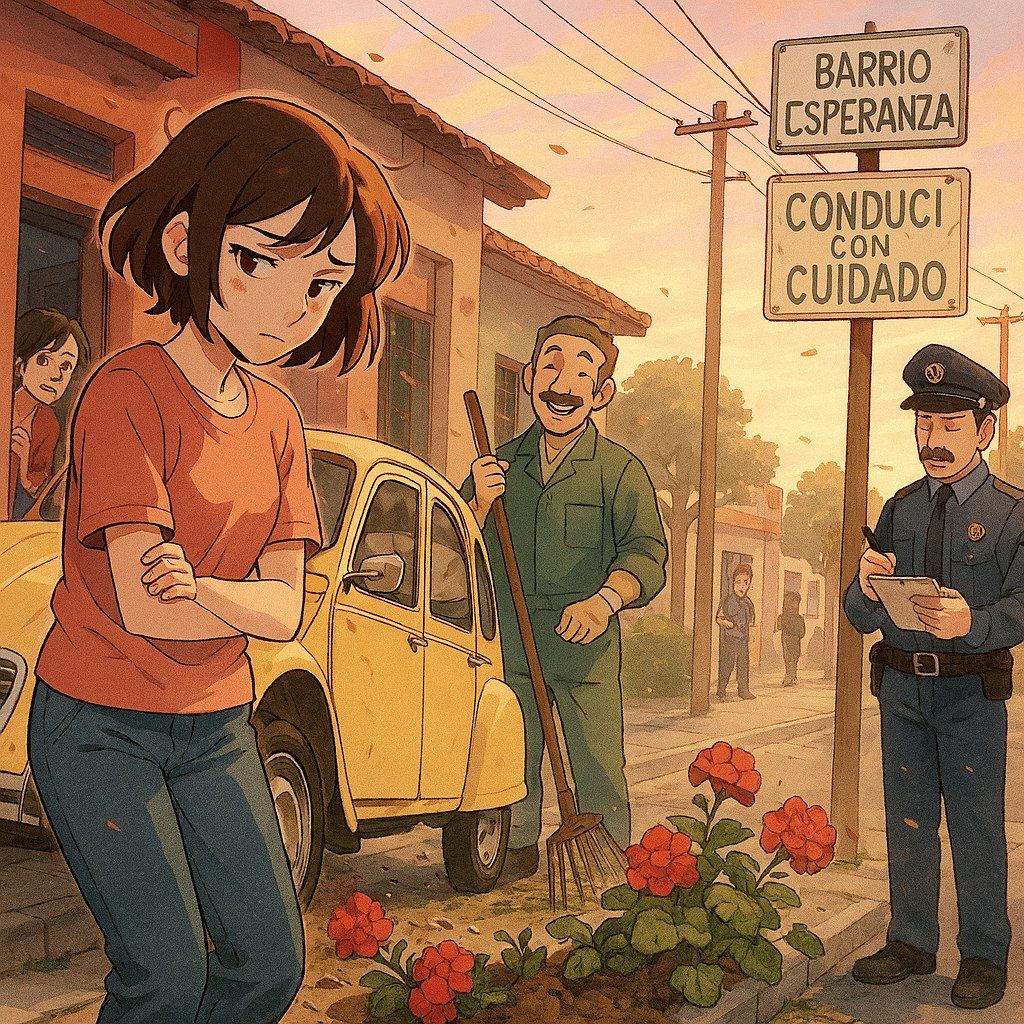
It was a Sunday that smelled of fresh dough and a lazy afternoon sky in Hope Neighborhood. The neighborhood moved to its own rhythms that day: the bakery opened later than promised, the dogs seemed to have rehearsed a choreography, and the cats watched from the roofs with the attitude of toll collectors for crossing the street. In a peach-colored stucco house, fifteen-year-old Lola prepared a small mission that in her mind had the drama of a movie: return a basket of empanadas her mother had asked her to take to her friend Vale before they got cold. Lola was not an experienced driver. She had taken a quick lesson with her uncle Paco the week before in the supermarket parking lot, and uncle Paco — a kind man who was never on time — had handed her his old yellow Citroneta, a car with more stories than door handles. Lola had half-washed it, dusted off the radio, and adopted a grown-up look that was just a little off-center. On the passenger seat rolled an untidy bottle of cider: Lola hadn’t planned to drink; the bottle was leftover from a family celebration where she’d toasted with a half-glass more out of excitement than habit. In Lola’s head the day looked simple: get the car, deliver the empanadas, be back before her mother noticed she’d used uncle Paco’s car. She underestimated two crucial things: the Citroneta’s capacity to surprise and her own ability to narrate the odyssey she was about to star in. Solstice Street, which the Citroneta took with a certain flair, was lined with houses with small sidewalks where plants lived like dignitary residents. On one of those sidewalks worked Mr. Armando, the neighborhood gardener. Mr. Armando was a middle-aged man with callused hands, an easy smile, and a reputation for telling jokes nobody asked for but everyone listened to. He had a toolbox in his hands and a list of small tasks occupying his mornings. “Hey, Lola!” Mr. Armando shouted when the Citroneta rounded the corner. “Can you hand me that screwdriver in the drawer?” Distracted by the radio and mentally preparing the best tone to say “sorry” if something went wrong, Lola didn’t hear. The car brushed Mr. Armando’s leg as if giving a distracted greeting and, in a move that mixed surprise with theatricality, sent him toward a pile of soil sacks and stacked pots. Armando fell backward, looked up at the afternoon as if he had just been given an unexpected massage, and after a few seconds started to get up amid contained laughter. “What kind of massage was that, young lady?” he said, shaking off leaves as if to prove everything was fine. “Technology doesn’t forgive stylish moves these days.” Lola, heart pounding, hit the brakes and saw the flowerbed crushed. The Citroneta sat with one wheel on the sidewalk and some geraniums Mrs. Mirtha tended with devotion poked their heads out between mud and metal. The scene was as absurd as a poorly printed postcard. Neighbors began to peer out: the neighbor who knew everything (actually knew little but spoke a lot), the kid from the kiosk with his cap turned back, and the mail carrier who never missed gossip and had already run over to catch the best angle of the story. Amid murmurs and glances, a patrol car arrived. Officer Gutiérrez, a man with a neat mustache and an equally neat notebook, stepped out with a determined stride. “Who was driving?” he asked, striking a documentary posture ready to record the scene live. Lola climbed out with hair mussed and flushed cheeks. Her hands trembled and her voice had that hurried tone of someone arranging words before they do it for them. “I was,” she said. “I was bringing empanadas.” The officer asked her to take a breathalyzer test. It’s a standard procedure: a blow into a device, a tense silence, a clarification of whether one had been drinking or not. But Lola had a habit of talking when nervous. She began explaining that the bottle wasn’t hers, that it had been a celebration at home, that the empanadas were crucial, that Mrs. Mirtha tended those geraniums more carefully than her own dog. She spoke as if trying to control the chaos with words. “Officer, look,” Lola said, “if the machine measured the nobility of empanadas, I’d test optimal.” The device, patient and electronic, waited for a formal blow. Lola interrupted the instruction with an anecdote about uncle Paco and his talent for losing brake lights. The officer, patient as someone who’d heard every type of explanation, tried to resume the test. But the device produced no valid reading once the test was interrupted by Lola’s insistence on narrating her version of events. Formally, the test was considered positive because of the interruption—a legal variable where silence and breath matter more than eloquence. The news—always quick to travel in a small block—reached the judge’s ears, and the Justice system, with its unmistakable taste for paperwork, opened a case for negligent injury. It was a harsh phrase to fit into the capsule of a neighborhood used to arguing about the best meat pie recipe: the file, the notifications, juridical explanations. For the neighbors, the expression “negligent injury” sounded serious and required attention that wasn’t as funny as an empanada afternoon. Meanwhile, Mr. Armando was taken to the clinic in an ambulance. He received careful, professional attention; luckily his injuries were not severe. He spent the night with bandages and a head full of stories to tell upon his return to the neighborhood square. What did get hurt was his pride: he’d lost his unofficial medal of “Most Patient Neighbor,” an award he accepted at every opportunity. Between jokes he recited an endless list of puns that, ironically, did more for his recovery than medicine. In the following days the neighborhood’s life turned into a mix of formalities and humor. The police station collected statements; the court requested technical reports; uncle Paco promised to fix the Citroneta and swore “an accident isn’t excuse to disgrace the family car.” Mrs. Mirtha, with the rigidity of someone who cares for plants like relics, demanded her geraniums be replaced and insisted on receipts and paperwork—everything must be in writing. Lola, for her part, faced a chain of consequences that were more educational than punitive: intensive driving lessons, multiple talks about responsibility, and a bunch of community tasks to repair the damage. They were not soft nor humiliating punishments but lessons that sank in with the intensity of learning by personal experience. Her mother combined love with firmness, uncle Paco showed a mix of guilt and support, and Vale—the friend who was supposed to receive the empanadas—went through a phase of anger that later turned into shared laughter when the story became required anecdote at every group gathering. The neighborhood refused to let the matter become public shaming. There was a collective intention to turn the experience into something constructive: a safety-awareness campaign humorously titled “Drive Carefully (and Keep Your Hands on the Wheel).” Mr. Armando agreed to be the face of the campaign, with a slightly raspier voice but the same intact smile, posing in front of a poster with geraniums and a slogan that blended warning with warmth. “If you’re going to deliver empanadas,” the poster read, signed by Mr. Armando, “better ask your friends to call you first.” The community organized workshops in the square, talks with police officers, and above all a driving circuit where neighborhood youths could practice without having to face the real world. They painted a mural of the Citroneta in bright colors, one wheel on the sidewalk and the geraniums recovering as a symbol that life, with patience and care, can be reborn. Lola had time to reflect during her learning process. She learned—practically and sometimes painfully—that responsibility does not mix well with improvisation, that a poorly secured bottle can change the course of an afternoon, and that some decisions deserve a second thought. She also learned the difference between the adrenaline of adventure and the calm of prudence. The cold empanadas, in the end, were a lesser evil compared to the possibility of tragedy. Over time things returned to a new normal: the Citroneta was fixed by uncle Paco (who took the chance to install new fuses and a horn that made funny noises), Mrs. Mirtha planted new geraniums and posted a small sign that said “Do not park on the flowers,” and Mr. Armando reclaimed his gardening spot with a new medal: “Ambassador of Patience,” awarded by the neighborhood association. The Justice process followed its legal course with its due deadlines; for the community, the most important thing was the collective learning. The story concluded one afternoon in the neighborhood square, at a fair where empanadas, pastries, and desserts were sold. The polished yellow Citroneta, adorned with a decorative ribbon, was parked like a trophy of an anecdote turned positive. Lola handed out leaflets with drawings of geraniums and safety messages; each flyer had a small slogan she invented: “Geraniums live better with attentive brakes.” Mr. Armando sat in the front row, applauding with enthusiasm that hid the satisfaction of someone who knows, despite everything, his life remained intact. Before the afternoon dissolved into stories, Mr. Armando approached Lola, placed a hand on her shoulder, and with the mix of severity and affection that characterizes neighbors who know a lot about life, said: “Lola, next time you want to impress someone, start by impressing the brake.” She laughed, scanned the square, and—making a promise that sounded sincere—said: “Promise. And if needed, I’ll give you back the screwdriver too.” The square filled with laughter. The security cameras that had recorded the original scene later served as footage for a homemade short film the neighborhood youth made for the campaign. In Hope Neighborhood there remained, besides the anecdote, a firm feeling: adventures can be fun, but it’s better if they don’t leave geraniums as victims. And so, among empanadas, new geraniums, and a Citroneta with a comical horn, Hope Neighborhood closed a chapter that had gone from incident to shared lesson, showing that a community, with humor and solidarity, can turn a stumble into teaching. Source of the images. Image created with Bing.
No comments yet