 @mc5punk
Short story: The Like That Unleashed the Plaza
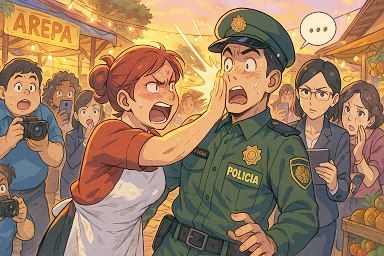
Once upon a time in the town of Valdelío —the kind of place that only appears on maps if you look for where rumors spread fastest— there was an afternoon that promised to be as ordinary as any other: people buying arepas, children running around, and the fruit seller hawking her prices. But as often happens in neighborhood tales, a single misinterpreted message and a phone too eager to react were enough to turn calm into spectacle. The afternoon began with a small rumor: a notification on Doña Lupita’s phone, a photo in Officer Carlosín’s stories and a blue heart that, by way of misunderstanding, went from an innocent gesture to evidence of betrayal. Maruca, who had seen everything through the gap at the vegetable stall, was quick to put the story into circulation. Maruca (approaching the empanada stall in a conspiratorial voice): —Lupita, I saw you the other day at the corner and I heard something! They say that officer of yours liked someone in his stories... and the woman in the photo didn’t look like she was from around here. Doña Lupita (frowning, shaping empanada dough): —Didn’t look from here? Carlosín has been coming to my stall for years; I’ve even seen his badge. What kind of tale is that, Maruca? Maruca (confident): —I don’t tell tales, Lupita, I tell headlines. If you want, I’ll pass you the video from the neighbor on the second floor who saw everything. The neighbor on the second floor, not invited to the conversation, appeared just long enough to confirm and give the story its definitiveness: “a video.” The rumor, now with audio and visuals, spread through the plaza like wildfire. At that moment Officer Carlosín arrived, his uniform immaculate and his hands more hesitant than his stride: Officer Carlosín (trying to sound calm): —Lupita, what’s going on? People are pointing at me... I didn’t do anything wrong, I just—interacted with a profile I don’t know. Doña Lupita (apron stained with flour, voice raised): —Interacted? I don’t like interactions when they come in the form of hearts on other people’s posts! And what about that photo with that woman in your story? Officer Carlosín (getting nervous): —That was a technical mistake, Lupita. I was watching stories and I tapped by accident. You know how phones are… they have a mind of their own. The Park Sparrows, always tuned into drama, formed a chorus of opinions: Neighbor 1 (adding spice): —Tell the plaza what happened! —she shouted. Neighbor 2 (pointing like a juror): —If it’s true, let the whole town know. Tension rose when Gordo Memo, convinced this was informational gold, pulled out his camera and began recording: Gordo Memo (adjusting the lens): —Don’t move. I’m uploading this to all my networks. If this goes viral, I’ll buy a whole drum of empanadas with the earnings. Maruca (proud of the event): —Memo, if you post it, put my comment at the top. I want people to know I warned them. Doña Lupita, not the type to let things be decided on social media alone, stepped forward and demanded a public explanation. Her words, sharp, found the officer in evident trouble: Doña Lupita (clutching a napkin like a banner): —Carlosín, are you going to tell me the truth or just give it to me in likes? What does that woman have to do with you? Officer Carlosín (making a gesture of resignation mixed with a lack of good ideas): —Lupita... she’s just a colleague who asked me for help on a report. I have nothing to hide. Don’t you trust me? Doña Lupita (laughing sarcastically): —Trust? And what do I call this then? A digital accident? Are you going to show me the report? The exchange heated the morning further. Dr. Reyes, who arrived with her notebook and measured tone, tried to apply method and calm: Dr. Reyes (raising a hand as if requesting the floor at a meeting): —Please, everyone. Before this gets out of control, we can resolve it calmly. There are procedures: talk, clarify, and if necessary, present formal evidence. Doña Lupita (still loud but with a touch of pride): —Evidence? You want evidence? Right here, in this plaza full of witnesses that has become a court—doesn’t that count? Even the hardware store dog looks at me reproachfully. And then, in the middle of the commotion and mediation, what the crowd expected happened: Doña Lupita, overcome by surprise and anger, slapped Officer Carlosín. It wasn’t just any slap—it felt rehearsed for drama, with natural plaza acoustics providing the perfect sound effect. Gordo Memo (recording anxiously): —Camera steady, this is gold! —he whispered as he filmed vertically, the best orientation for virality. Witnesses reacted as if attending an improvised play: some applauded, others booed, and a large group began narrating aloud while recording: Neighbor 3 (in a judge-like tone): —She had every right. If there’s cheating, it should be known. Neighbor 4 (more cautious): —Calm down. Violence isn’t the solution. If necessary, file a complaint. Carlosín, more shocked than hurt, rubbed his cheek and scanned for the support of his uniform: Officer Carlosín (voice between offended and embarrassed): —Lupita, really? I didn’t think— I thought you’d understand. Doña Lupita (firm but with a hint of vulnerability): —I understood when you told me you’d been doing night shifts and missing dinner. Yesterday I found messages that told me a different story. Do you think a woman forgets that so easily? Dr. Reyes, staying in her role as moderator, tried to steer things back: Dr. Reyes (attempting to calm tensions): —You can sit here, speak in front of witnesses and leave a written record. There are legal paths for cases like this: complaints, mediation, reconciliation. The plaza is not a courtroom. Maruca, tireless, added her version full of details and suspicions: Maruca (leaning in confidentially): —I saw the officer at a café the other day with a woman wearing dark sunglasses. I won’t shout it, because I’m not certain... but the detail is out there. Gordo Memo, phone halfway through uploading the video, interrupted with shamelessness: Gordo Memo (pressing the screen): —If this explodes, I could save a bunch of local reporters. Imagine the headline: “Love, Likes, and Arepas: Valdelío’s Scandal.” Neighbor 5 (with dark humor): —We could sell T-shirts: “I was in Valdelío and I survived the slap.” The video went viral almost instantly. In hours, the plaza that had once been for bread purchases trended across town. Comments, memes and theories multiplied. Some demanded sanctions against the officer for breaching decorum; others asked that Lupita be held accountable for assault. Official uncertainty remained: authorities did not confirm the causes nor the romantic relationship, and the local prosecutor’s office, after receiving calls, opened an inquiry. Meanwhile, daily life continued, begrudgingly. The fruit seller, ever the entrepreneur, began selling T-shirts reading “I Witnessed Valdelío’s Slap” and offering discounts to anyone who brought the original video. The Park Sparrows, for their part, kept commenting. Days later, Dr. Reyes gathered the protagonists for a symbolic reconciliation in the plaza, now with fewer cameras and more people seeking closure: Dr. Reyes (pen ready): —I propose they sign a statement of understanding: public apologies if appropriate, and referral to formal channels if needed. Doña Lupita (somewhat calmer, eyes still proud): —I can apologize if I see remorse. But let this teach people this isn’t show business. Officer Carlosín (looking ashamed): —If I hurt anyone, I’m sorry. But I ask that this be investigated calmly. No one deserves their private life to be decapitated by a like. Dr. Reyes, in her pedagogical tone, made clear something many didn’t want to hear: Dr. Reyes: —Social networks amplify conflicts and rumor feeds on the lack of information. If there are breaches, they should be resolved through proper channels: complaints, evidence and sanctions where appropriate. Violence only fattens the problem. In the epilogue of this story —retold in many versions and spread in voice messages and chain texts— a diffuse but useful lesson remained: screens multiply exposure, versions abound, and the official truth takes time to arrive. Doña Lupita returned to her empanada stall with a clientele that, out of curiosity or solidarity, visited more than before. Officer Carlosín cleaned his uniform and received calls from the station to clarify his situation. Gordo Memo, who had uploaded the video, gained followers and criticism from those who saw his action as sensationalism. Final dialogue (a reflective closing): Maruca (making a mental note of the news): —I’d say this taught us all to handle the like button better. Doña Lupita (serving an empanada with half a pardon and half a reproach): —Next time I see a suspicious like, I’ll check the content first and then, if necessary, call Dr. Reyes. Officer Carlosín (sighing, hand on the pocket where he keeps his phone): —And from now on, I’ll turn off story notifications. Thus ends the episode that Valdelío —and the networks— turned into an anecdote: no absolute truths, many versions, and a plaza that learned to be cautious with likes and quick judgments. The End. Source of the images. Image created with Bing.
No comments yet