 @mc5punk
Short story: The Lights That Won't Be Silent
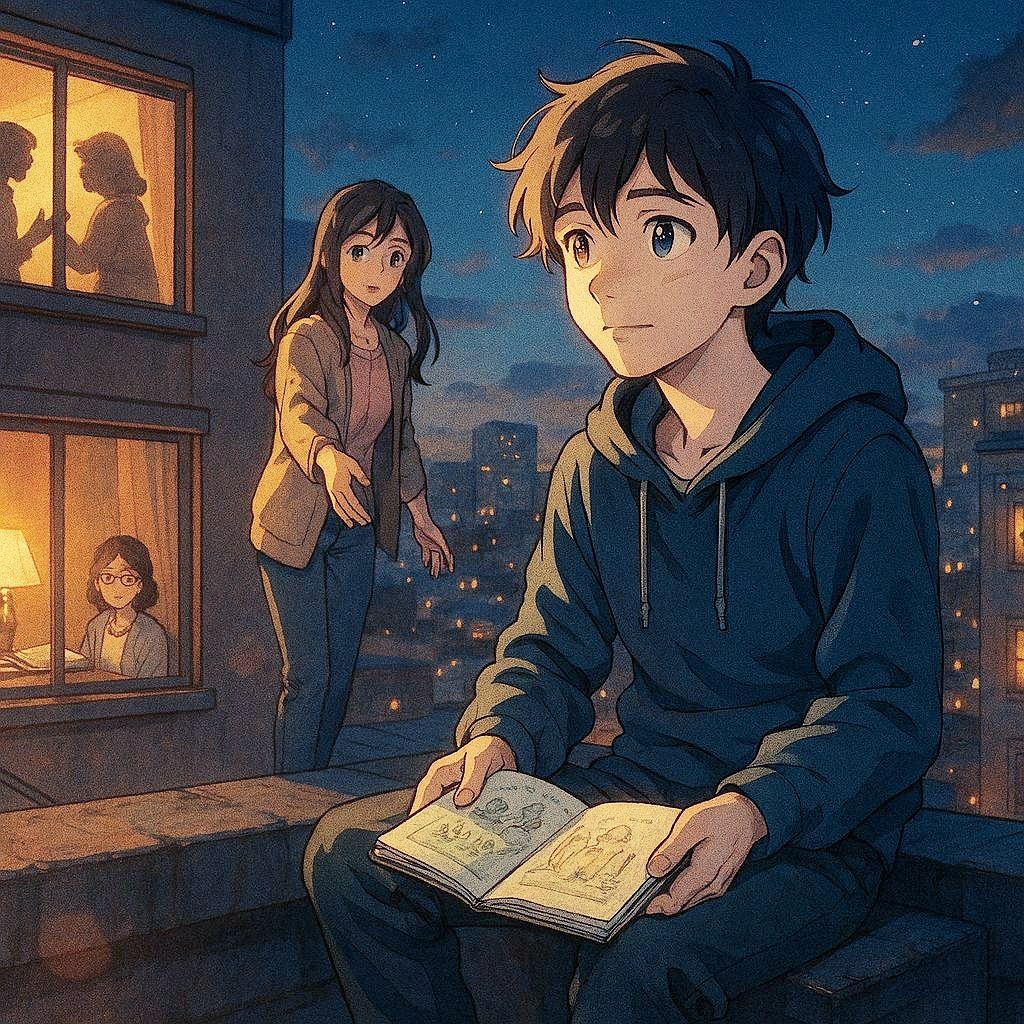
The house on Oliva Street seemed to sleep every night, but it was not a peaceful sleep: it was an endless vigil. From the sidewalk, the building offered an appearance of normality: closed windows, drawn curtains, the visual comfort of bulbs switching off at the same hour. But in the third-floor apartment, the lights obeyed other orders. Outside, the city breathed; inside, however, something else switched on — a silent alarm that never let up. Mateo was ten years old when he began to notice that his world was made of noises he had not asked for. He held a book like a shield; not so much to read as to put a barrier between his body and the vibration of voices that bounced off the walls. The arguments rose like waves: a sharp sentence, a louder reply, a door slammed with force. He learned quickly to measure the house by the distance between a goodbye and a threat. His body learned before his mind: at the first touch of a quarrel his amygdala — that tiny sentinel deep in the brain — lit a red light. His pulse sped up. The world shrank to a bright point where anything could explode. "Mateo, turn that off and come eat," his mother Elena ordered from the kitchen, her voice tense like a wire. "I'm… almost," Mateo replied in a low voice, pressing the book to his chest as if he could stop the trembling in the air. His father Andrés crossed the living room with short steps and a brusque look, letting out a sigh that to the boy sounded like a sentence. "Again with that?" Andrés said without looking at him. "This home needs order, not stories." Mateo didn't understand why the volume of a voice could determine the weight of a house. When his father grew angry, the whole apartment seemed to tilt toward explosion. His heart learned to anticipate violence as a natural law. That constant tension transformed childhood play into survival exercises: where other children built block castles, he raised forts of cushions and blankets, tunnels to protect him from an invisible enemy. He learned to calculate the distance to the kitchen door, to estimate how long a blow would take to reach his room. At night he chewed on the shadow of his father's footsteps until sleep reached him exhausted. Sometimes he woke believing that the racket he heard in the night was an explosion; his chest broke into a primitive panic, identical to that of men returning from places where war left marks on skin and memory. His terror was no less real for lacking a uniform or battlefield; inside his skull the maps were the same. Doctors said it in cold, precise words that the adults barely heard: MRI scans showed that children like Mateo, raised in homes where conflict is the daily grammar, had hyperreactive threat centers — amygdalas that remained on constant alert, looking for dangers that did not exist. "A hostile home reconfigures a child's brain for war," a doctor said in the consultation, with a professional tone that made the phrase fall into the room like a slab. For children that statement was not metaphor: the scanner image showed the agitation of an organ in alarm; in daily life it translated into startle responses, broken sleep, a tolerance threshold reduced to inches. The phrase stuck to Mateo's room like an echo. Every object seemed to conspire against calm: the lamp that flickered during tense moments, the chair always conveniently near for someone to bang, the curtain that moved with the subtle violence of held breath. At school, the boy shrank in his world. His teachers spoke of "withdrawal" or "behavior problems"; yet the specialists' words did not always cross the distance to the kitchen, where meals were served quickly and conversations ended in reproach. One afternoon Lucía found him sitting on the building stairs with a notebook and pencils beside him. She lived on the second floor and worked at the neighborhood community center; she had a habit of paying attention to small things. "What are you drawing?" she asked softly, crouching to be at his level. Mateo pointed to a figure of hard lines, with large eyes and a rigid posture. "It's a guard," he murmured. "In case the yelling comes." Lucía let out a sigh that mixed sorrow and tenderness. She didn't want to scold or interpret; she simply offered company. "Come to the park with me. You don't have to explain anything," she said, holding out her hand. In the park, the afternoon tempered by wind, Mateo swung on the swing with a serious face. A sudden gust messed his hair and his body shrank automatically; the amygdala lit the same alarm that had accompanied him for years. The shadows of the tree crowns traced shapes on the ground and he perceived them as possible hiding places for danger. "Breath with me," Lucía suggested. "Five seconds, hold, five seconds. Like you're inflating a balloon." Mateo, fingers still cold, imitated the breathing. The tremor, barely perceptible at first, eased. "Do things scare you a lot?" Lucía asked without hurry. "Sometimes I feel like my heart starts looking for dangers," he confessed, looking at his hands. "Like I can't turn the alarm off." "You're not to blame for that," she answered. "Your body learned to protect you. We can teach it other signals." In the following weeks Lucía's presence became a comforting constant. She invited him to the community center, where there were music and drawing workshops and, above all, a space where children could name what they felt without fear of judgment. There Mateo met other kids who had also learned to live with an internal radar that sounded for no apparent reason. He learned simple exercises: breathing with the hand on the belly, stretching arms until he felt his heartbeat, walking slowly counting steps. They were modestly powerful actions. The MRI that had been a cold image on a screen gained names and helping hands: anxiety, hypervigilance, memory. Time moved on with its usual ambivalence. In adolescence Mateo's reactions became more complex. The same mechanisms that had saved his life in a tense home became social obstacles. A trivial argument with friends, a classmate's joke, a brusque gesture — any of these could make his body fold into armor that did not always allow him to gauge the situation. At school, the classroom silence, exams, and recess movement — all could be perceived as a military operation of uncertainties where his amygdala kept weapons ready. Teacher Ángela, who had taught at the school for years and had seen generations come and go, noticed a pattern others ignored. "Mateo, do you want to stay a while after class to review?" she offered one afternoon with the warmth she reserved for students who seemed to carry an invisible burden. "Okay," he accepted in a small voice. "Thanks, teacher." Ángela did more than assign homework; she taught organization techniques that paradoxically brought order to his mind: lists with small steps, schedules that didn't overwhelm, writing exercises to turn fears into words. Sometimes a simple routine is an anchor that quiets an alarm. But progress was not linear. One night, when the argument at home went on longer and harder than usual, Mateo felt the walls closing in. The fight rose in pitch until it became unbearable. He sought solitude on the building roof, a place where the air felt less heavy. He curled against the railing and looked at the city: distant lights, windows flickering like domestic stars, people returning to their homes without the noise he carried. He breathed differently, intending each inhalation to push something inside that wanted to be released. He remembered Lucía's voice: "You are not a trench, you are a child." That simple, human phrase created a small crack in his armor. The next day he went down and showed up at the community center, where they welcomed him like someone returning home. There they referred him to therapy with psychologist Marina, a patient woman who worked with adolescents and knew the anatomy of anguish. "When the fights start," Mateo said in the session, voice breaking at times, "I feel like I have to be ready. Like something bad is always going to happen." Marina listened without interruption, with the calm of someone who knows that the urgencies of the soul are not erased by quick fixes. "Your brain learned that to protect you," she explained in a measured voice. "It is not your fault. But we can teach it new signals: exercises, words, small practices that say you are safe." In therapy Mateo learned to name the flood of sensations that overwhelmed him: hypervigilance, sound flashbacks, the inability to relax even in the presence of people who posed no threat. With Marina he practiced techniques that combined breathing, mindfulness, and narrative writing: recounting what had happened with every possible detail — place, sounds, smells — so memory would stop being a vague threat and become a story that could be ordered. Family work was pursued where possible; not to blame, but to offer guidelines to reduce common triggers. The path was not straight or fast. There were relapses: sleepless nights after a fight, startle responses in ordinary moments, arguments that reminded him why his guard was always up. But there were also small, steady advances. He learned to recognize the danger signal before it turned into fire; he began to say aloud, with a confidence gained through practice, "I need a moment," and you could see how the pieces around him made room. Breathing became a bridge between alarm and calm. The helping hands — Lucía, teacher Ángela, Marina — formed a net that held fragile days. One afternoon, now in his teens, Mateo sat at the kitchen table with an open notebook. In the pages the strokes had changed: old forts had given way to gardens where something unsharpened could grow. Andrés, his father, appeared in the doorway and scanned the drawings with a curiosity that might have been new or reclaimed. "What is all this?" he asked, more curious than severe, his guard lowered for the first time. "They are things that make me feel calm," Mateo answered, looking at him honestly. "Do you want to help me water them?" The silence that followed was dense but not hostile. Andrés stood for a few long seconds thinking the words he did not know how to give. Finally he nodded and took one of the sheets carefully. "All right," he said at last. "Let's water them." Not everything in the house changed immediately. There were fights, yes; arguments that still scraped nerves. But the complete reconfiguration of the brain no longer seemed inevitable. Mateo had built an internal alliance: therapy with Marina, friendship with Lucía, teacher Ángela's patience, and a toolbox — breathing, writing, routines — that he used as one equips for a long journey. His amygdala remained instinctively watchful, but with learnings that allowed him to modulate the response. Mateo's story is not one of absolute victory nor of eternal defeat. It is the testimony of a daily struggle where the invisible ceased to be an immutable destiny. A hostile home can, without doubt, program the brain's alarm for war, but there are also hands, words, and strategies that can reinstall the possibility of silence, of play that is not a fortress, of nights when the heart can lie down without fear. Mateo learned to live with scars that did not define him completely; in them he found a map, not of war, but of possible paths toward peace. In the end the lights stayed on some nights in the house on Oliva Street, but Mateo also saw other lights: the lamp at the community center, the window light of teacher Ángela, the one that lit up in Marina's office each time a productive session closed a notebook. They were not lights that erased the shadows, but they were beacons that showed that even brains marked by hypervigilance could learn to recognize when there were no enemies in sight. And that possibility, in his case, was enough to begin to reweave a childhood interrupted by noise. Source of the images. Image created with Bing.
No comments yet