 @mc5punk
Short story: The Christmas of the Loose Cable
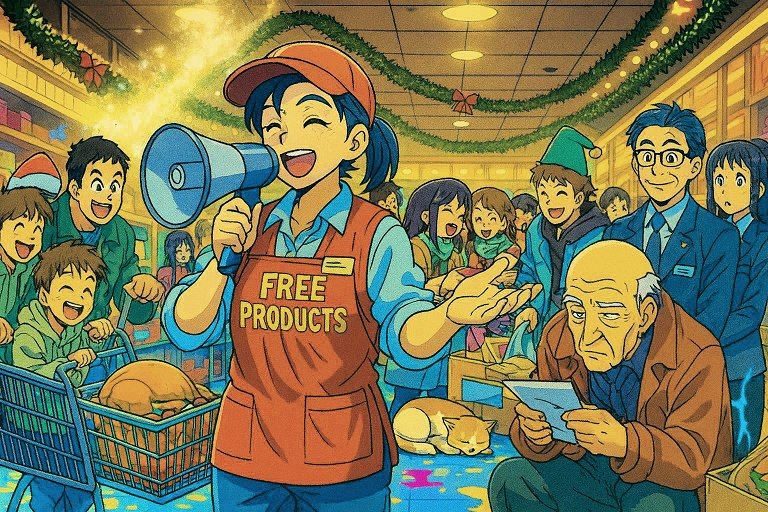
I arrived at the H‑E‑B in Burleson that afternoon with the feeling of stepping into an open box of memories whose scent had escaped: roasted turkey, lemon-scented soapy water, and those buttery cookies that only show up in family photos and holiday market stalls. It wasn’t just the smell of fresh products; the air had the density of a collective memory, as if years of small household rituals had accumulated between the aisles and someone, without much ceremony, had lifted the lid and let loose what had been sleeping on the shelves. I wore my red hat, tilted from the morning’s hurry, and the store vest—marked by stories: a stain that reminded me of sauce spilled in 2018, the flattened pen I used so much to jot orders, and a folded tag that looked like an old postcard. I had spent enough Christmases behind that counter to know that generosity can be a mechanical gesture, almost administrative, or a decision that bursts forth in an instant. That afternoon, without a plan, I chose the latter. Over the radio came the standard technical notice: “problems at the registers.” On any other day that would mean pauses, calls, protocols, and, with luck, an operational calm restored. I, however, saw a crack to slip something different through. I climbed onto the small speaker stand, took a deep breath, and announced in a voice that would soon change the store’s dynamic: “H‑E‑B family, today the products are free!” The sentence flipped a switch. First came disbelief: surprised, cautious looks, carts slowing, the murmur thickening. Then complicity arrived: incredulous laughter, conversations lighting up, and a communal rhythm quietly stitching its own rules. The atmosphere shifted from technical expectation to an improvised human choreography. Mr. Ernesto was among the first to come forward, his crumpled list in hand as if the paper—a relic of the shopping ritual—might vanish in the surprise. He looked at me with that blend of prudence and hope that belongs to those who have lived many Christmases. “Is this for real? Is it a radio prank?” he asked. “It’s real, Ernesto. But one thing: half a dozen per person—Christmas spirit must be shared,” I answered, with the voice my experience gave me and the need to prevent chaos. That small, improvised rule—timid and humane—was enough to channel the collective energy. Nobody wanted to turn the gesture into looting; everyone sought the thrill of an unexpected gift. So, with modest guidelines and common sense, the store began to transform into a stage where generosity and solidarity were rehearsed. In the cereal aisle I saw Camilo and Raúl like two kids in an imaginary sled race: carts colliding with almost comic theatricality, exclamations, and neighborhood banter. “If this is real, I’ll take everything,” one said amid the confusion. “Calm down, champ. Half a dozen. And if you have extra, share it,” the other replied. What started as a chance to hoard ended with a sharing gesture: Camilo gave a box to Lucía, and that simple act resonated more than any viral post. Youthful generosity, somewhat naive, proved contagious: one gives and the giving ripples outward. Javier, wearing an elf hat, organized his household squad as if leading a Sunday mission, assigning tasks with the solemnity of a commander: “You, the sauce. You, the dough. And you, distract the kids with treasure stories.” The children, wide-eyed, shouted: “Treasures!” Javier smiled wearily: “Let them be edible, please.” Imani, not afraid to look foolish, climbed onto a cart and turned it into a platform: “Everyone to the packing line! If we work as a team, we’ll finish sooner.” The crowd responded with a cheer: “Let’s go!” What followed was an endearing mix of comedy and tenderness: elderly women teaching teens how to fold and pack, young people discovering that giving can sting and yet fill you, tired employees showing glints of pride at how an improvised act could become meaningful. The scene developed its own rhythm, with moments that felt cinematic: comic mishaps—like when a bag of flour burst and left a white cloud that drew laughter—and moments of pure emotion, such as the delivery driver who, off the clock, insisted on adding a turkey to a family’s bag. Mr. Delgado arrived from the office with the expression of someone eager to restore order. At first he spoke in procedural terms and risk assessments: “Marta, we could get into serious trouble. Did you get permission?” I answered honestly, seeing the full picture: “No. I asked for a little common sense.” And it was precisely that common sense—the ability of people to organize themselves—that began to calm him. Observing customers forming lines, taking turns, and restraining impulse, his stance shifted. Rather than suppress, he chose to channel: he set up a holiday assembly line where staff and customers collaborated; he assigned roles and made sure every household received a fair share. “All right, if we’re doing this, we do it right. Everyone to their stations: who packs, who distributes, who comforts,” he said, trying for firmness and ending with the gratitude of someone discovering something new. An employee muttered with a knowing smile, “Boss, this tastes like tradition.” Indeed, improvisation took on the ritual weight of a practice that could be repeated. The store became a temporary workshop: packing stations, teams counting and recounting to ensure fairness, people taking turns tending the improvised gift register. From that ritual, micro-stories emerged: the elderly woman teaching a young man to wrap without crushing, the teen confessing he felt useful for the first time, the mother who wept when she received an unexpected bag, and the child who burst out laughing at finding a chocolate in his sack. Humor underpinned much of the day. Beyond the flour cloud there were moments right out of a farce: Christmas music interrupted by the crowd’s chatter, carols hummed by customers who weren’t even shopping for them, and overlapping conversations improvising their own script. But there was also tenderness and everyday nobility: the delivery driver adding a turkey, the couple yielding their turn to a family with children, and the teenager handing out hugs as skillfully as she tucked cans into bags. Camilo, who had come in hunting a score, left with something different: a quiet pride in having helped and being part of something larger than his craving. Mr. Ernesto put his list into his pocket as one tucks away a story to tell his granddaughter. Lucía promised to invite a new family to dinner. Mr. Delgado, surrendered to the beauty of organized chaos, officially announced the first “H‑E‑B Community Night” and said, trying to sound solemn: “Today we don’t open a file; we start a tradition.” I, looking around amid bags, opened cans, and lingering carols, replied simply: “I just wanted no one to leave hungry, boss.” Hours after impromptu songs, packing directives, and conversations flowing like rivers, the technicians fixed the problem. The solution was mundane: a loose cable and a stubborn update that only needed a reboot. The contrast between the technical prosa of the fault and the human poetry that had grown during its span was almost humorous. The real fix wasn’t the registers returning to function; it was what remained in people. When the revolving door footage—the video that captured the perfect blend of humor, disorder, and kindness—began circulating online, it wasn’t scandal that dominated but nostalgia. Clips were shared with affectionate comments, memes that read like sentimental postcards, and stories celebrating a time when people knew each other by name in stores. The community responded with warmth: anecdotes were exchanged, past holiday tales resurfaced, and new memories were woven. That Christmas didn’t change the world or inaugurate official anthems. What it did change was dinner-table talk and household conversations: it added new anecdotes, recurring laughter, and the sense that sometimes a technical failure is the perfect pretext for humanity to remember how to share. Mr. Ernesto, back in his chair with a hot cup in hand, set his list next to a photo of his wife and murmured like someone who had made a discovery: “I never imagined a loose cable would give us so much story.” I leaned my hands—still a little sticky with maple syrup from a can that had spilled by accident—against the backroom doorframe and looked at the child’s drawing someone had taped up: a big sun, clumsy strokes, and the message “Thank you.” No applause was necessary; the pride was quiet and enough. The store returned to routine, but now it was threaded with an echo of carols and a tacit promise: if the “technical problems” returned, perhaps someone else would choose generosity over waiting. And so it remained in the town’s collective memory: a postcard with flour dust on the floor, children’s laughter, the satisfied smile of a manager who’d discovered a tradition, and the dog Sock asleep at the end of an aisle with a small piece of chocolate in his snout. In Burleson, if someone mentions “technical problems” now, it’s no longer an alarm but an invitation to smile and remember the afternoon a loose cable, for a moment, lit up Christmas. Source of the images. Image created with Bing.
2 comments
I really liked this story. The details felt very real and human, and the message stayed with me after reading. Thank you for sharing this moment.
You are welcome 👍