 @mc5punk
Short story: The Second Chance for Luna
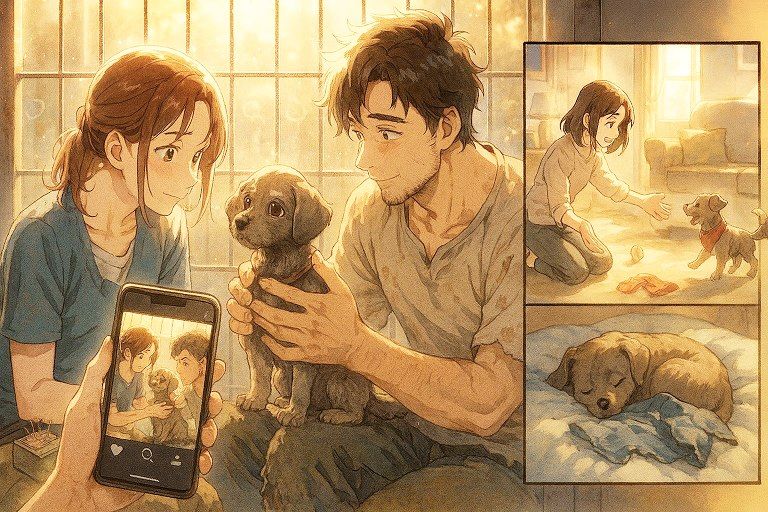
The animal protection volunteers had spent weeks going through shelters and refuges looking for dogs and cats that, for various reasons, no one had claimed. That morning, the sun barely peeked through gray clouds as Marta and Javier entered a hall of cages where the light seemed to bounce off sadness. There were several animals, but one in particular caught their attention: a small dog with grayish-brown fur, thinner than usual, who curled up in the corner of a cage as if trying to make herself as invisible as possible. “Look at her,” Marta murmured, her voice tight. “She doesn’t have any energy. I don’t think many people have even noticed her.” Javier crouched in front of the cage and rested his hand on the wire without invading her space. The dog lifted her head and, for a moment, her eyes reflected a mix of fear and hope, as if searching for a sign that someone would truly stay with her. “She seems like she wants us to reach in,” he said softly. “But we won’t scare her. Better take a photo and share it.” Marta took out her phone and snapped several pictures. Looking back at the dog, she felt a pang in her chest: it wasn’t just her physical condition; it was the expression, a quiet sadness that had settled into her features. That same afternoon they wrote a message to accompany the best photo: Volunteers from animal protection shared this image hoping to find her an opportunity in a home outside the shelter. Her photo, taken during a visit to a little dog behind bars, moved thousands of people on social media and sparked adoption requests from different parts of the country. They posted the photo and waited, aware that sometimes posts don’t reach the places one hopes. But the response was immediate and overwhelming. Comments began to multiply: messages of encouragement, rescue stories, offers of financial help for vaccines and transport, questions about her health and age. An unusual number of people asked for more information. Among the messages was one that stood out for its simplicity and clarity of purpose: a woman named Elena, writing from the United States, said she wanted to give her a home and asked what was needed to bring her across the border. “I want to give her a home,” Elena wrote. “What does she need to cross the border? Any health issues? Is she active or calm?” The logistics were complex and required coordination. Veterinary certificates, vaccination records, an international transport protocol and, above all, funds to cover the process were needed. The volunteers organized a fundraiser among friends, local supporters and donations that kept arriving—each with words of hope. Marta and Javier, together with other helpers, worked tirelessly: the dog was examined by a veterinarian who confirmed that, despite her thinness and listless appearance, she had no serious illnesses. She received the necessary vaccines and antiparasitic treatment. They also gave her a final session of affection before her departure: they fed her carefully, brushed her coat and held her so she would feel that, at last, someone was seeing her. “I brought her a toy I sewed from old rags,” Marta said on the last afternoon before the trip. “I wanted her to have something that smelled like us, like hands that cared for her.” “And I left her my old shirt,” Javier added. “I thought that way, on the plane or in the new home, she’d find a familiar, comforting scent.” Departure day was a mix of anxiety and relief. At the airport, the dog stayed curled up on Javier’s shirt, her breathing long and steady as if, for the first time in a long while, she could allow herself to rest. The volunteers gave her one last look before saying goodbye. Marta held back tears seeing how, for the first time in a long time, the dog lifted her head without that heavy look of despair. When Elena received her in her country, the house greeted her with the same warmth felt in the messages: a woman waiting with a gentle smile and hands ready to mend a life. Elena knelt, called her softly and invited her to come closer. “Hello, my little one. Welcome home,” Elena said as she reached out her hand. The dog, still shy, sniffed the surroundings. The change was almost instant and miraculous. Leaving the cage behind seemed to open up a whole map of possibilities. The dog, who until then had had no name, showed renewed interest in the world: she began to sniff every corner, wag her tail timidly and play with a small rubber ball she found in the living room. Elena watched her with a mix of restrained emotion and satisfaction. “Look at this,” Elena told her friend on the phone that night. “You wouldn’t believe how she changed. As soon as we took her out of the cage she started moving, exploring. It’s like she woke up.” The hours went by with everyday discoveries that were new frontiers for the dog: the smell of wet grass in the yard, the crunch of leaves, the warmth of a sunbeam coming through the window. For the first time she knew the comfort of a soft bed, long unhurried strokes, hands that brushed her with tenderness. At night she settled beside Elena and rested her head on her knees, surrendered to the safety of a home that accepted her unconditionally. Her eyes, once dull, now shone with curiosity and trust. Meanwhile, the image that had started it all kept traveling. The original post became a before-and-after thread: the photo of the dog behind bars and the new images of a rebuilt life. Stories like hers inspired others to take an interest in shelter animals, offer donations, and ask how to replicate that support in their communities. “It’s incredible,” Javier said, scrolling through the responses on his phone. “We didn’t just find her a home; we created a network of solidarity that reached so far.” Months after the adoption, Marta received a letter and several printed photographs. The pictures showed the dog running around the yard, playing with a red scarf, sleeping in a plush bed, and receiving hugs from Elena. One photo revealed a detail that moved the volunteers: Javier’s old shirt she had been given was frayed and torn from use—clear evidence that the dog had kept it as a travel talisman and a memory of those who cared for her before her new life. “Her name is Luna now,” Elena wrote in neat handwriting on the letter. “We named her that because of the nights I saw her gazing at the light from the window. Thank you for saving her.” That simple word—thank you—resonated deeply among those who had always worked quietly for animals. Marta and Javier stored the photos in an album and, as they turned the pages, remembered every gesture that had made the rescue possible: the post, the chain of donations, the veterinary care, the transport, and Elena’s willingness. It was a lesson in how a single honest, heartfelt image can spark a wave of compassion that crosses borders and tangibly changes the life of someone no one else had chosen. The dog, who had learned to hide, was now learning to shine. She discovered calm, security and the small wonders of daily life: the feel of grass under her paws, the joyous claps when she managed to catch a ball, the human voices that called her name with affection. Luna allowed herself, little by little, to trust the new faces and the routines that keep life steady: regular meals, care, play and affection. Over time, Luna’s story became a beacon for others: posts showing her progress, messages from people wanting to know how international adoption worked, and new initiatives to help animals still waiting behind bars. Marta and Javier returned to their rounds with renewed hope, knowing that sometimes a single well-placed image can ignite the collective will to open doors that seemed closed. Luna, the dog who arrived nameless and wounded, offered daily proofs of her gratitude. She became Elena’s favorite, who proudly told her friends how a simple post had changed her life too. That action—taking a photo, sharing it and not giving up in the face of bureaucracy or distance—showed that solidarity knows no borders and that love for animals finds ways to manifest when given a channel. In the end, the transformation was not only Luna’s: it belonged to an entire community that, for a moment, chose to act. What began with a sad image behind bars ended as a powerful reminder: sometimes one single photo is enough to open the door to a second chance and, with it, a new, full and dignified life. Source of the images. Image created with Bing.
5 comments
Wow
😁👍
A touching reminder that small actions can create big change. One photo, shared with care, turned compassion into action and gave Luna a second chance at life. Truly inspiring.
Thanx for you comment 🙂👍
Please support me