 @mc5punk
Short story: The Trail of Rain
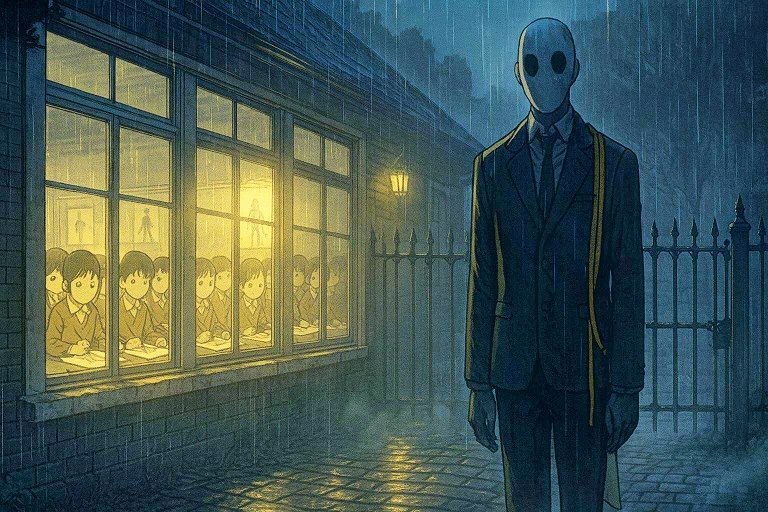
Year 1962. It had been raining since dawn and San Martín Primary School smelled of damp chalk and old books. The principal, Doña Marta Ávila, had gathered the second-grade students in the assembly hall to correct an exercise: “Draw something you remember about the rain.” Thirty-seven pencils paused, moved, and made lines with a decision no one could explain. Doña Marta, her hands trembling slightly, spread the first sheet across her desk. Second-grade teacher Herminia Rosales watched from a corner and stepped closer. They had just stacked the sheets when they noticed something wrong: although strokes varied in pressure and color, the drawn figure repeated with an unsettling precision. It was a tall man, faceless, with hollow eyes and holding a rope. Every child had drawn the same thing. “That can’t be… none of them know each other,” Herminia murmured. A boy, Tomás Gutiérrez, eight years old, stood near the desk and, without looking up, uttered a phrase that sealed the silence in the room. “We call him Yellow Echo. He appears when it rains.” The word seeped through the corridors like a dampness that did not dry. Inspector Raúl Estévez arrived that same afternoon and began to walk through classrooms and homes. He interviewed parents, checked notebooks, and dug through municipal records until he found an old note: in 1924 a fire in the hills had left the town on alert; someone, according to a clipping, had placed ropes to warn neighbors. No one knew the man’s name. Nothing explained why, in 1962, thirty-seven children who had never met would agree on the same portrait. Raúl interviewed the children individually. Each account followed a similar sequence: it rained; a sound like an echo came from the yard; then the long shadow with hollow eyes appeared and the rope. None spoke with the triviality of a child's invention; they all told it with the gravity of someone repeating a lesson learned. Luz Marina, seven, described her experience with a calm that chilled: “When it rains, I see him behind the gate. He stays looking and tells me not to make noise. He never speaks with a voice. It’s like… when someone repeats what I think.” Pablo, another child, added with unnerving matter-of-factness: “He threw the rope on me once. He didn’t pull me. He just left it on my shoulder like it was a promise.” Raúl returned that night to his boarding room with notes in his notebook and sleepless eyes. In the silence of the room, as if the rain had dragged the town’s memory up to the roof, the hollow eyes visited him in dreams. He woke with the feeling of having seen something that did not belong to him. Parents split between disbelief and panic. Some attributed the coincidence to a local folktale or a teacher who had shown the image; others began to watch the rainy afternoons as if an apparition were expected. One April afternoon, Luz Marina’s mother called in a panic: the girl had left home drawn by the call of the rain. They found her in the old house at the back, by the well, her hands white with mud and a rope tangled in her fingers. Psychologists, the priest, teachers from neighboring towns came to interview the children. All offered the same version: a faceless figure, hollow eyes, and a rope. They repeated “when it rained” as if it were an item on a list. Some said the figure showed familiar details: a birthmark, an old man’s posture, the sign of a scar on a wrist. No one could explain how they had matched so precisely. Raúl noticed a pattern: the rope was never used to tie; it always hung, supported, or held. The children called it “the promise.” When asked what Yellow Echo promised, Tomás gave an answer that sounded like a vow: “That they won’t forget. That they repeat what they hear. That they remember the rain.” A teacher asked if they remembered anything before seeing the figure. The answer was uniform: before the rain, nothing. Afterward, new dreams—fragments of other lives. Raúl began to think it was not just childhood imagination. Something in the rain activated memories the children adopted and reproduced as their own. To test it, he became an observer: he hid in the schoolyard during storms, waiting to see what the children saw. The rainiest night brought him an odd sound, like a tapping that did not belong to the water. The shadow appeared: tall, thin, featureless. The rope hung, and the air around grew colder. The figure did not speak, but in Raúl’s mind he felt a repeated phrase: “Don’t forget.” Then a foreign memory struck him: a mother sewing in a kitchen he didn’t recognize, a broken cup on a table. It was the blue pottery his family had once owned and lost in 1944. He vomited in the rain; in his notebook he wrote clinical relations and, between the lines, left that sense of having been touched by memories that were not his own. Meanwhile, in the town, Yellow Echo fed theories: mass suggestion, a school prank, a local illustrator’s circulating images. Isolation and control tests were run, but nothing explained the synchronicity. The school became a magnet for curiosity and fear; some parents withdrew their children; others stayed and kept drawing. Herminia found Tomás one day in the corridor, staring at his hands stained with a pale yellow powder that barely shimmered in the dim light. “What’s that, Tomás?” Herminia asked. “It’s from Yellow Echo,” the boy replied. “He left me a piece of promise. He says I must keep it.” The boy’s gesture carried authority; he moved his hand away when the teacher reached to clean it. That night, a neighbor heard Tomás recite dates and addresses no one had taught him. The boy didn’t know why he said them; he simply spoke them. The situation escalated until the municipality closed the school temporarily. Families who could left town. Those who remained kept the memory preserved in the yellow folder Herminia guarded—the thirty-seven sheets nobody wanted to touch. A month later, on a stormy dawn, the school burned. There was no technical explanation for the blaze. The library and Herminia’s study were devoured by flames; yet among the debris and ash, firefighters found the stacked sheets intact: the thirty-seven figures barely singed, their black lines casting shadows on the scorched paper. The community gathered around the smoking lot. Doña Marta, her hands burned, held a sheet to her chest; the figure seemed more absent than ever, as if the fire had emptied the page. Raúl, who had lost sleep since the first sighting, noted with a tremble in his notebook: “Culminating phenomenon with syncronicity and possible link to collective memory. Requires follow-up.” He did not write what he had felt the night in the yard. In his house, with rain striking the roof, he heard a rope scrape and believed he heard a repeating whisper: “don’t forget.” Over time, when the building was rebuilt and the school reopened under a different name, the yellow folder disappeared. Some claimed it had been destroyed to close the chapter; others insisted it was kept in a municipal archive. The thirty-seven children grew and dispersed. Most avoided the subject; a few became artists obsessed with long lines and faceless silhouettes. Two were later found dead with a piece of yellow rope in their hands: one a librarian, the other a carpenter who worked with ropes and membranes. The detail sparked rumors: the promise persisted. Decades later, Tomás, now gray-haired and withdrawn, accepted a recorded interview that was never played at the school. He looked at the camera with the calm of someone who keeps a secret close to the bone and said: “I don’t know if it was bad or good. I only know the rain brought voices that were not ours. It asked us to repeat them so someone would hear. It left us promises. It left us the rope.” Herminia, elderly, left a short note in her diary with less explanation and more sorrow: “The children repeated what the rain gave them. Sometimes memory comes at a price.” Later accounts from town residents added unsettling details: a woman heard her son recite the name of a woman who died in 1910; another heard precise descriptions of a kitchen demolished in 1938. An old man, Francisco, remembered a family legend that changed names but not meaning: his grandfather spoke of a man who walked the rain collecting broken memories. They called him “the echo” because he repeated voices; he had no face because he took faces. A rope, the old man said, symbolized the promises people handed over so the echo would not forget. The events left an enduring question: did Yellow Echo gather memories to preserve them, or did he tear them out so the townspeople were left empty and compelled to repeat them? No one could answer with certainty. Some believed the figure saved fragments time had forgotten; others thought he returned them with interest, demanding repetition as payment. On rainy nights, the town adopted a different habit of watching the clouds. Some shut doors and windows; others, upon hearing a faint scraping on the roof, swore it was not the wind but a rope brushing wood trying to repeat a name. The most superstitious avoided saying “promise” near children. Years later, new students began to draw without knowing the story. Sometimes the line came out crooked; other times, exact, as if an invisible hand guided the pencil. Faceless figures kept appearing in forgotten sketches, doodles, homework pages. And somewhere, in the memory of those who grew up under that rain, remained the certainty that certain words, images, and sounds can work like a tie: they bind people who never met through an echo that does not forget. The End. Source of the images. Image created with Bing.
No comments yet