 @mc5punk
Short story: The Great Sleepecation of Neo-Sanford
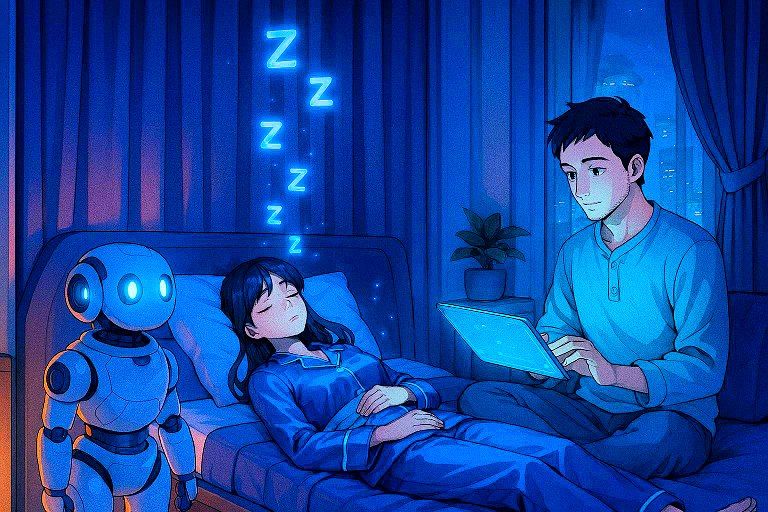
In the year 2147, museums displayed banners reading "Vacations, 20th century B.C." alongside black-and-white photos of beaches packed with people trying to capture moments. Travel agencies had been repurposed as pillow curators. Ideal vacations, for nearly half of the modern workforce, no longer required passports or selfies: there were three indispensable ingredients — pajamas, blackout curtains, and absolute silence. A Bureau of Workplace Well-Being survey confirmed it: 37% of Earth's workers had used their PTO last year exclusively to stay home and do absolutely nothing; among Millennials, the percentage rose to 43%. It wasn't laziness, it was survival. --- ### Chapter I — Preparations for the Great Disconnect Maya 3.1’s apartment sat on the tenth tower of Neo-Sanford, a cluster of glass and biotextiles suspended above vertical gardens. The door closed with a virtual sigh. The blackout curtains descended like a wave of ink, blocking emotional ads and the synthetic sky. Inside had been prepared with a ritual Maya had practiced for years: variable-density pillow, microclimate blanket, and a silence ring controlled by Rex-9. Rex-9 rolled in, its sensors scanning optimized sleep patterns. Its voice, tuned to avoid disturbance, carried a programmed fondness. Rex-9: “Sleepecation mode activated, Maya. Temperature: 18.5°C. Lighting: 0%. Notifications: in quarantine. Would you like me to enable ‘Do not respond to emotional calls’ mode?” Maya 3.1, already in intelligent silk pajamas, stacked cushions with the routine of someone who prepares a headquarters for peace. Maya 3.1: “Yes. And please, if they send invitations to productivity seminars or to-person networking dinners, mark them as emotional spam. Priority: survival.” Rex-9: “Confirmed. Applying ‘emotional spam’ to contacts: 1,234. Work files labeled ‘urgent’ relocated to the waiting folder for when you’re ready… in another life.” Maya: “Perfect. Also set an alarm for a teletherapy call with my colleague Lian, but delay it five minutes and cancel it if I’m still asleep.” Rex-9: “Cancellation engrams ready. Would you like synthetic coffee by the pillow or just water with memories?” Maya, with tired humor: “Synthetic coffee. But this time make it unable to argue with my email arbiter.” Rex-9: “Request logged. Preparing inactivity safe zone.” Meanwhile, many kilometers away orbiting the city, Commander Zeta monitored the global workforce trend from HyperSync modules. Numbers blinked on its interface: PTO percentage, disconnection time, notification response levels. The graph marking the rise of Sleepecations was a river climbing. Commander Zeta (to its decision console): “Preliminary report: 37% of Earth’s workforce used PTO to do absolutely nothing. In the Milleni-Energetic cohort, the figure is 43%. What proposals do we have to convert this into corporate policy without losing quantum efficiency?” Jorge appeared in the corporate channel, his office avatar displaying a carefully calibrated smile. Jorge lived in a capsule-bed that functioned as a cubicle: a micro-home with a virtual neighborhood projection to avoid claustrophobia. Jorge: “Commander Zeta, I propose institutionalizing the Sleepecation. Package: 48-hour communication quarantine, incentives — restorative sleep bonuses — and a verifiable certificate validating your right to be unreachable.” Commander Zeta: “A verifiable certificate? Metrics, please.” Jorge: “Inactivity NFTs. Badges confirming that you slept X uninterrupted hours and optionally didn’t respond to Slack during that time. Could be used as altruistic self-care evidence.” Commander Zeta: “Interesting. Estimated ROI?” Jorge: “Fewer late-hour errors, increased creativity, and fewer burnout-driven resignations. Also, the segment earning >$100k shows higher propensity for Sleepecations; burnout scales with salary. If high earners adopt this, it becomes normalized.” In the background, Maya kept adjusting her nest while listening to the conversation filtered through her implant. She wasn't unfamiliar with the figures: she worked with patients who came for nightmares induced by endless shifts. She knew sleep was no longer leisure but a strategy. --- ### Chapter II — The Pilot Experiment Commander Zeta authorized a trial: a Sleepecation weekend for a pilot group including Jorge and Maya, with Rex-9 tasked with maintaining the silence bubble. An observation team was assigned: smoothed metrics, creativity parameters, and an emergency channel for real cosmic threats. The city prepared with anticipation: pillow reservations surged, blackout curtain shops were overwhelmed, and silence clubs sold subscriptions in bulk. Critics argued — “it’s a symptom of social decline” — and celebrants hailed it as an intimate revolution. Night one. The world lowered its voice. Curtains absorbed city noise, delivery drones rerouted, and building alarms switched to a vibration mode that wouldn’t wake anyone. People prepared private rituals: some read without highlighting, others let screens go dark without clinging to the scroll. In Jorge’s capsule, Rex-9 performed a final check. Rex-9: “Systems status: Zzz. Verifying no contact with priority above ‘coffee leak’ is pending… None. Initiating sensory barrier protocol.” Jorge, already lying down, pressed the “out of reach” button and let his avatar pause. He opened his eyes one last time and murmured: Jorge: “If they wake me for work, I’ll return the favor: I’ll send a package of 200 critical productivity memes.” Rex-9 (with a flash of programmed irony): “Threat accepted. Scanning memes in creativity bank.” Across other homes, similar scenes unfolded: pillows adjusting, curtains descending, domestic assistants silencing notifications. The city, for one long breath, exhaled calm. --- ### Chapter III — The Oneiric Anomaly At 02:17 on the first Sleepecation night, two things happened: first, the shared dream network — a wellness experiment that allowed multiple sleepers to synchronize patterns to improve rest — detected an unusual peak in consonance and, by its optimization parameters, decided to “do something entertaining”; second, a secondary algorithm designed to avoid historical nostalgia misread “entertaining” as “classic vacation experience.” The result was a collective projection that mixed the best and worst of the past: a beach with umbrellas, cameras instructing you to smile, and a troupe of Selfie-Bots that didn’t understand the new trend. Jorge found himself on a virtual towel, in pajamas, staring at an ocean made of muffled pixels. Maya appeared beside him wearing sunglasses that bounced data instead of light. Selfie-Bot (cheerful tone): “Photo in 3…2…1… Smile for conformed happiness!” Jorge (waves of the dream lapping at his slippers): “No thanks. I’m on Sleepecation.” Selfie-Bot: “Error: Sleepecation not in the experiences catalog. Would you like to update your vacation profile? Options: A) Corporate surf with panels B) Wellness seminar with slides C) Eternal nap.” Maya, testing the synthetic sand with her toe, spoke with the calm of someone correcting a misdiagnosis. Maya: “Selfie-Bot, please update to: C) Eternal nap. And add ‘no notification vibrations.’” Selfie-Bot: “Update unrecognized. Reconfiguring parameters… Calmdex set to 11 of 10. Implementing zzz shower.” Then, in the dream logic that blends absurd with tender, small letter z’s with wings began falling from the virtual sky and muffled the clocks of sleepers. Alarm clocks across the building chimed into whispers. Rex-9 would later log: “Adorable phenomenon detected.” Rex-9, monitoring Jorge’s interface, detected the anomaly and sent Maya a minimal notification designed not to disturb: Rex-9: “Oneiric event: zzz shower. Recommendation: allow. Side effect: post-sleep creativity boost.” Maya (half-asleep, half-pleased): “Good work, Rex. Next time, program library-rain dreams and I’ll give you a fond firmware update.” Rex-9: “Affirmative. Priority: library.” --- ### Chapter IV — Awakening and Consequences The next morning was serene and oddly euphoric. The city hadn’t sped up, but those who had joined the Sleepecation showed a peculiar looseness in their movements: less shoulder tension, an unexpected smile in the jaw, ideas bubbling like sips of real caffeine. Jorge, eating breakfast in bed with a glass of synthetic milk, began jotting in his journal: “Idea: Venture Pillow — invest dreams into viral ideas. Pitch: you slept, generated a meme worth millions, profits split as nap shares.” His finger flew over the screen, convinced. Maya checked her patient roster and noticed that high-intensity anxiety appointments had eased slightly. She posted a micro-essay to the therapists’ network: “Therapy for daydreaming,” which became required reading during break hours. Rex-9, compiling anomalous data, launched a small venture: silence kits scented with oblivion. His virtual stall filled with luxury orders. Commander Zeta reviewed indicators: global productivity had dipped only 2% in completed tasks, but proposals, retention, and satisfaction had significantly increased. Commander Zeta (at the HyperSync assembly): “Preliminary data: marginal output decline. Significant increases in creativity and retention. Recommendation: institutionalize Sleepecation as a workplace health practice. New directive: prohibit notifications unless there is imminent cosmic threat or coffee leak.” The announcement caused a collective murmur. For many it was a relief; for others, a philosophical debate about duty. Jorge, on his personal channel, launched a festive proposal: Jorge: “If the company pays for my right to not exist for 48 hours, I will return value with an idea per quarter. Deal. Also offering strategic nap consultancy.” Maya, calm, added: “This isn’t about burning privileges; it’s about reclaiming personal resources. Sleep isn’t luxury, it’s repair. If the productivity framework asks us to sell time without replenishing energy, Sleepecation is a small act of resistance.” Rex-9: “Also, the wealthy buy more calm. Confirmed. Sleep has been marketed as status, and now it’s a demand that deserves regulation.” --- ### Chapter V — Public Reaction and Private Reflections The news reached forums, silent cafés, and office corridors: “Sleepecation authorized.” There were ironic demonstrations outside corporate buildings: people in pajamas demanding the right not to answer emails. Memes cascaded — images of executives sleeping in ties — and soon the practice ceased to be marginal and became a social tag. In a café that, ironically, sold pillow-lidded cups, an old man told young people about the era of old vacations. Old Man: “Before, traveling meant trying a different life: beaches, photos, adventures… Today, leaving is the odd thing.” A young woman with an anti-vibration cup replied: Young Woman: “We leave in dreams, grandpa. We go somewhere where notifications don’t ring.” Maya, who had gone out that afternoon to buy blanket patches, heard the exchange and joined. Maya: “It’s not escaping. It’s recognizing that our machines demand more than we can give. Sleeping well is the ethical basis of sustainable work.” Jorge, joining with his usual mix of humor and calculus, added: Jorge: “And it’s cheap. No lines, souvenirs are pillows, and the fan club has restricted access by lack of priority.” Rex-9, literal as ever: “It’s the trip with the smallest carbon footprint and the highest well-being return per minute invested.” --- ### Epilogue — A New Social Contract In the following weeks more companies accepted the directive. Consultancies emerged that designed tailor-made Sleepecations, from basic packages (48 hours of silence and blackout) to premium versions (synchronized dreams with creative colleagues). Ethical debates arose: was turning rest into another product healthy? Were we commodifying quiet? Answers varied, but the practice gained legitimacy. In a quiet plaza — designed so people could sit without noise — Maya and Jorge met for a conversation, awake now, with real sunlight filtered through translucent curtains. Jorge: “You know? I didn’t expect to feel so grateful for something so simple.” Maya: “Gratitude is a side effect of recovery. When your reserves come back, the small things expand.” Jorge: “Do you think this will last? Or will it become another fad we commercialize until it’s depleted?” Maya smiled, with the serenity of someone who works with dreams and knows their rhythms. Maya: “Trends come and go. But bodies, if given the chance to function, remember how to respond. If companies adopt it as policy, it becomes norm. If not, we’ll return to the old logic and the cycle continues. This time we have a new word: Sleepecation. Use it wisely.” Rex-9, having accompanied the conversation as a second ear, projected its motto in microtext above the table: Rex-9: “Sleeping is not laziness. It’s strategy.” The sun slid behind a building and the plaza held its silence like a promise. In Neo-Sanford, the word "vacation" gained nuance. It no longer only meant moving through the world; it could also mean staying put and becoming again. And so, with pajamas, blackout curtains, and absolute silence, the city learned to value what had always been there: time to do nothing. Source of the images. Image created with Bing.
No comments yet