 @mc5punk
Short story: The House of Silent Screams
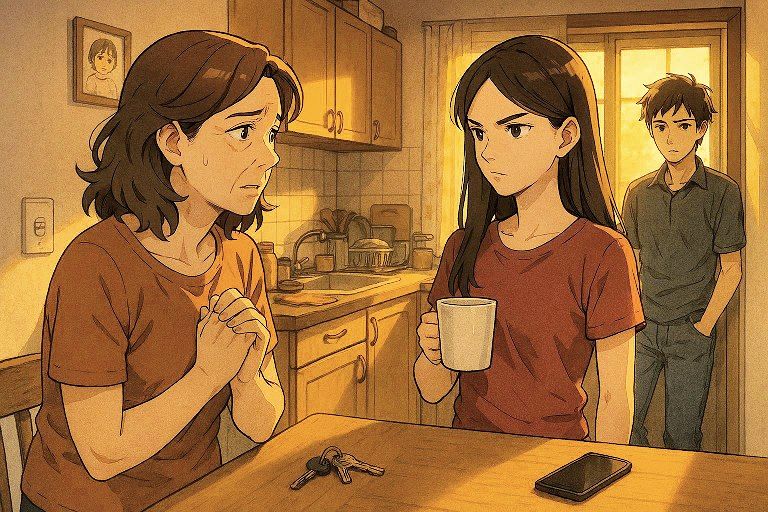
Mariana placed the key on the table with the same delicacy she always used to arrange the plates: a meticulous gesture that seemed to try to stop time. The key flashed for a second under the hallway light and then lay still, as if it were a mute witness to repeated habits. The apartment walls were covered with memories: framed photos, diplomas, newspaper clippings from a safer past. In one, a portrait of Mariana and her daughter Valeria when the girl was eight, cheeks full of carefree smiles. The image, however, seemed to belong to another house, another time; the faces had hardened over the years, especially Mariana’s, whose tenderness had turned into barbed-wire protection. Valeria arrived with her bag slung over her shoulder and her gaze fixed on the floor, as if the threshold were a border she needed permission to cross. She was twenty-two, studying at university and working part-time; her appearance was that of someone who already met external expectations but still sought the approval of the figure who had taught her to measure the world by the level of danger she perceived. “Can I have some tea?” Valeria asked, lowering her eyes before her mother could answer. Mariana, standing by the stove organizing spice jars, lifted her head with that mixture of relief and alertness that defined her. Her body seemed always to be calibrating risks: a gesture, a word, an incoming call. “Sure,” she said. “And switch your phone off at the table, you know I worry that you get distracted.” Valeria set her bag on a chair, took a cup, and moved to the cupboard. The sound of the wood opening echoed in the kitchen. Mariana’s hands moved slowly, as if each action were a check on what she could still control. “You’ll come tomorrow to the interview, right? I don’t want you to go alone.” The phrase was not new; it was a formula that had shaped Valeria’s life. Mariana closed the cupboard carefully, as if by shutting that door she sealed the possibility of her daughter being exposed without her supervision. “It’s not just any interview. If you’re going for a job, I want to go with you. I want to see the place, talk to them if necessary. I don’t like you being exposed.” Mariana’s voice sounded firmer than usual; behind that firmness was a deep anxiety, a conviction that her intervention was the barrier separating her daughter from everything that could harm her. Valeria remained still, the cup in her hands, feeling the familiar mixture of compassion and irritation. “Mom, I need to do it alone. I can’t ask others’ permission to live.” For a moment the kitchen hung between two truths: the love that moved Mariana and the need for autonomy that Valeria was claiming. The silence became an uncomfortable place where every breath seemed heavier. “And what if they make you uncomfortable?” Mariana replied, her voice yielding to fear. “What if they hurt you? I know the world is full of people who take advantage.” Valeria closed her eyes. Memories came in waves: the teacher who asked her to stay after class and Mariana’s immediate phone call; vacations canceled because “it wasn’t safe”; notes hidden in her backpack reminding her how to smile in an interview. She remembered the time Mariana showed up at the university office to ask a professor to reduce her workload because “my daughter gets too stressed.” It had been a well-meaning attempt to protect her, but for Valeria it had been humiliation and annulment. “You don’t own my fear,” Valeria said, her voice becoming firm with the effort it cost to hold. “When you do everything for me, you teach me that I can’t. You teach me I’m not capable of facing things.” The sentence fell with the weight of an accusation: not a petty reproach, but the result of years of small concessions. Mariana pale d. Her hands, which had always known how to sew buttons and heal scrapes with the same ease as they set a plate on the table, searched for an explanation, for logic to dismiss that reproach. “I take care of you because I love you,” she answered—the truest and most dangerous phrase she had. “How could I let you face the world alone if I know how much it hurts? I’d rather suffer a thousand times than see you suffer once.” It was a confession wrapped in a trap: love used as justification for control. Valeria squeezed the cup until the porcelain creaked. “Suffer so you can protect me?” she asked. “Or suffer because you won’t let me try? I can’t learn if you take away the falls.” Mariana hesitated. Her face mixed irritation, guilt, and fear. The latter dictated most of her decisions: envisioning any imaginable danger paralyzed her, and the only way to soothe that anxiety was to intervene, organizing her children’s lives as if they were fragile glass objects. In the next room, Tomás’s phone vibrated. Tomás was nineteen and still kept the patience and irritability of someone who had lived in the shadow of a hypervigilant mother. From his room, using the voice that always tried to avoid direct conflict, he asked: “Are you okay?” Mariana replied too quickly, as she always did when she wanted to prevent everything from becoming bigger than she could bear. “Yes,” she said. “Your sister is sensitive because of the interview. Don’t worry.” Tomás heard the echo of old rules. Since he was a child he had learned to measure his words, to solve chores without announcing problems, to avoid bringing bad grades or complicated relationships home so as not to spark his mother’s fears. He had learned to contain himself, to minimize. He knew the house’s invisible maps: what he could say and what he had to silence to keep the fragile calm. “Mom…” Tomás said softly. “Sometimes I feel like I lived in glass. I can’t touch anything without it breaking.” The phrase crossed the kitchen without crashing. Mariana closed her eyes; for a moment the mask she always wore seemed to crack. A memory hit her: the first time Tomás came home crying from school and she, trying to fix everything, had shown up before his teachers as if her presence alone could solve the world. That memory, once a source of comfort, now weighed differently. “I just want you to be safe,” she murmured. “You are my life.” Mariana’s voice, heavy with sincerity and fear, filled the room. Valeria stepped forward and approached, but did not touch her; the physical distance was small, the emotional one immense. “Then you have to trust. Trust that we can learn. Trust that I won’t disappear from the map. Trust that your fears won’t build prisons for us.” Valeria spoke with a mixture of firmness and tenderness. She didn’t want to hurt, but to open a crack where air could enter. She knew that behind her mother’s control were traumas and losses: sleepless nights when her daughter had been sick, the feeling of helplessness in the face of pain. That past justified Mariana’s fear, but it didn’t make it healthy. Mariana swallowed. Her breath became rough; her heart beat like a drum in her throat. Scenes flashed through her mind: the hospital with her feverish baby, the afternoon Valeria had scraped her knee and her body reacted before reason. Those moments were both refuge and chains. “And if I trust and something happens?” she asked, seeking an impossible solution. Valeria tilted her head. Her eyes shone with tears she deliberately held back, because crying in that kitchen would mean stepping back and reaffirming the pattern they were trying to break. “Then you’ll know I lived. And maybe you’ll hurt a little, Mom, but that doesn’t mean I’ll stop being your daughter. You are not responsible for everything that happens to me.” The house grew heavier, full of words and silence. Mariana stepped back, as if the idea of letting go demanded physical strength; for a moment she seemed about to collapse at the mere possibility of releasing control. Her deepest fear was losing her identity if she stopped being the absolute caregiver: motherhood had filled her days and given her meaning. Tomás dared to leave his room and crossed the kitchen to join his sister. He had the look of someone who had watched the dynamic since childhood and now, older, saw it with the clarity of one who had suffered its consequences. “That doesn’t mean you lose us,” he said. “It means we make room for ourselves too. You don’t have to disappear to keep being a mom.” Tomás’s words were an unexpected balm. Mariana looked at her children—two people growing and claiming space. She felt the contradiction: the love that tied them and the need to give them freedom. For the first time the dilemma stopped being abstract and became urgent and tactical. From the table, Valeria’s phone buzzed with a message from a friend: “Are you coming tomorrow? We need to talk about the project!” Valeria looked at the screen, breathed, and decided to close the phone with a gesture that was both small and revolutionary. “I’m going to the interview alone,” she said. “And I’ll stay for the project meeting. I don’t want you canceling my choices. I want to try.” Valeria’s words landed with the determination of someone who had thought long and hard before speaking aloud. Mariana watched her, and for a moment everything else dissolved: the house, the objects, the routines. Only that young figure stood before her, claiming the right to make mistakes. “If you’re going,” Mariana accepted, voice breaking into threads, “then I want you to tell me how you feel afterward. Tell me. So I don’t die of anxiety.” The proposal was a mix of concession and demand, a way to keep a thread of control without preventing the act. Valeria understood it as an intermediate step, a truce they could hold for now. “I will,” she promised. “But I need you not to come into the room when I ask to be left alone. I need you to trust.” Mariana nodded. That nod was a double vow: a promise to her daughter and an intention to begin working on her own fears. She knew it wouldn’t be easy; old habits don’t disappear with words. But there was something in Valeria’s look, in Tomás’s voice, that pushed her to try change. That night, when the lights went out, each of them fell asleep with a new, trembling part: a mother learning to let go without losing her love; a daughter learning to fall and rise without asking permission; a brother still searching for his voice. In the hours when the city seemed to breathe more softly, Mariana realized her life had revolved for years around a simple axis: preventing harm. Freeing herself from that axis meant opening to the possibility of her own pain, which terrified her. At midnight she woke startled by a dream in which her daughter walked down an unfamiliar street. For a moment panic seized her: she imagined extreme scenarios, improbable accidents, external threats. The instinct was to get up, go to Valeria’s room, check that everything was okay. She breathed deeply. This time, with her breathing still shaky, she stayed in bed. She did not call. She did not cross the door. She listened to the beat of her own heart and, for the first time in a long time, let time do its work without intervening. The next morning she woke with a mixture of relief and guilt. She had spent the night without acting and everything was still in place. That small success gave her a new certainty: trusting wasn’t renouncing love, but transforming it. Valeria returned in the afternoon with a story about the interview: she had felt nervous, had spoken frankly, and in the end they had invited her to a practical test. Mariana listened attentively without interrupting; when Valeria finished, her mother did not offer solutions or reproaches, she only asked: “How did you feel?” Valeria answered with the honesty of someone who had gained ground: “Scared, but happy. It felt strange not to see you in the room, but I felt capable.” Mariana nodded, and in that gesture there was something they all understood: the process would be slow and full of setbacks, but also small victories. There was pain, yes—letting go hurts—but pain didn’t have to be the excuse to refashion their children’s lives around fear. Over the weeks, small promises turned into fragile habits: Mariana stopped checking messages every hour; Valeria asked for more space without notifying every movement; Tomás stopped hiding his problems and began to speak more openly about his plans. Conversations remained tense at times, but they gained honesty. One afternoon, as the sunset stained the walls orange, Mariana stood staring at the childhood portrait of Valeria. For a moment she saw it as a compass: the love that had driven her to care should not enclose, but guide. Still, she knew fear would resurface with every unforeseen event, with every new step her children took. But something in her had changed: she now knew that protection could not be her only strategy. In the darkness that night, before sleep, she entertained the most painful possibility—that something bad could happen—and let it in as a necessary shadow in her chest. She did not call her daughter’s room. She stayed in bed, listening to the beat of her own heart, which for the first time in a long while beat with the whisper of a hand letting go. It was not a definitive act or a cure, but the beginning of a learning: loving without smothering, trusting without renouncing. And in that beginning, the house stopped being a place of silent screams and slowly became a place where voices could rise and fall without everything breaking. Source of the images. Image created with Bing.
No comments yet