 @mc5punk
Short story: The Boy with the Frozen Hair
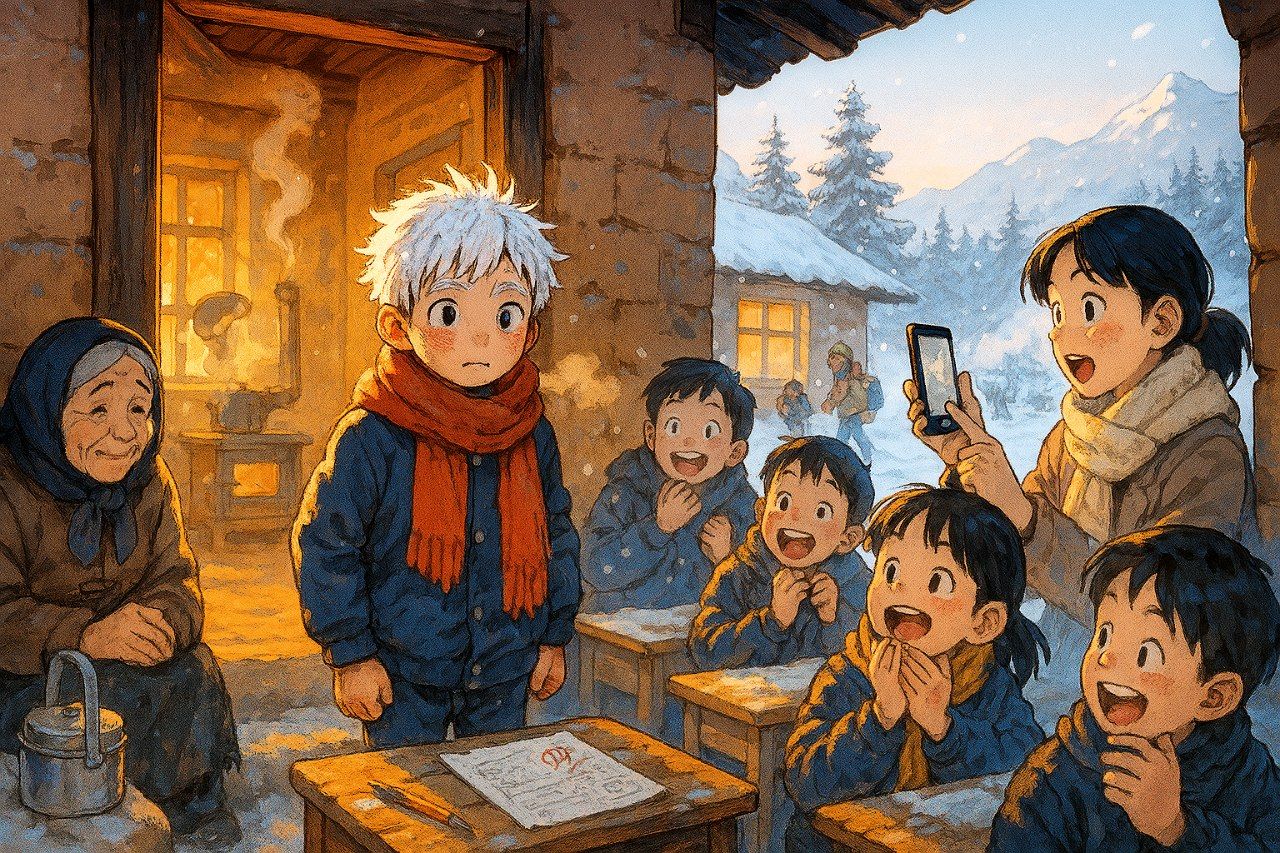
The morning in the village of Shānshuǐ dawned unlike most: a compact, dense silence with the sky washing the mountain outlines in a pale gray. The cold was not a suggestion but a law: the thermometer read -9 °C and the frost had turned the fields into broken glass. In a small mud house, beside a hearth that no longer warmed as it once did, Grandma Lín watched her grandson with rough hands and careful eyes as he prepared to leave. Wang Fuman was eight years old and possessed a determination larger than the house itself. It was not the first time he had walked several kilometers to attend school, but that morning he knew he could not miss the final exams. Grandma Lín wrapped the scarf around him as one ties a safety flag around an adventurer. "Grandma, I'm going," Wang said firmly as he adjusted the scarf until it covered his throat. "I can't miss it—today is math." "If you turn into an ice statue, I won't be able to sell you at the market!" his grandmother replied, trying to joke to hide her worry. "And bring a pot of soup for the way back; with this cold your stomach will declare war." Wang smiled with a mix of affection and haste. He didn't want anyone to worry more than necessary. He closed the door, left behind the mud house that smelled of tea and damp wood, and set off. The path to the school wound between pines and rocks; the frost crunched beneath his boots as if nature itself applauded his steps. The wind slapped his face with that reckless force that shaves the skin, and the cold transformed his hair into a hard white mass: a frozen hairstyle that made him look like a tiny old man or a snow statue in a school uniform. When he appeared in the schoolyard, the scene was both comic and sobering. The children stirred; some laughed, others stared in disbelief. Teacher Zhāng, usually a composed man, was stunned at the sight of the boy with frozen eyebrows and wind-chapped cheeks. The image was, in its simplicity, a story. "Is that a student or a penguin in uniform?" he muttered, half in disbelief and half in tenderness, before taking out his phone. "Wait—this needs to be documented." Mei and Lǐ, two classmates who laughed easily, leaned in to comment on the novelty. Whispers turned into jokes: "he looks like an ice-cream cloud," "did they pay him for the hairdo?" Even so, the laughter lasted only a few seconds. Wang crossed the classroom threshold with the composure of someone who knows why he has traveled so far and with a gesture that made clear the teasing would not distract him. He sat, rubbed his swollen hands to warm them, and set his pencil to the paper. While others chatted and fiddled with their pencils, Wang began to solve the problems with a calm that was both cool and resolute. In his head, the operations lined up with the same naturalness others use to thread beads on a string. Multiplications, divisions, fractions—each number on the test was met by him with the deference of someone who understands that problems are tamed by discipline. He muttered strategies under his breath—the voice of his own training: "Multiply, divide, breathe." His fingers, despite the cold that had made them stiff, moved with surprising precision. Those who had laughed earlier began to watch. Mei, who had once feigned indifference to avoid studying, felt a sting of shame mixed with admiration when he saw Wang finish sheet after sheet with confidence. Lǐ, who had relied on gossip rather than study, leaned over his desk and stopped moving his lips. The whole class settled into a hush of expectation: not only focused on the answers, but because the boy's attitude spoke of something bigger than a single test. At the end of the day, the results were a reality check: 99 out of 100 in math. The grade reflected will more than luck. Teacher Zhāng, who had taken the photo in a moment between surprise and compassion, uploaded the image with a few simple lines describing the scene: a student who had walked kilometers in extreme cold, a classroom without heating, and the determination not to miss his exam. The post began to travel across networks and communities within hours, crossing borders and touching hearts. The ensuing virality was not just a virtual phenomenon. The image shattered the complacency of those who saw it: donations, messages of support, and offers of help began to arrive. Organizations, anonymous individuals, and even an eccentric foreign volunteer who would later arrive with a multicolored scarf mobilized to turn concern into concrete action. Contributions for heating, warm clothing, school supplies, and repairs reached the small village like a warm rain precisely when it was most needed. Mr. Héctor—remembered by the community—arrived with boundless energy and a bag of tools. He had a foreign accent and a laugh that seemed to be out of tune with the village's concentrated silence, but his will was practical: windows, stoves, insulation. Grandma Lín, who knew how to measure help with common sense, received them with the blend of hospitality and pragmatism only those who have lived through scarcity possess. "Heating, finally!" Héctor exclaimed as he installed the first stove, his colorful scarf swinging against his chest. "Where should I start—walls or windows?" "Start by not making the drill dance in class," she replied dryly. "If you're going to drill, at least don't play out of tune." Within days, the windows were sealed, stoves installed, and the school that had sounded like a giant refrigerator began to breathe a new warmth. That warmth did not merely come from radiators: it filtered through simple gestures—coats arriving for the children, blankets for families, and new books for the library. The school's renovations meant more to the community than cement and paint; they were a promise that future tests would no longer demand extreme sacrifice. Wang returned to the school routine with the same steadiness but without ice in his hair. His cheeks regained color, and his focus remained an example for his classmates. Mei and Lǐ, who had started the morning with mockery, became humble observers. One day Mei approached and, without his usual irony, spoke words that showed he had changed. "You taught us something else," he said, honest in the way admiration sometimes is. "Bravery doesn't come in coat sizes." "And extreme hairstyles can help the world," Lǐ added with a shy smile, as if humor had softened into tenderness. Grandma Lín, for her part, did not lose the practical core that defined her. She thanked the helpers with the same firmness with which she had cared for her grandson. She took charge of organizing the donations, advising volunteers, and—of course—negotiating, in jest, a price for any frozen-hair contest volunteers might propose. "If they hold a frozen-hair contest, I'll charge admission and sell soup," she announced to general delight while stacking the donations in neat piles. The mountain mist, an almost mythic presence in the villagers' imagination, seemed to observe everything with that quiet humor reserved for one who has seen many seasons. It was as if the mountain itself approved the change: from a landscape that had challenged a boy to a community that had found a way, through solidarity, to warm itself. Over time, the anecdote became a habit of good news and small jokes. Someone seriously—and jokingly—suggested an annual frozen-hair contest, and Mr. Héctor, who never hid his taste for festivities, proposed improvements to the playgrounds, paths, and places where children gathered after class. The village changed in practical ways: more supplies, a less cold classroom, and a community better connected to resources that once seemed distant. Wang kept his 99/100 like a map of his effort—not a trophy of luck, but tangible proof that he met a challenge with diligence. The grade did not turn him into a celebrity; he remained a boy who helped carry water when needed and who sat with Grandma Lín in the evenings to listen to stories of different times. Yet his act awakened something that did not fade with spring: the idea that determination and community can transform adversity into new opportunities. Sometimes, when the wind returned and people gathered under the pines, the children would mock Wang's frozen hairstyle in jest and ask softly whether he would wear it again for fun. Everyone laughed, but the laughter carried respect. What remained clear was not the aesthetic gesture of frozen hair but the lesson that excellence and solidarity do not depend on abundance; they depend on the sum of wills that awaken in the face of need. Grandma Lín, to close conversations with her characteristic note, would remind anyone who wanted to hear: "Next time, son," she would say with that blend of affection and discipline typical of one who raises generations, "bring a pot of soup for the road. And if you want another viral hairstyle... pay my commission." And so, between laughter, new stoves, and completed exercise sheets, the village of Shānshuǐ learned that cold is best fought with human warmth, that a photograph can move mountains of help, and that a boy with hair full of ice actually had a heart burning with will. Source of the images. Image created with Bing.
No comments yet