 @mc5punk
Short story: The Blue Ribbon's Hand
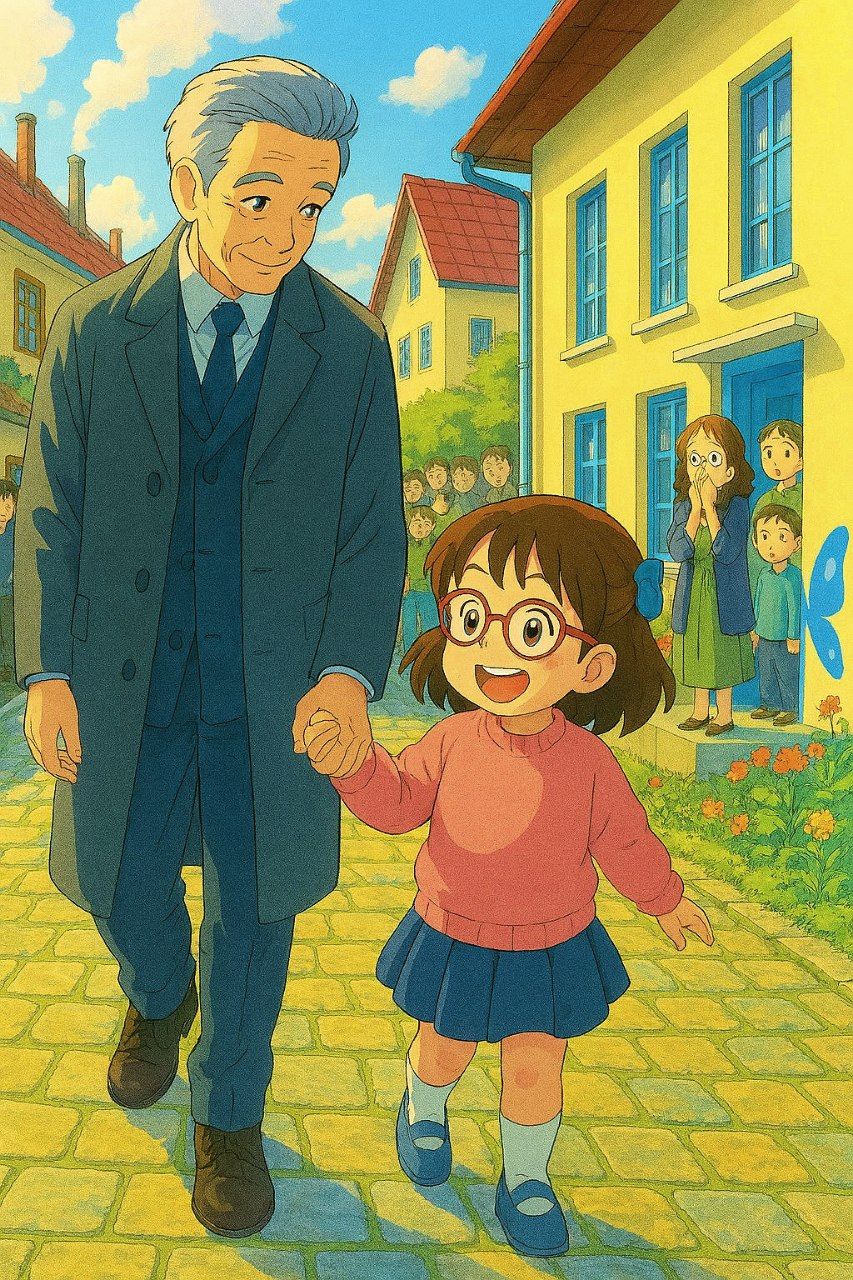
In the small neighborhood of Lirë, where narrow streets smelled of freshly baked bread and the evenings filled with the lazy smoke of chimneys, lived Ana Leka. She was eleven years old, her brown hair always adorned with a blue ribbon her grandmother had knitted, and a clear laugh that lit up any corner. Ana had Down syndrome: she sometimes walked slowly, tenderly repeated the songs she liked, and, above all, had a way of looking that seemed to stop time and cradle whoever received it. Her mother, Elda, worked sewing in a nearby workshop; her father, Ilir, repaired bicycles in the square. The family, simple and affectionate, devoted themselves to Ana with the tenderness of those who know the value of patience. The Niko School, where Ana had studied since she was little, was an old building with high windows and recesses where children ran after balls that struck the air with laughter. For years, Ana was part of that school community: she sat in the third row, repeated the poems that teacher Marina dictated in a measured voice, and loved art class, when colors and shapes allowed her to draw blue butterflies that she later hung on the wall. For many, Ana was the smiling girl with the blue ribbon; for others, merely “the special one,” a label that over time would begin to weigh more than it should. The neighborhood’s calm broke one winter when murmurs arose among some parents. What began as half-phrases—“that girl distracts the others,” “it’s not fair for my children”—evolved into coordinated pressure. Convinced that Ana’s presence “affected learning,” several parents demanded measures. At first there was no genuine attempt at dialogue with the family or an honest search for inclusive alternatives; the reaction was quick and selective. Some teachers, overwhelmed by the tension between the community and administrative demands, gave in to the pressure. The outcome sounded like punishment: Ana was removed from the main classroom and sent to a small room in the school basement, a place without heating, with small windows and old desks with wobbly legs. The little room became a sad symbol of isolation. There, Ana received instruction informally and often alone. Materials were scarce; notebooks were recycled. The girl who had once shared her colors with everyone was reduced to a routine of solitude. Teacher Marina, who had taught with passion and had always noticed Ana’s ability to memorize poems and her curiosity for illustrated books, tried to visit her whenever she could. She entered with a smile and a bag of clean sheets or a pack of colored pencils she had bought with her own salary. One morning, Marina pushed open the little room’s door and found Ana with cold hands, crumpled sheets, and a look searching for company. —Ana, come—Marina said, sitting carefully beside her—What are you drawing today? —Butterfly—Ana replied, pointing delicately to the drawing—Blue. Marina took her hand and said in a low voice, promising with the same firmness with which she defended her students: —I will fight for you, Ana. I don’t want you to be here alone. The teacher’s words could not erase the room’s cold, but they planted in Ana a hope that clung like a blue thread in her ribbon. The news of the isolation spread quickly. In the square, among conversations mixing concern and anger, opinions polarized. Some neighbors defended Ana; others, influenced by prejudice and fear, supported the decision to separate her. Ilir, Ana’s father, juggled work and the helplessness of seeing his daughter confined to a gloomy room. At dawn he sat by a lamp fixing bicycles while rage and sadness fought in his chest. Local reports described the room, published testimonies, and showed photos of worn notebooks. The story reached regional channels and, before long, landed on the desk of the country’s president, Marko Velich. Accustomed to receiving papers and figures, Marko read the case with a mix of disbelief and shame. He thought this kind of decision not only violated the law but attacked a child’s basic dignity. He decided not to remain at an administrative distance. One clear morning, without announcing it publicly, Marko took his gray coat, left protocol’s rigidity behind, and went to Ana’s house. He did not arrive with phones or press cameras; he carried only the conviction that he should accompany a gesture that said more than an official statement. He knocked, and Elda answered the door with surprise and a mixture of distrust and relief. —Hello, Ana—Marko said when the girl appeared at the threshold, bending gently—Will you give me your hand? Ana looked at him naturally, took his small hand without ceremony, and Marko felt the weight of responsibility become palpable in the warmth of that gesture. —I want to accompany you to school—he added softly—You are not alone. Word of the presidential visit quickly leaked out. People from the neighborhood began to gather, cameras surrounded the house, and neighbors peeked through windows. But the essential remained between the girl and the president who, hand in hand, walked the streets to Niko School. Their passage slowly changed the observers’ perception: it was no longer only the image of a figure of authority but that of an adult reclaiming a child’s dignity with a gesture. Upon arriving at the school, parents who had earlier demanded expulsion stood frozen; the scene seemed to require a reflection words had failed to achieve. Inside the main classroom, teacher Marina and the children stopped their activity to watch the arrival. Silences spoke more eloquently than any reproach. Ana, with determined steps, entered the class as if it had always been her home. The president paused and, looking at all the gathered families, spoke with a clear, firm voice. —Discrimination against children with disabilities is unacceptable—he said—Inclusive education is not a concession: it is a legal right. This school must be a place where all girls and boys feel safe and accepted. His words resonated in the room and beyond: in the hallways, the square, and the neighborhood’s homes. Some people lowered their gaze, others exchanged looks laden with guilt, and some, for the first time, reflected on the real impact of exclusion. Among the crowd, Ilir clenched his fists until his knuckles paled. He found his daughter among the people, hugged her tightly and whispered without looking at anyone: —Sorry. Change was not instantaneous nor a purge of old prejudices. What followed was a process requiring practical decisions and commitment. The school administration announced immediate measures: the basement room would be closed and Ana would return to the classroom with her classmates; training sessions on inclusive methodologies were scheduled for teachers; and a space for dialogue between families was opened to address fears, doubts, and coexistence practices. The community organized to improve resources: donations of materials, repaired windows, and a planned support program for pedagogy. Marina continued to be Ana’s support at school. With infinite patience and creativity, she worked on strategies so that children would share activities and learn together. Cooperative dynamics were introduced in which everyone had a role, from helping in the courtyard gardening to taking turns reading aloud. These exercises, designed to strengthen bonds, were small everyday acts that, over time, eroded distance. Ana’s classmates, initially cautious due to their parents’ influence and the novelty of living with differences, began to know her beyond the stereotype. They learned to laugh at her jokes, share snacks, and wait for her at the classroom door when she arrived. One day during art class, a group of children sat with her to draw butterflies. One of them, shy at first, said: —Ana, will you teach me how to make a butterfly like yours? —Sure—she replied, with the simple pride of one who shares. Ilir, who had taken part in the initial anger and the march that demanded her exclusion, experienced a silent transformation. Witnessing his daughter’s acceptance and the community’s response made him rethink his own beliefs. He moved from shame to action: he volunteered to help in a bicycle workshop the school organized for parents and gradually began talking with other parents about what inclusion really meant. The image of the president holding Ana’s hand was spread by national and international media. Many outlets reproduced it as a symbol of the fight against bullying and exclusion. For some it was a political gesture; for others, an ethical call for deep revision of social practices. Marko stated in public interviews: “We must protect children from bullying. There is no place for prejudice in education.” The repetition of his phrase served as institutional endorsement, but the most important changes happened in daily life: teachers who received training, adapted classrooms, neighbors volunteering, and, above all, a gradual shift in students’ perceptions. Not everything was perfect or linear. Some families maintained resistance; hurtful comments still spread on social networks. The wounds of exclusion take time to heal and certain spoken words are not undone overnight. However, Ana’s daily presence in the classroom and her interaction with classmates and teachers produced a cumulative effect: relationships among children became richer, more diverse, and over time, more empathetic. The school implemented inclusive activities for everyone: theater, a school garden, and music workshops where no one was excluded because of their pace. Ana, who had always enjoyed songs, found in music a space where her smile became contagious. Teacher Marina watched these changes with satisfaction: seeing her students collaborate, debate, and create together restored her faith in education as a tool for transformation. One spring morning, with the courtyard full of flowers they had all planted, Ana approached a newly opened blossom and, pointing to it proudly, said aloud: —Look, it’s for everyone. Elda covered her face with her hands and cried silently. It was a mixture of relief and gratitude filtered through years of anguish. The school, community, and local policies responded with actions and measures: support programs, awareness campaigns, and clear protocols against bullying were developed. Ana’s story became a catalyst for changes that transcended Lirë: other schools in the region took note and began designing inclusive initiatives. Over the months, the blue butterflies Ana drew began appearing on neighborhood walls: childish paintings celebrating difference and reminding everyone of the lesson learned. Parents' groups organized days to share experiences and dispel myths about disability. The school inaugurated a mural with butterflies of all sizes, a collective work symbolizing the diversity of its community. In later interviews, Marko emphasized the social and legal responsibility to protect children and guarantee their inclusion. But beyond official statements, what remained engraved in collective memory was the simple, powerful image: the president’s hand held by a girl with a blue ribbon. It was not an empty photo; it was a reminder that gestures, however small, can unsettle prejudices and help restore dignity. Life in Lirë continued with workdays, noisy markets, and orange-washed sunsets. Ana grew up among lessons, songs, and butterflies; her drawings became stories she told aloud in class. Marina, always by her side, continued to defend an education that welcomed differences. Ilir, transformed by the experience, opened a small bicycle workshop near the school where he sometimes gave talks to parents about empathy and cooperation. Elda, seeing her daughter laugh without reserve, wove new threads of hope. The lesson of Ana’s story did not end in a single news item: it permeated policies, conversations, and practices. What began as an injustice became an impulse to build fairer spaces. In Lirë, where the wind still carries the scent of bread and chimneys announce cold afternoons, the blue butterflies Ana drew eventually became an emblem of a community that gradually learned to accompany those it had once excluded. And every time someone passed the schoolyard mural and looked at one of those butterflies, it was hard not to remember the morning when a child offered her hand and an adult decided to walk beside her. Source of the images. Image created with Bing.
No comments yet