 @mc5punk
Short story: The House of Last Permissions
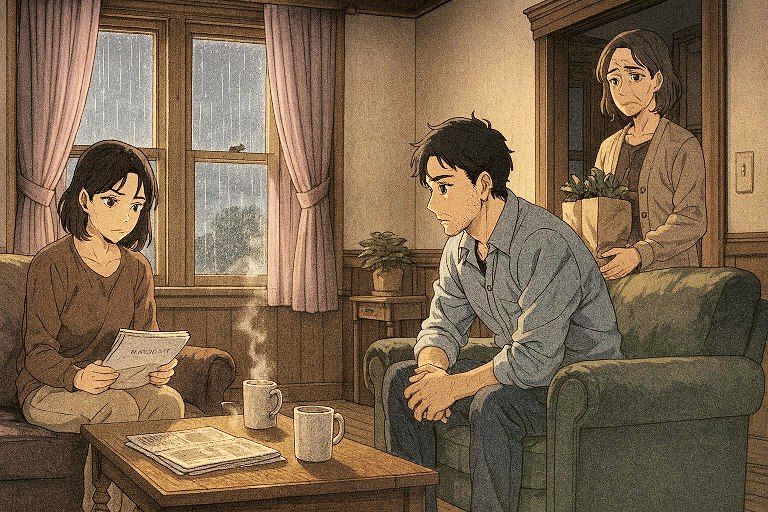
The house at the end of the block was one of those that seemed to have stopped in time: worn moldings, curtains that always smelled faintly of lavender, and a hallway that creaked with every step as if it kept an account of the years. In the dining room, a table with folded newspapers and coffee cups stained with rings. There was always a question in the air, a repeated murmur like a ritual: What do I do now? Not because ideas or desires were lacking, but because the silence after every possibility weighed more than any decision. Mariana was thirty-two. Her résumé showed modest accomplishments: she worked at a publishing house, had published small pieces, and had projects that appeared and vanished like poorly watered potted plants. At home, her plants waited for light that didn’t always come; in life, she waited for a nudge that would justify moving. She had a romantic relationship that floated between tenderness and fog: a man who called her “my love” and seemed to understand her, except when things required firmness and she, muted, couldn’t find it. The persistent feeling was that any misstep would shatter something that, deep down, didn’t entirely belong to her. One autumn afternoon, persistent rain turned the city into a gray curtain. Andrés, her brother, arrived unannounced, his hair wet and his hands in his pockets. He had come to pick up a box of old papers but stayed longer than planned. He left the box in a corner and collapsed into the living-room couch like someone settling in to talk about matters that couldn’t be postponed. “Do you find it hard to move forward even though you ‘try everything’?” Andrés asked bluntly, like someone throwing a stone to measure the depth of the water. Mariana looked at him with the usual expression of someone waiting for another to hand over the word that belonged to her. Her voice was a thread, like a breeze unsure whether to break the calm. “I try. Really,” she said. “But I freeze. I doubt everything. I need… I need someone to tell me it’s okay.” Andrés watched her for a second, gauging the truth of her words. “It’s not lack of ability, Mari. It’s not laziness. Not bad luck,” he said, his voice steady and uncompromising. She let out a small laugh that didn’t reach her eyes, resigned. “Then what the hell is it?” “Many times,” he replied, “it’s a wound that comes from Mom. When someone did everything for you—from fear, not from freely given love—your system learned: ‘I can’t on my own.’” Those words fell like a fine rain onto a surface she already knew. The image of her mother rose immediately: Ana, with her jacket buttoned against the cold, a look that probed imagined and real dangers; Ana who checked Mariana’s backpack, reminded her of her keys, and controlled even the labels on school clothes. What lay behind that vigilance, Mariana thought, had always been presented as love. “You never let me make mistakes,” she murmured. “If I were to fall, you’d already decided how I should get back up.” “That’s why it’s hard for you to decide,” Andrés replied. “Because somewhere you learned to ask permission to exist.” At that moment the front door opened and Ana came in with grocery bags hanging from her arm. She wore the expression of someone who keeps calm while feeling turmoil inside. She smelled of soap, fresh bread, and a worry that wouldn’t name itself. Seeing her, the tension in the room shifted its frequency. “Everything okay?” Ana asked, with the capacity she had to turn complex matters into household tasks. Mariana looked at her and, for the first time in a long while, felt the obligation to name what had always been the backdrop: the need for permission, the shadow of maternal oversight. “Mom,” Mariana said. “I need to talk.” Ana set the bags on the table, straightened her back as if a conversation with her daughter were another routine to be managed. Her voice was practical, ready to solve. “About what, darling?” she asked, in that tone that seeks to soften before entering choppy waters. Mariana drew a breath. Outside, the rain measured out a rhythm, and for a moment it seemed the beat would push her decision. “About you. About me. About how I grew up thinking I couldn’t move without your permission.” The grocery bags became background objects and the living room filled with a silence that smelled of years of things unsaid. Ana opened her eyes as if she’d received a question that wasn’t in her script. “I only wanted to protect you,” she replied, almost automatically. “I wanted to spare you pain.” “I know,” Mariana answered, with less anger and more exhaustion. “But it’s not the same. You didn’t prepare me to be wrong. You taught me to depend.” Their words started to reshape the room into something more difficult and, at the same time, more honest. Andrés intervened with the urgency of someone who had seen the pattern repeat and wanted it to stop supporting them. “That’s why it’s hard,” he said. “Because when Mom did everything for you—from fear, not from freely given love—your system learned something deep: ‘I can’t on my own.’ And today that shows up as constant insecurity, fear of making mistakes, emotional dependence, passivity, self-sabotage when things start going well, difficulty sustaining healthy relationships, and fear of bothering others or losing the bond.” Ana put her hands on the table and her breathing slowed, becoming more grounded and real. What came from her mouth wasn’t defense but a different tone—part guilt, part acknowledgment. “Overprotection is not deep love,” Andrés said softly. “It’s control disguised as care.” Ana let out a sigh as if the air had offered her an understanding her mind resisted. “I’m not the villain,” she murmured. “I was hurt too. I was protected until I couldn’t breathe.” The confession shifted the conversation to a more humane plane. Mariana hadn’t come to make her mother guilty, although the wound was real. What she wanted, more than pointing fingers, was for the dynamic to be seen with less justification and more shared responsibility. “I’m not asking you to leave my life,” Mariana said, with a voice firmer than she’d thought she had. “I’m asking you to let me make mistakes with you present, not piloting from fear.” Ana closed her eyes, as if the words needed a moment to settle inside her body. When she opened them, there was no denial—only an awkward, new acceptance. “And what do you want from me now?” she asked, a mixture of fear and hope. Mariana thought through her reply like someone packing light for a long trip. “That you don’t fix me before I fall. That you trust I can learn. That you stop asking permission for me to be. That you love me without making your love a control.” Their words echoed across the table, a different heartbeat. Ana brought her hands to her face, surprised by her own fragility. “I will try to hold back,” she said. “I don’t promise not to worry, but I promise to listen more and decide less for you.” Andrés looked at both of them and let a phrase fall—harsh in its truth and tender in its warning. “This isn’t fixed in one talk. It’s work for all of us. Mariana: healing is your responsibility. It’s not about punishing Mom; it’s about dropping what’s not yours to carry. Ana: you need to look at your story, too.” Mariana felt the knot in her chest, the one she’d carried for years, loosen at times and tighten at others. The conversation wasn’t a cure, but it opened a crack where light could get in. They walked after the rain; the city smelled of wet earth and the conversation continued in fragments: memories, silences, bitter laughter. From that day on she began a process made of small moves. Mariana made choices that once felt like mountains: she finished the manuscript she’d left in a drawer and sent it off; she declined invitations that drained her; she accepted a job interview in another city without asking permission to dream. Each action was both simple and monumental: sending an email without her mother’s validation, choosing clothes she wanted to wear, saying no without feeling like a traitor. Not everything moved in a straight line. There were nights when doubt invaded her and she dialed her mother’s number only to hang up before speaking. There were setbacks: a big decision she reversed because her protective voice had risen louder in the silence. There was self-sabotage—opportunities slipping by because she preferred the safety of the known. But over time those setbacks felt less catastrophic, because she could see them as part of the process rather than proof everything was lost. One night, Andrés and Mariana shared the kitchen: water splashing in the sink, the radio humming, them talking with the intimacy that only familiarity and the desire to rebuild provide. “It’s not just understanding it with your head,” Mariana said, watching the tea steam rise. “It’s like I’m uninstalling an old program that told me I couldn’t without someone else. I’m activating my autonomy.” Andrés smiled, tender in a way that avoided paternalism. “You’re going to stumble,” he said. “But stumbling is not dying. It’s learning the ground.” Mariana nodded, and determination softened her features—not the hardness of someone who blinds herself, but the firmness of someone who allows herself to grow despite fear. Months passed and the mother-daughter relationship reconfigured. There were conversations where Ana tried to restrain her urge to “fix immediately” and, with effort, asked more and said less. Sometimes she reverted to the old mode—“Are you sure? That’s not good for you.”—other times she breathed and listened: “Tell me how you plan to do it.” Mariana, for her part, learned to set boundaries without being devoured by guilt: “Thanks for worrying, but I’d like to try this on my own.” Both learned to negotiate love without turning it into guardianship. One afternoon, after one of those conversations that end in shared silence and warm tea, Ana approached Mariana with a voice cracked but honest. “I apologized the other day,” she said. “Not because I took away your freedom out of malice, but because now I understand that the way I cared for you kept you from breathing. It hurts me. I want to do better.” Mariana looked at her and understood that forgiveness was not a one-time coin to hand over; it was a process. Still, something in the house shifted. The mother stopped correcting small acts; the daughter stopped asking permission out of habit. It wasn’t a total transformation but a reordering: their bond changed its foundation. In social settings, Mariana began to notice the difference: in conversations where she used to cede her voice, she now took it; projects she’d abandoned for fear of failing she began to reclaim with small, steady steps. When she felt self-sabotage rising—accepting less than she deserved out of fear—she would ask herself a simple question: “Is this your desire or the wish of someone who fears for you?” Often the question was enough to bring her back to center. There was an event that marked another stage: a panel at the publishing house where Mariana presented a project of her own. Her presentation was imperfect, and at the end there were praise and criticism. She felt the vertigo of external judgment and, for the first time in years, didn’t seek her mother’s immediate approval to validate the experience. She called Andrés to share and he received her with enthusiasm. She called Ana too; this time the exchange was brief—“You did it.” Those two words, simple, came without correction. From his place, Andrés sometimes offered blunt reminders that served as signposts. “Healing isn’t just understanding with your head,” he told her one afternoon. “It’s releasing the emotional programming that kept you stuck. It’s activating your autonomy. It’s building identity without fear.” Mariana repeated the phrase silently like a map made into a mantra. What surprised her most was that she still loved her mother. The love didn’t vanish; it transformed. It no longer defined her life; it became a thread she could accept or loosen without being defined by it. The house at the end of the block remained home—cups of coffee, washed curtains, old conversations—but something essential had changed in how Mariana occupied its rooms: she stopped looking for approval in every gesture, in every choice. Sometimes she stumbled, sometimes she doubted; sometimes she fell back into old habits and asked for permission out of habit. And each time she did and the answer was, “Go, do it, I’m here,” the knot in her chest loosened a little more. The rain, which once felt like a metaphor for her doubts, stopped questioning which way she should go. And though uncertainty still visited her on long nights, Mariana knew something she hadn’t known before: the most important permission had always been inside. She didn’t need to erase the figure of her mother to reclaim her freedom; she needed to reorder the bond, accept the complexity of imperfect love, and learn to choose herself without guilt. The process wasn’t linear or miraculous. It was a series of small acts that, over time, changed her inner landscape: saying no, sending a text without asking for confirmation, accepting a job far away, holding a difficult conversation with someone she loved. It was also admitting setbacks and not abandoning herself because of them. It meant understanding that healing is not erasing the person who cared badly but learning to receive care without relinquishing one’s voice. By the last winter they spent in that house, Mariana hung a new plant in the window. She watered it not out of habit but from a genuine desire to see something grow by its own impulse. She watched the leaves, noticed new roots, and when she heard her mother calling from the kitchen, she felt the distance between caring and controlling was no longer an abyss. There were still difficult conversations, automatic corrections from Ana, and Mariana’s insecurities. But there was also space to make mistakes, to ask without begging, to choose herself without guilt. And so, step by step, the house stopped being a stage where everything needed authorization. Mariana learned to walk through its rooms with a permission nobody had given her but that had always belonged to her: the permission to be. Source of the images. Image created with Bing.
No comments yet