 @mc5punk
Short story: The Fog on the Lake
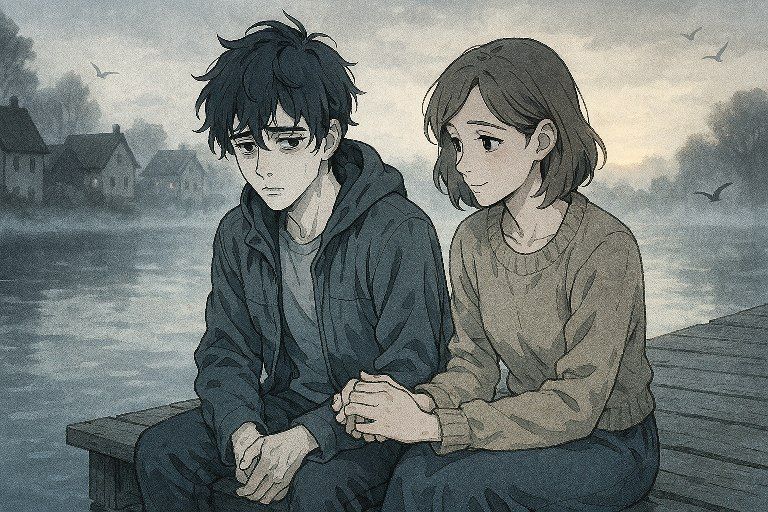
In Sombreira, a village where the gray sky seemed to mimic the souls of its neighbors, the lake was the secret heartbeat of the community. Its waves whispered confidences and the seagulls raised their chicks on the shores. But in recent weeks a denser shadow had settled over everything, a reflection of Samuel’s dimmed spirits—his once-easy laugh now barely remembered. Samuel’s Sadness One afternoon, when the sun spread pale behind the clouds, Samuel sat at the water’s edge and stayed still, staring at his own shadow on the surface. Elena, his closest friend, arrived silently and sat beside him. She watched the melancholy that marked his face. “Samuel,” she broke the silence, “I haven’t seen you laugh like before for a long time. Are you all right?” He looked at her; his eyes, once bright, seemed extinguished. “I’m a little sad,” he said, shrugging. “That’s not you,” Elena insisted, her voice cracked with worry. “You’ve always seen the world differently.” Samuel lied to shield himself: “It’s just a phase, I need time.” But inside he knew it was deeper and more ravenous than he would admit. The Specialist’s Voice The days went by and Elena’s concern grew into urgency. In a chat with friends, the subject of depression came up. María, at the village café, said lightly, “They say it’s only a phase, that time fixes everything.” That was not enough for Elena. She sought out Dr. Verónica, a mental health specialist with a calm voice and warm manner. Her office, painted in soft blues and lined with overflowing bookshelves, offered a quiet Elena accepted with some relief. “What brings you here?” Verónica asked with a smile that did not demand urgency. “My friend Samuel,” Elena confessed. “I think his sadness is something deeper. I don’t know how to help him; he always says he’s fine.” The doctor nodded with understanding. “Sadness is human; depression is something else: a disorder that needs attention.” Identifying the Symptoms “How can I help him recognize what he feels?” Elena asked, clinging to the hope of a practical answer. Verónica spoke with patient professionalism: loss of appetite is one of the signs you shouldn’t ignore. If someone stops enjoying food, if their desire and sleep change, there are clear warning signs. Elena remembered classes Samuel arrived late to, red eyes, tousled hair. “Sometimes he says he feels trapped between anger and sorrow,” she murmured through tears. “He doesn’t know how to handle it.” “It’s not easy,” the doctor said. “Many people with depression feel frustrated and alone. The first step is knowing you are not alone and that seeking help is valid.” The Revelation Back at the lake, Elena carried the conversation and the determination to speak plainly with Samuel. They sat on their usual bench, where the water returned to them a broken reflection. “I know there’s something in your eyes,” Elena began. “You don’t have to carry it in silence. Tell me.” Samuel looked surprised and then his face dimmed further. “I don’t know why I feel this way,” he said in a cracked voice. “I’m in a dark hole. Anger and sorrow mix; sometimes it’s like fighting myself and I don’t know how to get out.” Elena took his hand gently. “It’s okay to feel it. You don’t need all the answers now; just be honest with yourself.” “And what if they judge me? What if they think I’m exaggerating?” he asked, clutching her fingers with fear. “You’re not alone,” she replied. “Dr. Verónica can help you. You deserve to take care of yourself.” A small spark of hope showed in Samuel. “What if it doesn’t work? What if I never become the same again?” “It’s not about becoming exactly the same,” Elena said, “it’s about finding wellbeing. It’s a process. It’s worth trying.” Paths of Hope Samuel asked for help. At the first appointment, Verónica welcomed him with a calmness that let him speak without pretense. Slowly the sessions gave a name to what consumed him: it wasn’t weakness, but a treatable condition. He spoke of fears, of others’ expectations and his own, of sleepless nights and heavy days. “I feel like I’m in a fog,” he said during a session. “At times I think some clouds open, and other times they cover everything again.” “That’s part of the process,” the doctor said. “There will be good days and bad days; what matters is recognizing small progress.” The Light at the End of the Path With steady therapy and Elena’s companionship, Samuel began to recover fragments of himself: the music that moved him, a shared meal with friends, the simple pleasure of how the sky pleased him without question. It wasn’t an immediate reconstruction, but small, sustained steps. One afternoon they returned to the shore. The sun, shy, was breaking the fog. “Look,” Samuel said, “the sun has come out.” “It’s beautiful,” Elena smiled. “Sometimes you just have to take a step to shine again.” “I’ve learned it’s okay to ask for help,” he confessed. “I don’t have to do everything on my own.” “I’m here,” she replied, “always.” The lake, which had reflected shadows, began to show a different horizon: a mirror of possibilities. In Sombreira sadness still visited from time to time, but there was also room for healing. The fog that covered hearts slowly dissolved, and like a new dawn, life opened again. Source of the images. Image created with Bing.
No comments yet