 @mc5punk
Short story: The Pixelated Office
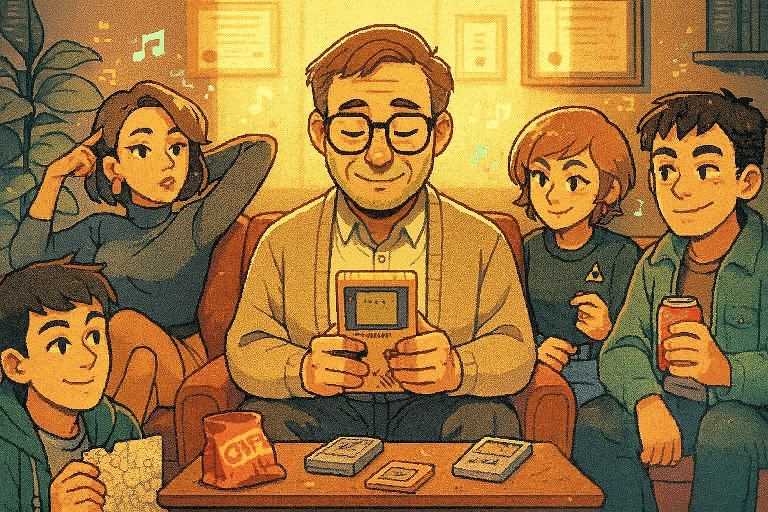
The counseling room smelled like a strange mix: fresh disinfectant, reheated coffee, and something else — the sweet scent of nostalgia, like a cartridge left too long in a shoebox. The walls, hung with diplomas and wellbeing posters, seemed to clash with a mote of dust drifting in the white light. The psychologist, a calm-eyed man with thick-framed glasses that reflected books and screens, rose with a modest bow. In his hands he held a yellow Game Boy, its screen scratched, its shell marked from a thousand falls. He cradled it like an artifact. “I’m going to explain why kids of the ’90s think differently from Generation Z,” he said, as if announcing a family recipe. “Don’t worry: it’s not science fiction, it’s domestic neuroarchitecture.” The room —filled with a mix of patients and the therapist’s acquaintances— fell into expectant silence. Marta crossed her legs and adjusted her jacket theatrically; Ana fiddled with a Zelda pin on her lapel; Luis nodded with the pride of someone who already suspected the moral; Tomás wore the confidence of a man who still draws maps on napkins. The psychologist began with a decidedly dramatic gesture. “First: the emotional gym of cartridges,” he announced. “Three lives, no more. One misjudged jump, one cruel loss, start again.” He told small but precise stories: Mario pushing you into the void without mercy, Sonic turning platforms into lessons of millisecond timing, Prince of Persia punishing hesitation with the cold embrace of a pixelated abyss. There were no tutorials, no auto-saves; only a reset button that returned you to the starting point and the obligation to begin again. “You failed and you returned,” Luis said, his voice honoring a merit forged in trial. “I broke a controller as a kid and my mother looked at me. ‘That will teach you not to hit things,’ she said. She didn’t punish me by taking it away; she punished me with free domestic life lessons.” “What I learned,” Marta intervened, “was planning. You had to memorize patterns, calculate jumps, save lives. It was rudimentary patience, but effective.” The psychologist nodded. “It’s involuntary training. Your brain practices trial-and-error until the response becomes automatic. Habits are built that are resilient, and if repeated enough, they become character.” Then the tone of the room shifted; the walls seemed to gain an 8‑bit texture and, for a moment, everyone heard a faint echo of chiptunes and jump sounds. The conversation moved on to spatial memory. “Tetris, Doom, Zelda,” the psychologist said. “Games without maps, without arrows to hold your hand. You had to remember routes, turns, chest locations. That strengthened the hippocampus — the part of the brain that helps us navigate the world.” Tomás, who had long kept the habit of drawing maps on napkins, boasted: “I get lost in modern shopping malls,” he said, “but give me a napkin and I’ll make you a battle plan. A GPS takes you straight; memory makes you owner of the space.” Ana laughed and added: “Today people ask Siri where the fridge is. If Siri failed, many would have an existential crisis.” Hearing that, the psychologist brought out his favorite contrast: defined endings versus infinite worlds. “Games ended. There was an ending, closure, a chiptune anthem and credits that returned you to the living room. You turned off the console, you ate, you lived. There were limits.” He contrasted this with the current landscape: Fortnite and Roblox, platforms that exemplify what he called “perpetual stimulation.” There is no definitive end; the activity is designed to expand, to hook you. The consequence: learning to tolerate, and at the same time to seek, constant stimulation. “Before, the ending returned you to life,” he said. “Now real life has to compete with a continual stream of rewards.” At this point the debate became personal and funny. Luis recalled how his father used to force him to turn off the console at dinner time. “‘Ten more minutes,’ I’d say,” he remembered. “‘No,’ my father said. ‘If you keep going, you’ll become a houseplant.’ The deal was harsh, but effective.” Marta clapped the armchair and pointed to another aspect: face-to-face socialization. “Sharing the same couch,” she said. “One controller for two, shouting and negotiations over who gets the next level. That taught you unwritten rules: wait your turn, coexist in defeat, celebrate small victories.” Ana replied wryly about the current era: “Now you connect with three hundred people you don’t see while sitting alone in your room with headphones. We share screens, but not the air.” The psychologist smiled tenderly. “Sociality then was physical, sensory. You learned to read gestures, to negotiate, to lie with a look. Sociality now is another thing: communication is exercised, yes, but something of face-to-face reading is lost.” The subject of reward took the conversation to a more serious tone: dopamine and the economy of immediacy. “Before,” he explained, “you waited a week for a magazine with tips. You saved for months to buy a game. Reward came after waiting, and that waiting reinforced frustration tolerance.” Ana made a conspiratorial face. “I had a coin jar with Pokémon stickers,” she said. “Today you buy a skin and dopamine fires in milliseconds. Instant gratification became the new social club.” The psychologist added a clinical observation, the tone of someone who’s seen this dynamic in patients: “When your brain learns that satisfaction always comes quickly, life that requires delay and effort feels slow and sometimes intolerable. It’s a mismatch between the pace of instant rewards and the real demands of adult life.” Then, with a glint almost mischievous, he addressed deep concentration: that near-religious state where you lose yourself in a task until it’s solved. “The afternoons of the ’90s demanded sustained commitment: hours glued to the screen with no notifications, no browser tabs fighting for attention. That cultivated the capacity for deep focus.” Tomás added, half-joking and half-serious: “Once I locked myself in my room until I beat a boss. I came out as though I had won a mental endurance marathon.” The psychologist concluded that Generation Z carries a different relationship to attention: fragmented, shaped by interruptions and FOMO. It wasn’t a condemnation; it was a description. The session that had started with a Game Boy and a clinical attempt at explanation grew into a chorus of stories. The therapist paused and let the attendees tell anecdotes, each enriching the mosaic: the time Luis hid a cartridge under the bed, the time Marta saved for months and cried opening the box, the time Ana negotiated a “half-hour more” and still recounts it as a small triumph. “What you repeat,” the psychologist said at last, “is the app you install in your brain. If you repeat trial-and-error-patience, the brain learns to tolerate frustration. If you repeat instant gratification, expectations recalibrate.” There were laughs and silences. Glances moved from the Game Boy to each other’s faces, and in that shared look you could read complicity, pride and a precise melancholy. No one dared say “the past was better,” but there was tacit agreement: every era brings strengths and traps. Before leaving, Ana, conspiratorial, asked: “So what do we do? Do we train patience as a muscle we forgot?” “Exactly,” replied the psychologist. “We can choose practices that work patience, spatial memory, real connection. Not to demonize Gen Z, but to expand options. It’s about training intentionally.” The Game Boy remained on the table like a baton. In the pencil cup, batteries gleamed metallic. As they rose, Luis couldn’t hide a gesture of affection: he approached and touched the console almost reverently. “A quick round?” he asked, half a joke, half seduced by the familiar mental state. The psychologist raised an eyebrow and, after contemplating with the solemnity of a moderator in an intergenerational debate, set a condition that provoked laughter: “Only if you promise to turn it off when it’s over,” he said. “And if you save, make sure you go out for a walk afterward.” “But can I save?” asked the young man who had defended streaming benefits minutes earlier, seeking middle ground between worlds. “You can save,” the psychologist agreed, “in exchange for committing to restart real life with the same discipline you use to beat levels.” The young man smiled, accepted, then added with the mix of mischief and sincerity unique to those raised between cartridges and updates: “Deal. But believe me, the boss has a vulnerable window.” Laughter filled the room. Marta, ever practical, fished a pack of retro chips from her bag (instant emotional nourishment), opened it and shared. Luis raised a can of soda as a symbolic toast. “To lost cartridges and batteries that never lasted long enough,” he declared. They clinked drinks and smiles. The Game Boy blinked on the table with the enigmatic calm of one who’s watched generations play, learn, fall and get back up. The counseling room slowly returned to its normal size: framed diplomas, the potted plant in the corner, the white light that no longer flickered like a CRT. But something lingered in the air: the feeling of having rediscovered something —not a perfect past, but a way of seeing the world that could be reclaimed on purpose. As they left, Marta hung back for a moment and said quietly to the psychologist: “I’ll try turning off screens ten minutes before dinner. Maybe I’ll memorize the recipe.” The psychologist looked at her and replied with a smile that tasted like a benign edict: “Start with the screen, end with the street. It’s a more human training plan.” The door shut, but the Game Boy stayed, witness to stories and promises. Outside, the afternoon moved at its usual speed and, yet, something was different: a small group of adults carried inside them a pixelated resolve —the intention to deliberately train patience, memory and connection. Not to return to the past, but to use it as a palette to paint a more bearable present. And in each mind lingered the image of a cartridge that, with its limits, had taught many to try again. Source of the images. Image created with Bing.
2 comments
Beautifully written. The story flows naturally and feels honest without trying too hard.
Thanx 🙂