 @mc5punk
Short story: The Sanctuary of Figures
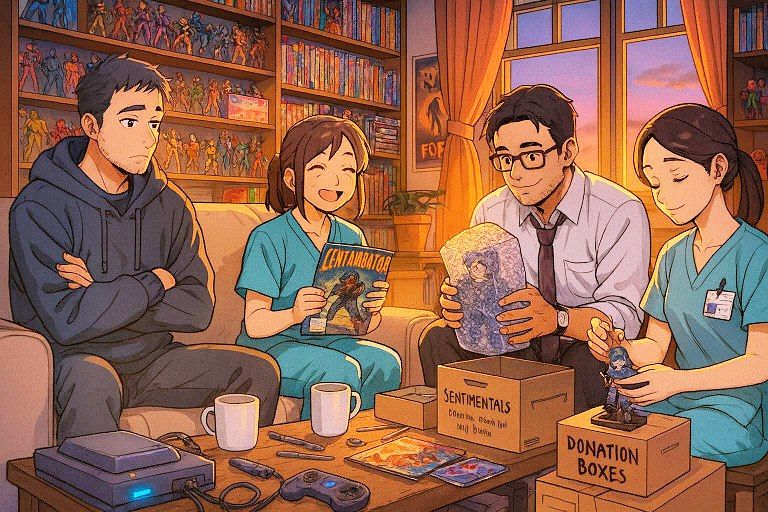
Eduardo woke up on a Sunday to an alarm emulating an 8-bit effect and, without an ounce of shame, answered with a vocalization that sounded more like a forgotten video-game hero. He was thirty-two, and his apartment was not conventional: it was an emotional sanctuary where every shelf, box, and poster told a small geography of his life. Action figures posed dramatically on ledges, comics were organized by color as if for chromotherapy, and in one corner the console projected a blue light that gave him the same sense of security a pacifier once had. Martina was already awake. Cups of coffee piled on the table, two notebooks full of convention notes, and a comic signed by an artist she had followed since she was twelve. Her eyes shone with a blend of devotion and efficiency: attention to detail and passion combined in someone who could recite editions, reprint dates, and the price of a limited-run figure. “If you reach Friday with two unopened, it’s not burnout; it’s art,” Martina said, sliding the comic between her fingers as if holding a relic. Eduardo looked at her and grew solemn. “Then I must be in full Renaissance: I have at least five masterpieces to open.” “Óscar—” a voice yelled from the hallway— “did you bring the figure?” The door opened and Óscar entered as if returning from a minor conquest, cradling a package wrapped in bubble wrap. He was a lawyer, tall, with that mix of seriousness and pride that makes every acquisition an act of personal affirmation. “I brought the limited edition,” he announced, placing the package on the table with the reverence of someone depositing a certificate. “It’s worth more than a master’s tuition, but it reminds me I survived worse trials.” Julia, who had just finished a night shift at the hospital, set a bag of assembly materials on the table. Her gaze was practical: skilled hands, the patience of a nurse, the ability to defuse urgencies with a calm others envied. “I brought supplies and chocolate. Priorities,” she said as she opened the box with surgical precision, letting pieces fall into place as if the figure already knew where it wanted to be. The afternoon began with a seemingly frivolous mission that nonetheless carried symbolism: organizing the display case. It wasn’t just about aesthetics; it was a staging of moods. “Emotional symmetry is crucial,” Julia decreed, placing a frowning figure next to another wearing an excessive grin, as if their coexistence would prevent sentimental catastrophe. “Let’s align emotions by color: melancholy blue, euphoria yellow, anxiety gray (we’ll keep that one out of sight),” Eduardo said in the tone of an occupational-therapy professor, moving pieces like a clinician might. “And nostalgia?” Martina asked. “Where do we put that?” “In the center, like the sun,” Óscar said solemnly. “If nostalgia goes out, the whole system collapses.” They worked in silence at times, between laughs and small aesthetic disputes. Positioning a figure involved decisions: should it face forward or toward the window? Should it have its back to the most valuable piece? Every posture warranted conversation. The ritual then shifted into a session of self-knowledge. Óscar, who argued serious cases by day, unleashed himself on the console. He sat upright, grabbed the controller, and furrowed his brow with the concentration of a prosecutor confronting contradictory evidence. “If I beat the dragon on level three, I’ll be able to ask for the raise without sweating,” he declared, pressing buttons with the intensity of someone preparing an argument. For him, victory was a ritual that injected confidence to face a negotiation at the office. “And if the dragon represents your boss?” Julia asked with a half smile. “Will you present evidence after the fight?” “No need,” Óscar replied, glued to the screen. “Winning brings the aura.” Martina, by contrast, played with another intention: her avatar collected virtual flowers with the solemnity of a monk in retreat. She didn’t compete to win; she gathered small in-game objects like someone who cares for little gestures. “It’s gratitude for the physics of the pixel,” she announced aloud in a moment of ecstasy upon picking a flower. No one knew if she was joking or inventing the definition of an academic treatise. “Is that taught in some workshop?” Eduardo joked. “Because I need intensive pixel-gratitude classes.” They laughed. Stories of childhood, convention anecdotes, and impulsive purchases followed. Between comedy and complicity, the conversation opened to more serious topics without losing the lightness the ritual allowed. A few days later an envelope arrived that altered the atmosphere: the job offer. Eduardo held it between his fingers and looked at it like a figure you must decide whether to display or store. “Are you moving?” Martina asked, closing the comic at last. “It pays better, but it would mean moving far away,” Eduardo said. “And my sanctuary? And the display case?” Óscar put the figure on the table as if delivering emotional jurisprudence. “You can always pack the move in three boxes: essentials, sentimentals, and ‘no, please.’” “Put it in ‘sentimentals,’” Julia suggested. “And write a note: ‘Open me when you feel brave.’” Eduardo smiled with gratitude. He wrote the note with the same solemnity with which contracts are sometimes signed: “Open me when you feel brave,” and placed the package in the indicated box. It wasn’t grandiose; it was a small ritual of commitment to himself. That night, with a bottle of wine open and pieces scattered across the table, Martina confessed something she had been carrying in the backpack of fatigue. “I’ve bought boxes of figures after rough shifts,” she said between sips and parts. “It’s comfortable: figures don’t ask me to explain why I’m tired.” “Do you worry about accumulating?” Julia asked, looking at her friend with the warm professional tone of someone who listens to late-night confessions. “Yes,” Martina admitted. “Sometimes I fear it’s an excuse not to face other things.” Julia, with the serenity of someone who has seen patients negotiate with their emotions, proposed an experiment: “Label every purchase with an emotional reason and review it three months later. If the reason is ‘Sunday sad impulse,’ the figure should find a new home.” “Sounds sensible,” Óscar said. “Apply it to exes too, please. Less drama.” The proposal had the efficiency of a clinical technique: name impulses, submit them to a time window, decide with a cooler head. Eduardo was surprised to discover that many of his purchases were wrapped in what he began to call “emotional chemistry”: memories of his father, study nights, broken promises turned into plastic comforts. Their enthusiasm for testing the method led them to a collectibles fair that turned each stand into a time capsule. The place smelled of glue, nostalgia, and snacks; people wandered in ’90s band shirts carrying bags of small relics. In one aisle a couple argued over a Funko. He wanted it as an investment; she wanted it because the piece connected her to childhood. In the end they bought one each and left a third copy on a swap table for whoever needed it. The scene summed up the issue perfectly: collecting as investment and collecting as moral memory. “That Funko was mine in high school,” a man said, pointing at a shelf with watery eyes. “And now?” Julia asked, watching the fervor with the distance of someone who witnesses repeated human rituals. “Now it’s mine, and it always will be,” the man declared, with the vehemence of someone staking rights to his past. Elsewhere, a booth offered a talk on mental health sponsored by a brand of figure-carrying bags. The mix of earnestness and commerce seemed a faithful reflection of the kidult phenomenon: a market that monetizes emotional anchors. Back home, loaded with bags and anecdotes, the four weighed things on the living-room floor, surrounded by open boxes, half-assembled parts, and a ’90s movie playing on the TV. They felt a quiet satisfaction, like someone who has finished a therapy session and also eaten pizza. “Playing hands us out emotional responsibilities,” Óscar said, a bit soberly. “One day you deal with bills, another you defeat dragons. Both actions restore a sense of competence.” “So,” Eduardo said, holding the note in his hand, “if a figure makes you call a friend, great; if the smile replaces an important call, bad idea.” Julia nodded with the clinical calm that comforts. “Practical rule: if play adds life, continue; if it subtracts life, redefine.” That evening, amid laughs and measured silences, more intimate confessions came forward. While assembling a figure with clumsy hands, Martina voiced a metaphor that moved the group. “Sometimes I feel that putting this together is building my own story. If I break a piece, I force myself to rebuild.” “Then don’t break any,” Eduardo answered in a coach-like tone. “But if you do, call someone. No manual substitutes a friendly voice.” It was a promise trivial and profound at once: using community as antidote to the isolation some collections create. They cultivated a new social practice: donate pieces, trade stories, use collecting as a bridge between generations. Soon after, Eduardo decided to accept the job that required the move. He bought a smaller display case for the new living room, packed some pieces into the “sentimentals” box, and chose to donate others to a community center where children and adults could swap stories and figurines. He didn’t act out of heroic detachment but out of the realization that the genuine value of his objects wasn’t rarity or price but their power to generate encounters. “Are you doing this for heroic detachment?” Óscar asked, curious. “More like altruistic selfishness,” Eduardo replied with a smile. “I want to see someone discover the magic I once had.” The fair, the labels, and the quiet votes about what to keep and what to give away became a small lesson. Sharing pieces proved therapeutic: seeing someone find joy in something you once loved didn’t diminish ownership; it multiplied it. The night Eduardo closed the last box, Martina had a rough shift. When she returned she found a figure on the swap table that reminded her of something she’d lost as a child. She didn’t buy it on impulse; she picked it up and, instead of stashing it away, called someone to recount the shift. The act was simple but significant: the piece acted as a catalyst for human connection. The comedy of the kidult phenomenon lay in that absurd, lovely mix: adults arguing about the best posture to display a figure as if drafting a code of ethics, applying emotional productivity metrics to leisure time, celebrating a reissue with the same intensity as a sincere encounter with a friend. “What if one day we don’t want to play?” Óscar asked as they turned off the TV and the console’s blue light dimmed. “Then we rest,” Julia replied. “But we’ll know where our toolkit of emotional aids is when we need it.” They laughed, fixed pieces, and shared stories until the lights dimmed. The original question—how far is healthy play and when does it become excess?—remained open, but it ceased to be an accusation. It became an invitation to deliberation: practice play as soul exercise, with awareness, limits, and company. In the end, Eduardo left the figure in its box with the note “Open me when you need courage,” placed it among the sentimental items, and moved. The smaller display shone in the new living room; some figures found new homes in the community; others stayed with them as witnesses to a stage of life. And when Martina had another hard shift, the network they had woven proved useful: a figure on a swap table made her smile, and that smile led to the call she needed. Adulthood, they concluded without grandiosity, is not defined by renouncing childish pleasure but by choosing intentionally when to open a box, when to donate a piece, and when to turn off the console to live what happens outside the screen. Playing wasn’t escaping: it was practicing curiosity, patience, and laughter. The true measure wasn’t how much one collected but whether that act multiplied connections or isolated them. Amid laughter, debates about limited editions, and therapeutic gameplay sessions, the group adopted a motto: “If play adds life, continue; if it subtracts life, redefine.” It was a simple, almost poetic slogan that accompanied them when, years later, someone left a figure on a stranger’s table and received in return a smile worth more than any limited edition. Source of the images. Image created with Bing.
No comments yet