 @mc5punk
Short story: The Return of the Lights
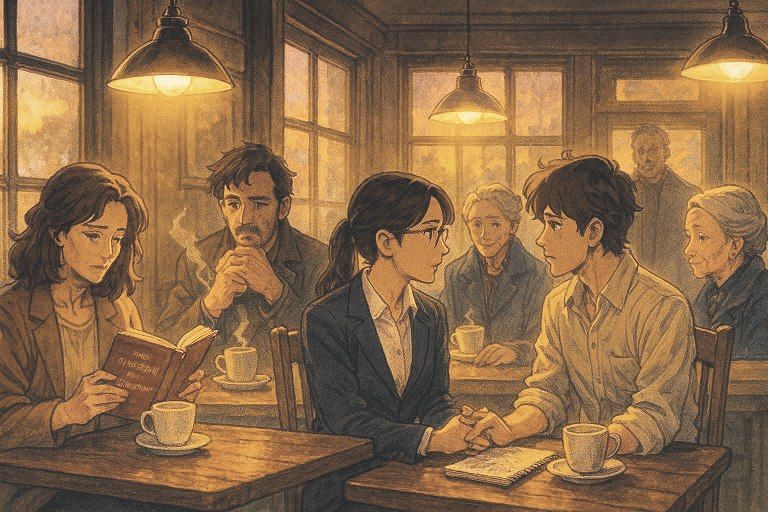
I The city wore that end-of-year air: lit windows like steady breaths, dry leaves clinging to curbs, and a comfortable melancholy seeping through door cracks. In the old neighborhood, a café with wooden tables and hanging lamps that looked like beacons gathered those who still preferred human warmth to a cold screen. There, by the fogged window, a group met that would, without knowing it, disassemble and recompose the idea of what living together means in contemporary days. Clara arrived before the others. She held a copy with a slightly worn cover: The Syndrome of Superwomen. She carried it with the reverence one reserves for an object that stirs one’s own past. Around her voices filtered in, but she seemed inside a bubble where phrases took the shape of portraits. She had read the book more than once, not out of devotion to the author but because its thesis haunted her like a persistent notification: that the professional and social achievements of so many brilliant women do not automatically translate into more romantic opportunities; on the contrary, they sometimes push them away. Raúl arrived with that mix of affection and teasing that only university friends retain. They had shared exams, laughter, and long nights; now they shared an interior geography of memories. His voice, when he sat down, carried the surprise of someone who does not know whether to laugh or be serious. “Are you still reading it?” he asked as he pushed his cup forward, hoping to warm more than his hands. “Not for fashion,” Clara replied with a tired smile. “I read it because it questions me. Listen to this: ‘Women are disappointed by the insufficient evolution of men, and men are disoriented by the evolution of women.’” The words hung between them, heavy and clear. Raúl frowned, not so much in disagreement as from the discomfort of what certainties state: that two social halves that thought they fit together were now dancing to different rhythms. II The bell over the door jingled and Marta and Javier entered, nearly arm in arm as if they needed the certainty of touch to cross the cold. Marta was a lawyer, and her step had the firmness of someone who has learned to stand in courtrooms and boardrooms. Javier was a designer; his hands held the memory of pencils and grids, and on the notebook he placed on the table were quick lines, as if he needed to draw the world to understand it. They sat with the warmth of novelty settling into the everyday. Marta glanced at the book in Clara’s hands with a mix of curiosity and reluctance: the pages spoke of something she lived in her skin but did not always find the words to explain. “What are you talking about?” she asked directly, the question of someone seeking maps not to get lost. “About a crisis,” Clara said. “That in the West there’s a tension between enormous female advancement and a male evolution that, according to the author, hasn’t fully kept up. Women’s achievements haven’t opened a fan of opportunities in love; sometimes they’ve closed doors.” Javier put his notebook aside and rested his forehead on his palm, as if trying to order a complex idea. “Do you feel avoided?” he asked honestly. Marta looked out the window where lights trembled like small questions. “Sometimes. I’ve been ambitious, worked, trained, and fought for a place. But often the emotional world still expects a woman who fits roles that no longer interest me. There’s a double mandate: succeed and at the same time remain ‘easy’ for love. That wears you down.” The sentence opened a small crack that released experiences often stacked in silence: dates that end in awkwardness when female success is read as a threat; invitations turning into evasions; men who approach timidly, not out of respect but insecurity. Raúl, who had his own contradictions, chimed in with a question that carried both defense and vulnerability. “It sounds paternalistic: ‘men have to get their act together.’ Who sets that pace of maturation? Are men or women being asked to change, or society?” III Elena appeared nearly without sound. An older woman in a blue coat, her face held years of listening and accompanying. She had been a couples therapist and, though retired, still had the patience of someone who knows major things are never resolved in a hurry. She came closer because the words at the table reminded her of the consultations she’d attended for decades: loves worn down by an absence of words, couples confused by preestablished roles, individuals without emotional maps. “I read the book,” she said softly. “Antoni gives a diagnosis, not a magic recipe. He speaks of personal and social responsibility. Maturity isn’t a trend: it’s intimate work that must be practiced.” Marta, seeking guidance, asked with the urgency of someone who wants to avoid painful mistakes. “How does that translate into day-to-day life?” she asked. “What do we do so the distance between what we are and what society asks of us doesn’t become an abyss?” Elena sipped her coffee and let silence do its work. Then she listed, calmly, as one who has seen that simple formulas are often the hardest to apply. “Three things, repeated and practiced every day: transcendent acceptance, constructive intelligence, and personal maturation. Accepting that we have changed is not resignation; it is acknowledging that life has transformed us. Constructive intelligence is negotiating roles with care and honesty, not imposing them by tradition. Personal maturation is the intimate discipline of looking at our wounds and working on them without looking for scapegoats.” IV The afternoon unfolded in layers. Miguel walked into the café like someone walking into a second home: he now ran an NGO and had the seriousness that comes with public responsibility. He had been Clara’s classmate years ago, and his presence added another perspective—the one of people who work with young men and see how new masculinities form. “I work with young men,” Miguel said. “Many are lost because the expectations they receive are contradictory: they are told to be free, but no one teaches them to be with others without competing. They lack models of vulnerability. That’s not anyone’s fault in particular; it’s a failure of emotional education.” Javier listened closely. He paused and confessed, with a faint blush, what he had learned through trial and error. “I thought a certain hardness was part of being ‘masculine.’ It took me a long time to allow tenderness. But when I did, I didn’t lose anything; I gained closeness.” The table turned into a kind of gentle confessional. Stories intertwined: women promoted at work who lost pieces of their intimate lives, men who felt disoriented without emotional manuals, couples renegotiating old agreements in light of new forces. “Bolinches warns of a ‘war of the sexes,’” Clara said. “I don’t want to be alarmist, but there are real tensions. If we don’t manage them, frustration can become distrust, and distrust can become aggression.” V Soon the talk turned practical, because among all those diagnoses there was an urgent need for touchable, testable solutions. The table filled with modestly revolutionary ideas: dinners devoted solely to expectations spoken without judgment, community workshops on emotional education, men’s spaces to practice vulnerability without shame. Marta and Javier made concrete agreements: split household tasks not according to abstract ideals of fairness but according to what each could and wanted to do; meet weekly to speak about feelings and small resentments that, unvoiced, calcify into walls; accept therapy as a preventive tool rather than a last resort. Elena and Miguel offered to organize a workshop at the neighborhood cultural center. The idea was simple: teach young people and adults to identify emotions, to communicate boundaries, to negotiate affection without turning relationships into battlefields. It was a community gesture that said transformation is not only individual but social. VI As night fell, the café lights grew more intimate. The farewell was slow, like someone reluctant to break a truce. Raúl, who had watched the conversation with the nostalgia of someone who believes the past contains valid codes, asked with a mixture of tenderness and humor. “So, what do we do first? Get our act together?” Clara closed the book gently on the table, like someone who closes an old wound but does not rule out returning to it. “Yes,” she said. “But without blowing the fuse. Start by listening—small acts of daily courage. There’s no single recipe. There’s commitment, patience, and the willingness to make mistakes without turning them into sentences.” They walked out into the December cold. It was a small cinematic moment: breath vapor, crisp bags, footsteps on cobblestones. Each returned home with something new: promises, ideas, a workshop signup, the feeling of having lit a small lamp. VII The following weeks brought practical work. Marta and Javier tested their agreements; there were tense days and tender ones. Not everything worked the first time: routines needed adjustment, and habits proved stubborn. But there were concrete advances: honest talks about family fears, moments of support when one came home exhausted, and a decision to attend a therapy session together to avoid repeating inherited patterns. The workshop Elena and Miguel ran at the cultural center drew more attendees than expected. Young people came who, for the first time, heard that vulnerability is not shame but possibility. Men arrived who admitted they had learned to disguise rather than express. Women attended wanting to be heard without their voices being construed as threats. The sessions didn’t resolve everything, but they provided tools: communication practices, empathy exercises, small coexistence contracts to try in real life. VIII Over time, Clara’s copy of Bolinches’ book remained in the bookstore window, a discreet beacon inviting reading and debate. But what was planted at that café table became something else: not passive acceptance of a diagnosis but a collective and practical response. The author’s prescription—transcendent acceptance, constructive intelligence, personal maturation—stopped being a printed phrase and became an everyday discipline. Clara, who had come in carrying resentment and nostalgia, found in the conversation something unexpected: the possibility of believing in love again without shortcuts or renunciations. Raúl, who feared losing certain privileges in the transformation, learned to value an intimacy richer than preset roles. Marta and Javier continued building, imperfectly and bravely, their own way of being together. Elena, in retirement, confirmed that listening remained the primary therapeutic principle. Miguel kept creating spaces, this time equipped with better tools. IX The city carried on: lights turning on and off, loves born and eroded, people learning to read one another’s signals. The feared “war of the sexes” didn’t break out—not because the threat didn’t exist, but because some chose to invest in bridges rather than trenches. It was slow work, often imperfect, but real. One January night Clara walked alone down the avenue. She carried the agenda where she had written upcoming workshop dates. Passing the bookstore, she looked at the cover of the book that had brought her to that conversation. She didn’t buy it. She simply watched the street: couples walking by, people talking into phones, a group of young people laughing without pretense. A deep, sweet nostalgia rose in her, like remembering something irretrievable yet grateful for what it taught. The lamplight threw her long shadow on the pavement. For a moment she thought of all that had been gained and all that remained to be done. She smiled softly and thought that contemporary love needed more than diagnoses: it needed organized patience, daily courage, and the willingness to learn without humiliation or renunciation. In the end, with imperfect agreements, improvised workshops, dinners ending in tears and laughter, and the persistent habit of asking and listening, that group lit a small light that, added to others, began to return the city a less hostile, more humane horizon. It wasn’t the triumph of a thesis or proof of an author; it was the daily labor of those who decided to care for coexistence in a time that demands looking, learning, and loving again. Source of the images. Image created with Bing.
No comments yet