 @mc5punk
Short story: The Semester Printed: Lucas and His 3D Printer Odyssey
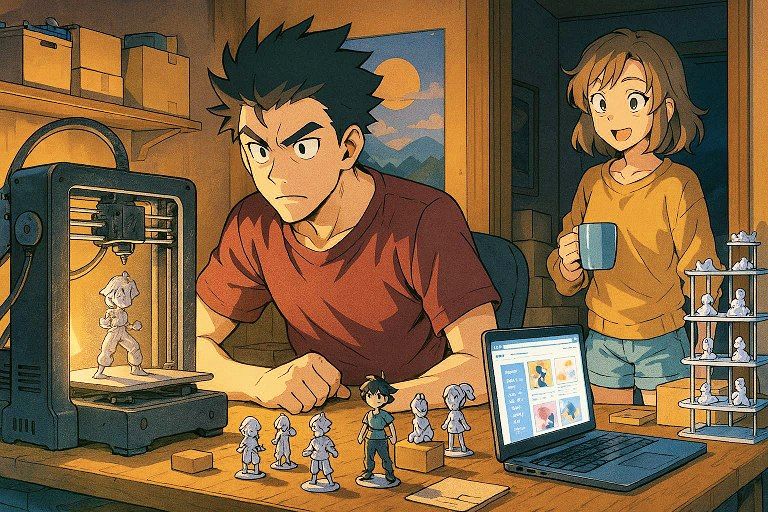
Lucas was about to drop out of college. It sounded more like a defeated mantra than a remote possibility: bills piled up like unfinished homework, free hours were tokens someone kept, and weekend waiter shifts neither covered tuition nor left time to study. Every time he waited tables he felt he was selling not just plates but minutes of his academic life. He began to believe that university and he were doomed to perpetual misalignment. The solution, ironic and ridiculously simple, was in plain sight: a 3D printer gathering dust on his desk, forgotten since a prototyping class project. Its cover wore a thin gray layer betraying months of neglect; the printer windows showed hardened filament residues like tiny sculptures of defeat. One afternoon Lucas looked at it with more desperation than ingenuity and, after a quick search through tutorials and forums, powered the machine on like someone waking a sleeping elder. "If I had one euro for every time I think about quitting, I'd have… well, two euros. Maybe enough for a coffee," Lucas muttered, with a mix of sarcasm and hope. Marta, his flatmate, heard him from the kitchen. She always had a mug in hand and an opinion ready to serve. "Either win the lottery or stop spending on expensive coffees," she replied without looking up. That afternoon, while he dusted off the printer and calibrated the print bed, Lucas received a message that seemed to come from the web’s most seductive corner: a link to a pack called “GeekMadness.” He opened it with the attention of someone looking at a menu in a fancy restaurant after months of instant noodles. Voice-over (message on Lucas’s phone): "I discovered the GeekMadness pack and saw the 'Anime' folder. There were thousands of Dragon Ball, One Piece, Naruto files... things people pay fortunes to own." Lucas froze for a second, like a character who had just discovered a secret door in his house’s library. "19.99€. Okay. Either I'm a genius or I'm a thief with a credit card," he said, smiling nervously as he clicked "buy." Marta raised an eyebrow, familiar with her roommate’s financial whims. "You bought a mysterious pack for twenty bucks on the internet? Does it come with an invisible cloak?" she asked. "Better: an online shop in my dorm," Lucas replied theatrically, as if announcing an incipient revolution. What followed read like a low-budget entrepreneurship movie. Lucas reorganized his bed to make room for the printer, improvised a photography corner with a white poster board, and built an online store with descriptions more enthusiastic than precise. He set prints to run before classes, like someone programming a washing machine; the machine worked in his absence, extruding plastic in layers that, after hours of patience, became keychains, figures, and small statuettes that, to his surprise, found buyers. Sergio, a lifelong friend, entered the room one day and found an array of miniature characters. "Hey, is this official? Because if it's not, you can tell… but not too much," Sergio said, touching a figure whose cape had a suspicious fold. "It's... limited edition. Only for people who appreciate artisanal texture," Lucas answered without blushing. At first there were errors: pieces with fused fingers, faces that looked like a failed makeup experiment, colors that didn't match references. But customers were forgiving: they bought for nostalgia, for the homemade charm, or because they wanted something unique. Lucas adjusted parameters, learned to post-process with surgeon-like patience, and sanded until layers smoothed into well-told stories. Still, not every figure came out perfect; some looked like muscular croissants, a detail that oddly gave the line personality. Anonymous seller (popup message on the computer): "With a one-time investment of 19.99€, you can turn your dorm into an online shop. You set it to print before class, and when you return you have products ready to sell for €30, €50 or more." Gradually, order notifications replaced the anxiety over outstanding bills. The printer went from an overlooked appliance to a time machine that returned hours: it printed at night and Lucas packed shipments in the afternoon like a modern artisan. His listings, direct and humorous, attracted customers who valued the handmade touch and the price-to-exclusivity ratio. He began to invoice while he slept. The idea of clocking physical hours at a restaurant became a memory with the smell of sauce and stacked plates. "Now I make money while I sleep or study. My parents didn't believe it until they saw I paid the semester myself," Lucas said one afternoon, showing the bank transfer with the mix of pride and relief felt when a mountain of debt loses some height. The news reached his mother like a reality-check and surprise; she had imagined her son working double shifts as a waiter until exhaustion, not seeing a screen figure that resolved months of tension. Lucas’s mother (looking at the bank screen): "You paid the semester by yourself?" Lucas answered with the smile of someone discovering that improvisation can be profitable. "Yes. I now make money while I sleep or study." His mother took a second to grasp it, mixing pride with slight confusion over the universe of 3D printers and digital storefronts. "And what's next? Will you drop out and open a Dragon Ball jewelry factory?" she asked, half joking, half worried. "Not exactly. But maybe a line of student accessories. Keychain: 'Approved by the Dragon,'" Lucas replied, already imagining a catalog of useful and witty items. Marta, always the practical voice, soon pointed out the logistics: nightly noise, boxes everywhere, and customers expecting fast shipping. "Good. You saved your degree with plastic and faith. Now you just need to invent something so the printer stops sounding like a sleepy T‑Rex at three in the morning," she said, part proud, part worn out. Sales maintained their pace; some products sold for €30, others for €50 or more depending on rarity and finish. Lucas learned to pack with care, answer messages patiently, and negotiate with shipping platforms as if speaking to logistical deities. The printer allowed him to reconcile schedules: print during dead hours, study when required, and spend only a few evenings handling orders or meeting local customers. Sergio, happy with his purchase, spread the word and brought in several orders from different cities. Reviews were affectionate and sometimes hilarious: one buyer wrote that his nephew solemnly declared the figure "more authentic than the official collectible," and the order became a small viral hit among friends. Anonymous seller (final message, like the episode’s closer): "With €19.99 you can change your life. Results not guaranteed for napping skills." That irony struck Lucas: the small one-time investment had catalyzed a process of learning, risk, and creativity. Not everything was easy; nights without sleep to fulfill orders, days stressed over defective pieces, and the constant worry of balancing entrepreneurship with study. But the scales slowly tipped toward hope: tuition was paid, delivery deadlines met, and more importantly, Lucas had regained something he thought lost—the confidence that he could navigate hardship with ingenuity. His dorm was no longer just a student room: it was a workshop, an office, a photo studio, and a warehouse. The printer kept working, sometimes delivering small joys in the form of figurines with charming imperfections. Lucas kept studying; the nightly print runs had not turned him into an undegree-holding entrepreneur: he still attended classes, took exams, and accumulated projects with the same mix of fear and determination with which he had begun. At a later family dinner, his mother, between spoonfuls, said with pride and a touch of disbelief: "You found a way to pay for it. I'm proud." Lucas looked at his mother, at Marta and Sergio, and at the printer, which in the corner emitted a faint hum as if quietly celebrating. "Yes," he replied. "And the best part is I did it without selling my soul—just some plastics and a lot of time without Netflix." They laughed. The printer continued its nocturnal work, college life carried on, and Lucas learned that sometimes solutions are in what you already have: a printer, an idea, and the courage to try. The End. Source of the images. Image created with Bing.
No comments yet