 @mc5punk
Short story: The Selfie That Wanted to Be a Polaroid
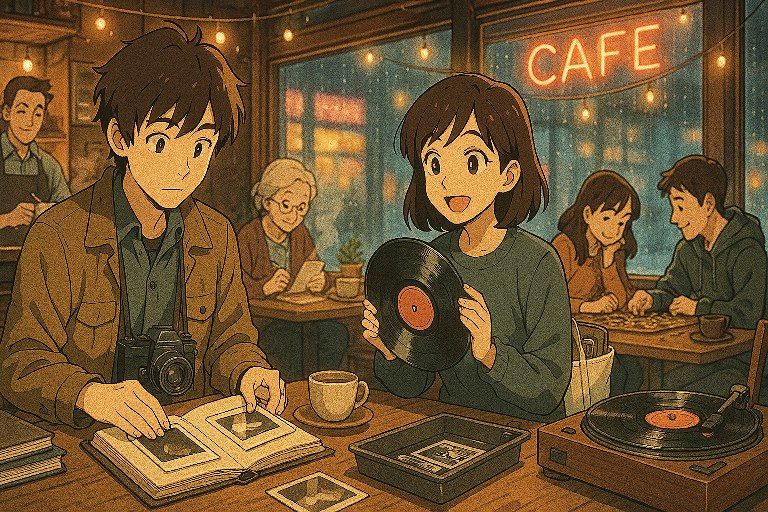
Luis found the camera in a box among lonely socks and a note from Don Álvaro that read: “If it doesn’t come out, blame the film.” It was a discovery that smelled like a garage and long Sundays. He had learned to measure the world by the glow of screens: life came in notifications, in photos that were seen and disappeared with the same swipe. But that camera, heavy and noisy, demanded another kind of attention. Holding it made him feel guilty and enchanted in equal parts, like someone rescuing a plant that was about to die and discovering it still had leaves. Maia arrived at the café with a bag of vinyls that looked like little graphic novels: covers halfway between elegance and excess, labels glued on crooked, and a smell of old paper that tasted like bygone time. “I brought something that doesn’t ask permission to play itself a hundred times per second,” she announced with the flourish of someone introducing an eccentric friend. Tomás, behind the counter, raised a professional eyebrow and said, “Is it dangerous?” Rita, listening from her table with a tea that seemed to have lived through many conversations, asserted with the authority of someone who has seen trends come and go: “In my day records didn’t ask if you were ready for the song.” The idea for an analog get-together was born out of whim and cemented by fondness. “Bring an object that speaks about you,” Maia proposed in the café group, and the responses were eclectic. Tomás brought a concert poster weathered by humidity; Carla and Nico treated it as a joke and showed up with a board game that smelled of childhood; Don Álvaro didn’t attend in person but arrived as a stained Polaroid with that crooked smile he always had in family photos. The first unwritten rule of the gathering was simple: don’t look at your phone before the third coffee. No one said it was an order, but the expectation worked like a tacit oath. The second rule, born from laughter and gentle corrections, was that no one could talk about “the cloud” without clarifying whether they meant actual clouds or meringues. The tone wavered between solemn and ridiculous, like when you start a new tradition and pamper it with ceremonial gravity. Don Álvaro’s Polaroid came out half burned. There was a moment of silence, then an avalanche of affectionate comments: “Conceptual art,” Maia said; “or the camera took a day off,” Tomás added. No one was offended; the imperfection was received as proof of authenticity. Placing the photo in an album became a rite. Luis held it and, looking at the white edge stained with developer, felt he was seeing more than an image: he was seeing the possibility of something that took its time to be born. When the needle dropped on the turntable, the sound filled the room with a texture compressed playlists did not know: there was a crackle, a whisper, and then the music emerged with the amplitude of something unafraid to occupy space. Nico, by habit, tried to take out his phone to record the first minute; Rita looked at him as if he had tried to eat soup with chopsticks. “Patience, kid,” she said, and her voice had the sternness of someone imposing calm on a domestic storm. What could have been a mere display exercise became a lesson in listening: letting the song settle in the body, noticing the silences between notes, allowing the crackle to tell its own story. Developing photos became a sort of collective alchemy. Luis worked with improvised patience: he timed exposures, chatted with the developer as if it were an old acquaintance, and celebrated every image that emerged from the fog as a small domestic miracle. Imperfect photos produced laughs and tender oohs: a hand cut out of a frame became “the hand that never gives up,” and an overexposure became “an homage to the sun.” The café crowd adopted its own language for mistakes: errors became titles worthy of an exhibit. The board game Carla and Nico brought, with its worn pieces and stained instructions, was an endless source of joy. What started as light competition turned into a ceremony of affectionate cheating and flexible rules. Nico, accustomed to the instant gratification of digital achievements and levels, discovered a different satisfaction: rolling a die with one’s hands, hearing the pieces scrape the board, watching others’ faces. At one point, winning a game by improvised strategy made him shout with an intensity that would have embarrassed his avatar online. It was an absurd but necessary victory. Tomás confessed stories no one expected: once he tried to play a record backward and pretended it was a remix; another time he mixed discs with such enthusiasm he made a personal cafe compilation. Rita explained how writing letters helps order life: “It’s not the same as sending a message; handwriting forces you to be honest,” she said, and everyone went quiet, smiling in the way people do when they understand that truth can be a manual practice. Don Álvaro, through his Polaroid, sent a note that read: “Always look twice before you erase.” It landed with a gravity no notification could match. Laughter became a habit that mingled with nostalgia. Many anecdotes had a comic edge: someone told how they tried to clean a record with tap water and ended up with a track that sang off-key; another confessed the embarrassment of writing a letter without a clear addressee and then using it as a bookmark. Luis, amid jokes and lessons, learned that nostalgia isn’t a lament but a tool to rewrite one’s relationship with the present. It wasn’t absolute rejection of technology: phones still had a practical role. It was more an experiment in boundaries, a polite request for a truce. Gradually, the get-together turned into a custom. Weekends at the café featured cassette swaps, developing sessions, and handwritten letter afternoons. The neighborhood bookstore offered binding workshops and an old community room filled with tables where people practiced calligraphy and mixed vinyls. The ripple effect wasn’t a mass phenomenon nor an academic nostalgia movement; it was an organic expansion of people seeking tactile presence. The Gen Z crowd that frequented these spaces didn’t give up screens: they used them, loved them, and exploited them to create. But they discovered some things screens couldn’t give easily or honestly: the time a vinyl requires, the suspense before a developed photo appears, the lack of instant redemption that allows mistakes to exist without leaving a trace. They began labeling notification-free hours as rituals: “no-scroll Sunday,” “vinyl night,” “notebook morning.” These were deliberate acts, small rudder corrections in an ocean of infinite content. The change was mostly intimate. Luis noticed subtle shifts: his gaze softened when waiting for an image to appear on paper; his hands learned to measure a record’s fragility; his humor mellowed, able to tolerate long silences without fishing for them with a finger. Maia embraced a collection that was no longer exhibitionist but meditative: she chose records by mood and treated each listening as a date with herself. Tomás scheduled themed days at the café and was surprised when the clientele shifted: people who wanted to talk more and tweet less showed up. Rita taught letter-writing and received in return stories that seemed to have been waiting for a pen to be born. The coexistence of digital and analog ceased to be a stark opposition and became a courteous dance. Screens remained useful—maps, urgent messages, video calls with distant family—but they fit into a rhythm that practiced pause. The balance was neither perfect nor permanent; relapses happened, days of compulsive scrolling and impulse online purchases. But there was now the conscious possibility of cutting the inertia and choosing another textural experience. On a rainy night, with the café warm and the city smelling of wet asphalt, Luis placed the last photograph in an album and looked at it as someone regards a relic without mythologizing it. The image was imperfect: the light had misbehaved and the focus had betrayed him. He called it aloud “The Existential Blink.” Maia, in her usual dramatic manner, provided a soundtrack with a vinyl that crackled like a confession. Rita handed out cookies and between bites said, “The important thing is not to lose the habit of writing.” Tomás promised a day of rare records and Carla and Nico returned the board with pieces still warm from use. When the evening ended, the farewell carried the weight of things felt rather than announced: a tacit agreement to return, to care for the spaces that let them breathe differently. Luis glanced at his phone out of habit, saw the piled notifications and, without drama, put it back in his pocket. He didn’t switch it off out of prejudice; he set it aside like someone who doesn’t interrupt a conversation to wave at an acquaintance. He had learned something more practical than romance: he could live with technology without letting it dictate every gesture. Gen Z wasn’t fleeing modernity nor embracing the past with melancholic nostalgia. What was happening was subtler: they were rediscovering tools that let them feel more deeply and without total mediation. The camera, the vinyl, the notebook, and the board game were not relics; they were instruments for reclaiming pause, touch, and screenless creativity. At bottom, it was a bet on authenticity in a world that rewards speed. And under the café’s neon that blinked in a rhythm caught between old and new, the small community kept finding reasons to meet. They didn’t make nostalgia a religion but a prolonged, affectionate joke: they celebrated mistakes, honored annoying noises, and learned to laugh at their own exaggerations. In every gathering the same simple, firm feeling appeared: it wasn’t about living without technology, it was about teaching time some manners. Source of the images. Image created with Bing.
No comments yet