 @mc5punk
Short story: Rebirth Among Lights
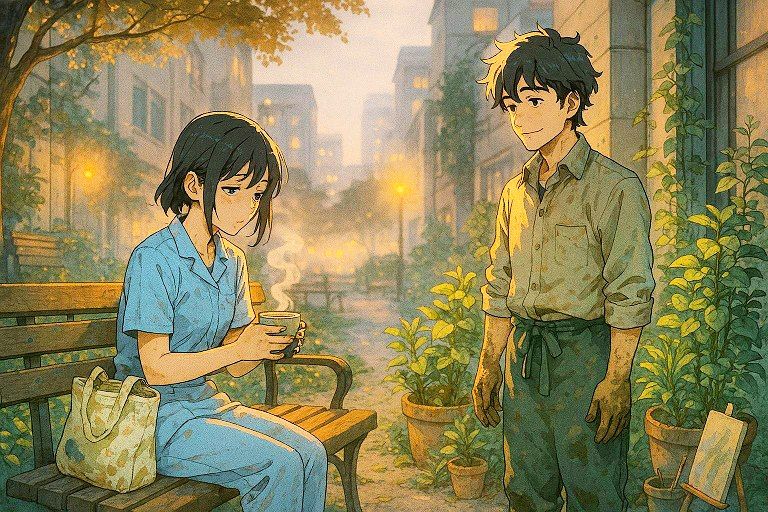
Alma walked through the city like someone crossing a stage lit by demands: the lights were promises and the rushes, curses. Every morning she rose with a list lodged in her throat: consultations, pills, calls. She tended bodies, names, and emergencies while her own life unraveled into silences that no one claimed. Her family loved her; her friends sent messages; her phone piled up “likes” like hollow medals. And yet, when night closed her eyelids, an ancient exhaustion claimed her: neither sugar nor forced smiles could mend that tear. One afternoon, after a shift that seemed to have no end, she met Mateo, a former classmate who had become an urban gardener. They met in a small park, hidden between concrete walls and windows that looked without seeing. Mateo watched her with the patience of someone who has learned to listen to silence. “When was the last time you listened to yourself?” he asked in a steady voice. Alma wanted to answer and could not find the words; fragments surfaced, choked. “Work, family, messages… everything demands me,” she murmured. “I feel I attend to other lives and mine unravels.” Mateo handed her a cup of tea between his hands as if offering a small rite of return. “I listen,” he said. “Do you remember the last time you asked yourself a question and didn’t answer it for others?” She laughed with a thread of nervousness and drank the tea like someone seeking shelter. The warmth reached her fingers and, for a while, the city seemed less voracious. They walked among potted plants, and Mateo spoke of his own escape from devouring financial security to the truce of soil and greenery. “An old man once told me,” he said, “’Manage stress — it kills more than sugar.’” It wasn’t literal, but he understood that the absence of care also makes one ill. The phrase sank into Alma like a seed buried in dry earth. At the hospital they spoke to her of figures: glucose levels, blood pressures, medication schedules. No one had told her that stress could be lethal in the form of absences, sleepless nights, stolen smiles. That night she returned to her apartment with the cup still warm and a question lodged in her chest. The transformations began as small betrayals of her old survival pattern. When her mind rushed toward future tasks, Alma forced herself to repeat silently: “Live the now, not ‘for later.’” At first the discipline felt heavy; her profession demanded foresight. She learned, with awkwardness and patience, to distinguish necessary foresight from anxiety that consumes. She clung to the warmth of a cup between her hands, to the laughter of a child in the waiting room, to the slow passage of the sun across the kitchen window. Those simple, scarce moments began to stitch the torn fabric of her days. One Sunday, after a shift that left her empty, she recalled another saying of Mateo’s: “Do only what does not create inner resistance.” For the first time she allowed herself to say no without guilt pinning her knees. She returned a volunteer commitment that drained her and stopped attending meaningless meetings. The gap that emerged was not a terrifying abyss: it filled with soft time that held books, walks, and care for herself. The networks continued filling with digital hearts, but Alma changed her focus. Instead of measuring her worth in “likes,” she began to nurture real connections. She called her mother and finally listened without hurry; she went back to drinking coffee with friends with whom conversation could linger late; she accompanied the elderly neighbor on slow walks, without theatrics. In her notebook, with a firmer hand, she wrote: “Care for real connections, not ‘likes.’” Those words echoed in her chest like a tender command. One night she dusted off brushes without pretension and painted for the simple pleasure of painting. She sat before a canvas and, seeking neither fame nor sales, let the colors converse with her quiet need. She then felt a different beat in her chest: calm entwined with a purpose that asked for no applause. She looked up the word ikigai and wrote it down almost in a whisper: “Reason to wake up every day.” It was not a blinding revelation but a slow discovery: her ikigai lay in accompanying and creating, in healing without losing herself, in putting color where there had been estrangement. She rearranged her life around that faint center. She kept shifts, but with boundaries; she painted without demanding outcomes; she reserved time for people without masks or performances. There were setbacks: sleepless nights, calls that ripped her from sleep, the old temptation to please until she wore out. Each time inner resistance rose again, Alma reviewed her personal list as if it were a familiar map: manage stress, live the now, do only what flows, care for the real, find ikigai, keep near those who return you to yourself. Love arrived without melodrama, with the calm of an open book on a rainy afternoon. Lucía appeared like someone who shelters a clear warmth: a librarian with a soft voice, patient and without demands. When Alma came tangled in knots, Lucía did not ask for explanations; she listened, returned sincere laughter, and welcomed her good and bad days with a quiet that nourished. One night, sharing tea with Mateo, Alma said with a voice broken by gratitude: “Your phrase was right: having someone with whom you can be yourself is better than any vitamin.” Mateo nodded, satisfied. “There is no substitute for the company that lets you show up unmasked,” he replied. The changes were never perfect or immediate. The path was full of relapses and gray days, but also of mornings when she woke with a calm reason to get up. Her health began to speak in kinder tones; her work regained a more humane meaning; and her relationships grew deep without forced shine. When asked what had changed, Alma simply took a sip of tea and offered a smile that did not seek validation. On a balcony overlooking the city of lights and rush, Alma thought about the distance between noise and heartbeat. She had chosen less noise and more heart. She woke each day with something that sustained her and with someone beside her for whom she did not have to pretend. She closed her eyes, and for the first time in a long while, she truly felt at home with herself. Source of the images. Image created with Bing.
No comments yet