A Small Help Can Go a Long Way: A Dollar for Cebu
Hello everyone,
I’m reaching out with a humble heart to ask for your kindness and support. Many families in **Cebu, Philippines**, are currently in need...
Some have lost their homes, belongings, and livelihoods.
Not everyone can give much, but even one dollar or a cents can bring hope. When we come together, small acts of generosity can create a big impact.
Let’s show that compassion knows no borders. Whether it’s a small donation, sharing this post, or simply leaving words of encouragement — it all makes a difference. ❤️
📍 Goal: To help Cebu families rebuild and recover
Send any small amount, even just a dollar or a cents, and it will go a long way when combined with others.
Let’s turn kindness into action. Together, we can make a change. 🙏
Thank you for your time, your heart, and your generosity.
You can send here USDT Bep20-
`0xe03a01a6ccba7206b395c8e828f060d8218de456`
Or simply by tip here on this article.
#ADollarForCebu #HelpCebu #KindnessCounts

I still thank you readcash!
I've gone for so long. I didn't even open readcash even once per month since I left. It was 4 months ago.
But when I'm back. I'm happy to saw that I still have $4 in my wallet.
Maybe it's because of my refferal.
I was still hoping that my account will remove from spam group.
So I can now use to write everything again.
But I guess it's impossible.
Readcash is one of my favourite platform up to now. But sadly I know even I write I didn't get any tip from the random rewarder.
Actually I had a big problem and I'm scared.
Let me write about it at some other time.
I've missed you all so much! 😩
Advisory on Spark Token Distribution
To all coinsph wallet users.
This is to inform you that Spark (FLR), the native token of the Flare Network which aims to enable the use of tokens like XRP as smart contracts, is set to go live in 2021. As part of their preparations, a deadline has been set for holders of XRP to confirm their support for the Network by December 12, 2020 8:00 AM (Manila time).
**However, please be informed that Coins.ph will not be supporting the upcoming Spark token distribution.** They encourage their customers who plan on participating in the token distribution to transfer their XRP held on Coins.ph or Coins Pro to supporting wallets, which can be found here. You may also check Flare network’s guide on how to claim your Spark tokens if you decide to transfer your funds to a self-custody wallet. http://email.coins.ph/c/eJyVUk2zmjAU_TWwcXAwCIQFC308X503T-vUsXbFRAgYJSQmQYq_vglqpctOmMzl3HO_Tm6GKEekrC1_LnBGOMG1SnNGEdFQEpfaqMYZo3b2ImIDprI5nHCmDGuWX4lkohuxevSDI3EebdkZ16OESCXIoVGE1XYeR7mH4TDRFQmCjNMkeWO1EqyySQxc4E6ACycugK47noz9GYwWYZj482k08ZPEmroZI7Uc86N9jPMARKAopnlRuGEIC-xCDFBwwGE2AZEf2iKWSKAjRV1ZMV1Rh7_mquKjUlxa3swCC_0VFRJ4_Lu7aVs2nDOhSF06LaoqrKTheItG0VSyRmTY8pIrFswCgcEozklDNdYr9AAzPZcWVaPZfcIn_tTBS3rNLOADt9ett4ba9YDT33cfzjA9YNH_mPNIqbAw1Ve4lbpZZQiBac_0cNWO7W25XvrtHH7_UA6TEq0D-PW-bvmtu8iufW8P5_OpQadruUkR3NHlGv68tJePbVlu6O4L7sRMOfv9G_5sV99aXp1m_udmNSe_OoWa_a69bHRHXtJfw3f-31UZhD7NlOQmHAIvDKMhgQtmcqc1ovi-Ro_FGHBUx3vfS5h_vJjyCin8N4WtYqOacy_mwMgNIvgA_wAEwRMd http://email.coins.ph/c/eJyVUl2TmjAU_TXw4sDEIBoeeNBl3To7u9apY-0TE0IWo4RgEqT465ugVvrYCZO5nHvu18klmNeYFZUTLiQlrGa00mkuOGYGSuLCGKVPBHfJk0gtmKomO1KiLWueX5gSshuJavSjxvI02ooTrUYJU1qyrNFMVG4eR3lA0TDRBUuGrdMmeRGVlqJ0WQwBBGMI0BhABIA_9sM5ipazWRIuJtE4TBJnAohglfLrg3uIQTBBEYUwmlAU0hCEBBATN54EWZYb25WxwhIfOO6KUpiKJvw5VxkftK6VE8wduDRfVorC_yqxpP7v7moAUmLGWVV4yk7mfeGzssxg2WieKtFIQp0guVApHDi1GKc5a7jBep3uIDHTGWkNSm5zPvCHGkHSK-fAEIJevd4aKtgDXn_ffJRQnlHZ_9hzT6mptNU_aatKqrUlTG17toeLcWyvq_UqbBfo-5v2hFJ4PUUfr-u2vnZn1bWvbXY6HRt8vBSbFKMdX63Rz3N7ftsWxYbvPtBOzrW337_Q9_bzW1uXx3n4vvlcsF-dxs1-1543pqMg6a_ha__vwgxCH2bKchuOYDCbRUNCLYXNnVaY09sy3ddjwNFd3fuewvzjpbwusaZ_U7g6tqp5t2IeisA0QnfwDxlOFCE
If you have any questions or concerns, please email them at help@coins.ph or tap Send them a Message using your Coins app.
**If you want to participate in the event that said above, you need to hold an XRP token to receive a free $SPARK token.**
How?
Who can claim the Spark token?
All XRP owners barring Ripple Labs and certain previous employees of Ripple Labs can claim the Spark token.
**How many Spark tokens are available to claim?**
45 Billion.
**Does your exchange support the Spark distribution?**
If you are a customer of an exchange support, your exchange has indicated to the public that they will distribute Spark tokens pro-rata to their customers based on their XRP Holdings. If your exchange is not listed on that link, you should now assume that your exchange will not participate. customers based on their XRP Holdings
Here are the following supporting exchange. https://flare.xyz/supporting-exchanges
📣**KINDLY LIKE /COMMENT /UPVOTES THIS ARTICLE IF YOU WANT TO. ALSO SUBSCRIBE IF YOU HAVEN'T. THANK YOU SO MUCH FOR READING.**


My earnings here is very low now. 😢It really makes me sad. I lose my motivation to write an article because I didn't receive any amount of tip from the random rewarder in almost 1 month. I don't know why. I just got an affiliate payment worth of $0.02 every other day. 😭 But I'm still grateful for all my affiliates because they still also stayed here.
Grow From Within.
**Your vision will become clear only when you can look into your own heart. Who looks outside, dreams, who looks inside awakes.**
Once we have learned from without, we then have an example, a pattern as to how to grow from within.
Those who have lived their lives by adhering to natural laws and have been the type of people we would like to be, serve as examples to us, and their lives become blueprints for us.
These wonderful people becomes our heroes, models, mentors, and we desire to emulate their character traits into our own lives.
Through the lives of these models, we can see, in great detail, their triumphs, the corresponding obstacles, and how to rise above challenges that we wouldn't otherwise anticipate.
We pay close attention to what they do, say, think,and even feel.
We pay attention to how they prepare to achieve their successes.
These people may not be absolutely perfect (none of us are), and so we need multiple models.
Each of us is unique,so again we need multiple models customized to our unique personalities and circumstances.
We look for the very best, the devine, in our heroes and models.
In our private or unseen lives, we begin to live our lives in like manner as our models.
We begin to form habits and live our lives according to natural laws.
Like planting seeds, in time, our habits of vision, empathy, love, contribution, and integrity blossom and bear fruit.
Not only do they bear fruit, but they do so time and time again.
The more we see desirable results, The more our confidence grows.
Our confidence in such living grows in our hearts as well as in our minds.
These habits that we form are not just stuff we put on a list and check off as we do them, but rather, these natural laws change our very nature.
Once we can sense that our very nature is changing, It is so exciting.
We get so excited by the positive results from living according to strong character traits that we want to share it with those in our family and others in our private lives.
In Time we so greatly appreciate the transformation and improvement in our own lives that we want to help our loved ones do the same.
We in turn become a model for others.
If our lives have truly been lifted, We want to lift the lives of others.
“Truly” is the operative word here.
This means we are convinced of the power and efficacy of natural laws in our hearts and in our minds.
We have implemented these natural laws or character traits and know firsthand the results that can come from adhering to them.
We must keep working on implementing these natural laws or character traits until they become so obvious to us that we surrender our wills to those natural laws or character traits.
Learning from without and growing from within, Takes effort, But it is well worth the effort.
I hope your results and your excitement make you not only want to share with your families, But that you would also want to share with those in your community life—your neighborhoods, Work colleagues, And even strangers, For that matter.
Share your experience and insights of how adherence to natural laws or character traits has helped you.
This approach of learning from without and growing from within naturally resonates with most people, Because we have all experienced it to some degree.
Look at it this way.
Can you think of a person who saw you in a more favorable light than you saw yourself?
Because such a person has a come, you have “learned from without.”
Because someone has become the source of light or inspiration for you, Haven't you in turn desired to become the source of inspiration for someone else somehow, Which caused you to grow even more? That's one example of learning from without and growing from within.
Allow me to give another example.
Just before my husband and I were married, We were busily trying to find an apartment where we would live.
When we found an apartment, We wanted to furnish it with a few things, But like many newlyweds, We were broke.
The only furniture we had was a lamp. That was it. Picture a one-bedroom apartment with just a lamp.
Even though the apartment was small, It was so empty that it would echo every time someone spoke.
My husband's friend from work, Caloy, Knew of our circumstance and wanted to speak to me in private.
A few days after our conversation she had fully furnished our apartment.
In the kitchen/dining area he got a microwave and a microwave stand.
He also managed to find a dining room table with four chairs.
In the living room he got an area rug, A sofa, A loveseat, A couple of plants, A chair, And some decorations for the wall.
Of course, We contributed our lamp.
In the bedroom he furnished a new bed, Dresses, And two night stand.
All of these furnishings are not something he could readily afford, But he wanted so much to do this wonderful things for us.
When we were all in the apartment for the first time, Marveling at our fully-furnished apartment, Caloy said that they were in a very similar circumstance when they were married.
Someone had also furnished their apartment and simply asked in return that when the opportunity arise in the future that Caloy and his wife would do the same thing for another couple.
He thanked us for helping his fulfill his promise, And asked us to do the same for someone else in the future.
This was such a profound experience for my husband and me, And we look forward to fulfilling our promise to Caloy.
Learn from without and grow from within.
What man actually needs is a tensionless state, But rather the striving and struggling for some goal worthy of him. What he needs is not the discharge of tension at any cost, But the call of a potential meaning waiting to be fulfilled by him.
Most of us can recall times in our lives when we grew exponentially, And there were tough moments associated with that growth.
Many times people tell me they want to get back to when they grew so much and lived a life of constantly learning from without or learning from others and growing from within.
It's almost as if there were different seasons of life in which we experienced such growth.
When I have asked these same people why such growth didn't continue, Given that it was so beneficial, The most common answer is, “Life just got so busy!” Well, Life probably won't be less busy any time soon for most of us.
If in the midst of such busyness we would get back to living such a life, With a time-management tool that would integrate natural laws or the strengthening of our character, We would indeed become the people we want to be.
Ultimately what people want is to have a rich personal life, Rich family life, As well a life of contribution to the broader human family, Whether it's through professional work or volunteer endeavours.
In the context of our three lives, We want to unlock and unleash the potential we all feel is inside of us.
Look at it as a three-Combination lock that you probably used in high school.
Do you remember the directions to open your combination lock?
You had to turn the dial clockwise to a specific number lined up to a notch and then turn to the left for the second number until you passed the second number for the second time around.
You then turned clockwise again to the third number, And when you pulled on the shackle the lock would open.
What would happen to me, However, Was that every now and then, In my rush, I would only turn counterclockwise to the second number once instead of twice, Before turning clockwise to the third number.
When I pulled the shackle, It wouldn't open.
There was no other way to get the combination lock to work other than to start over and try again.
There were no shortcuts on the combination lock.
It is much the same way with our three interconnected lives.
If we want to unlock and unleash the full potential that is in each of us like the unlocking of a combination lock, There is a process that works—and there are no shortcuts. Learn from without then frow from within.
📣**KINDLY LIKE /COMMENT /UPVOTES THIS ARTICLE IF YOU WANT TO. ALSO SUBSCRIBE IF YOU HAVEN'T. THANK YOU SO MUCH FOR READING.**


Free coin at coinex.
November 19,2020.
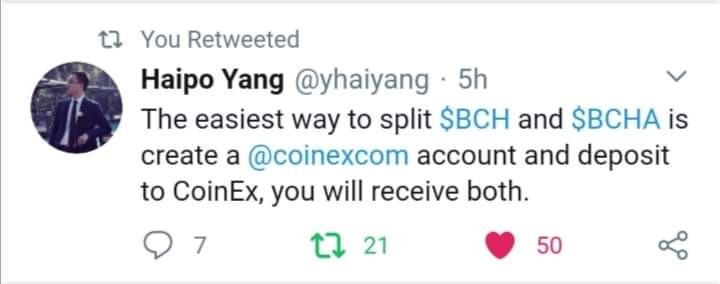
I read Mr haipo yang's post on twitter. And this is what I read.
And when I read this, I immediately tried to deposit into my coinex account using what I earned here.
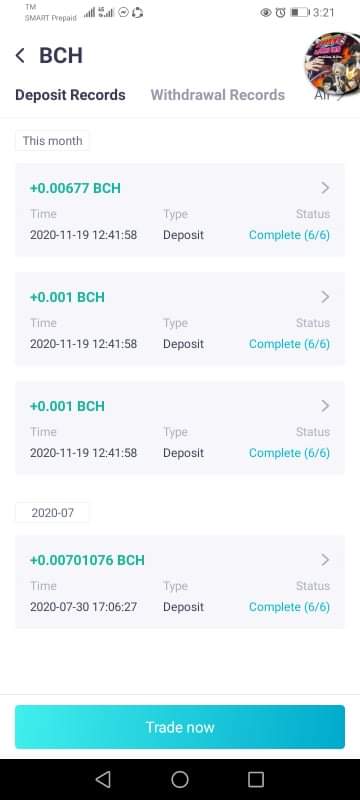
Just a few minutes, my deposit arrived in my bch wallet of my coinex account.
But I wonder why I have not received the amount / token mentioned in Mr haipo yang's post.
But BOOOOM! I thought it was a joke 😂.
After almost 3 hours I got a text from coinex that I received a fund and the name of token was **“BCHA”.** I know you heard about this token because many people talk about it.
I immediately open my coinex app to see if I really receive the said “BCHA” token. And YEY! I got it! 😍
It's funny because I hope ... I rely on delusions.
I thought how much money you deposited is also what you will receive.
But I misunderstood it.
I mean, I thought that if what is the value of the satoshi that you deposited, that is also what you will receive and not the exact amount of your deposit. I don't know if you understood my explanation. But I hope you understand.
For example.
I deposited 0.01 bch, I received a free bcha of 0.01. But not how much / amount of my deposit I received. But I only received the satoshi that was 0.01.
However, I am happy with my experience of receiving a free token even at a low value , (who wouldn't be happy to receive a free token right?)
I want to thank Mr haipo yang, because in his twitter tweet I read and found out about it.
I do not know if until now, at this time you still have something to receive if you do what I did to receive the said token. But nothing will be lost if you try, right?
This is where I end up sharing my experience that I received a new token for free.
**📣KINDLY LIKE /COMMENT /UPVOTES THIS ARTICLE IF YOU WANT TO. ALSO SUBSCRIBE IF YOU HAVEN'T. THANK YOU SO MUCH FOR READING.**
Coins.ph Update.
Yesterday I received an email from coins.ph,
They informed me that the Bitcoin Cash (BCH) hard fork that started on November 15, 2020 has completed. They have re-enabled sending, receiving, and converting BCH in Coins.ph and BCH trading in Coins Pro.
They also give a note that the BCH hard fork resulted in two different tokens: Bitcoin Cash Node (BCHN) and Bitcoin Cash ABC (BCHA). **Coins.ph and Coins Pro shall be supporting BCHN as the continuation of the BCH chain**. Any mention of BCH on Coins.ph and Coins Pro moving forward will be in reference to BCHN and its blockchain. **To ensure that transactions in the network are secure, incoming BCH transactions will require 25 confirmations** until long-term blockchain stability has been achieved.
On the other hand, sending and receiving BCHA with your Coins Wallet will not be possible. *(don't try to send your BCHA coin to coins wallet)* Should there be BCHA sent to your Coins Wallet, this will be considered a **cross-chain deposit**.
For further information on their resumption of BCH service, you may visit this **FAQ**.
If you have any other questions, feel free to contact them at help@coins.ph. http://email.coins.ph/c/eJylUk2TojAQ_TV4sbD4EMwcOAjorDU1fsxOue5erAA9EoeQmAQp5tdPgrq65wUq6bxu-nVed44px-RQW0EsICecQK32BaOYaCiNDtqoRjmjg_weCAbcyyY7Qq5MVExUzkg9TLAsh0QO38Ce1TiroBgyjWqXHPFyiOvichiuBRsU0VPhA3pMfMaCYEVYT52wWglWDUjkOZ7jui5yHCd0_ZE7Sp3UncdxMglmyXgcj62xk19JBmWEXN_zvbGXeYDDJ-ThMaAiDN0JfBSTLMMDEUkscElxd6iYZtS_3-9ZRaVSXFr-1PLm-pMN50yo0Y1AQ2WuF6jtRhq_1kBXbEw_dPrHn3iunQgmpZ2UWkg7Bc4kUfaaVSTvLH_eKLqXrBE5WH56BsEsLzQYhYI0VGO9xFcw10Lormg0v0hyw2_C-ekbyIbyXjkv8Bz20W_XtvS2aU1v_ARxJprX2Ha_LtkZaAaiP7gTsyW9bd4rlwJhylpCKytQygSHpm5T3Fk73r8Wq0XQxmj9rGx9cbwK0ets1fKv7iS7dtZmn5_HBh_Ph80eoy1drNCvU3t6fj8cNnT7irZiquzdLoGXdvmj5dVxGrxsljH53fE_zY4_nTa6Ij_tl8eJ-d8hfEh1M_ekMOmQOwnC4DGAC2a49jWmcBnQ68g9xKiO9767UP94gfIKK_ibYqAio6J9IbMR8kPNeQG_AcDQMPM http://email.coins.ph/c/eJylUk2TojAQ_TVwsbD4jHjgIKCz1tToODvlunuhQshgHEJiEqScXz8J6uqet6CSx-umX_erRpBySOrWilKBEeEEt6qoGIVEU3lSa9CMEaM2uidiQxayKw8YKZOVEoUYaUcZlPsRkaM37MxbWDa4GjHN6pAc8_0IttXlY_QqmF0l0yrA8WPhExQEKsIG6Yy1SrDGJonv-q7nebHrusALxt44d3NvkabZJJpnYZiGVuiiq4i9T4AfTksA3Aig6UcJPc-P_HASh1EJKxBMQlskEgq4p_BcN0wr6t_vczbJXikurWBm-Qv9yo5zJtT4JqCpPdIHbp1O6hsKRVCDDZzqBt0g8kDoAytYdIoWknUCYSvIT1gwyweGo7giHdXc4OOVRHpabb1m0WXuG39zJ8jfsOwoH-zRE7nsY7iu3g_Y-D-An1iciNY12BnOFTthWmIxfHgTc2UDNs9VS2Fh2lrhXjZYKZMMTN-muZMOvH8t18uoT-PXJ-UwKeEaxC_zdc-_zkd57ud9-fl56ODhVG8KGG_pch3_OvbHp_e63tDtS7wVM-Xsdhl-7lc_et4cZtHzZpWS32f-p9vx6XGjOwry4Xhci__dtIdSN1iQypSLvUkEoscELpjRKlpI8WULr3v1kKPOfIjdjfoniilvoMJ_S9gqMS46FzEnjgOgNS_kN0uqJks
I know that some of you have received this kind of email from coins.ph, but I also want to share it, so that other people who doesn't read or received the email from coins.ph will also know the update.
**📣KINDLY LIKE /COMMENT /UPVOTES THIS ARTICLE IF YOU WANT TO. ALSO SUBSCRIBE IF YOU HAVEN'T. THANK YOU SO MUCH FOR READING.**


Bitcoincash upcoming protocol.
Coins.ph emailed me earlier about the upcoming bitcoincash (BCH) protocol that is expected to take place on November 15, 2020 at 8:00PM (PHT). It says that multiple proposals have been made in the BCH community which could mean that different versions of Bitcoin Cash may be created after the upgrade.
I know that if you are using coins.ph wallet, you also know about it and you already read about this.
They say that in order to secure your BCH while the upgrade is taking place, the measures will be implemented on Coins.ph and Coins Pro beginning on November 15, 2020 at 7:00 AM (PHT). These measures will be in effect until it is clear that the BCH network is already stable:
Temporary disabling of sending, receiving, and converting Bitcoin Cash in Coins.ph wallet.
Temporary suspension of Bitcoin Cash trading in Coins Pro,
Automatic cancellation of any open orders of Bitcoin Cash in Coins Pro,
It says that Coins.ph wallet will continue to monitor developments and work on technical requirements as required. Rest assured that you don’t need to take any specific actions while this upgrade takes place. You may also check for updates on https://status.coins.ph and check for FAQs here.
If you have any questions or clarifications, you may tap their email and send them a Message in your app or email them at help@coins.ph.
Thank you for your continuous support.
**📣KINDLY LIKE/COMMENT/UPVOTES THIS ARTICLE IF YOU WANT TO. ALSO SUBSCRIBE IF YOU HAVEN'T. THANK YOU SO MUCH FOR READING.**


I can not think of anything. (Translated in English )
So far I have not thought of writing a good topic or even a good one with top information to share with you readers.
I have recently been busy with many things, and one of the reasons I am busy is my child's module. I have a hard time keeping up with what I have to do. When I work at night shift, in the morning I teaching my child, When I am in the morning shift, in the afternoon I will teaching him. One thing I have a big problem with my son is his condition. he has a disease called dyslexia but I have not confirmed it yet, because we do not have enough money to consult a specialist. The disease I mentioned is a symptom that when a person has difficulty reading, has difficulty writing and has difficulty spelling. So I know this because I searched for an answer to my question on google. And those symptoms that I found to be compatible with what my child is experiencing now.
My son is ten years old but he is only in the third grade instead of he is in the fifth grade.
He has difficulty understanding, his head hurts when he forces himself to understand the thing he is studying.
When I tell him to write or copy a few words, for example:
**b**ecome - instead of writing like this. no, **d**ecome what he wrote.
As for the taste, when I give him a taste of **sour** food, he will say **salty**.
When I asked him what the English of **"Big"** was. his answer was **"small"**.
Those are just some of the examples my son is experiencing. I know that if I am struggling with his condition he is having more difficulty than I am.
This I just thought to write because it is a reason why I do not often be active today here.
Honestly sometimes I do not know what to do with my child but I can not give up. But I will extend my patience even more and understand his situation better.
The pain he is going through I still do not know where it gets and why this kind of pain develops.
Another reason why I also write this is that I would like to ask for advice or suggestions from all of you readers.
I hope you know something about this disease and how it can be solved.
**KINDLY LIKE/COMMENT /UPVOTES THIS ARTICLE IF YOU WANT TO. ALSO SUBSCRIBE IF YOU HAVEN'T. THANK YOU SO MUCH FOR READING.**


Wala ako maisip.
Hanggang ngayon wala ako maisip isulat na magandang paksa o kahit magandang mayroong nangungunang impormasyon para maibahagi sa inyo na mga mambabasa.
Kamakailan ay naging abala ako sa maraming bagay, at isang dahilan na rin ng pagiging abala ko ay ang modyul ng aking anak. Nahihirapan ako pagsabay-sabayin ang aking mga dapat gawin. Pag ako ay pang gabi sa trabaho sa umaga ako ay nagtuturo sa aking anak, Pag ako naman ay pang umaga sa hapon ko naman sya tuturuan. Ang isang bagay na malaking problema ko sa aking anak ay ang kanyang kalagayan. mayroon syang sakit na kung tinatawag ay (dyslexia) pero di ko pa naman ito nakukumpirma, sapagkat wala pa kami sapat na halaga ng pera upang maipakunsulta sya sa espesyalista. Ang sakit na aking nabanggit ay ang sintomas na kapag ang isang tao ay hirap magbasa, hirap sumulat at hirap sa pagbaybay. Kaya ko ito nalaman dahil ako ay naghanap ng sagot sa aking tanong sa *google.* At ang mga sintomas na iyon nga ang aking natagpuan na tugma sa dinaranas ng aking anak ngayon.
Ang aking anak ay sampung taong gulang na ngunit sya ay Nasa ikatlong baitang pa lamang imbis na sya ay Nasa ika-limang baitang na.
Nahihirapan sya umintindi, sumasakit ang ulo nya kapag pinipilit nya ang kanyang sarili na intindihin ang bagay na pinag aaralan nya.
Kapag pinasusulat ko sya o pinakokopya ng ilang mga salita, halimbawa :
**b**ecome - imbis na ganito ang kanyang isulat kaso hindi, **d**ecome ang kanyang naisusulat.
Sa panlasa naman, kapag pinatikim ko sya ng pagkaing **maasim**, sasabihin nya **maalat**.
Kapag tinanong ko sya ano ang engles ng **Malaki** ang sagot nya ay **small**.
Ilan pa lamang yan sa halimbawa na pinagdadaanan ng aking anak. Alam ko na kung ako ay nahihirapan sa kanyang kalagayan ay mas higit syang nahihirapan kaysa sa akin.
Ito ay naisip ko lamang isulat dahil ito ay isang dahilan kung bakit hindi ako madalas maging aktibo ngayon dito.
Sa totoo lang minsan hindi ko na alam ang aking gagawin sa aking anak ngunit hindi ako maaring sumuko. Bagkus lalo ko pang habaan ang aking pasensya at intindihin mabuti ang kanyang kalagayan.
Ang sakit na kanyang pinagdadaanan ay hindi ko pa din malaman kung saan ito nakukuha at kung bakit nagkakaroon ng ganitong klaseng sakit.
Isang dahilan kung bakit ko din ito na isulat ay nais kong humingi ng payo o mungkahi sa inyong lahat na mga mambabasa.
**LIKE /COMMENT /UPVOTES kung nais nyo. Maraming salamat sa inyong pagbabasa.**


vote YES PROP-IFP (MEME contest )
Recently, I made the article “THANK YOU ” and I mentioned there about my sincere gratitude to this platform and i also mentioned there that this platform is also the reason because I read the meme contest from sir @micropresident . https://read.cash/@Sarahmay/thank-you-0ea657e7
Now that I know that there is another meme contest from him so I decided to ask him if he allow me to make an article about his meme contest and he said “sure”. So you are lucky if you are reading this now because you have the opportunity to join/participate in his meme contest. (everyone can join)
I have a simple way to give you some tip to successfully join the meme contest. **JUST READ CAREFULLY.**
To join, you need to download GET REDDIT.COM and join reddit.com R/Commucurrency Community , because that is where you will post your entry. https://www.reddit.com/mobile/download https://www.reddit.com/r/commucurrency?utm_medium=android_app&utm_source=share
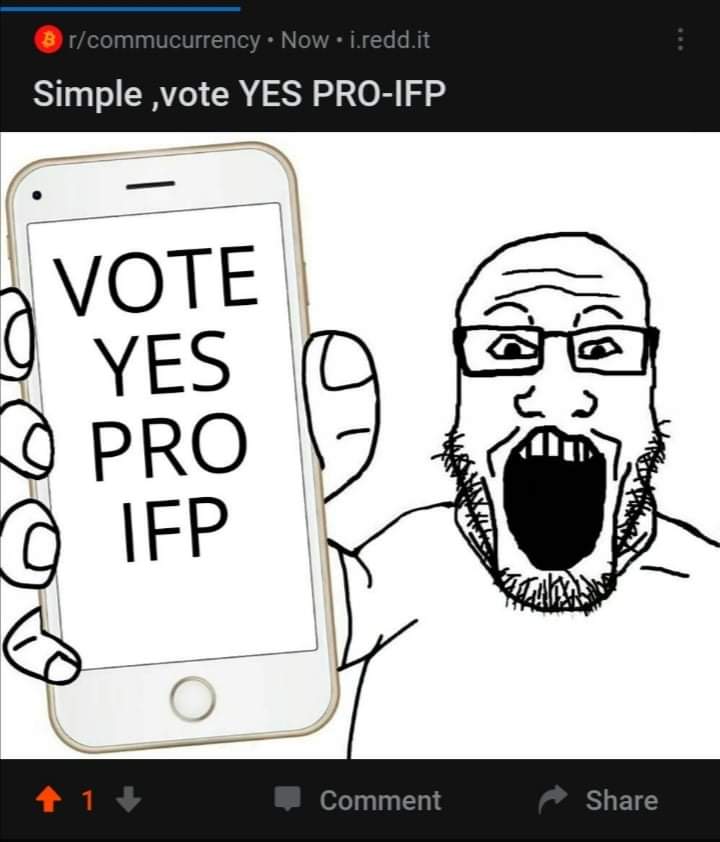
I'll give you an example of the meme that I made or my entry. This is just an example.
If you have any questions regarding to reddit you may ask me on comment section.
When you are done what I've said above, let's continue to the **RULES** and the **MECHANICS** of the **MEME CONTEST** .
So here's the deal.
A New meme competition. it will ends on the evening of the 14th of November (TBD exact time).
You should Submit your memes to r/commucurrency . *(there is no minimum / limit per day, so this means unli meme entry)* https://www.reddit.com/r/commucurrency?utm_medium=android_app&utm_source=share
They'll have a meme review and be awarding top **price is $250**, **2nd prize is $100, and third prize is $50.** And then variety of small discretionary awards between now and then.
**Remember/notes** that Memes should not be attacking anyone, or anything. As always, humorous (or highly confusing will suffice...). Somewhat kinda logic I guess 😅
Memes should be focused around BCH and the awesome things that can be built in the future to absurdity (BCH Space station, etc.).
**STYLE IDEA :**
The US is about to go into another election here shortly. There is a large number of political ads being sent around. "**Vote yes on Prop XYZ**."
Thematically, it would be apropos to lift some of those content and paste over it.
click this LINK to redirct you on the examples of the stuff that gets sent out https://www.google.com/search?q=vote+yes+on&client=firefox-b-1-d&source=lnms&tbm=isch&sa=X&ved=2ahUKEwisn7zL9NnsAhWSJzQIHawzDNYQ_AUoAXoECAkQAw&biw=1117&bih=1259&dpr=2
But i have one last thing to say this is from him "**Vote yes on Prop IFP" isn't sufficient. Gotta include something absurd with it.**
Imagining those prizes, isn't exciting? And this is really a big help if you'll think.
I look forward to your participation and your entries. 😉 Let's say YES together. 😇
📣**KINDLY LIKE /COMMENT /UPVOTES THIS ARTICLE IF YOU WANT TO. ALSO SUBSCRIBE IF YOU HAVEN'T. THANK YOU SO MUCH FOR READING.**
The Implications for Practice of a Policy's Perverse Incentives
IN my other article , I discussed the paradigmatic use of generally valid rules to translate the moral principle into practice. As I argued, generally valid rules can help avoid the moral difficulties posed by case-by-case decision making. I also argued that the distinction between assisted suicide and withdrawal of medical treatment reflects the need for a generally valid rule to sort morally justified from morally unjustified patient deaths. https://read.cash/@Sarahmay/the-moral-principles-that-actually-drive-right-to-die-law-d243e478
The second paradigmatic approach for the translation of principle to practice involves the effort to avoid perverse incentives, When implemented, rules, judgments, and other policies' take on a life of their own. They not only resolve prior dilemmas; they also influence subsequent behavior. Accordingly, when an ethical or legal policy is employed to restore justice to an existing situation, it might also have the undesirable effect of inviting future injustice in new situations. In other words, rules and judgments can create counterproductive incentives, incentives that will undermine either the moral principles on which the policy is based or other important moral principles. This kind of unintended consequence of a policy makes the policy less desirable as an option. Hence, it is important to fashion rules or judgments in a way that avoids perverse incentives.
Once ethical and legal policy takes into account the possibility of perverse incentives, rules or judgments may no longer reflect straightforward applications of their underlying moral principles. Rather, they may appear to be inconsistent with their underlying principles. This apparent inconsistency, however, is simply the consequence of giving consideration to the concern about perverse incentives. In other words, there is no inconsistency between principle and practice once the moral analysis takes into account the impact of practice on future behavior.
Suppose, for example, that a mentally ill patient plans to harm another person and discloses that intent to a psychiatrist. The psychiatrist does not warn the person at risk, and the patient kills the person. when the family of the dead person sues the psychiatrist for failing to warn of the risk of harm, a court might conclude that justice requires some imposition of liability on the psychiatrist. In one view, the psychiatrist acted wrongly in failing to warn of the risk of harm, and liability can both compensate the family of the dead person and deter other psychiatrists from repeating the wrongful action of the patient's psychiatrist.
However, a rule of liability might breed subsequent injustices. If it is clear that psychiatrists will no longer protect the confhdentiality of threatening patients, those patients might reject the optiOn or psychiatric treatment entirely. Without treatment, the patients may pose a greater risk to other persons. They will not have a psychiatrist to issue a warning, and, more importantly, they will not be receiving the treatment that might diminish their desire to harm other persons. The public may actually be better protected by a rule that requires psychiatrists to preserve the confidentiality of their patients, even when a patient 1s threatening to harm another person. Having dangerous patients receive treatment without warnings to persons at risk is safer than having dangerous patients not receive treatment at all.
In short, if the goal is to protect the public from harm, concerns about perverse incentives might lead to the conclusion that ethics and law should not impose on psychiatrists a duty to warn individuals ot threats issued during therapy by mentally ill patients. Even though a straightforward application ot principle might indicate the need for a duty to warn, accounting for the possibility of perverse incentives could result in the conclusion that a duty to warn is inappropriate.
The approach of avoiding perverse incentives recognizes that ethical and legal decisions are forward looking, as well as backward looking. That is, a rule or judgment not only serves to resolve an existing dilemma, it also influences the behavior of people in the future.
Of the three paradigmatic approaches for translating principle into practice, etforts to avoid perverse incentives are probably the most widely recognized. Utilitarian analysis is concerned with all of the consequences of moral and legal decisions, whether desirable or undesirable, and should therefore lead to consideration of perverse incentives. Moreover, the perspective of law and economics has become highly influential in recent years, making judges increasingly attentive to the incentives that their decisions create.
Accordingly, discussions of issues in medical ethics and the law often address the perverse incentives of a policy option. I have already mentioned the example of a duty for psychiatrists to warn about dangerous patients. Physicians preserve conhdentiality in other contexts to avoid perverse incentives. lf a patient needs a kidney transplant, for example, family members might be advised of the possibility of donating one of their kidneys to the patient. Blood testing would be needed to determine whether family members had compatible immune systems such that the patient's immune system would not reject a kidney transplanted from a family member. In some cases, a family member would be a compatible donor, but would not want to give up a kidney. In those cases, physicians will report to the patient and the other family members that the unwilling donor was not medically compatible. If physicians disclosed family members' real reasons for declining donation, unwilling donors might feel coerced into becoming organ donors against their true willthey might find it too difficult to face their sibling, child, or other relative once that person knew of their unwillingness to donate.
Public health measures also invite consideration of the possibility of perverse incentives. As states were developing their responses to the HIV epidemic in the 1980s, they shied away from mandatory testing programs or mandatory reporting of persons with positive HIV tests, on the ground that such requirements would deter persons with HIV infection from seeking medical care and therefore increase rather than decrease the spread of HIV. Similarly, states routinely permit adolescents to consent to treatment for venereal diseases, drug abuse, or other sensitive conditions, out of concern that a requirement of parental consent would deter minors from seeking timely medical care."
Although the perverse incentives that would be created by ethical or legal policies play a critical role in deciding whether a proposed policy is desirable, the incentives can easily be overlooked. When considering a bioethical dilemma, one is inclined to decide how best to resolve that particular dilemma. Consider, for example, the Baby Richard case. Baby Richard's mother had placed him for adoption when he was four days old, without telling the child's father. Nearly two months later, the father found out about his child and filed for custody. The adoptive parents opposed the petition, and the resulting legal proceedings consumed four years before Richard's father was finally awarded custody. The decision was harshly criticized,' and, in terms of that case alone, the outrage was understandable. The birth father and the adoptive parents both had legitimate claims to custody, but, from the perspective of the child's interests, it seemed clear that Richard should have stayed with the parents who had raised him for all but four days of his four years of life.
However, if one looks beyond the Baby Richard case to the implications of a rule or judgment in favor ot the adoptive parents, it is much easier to justify the court's decision. If the adoptive parents had retained custody, the court would have sent the following message to other people: If you are in a custody dispute over an infant, and you currently have custody, you should drag out legal proceedings as long as you can. That way, the courts will be faced with the fact that you have served as the child's parent(s) for nearly all of its life and that it would be disruptive and psychologically traumatic for the child's custody to be changed. Such a message creates worrisome incentives. Moreover, the incentives favor wealthy persons since they are in a much better position than poorer persons to attord a protracted legal struggle. In short, we can often develop better rles and judgments when we consider not only whether we do justice in the cases before us but also by taking account of the implications of our rules or judgments for future behavior.
I will further illustrate the paradigm of avoiding perverse incentives by demonstrating its importance for a key life-and-death issue in medical ethics-refusals of treatment by pregnant women when the treatment is necessary to preserve the life (or health) of their fetuses.
📣**KINDLY LIKE/ COMMENT /UPVOTES THIS ARTICLE IF YOU WANT TO. ALSO SUBSCRIBE IF YOU HAVEN'T. THANK YOU SO MUCH FOR READING.**


Thank you !
First of all, I want to express my sincere gratitude to this platform, because it has helped me so much financially and not only that. This platform also helped me a lot because I learned so much. In the four months I have been using it I have learned a lot by reading various kinds of articles especially about cryptocurrencies, there are things I did not know at first but now I know. And right now I do too. Like writing articles with interesting leading discussion and with leading information as well as trading various tokens. in the world of crypto, at first I did not understand it and there were many questions in my mind. if not for this platform, I would have learned nothing in the world of cryptocurrencies. Because here I can only read things about crypto currencies. And when I learned, I was amazed. "It's like that." Like bitcoincash. Bitcoincash is a very good token and I use it best. The transaction is fast and the transaction fee is very long. That's one of the best things I like about this platform, because bitcoincash is the preferred wallet that its platform has even if it says there is another way or another token to withdraw your income from it. It is so much fun to be a part or member of this platform. I can't explain the feeling. But I know you also understand what I mean if you are happy to be here.
So I thought of writing this because I want to share / show the things I bought using my income here. At first I used my income here to buy groceries, until I learned to save and that's how I can buy the things I want. Similar to the ones in the photo I will show below.
My income on this platform helps me a lot more. Just like my monthly home credit bills are saved because of this platform. And much more. This platform is very good. Although sometimes I also make mistakes. It was not immediately banned. Unlike Other sites. And on this platform is also the reason because I read the meme contest of Sir @micropresident which is also one of the things that added to my savings here so that I can buy a new cellphone. So I am also very grateful to them for creating the meme contest. And all I earn on this platform that I used to buy things, you can see in the images below.
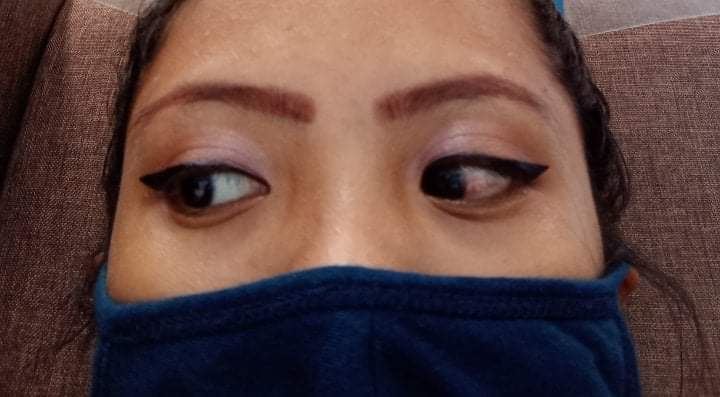
This is the time when I had to wear glasses again because my eyes were irritated, because I did not know that the contact lens I was using had a hole so my right eye was injured. My vision was so blurry that the previous 5.25 - 5.00 grade of my Eye became 6.25 - 6.00. I feel those times I will be blinded. haha. But thank god my eyes are okay now. It's really different when I have savings here on this platform because when there is an emergency / need, I have to expect something to be withdrawn / pulled.
The reason why I buy this is because I always love to sing.
I immediately bought three of them hahahaha. Then I sold the two for 100php because they were only 76php each. This is my first time ordering at Lazada. And I was satisfied and it was followed by another.
And another one.
And last. 🤭😇
That's it. Thank you so much for those who support me in all my subscribers/readers. Thank you so much.
**📣KINDLY LIKE /COMMENT /UPVOTES THIS ARTICLE IF YOU WANT TO. ALSO SUBSCRIBE IF YOU HAVEN'T. THANK YOU SO MUCH FOR READING.**
Daily Planning
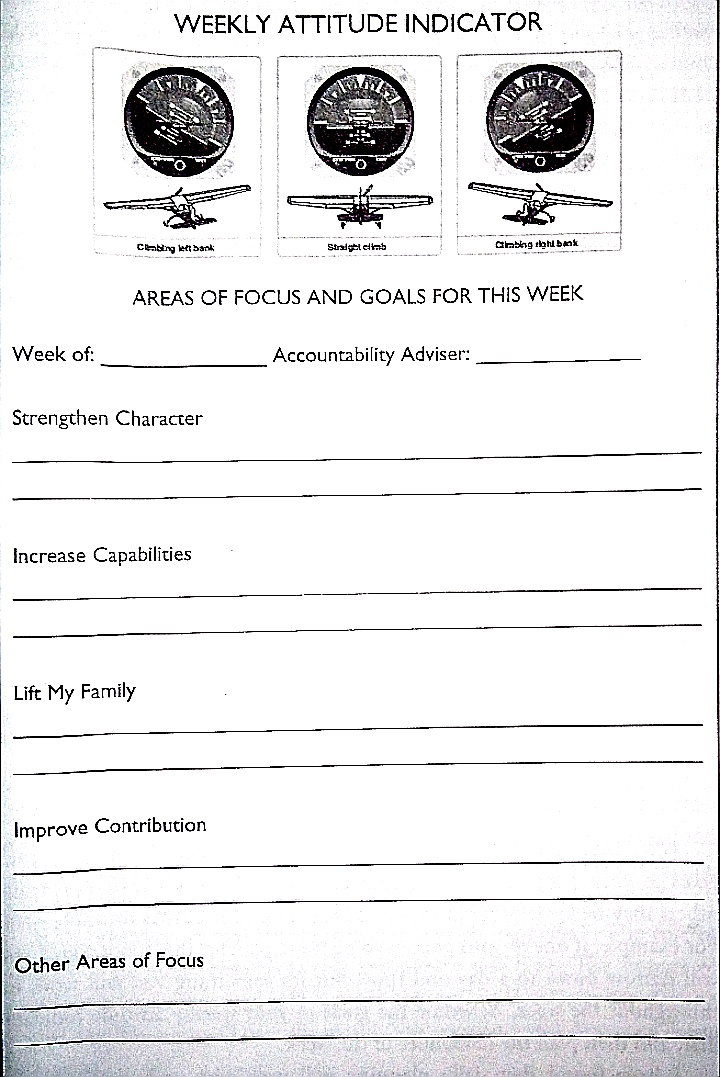
After you have filled out your weekly attitude-indicator, transfer your goals to your calendar. Some of your goals can be easily transfer others may be areas of focus that you look for opportunities to implement For example, if one of your goals is to be more patient, this is not a goal you will narrow own to a day and time, but its something you will work on throughout the week. Schedule the goals in your weekly attitude indicator first, and then plan the remainder of the week I have found that daily planning will vary with each person's style, schedule load, detail orientation, personality, and complexity in the family nature of work, and number of roles outside of home and work. The essence of daily planning is making sure you have written down all of your appointments, so you don't forget. You will also jot down your to-do list, which is nor time-specific as your appointments are. After you have created your to do list, put an "M" next to those items on your to-do list that you must do, an "S" next to those you should do and a "C" next to those you could do. Prioritize and number all of the items you must do, so you'll have M1, M2, M3, and so forth. Do the same thing with the should-do list and your could-do list Do the must-do items first followed by the should-do list, and lastly the could-do list if you have time. Check each item off as you do it, because it feels good. https://read.cash/@Sarahmay/attitude-indicator-a19b6603
you have a different process for daily planning that you like, do that.
You will more than likely gravitate towards a system that feels comfortable to you on daily planning. There is more than one right way to do daily planning. You will always be truggling with how much is too much to try to tackle in one day, and how much is not enough. Think back to the all-you-can-eat buffet analogy. Metaphorically speaking, get enough done so that you get your money's worth, but not so much that you get that bloated, "I shouldn't have done that"feeling. Regardless of whether or not you have the proper balance in your daily planning, what is infinitely more important is meeting the goals you put in your weekly attitude indicator. Think like a highly-effective and happy executive and/or mom. Congratulate yourself for getting the big stuff done—the vital and impactful few items that lead you to your mission—and dont sweat the never-ending smaller stuff. https://read.cash/@Sarahmay/all-you-can-eat-versus-selective-neglect-e7c80667
Consider what you accomplish each time you live according to your goals in your weekly attitude indicator. You will have piloted your life to a culture of being more and not just doing more. That was the goal. You will come out of that holding-pattern feeling. You will weave your warp of character and weft of activities and goals, and you will ill help your family members do the same. You will make improved contributions in your other roles. you are divine. A mother's (and father's) work is priceless.The role of a parent is the most important role any person can have. The impact of parenting is immediate and will last for generations. I express my deepest appreciation for moms all over the world. You are wonderful. You are a living Inspiration.
This has been quite a journey (or flight) that we have taken together. This has been more than just about time, time management, or time-management tools. It is really about knowing how to use time to deliberately weave Where is the Life we have lost in living? Where is the wisdom we have lost in knowledge? Where is the knowledge we have lost in information?
📣**KINDLY LIKE /COMMENT /UPVOTES THIS ARTICLE IF YOU WANT TO. ALSO SUBSCRIBE IF YOU HAVEN'T. THANK YOU SO MUCH FOR READING.**


The Moral Principles That Actually Drive Right-to-Die Law
Earlier, I mentioned my belief that the right to die rests primarily on the sense that patients may decline continued lite when they are irreversibly ill and suffering greatly rather than on the sense that patients may exercise a broad freedom to choose death over life. Evidence for my view can be found, as I indicated in the preceding section and in my other articles, in the reasons that courts and scholars give for recognizing a right to refuse life-Sustaining treatment. Typically, the right 1s justified both in terms of patient autonomy ana because the patient is irreversibly ill and suffering from the ravages of illness.
Another important piece ot evidence for my view can be found in court cases dealing with retusals of blood transfusions by young adults with a good prognosis tor full recovery. In those cases, trial courts typically authorize transfusion over the objections of the patient (or the patient's family when the patient is temporarily incompetent). Although the clear trend among appellate courts 1s to hold that the right to refuse treatment extends even to young, healthy persons refusing treatment as simple as blood transtusions, the patient's right to refuse is vindicated on appeal only after the treatment has already been imposed. These cases are relevant here because they typically involve a retusal of a blood transfusion by a Jehovah's Witness. If individual autonomy and the authenticity of the retusal were the critical issues, courts should have no trouble permitting the patients to refuse blood transfusions. Jehovah's Witnesses reject blood transtusions as an essential part of their religious belief. Accordingly, the willingness of trial courts and some appellate courts to permit unwanted blood transtusions suggests that the courts are influenced strongly by the fact that the transfusion will restore the patient to good health. A right to refuse treatment belongs to the irreversibly ill, not to those who can be cured.
Many of these Jehovah's Witness cases might be discounted because the patients had minor children or were incompetent when the need for transfusion arose. The judges requiring transfusion might have decided the cases differently if the patients did not have young children, or if the court could have relied on contemporaneous refusals by the patients rather than having to rely on evidence of the patient's wishes that existed before the patient lost decision-making capacity. Yet courts do not invoke a patient's parenthood when the patient is seriously and irreversibly ill. And in the cases involving patient incompetence, the need for a transfusion sometimes arose during surgery, and the patient had given written instructions refusing blood transfusion at the time of admission to the hospital. In any event, when the individual's basis for refusing blood transtusions lies in a firmly held religious belief, it is difficult to justify imposing a transfusion on the ground that the patient is unable to reaffirm the religious belief at the time the transfusion is needed.
I Can also cite my own experiences for the view that physicians see a right to refuse life-sustaining treatment as turning on the severity or the patient's medical condition. During discussions of this issue, I have heard many doctors describe cases in which they have imposed unwanted life sustaining treatment on relatively healthy patients. In such cases, the physicians indicated their belief that patients should not be able to decline care that would give them the opportunity for many years of healthy life.
Or, consider the case of Shirley Egan's daughter discussed above. She asked that her ventilator be withdrawn a few months after she had he shot by her mother. Inasmuch as she had accepted the ventilator for a fair amount of time and her condition was irreversible, her refusal of further treatment likely reflected a genuine and enduring expression of autonomy. Accordingly, if considerations of autonomy underlie the morally justifed wish to die, the daughter's death should not have been controversial. It should have been seen the same as if she had been left permanently unconscious by her mother's bullet and the ventilator withdrawn pursuant to her living will. Yet the public seemed to see her refusal of treatment more as a suicide than as a treatment decision driven by her injury. And the public saw her refusal that way apparently because she could live for many years and with her full intellectual capacities. In other words, the public seemed to question whether she really was injured seriously enough to choose death.
I can offer a final piece of evidence to support the view that the patient's condition is just as important in right-to-die law as whether the patient is acting autonomously. The right to have life-sustaining treatment withdrawn exists not only for patients who are competent or who previously were competent. It also exists for incompetent patients who never were competent. For such patients, a withdrawal of treatment cannot be justified in terms of the patient's autonomy, but only in terms of the patient's best interests. Under a best-interests standard, the key considerations will be whether the patient has a serious and irreversible illness and whether the patient is suffering.
Although I believe that a patient's condition is a key factor behind the patient's right to retuse treatment, concerns about patient autonomy are still important. In my view, the right to have treatment withdrawn (Or withheld) in fact rests primarily on considerations regarding the patient condition. Still, once a right to treatment withdrawal is recognized, it matters whether the patient wants to exercise that right. Some patient will want treatment withheld or withdrawn; other patients will prefer to receive life-sustaining treatment. Patient autonomy comes in, then, on the question whether the patient will accept or refuse treatment once the patient has a choice to accept or refuse it.
Finally, recall my earlier point that whether I am right or wrong about what moral principles actually drive right-to-die law, we end up at the same categorical distinction between physician-assisted suicide and the right to refuse life-sustaining treatment. Whether we defer to the patient's genuine expression of autonomy, or we make an objective assessment of the patient's condition before recognizing patient choice, we still come to a regime in which patients can have life-sustaining treatment withdrawn but cannot die by suicide or physician-assisted suicide.
Because both theories about the morally justified patient death take us to the same categorical distinction, I am not including an argument as to which theory is normatively correct. My theoretical goal in this book is to illuminate the translation of principle into practice, and for that purpose it is not important to decide between the competing underlying principles.
📣**KINDLY LIKE /COMMENT /UPVOTES THIS ARTICLE IF YOU WANT TO. ALSO SUBSCRIBE IF YOU HAVEN'T. THANK YOU SO MUCH FOR READING.**


Weekly Planning Process
Review your flight plan or mission. https://read.cash/@Sarahmay/mission-statement-flight-plan-85c838ed
Review how much you moved towards your mission during the past week and celebrate and/or pre-forgive yourself.
Review possible activities from your areas of focus tabs. Come up with your goals that you will implement in the coming week to lift each area of focus within your life and write them down in your weekly attitude lindicator https://read.cash/@Sarahmay/attitude-indicator-a19b6603
Transfer your goals to your calendar.
Report and give an accounting to your accountability adviser.
Sometime between Friday afternoon and Sunday evening block out fifteen to twenty minutes to plan your coming week. In your planning time, first think in terms of your mission or your life's fight plan. Reconnect. Be inspired and renewed by your mission and what you want to do and be in your life. Remember from the loom analogy that you are trying to improve both your warp of character and your weft of goals and activities.
After reviewing your mission, think about the week before. Did you move closer to your mission?As you review the areas of focus in your life (your character, your Capabilities, your family. and your roles in the community at large) did you do your part to lift each of these areas of focus, or were you weighed down in some? Celebrate those areas you were able to lift! There Is not enough celebration going on for significant weekly accomplishments that bring you closer to your mission. Raise both arms in air and congratulate yourself In those areas where you were weighed down, remember the prin- ciple of pre-forgiveness. You have a divine nature and divine potential, and you have the upcoming week to make improvements.
The next step is to review ideas from this article that you would capture in the areas of focus tabbed sections in your time-management tool. There may the be additional ideas you have written down. The concept is to continually add to the list, other ideas and goals that will help you lift yourself and others. For the coming week you may consider goals from the list you have written on your areas of focus tabs or by simply reviewing your list, you will probably come up with other thoughts and ideas.
The next step is to choose your goals for the week. Thinking specifically of this week, ask yourself what should you continue doing, start doing, and stop doing that will lift cach of the areas of focus in your life. On the picture below , you will see what your weekly attitude indicator will look like.
After you fill out your weekly attitude indicator, think for a moment about what your week would be like if you were able to accomplish everything on your weekly attitude indicator. If the goals you have written down are goals that you feel will truly lift your character, capabilities, your family, and help you improve the contributions you are making in other roles of your life, it will give you a sense of moving towards your mission. In those cases when you only accomplish part of the goals you have written down on your weekly attitude indicator, you should still feel pretty good because you are making deliberate strides towards your mission. If you find that in certain weeks you are not able to finish everything you have set out to do in your week attitude indicator, pre-forgive yourself and try it again the following week.
In the early 1900s an Italian economist, Vilfredo Pareto, came up with a mathematical formula to describe the unequal distribution of wealth in his country. He observed that 80 percent of the wealth was held by 20 percent of the population. In the 1930s and 1940s a management consultant, Joseph Juran, recognized a principle he called "the vital few and the trivial many." He asserted that 20 percent of something is responsible for 80 percent of the results. This 80/20 rule has applications in many areas. For example, you may find 20 percent of your sales staff produces 80 percent of your sales.You may also find that 20 percent of your work consumes 80 percent of your time and resources, I would suggest that in the field of time management, similar conclusions can be made. There are the "vital few" activities that can have a remendous impact on how you use your time and thus lead you to be the person you want to be The goals you select in your weekly attitude indicator are intended to be the "vital few" goals or perhaps the 20 percent of your activities that will facilitate 80 percent of the results. As a mother or any other executive, focus on the power of the vital few and not the length of to-do lists. Separate the impactful few from the immediate many.
The last step of your weekly planning process is to let your accountability adviser know how your last week went and what your goals are for the coming week. This need not be a long process. Remember that the probability of completing your goals go up to 95 percent when you have a specific appointment with your accountability adviser and give an accounting of your progress. Choose an accountability adviser whom you trust and is willing to help you reach your goals and be the person you want to be.
**📣KINDLY LIKE /COMMENT/UPVOTES THIS ARTICLE IF YOU WANT TO. ALSO SUBSCRIBE IF YOU HAVEN'T. THANK YOU SO MUCH FOR READING**.
Genuine Expressions of Autonomy as the Moral Justification for a Patient's Choice of Death
According to one important view, individuals enjoy a fundamental right of self-determination for critical personal decisions. In this view, the right to control one's destiny is a core right in our society. Different arguments have been put forward to justify such a fundamental right, but the important point for this discussion is the view that the right includes the freedom to end one's life. Although the state may have an interest in prolonging a person's life, the state's interest must yield to the right of individuals to decide the circumstances and timing of their deaths. Or, to put it another way, the state's interest in prolonging a person's life exists only as long as the person wants the life prolonged. The state can act to protect individuals from having their lives taken involuntarily but not to protect individuals from taking their own lives voluntarily. In his dissenting opinion in the Cruzan case, Justice Brennan invoked this view to explain why Nancy Cruzan's right to have her feeding tube withdrawn superseded Missouri's interest in preserving her life.
At first glance, this theory might permit all four of our patients to end their lives. All four patients chose to take death-hastening action. Alternatively, an autonomy-based theory might permit the treatment withdrawal from the permanent-ventilator patient and the suicide of the end-stage cancer patient but not the treatment withholding from the curable patient or the suicide of the depressed patient. With the latter two patients, one could object to the refusal of antibiotics or the suicide on the ground that neither person was making a choice that reflected a genuine expression of autonomy. But whether two or four of the patients could end their lives, the important point is that it should not matter whether the personcould live for several decades in good health or for only a few months in poor health. It should not matter whether the person needs antibiotics for a couple of weeks or a ventilator for the rest of his life. It also should not matter whether the person would die by treatment withdrawal or suicide. With individual self-determination as our guide, we would only want to ensure that the patient was making an informed and voluntary choice of death-hastening action.
However, even acepting a fundamental right to die for all persons, we still can derive an explanation for the law's categorical distinction between treatment withdrawal and suicide. This explanation reflects concerns about the validity of a person's decision to die. Even assuming that all individuals have a right to end their life, we still want to ensure that the choice to end one's life is a genuine expression of the person's autonomy.
Autonomy is not served if the person chooses to die out of incompetence, irrationality, mistake, fraud, or coercion. Accordingly, before we honor a patient's request for life-shortening action, whether a treatment withdrawal or an assisted suicide, we would want to confirm that the request is a valid exercise of self-determination.
To be sure, for any decision by a person, we would be concerned whether it reflects a genuine expression of autonomy. Nevertheles, because so much more is at stake with life-and-death decisions than routine, daily decisions, we have special concern about the validity of those decisions. This point was made by Ronald Dworkin in his discussion of the The Philosopher's Brief to the Supreme Court in the physician-assisted suicide cases. The brief argued in favor of a fundamental right to make momentous personal decisions, including decisions about the circumstances and timing of death. The brief also acknowledged that people may make their momentous personal decisions "impulsively or out of emotional depression, when their act does not reflect their enduring convictions." Given the irrevocability and far-reaching consequences of a decision to die, Dworkin wrote, the state may prevent people from ending their lives when the state believes it unlikely that the person is acting on the basis of an enduring conviction.
A need to ensure that a decision to shorten life is genuine does not necessarily preclude a regime in which all patients could choose death, whether by treatment withdrawal or suicide. Under such a regime, there would be some kind of mechanism to ensure that the person actually was competent, was thinking rationally, had a clear understanding of the situation, and was not acting in response to coercion. In large part, the requirement of informed consent is just that kind of mechanism, so we might say that a patient can choose to hasten death once a physician has confirmed that the patient is acting voluntarily after being fully informed about the decision (as we do with decisions to retuse life-sustaining treatment). We might also require thata second physician make the same confirmation, and we might encourage or require the participation of a mental health expert to ensure that the patient does not have a treatable depression (as Oregon does in its assisted suicide law).We would also want some assurances that the decision came out of an enduring conviction. To ensure that the choice to hasten death comes out of an enduring conviction, we might require a period of time over which patients must persist in their desire (again, as Oregon does in its assisted suicide law).
However, there are serious practical problems with efforts to ensure that choices of death-hastening action reflect genuine expressions of autonomy. We know that our methods for determining competence, assessing rationality and understanding, and detecting coercion are imperfect. As good as we might be in these activities, we are not perfect (and it is unlikely that we will ever be perfect). Given the imperfections of our methods for ascertaining the validity of individual decisions to shorten life, we are going to have a "false positive" rate. That is, in a number of cases, a physician will conclude that the patient is making a genuine expression of autonomy when the patient is in fact not doing so. The physician may wrongly conclude that the patient is competent, may wrongly believe that the patient's thinking is rational, or may fail to detect coercion by a family member. If the patient is allowed to die in such cases, the patient's autonomy will be frustrated rather than vindicated. In other words, we will have wrongful patient deaths from false positive determinations that a patient's decision to hasten death is genuine.
To protect against the risk of wrongrul deaths, we can turn to an important insight from Bayesian analysis." Bayesian analysis tells us that if we have imperfect methods of ascertainment, we can identify circumstances in which the false positive rate will be high and circumstances in which the false positive rate will be low. The false positive rate will be high when the "background" likelihood of the thing being measured is low. Conversely, the false positive rate will be low when the background likelihood is high. For example, suppose there is a medical test that is used to detect coronary artery disease. we limit the test to middle-age or older persons who have chest pain wnen they exercise, who eat a diet high in fat, and who have a family history of coronary artery disease (i.e., People who are at high risk for coronary artery disease), the false positive rate will be much lower than if we give the test to young people with no syptoms of chest pain, a diet low in rat, and no history of coronary artery disease (i.e., people who are at loW risk for coronary artery disease). Bayesian analysis tells us, then, that to lower the risk of wrongful deaths, we would want to permit patients to die only when there is a relatively high background likelihood that the patient's decision to hasten death is genuine. Indeed, given the grave consequences of a wrongtul decision to choose death, we would want an especially high background likelihood that the patient's decision is genuine. We might draw an analogy to decisions about guilt and innocence. Because of the great harm in finding an innocent person guilty, we employ many safeguards in criminal law to protect against wrongful convictions even though we thereby risk acquitting some guilty defendants. As is often said, it is better to let ten guilty people go tree than to convict one innocent person.
The categorical distinction between treatment withdrawal and suicide gives us the especially high background likelihood that we desire. When a patient refuses lite-sustaining treatment, we recognize that there are good reasons tora patient to do so. The patient may find the side effects of the treatment ntolerable, may feel that the benefits of continued life with serious and irreversible illness are outweighed by the burdens of such a life, or may have religious objections to the treatment. Given these reasons why patients in general may want to refuse treatment, we can safely allow right to refuse treatment as long as we are comfortable that the withdrawal is what the particular patient wants. The physician's conclusion that the patient genuinely is ready to die is likely to be a correct conclusion (i.e., a true positive result).
With suicide, on the other hand, we have good reason to suspect an insufficiently high likelihood that the person's choice reflects a genuine expression of autonomy. Temporary depression is a common reason for people to attempt, or seek assistance in, suicide. In most cases of suicide, we believe that the individual is acting irrationally, out of impaired mental competence or out of convictions that are not enduring. The young person who has had a serious setback in lite may have ditfhculty maintaining a long-term perspective. Given the insutfhcient likelihood of genuine wishes to die among suicidal persons, it is not safe to rely on individual assessments of the individual's desire to die. There is too high a risk that physcians or other evaluators will incorrectly conclude that a person's choice of suicide is genuine. Consequently, we have chosen to prohibit the practices of suicide and assisted suicide entirely. The categorical distinction between treatment withdrawal and suicide ensures that a person's choice of death is a genuine expression of the person's autonomy.
One might respond that I am using the wrong measure when I consider the validity of suicidal desires in the general population. Among terminally ill patients who request assisted suicide, the background likelihood that the request is genuine will be higher than for all persons who desire suicide. This is an important point, and I will respond to it below. Briefly, I will argue that differences between dying patients and other persons explain why the categorical distinction between treatment withdrawal and suicide needs refinement such that a right to assisted suicide should be permissible for terminally ill persons.
📣**KINDLY LIKE/ COMMENT /UPVOTES THIS ARTICLE IF YOU WANT TO. ALSO SUBSCRIBE IF YOU HAVEN'T. THANK YOU SO MUCH FOR READING.**


What We Learn from the Four Patients about the Role of the Withdrawal/Suicide Distinction
As a Proxy for the Morally Justified/Morally Unjustified Death Distinction
According to conventional ethical and legal analysis, it is permissible for both curable and permanent-ventilator patients to refuse medical treatment, despite the lethal consequences of their refusals. The right of self determination and the right to control one's body are viewed as permitting people to decline any unwanted medical treatment, even in cases in which the treatment is life-sustaining. As one court wrote,
*[T]he right to self-determination ordinarily outweighs any countervailing state interests, and competent persons generally are permitted to refuse medical treatment, even at the risk of death... . [The] right to self-determination would not be affected by [the patient's] medical condition or prognosis.. [A] competent person's common-law and constitutional rights do not depend on the quality or value of his life.*
Conversely, conventional analysis would forbid either the depressed or the end-stage cancer patient to commit suicide. Suicide, it is said, is a moral wrong, even for the terminally ill individual.
Yet I believe our moral intuitions come out differently. Our moral intuitions tell us that the permanent-ventilator and the end-stage cancer patient should be able to die. Both of them have serious and incurable illnesses. Both of them are suffering greatly from their illness, physically and/or psychologically. By insisting that they stay alive, it seems as if we would be only prolonging their dying process. On the other hand, our moral intuitions tell us that the curable and the depressed patient should be denied the option of death. With appropriate medical care, both patients could be restored to many years of good health. For these patients, treatment withdrawal or suicide would begin the process of death rather than avoiding its prolongation. Moreover, we have good reasons to doubt that these patients have a genuine wish to die. In the absence of a religious objection to medical treatment, it is hard to believe that someone would refuse health-restoring antibiotics, unless the person misunderstood the situation or had a diminished decision-making capacity. Similarly, when a person is depressed, we believe that the person is unable to look beyond the current despair to give adequate recognition to longer-term interests.
Our moral intuitions, then, tell us that some people should be able to refuse lite-sustaiming treatment (e.g., permanent-ventilator patients) and other patients should be denied that freedom (e.g., curable patients). Similarly, some people should be able to commit suicide (eg., end-stage cancer patients), while other people should be prevented from that act (e.B, depressed patients). How should we explain the gap between our moral intuitions and the distinction in law (and ethics) between treatment withdrawal and assisted suicide? Why is it that, when deciding who should be able to act in a way that hastens death, our legal (and ethical) rules come to different conclusions than do our moral intuitions?
One possibility is to reject our moral intuitions as misleading. Sometimes, in tact, our moral intuitions lead us astray. For example, we often are uncomfortable with new technologies that are ethically appropriate, Simply because we are not used to them. " When the first child was born through in vitro fertilization, many people argued that it was wrong to have "test tube" babies." Over time, however, we have come to realize that the desire to have children is of such fundamental importance that infertile couples should be able to reproduce even if it means using in vitro fertilization (or some of the other artificial methods of reproduction).
Although moral intuitions are often unreliable, there is no reason to think they are unreliable in the case of our four patients. Accordingly, we need to look elsewhere to reconcile our moral intuitions with the legal (and ethical) distinction between treatment withdrawal and assisted suicide.
To reconcile our moral intuitions with the distinction between treatment withdrawal and assisted suicide, I will argue that society has defined the right to die in terms of categorical, bright-line rules, rather than by using case-by-case judgments about the morality of individual patients deaths. An outline of the argument follows: As I have explained, there is no morally significant difference between the act of treatment withdrawal and the act of suicide (or assisted suicide). What matters is whether the person has made a morally justihed decision to hasten death. In an ideal world, we would consider a patient's decision to ch0ose life-shortening action, and then either permit or torbid that action, depending on the nature of the decision. However, as I will explain, there are serious problems with case-by-case efforts to decide whether a patient is making a morally justified decision to hasten death. Accordingly, as in other contexts, it is helpful to come up with categorical rules that generally result in decisions that retlect our moral principles. The distinction between treatment withdrawal and suicide is one of those categorical rules. Although any particular treatment withdrawal may or may not be morally justified, the typical treatment withdrawal is moraly justiied. Conversely although any particular suicide may or may not be moraly justified, the typical suicide is not morally justified."e By permitting treatment withdrawals and forbidding suicides, we are generally successtul at permitting patients to die when they are morally justifhed in choosing death and preventing patients from dying when they are morally unjustified in choosing death. The distinction between treatment withdrawal and assisted suicide for dying patients, then, reflects a broader distinction in society between treatment withdrawal and suicide. As a general matter, suicide is forbidden on the ground that individuals should not take life-shortening action. However, society has permitted treatment withdrawal despite its life-shortening effects because it is believed that treatment withdrawals typically reflect a morally justified decision to hasten death.
Note that, when I say that treatment withdrawals are generally permitted by ethics and law, I mean that patients generally can choose whether or not to accept lite-sustaining treatment. A treatment withdrawal is permitted with the consent of the patient (or the patient's surrogate decision maker). However, if a patient wishes to have lite-sustaining treatment provided, it generally would not be acceptable to withhold or withdraw the treatment.
My argument raises two important questions. First, what do I mean by "morally justified" and "morally unjustihed" patient deaths? Second, why is it necessary to have a categorical, rule-based approach rather than a case-by-case approach for sorting the morally justified from the morally unjustified?
The answer to the second question depends on the answer to the first question. If one believes that a patient's choice of death is morally justfied when it reflects a genuine expression of the patient's autonomy, we can turn to principles of autonomy to explain the need for a rule-based ap- proach to distinguish morally justified from morally unjustified deaths. If one believes that patient autonomy is not sufficient to justify a choice of death, but that the patient must also be suffering from a serious and irreversible illness, as I think most people actually do believe, we can turn to concerns about excessive government power to explain the need for a categorical approach.
Note that it is not critical to my argument to determine which explanation for the morally justified death is correct. I am arguing that, whether we adopt the autonomy-based or the serious illness-based theory for the morally justified death, we will still end up at the categorical, bright-distinction between treatment withdrawal and suicide (or assisted suicide). Note also that if I am correct in my earlier argument that there is no meaningful moral difference between the act of treatment withdrawal and the act of suicide, both theories for the morally justified death apply equally to treatment withdrawal and assisted suicide. I recognize that some people may reject the idea that any patients are morally entitled to decide in favor of death-hastening action. My arguments here, as in my other article, ultimately rest on the critical assumption that I made in other article. There, I indicated that I was assuming that it is morally acceptable for patients to refuse medical treatment even when death will likely result from the refusal.
I will now turn to the two important moral bases for life-shortening action and demonstrate how they both lead to the same bright-line distinction between treatment withdrawal and assisted suicide.
📣**KINDLY LIKE /COMMENT /UPVOTES THIS ARTICLE IF YOU WANT TO. ALSO SUBSCRIBE IF YOU HAVEN'T. THANK YOU SO MUCH FOR READING**.


Four Patients Who Illustrate the Absence of an Important.
Difference between Assisted Suicide and Treatment Withdrawal.
Michael Doe, a twenty-four-year-old male, has ben brought to the hospital by a friend. Previously in good health, Mr. Doe is experiencing a severe headache and a stiff neck. Based on physical examination and laboratory tests, the emergency room physician makes a diagnosis of pneumococcal pneumonia and pneumococcal meningitis.
The physician informs Mr. Doe that he should be hospitalized immediately and given antibiotics. He refuses treatment and says he wants to go home. The physician explains the severe danger of going untreated and the minimal risks of treatment. (Without treatment, there is a likelihood of death of 60-80 percent, with survivors generally having major and permanent neurologic damage. With treatment, there is a greater than 90 percent chance of full recovery.) Mr. Doe persists in his refusal. There is no evidence ot compromised decision making due to an altered mental State (although the patient's high fever might lead the physician to suspect some incapacitation)." Further, Mr. Doe does not explain his refusal of treatment in terms of a personal belief, for example, a religious objection to antibiotics. Mr. Doe simply refuses and will provide no reason for the refusal. (One might conclude that physicians should impose life-sustaining treatment on Mr. Doe because he has given no reason tor his refusal and that this case simply illustrates that the right to refuse life-sustaining treatment requires a competent retusal. A small change in the facts could respond to this point. For example, assume that Mr. Doe would need artificial ventilation for a few days in addition to antibiotics, and he refuses the ventilator because he does not like the idea of being on a ventilator. From now on, I will refer to Mr. Doe as a "curable" patient.)
Jonathan Poe' was hospitalized and placed on a ventilator in December 1990, at the age of sixty-seven, because of difficulty breathing. This was his second experience with artificial ventilation. In 1936, nearly twenty years before the discovery of the polio vaccine, Mr. Poe had developed polio and spent six weeks in an "iron lung." He recovered completely, but his need for a ventilator in 1990 resulted from "post-polio syndrome," a condition in which a person's polio becomes reactivated and causes the same symptoms as with the original infection. During the few weeks after his 1990 hospitalization, it became clear that Mr. Poe would be ventilator dependent for the rest of his life. For Mr. Poe, having to live with continuous mechanical ventilation, with the consequent inability to speak, made his quality of life unacceptable. Accordingly, he asked that the ventilator be withdrawn. He was seen by a psychiatrist and two medical ethicists, all of whom agreed that Mr. Poe was making a carefully considered decision. Mr. Poe persisted in his wishes, and, on February 25, 1991, his ventelator was withdrawn. He died in fifty-three minutes, with thirteen family members and friends at his side. (From now on, I will refer to Mr. Poe as an example of a "permanent-ventilator" patient.)
Vincent Foster was a White House lawyer who died by a self-inflicted gunshot at the age of forty-cight, seemingly at the pinnacle of a life in which he went from one success to another. A friend of President Bill Clinton snce their childhood days in Arkansas, Mr. Foster had starred as an athlete in high school, finished first in his law school class, and become a leading partner in one of Arkansas's most prestigious law firms. When Mr. Clinton assumed the presidency in January 1993, Mr. Foster moved to Washington, D.C., to become the president's close and trusted legal adviser. Only six months later, however, Mr. Foster's body was found in a park just outside of Washington, after he shot himself in the mouth. According to friends, difficulties at work had taken a toll on Mr. Foster, and he had been showing signs ot depression during the last month of his life. He had just started to take an antidepressant medication and had obtained the names of local psychiatrists, but apparently he was overcome by his despair. (From now on, I will reter to Mr Foster as an example of a "depressed" patient.)
Jane Roe" was a sixty-nine-year-old retired pediatrician who was diagnosed with cancer in 1973. Treatment subdued the cancer until the fall of 1988, when it came back. By 1993, the cancer had metastasized throughout Dr. Roe's skeleton. Although she tried and benefited temporarily from various treatments, including chemotherapy and radiation, the cancer became untreatable. In June 1993, Dr. Roe became almost completely bedridden, and she began to experience constant pain, which was especially sharp and severe when she moved. Medications could alleviate her pain, but could not relieve it fully. In addition to the pain, Dr. Roe suffered from swollen legs, bed sores, poor appetite, nausea and vomiting, impaired viSion, incontinence of bowel, and general weakness. She did not, however, have any loss of mental competence. When it became clear that even hospice care could not relieve her pain and other suftering, Dr. Roe decided that she wanted to end her life by taking a lethal dose of prescription drugs. Because the law in Washington state, where she lived, prohibited physicians from assisting their patients suicides, Dr. Roe asked a federal district court in Seattle to find the law unconstitutional. Dr. Roe was joined in her lawsuit by two other patients, five physicians and an organization, Compassion in Dying. Although the trial court and the court of appeals ruled in Dr. Roe's favor, the Supreme Court ultimately rejected her argument in June 1997. In the meantime, in February 1994, before the trial court issued its ruling, Dr. Roe died. (From now on, I will refer to Dr. Roe as an example of an "end-stage cancer" patient.)
📣**KINDLY LIKE /COMMENT /UPVOTES THIS ARTICLE IF YOU WANT TO. ALSO SUBSCRIBE IF YOU HAVEN'T. THANK YOU SO MUCH FOR READING.**


Mission Statement /Flight Plan.
Cultivate Character. What are at least three character traits you want to
Identify the personal goals and personal achievements you want just for
you. If you were the last person left on earth, what personal goals would
you set just for your personal satisfaction
Create Family Culture. From your gut, what do you want your family
culture to be like?
Contribute to Community. With your unique talents, gifts, and interests.
what are the contributions that you would like to make at work, your
community, your church, and in other roles you may have?
Mission Statement /Flight Plan Worksheet https://drive.google.com/file/d/123BU_6cstQqPtgVNUxUrRPUyHeFwgr9X/view?usp=drivesdk
The next items you should see are tabs for each of the areas of focus of your life. Have a tab for character, capabilities, family, and contribution. Within each tab is contained the ideas you have read and in this article Additionally, within each tab is where you will write down ideas of things you may choose to do in the future. For example, have you ever been driving own the road or going for a walk, and out of nowhere comes a flash of brilliant idea? Maybe a great idea comes to mind that you had not yet considered Perhaps you have questions you have been pondering for quite some time, and then the answer finally comes to you. Where do you typically put those ideas? Have you ever been in a work conference, and you come up with an insight that can positively affect your family? Where do you put those ideas Instead of just organizing your time-management tool strictly by time, have your time-management tool also organized according to each of the areas of focus of your life. Have a place where you collect your insights, Flashes of brilliant ideas, and inspired goals. Along with these insights you may collect, write down specific areas of your life that you feel need special focus, such as patience, kindness, or being a better listener. To get you started on what your collection of brilliant activities might look like, consider the following questions and write down a few ideas. Don't worry about how you might accomplish them at this point. Just jot down your ideas. This is your wish list For your work life (or for any role that you might have in your life in the community at large, such as a church role, coaching role, volunteer role, etcetera), what do you want to have happen that is not now happening?
What do you want to have happen that is not now happening in your family life?
In a global economy where change is happening in an ever-accelerating speed, assume that your current skills will be obsolete in a couple of year What new skill sets would you like to develop? What new knowledge would you need to and want to acquire?
What do you want to have happen that is not now happening in your personal life? What character traits would you like to develop?
**AREA OF FOCUS: CHARACTER**
How can I cultivate and strengthen my character?
What do I really want? Have the deep desire to be my best self. Commit to be divinative and begin and end my day with prayer or meditation as well as read scriptures or inspirational literature.
Remember the Zigzag path to growth. Growing pains are jus tpart of the process https://read.cash/@Sarahmay/zigzag-path-to-growth-be98a65b
Pre-forgive myself along the way
Assemble my advisory board
Assess my successes and setbacks through the Achievement tCycle, and make the appropriate adjustments
Identify and then reduce or eliminate lizard-brain and monkey-brain activities
learn from without, then grow from within. https://read.cash/@Sarahmay/learning-from-without-6579f810 https://read.cash/@Sarahmay/grow-from-within-3ecd02fe
What else do I want to have happen that is not now happening in strengthening my character? What should I continue doing stop doing, and start doing to make it so?
AREA OF FOCUS: FAMILY
How can I lift members of my family?
Help my family to be divinative by my example, and encourage them to begin and end their days using their divine brains Read scriptures or inspirational literature and monitor for any early-troubling warning signs.
Pre-forgive.
Listen with the intent to hear, and appreciate their splendor, honor,and glory.
Expand their vision with patience.
Speak words and display acts of kindness.
Help my children assemble their advisory boards.
What else do I want to have happen that is not now happening in my family life? What should I continue doing, stop doing, and start doing to make it so?
After your mission statement and individual tabs for each of the areas of focus of your life, the next vitally important part of your time-management tool is your weekly plan. Nearly every time-management tool in the market Is designed for a one-year time frame, whether it begins in the calendar year or you purchase them in the beginning of a quarter. Nearly every time-management tool in the market has a monthly calendar to jot down your upcoming events months in advance. Nearly every time-management tool in the market has a daily calendar to put down your to-do list for each day, and you can organize your tasks and appointments in the appropriate time. However, many time management tools aren't organized by the week.
For most people a week means a seven-day period. but historically a week has ranged anywhere between a three-day to a ten-day week in different parts of the world. The Aztecs and Maya even had a thirteen-day week. The length of the week is not as important as much as what the week represents. The week represents the shortest cycle of living. For our purposes we'll define the week as a seven-day period. In this seven-day cycle of living, your activities during the weekend tend to be different from your activities in the weekday. Even within your weekdays your activities on Mondays are different from your activities on Thursdays and so on. The totality of this seven-day week represents the shortest cycle of living. Think of piloting and navigating your life in increments of a week. Well cover the weekly planning process and a tool you can use that we refer to as a weekly attitude indicator.
**📣KINDLY LIKE /COMMENT /UPVOTES THIS ARTICLE IF YOU WANT TO. ALSO SUBSCRIBE IF YOU HAVEN'T. THANK YOU SO MUCH FOR READING.**


@DavidKomolafe thank you so much for your support and for giving me the sponsorship. 😇😉
Generally Valid Rules versus Case-by-Case Judgments
Although it might seem preferable to make case-by-case judgments that would closely track underlying principles, generally valid rules may be superior. As the abortion example demonstrates, it is not always feasible to make case-by-case assessments, and one can often achieve better results by employing generally valid rules.
By way of further illustration, it will be helpful to look more closely at the arguments in favor of both individualized judgments and generally valid rules.I will begin with an important advantage of individualized assessments. Case-by-case judgments can ensure that the full range of relevant considerations is taken into account for each decision. When a liver is available for transplantation, for example, physicians can look at the severity of the patient's liver failure, the proximity of the patient to death, the likelihood that transplant surgery would be successful, and the life expectancy of the patient with a transplant.
In contrast to individualized judgments, rules take into account some important differences but necessarily neglect other important differences. For example, assume that organ allocation policy is designed to maximize the length of time that recipients benefit from their transplant. Assume further that, to foster that policy, an allocation rule gives priority for kidney transplantation to the potential recipient with the best tisue match to the donor kidney. The rule would generally increase the number of years between the date of transplant and the date on which the kidney is rejected by the recipient. And the rule would take into account very important differences among patients in terms of their tissue matching. However, a rule based purely on tissue matching would ignore the fact that other considerations affect the length of time during which a transplanted kidney functions. Both the patient's underlying cause of kidney failure and the presence of other medical problems will influence the longterm success of transplantation. In other words, the allocation rule would ignore many relevant differences among patients that affect how long a transplant will last. In short, rules often undermine fairness by treating people alike even when they are different.
To put it another way, rules by their nature are both over inclusive and under inclusive. As Schauer writes, a speed limit of fifty-five miles per hour is overinclusive because it prevents people from driving at higher speeds even when it would be perfectly sate to do so (e.g., when driving on a flat and straight interstate highway, on a clear day, when there is no other traffic nearby). Similarly, a speed limit of fifty-five miles per hour is underinclusive because it permits people to drive that fast when rainy weather means that speeds above forty-five miles per hour are not safe. Rules thus can result in outcomes that are inconsistent with the moral justifications underlying the rules.
Although the greater complexity of case-by-case judgments can be advantageous, so can the greater simplicity of rule-based decisions. Case based decision making can encourage poor decision making, for example by overburdening decision makers with too many factors to weigh.Many scholars oppose "bedside" rationing of medical care, in which physicians make case-by-case allocation judgments, and one important concern is that a physician cannot possibly assimilate all of the data relevant to an individual rationing decision. The physician would need to know the magnitude of the potential benefit for the patient, the likelihood that benefit would be realized, the duration of benefit, the financial cost of thetreatment, and the benefit that would be realized it the treatment were denied and the saved resources used for another patient (or for a non health care service)." Thus, as John Rawls has noted, we might prefer general rules to guide many actions, on the ground that people will not correctly decide the optimal action in particular cases.
Case-by-case judgments are susceptible to error also because they leave room for decision makers to bring their self-interest, their prejudices, and their other unwelcome motivations to their work. The American Medical Association's Code of Medical Ethics, for example, prohibits certain gifts from drug companies to physicians, like airline tickets to conferences or cash payments to attend company-sponsored presentations, rather than rely on physicians to apply on a case-by-case basis an underlying principle, such as, "Do not accept gifts if acceptance might influence or appear to others to influence the objectivity of clinical judgment. " With such a principle as a guide, many physicians will not give sutfhicient weight to the effects on their judgment of gifts. Similarly, police officers who rely on their individualized judgment may end up pulling over cars driven by African-Americans more often than those driven by whites. To be sure, decision makers may not be aware of the influence of self-interest or other unfair bias. But that does not change the fact that rules may be needed to prevent undesirable biases from infecting decision making. Rules, then, effect an allocation of power, by which decision-making authority is withdrawn or withheld from some people, out of concern that they will not use their authority wisely.
The simplicity of rule-based decision making offers several other advantages. By streamlining the decision-making process, rules save time. They free decision makers from having to undertake a thorough and nuanced investigation and calculation every time a decision comes up. If each organ is given to the patient who has been on the waiting list for the longest time, it is a Simple matter to identify the recipient of each organ. Similarly, as Schauer observes, speed limits can tell us exactly how fast we are able to drive and spare us the need to figure out on our own the maximum safe speed. This is the argument from efficiency.
Related to the argument irOm ermciency is the argument from predicability, or reliance. People can plan their lives much more expansively once they know that they Can rely on the existence and enforcement of rules. Automobile manufacturers would have great difficulty operating their assembly lines it they could not sign contracts for the delivery of parts on future dates, Contracts that they know will be enforced by the rules of contract law. Likewise, people waiting for organs would spend much of their maneuvering for priority in the allocation process if they could not rely on the authority of organ allocation rules to determine who among potential recipients will be chosen for transplantation. When decisions are made on a case-by-case basis, people must accept a good deal of undesirable uncertainty, and rules can address that concern.
In some cases, rules are employed because insufficient information makes more refined judgments impossible. Many medical guidelines reflect this reason for rules. For example, the National Cancer Institute recommends that women receive regular mammograms to detect breast cancer once they reach age forty. Yet some women in their forties, fifties, or older have a very small risk of developing breast cancer, while other women at those ages have a substantial risk. In the future, advances in medical knowledge will probably allow physicians to identify which women age forty or over really need to be screened for breast cancer and which do not need to be screened. For the time being, however, the best cancer experts can do is recommend mammography for all women starting at age forty (or fifty).
In the end, it seems fairly clear that both case-by-case judgments and rule-based decision making have important roles, and many life-and-death decisions are made through a combination of the two methods. For example, the liver allocation guidelines of the United Network for Organ Sharing (UNOS) assign priorities to patients waiting tor a liver transplant, and an available organ is generally given to the first person on the waiting list. Transplant surgeons do not undertake a comprehensive analysis to decide the most appropriate recipient each time an organ becomes available. However, transplant surgeons are given discretion to decide not to transplant a liver into the first person on the waiting list if they do not believe it is appropriate to do so, based on their medical judgment. If the first person's surgeon declines the liver, it goes to the next person on the waiting list (unless that person's surgeon also declines the liver).
**📣KINDLY LIKE /COMMENT /UPVOTES THIS ARTICLE IF YOU WANT TO. ALSO SUBSCRIBE IF YOU HAVEN'T. THANK YOU SO MUCH FOR READING.**


Attitude Indicator
From the simplest to the most sophisticated airplanes, there are certain gauges in the instrument panel that exist in all of them. The gauge in an instrumentation panel of a plane that lets the pilot know the orientation of the plane relative to the earth is called a gyro horizon or artificial horizon. Interestingly, it is also called an attitude indicator. The attitude indicator let's a pilot know whether the plane has the nose pointed down and the plane is moving downward towards the earth below, or whether the nose is pointed up and the plane is rising. Similarly, we can engage in activities we have outlined, that we know will lift and move us upward and forward toward our mission, or we can engage in other activities that weigh down our lives and direct our lives downward. Through this allegory you'll not only get a sense of where your attitude is currently heading but also what may be causing your attitude to be great or less than ideal.
The attitude indicator will also tell a pilot when the plane is rolling or tilted to the left or right as the plane turns. If the plane continues to turn In one direction, the plane will be traveling in a circle or oval shape. Some commercial flights will do this on purpose when they are waiting to get clearance from the air traffic controller to land. This is called a holding pattern. Have you ever felt that your life has been inholding pattern? This holding- pattern feeling we may have from time to time-in which we get the sense that our lives are not really moving forward--could happen in four ways. First, it could happen when you are not doing enough to lift yourself, while at the same time you are doing the best you can to lift your family and everyone else. I see this all too often with moms who, in the name of contribution to others, end up neglecting themselves and in time will be less able to lift their family or anyone else.
The second holding- pattern feeling can also happen when you are lifting yourself, your families, and others, but you may feel disconnected from the natural laws or principles or character that would give you the most direct route to the person you want to be. For example, Ive heard mothers say in retrospect that although at times they may have lifted themselves physically through exercise and a healthy diet, lifted themselves emotionally through social activities, lifted themselves mentally through reading amd study, they still felt weighed down. More than they cared to admit at the time. they approached life through the lizard-brain or monkey-brain mindset of competitionand fitting in to social norms at all costs. They later know down deep inside that their actions did not represent their best selves. Both of these scenarios of not doing enough to lift yourself or renew yourself toward your belief system, promises, vows, or covenants you have made, can create the feeling of being in a holding pattern in one direction.
Third,the holding-pattern feeling can also happen if you are not doing enough to lift your family. Like a plane that has lost an engine, when things are not going well on the home front, we lose power and speed, our progress impeded, and we feel it. It is worth reminding all of us again that success at home is doing everything we can do to creare the culture we want in the home.It doesn't guarantee that every member will respond to our wishes, because they each have the power to make their own choices. The point is making sure we do our part.
Fourth, it can also happen when we are not an active participant in the community large. We all have an inward desire to contribute to the world we live in and to make a difference in our own unique ways. When we are not consciously and actively contributing and instead are sitting on the sidelines as a bystander, this can give you that holding-pattern feeling as well. We will provide you with a tool that you can use a tool to serve as an attitude Indicator for your life. It will take the elements of all the allegories we have discussed and implement them.
**Pulling It All Together**
In your mind's eye, imagine looking at your current time-management tool, whether it is paper-based or electronic. In your imagination, remove from your current time-management tool everything that has dates and times. Furthermore, in your imagination remove the A-Z tabs where you record important names with their addresses, phone numbers, and e-mail addresses. After you have removed the pages with dates, times, as well as pages with important names and their useful information, what is left? If your answer is binder or nothing of significance then what you have is a time-management tool. Our goal is much Inore than just a time-management tool, but a strategy to pilot and navigate your life to a culture of being more and not just doing more.
**Structure**
We recommend that when you open your paper-based planner, the first thing that you should see is your mission statement. Seeing it first every time you open your planner will be a constant reminder to you of your life's flight plan. If you have an electronic time management tool, have your mission statement easily accessible. On the following page is an example of what this page may look like. You will probably have additional pages as you revise and refine your mission statement. Your revisions will come as you gain additional insights about your unique divine life.
📣**KINDLY LIKE /COMMENT /UPVOTES THIS ARTICLE IF YOU WANT TO. ALSO SUBSCRIBE IF YOU WANT TO. THANK YOU SO MUCH FOR READING.**


Talking about unfairness and dissatisfaction.
If you have time to do that, look sternly at yourself critically, and strive to correct yourself."
There are a lot of people who think it is only normal to talk about unfairness and dissatisfaction, and who are not all ashamed to do so. What's more, there is an actual tendency among people to think about this, as if it were a common human trait. There is also an extremely large number of people who just because they feel unfairness and dissatisfaction indeed talk about it, thinking that they will be able to progress and/or improve their share in human society. This constitutes the same mistake as the way a person think that they will be able to differentiate between good and evil or to discover an incomprehensible truth just because that person doubts.
This is because the only thing that the bad habit of talking about unfairness and dissatisfaction is to make a person feel a lot of "anfuish" and "agony in his or her heart, and once a person realizes that this will not bring about any greater yield of value in life, this can definitely be considered to be proof that it was a mistake, And the result of unfairness and dissatisfaction is that, before a person can realize it, this causes the person to no longer be able to control himself or herself at all, which is a very unfortunate result indeed.
Althought it is not necessary to talk too much about it, when a human being lives his or her complicated and busy life, this is just like bringing a ship into rough seas, because that person did not know anything about piloting a ship, and without, of course, being able to obtain such things as happiness, success, prosperity or good health, that person becomes miserable castaway on the rough sea of life, and will merely and unavoidably end his or her life tragically.
Actually, you cannot find a large number of people without looking around this great world of ours, but simply by looking carefully around you? I'm talking about people who, while being well educated, having good position in life, and having a great deal of financial clout, feel more unhappiness in their lives than they do happiness.
More than anything else, this is a result of not being able to completely control oneself, which is so important in the construction of an ideal life. To put this in terms which are easier to understand, such a person is constantly being threatened by events in life, or that is to say, not only of course by things that have to do with their health and destiny, but by the trifling everyday affairs of life, and just as I have already mentioned, people who do not know how to pilot a ship do not know how to pilot oneself even in an insignificant storm, so that just as if they have lost their presence of mind, they are unable to live their lives with real peace of mind. And what's more, the basic reason for this is because they do not have a positive "frame of mind."This is because they are satisfied with having a negative heart. Also, people who do not even realize at all, they are in the bad habit of recklessly criticizing others, will bring about a worthless actuality whereby the fundamental attitude of their heart, with out them even realizing it, deteriorates into negativity, unless they correct this.
There is a proverb which goes something like, "lf you are going to look at the way others act, correct the way how you act." This means that a person who recklessly criticizes the words and actions of others does not try to correct his or her own actions, accurately comparing them to the actions of others, and only criticizes others, there is no value in such criticism. To delve deeper into the matter, since people whom it comes natural to recklessly criticize others do not reflect upon themselves at all, such people do not make any progress or improvement at all in controlling themselves, which is the most important thing in life.
And so, you should first of all stop searching for the flaws and faults of others, and rigidly search for your own flaws and faults.
Our group of employees should of course be serupulously mindful of this teaching, and pay close attention in placing values in their lives. It is an excuse of the average person to say that he or she understands other people immediately, but does not understand himself or herself easily.
People should consider it's one of the obligations in life to strive always strictly to criticize themselves, and to earnestly correct themselves.
📣**KINDLY LIKE/ COMMENT/ UPVOTES THIS ARTICLE IF YOU WANT TO. ALSO SUBSCRIBE IF YOU HAVEN'T. THANK YOU SO MUCH FOR READING.**


Lifting by Contributing
**When you cease to make a contribution, you begin to die.**
As with many high school students getting ready to graduate, my conversations with my high school friends revolved around discussing our plans after high school, including career choices. Our conversations centered around which careers would give us the greatest opportunity to be rich, sounded the most glamorous, and how those careers would eventually allow us to live the life of the rich and famous. Our conversations centered on what our careers can do for us. I don't recall many of our conversations being centered on what contributions we wanted to make in our careers.
Being a number of years removed from high school graduation, I have learned a few things about careers. I have learned, for example, that the market place is predominantly a lizard-brain, competitive, eat-or-be-eaten environment, and the structures and compensation systems are set up to perpetuate more of the same. I learned another important lesson early on in my career when I asked a wise mentor boss the definition of politics. He said politics is the art of self-preservation. I never forgot that definition. Much of the market place is a political environment that fosters more monkey-brain thinking of doing what is necessary to fit in even if it doesn't make sense—simply for the sake of self-preservation. These lizard-brain and monkey-brain systems would not exist if they didn't serve a useful purpose. However, they can go too far when such thinking dominates the work culture as it too often does. https://read.cash/@Sarahmay/one-brain-will-dominate-459fb944
It is not this way with every organization, team, or working person, however. Although success in the short run can be gained with a lizard-brain and monkey-brain mindset, work-life success in the long run will most likely be achieved with a divine-brain mindset of contribution. Such a divinative mindset will allow you to be successful in your work life, as well as simultaneously successful in your family life and personal life. You can't expect to have divine-brain thinking in the development of your character and your family while using predominantly lizard-brain and monkey-brain thinking at work. It will give you the sense that your life is misaligned.
**One man cannot do right in one department of life whilst he is occupied in doing wrong in any other department. Life is one indivisible whole.**
If you see in your workplace a predominantly lizard-brain and monkey. brain thinking environment, and it makes you feel uneasy, be grateful for that feeling. It is a signal that you want to have your divine brain be your dominant brain at work. Nearly every profession has components of contribution that everyone can focus on, but too often the significant contribution that tan be made is blurred, and the point of focus is instead pointed in the direction of making money or playing internal politics. You may need to go in a different direction. A different direction might mean changing to a different industry, a different company, or it may mean you are in the right place, but you need to figure out how make your divine brain be more dominant at work through focusing on what contribution you would like to make in your chosen profession. Perhaps you have the positional power to make systemic changes and change the culture to one of contribution with less internal competition. Regardless of whichever change is appropriate for you, make the change—because piloting your life toward your life's mission depends on it.
The spirit of having the divine-brain mindset of contribution also applies in every role you may have outside of your work role, whether you are the soccer coach for your child's neighborhood team, a volunteer in your child's school, a leader in your church, or you are starting a part-time business. thing you do Focusing on contribution unleashes your creativity and passion for everything you do.
**My object in living is to unite my avocation and my vocation as my two eyes make one in sight.**
What do lifting your character, your capabilities, your family, and lifting by contributing in all your roles have to do with time management? Everything! This time management philosophy is not about making a long to-do list and seeing how many items you can check off your list in a day. This is about using your time with the intent to pilot your life to a culture of being more and not just doing more. This is about thinking like the most effective mothers and executives and discerning which activities, though they may be few in number, will have the greatest impact in your life. You have created your flight plan by creating your mission statement. By lifting and cultivating your character, your Capabilities, your family, and by lifting other people in your other roles through the spirit of contribution you will be on your way to realizing your mission and being the person you want to be.
**📣KINDLY LIKE /COMMENT /UPVOTES THIS ARTICLE IF YOU WANT TO. ALSO SUBSCRIBE IF YOU HAVEN'T. THANK YOU SO MUCH FOR READING.**


Help Expand Vision with Patience.
In my associations with many parents, as well as in my own experience, there is a tendency to underestimate our children's intelligence and overestimate their experience. Consequently we make certain assumptions about what we thought they should already know, and we're disappointed when they don't act accordingly. These could range from the very pragmatic to the abstract, such as:
Cleaning their rooms
Eating etiquette
Cleaning up their messes
The value of work
Understanding that the decisions made today affect the future
The importance of respecting people's time
They are judged by their appearance regardless of whether it is right or wrong
Being respectful to others makes a big difference
The power to choose, etcetera
John Wooden was the men's basketball coach for UCLA, and in his tenure he won ten NCAA national championships. That is the highest number of men's basketball championships for any coach; the next closest is four. He was also voted the coach of the century for all of sports. One of the first things he would teach his players was how to properly put on their socks and tie their shoes. The players thought it was a childish exercise at first, but he would explain to his players that not putting on your socks and shoes properly could give you blisters, which could affect the quality of your play, and that could negatively affect the outcome of a game. All of his players were talented, and had been playing basketball for many years. Many of them would go on to play at the professional level, but he taught them the basics and expanded their vision of why these and other basics are so important.
Expanding your children's vision and understanding with patience means being more apt to teach, mentor, and coach, than to assume and judge. Ask your kids questions to check their level of understanding. Through asking questions you'll know what parts to skip and what to emphasize. There may be some things they know already, and you just need to do a quick review, but there's no shame in over communicating if they already understand. Don't you wish over communication would happen more often? When kids do something wrong, get in the mode of listening. Then when you have listened sufficiently so that you can hear glory and honor, you can lovingly teach and expand their vision and understanding instead of lecturing. Much like coach John Wooden explained how putting on shoes and socks correctly can affect the outcome of games, take the time to help your children make the important connections that will help them in their lives. Some connections are harder for them to make, because they have not had the same life experiences you have had. Imagine how uplifting it would be when we make mistakes, if someone would suspend judgment, would take the time to listen, and then expand our vision and understanding. We would feel affirmed, valued, and worthy of someone's time and attention to explain things to us.
What would add weight and drag, using the flight analogy, would be to assume, be impatient, and have a family member feel stupid. You may have even taught the same lesson before. That's okay. Learning requires repetition, and sometimes they, like us, may have taken a mental vacation when we should have been listening. So you may have taught them, but they may not have been listening at those critical moments. Keep teaching, pre-forgiven, and expanding their vision while being patient yourself.
**Do Acts and Use Words of Kindness.** In the allegory of the four seasons, we mentioned the idea that achievements stem from what we do and from what we say. One of the most important things we can do to lift our families is to use words with them that communicate affirmation, acceptance, and validation. Be quick to compliment. Be quick to point out your family member's character strengths when you see those strengths manifest. Let you family members know that you love them, appreciate them, and are proud of their right decisions. Affirm them as they live their lives down a path that will help them be their best selves. https://read.cash/@Sarahmay/four-seasons-68c854c2
**Help Your Children Assemble Their Advisory Boards.** Have you ever been concerned that your children may be spending time with the "wrong" crowd? In your time-management strategy include time to help your children assemble their advisory boards. Share what you have learned in assembling your own advisory board. Tell them what a difference it has made for you. Help them come up with the criteria for choosing members of their advisory boards. As you model for your children what it means to be divinative, to be pre-forgiving, to listen, to speak words of kindness and affirmation, and as you expand their vision with patience, you will strengthen your relationship with them. With a strong relationship your family members will be open to having you be part of their advisory boards and offering your input in assembling the remainder of their advisory boards.
📣**KINDLY LIKE/ COMMENT /UPVOTES THIS ARTICLE IF YOU WANT TO. ALSO SUBSCRIBE IF YOU HAVEN'T. THANK YOU SO MUCH FOR READING.**


Turning the whole life to gratitude, and living a truly meaningful life
I always "why there are so many people who don't relish the charm in their daily lives."
This is because, when you look at people's attitude towards their everyday lives, there are small number of people who are hopeful and positive, while there are some who generally live their lives from beginning to end negatively, weakly, and without vigor.
To delve deeper into this matter, there are such people who do not try to live relishing the charm in their everyday lives, and if they do not try it to live their everyday lives, and if they do not try it to live their lives relishing the charm everyday, as a result they will live meaningless lives from beginning to end, during which they have to spend the days that will never come back again with very little worth, as they head in a negative direction whether they are sad, they suffer, they get angry, have hardships, without being charmed by anything or feel any great pleasure at all, but rather working hard merely for the sake of living.
Frankly speaking, people who work only because they have to work in order to live, with the value that they place on work degenerating into that which is secondary, are unable to work with a proper mindset by which they consider it as primary, or in other words, the essential purpose in human life, which is living in order to work, instead of working in order to live.
And so, a natural result of this as a reward for their work is that, many people who do not feel any satisfaction. In other words, unless the result of their work as they had hoped it would be, they end up feeling unjust and dissatisfied and in some cases, even desperate. And even if they do not go as far as that, they cannot avoid living weak lives in which they do not find pleasure in living.
And so, in order to live a meaningful life, we must always pay attention to relishing the charm in our own everyday lives.
No! This is not exactly true.
Strictly speaking, people who are wanting in the degree to which they pay such attention to things, no matter how good a position station they migth have in life, and no matter how much wealth they might have attained, it will all be meaningleas, empty and desolate.
What is particularly wrong for a lot of people is that they seek charm in their everyday lives on the material level. Relishing the charm in one's everyday life is a matter of the heart, and not a material matter. No matter how much an income of a person might have, and no matter how many material things he or she might obtain, unless that person's heart can relish the charm in his or her everyday life, that person might just as well not have any of those things.
Such sayings as a "poor wealthy person" or " inability to live up to one's rank" are metaphors which describe this truth.
A sensible person whould understand this right away, without thinking very deeply about.
For example, no matter how lucky a person might appear to be objectively, how is it for that person if he or she is unsatisfied with his or her present circumstances, and does not feel any satisfaction?
In constrast to this, even a person who is not objective and appears to be unhappy and if that person, after finishing a day's work, when filled his or her empty stomach on even a meager meal, feels infinitely thankful for this being the flower of his or her own noble labor and the fruit of his or her efforts int which he or she put body and heart?
Compared to a miserable life in which a person, living in a stately palace with warm clothing and plenty to eat, and who doesn't feel any appreciation or emotion at all, but who merely feels unfairness and dissatisfaction about what he or she has, in truth if a person can life his or her life, turning everything to appreciate and emotion, then wouldn't the things that had always been there in the past make up a noble life of an exalted value.
No! It is actually putting into practice this mental attitude which brings about of its own accord an indescribable subtle inspiration in a person's heart each moment that he or she lives, so that at all times that person will naturally be able to relish the charm of life.
And so, strictly speaking, a person who lives but does not relish the charm of life cannot really be said to be living his or her life.
More strictly speaking, the hardship and unhappiness of life are the result of whether a person has relished the charm of life.
As I have already mentioned, wheather a person be of a high or low status in life, or whether a person be rich or poor, is only secondary.
This is the truth!
Even if a person has a whole mint worth of money, or even if a person has a high station and honors in life, unless that person tries to relish the charm of life, then there is no way that he or she will be able to relish true happiness.
In the hard-to-live-in modern world, during an age when people get little fun out of life, there might be some people who think that it is too much to tell a person to do something like discovering the charm in life. However, if I could speak without holding back, such a person has quite a narrow perception of human life, and what's more, if I were forced to say more, I would say that this is because that person looks at things on the surface.
I see!
Considering the things from a perspective of the burden, a person bears in his or her life, or the victim(s) thereof, it would seem that, generally speaking, there is nothing which is as painful difficult or troublesomr as human life. And the more you think about it, it often seems that you have been going around in a mysterious emotional state which is strangely enough, a mixture of pain and pleasure which have become entangled with one an other, so that you yourself cannot even tell what is going on.
However, life should be observed three-dimensionally. If you do this, you will intuitively feel that in addition to your life unexpectedly expanding in scope, the particulars of your life will, like an elaborste piece of fabric, have been inlaid with a variety of extremely intricate colors.
And then, what you intuitively feel will help you to find a rather large amount of things in your life which seems to be considerably fun, amusing, pleasant and sweet.
Therefore, no mattet what as much as possible you have to be always careful in your own everyday life. To be mindful of relishing the charm of life.
What I would particularly like you to know is that the charm of life is not only found in pleasurable circumstances, nor it is found only when a person has money and wealth of material things.
It exists in sad things, as well as in sad circumstances, absolutely regardless of the so-called class discrimination in human society.
This is not actually true. Rather, since people who are riches and who have a high position in life try to obtain the charm of life from such things, it is hard for them to truly relish the charm of life.
Accordingly, it is not easy for such people to thoroughly relish true happiness.
And so, examining this truth, we should try, to the very best of our ability, to find charm in life, both widely and deeply.
The point is for us to increase the strenght in our hearts.
If we can do that, then the scope in which we live our lives will greatly expand, and the particulars of our lives will be enriched, while we will perceive an abundance of nature and a lot of happiness.
In other words, life mush not be merely " existence". And the reason that life must be creation is also because of this.
That is to say, one's mental attitude in life must not be 'to be," but " to become."
To say this in more easily understood terms, life is not merely "being," but one must always have mind-set "to create".
To speaak in greater detail, human beings should consider how they should properly take intentional action in their lives, with human intention.
Only then can human beings adapt to the fundamental human mission.
This means that no matter what, in order to live properly in this world, we should try to live by turning all the circumstances in our lives to pleasure, and constantly integrating them into "creation".
Only then will you perceive the value of human life, and at the same time believe that this is really the proper way to perceive life, and that it is a noble obligation.
📣**KINDLY LIKE/ COMMENT/ UPVOTES THIS ARTICLE IF YOU WANT TO. ALSO SUBSCRIBE IF YOU HAVEN'T. THANK YOU SO MUCH FOR READING**.


Listening when emotions are high.
Have you ever had someone come to you, wanting to talk when he was highly emotional? After a few minutes, as you sat frozen in silence, he thanked you then left. He felt better, and you were left by yourself wondering what had just happened. When this has happened to me, I've often wondered what the person was thanking me for, because I clearly didn't know when he came in, nor when he left, what he was talking about.
When it comes to the use of your time in lifting members of your family, one of the most important skills in building relationships is the ability to listen when the emotions are high. It's much more difficult with a family member than with others, because we are emotionally invested. We bring into the conversation years of experience from the past, and years of concern for the future. Generally speaking, women are much better at this skill. I have seen many who have an almost unconscious competence when it comes to listening with empathy. So for some of you, this may be a good review. For others, it will bring consciousness to your unconscious competence. For others still, it will be your means to help someone else develop listening skills.
Think of a scenario—let's say a highly-emotional teenager. Is he logical or illogical? Is he rational or irrational? More than likely he is both illogical and irrational. He will come to you, and because you have a desire to help, and because you love this teenager, you truly want to understand what is troubling him. The tendency is to want to ask questions. Why do we do that? Because our intent is to want to first understand, and then we can help. After all, how can we help, when we don't even understand the problem? We may think that if we can just get some key information—it doesn't even have to be complete—but enough so that we can process it from experience or others we have known, then we can make some progress. We just need a few helpful hints to help get started. If he can answer your questions, if his comments make logical sense, and if he doesn't become even more emotional, then you're fine, and this strategy will work. If not, change your strategy—immediately.
The problem with this scenario is, the more questions we ask, the more emotional teenager tends to become. The more emotional he becomes, the more illogical the answers. The more we ask questions to clarify, the more irrational he becomes. The more emotional and illogical and irrational he becomes, the more irritated we become. Sound vaguely familiar? Let's keep going. The more irritated we become, we can sense that we are getting more emotional.
Let's review. The conversation started with an emotional and irrational teenager and a cool, calm, collected parent with no other agenda than to help this child. After a few questions, the teenager's emotional level has escalated, and the parent is headed in the same direction. When the emotion of the parent matches that of the child—folks, that's called a fight! We may have started with intentions to help, and we may end up with name calling. What happened to the listening for splendor, honor, and glory? It gradually disappeared somewhere in the conversation.
Rewind. When the emotions were high with the teenager, and he was irrational and illogical, we were doomed to fail when our intent was to try and understand him. We didn't stand a chance of understanding him, because he didn't understand himself. The situation calls for a different skill-set and mind-set. The mind-set should change from trying to understand him to helping him feel understood. This is worth repeating. Don't try to understand someone who doesn't understand himself. Instead help him feel understood. This requires a few ground rules.
Don't ask too many questions. He doesn't have the answers.
Don't give answers. He doesn't know the question.
Don't tell him whether he is right or wrong. He doesn't know what's up from down, much less what's right or wrong at the moment.
When we listen to someone when emotions are low, usually the active use of the ears and mind is enough. We use the ears to get incoming data, and we use our minds to process the data. When emotions are high, we need to use two more organs above and beyond the mind and the ears. We also need to use the eyes and the heart. We both see and feel what someone is going through. Use your ears, minds, eyes, and heart, and then use your own words to reflect back what is happening.
The skill itself is quite simple, actually. You have used it many times and may not even have realized it. Think back to when you were watching a particular movie at home for the first time, and there was a part of the movie that was sad or tragic. As you were watching these scenes, let's say a friend came into the room and asked you what just happened in the last scene of the movie. I would imagine as you would try to tell your friend what had just happened, that you would intend to be as accurate as possible. You would use words to convey the context, the content, and the feeling. You would translate what had just happened without any judgement. What happened is what happened. And you are just trying to be accurate in your story telling. Listening with empathy is trying to be accurate without any judgement. In trying to convey what is happening in the movie, I can't imagine that you would begin by giving advice or asking questions.
Listening to someone who is emotional is listening with the ears, mind, eyes, and heart. You simply want to reflect back what is happening. Your intent is to help him feel understood. He is not interested in your advice or questions. He is not even interested in having you understand him. He is interested in feeling understood. When you have listened and feel the need to say something, simply convey back to him primarily what your eyes see, and what your heart feels as you would convey to someone else what had just happened in a movie. The more he feels understood, eventually the less emotional he will be. In time, when he is ready and asks for it, you can give advice and ask questions. In the meantime, help him feel understood.
Allow me to give a word of caution here, however. If this skill is used with the wrong intent, the other person will sense it, and you can be in big trouble. The wrong intent is to come in as the problem solver, making the other person feels as if she is getting fixed. The right intent is to truly want to help the person feel understood and have no other agenda.
**📣KINDLY LIKE /COMMENT /UPVOTES THIS ARTICLE IF YOU WANT TO. ALSO SUBSCRIBE IF YOU HAVEN'T. THANK YOU SO MUCH FOR READING.**


Lifting your family.
**There is no doubt that it is around the family and the home that all the greatest virtues, the most dominating virtues of human society, are created, strengthened and mentained.**
The following are the highest-leverage activities we can do to lift our family members.
Help your family to be divinative.
Monitor any early warning signs.
Pre-forgive.
Listen.
Expand their vision with patience.
Words and acts of kindness.
Help your children assemble their advisory boards.
**Be Divinative.** We've certainly covered this topic of being deliberate and definitive in our resolve to have our divine brains be our dominant brains. As we personally see greater benefits from being divinative, the more we will want to share this with our families. Help someone be more divinative is a wonderful gift to give. However, this is a gift that can only be given after it has been received. Helping others to be more divinative requires us to be divinative first and be a model. Lifting our families by encouraging them to be divinative takes our examples and convictions. It may even require our testimonials that it works. Let your family know the difference that being divinative has made and continues to make in your life when you begin and end each day in the divine-brain mode. Be consistent in asking them if they began and ended their days with prayer or meditation and reading scriptures or uplifting literature. Remember the statistic that if you want to achieve a goal, your probably of achieving that goal rises to 95 percent if you make a firm decision to act, make a time commitment, create a plan, and hold yourself accountable to someone else. To achieve the goal of having your family members be divinative, as the leader in the home, share your decision, commitment, and to help each family member be divinative consistently every day. As a leader in the home, allocate some time daily to be responsible for being the person who will help each member of your family be accountable for divine-brain thinking.
How do you do this exactly? First begin your day with your personal prayer or meditation and reading of scriptures or inspirational literature. Then, having begun your day in the divine-brain mode, ask each member of your family in the morning with a smile, “Have you started your day with your smartest divine brain already going? This may sound cheesy to you, but imagine what it would be like from your children's point if you asked them to do something you had not done, and you asked them with a frown on your face? They would Think, *Mom or dad wants me to do something that they don't look enthused about?* If, on the other hand, they can feel your excitement. And if they can see the difference it is making in you, they will more likely follow your lead. This activity literally only takes a few seconds each day to complete, but it can make a profound difference to you and every member of of your family.
**Monitor any early-warning sign**. In my travels for work, from time to time I find myself in the middle of bad weather patterns. In such travels I found it a great benefit to find out in the news, early warning signs, whether the dangers that lurk ahead are winter storms or flash floods. In other parts of the world, there may be early warning signs for hurricanes, tsunamis, or tornados. Such warning allow all of us to prepare for dangers that we may not have expected or could not yet foresee. As you consider your family members, it is also possible to have early warning signs of dangers that you may not have expected or cannot yet see.
As you make it part of your daily routine and time management with your family to read together inspirational literature—whether you are reading the bible, Bhagavad-Gita, Qur'an, buddhavacana, or Aesop's fables—these are great opportunities to reach about character. It is of equal importance that as you read and learn together as a family, you listen and pay attention to how family members respond and comment on what you are reading. Their comments can provide early-warning signs on those principles where they have questions or are struggling. Inspirational literature teaches us lessons that others have learned in the past. They teach us about success and failure paths that others have taken in the past. The way your family responds to the lessons in inspirational literature will let you know whether they too are headed down success paths or failure paths. If they are headed down success paths as illustrated in your reading, congratulate them and let them know how you are pleased that they are living their lives in much the same way as the wonderful examples you are reading about. If, on the other hand, you discern that they are headed down a failure path, whatever scripture or inspirational literature you are reading, probably will give you helpful insights that you can then highlight. Have the wisdom to listen more than your lecture. Have the courage to speak plainly. In the complex world in which we live, straight talk with love is best. The ability to get early-warning signs of danger about your family members is worth every minute of time you spend to secure it.
Mom's tell me that at first the family is excited about these divinative activities, because of the novelty. Within a few days, however, at times the kids just roll their eyes in disbelief that this phase hasn't already passed. Persist. Commit to being consistent for twenty-one days, because it takes about that long to form a habit. Remember, you are helping family members begin and end their days in the divine-brain mode. You are facilitating the building of character, and you are helping them learn to listen to their internal voices of character. Think back to the achievement cycle. Our internal voices of character affect how we think and feel, which in turn influences what we do and say, which will determine our achievements. Learning together from scriptures or inspirational literature as a family is such a high-leveraged use of your time.
**Pre-forgive.** Along with personally being divinative, we have also covered the notion of Pre-forgiving yourself. It is a pre-requisite for you to pre-forgive others, especially those in your family. In a world where criticism, cynicism, and perfectionism are becoming more prevalent than encouragement and the celebration of successes, we need more than ever to be reassured and pre-forgiven. The spirit of pre-forgiveness is seeing the very best in your family members now, as well as seeing the potential in their divine brains for the future. Pre-forgiveness with family members is letting go of those times when they think more with their lizard-brains and monkey-brains than with their divine brains. It also means continuing to have confidence and faith in the best and the divine in them. As you consider how you manage your time, include pre-forgiving your family members as an area of focus. https://read.cash/@Sarahmay/pre-forgiveness-e7f5fc85
Listen. As we go through our planning process, whether for the day or week, we are trying to come up with the activities that would be of greatest worth for us to accomplish. One of the greatest things we can do to lift family members is truly listen with the intent to understand them more deeply.
When you look at the history and the origin of the word *listen*, you will find that it means to *hear splendor and honor.* Listen also means to *hear* *glory*. Imagine how our conversations would be different if we listened with the intent to hear splendor, honor, and glory. We would be less inclined to listen with the intent of fixing someone or solving her problems, because we are first trying to appreciate how wonderful she already is. In a training session for teachers that I attended on teaching teenagers, the instructor said in essence:
**If you could fast forward in time and realize who your students have the potential to become and get a glimpse now of what they will eventually accomplish, you would be too intimidated to teach them.**
I'm not suggesting living in a pollyanna world, but simply encouraging all of us to give us much credence to potential as we give history. When we bring home a newborn from the hospital, we watch in awe at this beautiful baby. We wonder what her life will be like. We dream of what she can eventually be. In short, we don't worry about her history, because she has none. We only look at her potential. As each year passes, however, the scales slowly tip toward praying ever more attention to history and a little bit less attention to potential. In time, we give what people have done in the past more weight than what they can become in the future. Eventually, there comes a point where we decide that what we see now is all we will ever get in the future. Good or bad, we now have a finished product in reality, there is plenty of potential left. As long as we live, there are chapters in our lives yet to be written.
Have you ever had someone see you in a better light than you saw yourself? What were they looking at... Just your history? I don't think so. I believe they saw, in equal doses, what you have done in the past and what you can yet do and be. They then focused their attention on what you can be. Imagine driving your car with your front windshield covered, and you drive forward, only looking at your rear-view mirror. Disaster! Similarly, we sometimes try to move forward with our loved ones and work colleagues while only looking backwards. Listen with the intent to hear honor, splendor, and glory. See and focus more on the potential than history of others. You will marvel at the improvement in your relationships as you are deliberate with this skill. Schedule in your planner the time to implement this into your life.
**📣KINDLY LIKE /COMMENTS /UP VOTES THIS ARTICLE IF YOU WANT TO. ALSO SUBSCRIBE IF YOU HAVEN'T. THANK YOU SO MUCH FOR READING.**


Ang Daan sa pag-aampon ng masa: sa Susunod na Henerasyon ng mga tagabuo ng BCH.
**Ang Daan sa pag-aampon ng masa: Makuha ng Mga Mata sa iyong Mga Proyekto at magbigay-inspirasyon sa Susunod na Henerasyon ng mga tagabuo ng BCH.**
Mag-isip ng isang video na naglalagay ng buod ng lahat ng ginagawa ng mga **gumagawa ng Bitcoin Cash.**
Isang video na nagbibigay **inspirasyon**, hindi lamang sa iyo, ngunit mga bagong tagabuo, bagong mamumuhunan, bagong negosyo.
Iyon ang nilikha ko **NGAYON**.
**At magiging bahagi ka nito**.
Sa proseso, pagkuha ng bagong pansin sa **IYONG** mga proyekto, upang maaari ka ring lumaki.
Papasok kaba?
**Ang konsepto**
Narito ito: Bitcoin Cash: Ang Daan sa malawak na Pag-aampon.
Ang ideya ay upang ipakita kung ano ang ginagawa ng iba't ibang mga tao at mga koponan sa BCH. nangunguna sa fork upang maipakita na kami ay aktibo, nasasabik at nagtatayo.
Ipakita natin sa lahat kung ano ang isang buhay at desentralisadong ecosystem na mayroon tayo!
**Ang Gawain**
Sa isip, makakagawa ka ng isang maikling video (sa iyong cell phone ay mabuti) pagsagot ng 3 mga katanungan ngunit kung mas gusto mo ang isang nakasulat na pahayag ay ayos din. Ngunit masidhing nais ay ang video kung posible.
Narito ang 3 katanungan:
1. **Sino ka?** (maikling pagpapakilala: pangalan, pangkat, kasanayan, background)
2. **Ano ang ginagawa mo para sa / sa Bitcoin Cash ngayon?**
3. **Anong layunin ang nais mong makamit para sa / sa Bitcoin Cash sa susunod na taon?** (huwag mag-atubiling talakayin ang paningin at mga priyoridad)
Kung tatagal ka lamang ng 30 segundo upang sagutin ang bawat isa, mahusay iyon. Ngunit huwag mag-atubiling ipagpatuloy hangga't gusto mo.
Kung pinili mong gumawa ng isang video **(mangyaring pumili ng video kung maaari)**, mangyaring tiyaking maliwanag ka (nakaharap sa isang light source) at ang kapaligiran ay hindi maingay o e-echo.
**Paghahatid**
Maaari mong gamitin ang wetransfer.com upang ipadala sa akin (george@panmoni.com) ang mga file hanggang sa 2GB, ibahagi ang mga ito sa pamamagitan ng dropbox sa george.donnelly@gmail.com o ipadala ito gamit ang Google drive sa parehong address ng gmail. https://wetransfer.com/
**DEADLINE:**
Biyernes 23 Oktubre Salamat !! Unahin natin ang aming pinakamahusay na paa para sa ecosystem ng Bitcoin Cash upang masiguro natin ang isang magandang pagsisimula sa Nobyembre 16! Pasiglahin natin at makipag-usap!
**P.S.** Kung ikaw ay nasa umuunlad na mundo, Latin America, Africa, Central o South Asia, atbp. karapat-dapat kang **manalo ng hanggang sa 0.2 BCH** para sa NAKAKATULONG na video ng iyong sarili na sinasagot ang mga katanungang ito, na ipinapakita ang iyong mukha at ipinapakita ang iyong lungsod.
Original link: https://read.cash/@georgedonnelly/the-road-to-mass-adoption-get-eyes-on-your-projects-inspire-the-next-generation-of-bch-builders-7d90823e
Thank you very much sir @georgedonnelly . Because your always working for the development and constantly taking new steps for improving Bitcoin Cash. And with us all. Bitcoin cash is our dream and I really loved to use it. I really thank you for allowing me to translate this important article into Tagalog language . Good luck to all who participate in this contest and also to you sir @georgedonnelly .
I will try to participate here too. Thank you so much again. ❤️
**📣KINDLY LIKE /COMMENT /UPVOTES THIS ARTICLE IF YOU WANT TO. ALSO SUBSCRIBE IF YOU HAVEN'T. THANK YOU SO MUCH FOR READING**.


 @Sarahmay