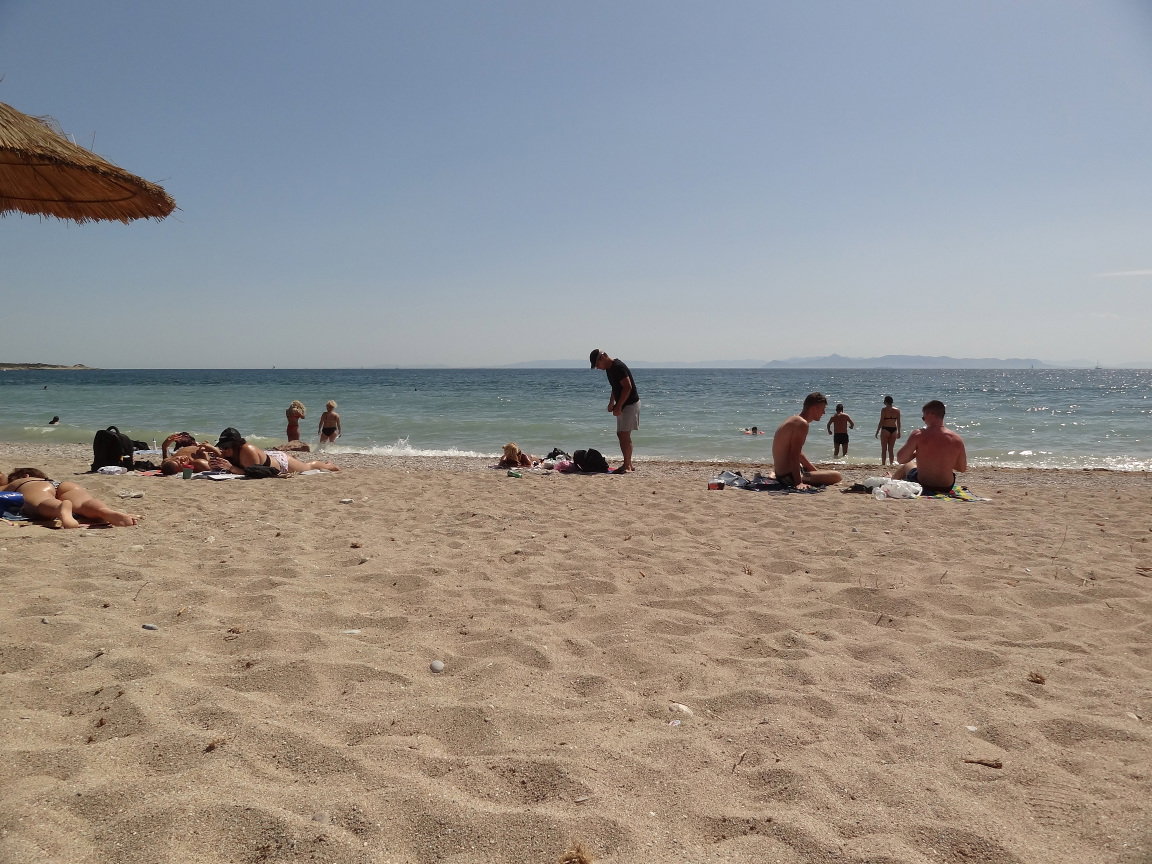
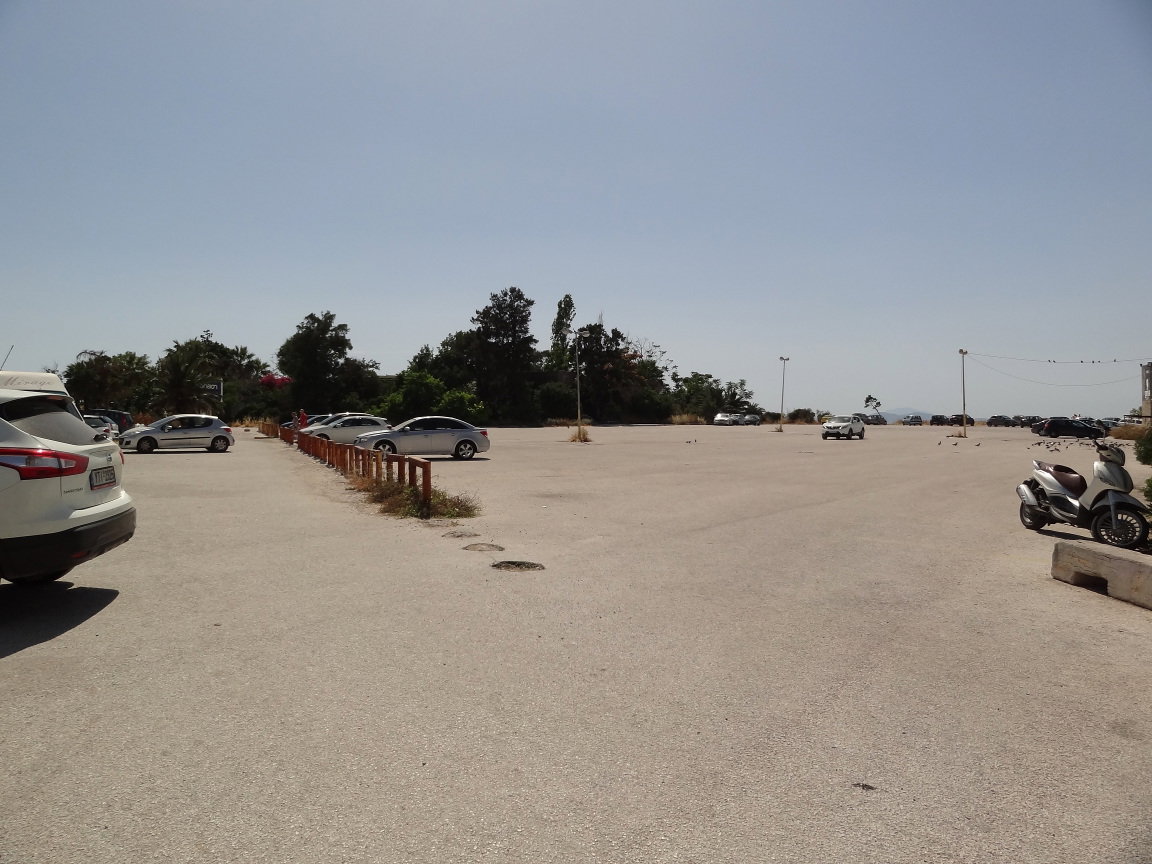
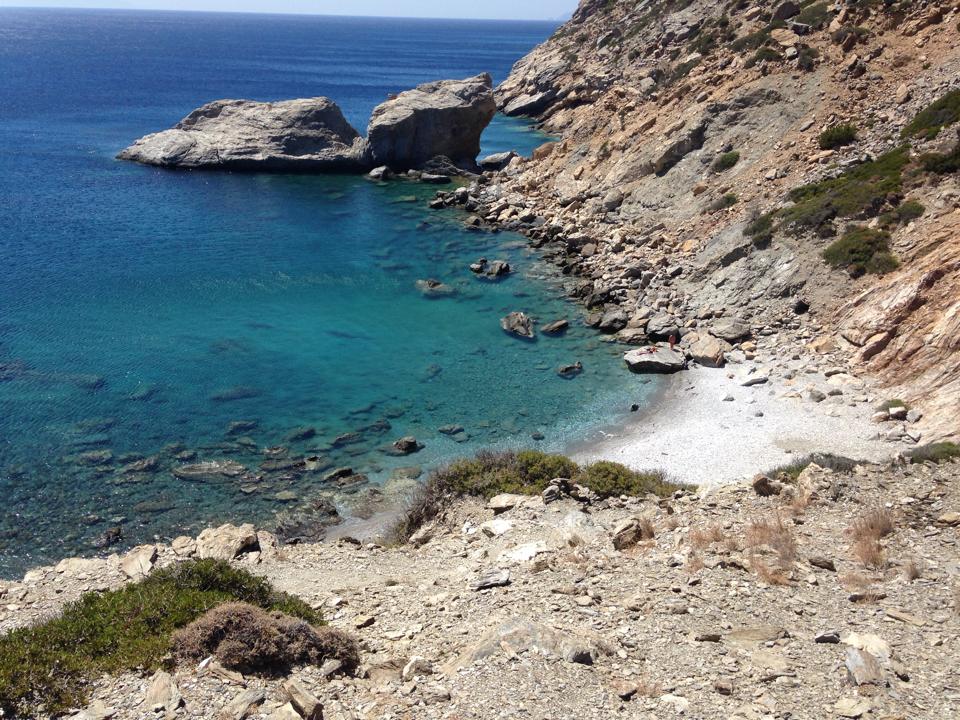
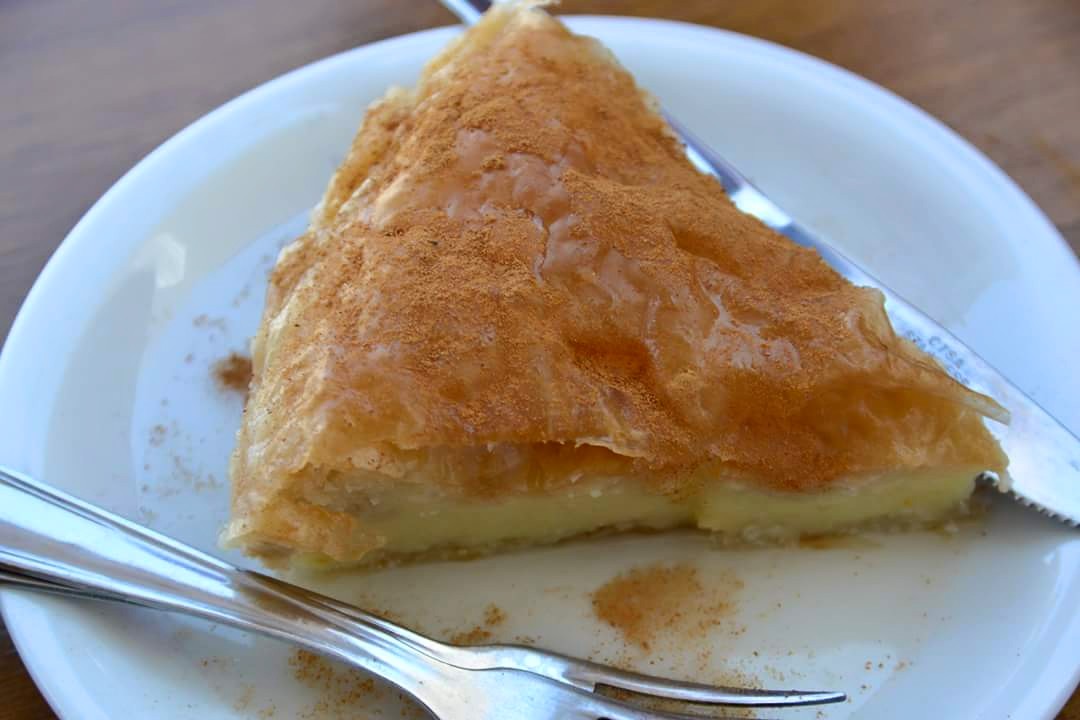
Griekenland - Eten & Drinken - Zoetigheden: Galaktoboureko.
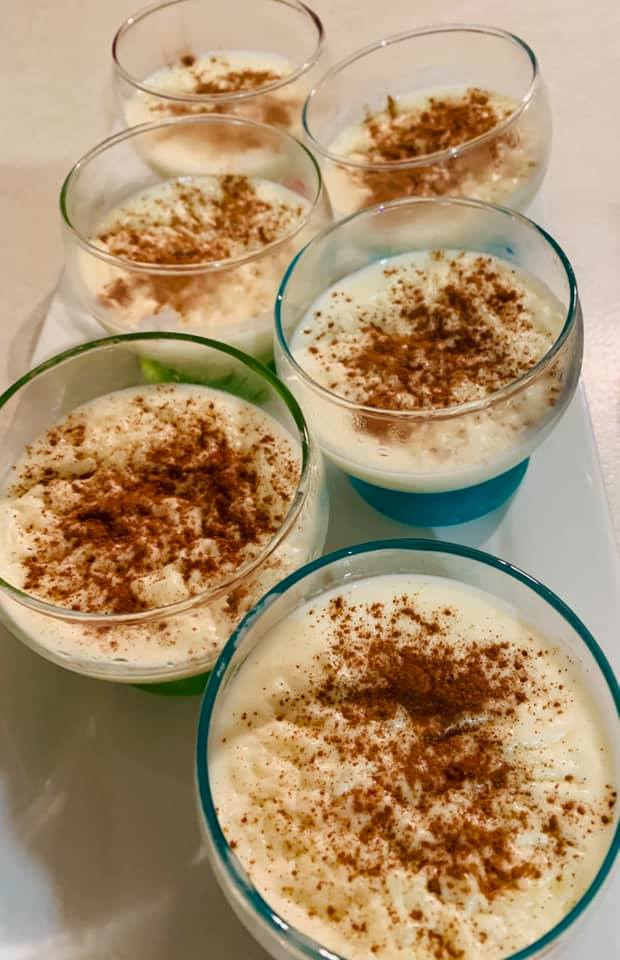
Galaktoboureko is volgens mij één van de lekkerste zoetigheden die we hier hebben in Griekenland. Het is een soort van bladerdeeg gevuld met een 'warm' mengsel van suiker, melk, eieren en tarwegries, op smaak gebracht met vanille en citroensap.
Het kan vers 'warm' uit de oven of 'koud' gegeten worden. Galaktoboureko wordt bijna altijd opgediend met een lekkere sterke 'Griekse' koffie en een glas water. Ik geef de voorkeur aan deze zoetigheid boven de andere 'zware' siroop gebakjes zoals Baklava of Kantaifi omdat het minder calorierijk is. https://read.cash/@chryptof/griekenland-eten-drinken-zoetigheden-baklava-79c4b61d https://read.cash/@chryptof/griekenland-eten-drinken-zoetigheden-kantaifi-9569413f
**Ingrediënten**:
Voor het gebak:
- 1/2 liter melk.
- 300 gr. 'filo' deeg. (dit lijkt een beetje op bladerdeeg maar het is het eigenlijk niet).
- 100 gr. suiker.
- 75 gr. tarwegriesmeel.
- 200 gr. gesmolten boter.
- 3 hele eieren.
- 2 eierdooiers.
- 1 vanillestokje.
- bloem.
- kaneel.
Voor de siroop:
- 300 gr. suiker.
- 200 ml water.
- 1 eetlepel citroensap.
- 1 theelepel vanille-extract.
**Bereiding**:
Voor het gebak:
- (1) Warm de oven voor tot 180° Celsius.
- (2) Kook de melk (1 - 2 minuten) en laat ze terug afkoelen.
- (3) Plaats het bakpapier in de bakvorm.
- (4) Bestrooi het bakpapier met bloem.
- (5) Leg de helft van het 'filo' deeg (bladerdeeg), op het bakpapier, in de bakvorm. (ZORG ERVOOR DAT HET AAN ALLE KANTEN EEN 2 - 3 CM OVERHANGT).
- (6) Vet het 'filo' deeg in met ongeveer 1/4 (50 gr.) van de gesmolten boter.
- (7) Klop in een kom de eieren, de eierdooiers en de suiker tot een 'schuimig' geheel.
- (8) Schep voorzichtig het tarwegriesmeel, de melk en de vanille eronder. (ZORG ERVOOR DAT HET MENGSEL SCHUIMIG BLIJFT).
- (9) Verwarm de kom zodat het mengsel stroperig wordt.
- (10) Haal de kom van het vuur en roer er 100 gr. gesmolten boter door.
- (11) Giet het mengsel op het 'filo' deeg.
- (12) Bedek dit alles met de andere helft van het 'filo' deeg.
- (13) Vouw de overhangende randen van het onderste 'filo' deeg (zie punt 5) over het bovenste (deksel van) 'filo' deeg.
- (14) Vet met 1/4 (50 gr.) van de gesmolten boter de hele bovenkant in.
- (15) Snijd voorzichtig de gewenste porties voor.
- (16) Bak de Galaktoboureko mooi goudbruin. (ongeveer 40 minuten).
Voor de siroop:
- Doe het water in een (diepe) kookpot.
- Voeg de suiker toe aan het water.
- Kook dit mengsel ongeveer 5 minuten.
- Voeg het citroensap en het vanille-extract toe aan het mengsel.
- Kook nog 2 minuten door.
Tenslotte:
- Giet de 'hete' siroop over het 'hete' gebak.
- Strooi wat kaneel over de top om op smaak te brengen.
Smakelijk!
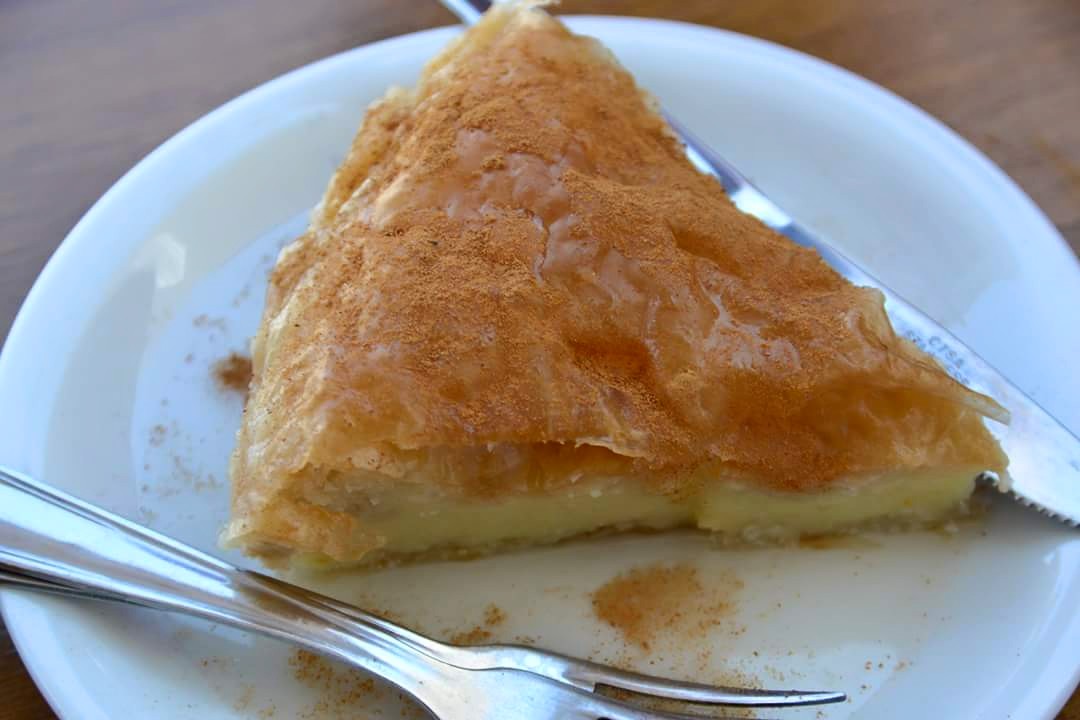
Griekenland - Eten & Drinken - Zoetigheden: Kantaifi.
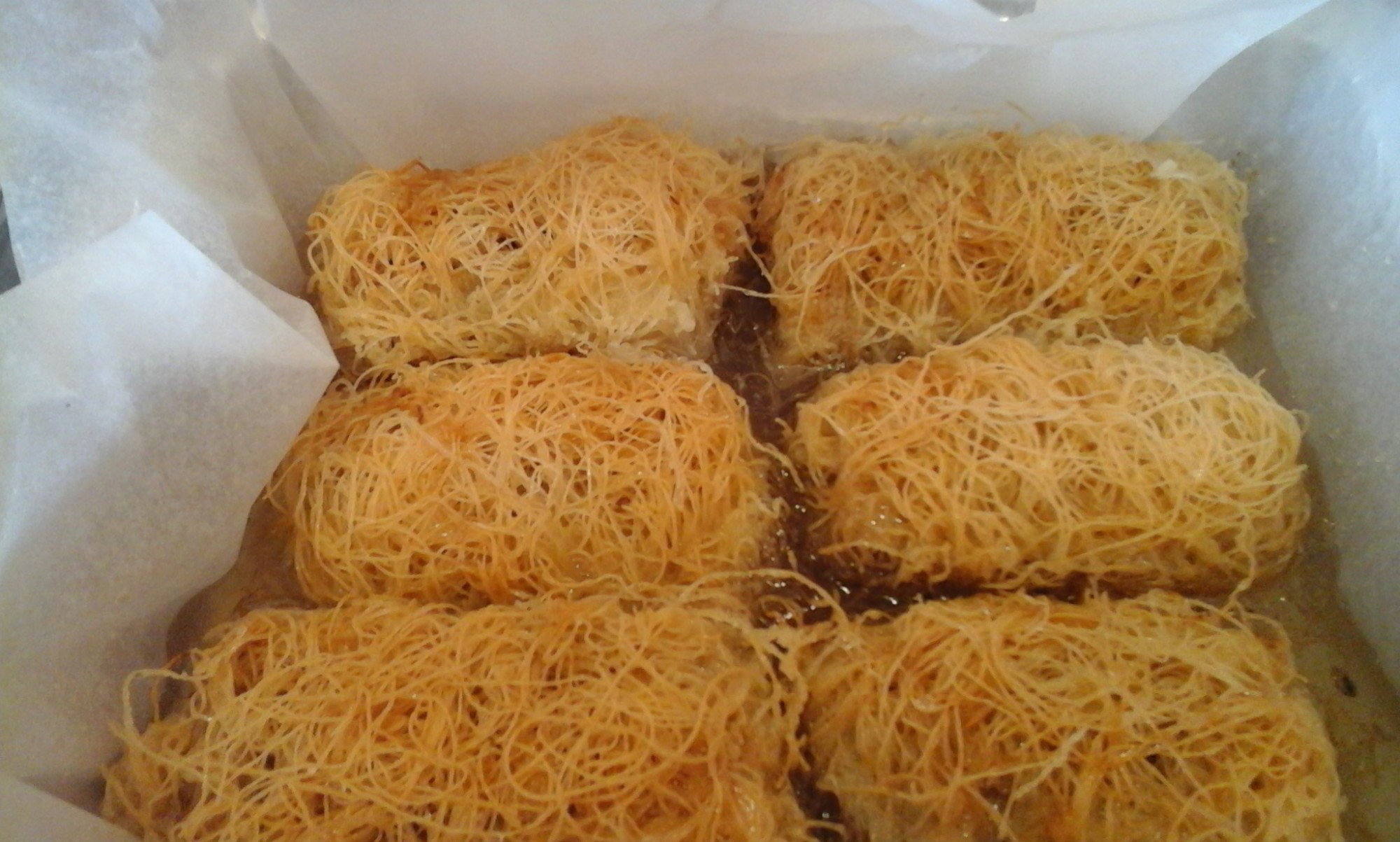
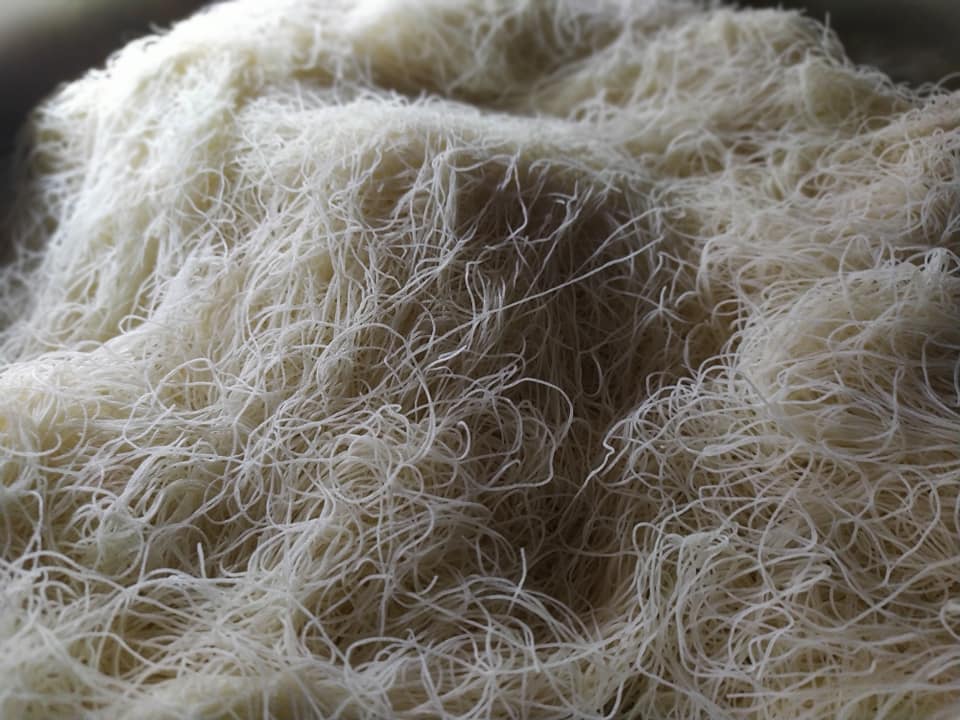
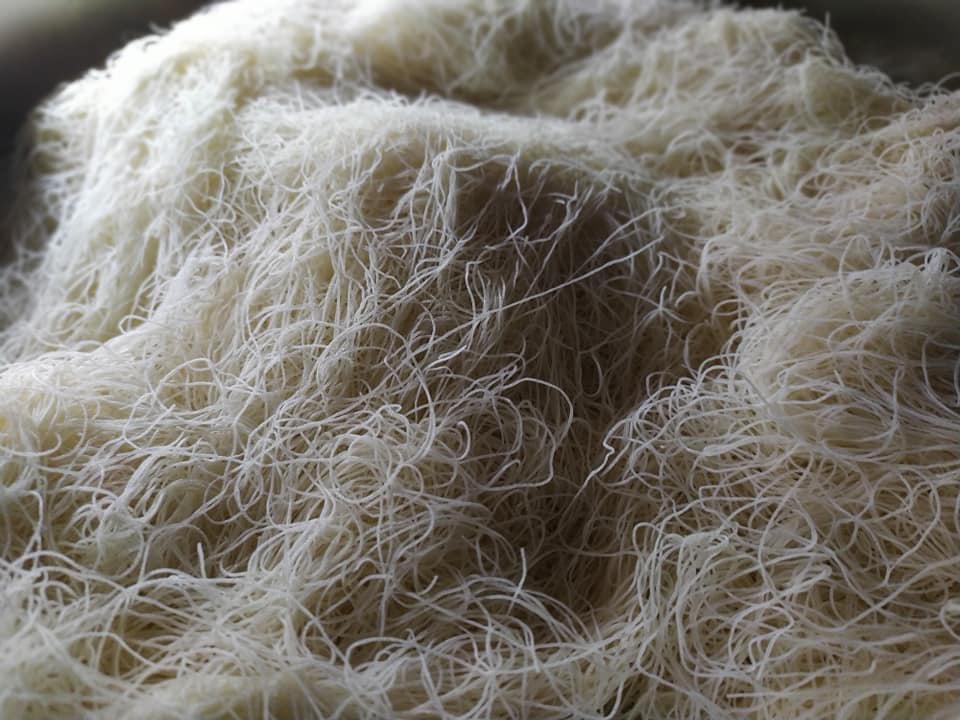
Wanneer iemand de bovenstaande afbeelding ziet, volgen meestal vragen als: 'Wat is dit?', 'Is dat spaghetti?', 'Is het een soort stof?', 'Is het engelenhaar?'.
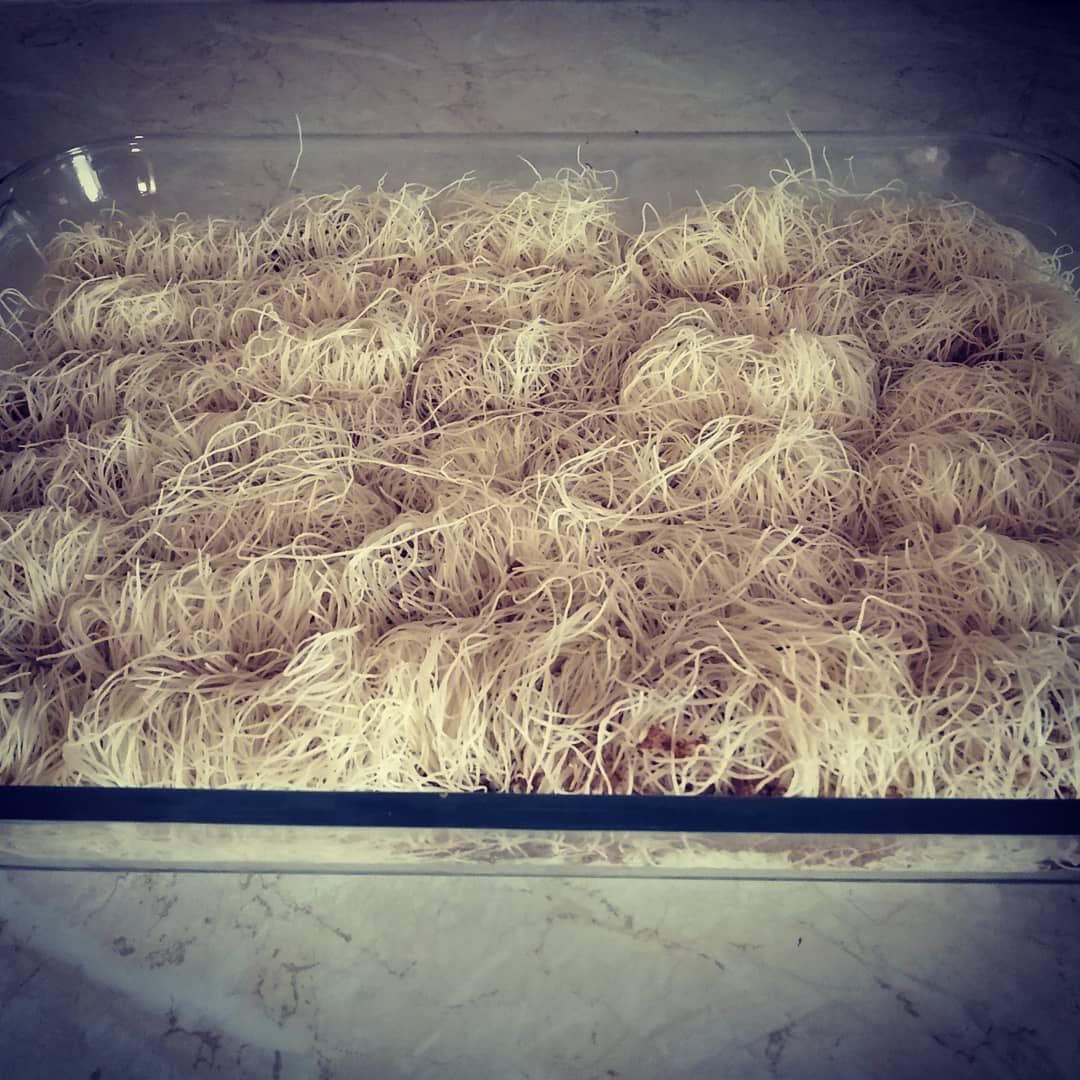
Nee, dit is Kantaifi! Dit zoete gebak is algemeen bekend in heel Griekenland en het Midden-Oosten en wordt meestal opgediend met ijs en/of een 'Griekse' koffie.
In dit artikel laat ik je zien hoe je Kantaifi maakt met een 'kant-en-klaar' deeg. Het is mogelijk om het deeg zelf te maken, door het vele malen, opnieuw en opnieuw, uit te rollen tot je een structuur bekomt zoals op de afbeelding hierboven, maar ik garandeer je dat het een echt Titanen werk is! Het is beter dat je je focust op de Kantaifi zelf (in plaats van op het deeg) en dat je het verse 'kant-en-klaar' deeg bij je plaatselijke bakker koopt.
**Ingrediënten**:
Voor het gebak:
- 500 gr. gehakte walnoten.
- 100 gr. gehakte pistachenoten.
- 1 kg. Kantaifi deeg.
- 1/2 theelepel gemalen kruidnagels.
- 2 theelepels gemalen kaneel (poeder).
- 250 gr. boter.
Voor de siroop:
- 2 kg. suiker.
- sap van 1 citroen.
- 1 liter water.
**Bereiding**:
Voor het gebak:
- (1) Meng de gehakte walnoten, het kaneel en de kruidnagels.
- (2) Smelt de boter in een bakvorm (met een hoogte van minimaal 3 cm).
- (3) Verwarm de oven voor op 180° Celsius.
- (4) Vet de bakvorm in met olie.
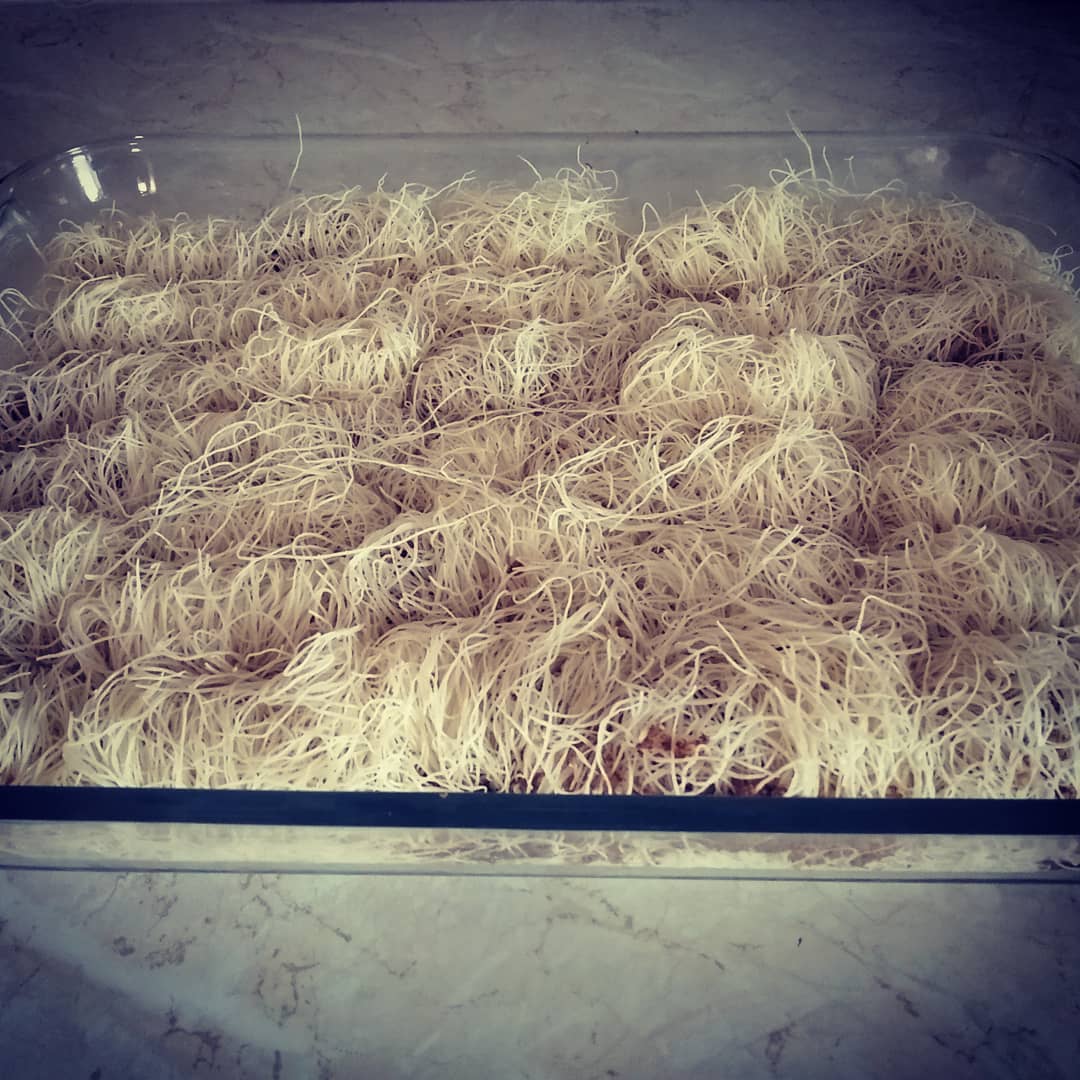
- (5) Ontwar het Kantaifi-deeg in 30 ongeveer gelijke delen (van 2 cm x 20 cm).
- (6) Leg aan één uiteinde (van zo'n deel) een handvol gehakte walnoten.
- (7) Rol de Kantaifi-draden op zodat het notenmengsel volledig bedekt is.
- (8) Herhaal de stappen (6) & (7) voor alle andere delen.
- (9) Leg alle rolletjes, MET DE NAAD NAAR BENEDEN, dicht tegen elkaar in de bakvorm.
- (10) Giet wat gesmolten boter over alle Kantaifi rolletjes.
- (11) Bak de Kantaifi mooi goudbruin. (ongeveer 45 minuten).
- (12) **Laat de Kantaifi afkoelen**.
Voor de siroop:
- Doe het water in een (diepe) kookpot.
- Voeg de suiker toe aan het water.
- Kook dit mengsel ongeveer 5 minuten.
- Voeg het citroensap toe aan het mengsel.
- Kook nog 2 minuten door.
Tenslotte:
- Giet de siroop over de Kantaifi. **Zorg ervoor dat de Kantaifi 'koud' is en dat de siroop 'heet' is**. (anders gaat de Kantaifi 'slap/plat' worden).
- Laat de siroop MINSTENS 12 UREN intrekken! (hoe langer, hoe beter).
- Strooi, voor decoratie en smaak, wat gemalen pistachenoten over het geheel.
Smakelijk!
Dit gebak is erg calorierijk dus eet het met mate. Om de een of andere reden krijg ik steeds hoofdpijn als ik te veel Kantaifi eet. Al heb ik nog steeds niet ontdekt waarom dat is.
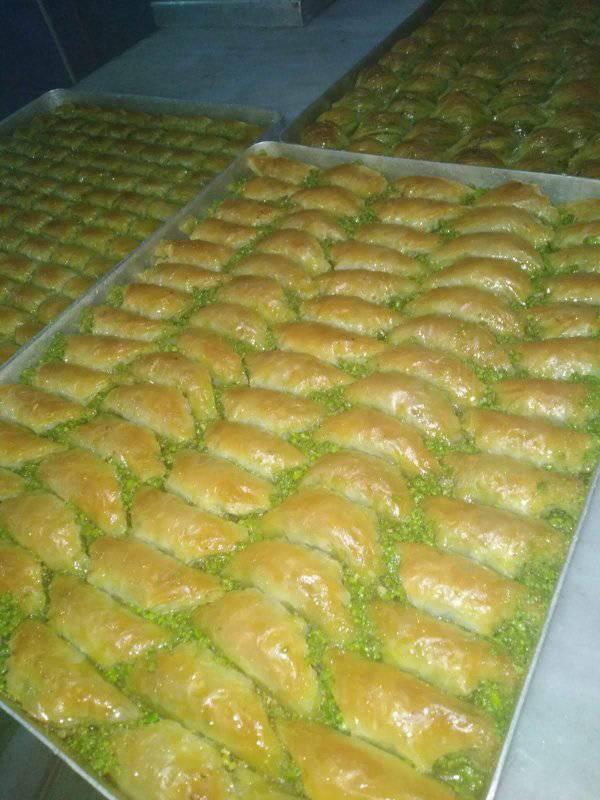
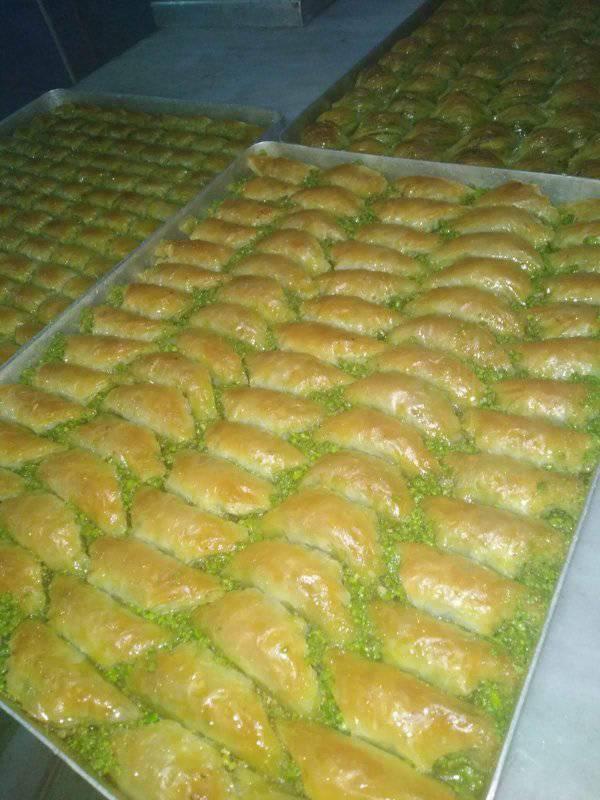
Griekenland - Eten & Drinken - Zoetigheden: Baklava.
Grieken en Turken waren doorheen de geschiedenis nooit echt 'goede' vrienden, maar op sommige vlakken lijken ze erg op elkaar, vooral door de populariteit van 'Baklava'.
Ik ga geen politieke kleur aannemen aangezien Baklava veel te 'zoet' is om over de oorsprong ervan te discussiëren.
Dit zoete gebak is algemeen bekend in de Balkan en het Nabije Oosten, dus zou ik het liever een mediterraan dessert/snack noemen. Het is meestal vergezeld van een 'Griekse' koffie of een glas water. Baklava is 'De manier' om je gasten te verwelkomen.
**Ingrediënten**:
Voor het gebak:
- 50 gr. gehakte walnoten en/of amandelen.
- 4 eetlepels paneermeel.
- 4 eetlepels suiker.
- 1 theelepel kaneel (poeder).
- 250 gr. boter.
- 300 gr. van 'filo' deeg. (dit lijkt een beetje op bladerdeeg maar het is het eigenlijk niet).
Voor de siroop:
- 250 gr. suiker.
- 200 gr. honing.
- 2 kruidnagels.
- 1 vanillestokje.
- sap van 1 citroen.
- 1,5 liter water.
**Bereiding**:
Voor de siroop:
- Doe het water in een (diepe) kookpot.
- Voeg de suiker toe aan het water.
- Kook dit mengsel ongeveer 5 minuten.
- Voeg de honing, de kruidnagels en het vanillestokje toe.
- Kook nog 2-3 minuten door.
- Filter de kruidnagels en het vanillestokje eruit.
- Meng het citroensap door het geheel.
- Zet deze siroop op een koele plaats.
Voor het gebak:
- (1) Meng de gehakte walnoten en/of amandelen met het paneermeel, de suiker en het kaneel.
- (2) Smelt de boter in een pan.
- (3) Verwarm de oven voor op 180° Celsius.
- (4) Vet de bakvorm in met boter.
- (5) Smeer iedere laag van het bladerdeeg in met boter.
- (6) Leg minimaal 2 lagen van het bladerdeeg in de bakvorm.
- (7) Breng een laag notenmengsel aan.
- (8) Herhaal de stappen (6) & (7) 9 tot 10 keer.
- (9) Werk af met 1 of 2 lagen van het bladerdeeg.
- (10) Besprenkel de bovenste laag met wat water.
- (11) Bak de Baklava mooi goudbruin (ongeveer 30 - 40 minuten).
Tenslotte:
- Giet de siroop over de Baklava. **Zorg ervoor dat de Baklava nog 'heet' is en de siroop 'koud' is**. (anders gaat de Baklava zijn krokantheid verliezen ).
Smakelijk!
Dit gebak is erg calorierijk dus eet het met mate anders garandeer ik je dat je, net als ik, 17 kg aankomt in enkele weken.
Greece - Around Athens – Vouliagmeni – Beaches: On the Rocks.
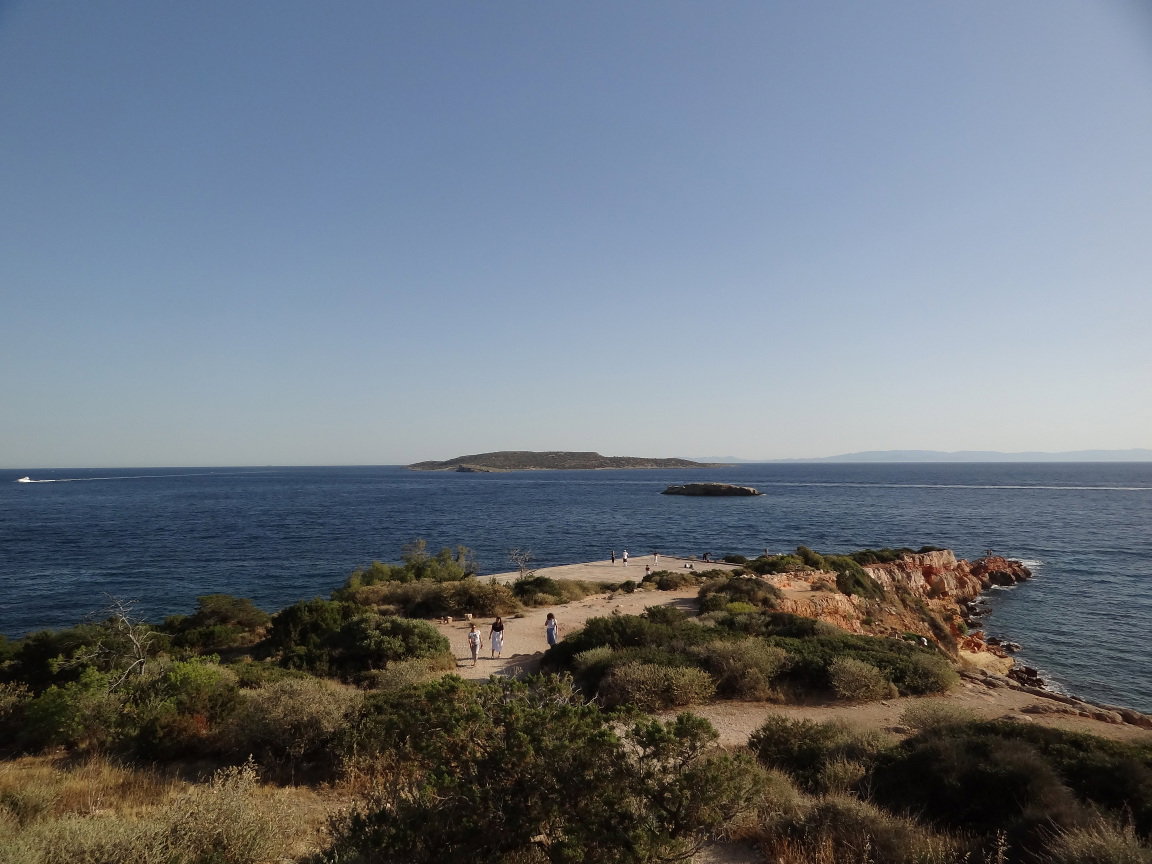
This beach is only for the real 'adventurous' people among us as it is not really a beach. I would rather call it a nice place to enter the sea and enjoy a refreshing bath as the waters are very 'bluish' and deep here.
This place is rocky and is so not very suitable for families with small children. Unless you know where and how to enter the sea. (There are some steps). Last year I found a young boy here that got his body teared to blood by the waves and the rocks. So be careful.
If you take a diving mask with you, you will realize that the sea is full of big fish here. By late of August (early September) you will find a lot of Garfishes (Ζαργάνες) here.
If you come here early in the noon, and you are a skilled swimmer, you could try to reach the small island opposite. You will need to swim for about 20 minutes to get there. It is worth the swim.
On the back side it has a very nice (rocky) yellow golden beach. You will be here, in peace, all day, alone. Even more fish can be found here. (That is why you will always see a lot of seagulls flying over this place).
If you want to try the transfer there, take 2 things into account. First, leave around the noon as there will be nearly no boats passing between the shore and the island and the sea will be calm. Second, come back before 16:30 as after that the wind and the waves will make it hard swim to return. (I was there, I know what I am saying: KEEP IT SAFE).
Be aware that there is no accommodation at all. If there is anything you might need (drink, food, bed or umbrella) make sure you take it all with you!
Later in the afternoon/evening fisherman will come here because it is a great spot to catch a nice dinner. (as I said, a lot of fish here).
A lot local youth come here to swim and practice some cliff dives. Be careful if you want to do the same. They have come here for many years and know what they are doing.
Even later in the evening, a lot of people flock here to enjoy the sunset above the islands of Aegina and Salamina. Very beautiful!
**QUICK DETAILS**:
**LOCATION** : 37°47'52.3"N 23°46'14.5"E (37.7978622 23.7701459).
**TYPE** : ROCKY.
**FACILITIES** : https://www.google.com/maps/place/37%C2%B047'52.3%22N+23%C2%B046'14.5%22E/@37.7978622,23.7701459,160m/data=!3m2!1e3!4b1!4m5!3m4!1s0x0:0x0!8m2!3d37.7978611!4d23.7706944
NO ACCOMMODATION AT ALL.
**NOT** CHILD FRIENDLY (very rocky).
ACCESSIBLE BY CAR.
BEAUTIFUL SPOT TO ENJOY THE SUNSET.
**NO** TREES (for shade).
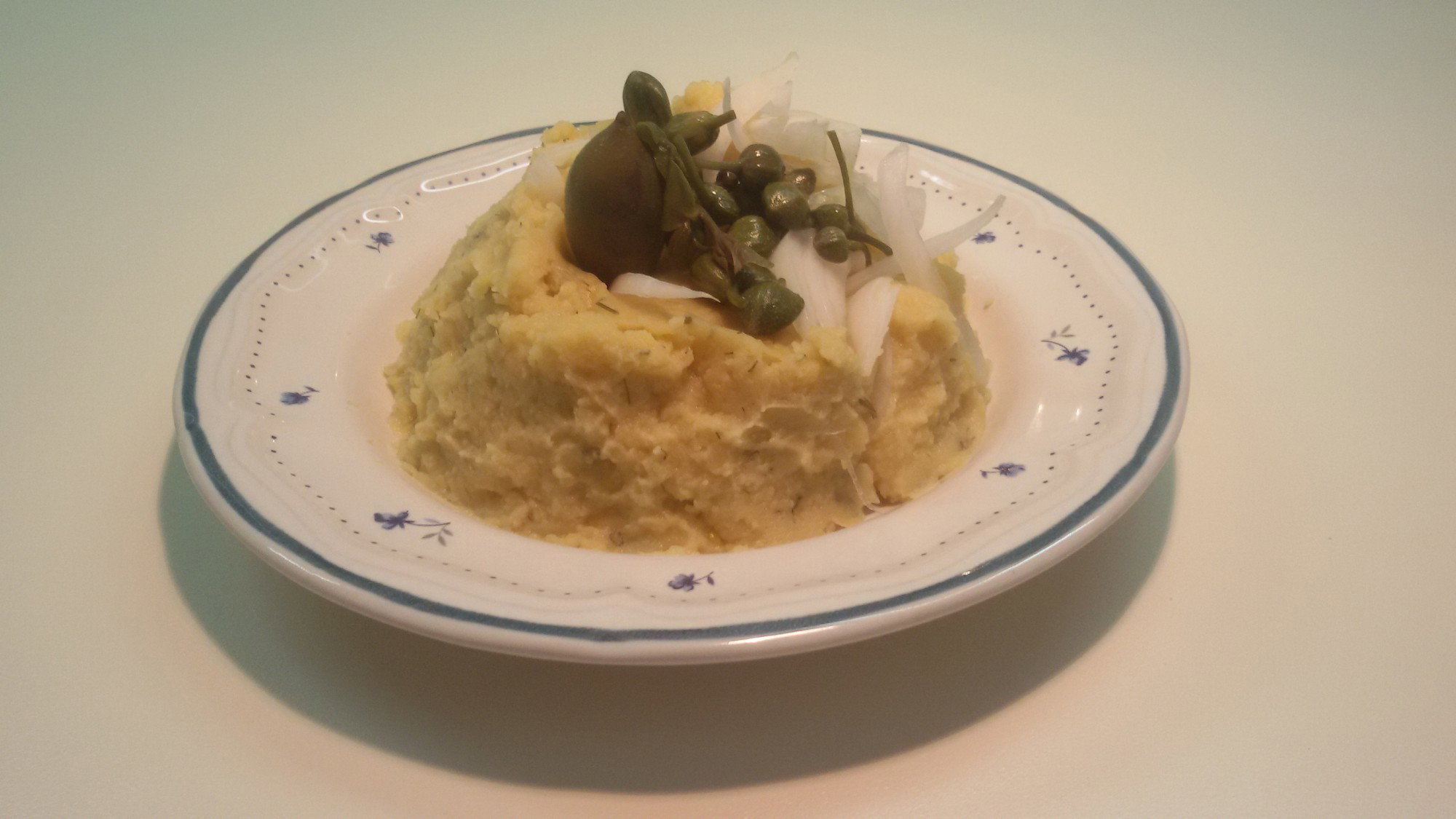
Greece - Food & Drinks - Side Dish: Fawa.
Greeks just LOVE legumes (beans, lentils, chickpeas, yellow split peas, ...). You will find many variations created from them. In this post I show you how to create 'Fawa'.
'Fawa' or 'Yellow Split Peas puree' is a very easy to create side dish of the Greek cuisine as it has only 3 main ingredients: yellow split peas, onions & fennel.
Yellow split peas are very healthy. They contain a lot of Potassium, Iron and Magnesium.
The most famous yellow split peas come from the island of Santorini. A combination of the perfect soil with short heavy Cycladic rains make that the split peas here become sweeter then everywhere else.
'Fawa' is as dish that is served 'cold' and is most of the times accompanied with fresh white bread. It's taste is just fabulous! (or should I say fawa-lous).
I like it so much that I could eat this, during the summer, nearly every day. mmm, I LOVE it!
**Ingredients**:
- 500 gr. Lentils.
- 1L of water.
- 200 ml. olive oil.
- 2 onions.
- juice of 1 lemon.
- 1/2 bunch of Fennel.
- 1 teaspoon of salt.
- 1 teaspoon of (black) pepper.
- 2 tablespoons of capers.
**Preparation**:
- (1) Heat up about 100ml of olive oil in a frying pan.
- (2) Cut 1 onion in small pieces.
- (3) Fruit the onion pieces in the olive oil for about 2 - 3 minutes.
- (4) Pour 1L of water in the pan.
- (5) Boil the water (with the onion pieces).
- (6) Add the 500 gr. of lentils.
- (7) Boil this mixture until all the water evaporated. (the lentils should be very soft now).
- (8) Cut the fennel leaves in small pieces.
- (9) Mix the lentils and the fennel leaves in a blender.
- (10) Bring on taste with the salt and pepper.
- (11) Let the mixture cool down for about 30 minutes. (the longer the better).
Finally:
- Straight before serving, spoon 1oo ml of olive oil and the lemon juice in the lentil puree. (Mix well).
- Cut 1 onion in slices or pieces.
- For decoration, Put the capers and the onion on top of the 'Fawa'.
Enjoy!

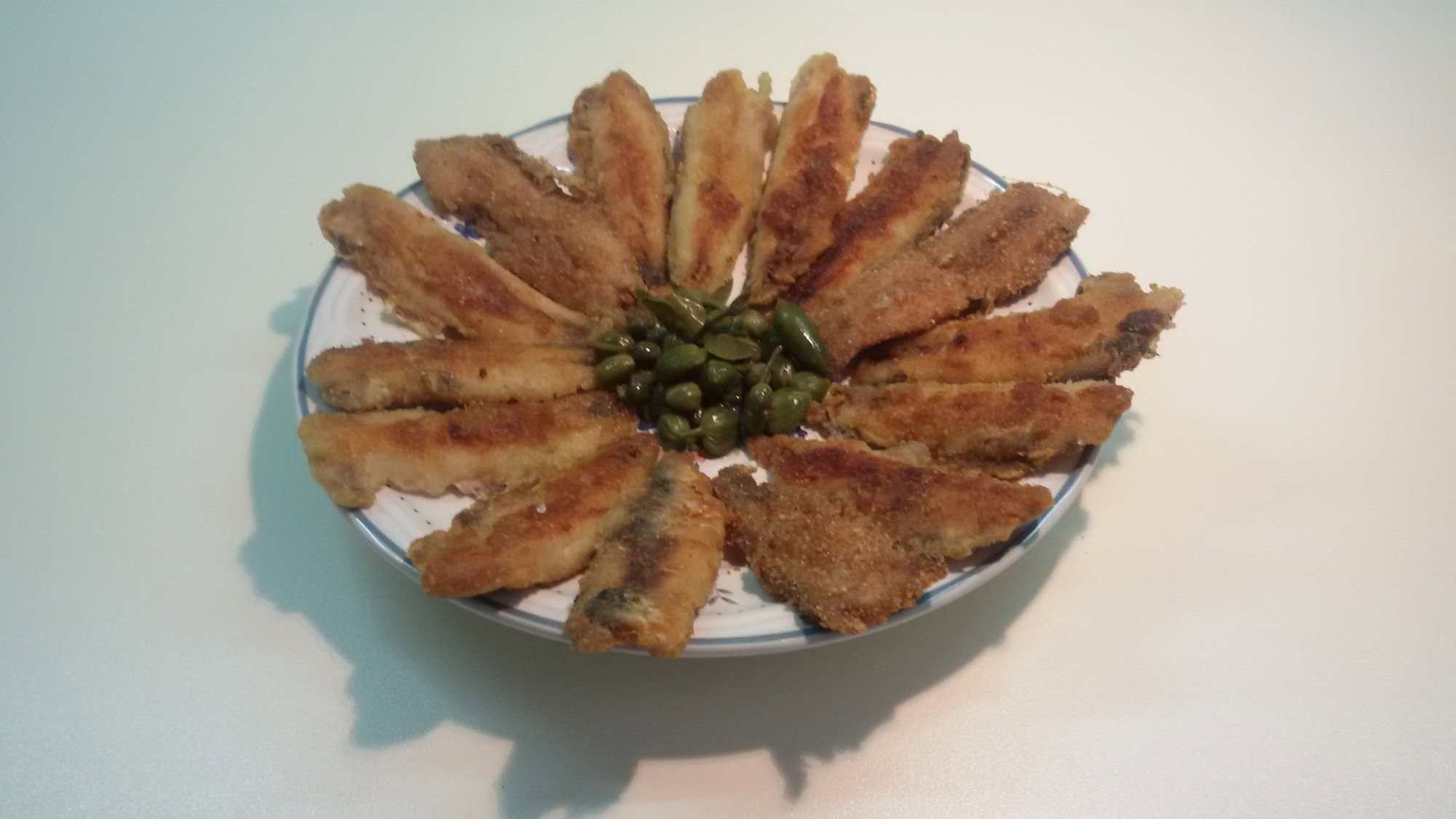
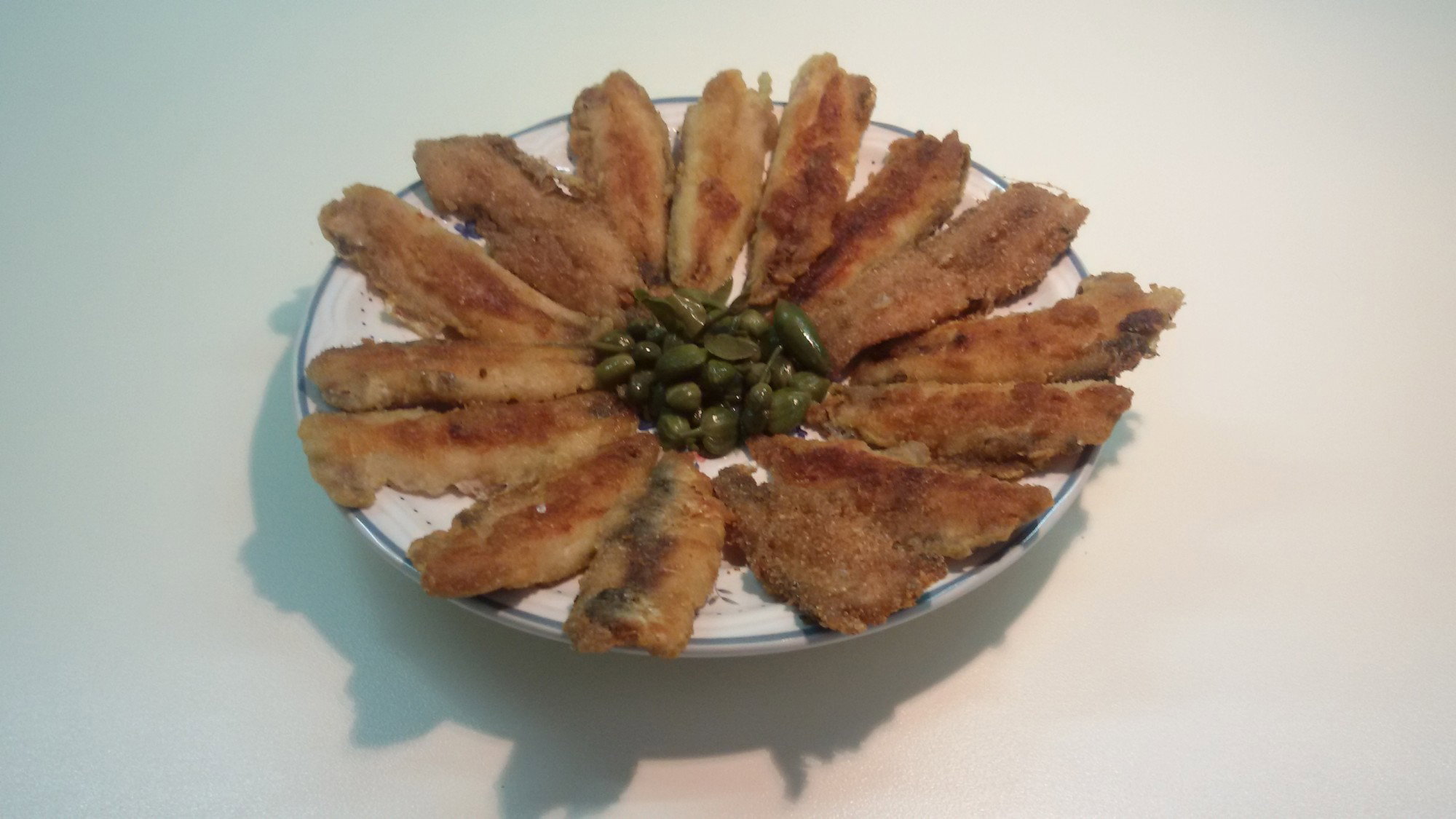
Greece - Food & Drinks - Side Dish: Sardeles Tiganites Filleto.
'Sardeles Tiganites Fileto' is a very easy to create side dish of the Greek cuisine. Its has only 2 main ingredients: sardines and flour.
'Sardeles Tiganites Fileto' is the Greek expression for 'Fried Sardine Fillets'. You could say that it is, in some way, the Greek version of what the British call 'Fish & Chips'. I know that they normally use codfish but here we use sardines.
This dish is mainly served with lemon wedges and capers though another dish that suits this one very well is Skordalia. And off course, always nice and fresh, in the summer, a typical Greek Salad (Choriatiki Salata). https://read.cash/@chryptof/greece-food-drinks-side-dish-skordalia-3213ceed
No matter how you serve this dish, 'warm' or 'cold', or with whatever you accompany it with, there is only one thing that should never lack from the table: TSIPOURO!
**Ingredients**:
- 25 Fresh Sardines.
- 300 gr. flour(for breading).
- olive oil.
- juice of 1 lemon.
- 1 whole lemon.
- salt.
- (black) pepper.
- 2 - 3 tablespoons of capers.
**Preparation**:
- (1) Cut the the heads from the sardines.
- (2) Fillet the sardines (cut, in the middle, from head to tail, to end up with 2 similar halves).
- (3) Take out the small fish bones (spline).
- (4) Bread the sardines in the flour. (you could use a plastic bag: put the sardines and the flour in it and shake until all the sardines are nicely breaded).
- (5) Heat up some olive oil in a frying pan to about 180° Celsius.
- (6) Put the sardines in the frying pan.
- (7) Bring on taste with salt and pepper.
- (8) Fry the sardines until golden-brown. (about 12 minutes).
Finally:
- Put the sardines clock-wise on a plate, and put the capers in the center.
Enjoy!
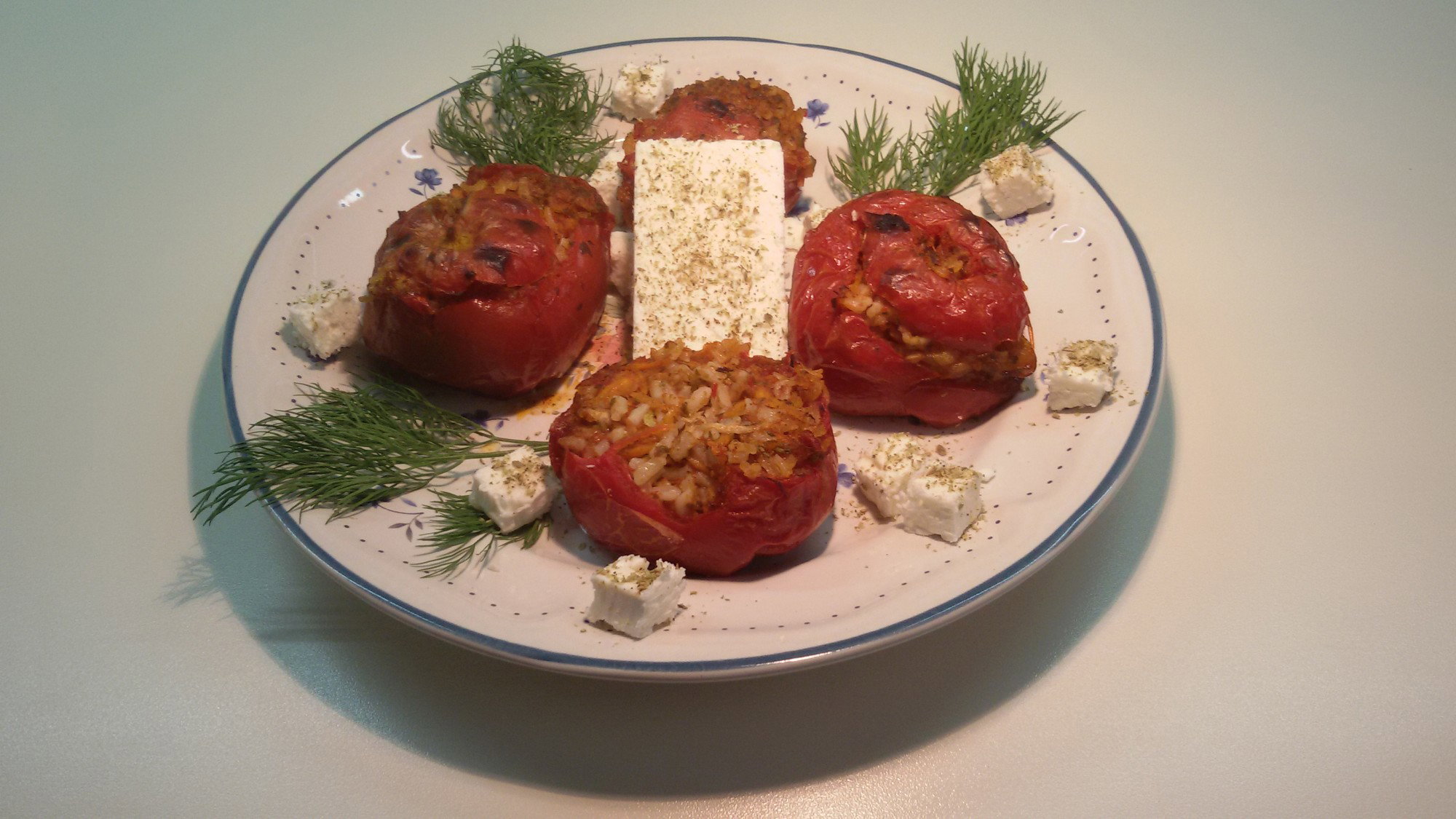
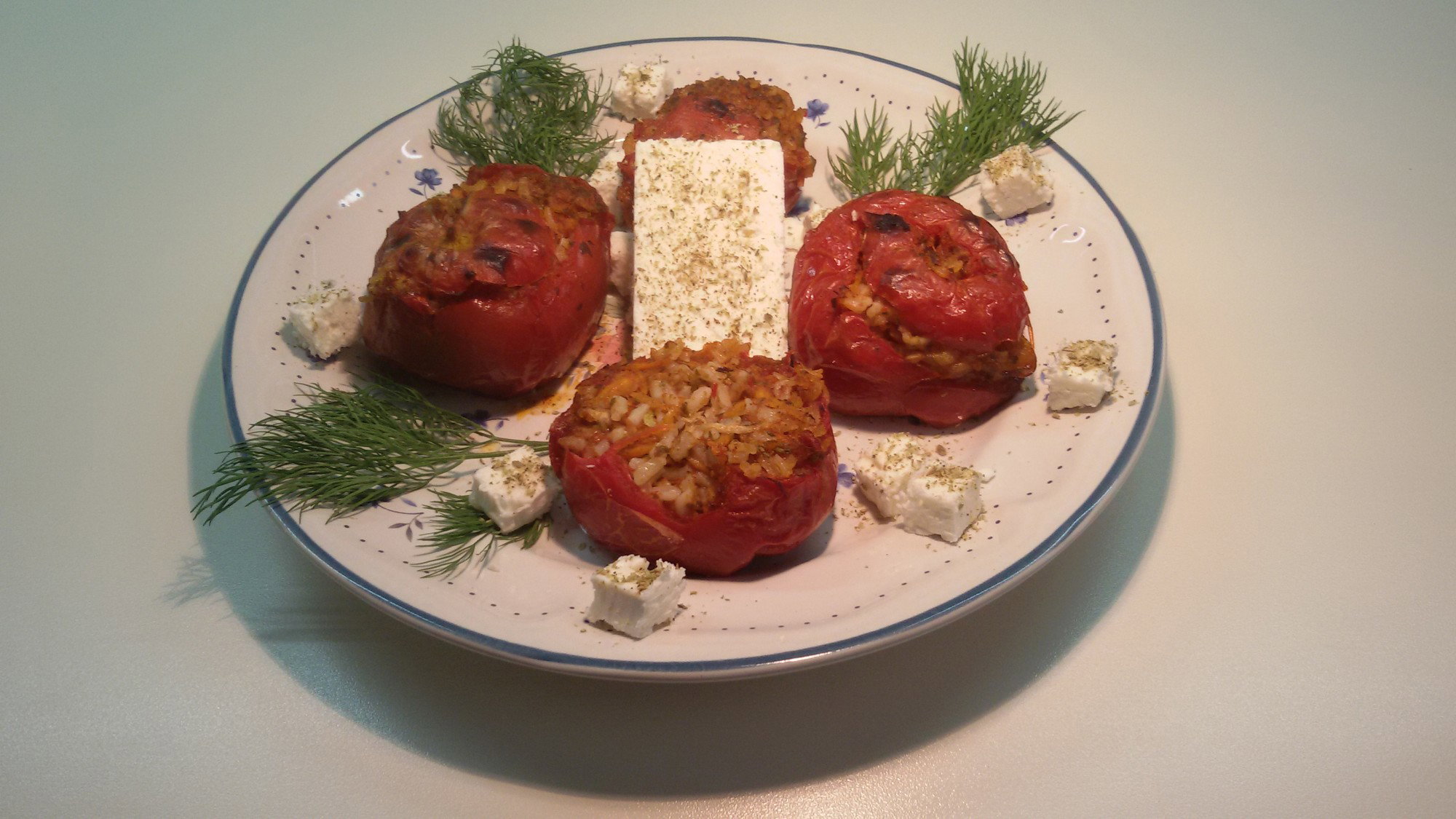
Greece - Food & Drinks - Main Dish: Ntomates Gemista.
Gemista is the Greek word for ‘stuffed’. So ‘Ntomates Gemista’ means ‘stuffed tomatoes’. When we say gemista, we not only take into account tomatoes but also other vegetables like peppers, aubergines, …
Gemista is a typical summer dish. It can be served straight away, ‘warm’, from the oven or ‘cool’ from the refrigerator. The latter is my favorite. I just LOVE Gemista that was prepared (and stored in the refrigerator) yesterday.
This dish gives a straight away ‘refreshing’ feeling. Moreover, it is a dish that is easy to prepare. It has only 3 main ingredients: tomatoes, onions, mint.
I believe gemista should always be served with Feta and oregano. The taste is just heavenly. I like it, in the afternoon,accompanied with some tsipouro.
**Ingredients**:
- 10 Tomatoes.
- 250 gr. Rice.
- 250 gr. Onions.
- 250 ml. Olive oil.
- 250 ml. Water.
- 150 ml. Tomato juice.
- 4 – 5 twigs of fresh mint.
- (black) pepper.
- salt.
**Preparation**:
- (1) Cut the tomatoes (in such a way that you take off, some kind of, lid) .
- (2) Scoop the tomato fruit meat out of the tomatoes.
- (3) Mash the tomato fruit meat.
- (4) Heat up about 100 ml. of olive oil in a frying pan.
- (5) Fruit the onions in this oil.
- (6) Scoop the rice in this mixture.
- (7) Bring on taste with salt and pepper.
- (8) Add the tomato fruit meat.
- (9) Boil all this for about 3 minutes.
- (10) Take the frying pan from the fire and let it swell for about 5 minutes.
- (11) Add and stir the fresh mint leaves through it.
- (12) Fill the tomatoes, with this mixture, for about 2/3.
- (13) P re-heat the oven to about 180 degrees Celsius.
- (14) Oil an oven tray and put the ‘stuffed’ tomatoes in it.
- (15) Add some olive oil.
- (16) Add the 250 ml. Of water.
- (17) Put the lids on the tomatoes.
- (18) Bake the tomatoes for about 1 hour.
- (19) Take of the lids of the tomatoes.
- (20) Bake for another 10 minutes (to color the filling).
Enjoy!
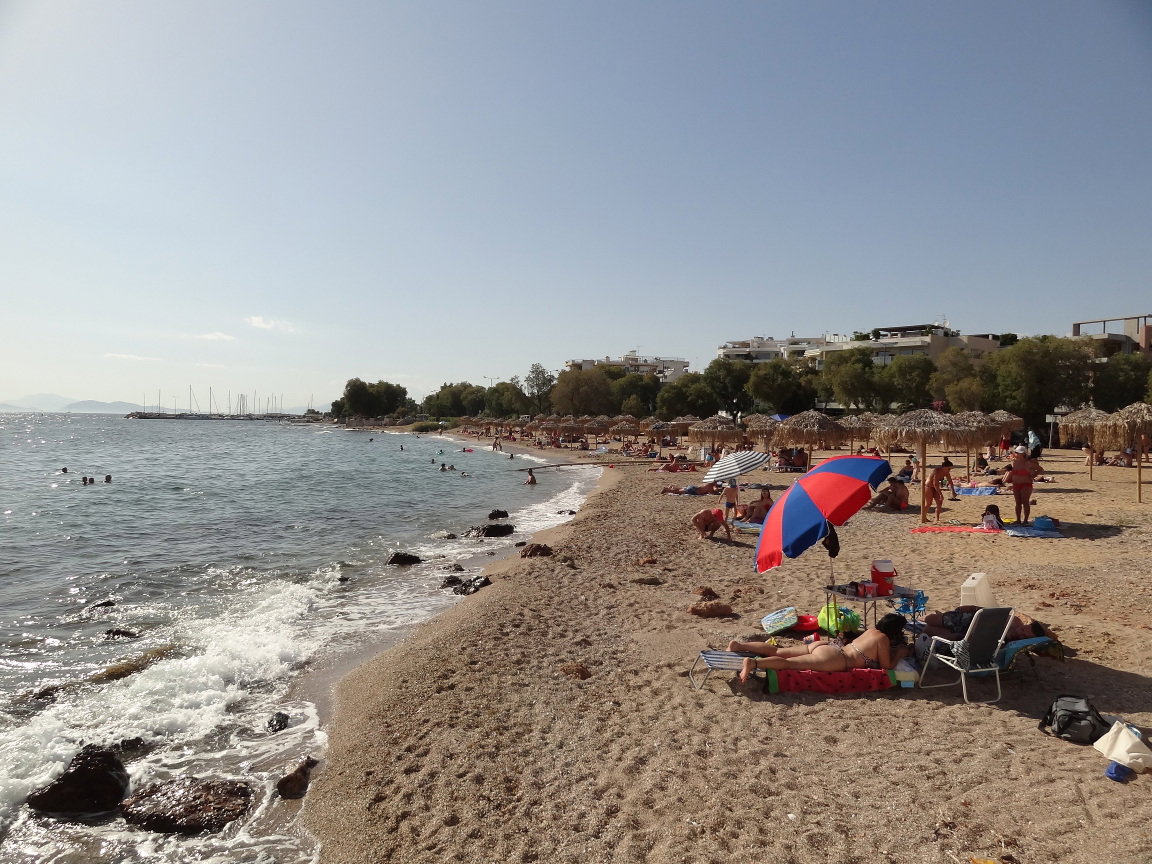
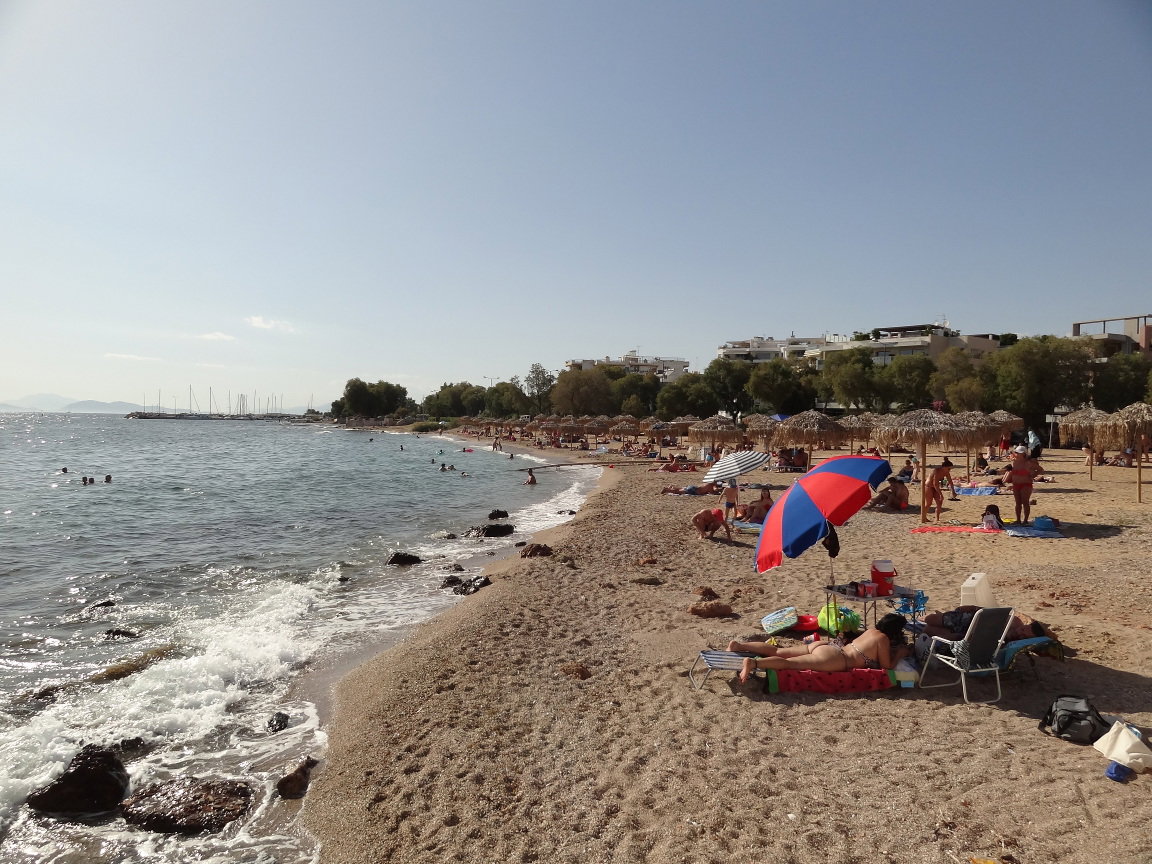
Greece - Around Athens – Voula – Beaches: Galini Beach.
Galini Beach is also known by the locals as 'Dimarcheio Beach' as Dimarcheio is the Greek word for 'town hall' so this is the beach next to the town hall of Voula. It is the 5th and last beach that you will find here in Voula (coming from Athens city center).
Depending on the road you take, this beach is, by car, between 17 and 20 km away from Athens (Syntagma square).
The shortest way to get here is by following Vouliagmenis Avenue (Λεωφόρος Βουλιαγμένης) but this is, in my opinion, a quite boring road.
The other option is that you come here over Paleo Faliro (Παλαιό Φάληρο). If you follow Siggrou Avenue (from the center of Athens) and keep driving on the right lane, the interchange to Poseidonos Avenue (the road where this beach is located) happens automatically. This is a much more pleasant excursion as you drive next to the sea, almost all the time.
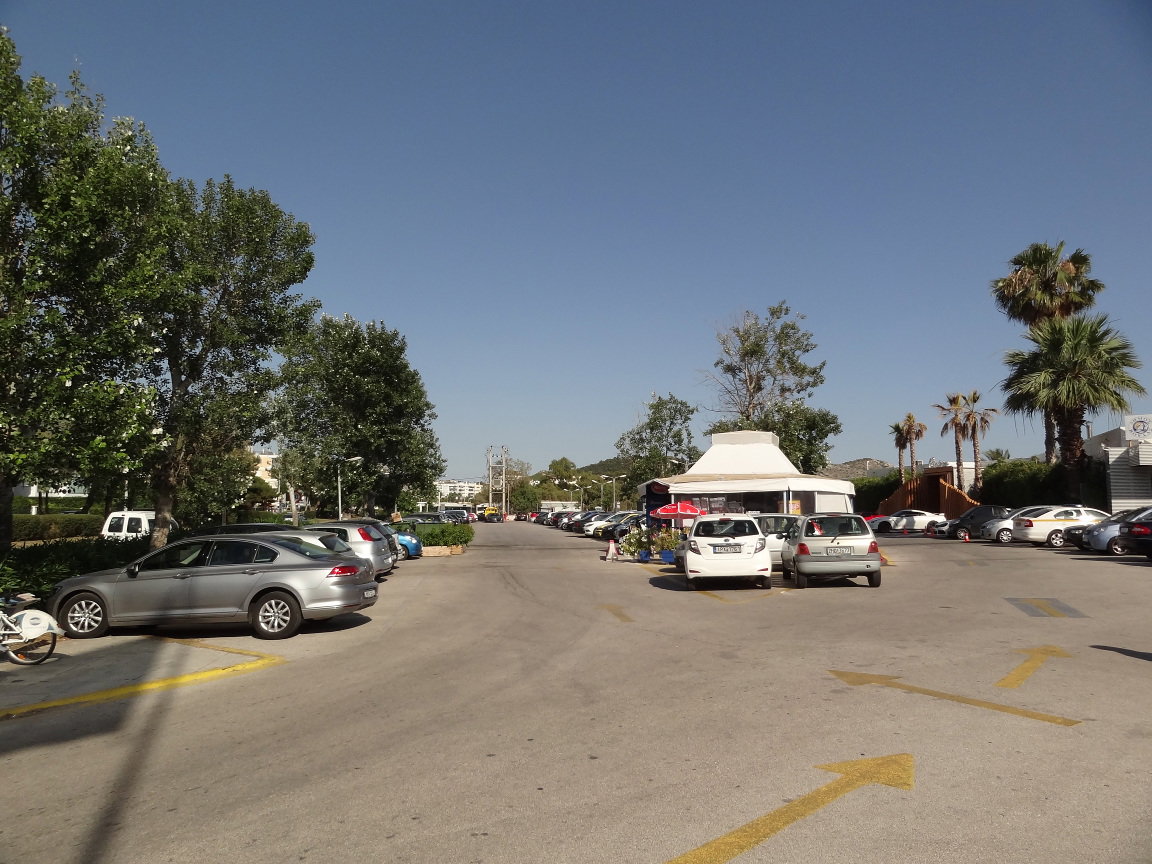
Next to the beach, on the left side (facing towards the sea), there is big guarded FREE parking.
The beach is also approachable by taking the bus. The end station of Voula is only 200m away, on the left side (facing towards the sea), from the beach.
For the more ‘sportive’ people among us, this beach is also, in a safe way, approachable by bicycle. On the parking, mentioned above, you will find an ‘i-bike’ sharing station. "Get everywhere by bicycle".
Galini Beach is a very nice, small, sandy beach and because of its shallow waters it is very suitable for families with smaller children.
The municipality has upgraded this beach this year with some accommodation to serve the bathers.
There are a lot of umbrellas so there is no need to bring one your self. Remember, first comes first served. If you didn’t make it, be happy, there are also some trees to find shadow during the hot summer days.
There is also a dressing cabin so that you can easily change your (wet) swimsuit for your clothes.
Special in this beach is the installation of a 'Seatrac'. This device allows people with a disability (or elderly people) to enter the sea in an easy way. It looks like a small roller coaster that transports the guest into the water.
**QUICK DETAILS**:
**LOCATION** : 37°50'12.0"N+23°45'56.9"E (37.8366678 23.7652571).
**TYPE** : SANDY.
**FACILITIES** : https://www.google.com/maps/place/37%C2%B050'12.0%22N+23%C2%B045'56.9%22E/@37.8366678,23.7652571,160m/data=!3m2!1e3!4b1!4m5!3m4!1s0x0:0x0!8m2!3d37.8366667!4d23.7658056
PARTLY ORGANISED (FREE umbrellas & dressing cabin).
SEATRAC.
CHILD FRIENDLY (shallow waters).
ACCESSIBLE BY CAR, TRAM & BICYCLE.
BICYCLE SHARING STATION ON THE PARKING.
BIG GUARDED PARKING.
TREES (for shade).
Greece - Around Athens - Glyfada - Beaches: Star Beach.
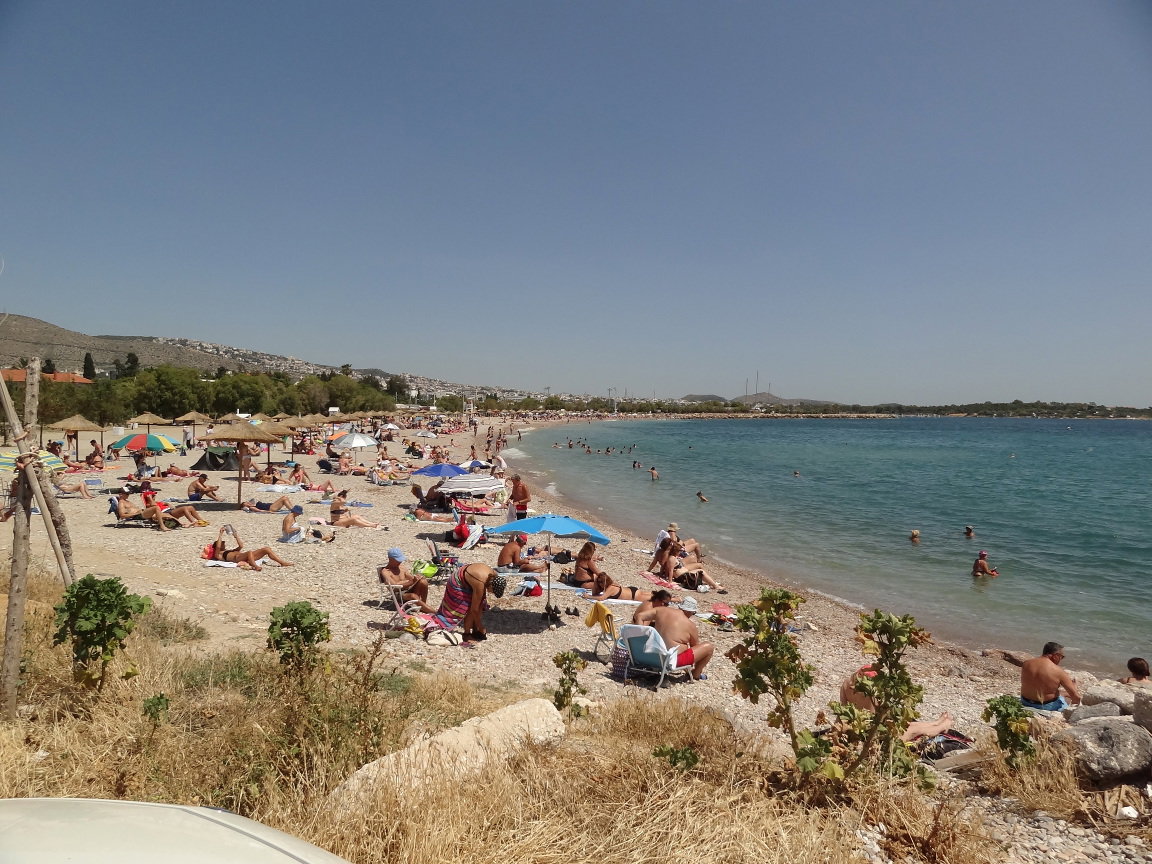
The 3rd beach of Glyfada is a nice, relatively long (about 800m), sandy beach. During the weekends it can get quite crowded it here (even in 2020) as it is one of the first ‘nice’ beaches close to the city center of Athens.
This beach is, by car, only 17km away from Athens (Syntagma square). Next to the beach, on the right side (facing towards the sea), there is very big, free, (unguarded) parking spot. Be happy, it is safe to park here.
The Star Beach is also approachable by taking the tram line from the Syntagma square (the main square of Athens) towards ‘Voula’ . The stop is called ‘Παραλία Γλυφάδας’ (Glyfada Beach). In this way, you will reach the beach in about 45 minutes.
For the more ‘sportive’ people among us, this beach is also, in a safe way, approachable by bicycle.
Because of its shallow waters, this beach is very suitable for families with smaller children. There is also a small playground, on the beach, so that the children do something in case they got bored of the sea. The playground is fenced so that when they to totally go up in their game, not accidentally run towards the tram/street.
If you come relatively early in the noon you will not need to take your own umbrella as you will find that the beach is equipped with ‘free’ umbrellas. First comes, first served!
If you didn’t make, be happy there are also some trees to find some shelter.
(This year the umbrellas are placed taking in account the COVID-19 regulations.)
Except for showers and dressing cabins, this beach has no other accommodations to offer. I noticed that the beach bar, that used be here, didn’t open yet. (as of June 2020). If things change I will let you know.
The beach is guarded by a team of life-guards until 19:00 in the evening.
The municipality of Glyfada did a great job here.
On the left side of the beach (facing towards the sea), you will find the ‘Sea Turtle Rescue Center’.
**QUICK DETAILS**:
**LOCATION** : 37°52'00.0"N 23°44'20.4"E (37.8666667 23.7368113).
**TYPE** : SANDY (small pebbles).
**FACILITIES** : https://www.google.com/maps/place/37%C2%B052'00.0%22N+23%C2%B044'20.4%22E/@37.8666667,23.7368113,641m/data=!3m2!1e3!4b1!4m5!3m4!1s0x0:0x0!8m2!3d37.8666667!4d23.739
PARTLY ORGANISED (FREE umbrellas, showers & dressing cabins).
CHILD FRIENDLY (shallow waters & playground).
ACCESSIBLE BY CAR, TRAM & BICYCLE.
BIG PARKING.
LIFEGUARDS.
TREES (for shade).
Greece - Food & Drinks - Side Dish: Skordalia.
Skordalia (garlic sauce) is a very easy to create appetizer/side dish of the Greek cuisine. Its main ingredients are garlic, bread and olive oil.
This (side) dish is mainly served with fish. Actually this sauce is part of a dish that is consumed by (almost) ALL Greeks on the 25th of March, the National Feast Day. On this day (nearly all) Greeks eat 'μπακαλιάρος με σκόρδaλια' (Codfish with garlic sauce). It is the only day in the fast, towards Easter, that we eat fish.
Garlic is an ingredient that is very present in the Greek cuisine. Not only because of its hearty, warm taste but also because it is seen as a medicine. As far as 400 years before Christ, the famous medicine Hippocrates mentioned garlic as having a positive effect against tumors and was a good remedy against high blood pressure. And of today, garlic is also praised for its anti-bacterial effects. (It can be used to stop an accurate tooth-ache).
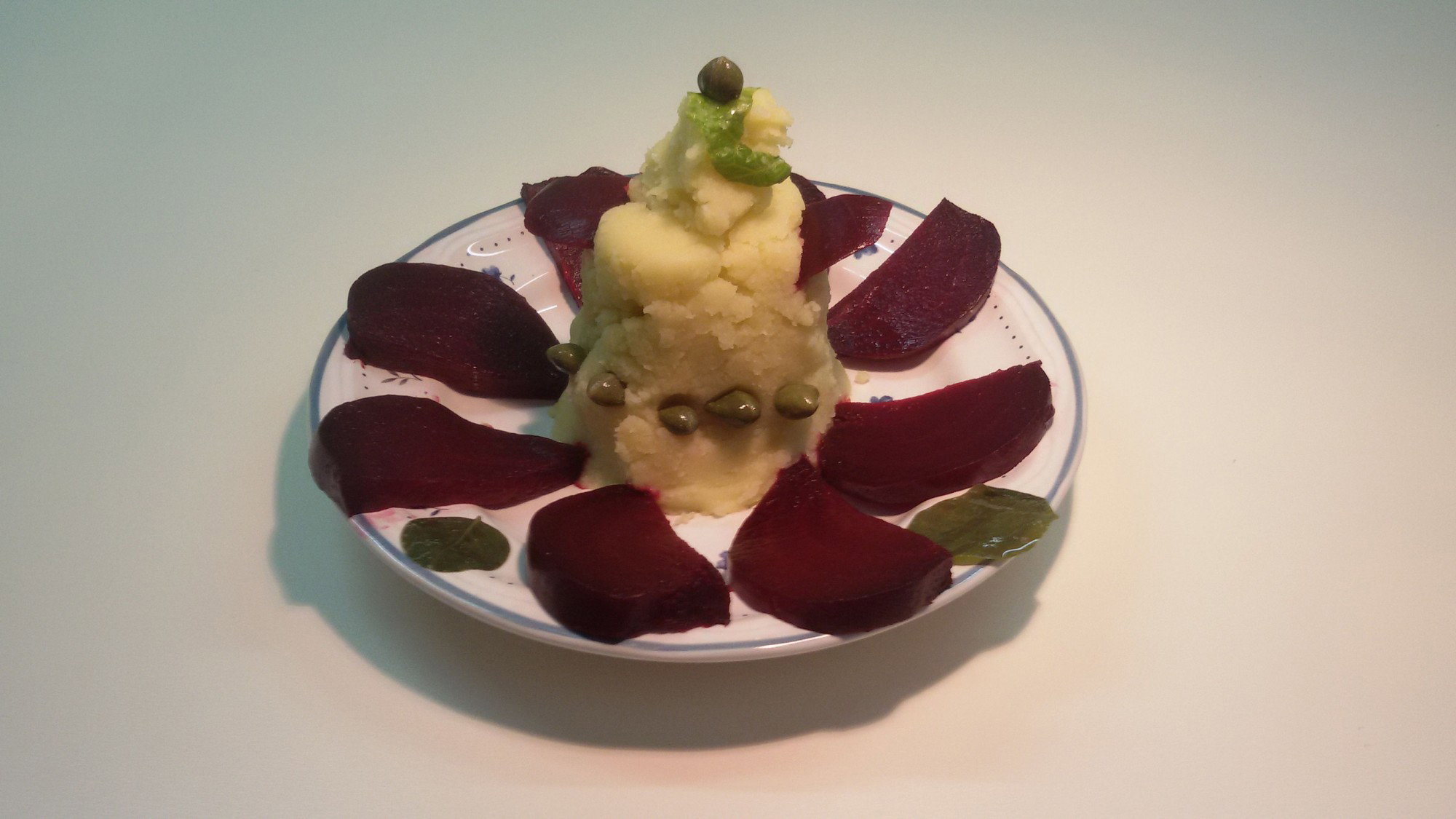
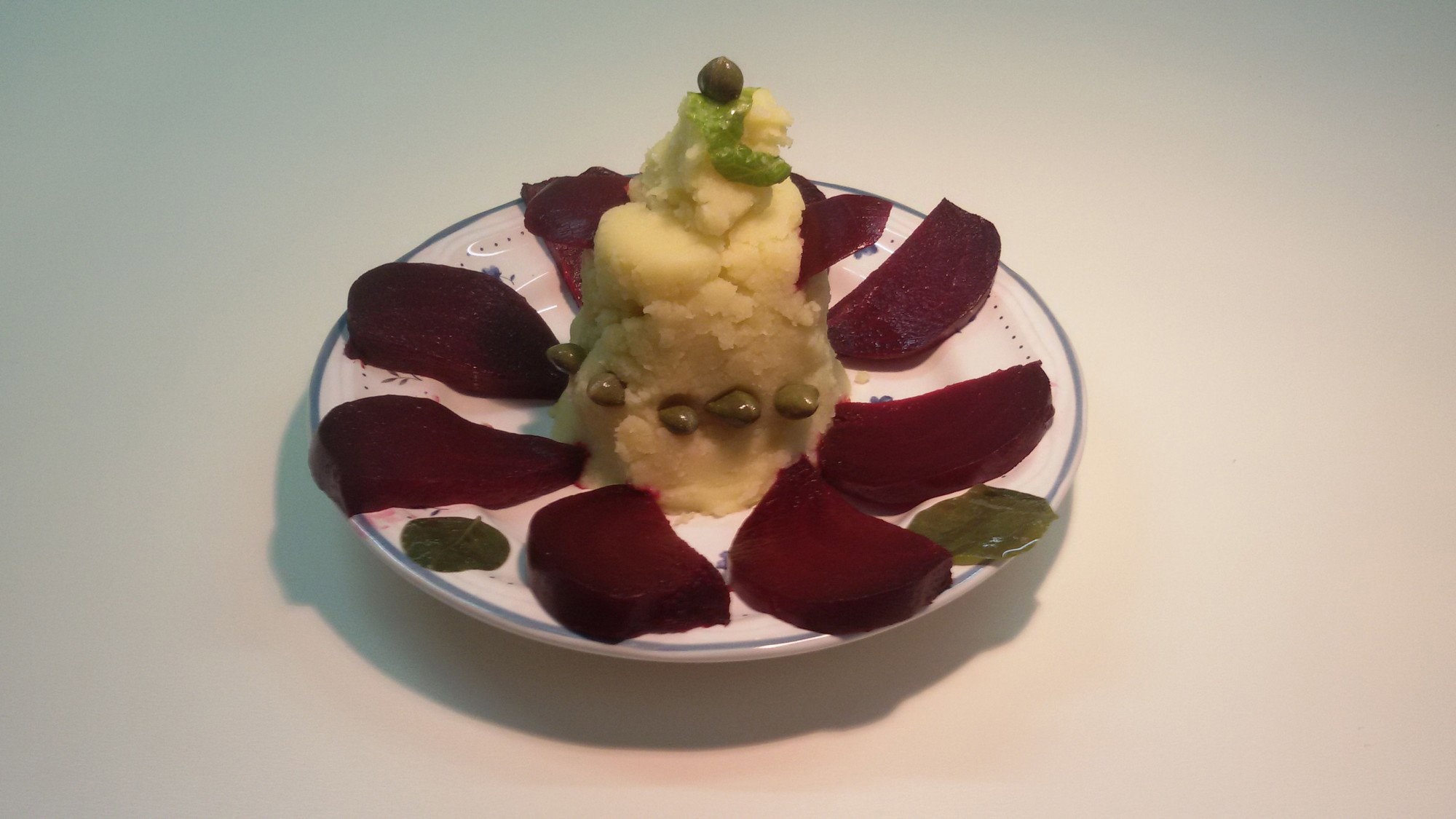
I like to serve Skordalia mainly with beetroots as it tempers the typical garlic smell. Today I prepared a dish with beetroots and sardines.
Ok, garlic has its typical smell but I don't care (much) about it. It is healthy!
So take me as I am or leave me as I am. I just LOVE it!
**Ingredients**:
- 500 gr. white bread. (I prefer some 1-2 days old litourgia, a special type of bread created for church ceremonies).
- 4 cloves of garlic.
- 200 ml. olive oil.
- juice of 1 lemon.
- salt.
**Preparation**:
- (1) Soak the bread (litourgia) in some water for about 20 minutes.
- (2) Squeeze the water out of it.
- (3) Mash the bread with the garlic cloves.
- (4) Add, gently, the olive oil and the lemon juice.
- (5) Add some salt.
Instead of the bread, you could also use mashed potatoes to create this mousse. It is not the 'traditional' way, but is the most common way, nowadays, in Greece. Actually it is quite rare to find Skordalia based on bread in restaurants or taverns.
Another tip is to store this sauce in the refrigerator for 24 hours as the taste will be much, much better.
Enjoy!
LOVE
Experiencing the values in one other and drawing this ones' attention on those values, that is what LIFE is all about:
LOVE
**L**(ife)**O**(n)**V**(alue)**E**(xchange)".
Laziness and Blockchain drive technology.
We can define “technology” as… *entities, both material and immaterial, created by the application of mental and physical effort in order to achieve some value*.
This value, we strive for, is **comfort**. By creating ‘tools’ or as I call them ‘extensions to our bodies’ we try to make our life easier, more efficient and so of a higher quality.
We could look at the early humans and see that they were using primitive (stone) tools to ease their life during the hunt and say “this is were it all started”. But I would like to go one step further and say that **our body itself is technology**!
Let’s assume that all life started from a ‘one cell’ organism whose life, mainly, consisted out of absorbing and dumping. After having done so, for a long time, these cells realized that by joining together as organisms they could split the ‘workload’ and have a more comfortable life.
Finally these organisms started to mutate and organize themselves to execute specific functions. So started the creation of stomach cells, liver cells, brain cells and so on... to work together in a (human) body as we know it today.
But it doesn’t stop here, it is a process that is in a constant evolution. We, human beings, are actually experts in this laziness. Some of the greatest innovations were developed by people who were to lazy or got bored doing a particular task. After having done such boring tasks over and over again, the most lazy ones among us questions themselves “There must be an easier way to do it. How?”.
Even Bill gates once stated: “*I will always choose a lazy person to do a difficult job, because, he will find an easy way to do it*”. After I mentioned this quote to my boss, I got fired. It seems he didn’t understand underlying logic.
More even, if we look to animals we notice that the most active ones, bees for example, have a very short lifespan. While on the other hand the most lazy ones, elephants and turtles, get very old!
This put you at thinking, right?
We, human beings, have the capacity to invent things to make our life more comfortable (~lazy). I started thinking about this the very first time I really paid attention to somebody working with a bulldozer. It was magically how this gigantic thing was in sync with the movements that worker made. It obeyed like a slave.
Now, thinking about slaves, I am not sure if machines/technologies are slaves to us or we are slaves to machines/technologies. Think for example of a GPS. Is the GPS our slave? Or are we obeying the GPS?
The main problem that we, human beings, have is that we are very limited by our bodies. We are imprisoned in it and it has its limitations. No one, with an arm length of 76 cm, is able to grab that cold beer, in the refrigerator in the kitchen, while sitting in his lazy chair, in the living room. No one, with a leg length of 95 cm, is able to make steps bigger then 75 cm. No one is able able to run 100 km an hour, No one is able fly, no one is able to dive for more then an hour, but…
We have our brains (and with it, our dreams) to create extensions to our bodies to make us achieve the ‘unbelievable’. We want to move faster, so we create the engine. We want to fly, so we create the airplane.
But here lures a danger around the corner. Some extensions might bring our lives in danger. Think for example of the many car accidents, airplane crashes and so on that happen. Sometimes they just happen because of failure but sometimes they happen, on purpose, initiated by hackers.
There are several technologies, somewhere in a dusty drawer, that never took off because of this reason. I think for example of bionic arms or Virtual Reality. Until now we could never tell for sure that the signal, send to the arm, was not compromised (and make, let’s say, the user punch himself in the face) or that the ‘virtual’ reality was not altered so that a player for example falls from a building causing him to experience a real heart attack.
https://youtu.be/Z42_5OOaBs0
But now, with Blockchain in place, these technologies can finally take off and with it, we will be able to create much more challenging body extensions. This will bring us, human beings, to a next level of ‘super humans’, a new species I would say. Just like life evolved from a one cell to the complex body as we know it today.
For now, let’s remain lazy and keep on dreaming!
Greece - Islands - Cyclades - Amorgos - Beaches: Ammoudi
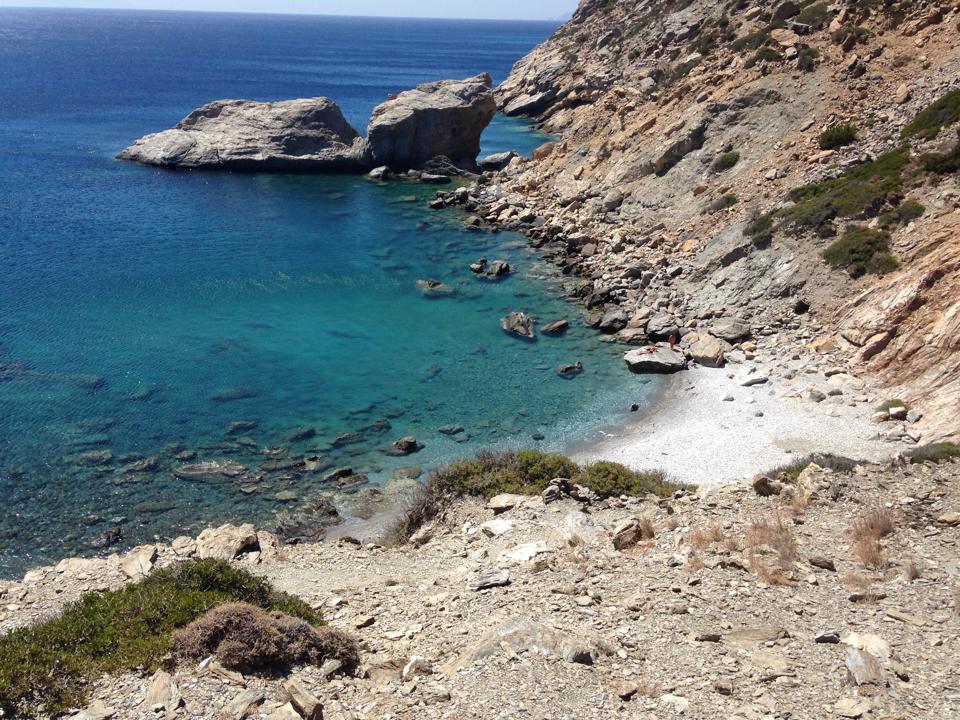
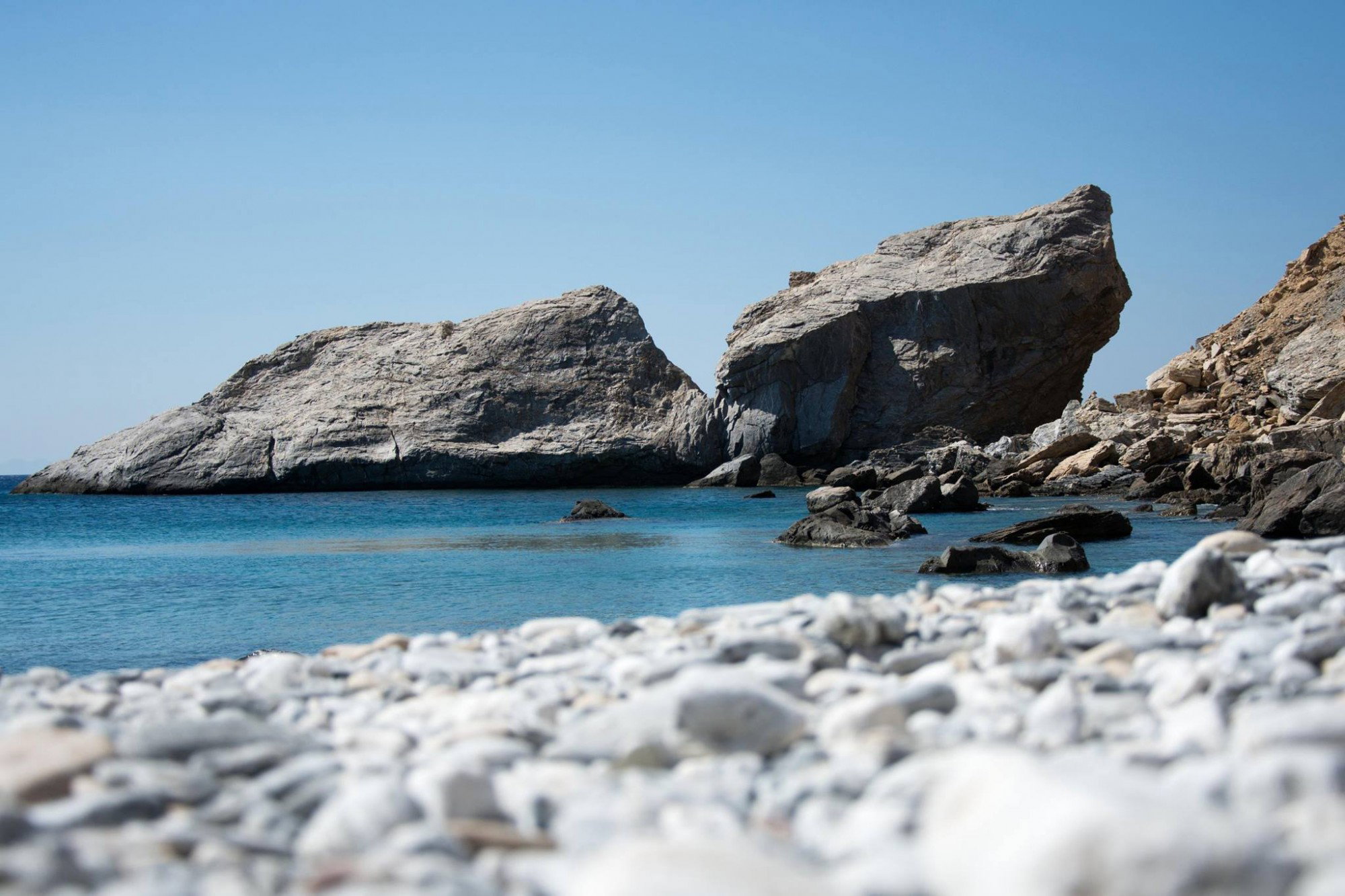
Ammoudi is a very small, isolated, beach in the south east of the village Arkesini. This beach is only for the real 'adventurous' people as it is only accessible on foot. From the Loza square, in Arkesini, you will find a 30 minutes long 'wild' path leading here. For this reason I believe this beach is NOT suitable for small children. Even I slipped a few times over loose rocks. Ok, I have to admit here that I walk everywhere on sandals ;-).
The beach is covered with small pebbles and has like most beaches here crystal clear blue waters. Because of the rocky underground, it very nice to practice snorkeling/scuba diving here. Many beautiful fish can be observed here. (because of the remoteness).
As not many people make the effort to step down this path, most probably you will enjoy this beach in a 'private' way, all day long.
Also be aware that there is no accommodation at all. If there is anything you might need (drink, food, bed or umbrella) make sure you take it all with you! You will not even find a single tree here. So it advisable to take a lot of sun cream if your are sensible to the sun.
As this beach is on the east side of the island, make sure you return back 'in time' to Arkesini. The sun sets very rapidly here and you don't want to find yourself, in total darkness, on the rocky path back!
**QUICK DETAILS**:
**LOCATION** : 36°46'54.8"N 25°49'06.0"E (36.7818889 25.8161393).
**TYPE** : PEBBLES.
**FACILITIES** : https://www.google.com/maps/place/36%C2%B046'54.8%22N+25%C2%B049'06.0%22E/@36.7818889,25.8161393,604m/data=!3m1!1e3!4m5!3m4!1s0x0:0x0!8m2!3d36.7818889!4d25.8183333
**NO** ACCOMMODATION.
**NOT** CHILD FRIENDLY (rocky path leading here).
NO SHADE.
ONLY ACCESSIBLE ON FOOT.
NUDISM TOLERATED.
Greece - Food & Drinks - Side Dish: Melitzanes Tiganites.
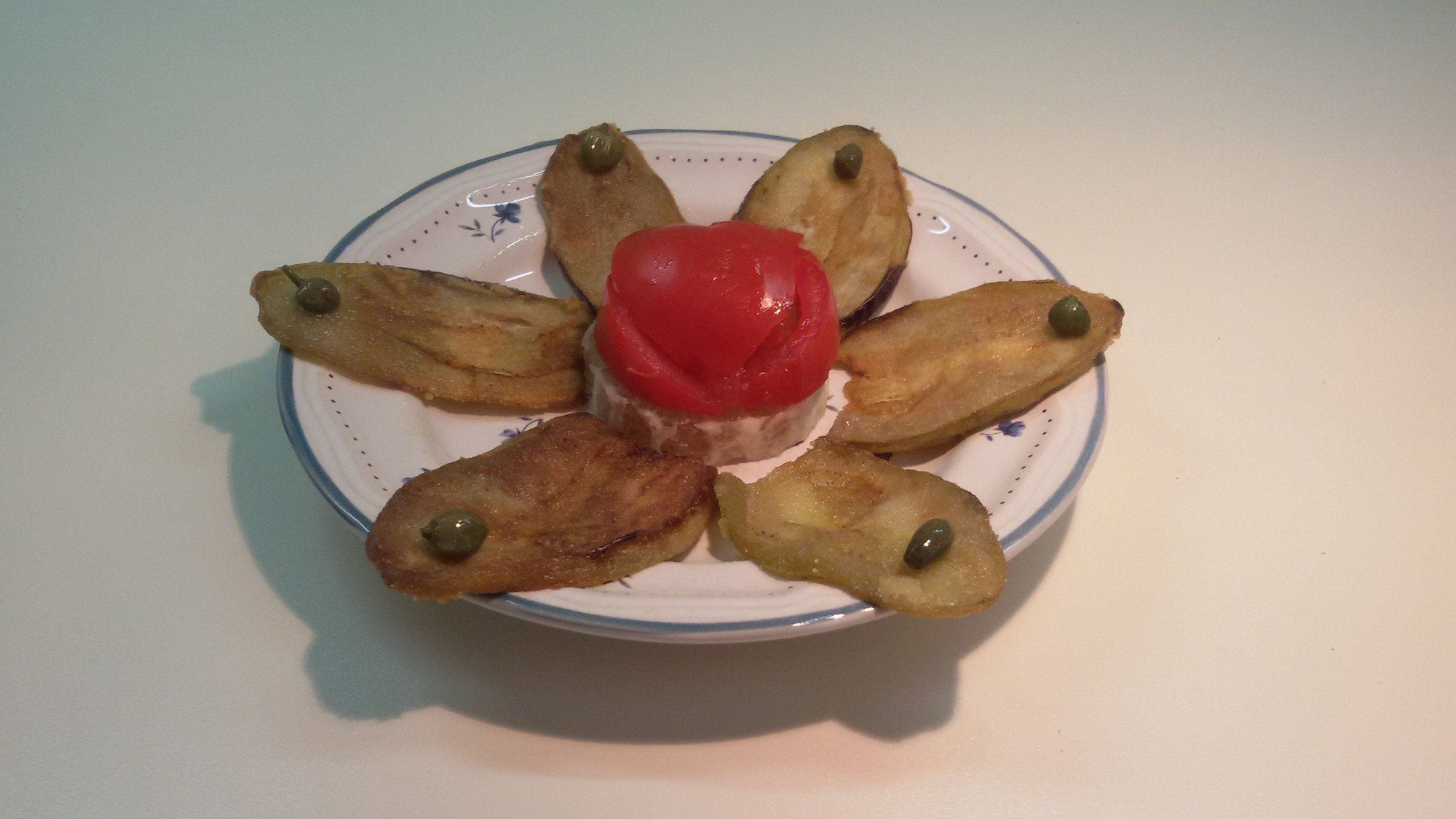
Melitzanes Tiganites (fried eggplants) is a very easy appetizer/side dish of the Greek cuisine. It is simple, yet tasty, and it needs only 4 ingredients: eggplants, lemon juice, flour and eggs.
Eggplants have a very positive effect on our body as they contain in addition to fibers, a lot of vitamins, minerals and phytonutrients. These phytonutrients have antioxidant features and protect the fats in our brain cells. Egg plants also help in reducing high cholesterol levels.
Unfortunately, because of its (according to me pleasantly) bitter taste, most children don't like egg plants at all. For this reason I create this fried 'eggplant chips' version. Now they are even fighting to take the last slice. THEY JUST LOVE IT!
Fried eggplants are mainly served, as an appetizer/side dish. They can be eaten both warm and cold.
The warm version of this dish is usually accompanied with a salad.
The cold version is served with tzatziki and some fresh, white bread. Instead of sprinkling salt on the slices, I add some capers (as a natural salt). During the hot summer days I also like to drink an ice cold beer with this version. https://read.cash/@chryptof/greece-food-drinks-side-dish-tzatziki-0b7c912a
**Ingredients**:
- 2 (big) eggplants.
- 2 eggs (for breading).
- juice of 1 lemon.
- 300 gr. flour(for breading).
- olive oil.
- salt.
- (black) pepper.
**Preparation**:
- (1) Cut the eggplants, over length, in thin slices.
- (2) Sprinkle the slices with lemon juice.
- (3) Take 2 (deep) plates.
- (4) In one plate, beat the eggs, until nice foamy.
- (5) In the other plate, mix the flour with salt and pepper.
- (6) Take one eggplant slice.
- (7) Dip the slice in the beaten eggs.
- (8) Wallow the slice in the flour mix.
- (9) Repeat (6) to (8) for all the other eggplant slices.
- (10) Fry the slices until auburn (golden-brown).
Finally:
- Sprinkle some fresh chopped mint leaves on it.
- For decoration, add some capers.
Enjoy!

Greece - Food & Drinks - Pastry: Chortopita.
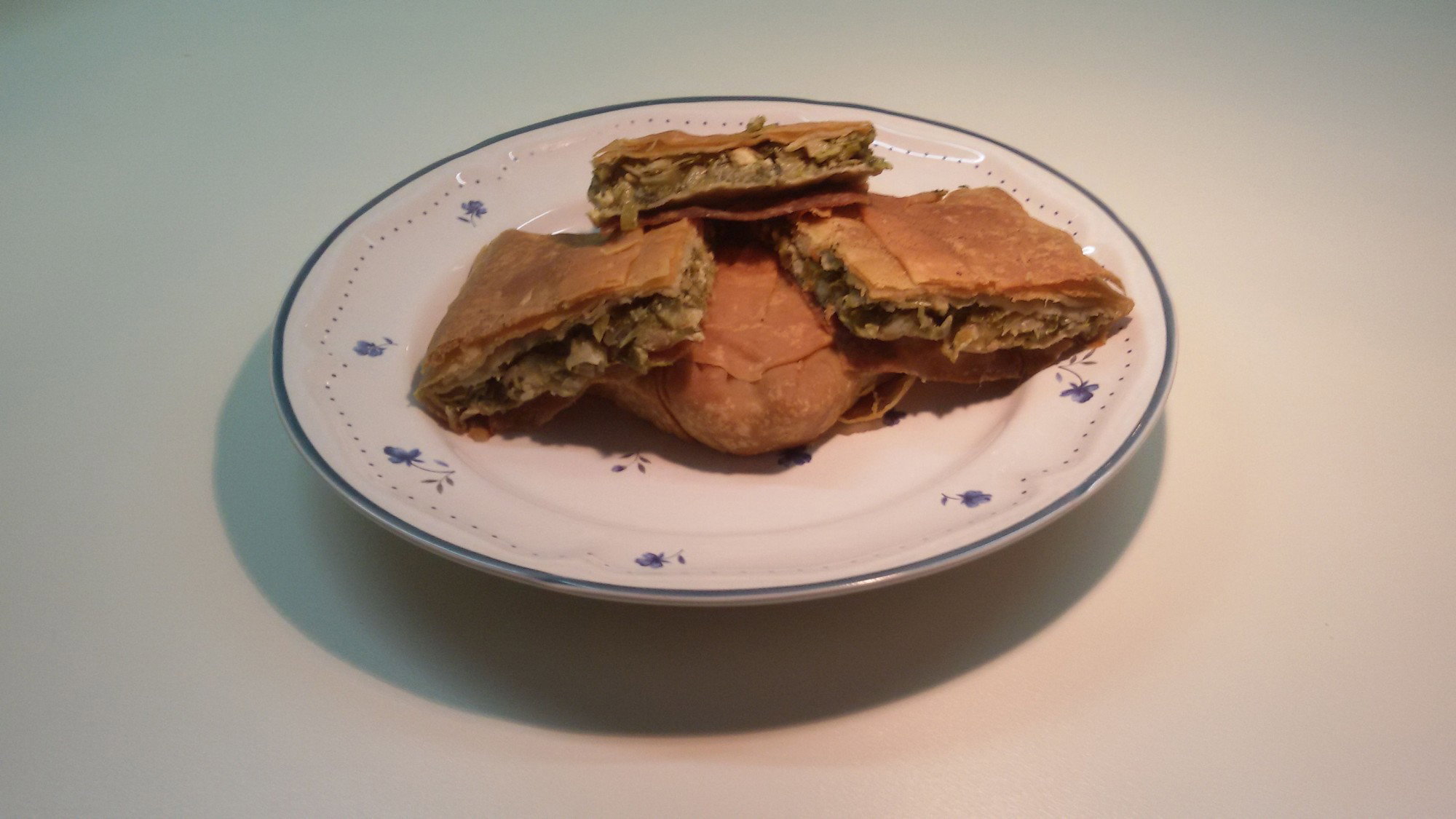
As mentioned in a previous post of mine, about tiropitakia, Greeks and their pites (pies) are like two hands on a belly: inseparable! https://read.cash/@chryptof/greece-food-drinks-pastry-tiropitakia-ce1d92ad
In this post I show you how to make **Chortopita** (green pie), the 'traditional' way. That means that you make the dough yourself. Creating this dough is a very time-consuming work as you have to roll it, twist it, roll it, twist it, again and again until you have the right thickness and the right size. Please, be happy if it didn't work out the right way (from the first time). See it as another step forward in the 'training' process.
Even here in Greece we accept that only gia-gia (grandmother) knows how to make the perfect pita! It takes some time to figure out the right pressure on the dough rolling stick. These sticks are usually made from the wood of fruit trees as this wood is flexible but it doesn't bent.
If you are a beginner, and you really want to taste your self-made Greek pita, I suggest you not to bother with the dough and buy the fresh 'ready-made' dough from your local bakery.
On the bottom of this post I will reveal you a **cheat/trick** to create a 'perfect' (rolled) pita without bothering the whole process!
**Ingredients**:
For the dough:
- 500 gr. flour.
- 25 ml. wine vinegar.
- 50 ml. olive oil.
- 300 ml. of water.
- 1 teaspoon of salt.
- some corn flour.
For the filling:
- 500 gr. spinach.
- 300 gr. leeks.
- 400 gr. Feta cheese.
- 1 bunch of dill.
- 1 bunch of parsley.
**Preparation**:
For the filling:
- Mix the spinach, leeks, dill, parsley and Feta.
For the dough:
- (1) Pre-warm the oven to 180° Celsius.
- (2) Knead, in a bowl, the flour, wine vinegar, olive oil, salt and water. (so that it becomes a firm, elastic dough).
- (3) Sprinkle the mixture with some flour.
- (4) Cover the bowl with cling film.
- (5) Put the bowl in the refrigerator for about 1 hour.
- (6) Divide the dough into 6 equal parts.
- (7) Knead each part into a ball.
- (8) Sprinkle some corn flour on a (wooden) cutting board.
- (9) Roll the dough ball out to a thin layer (about 3-5 mm), having a size slightly bigger then your oven tray .
- (10) Repeat (8) to (9) for each ball.
- (11) Oil the oven tray.
- (12) Put the layer in the oven tray. (so that it overlaps the oven tray on each side for about 2 cm).
- (13) Oil, with a brush, the top of this layer.
- (14) Repeat (12) to (13) for 2 more layers.
- (15) Spread the filling over the layer, covering the entire oven tray.
- (16) Cover the filling, Repeating (12) to (13) for the other 3 layers.
- (17) Put the oven tray in the oven.
- (18) Bake for about 1 hour and 15 minutes or until auburn (golden-brown).
**Cheat/trick: Create Chortopita rolls.**
- (1) Roll out the dough to a thin layer (about 3-5 mm).
- (2) Cut triangles out of the dough with a base of about 7 cm and a height of 15 cm.
- (3) Take one such triangle.
- (4) Spread, about 2 cm above the base of the triangle, one tablespoon of the filling.
- (5) Oil the rest of the triangle (up to the top) with olive oil.
- (6) Roll the triangle, from the base up to the top.
- (7) Repeat (3) to (6) for the other triangles.
- (8) Oil the oven tray.
- (9) Spread all the triangles equally on the oven tray.
- (10) Bake for about 1 hour or until auburn (golden-brown).
Enjoy!
Greece - Food & Drinks - Alcoholic Beverage: Rakomelo.
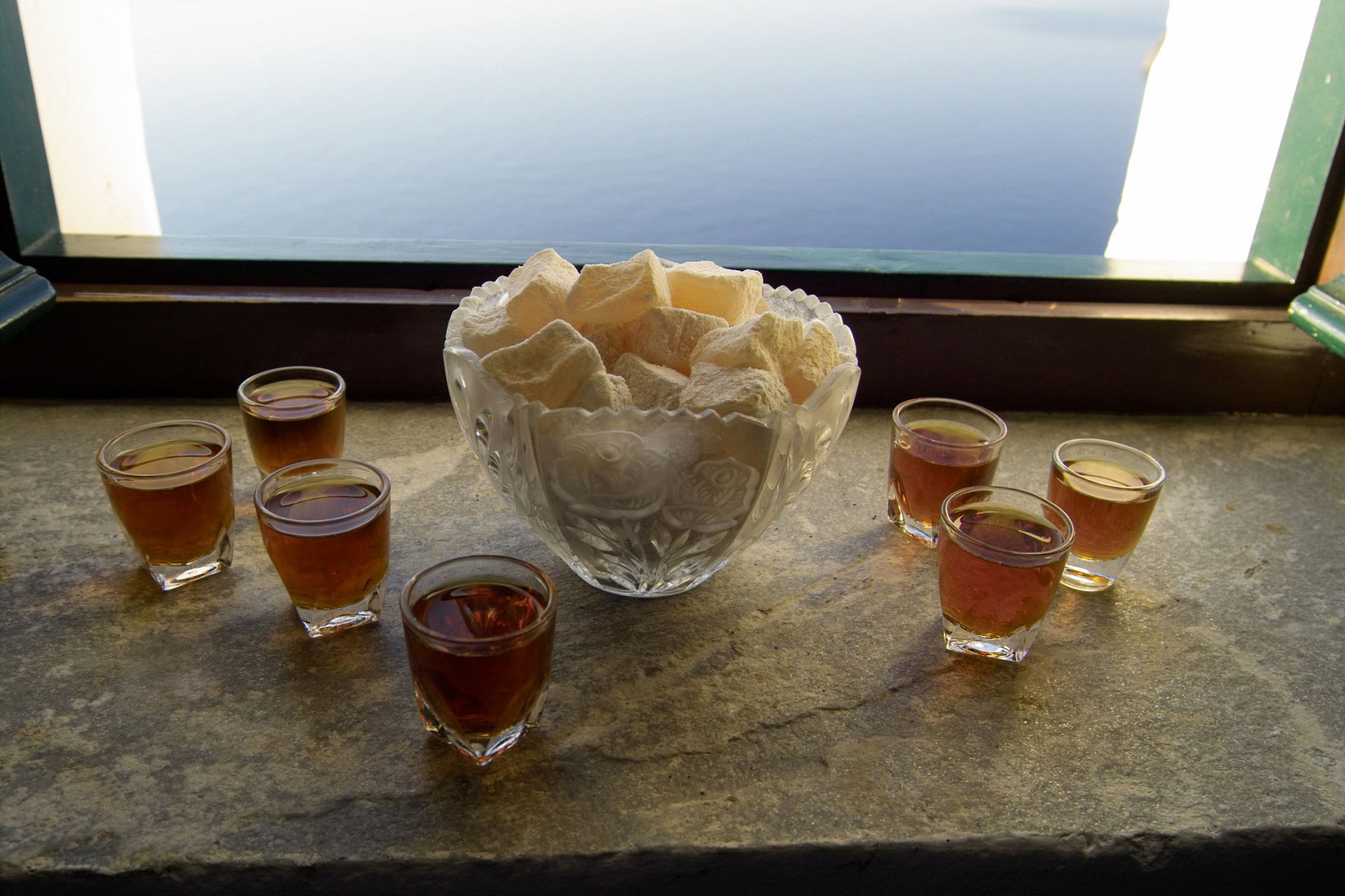
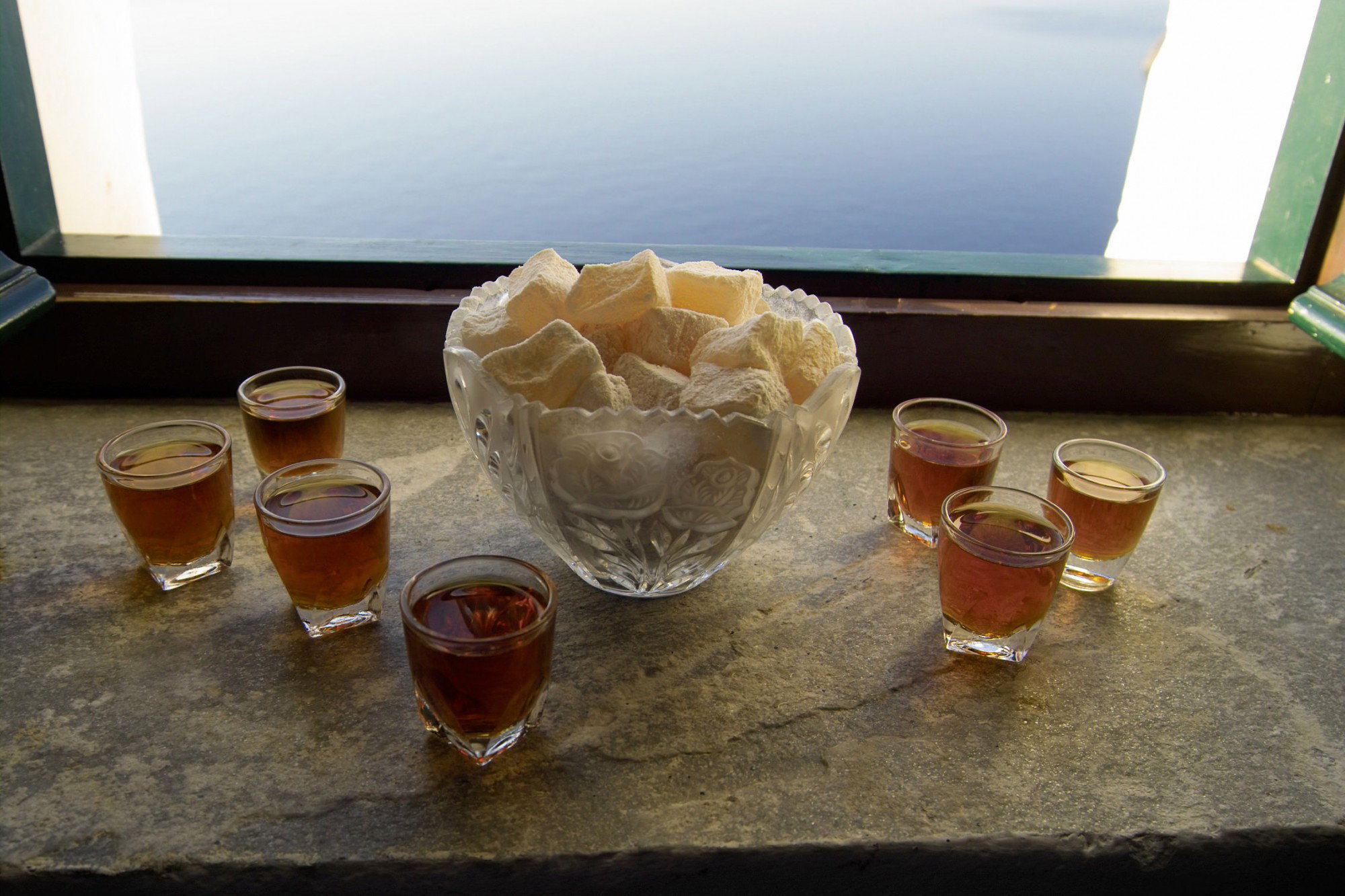
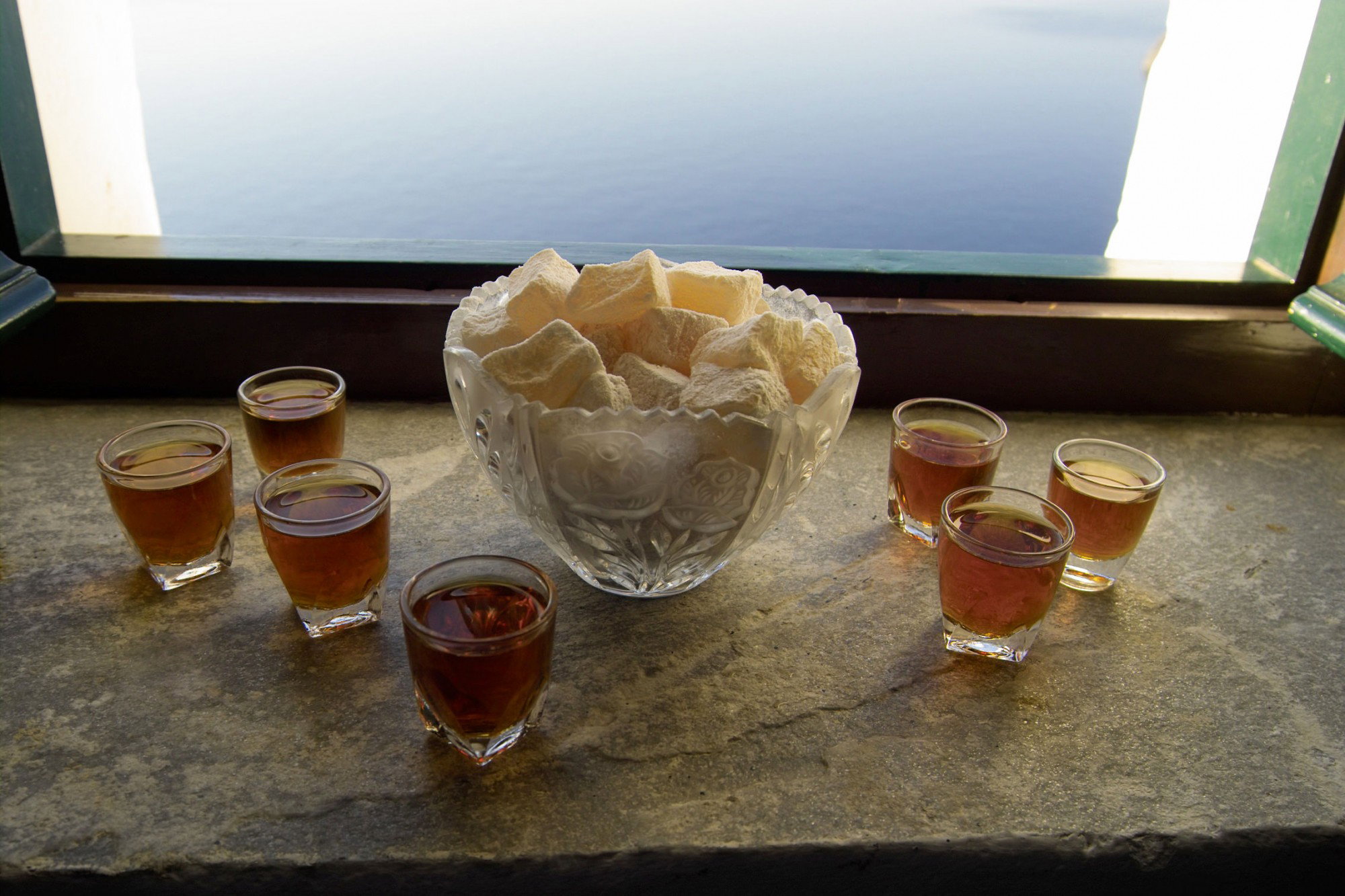
Since ancient times the residents of the island Amorgos were producing a traditional homemade liquor in order to treat their guests. Even today, if you visit the famous **monastery of Hozoviotissa**, the monks will welcome you with one of the finest (self-made) Rakomelo (also known as psimeni Raki). https://read.cash/@chryptof/greece-islands-cyclades-amorgos-churches-monastries-hozoviotissa-086b17b1
The base ingredients for this alcoholic beverage are Raki, honey and herbs (cinnamon, cloves, amorgi, carnation, …). Raki is the product of a double distillation of grapes. From this, you can understand that Rakomelo is a strong drink with a unique and delicious taste.
I am sure that once you had it, you will ache for more. (So please drink it with care).
Rakomelo can be consumed in the summer (with ice cubes) but I prefer to drink it ‘heated’ during the winter as it is what I call a heart-warming drink to sit back, relax and go, one more time, over those beautiful, care-free, summer ‘holiday’ memories.
Each time I read something about ‘**Ambrosia**’, being the drink of the Gods, I am sure they actually refer to Rakomelo.
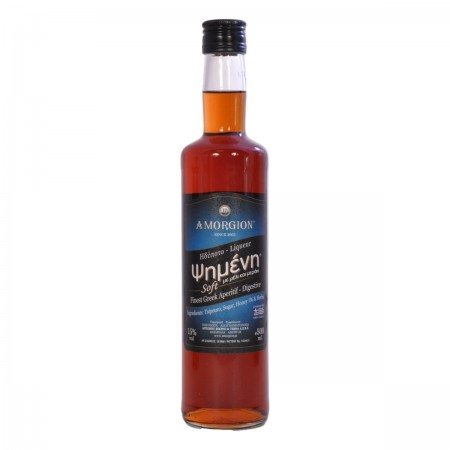
The most famous brand of Rakomelo here on the island is Amorgion. A bottle of 750 ml costs about 12 euros.
Cheers
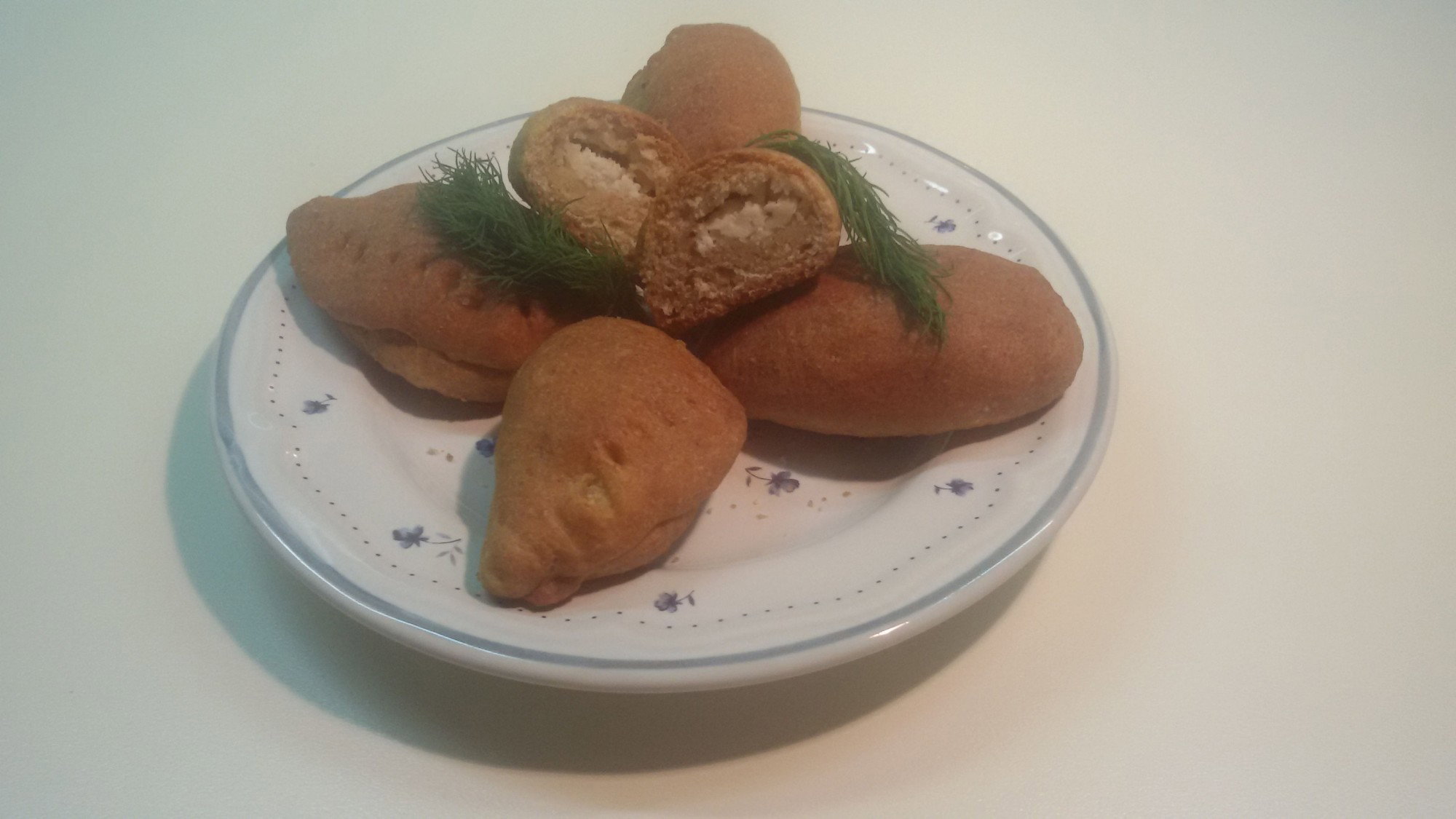
Greece - Food & Drinks - Pastry: Tiropitakia.
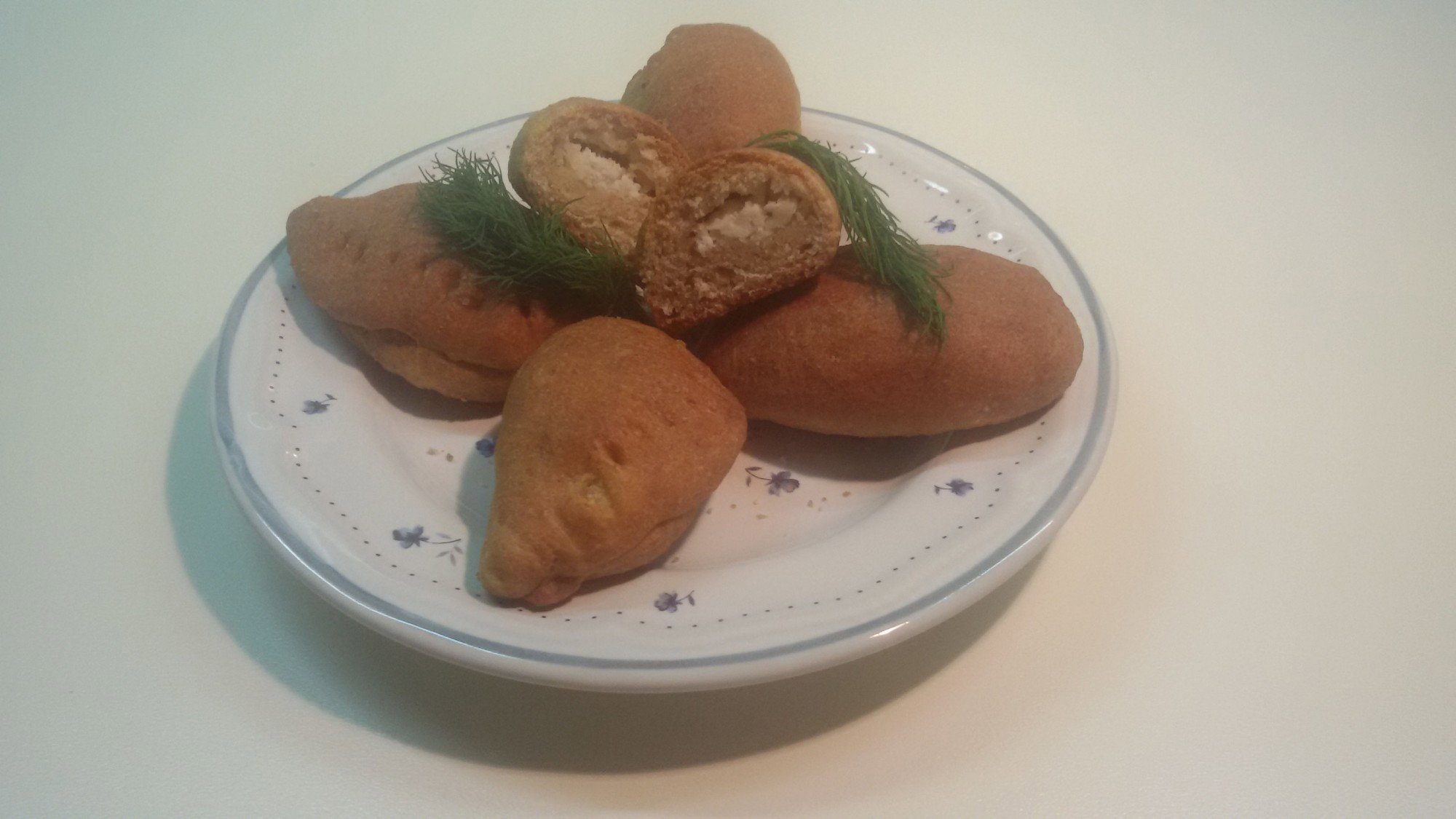
Greeks and their tiropites (cheese pies) are like two hands on a belly: inseparable!
We start eating them from as early as breakfast throughout the entire day. Tiropita with a 'Greek' coffee or a 'Frappé' coffee is the eminently way to have breakfast. Many times even combined with a cigarette. It is like a 'Holy Trinity'.
Also children love these small cheese pies so much that if you bake 24 of them, within the day they are all gone. (nobody knows where they went).
Tiropita is a cultural heritage here in Greece, yet they are very easy to create.
**Ingredients**:
- 500 gr. self-raising flour.
- 200 gr. yogurt.
- 150 gr. Anthotyros cheese.
- 150 gr. Feta cheese. (I prefer the Epirus one because it is, as the box says, "The delicious Feta").
- 150 ml. olive oil.
- 1 egg.
- (black) pepper.
**Preparation**:
- (1) Pre-warm the oven to 180° Celsius.
- (2) Mix, in a bowl, the yogurt, the olive oil and the egg.
- (3) Add to this mixture the self-raising flour.
- (4) Mix, in another bowl, the Feta cheese and the Anthotyros cheese.
- (5) Bring the cheese mixture on taste with (black) pepper.
- (6) On the kitchen counter, roll out the dough with a dough roll. (so that the dough is about 5 mm thick).
- (7) Cut, with a 10 cm cookie cutter (or the top of a glass), equal circles out of the dough.
- (8) Take one such dough circle.
- (9) Add in the middle of the dough circle a tablespoon of the cheese mixture.
- (10) Carefully fold the dough circle close (so that it looks like a half circle or a half moon). PUSH ONLY ON THE ROUND SIDE SO THEIR 'BELLIES' REMAIN A LITTLE PUFFY.
- (11) Repeat (8) to (10) for all the other dough circles.
- (12) Put some baking paper on the oven tray.
- (13) Spread the tiropitakia equally on the baking paper.
- (14) Bake the tiropitakia for about 45 minutes or until auburn (golden-brown).
Enjoy!
Greece - Islands - Cyclades - Amorgos - Food & Drinks: Rakomelo.
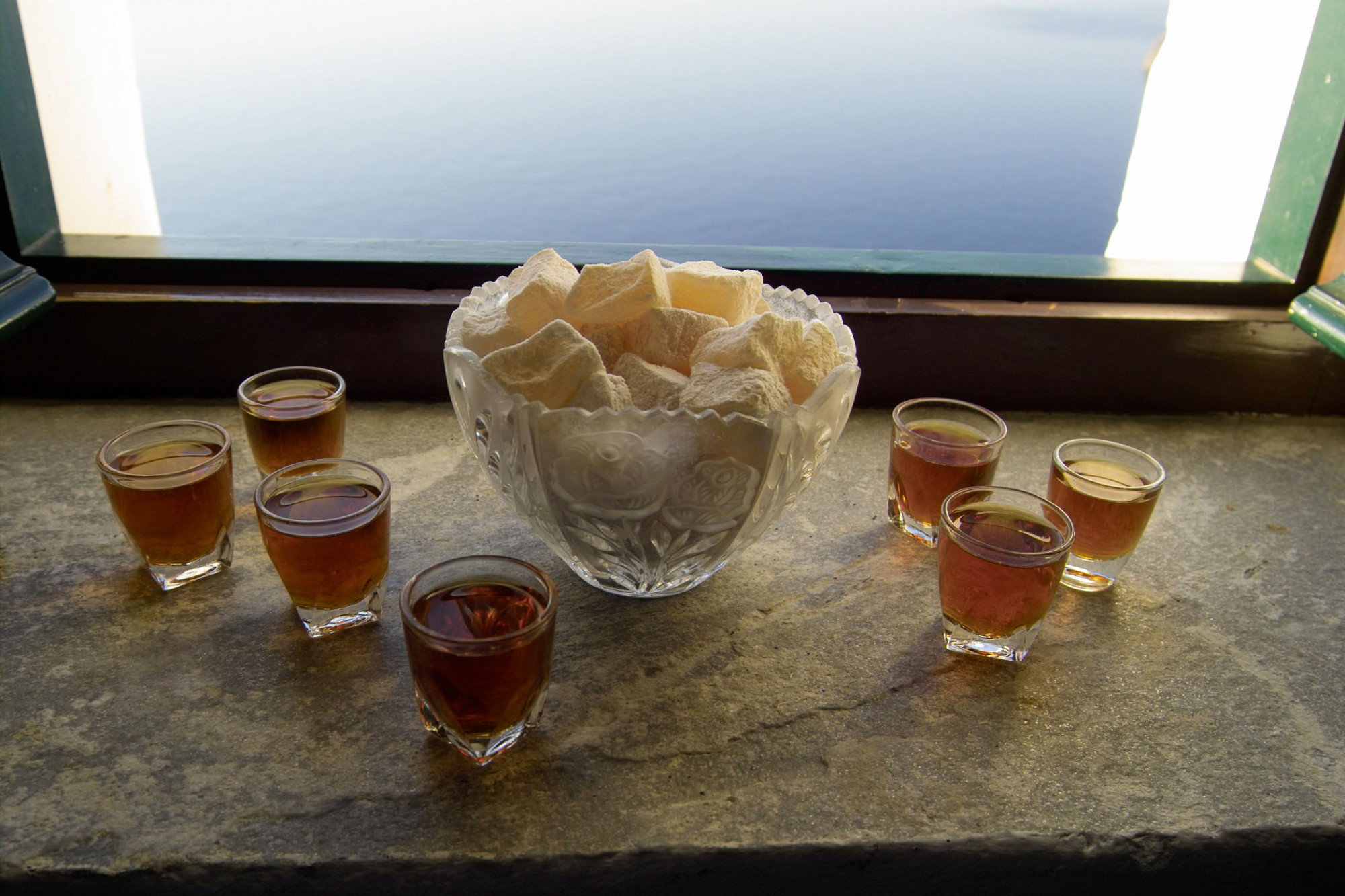
Since ancient times the residents of the island Amorgos were producing a traditional homemade liquor in order to treat their guests. Even today, if you visit the famous monastery of Hozoviotissa, the monks will welcome you with one of the finest (self-made) Rakomelo (also known as psimeni Raki). https://read.cash/@chryptof/greece-islands-cyclades-amorgos-churches-monastries-hozoviotissa-086b17b1
The base ingredients for this alcoholic beverage are Raki, honey and herbs (cinnamon, cloves, amorgi, carnation, …). Raki is the product of a double distillation of grapes. From this, you can understand that Rakomelo is a strong drink with a unique and delicious taste.
I am sure that once you had it, you will ache for more. (So please drink it with care).
Rakomelo can be consumed in the summer (with ice cubes) but I prefer to drink it ‘heated’ during the winter as it is what I call a heart-warming drink to sit back, relax and go, one more time, over those beautiful, care-free, summer ‘holiday’ memories.
Each time I read something about ‘Ambrosia’, being the drink of the Gods, I am sure they actually refer to Rakomelo.
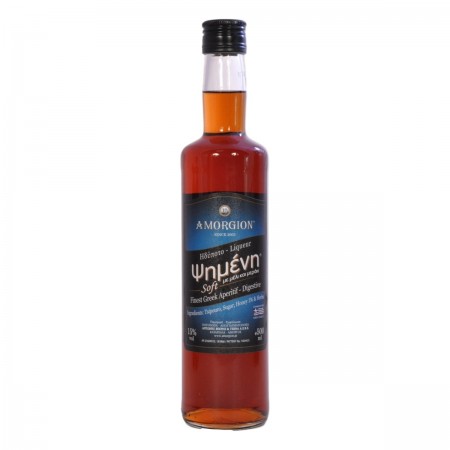
The most famous brand of Rakomelo here on the island is Amorgion. A bottle of 750 ml costs about 12 euros.
Cheers
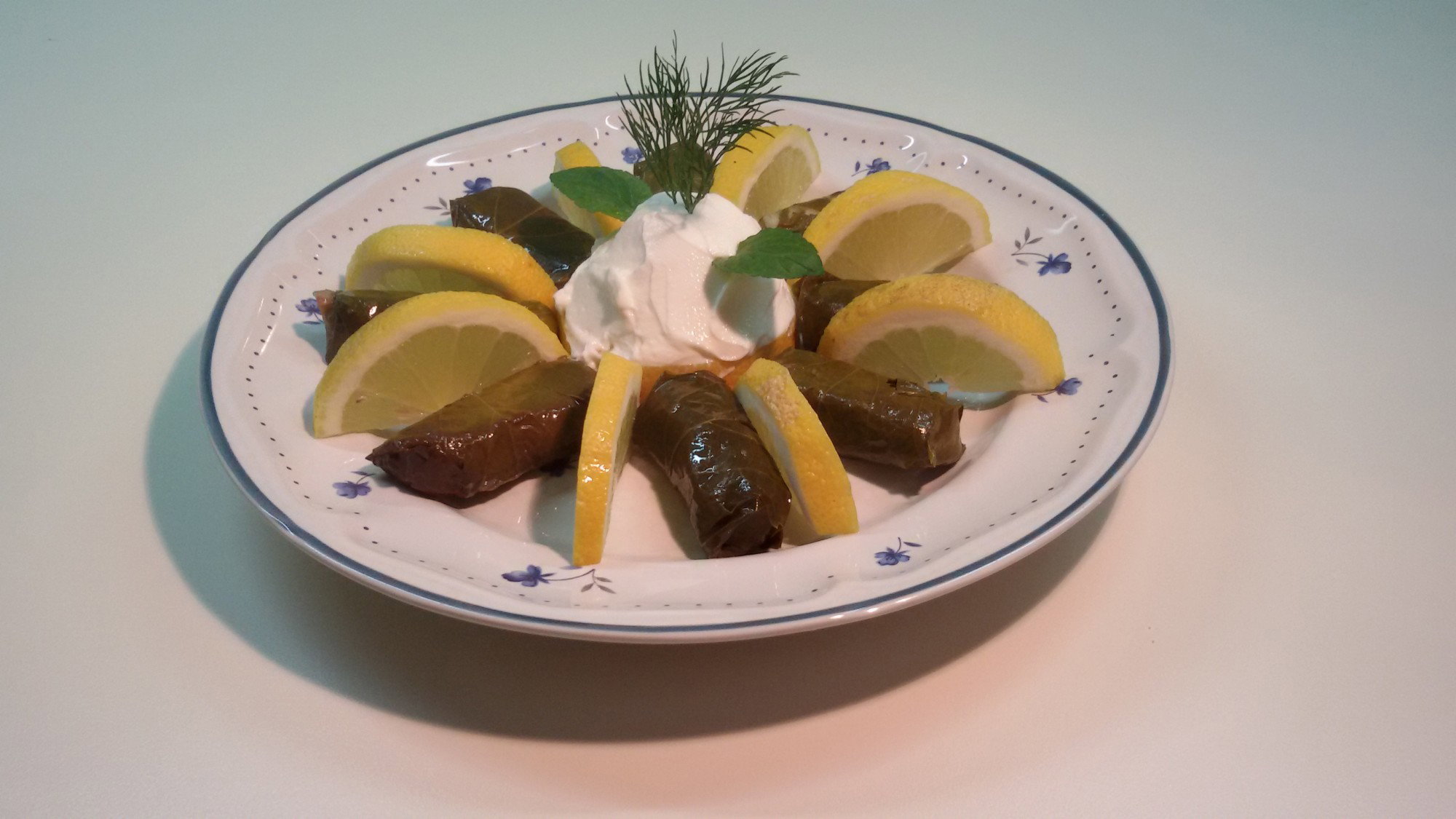
Greece - Food & Drinks - Side Dish: Ntolmadakia.
Ntolmadakia or 'stuffed wine leaves' is without doubt one of the most well known appetizer/side dish of the Greek cuisine. The base ingredients for this dish are wine leaves, rice, spring onions, dill and parsley. It is a not so easy to create dish as it takes a certain amount of time in preparing the rolls. But it is for sure worth to try it.
The version that I present here is a 'simple' version but nevertheless it is the most 'traditional' one and more over it also consumable by vegetarians. The word 'ntolmadakia' has its roots from the Turkish language as 'dolmak' (in Turkish) means 'to stuff'. For this reason it is obvious that there exist many different versions of 'stuffed' wine leaves.
Ntolmadakia can be served, as an appetizer/side dish, warm or cold. I prefer them to be served cold with yogurt and some lemon slices. In this way it is another dish that brings a long-tasting freshness in your mouth during the hot summer days.
I LOVE IT!
**Ingredients**:
- 750 gr. of fresh wine leaves.
- 500 gr. of rice.
- 1 bunch of spring onions.
- 2 bunches of dill.
- 1/2 bunch of parsley.
- 750 ml of water.
- juice of 2 lemons.
- olive oil.
- salt.
- (black) pepper.
**Preparation**:
- (1) Shred the spring onions.
- (2) Chop the bunches of dill and parsley. (ONLY THE LEAVES).
- (3) Put the rice in a pan.
- (4) Add the spring onions, dill, parsley.
- (5) Add the lemon juice and some olive oil.
- (6) Bring all this on taste with salt and pepper.
- (7) Stir this mixture very well and put it aside, for about 2 hours (the longer the better), so that the rice can absorb the taste of the herbs.
- (8) Parboil the wine leaves for about 3 minutes.
- (9) Take the wine leaves out of the water.
- (10) Take a wine leave and put it, with the shiny side down and the stem facing towards you, on the kitchen counter.
- (11) Put, near the stem of the leave, about a tablespoon of the rice mixture.
- (12) Fold the stem side (upwards) over the rice (so it is partly covered).
- (13) Repeat (12) so that the rice is firmly packed within the leave.
- (14) Fold the sides of the leave inwards (like holding your left shoulder with your right hand and your right shoulder with your left hand).
- (15) Repeat (10) to (14) for the other wine leaves.
- (16) Put all the packages, with the sealing side facing down, very close (pressing on to each other) next to each other, in a (high) pan. This will prevent them from opening. (the optimal is that the entire bottom of the pan is covered).
- (17) Sprinkle some salt and pepper to bring on taste.
- (18) Add the 750 ml. of water.
- (19) Add some olive oil.
- (20) PUT, CAREFULLY, A PLATE (or 2) TO PUT WEIGHT ON THE ROLLS. (so they don't swim around once the water boils).
- (21) Boil this on a medium heat until all the water is absorbed.
Finally:
- Serve with yogurt and lemon slices.
- For decoration, add some dill leaves.
Enjoy!

Greece - Islands - Cyclades - Amorgos - Beaches: Gramvousa
Gramvousa is a small sub-island of Amorgos with no inhabitants. It has 2 really breath-taking, sandy, beaches with astonishing crystal-clear waters. They are, for sure, a MUST SEE!
There are also many small paths that lead to other (mainly rocky) places where you are able to enter the sea and enjoy, all day long, your own 'private' beach. Mmm, feels like Onassis.
Be sure to be back in time to take the (last) taxi-boat back as the weather, after the sun sets, can become very harsh: the south wind will kick in and the temperatures will drop tremendously!
This small island is reached by a taxi-boat that you take from the beach of Kalotaritissa. The boats leave every hour between 11:00 and 19:00 and cost you only 5 euros.
If you come early in the morning, you could ask a local fisherman (in return of a small tip) to take you there.
(You can also take a taxi-boat from Katapola but we haven't tried that, so I can't give you more information about this). https://read.cash/@chryptof/greece-islands-cyclades-amorgos-beaches-kalotaritissa-627ff3a7
The beaches here are for 'real nature' lovers so be aware that there is, except for some umbrellas and sunbeds, NO accommodation at all!
If there is anything you might need (drink, food) make sure you take it all with you! Also, if you are sensitive to the sun, take a lot of sun cream and an umbrella as there are no trees for shade.
Because of the shallow waters, the beaches are extremely suitable for families with smaller children. They will love it here because they will quickly make new friends (there are only a few people here).
On the left side of the main beach, there is a small church devoted to the Virgin Mary.
**QUICK DETAILS**:
**LOCATION** : 36°48'08.6"N+25°44'46.5"E (36.8023994,25.7440563).
**TYPE** : SANDY (small pebbles).
**FACILITIES** : https://www.google.com/maps/place/36%C2%B048'08.6%22N+25%C2%B044'46.5%22E/@36.8023994,25.7440563,651m/data=!3m2!1e3!4b1!4m5!3m4!1s0x0:0x0!8m2!3d36.8023951!4d25.7462503
PARTLY ORGANISED (UMBRELLAS AND SUNBEDS).
CHILD FRIENDLY (shallow waters).
NO SHADE.
ACCESSIBLE BY TAXI-BOAT FROM KALOTARITISSA OR KATAPOLA. https://read.cash/@chryptof/greece-islands-cyclades-amorgos-beaches-kalotaritissa-627ff3a7
Greece - Food & Drinks - Sweets: Rizogalo.
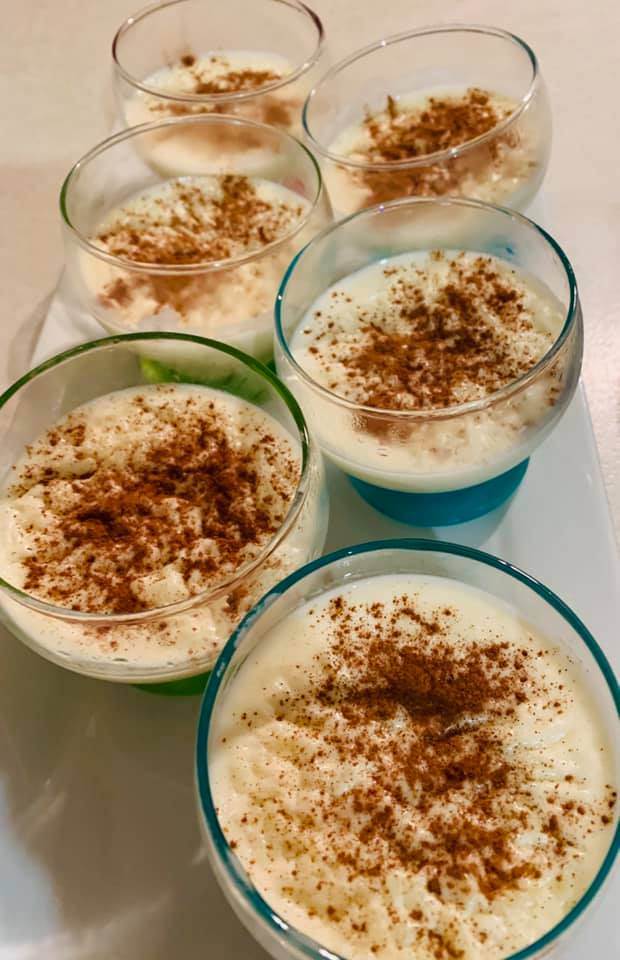
Rizogalo is a sweet Greek dessert/dish that is created from milk, porridge rice and starch (brought on taste with cinnamon and vanilla). It is mainly served with a glass of water (because it is really sweet).
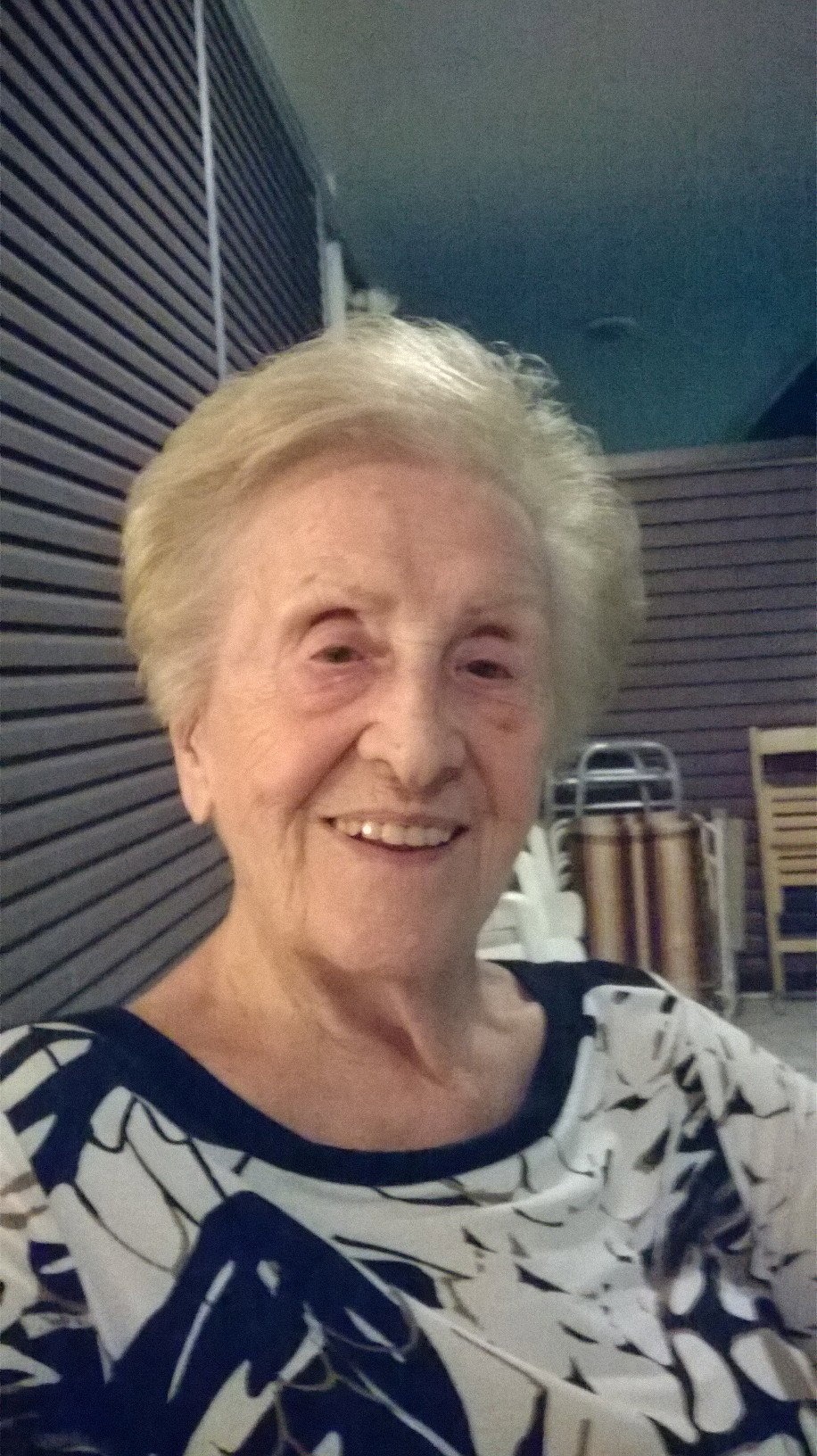
According to a good friend of mine (Bertha), its is the healthiest sweet that exists in Greece. She is convinced that this is **the secret** why she will celebrate, tomorrow (7th Of June), her **92th** birthday.
If you have the chance to visit Athens, make sure you visit 'Stani'.
It is a unique, traditional coffee shop (sweet shop/milk bar) downtown Athens. I am convinced that everything you taste here is EXCELLENT! If not let me know, I will pay the bill ;-) (just kidding). The place is located here: M. Kotopouli 10, Athens 10431 Greece. https://www.tripadvisor.com/Restaurant_Review-g189400-d2454425-Reviews-Stani-Athens_Attica.html https://www.google.com/maps/dir//37.985462,23.727985/@37.9804911,23.7250057,15z
**Ingredients**:
- 200 gr. porridge rice.
- 200gr. sugar.
- 400 ml of water.
- 1L of milk.
- 2 tablespoons of starch.
- 2 egg yolks.
- seeds of a vanilla stick.
- 1 tablespoon of cinnamon. (I prefer Ceylon cinnamon as it just tastes better).
**Preparation**:
- (1) Boil 400 ml of water.
- (2) Add the porridge rice and the milk to the boiling water.
- (3) Stir this until the rice gets soft.
- (4) Add the starch and the sugar.
- (5) Add the egg yolks and the seeds of the vanilla stick.
- (6) Whisk until the mixture becomes creamy.
- (7) Pour the hot mixture in the serving cups.
- (8) Let the serving cups cool down. (preferable NOT in the refrigerator).
Finally:
- On serving, sprinkle some cinnamon on top of the portions.
Enjoy!
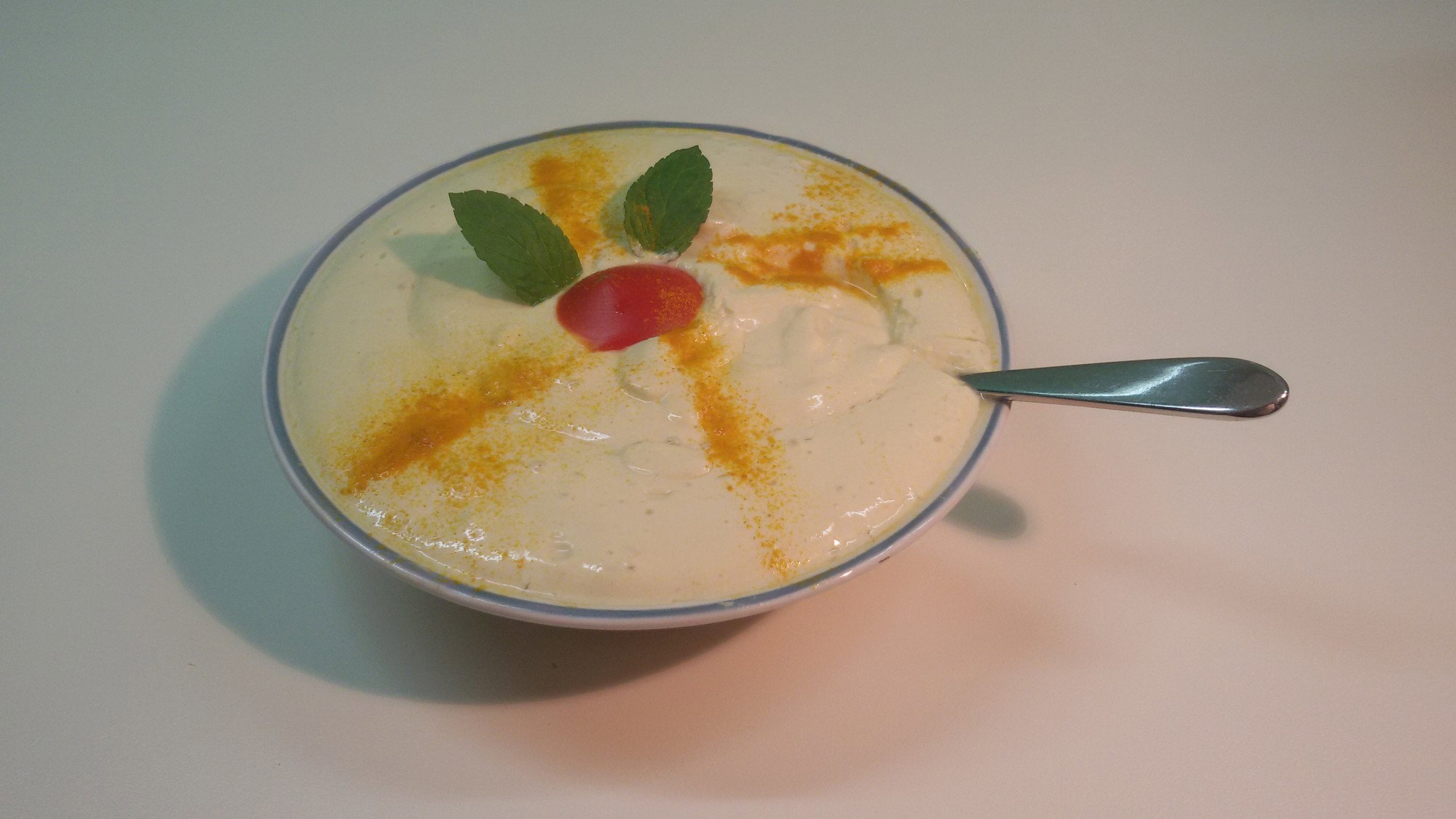
Greece - Food & Drinks - Side Dish: Tahini sauce.
Tahini sauce is a very easy to make appetizer/side dish of the Greek cuisine. It is created with Tahini, yogurt, garlic and lemon juice.
I like to prepare it especially after a very hot, tiring, summer day. The sauce is very refreshing and at the same time very energy level boosting. It is amazing that so much power is hidden in those small sesame seeds.
Tahini sauce is mainly served, as an appetizer, with white pita bread (both fresh and roasted) but it suits also very well fresh vegetables like cucumber and carrots (as a dip sauce). I also like it to dip in my fried pumpkin balls (similar to falafel).
**Ingredients**:
- 400 gr. of yogurt.
- 4 tablespoons of Tahini (I prefer the Makedoniko one as it has a great texture).
- 1 teaspoon of cumin.
- 1 teaspoon of salt.
- 2 - 3 garlic cloves.
- juice of 1 lemon.
- a few leaves of fresh mint (for decoration).
- a small tomato (for decoration).
**Preparation**:
- (1) Press the garlic cloves into the lemon juice.
- (2) Put this in the refrigerator, for about 15 minutes. (so that the lemon juice absorbs the garlic taste).
- (3) Strain the garlic out of the lemon juice.
- (4) In a blender, mix the juice, the yogurt, the tahini, the salt and the cumin, all together.
- (5) Add about 150 ml. of ice cold water.
- (6) Mix until the sauce becomes smooth and creamy.
Finally:
- For decoration, add a small tomato, some mint leaves and a little cumin.
Enjoy!
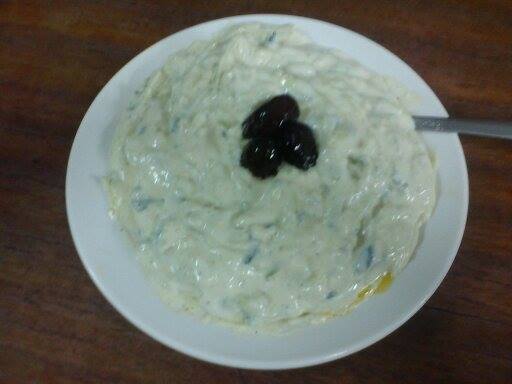
Greece - Food & Drinks - Side Dish: Tzatziki.
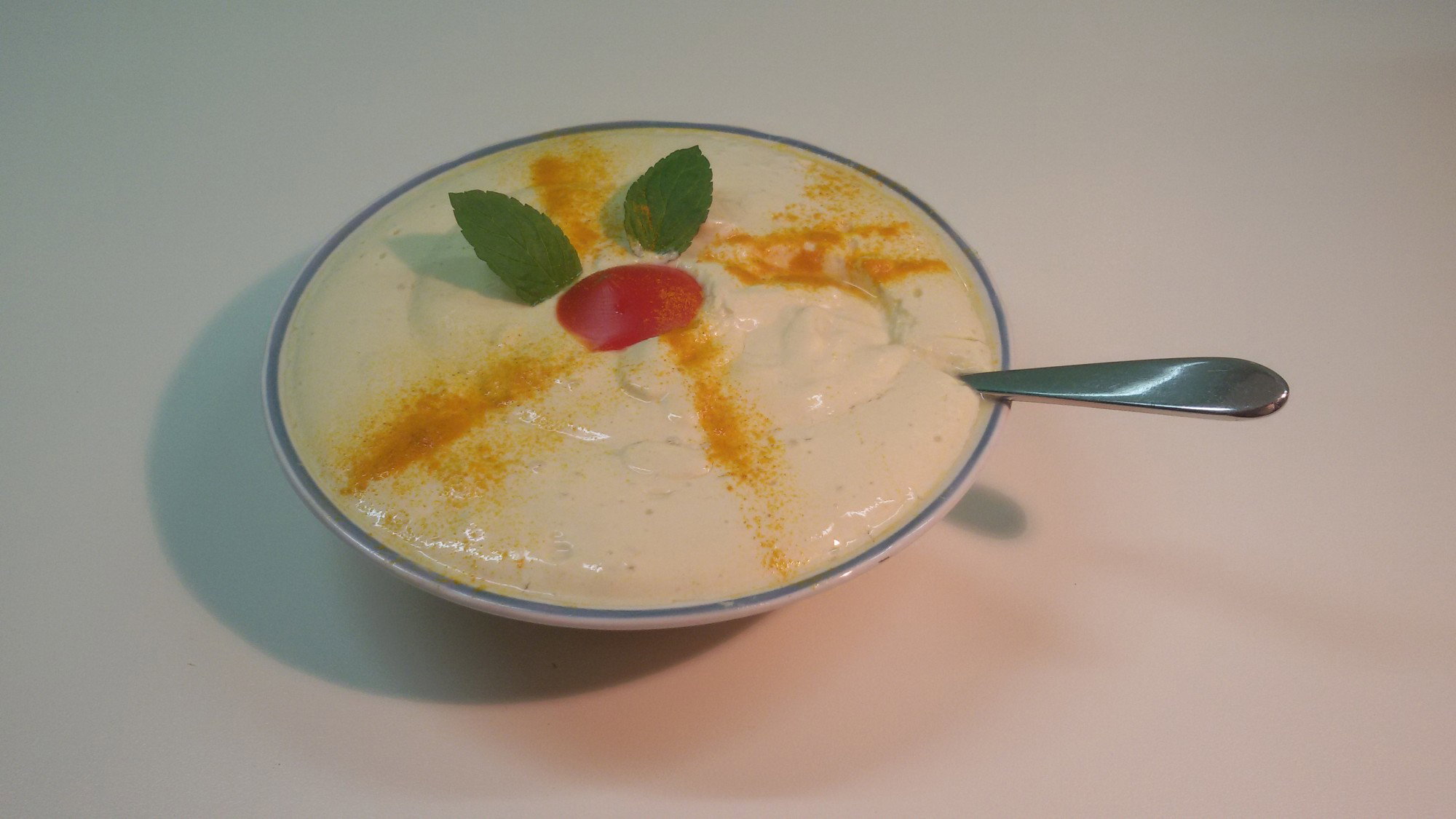
Tzatziki is a very easy, yet indispensable, appetizer/side dish of the Greek cuisine. It is created with cucumber, yogurt and garlic.
During the summer, I eat it nearly every day. After a very hot summer day, it brings immediately joy. Is it the 're-hydration' effect of the cucumber? Is it the 'coolness' of the yogurt? Is it the blood pressure lowering effect of the garlic? I don't know! It is just the 'Tzatziki' feeling, I guess. I LOVE IT!
Tzatziki is mainly served, as an appetizer, with white bread (both fresh and roasted) but it suits also very well grilled/roasted meat, especially chicken (fillet).
**Ingredients**:
- 1/2 cucumber (or 1 small cucumber).
- 500 gr. of yogurt.
- 3 - 4 garlic cloves.
- 2 tablespoons of olive oil.
- 2 tablespoons chopped mint leaves.
- 1 tablespoon of wine vinegar. (I prefer the Paros one).
- salt.
**Preparation**:
- (1) Grate the cucumber.
- (2) Sprinkle some salt over the cucumber.
- (3) Put this in the refrigerator and let the salt absorb (for about 15 minutes).
- (4) Press out all the excessive fluids.
- (5) In a bowl, mix the cucumber with the yogurt.
- (6) Press the garlic into the mixture.
- (7) Stir the olive oil, chopped mint leaves and the wine vinegar in the mixture.
- (8) Mix very well.
- (9) Put the mixture in the refrigerator for at least 45 minutes (the longer the better).
Finally:
- Sprinkle some fresh chopped mint leaves on it.
- Pour some oil over it.
- For decoration, add some (black) olives.
Enjoy!

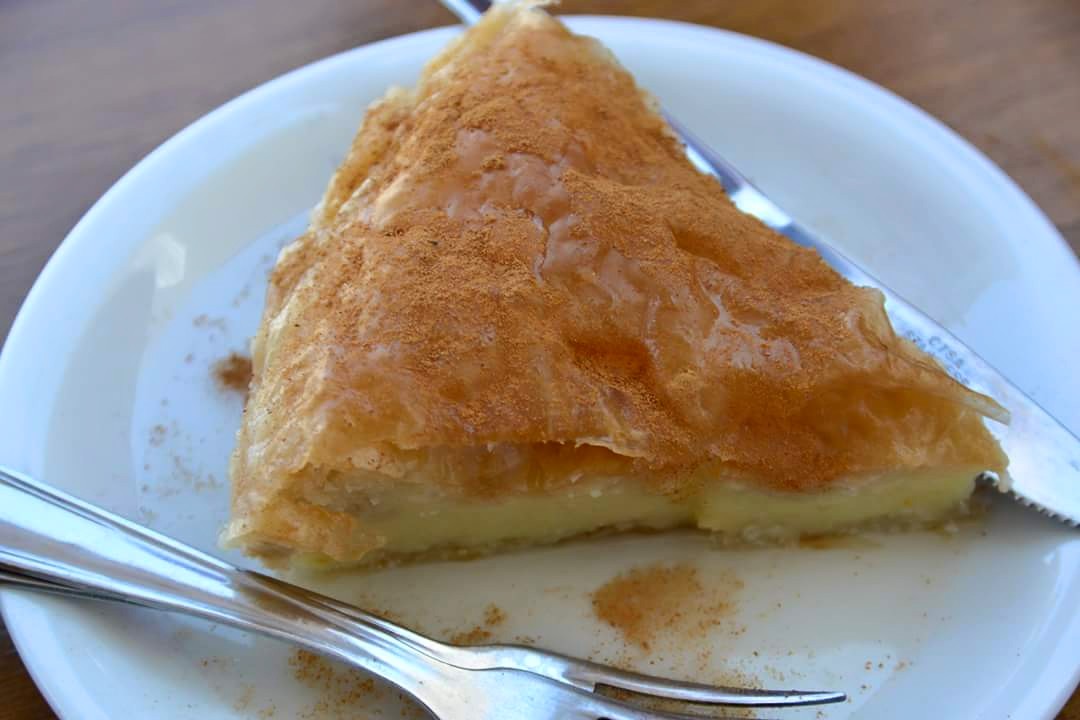
Gregrece - Food & Drinks - Sweets: Galaktoboureko.
Galaktoboureko is I believe one of the most tasty sweets that exist here in Greece. It is a puff pastry filled with a 'hot' mixture of sugar, milk, eggs and wheat semolina brought to taste with vanilla and some lemon juice.
It can be eaten fresh 'hot' from the oven or 'cold', but it is always accompanied with a nice strong 'Greek' coffee. I prefer this sweet over the other 'heavy' syrup sweets like Baklava or Kantaifi. https://read.cash/@chryptof/greece-food-drinks-sweets-baklava-fb635d54 https://read.cash/@chryptof/greece-food-drinks-sweets-kantaifi-8e59bd5e
**Ingredients**:
For the pastry:
- 1/2L milk.
- 300 gr. of 'filo' (puff pastry) dough.
- 100 gr. sugar.
- 75 gr. wheat semolina.
- 200 gr. melted butter.
- 3 whole eggs.
- 2 egg yolks.
- 1 vanilla stick.
- flour.
For the syrup:
- 300 gr. of sugar.
- 200 ml of water.
- 1 tablespoon of lemon juice.
- 1 teaspoon of vanilla extract.
**Preparation**:
For the pastry:
- (1) Pre-warm the oven to 180° Celsius.
- (2) Boil the milk and let it cool down again.
- (3) Place a baking paper into the baking mold.
- (4) Sprinkle the baking paper with flour.
- (5) Put half of the 'filo' (puff pastry) dough, on the baking paper, in the baking mold. (MAKE SURE IT PEEPS A LITTLE OVER THE BORDERS).
- (6) Smear the 'filo' (puff pastry) dough with about 1/4 (50 gr.) of the melted butter.
- (7) In a bowl, whip the eggs, the egg yolks and the sugar until 'foamy'.
- (8) Add carefully the wheat semolina, the milk and the vanilla. (MAKE SURE THE MIXTURE REMAINS FOAMY!)
- (9) Heat the bowl so that the mixture becomes syrupy.
- (10) Take the bowl from the heat and scoop 100 gr. of melted butter through it.
- (11) Pour the mixture on the'filo' (puff pastry) dough.
- (12) Cover with the other half of the 'filo' (puff pastry) dough.
- (13) Fold the peeping dough parts (see point 5) over the cover.
- (14) Smear again 1/4 (50 gr.) of the melted butter over the entire top.
- (15) Gently (pre)cut the desired portions.
- (16) Bake the mold about 40' until auburn (golden-brown).
For the syrup:
- Put the sugar in the water.
- Boil the mixture for about 5 minutes.
- Add the lemon juice and the vanilla extract to the mixture.
- Boil 2 more minutes.
Finally:
- Pour the hot syrup over the hot pastry.
Enjoy!

Greece - Islands - Cyclades - Amorgos - POI: Shipwreck Olympia.
As mentioned in another post of me, we discovered this Point Of Interest through a friendly local, George, who gave us a hitchhike from Katapola to our final destination: Kalotaritissa Beach (in the total southern part of the island). https://read.cash/@chryptof/greece-islands-cyclades-amorgos-beaches-kalotaritissa-627ff3a7
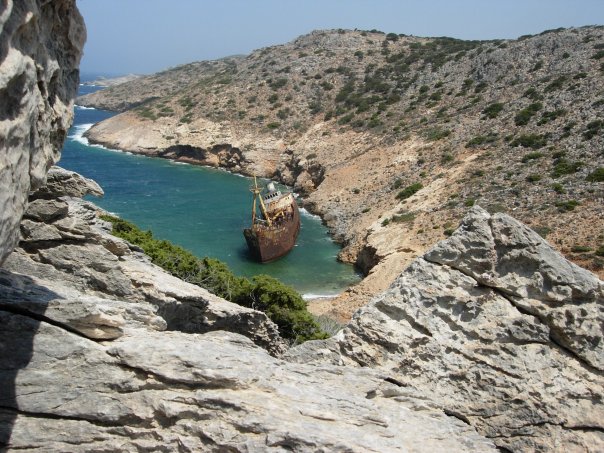
About five minutes before reaching our destination, he stopped and showed us here, on the right side, down the road, the famous shipwreck of the 'Olympia'.
It was February 1980, George was a young boy by that time (12 years old), when a very strong northern wind was blowing over the Aegean sea. At some point the locals noticed a big (Cypriot) ship drifting and fighting the huge waves. It seemed the captain was trying to pilot the ship into the small bay of Kalotaritissa to drop its anchor and find shelter but there it went wrong. George believes that because of the rocky sea bottom the anchor never anchored and so the ship was thrown on the rocks, crashed and finally sunk.
Immediately after that the fire department came to rescue the crew and, thank God, all of them got rescued. Some of the sailors were so grateful that they decided to stay and live their lives here in Amorgos.
When you visit the wreckage and take a close look to its bow you will say 'wait a second, it writes "Inland", not "Olympia"'. Because of the admirable (magical) rescue of the crew, they decided to change its name after the Gods of mount Olympus, according to the narrative.
Another myth that goes around the island is that the ship was entered by pirates who made it to sink but George doesn't believe a word of that.
The 'Olympia' wreckage was one of the main scenes in the 1988 movie 'Le Grand Bleu' (The Big Blue) of the French director Luc Besson, featuring Jean-Marc Barr and Jean Reno.
Make sure when you visit this site to bring some gloves, a good pair of surf shoes and an underwater camera so you can explore the wreckage from the inside! Unfortunately I don't have such a camera but I promise you that once technology will allow us to download the images in our brain, I will come back here and upload my entire memory.
**QUICK DETAILS**:
**LOCATION** : 36°47'19.5"N 25°45'26.4"E (36.7887571 25.7551449).
**TYPE** : POI.
**FACILITIES** : https://www.google.com/maps/place/36%C2%B047'19.5%22N+25%C2%B045'26.4%22E/@36.7887571,25.7551449,17z/data=!4m5!3m4!1s0x0:0x0!8m2!3d36.7887528!4d25.7573389
**NOT** CHILD FRIENDLY (rocky).
SNORKELING / SCUBA DIVING.
Greece - Food & Drinks - Sweets: Kantaifi.
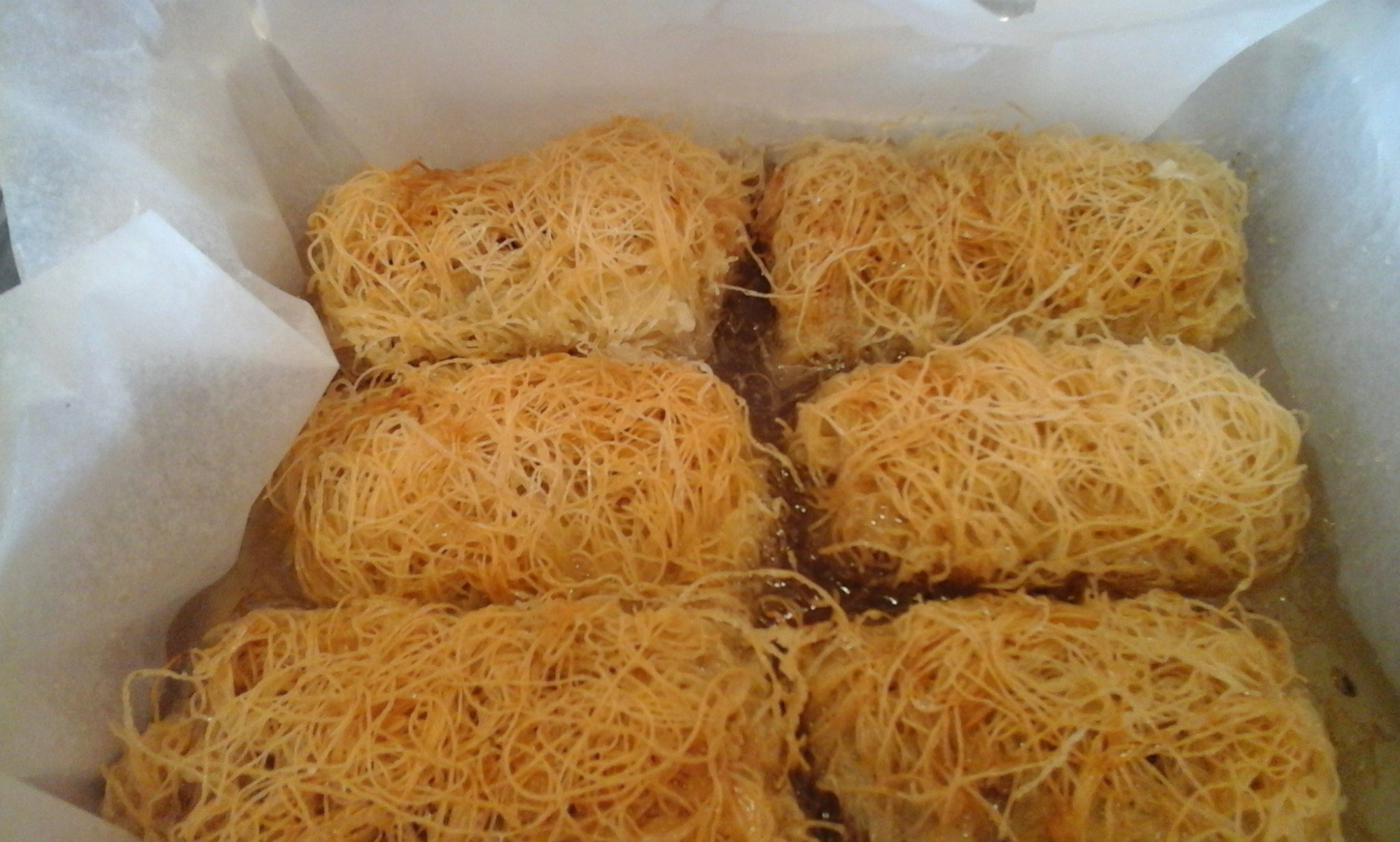
When people see the above picture they usually ask questions like: 'What is this?', 'Is it spaghetti?', 'Is it some kind of fabric?', 'Is it Angel hair?'.
No, it is Kantaifi! This sweet pastry is widely known throughout Greece and the Middle East and is usually accompanied with ice cream and/or 'Greek' coffee.
In this post I show you how to make Kantaifi using a 'ready-made' dough. It is possible to make the dough yourself by rolling it out again and again until you end up with a structure like in the picture above but I guarantee you, it is a real Titan work! Don't bother with it and buy the fresh 'ready-made' dough from your local bakery.
**Ingredients**:
For the pastry:
- 500 gr. chopped walnuts.
- 100 gr. chopped pistachios.
- 1 kg. Kantaifi dough.
- 1/2 teaspoon chopped cloves.
- 2 teaspoons grinded cinnamon (powder).
- 250 gr. butter.
For the syrup:
- 2 kg. of sugar.
- juice of 1 lemon.
- 1L of water.
**Preparation**:
For the pastry:
- (1) Mix the chopped walnuts with the cinnamon and the cloves.
- (2) Melt the butter in a baking mold (with a height of at least 3 cm).
- (3) Pre-warm the oven to 180° Celsius.
- (4) Butter the baking molds.
- (5) Untangle the Kantaifi dough in about 30 equal parts (of about 2cm x 20 cm).
- (6) Put on one end (of such part) a handful of the chopped walnuts.
- (7) Carefully roll the part (so that the walnut mixture is totally covered by the Kantaifi threads).
- (8) Repeat steps (6) & (7) for all the other parts.
- (9) Put all the rolls, WITH THEIR SEAM FACING DOWN, close to each other, inside the baking mold.
- (10) Pour some melted butter over the rolls.
- (11) Bake the mold about 45' until auburn (golden-brown).
- (12) **Let the rolls cool down**.
For the syrup:
- Put the sugar in the water.
- Boil the mixture for about 5 minutes.
- Add the lemon juice to the mixture.
- Boil 2 more minutes.
Finally:
- Pour the hot syrup over the pastry.
- Let the syrup absorb for AT LEAST 12 HOURS!
- For decoration, spread the chopped pistachios over the rolls.
Enjoy!
This dessert is very rich in calories so don't overdo it.
For some funny reason eating too much this, anyway, causes me to get a headache. I never knew why.
Greece - Islands - Cyclades - Amorgos - Beaches: Kalotaritissa.
This day we had to wake up very early (in holidays standards) to catch the bus to explore the most southern part of the island: Kalotaritissa. Bus connections here are very limited so if you miss the one you will have to wait for the next one to come. But as the feeling in bed, waking up surrounded with thousands of fresh flowers, was so sweet (imagine waking up inside a bottle of fabric softener), so relax we didn't make it.
Thank God the people here on the island are very friendly and hospitable so we found this man, George, who gave us a hitchhike. He was going there anyway to take care of his fields. So we jumped in the back of his pick-up and enjoyed one of the most breath-taking sight-seeing trips, inside the natural environment of Amorgos, that I could image. Just sit back, relax and feel the fresh wind fondling your skin, your hair, your entire body, mmm delicious.
About five minutes before reaching our destination, he stopped and showed us there, on the right side, down the road, the famous shipwreck of the Olympia. He told us, in short, what happened here in February 1980. https://read.cash/@chryptof/greece-islands-cyclades-amorgos-poi-shipwreck-olympia-da6a30bb
After that he drove us totally down to the Beach of Kalotaritissa and pressed us on the heart 'not to miss the last bus' back to Katapola as after the sun sets, the weather conditions become very harsh: the south wind will kick in and the temperatures will drop tremendously. Don't expect anybody to take you back as from that moment on there will be not a living soul down here on the island and you will have to spend the night here (alone). Sounds romantic, not?
The Beach of Kalotaritissa is one of the most beautiful experiences we had. (Don't make me choose though as I believe every single beach here has its own 'charm'). If you like it rough and wild, as close to nature as possible, this is the place to be.
The beach is relatively long and sandy and is because of its shallow, crystal clear, waters very child-friendly. There is a canteen where you can buy some drinks and a snack. (prices are slightly high though).
In the afternoon you will notice that many fishing boats will flock here to go out for fishing, together, later in the evening. You can take from this beach a taxi-boat (or a ask one of the fisherman, in return of a small tip) to take you to the opposite sub-island: Gramvousa. https://read.cash/@chryptof/greece-islands-cyclades-amorgos-beaches-gramvousa-e48d7f8e
Due to its unique, typical rock formations mainly found on the east side (on the left, facing towards the sea) of the main beach I always refer to this beach as 'Baklava' beach as they resemble the structure of the typical Mediterranean sweet. https://read.cash/@chryptof/greece-food-drinks-sweets-baklava-fb635d54
**QUICK DETAILS**:
**LOCATION** : 36°47'35.1"N+25°44'34.8"E (36.7930827,25.7418994).
**TYPE** : SANDY.
**FACILITIES** : https://www.google.com/maps/place/36%C2%B047'35.1%22N+25%C2%B044'34.8%22E/@36.7930827,25.7418994,325m/data=!3m2!1e3!4b1!4m5!3m4!1s0x0:0x0!8m2!3d36.7930806!4d25.7429964
PARTLY ORGANISED (UMBRELLAS AND SUNBEDS).
CHILD FRIENDLY (shallow waters).
CANTEEN.
ACCESSIBLE BY CAR.
TAXI-BOAT TO GRAMVOUSA (the small sub-island opposite). https://read.cash/@chryptof/greece-islands-cyclades-amorgos-beaches-gramvousa-e48d7f8e
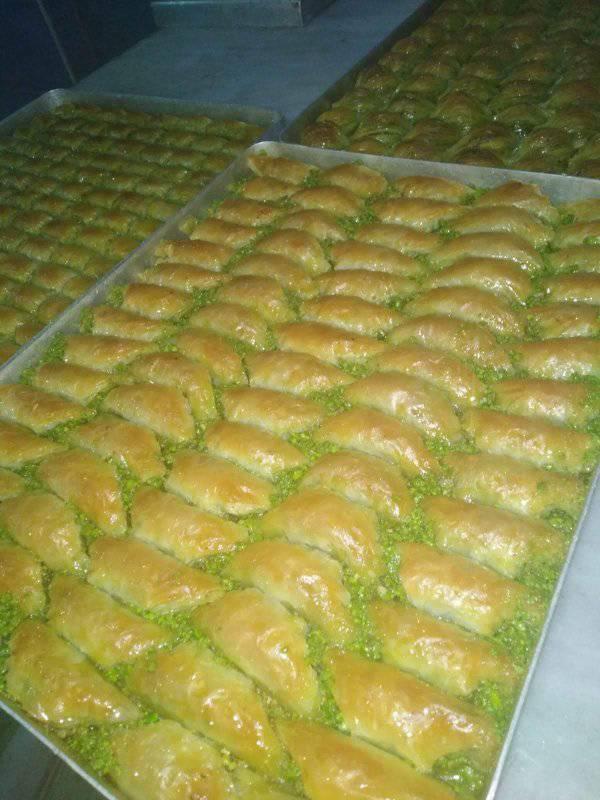
Greece - Food & Drinks - Sweets: Baklava.
Greeks and Turks were, throughout the history, never 'good' friends but in some areas they resemble a lot, especially through the popularity of 'Baklava'.
I am not gonna take any political color here as Baklava is way too sweet discuss about its origins.
This sweet pastry is widely known throughout the Balkans and the near East so I would rather refer to it as a Mediterranean dessert/snack. It suits very well a (and again) 'Greek' coffee or a glass of water. Baklava is 'The way' to welcome your guests.
**Ingredients**:
For the pastry:
- 50 gr. chopped walnuts and/or almonds.
- 4 tablespoons of bread crumbs.
- 4 tablespoons of sugar.
- 1 teaspoon of cinnamon (powder).
- 250 gr. of butter.
- 300 gr. of 'filo' (puff pastry) dough.
For the syrup:
- 250 gr. of sugar.
- 200 gr. of honey.
- 2 cloves.
- 1 vanilla stick.
- juice of 1 lemon.
- 1.5L of water.
**Preparation**:
For the syrup:
- Put the sugar in the water.
- Boil the mixture for about 5 minutes.
- Add the honey, cloves and the vanilla stick.
- Boil 2 - 3 minutes more.
- Filter out the cloves and the vanilla stick.
- Pour the lemon juice in the mixture.
- Place this syrup in a cool place.
For the pastry:
- (1) Mix the chopped walnuts and/or almonds with the bread crumbs, sugar en cinnamon.
- (2) Melt the butter in a frying pan.
- (3) Pre-warm the oven to 180° Celsius.
- (4) Butter the baking molds.
- (5) Coat the puff pastry (layers) with butter.
- (6) Put, at least, 2 layers in the baking mold.
- (7) Cover with some nut mixture.
- (8) Repeat steps (6) & (7) at least 9 to 10 times.
- (9) Finish with a buttered layer puff pasty.
- (10) Sprinkle a little water over the top layer.
- (11) Bake the mold about 30' - 40' until auburn (golden-brown).
Finally:
- Pour the syrup over the pastry. (Make sure the pastry is hot and the syrup is cold).
Enjoy!
This dessert is very rich so don't overdo it.
You will, just like me, easily take 17 kilos within a few weeks!

Greece - Islands - Cyclades - Amorgos - Stay: Pension Titika.
Pension Titika in Katapola is a place that was suggested to me by my neighbor Michael. He had been visiting Amorgos since 1987 so he was, for sure, a good reference.
This pension is run by Titika and George. This young couple invites their guests to be part of their family: very warm and very cozy. They will do everything to make your stay at their place 'unforgettable'. As I mentioned in another post of me, they even took us with them to enjoy the Agios Pavlos Beach together with them. https://read.cash/@chryptof/greece-islands-cyclades-amorgos-beaches-agios-pavlos-beach-f214bf55
Visiting this place will not make you feel like an ordinary customer! You will feel like you are one them, a true guest. They are always ready to guide you in finding the most beautiful pearls the island of Amorgos hides within it.
They have 10 rooms with 2 or 3 beds that are fully equipped to live your myth as a God in Katapola, Greece.
The entire place (the rooms, the garden, the terrace,...) is always extremely clean. I feel totally ashamed admitting that my place looks more like a mess even though much more people are staying/living here. And Titika is doing this all on her own: Amazing!
Unfortunately my neighbor Michael passed away but we will always remember and love him because this 'amazing' place opened his true being: Amorgos, Katapola and Titika could glue our ears on him for hours. We LOVE you Michael!
Greece - Islands - Cyclades - Amorgos - Beaches: Agios Pavlos Beach.
Agios Pavlos Beach was the first beach we visited as we were offered a ride by our host, Titika, of the Pension Titika in Katapola. https://read.cash/@chryptof/greece-islands-cyclades-amorgos-stay-pension-titika-e16c5bae
The beach is situated between Katapola and Aegiali and has a pebbled texture. You will find many locals here (mainly women with their children) that come to relax during the quiet hours (between 14:00 - 17:00). They prefer this beach above the ones in Katapola and Aegiali as it less known by tourists and is so more calm. If you want rest, close to 'home', come here ;-)
Because of its shallow waters, it is ideal to come here with small children. With a mask they will play endless 'hide-and-seek' with the many colorful fish that are housed in the rocky sea bottom here. You will be able to enjoy this beach long into the evening for the sunset as it is on the west side of the island. Beautiful!
If you are sensitive to the sun make sure you bring a lot of sun cream or an umbrella as there are no trees here. Because of the smooth fresh wind you will not understand how 'traitorous' the sun burns!
From this beach you can take a taxi-boat that will bring you to the very small island opposite: Nikouria. Here you will find three beautiful sandy beaches. If you come early in the morning you can also ask a local fisherman to bring you there (in return of a small tip). That's the way I like it.
**QUICK DETAILS**:
**LOCATION** : 36°52'41.1"N 25°55'56.8"E (36.8780876 25.9302504).
**TYPE** : PEBBLES.
**FACILITIES** : https://www.google.com/maps/place/36%C2%B052'41.1%22N+25%C2%B055'56.8%22E/@36.8780833,25.9302557,17z/data=!3m1!4b1!4m5!3m4!1s0x0:0x0!8m2!3d36.8780833!4d25.9324444
PARTLY ORGANISED (UMBRELLAS AND SUNBEDS).
CHILD FRIENDLY (shallow waters).
BEACH BAR & TAVERN.
ACCESSIBLE BY CAR.
TAXI BOAT TO NIKOURIA.
CALM (less known by tourists).
 @chryptof